RECHARGE AND REUSE IN VENTORY REPORT
←
→
Page content transcription
If your browser does not render page correctly, please read the page content below
RECHARGE AND REUSE
   IN VENTORY REPORT
           Prepared for
WESTCAPS, Maricopa County, Ar izona
        Novembe r 2006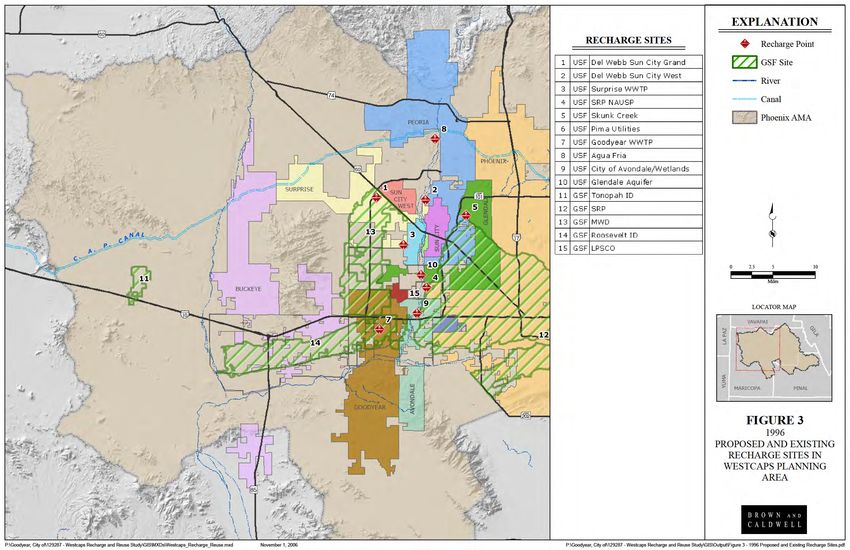
RECHARGE AND REUSE
 INVENTORY REPORT
         N o v em b er 2 00 6

          Pr ep ar ed fo r

           Pr ep ar ed b y

201 East Washington Street, Suite 500
       Phoenix, Arizona 85004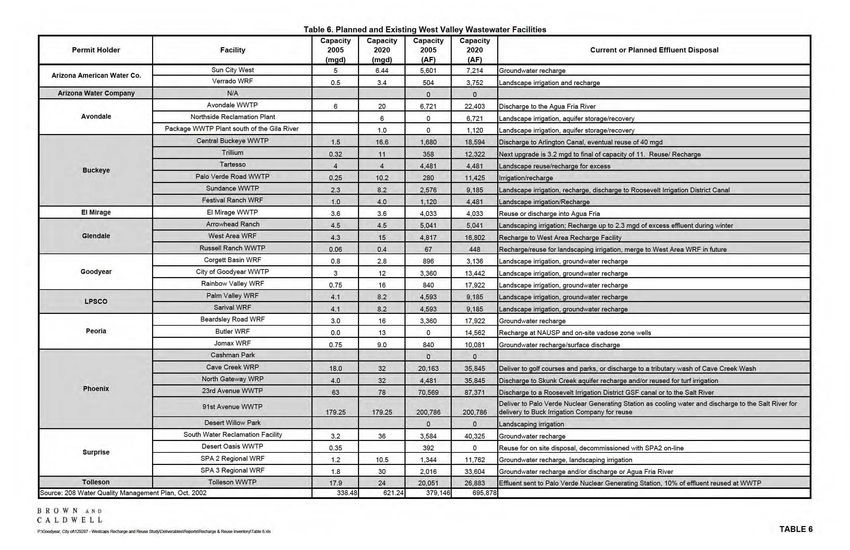
TABLE OF CONTENTS
1. INTRODUCTION.....................................................................................................................................................1-4
2. REGULATORY ISSUES .........................................................................................................................................2-4
    2.1 Regulatory Issues Governing Recharge and Reuse.....................................................................................2-4
        2.1.1 Arizona Department of Water Resources .........................................................................................2-4
        2.1.2 Arizona Department of Environmental Quality..................................................................................2-4
3. RECHARGE AND WASTEWATER TREATMENT PLANT CAPACITY ..................................................................3-4
    3.1 Recharge and Wastewater Treatment Plant Capacity in the Westcaps Study Area.....................................3-4
        3.1.1 Recharge Project Capacity ...............................................................................................................3-4
        3.1.2 Effluent Production in Westcaps Study Area ....................................................................................3-4
4. WESTCAPS MEMBERS CURRENT UTILIZATION ...............................................................................................4-4
    4.1 Westcaps Members Current Utilization of Recharge and Reuse, and Future Plans.....................................4-4
        4.1.1 Arizona American Water ...................................................................................................................4-4
        4.1.2 Arizona Water Company...................................................................................................................4-4
        4.1.3 Avondale...........................................................................................................................................4-4
        4.1.4 Buckeye ............................................................................................................................................4-4
        4.1.5 Goodyear ..........................................................................................................................................4-4
        4.1.6 Peoria ...............................................................................................................................................4-4
        4.1.7 Phoenix.............................................................................................................................................4-4
        4.1.8 Surprise ............................................................................................................................................4-4
        4.1.9 West Maricopa Combine...................................................................................................................4-4
5. SUMMARY OF COMMON ISSUES........................................................................................................................5-4
    5.1 Summary of Common Issues in Fully Utilizing Recharge and Reuse...........................................................5-4
REFERENCES ..................................................................................................................................................... REF-4

                                                                                   i
                       P:\Goodyear, City of\129287 - Westcaps Recharge and Reuse Study\Deliverables\Reports\Recharge & Reuse Inventory\Report.doc
Table of Contents                                                                        WESTCAPS, City of Goodyear Recharge and Reuse Inventory

LIST OF FIGURES
    Figure 1            WESTCAPS’ Strategy, Developed September 2001......................................................................1-2
    Figure 2            LTSC Calculations..........................................................................................................................2-2
    Figure 3            1996 Proposed and Existing Recharge Sites in WESTCAPS Planning Area......... (follows page) 3-1
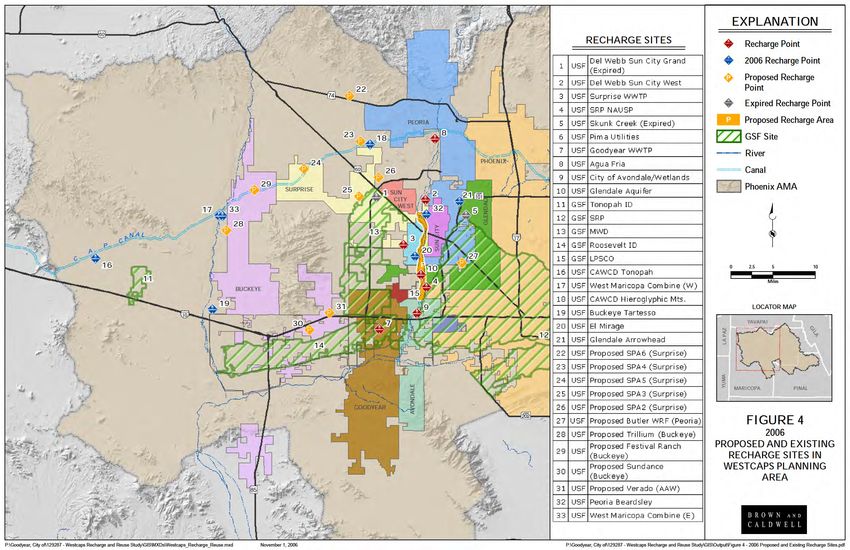
    Figure 4            2006 Proposed and Existing Recharge Sites in WESTCAPS Planning Area......... (follows page) 3-1
    Figure 5            Geologic and Water Features in WESTCAPS Study Area ..................................... (follows page) 5-1

LIST OF TABLES
    Table 1. Classes of Effluent ..................................................................................................................................2-4
    Table 2. Allowed Non-Potable Usage per Effluent Class ......................................................................................2-4
    Table 3. Large Scale Regional Recharge Projects................................................................................................3-4
    Table 4. Recharge Projects Owned by WESTCAPS Members.............................................................................3-4
    Table 5. WESTCAPS Water Storage Permits .......................................................................................................3-4
    Table 6. Planned and Existing West Valley Wastewater Facilities ................................................ (follows page) 3-4
    Table 7. WESTCAPS Members Effluent Production Reported to ADWR in 2005.................................................3-4
    Table 8. Summary of Water Available for Reuse and Recharge ...........................................................................5-4

                                                                                  ii
                      P:\Goodyear, City of\129287 - Westcaps Recharge and Reuse Study\Deliverables\Reports\Recharge & Reuse Inventory\Report.doc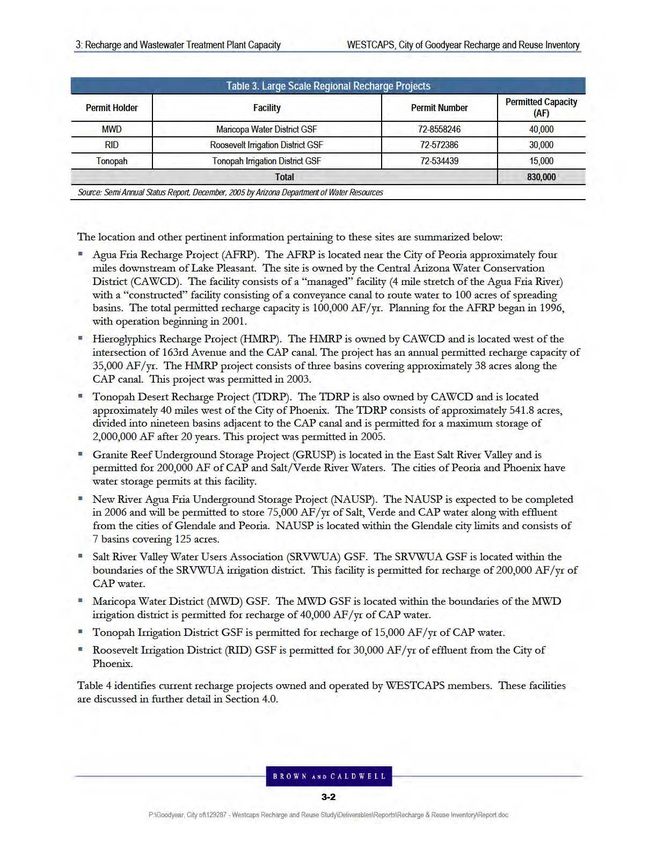
Table of Contents                                                                      WESTCAPS, City of Goodyear Recharge and Reuse Inventory

LIST OF ABBREVIATIONS AND ACRONYMS
AAW                  Arizona American Water Company
ADEQ                 Arizona Department of Environmental Quality
ADWR                 Arizona Department of Water Resources
AF                   acre-feet
AF/yr                acre-feet per year
AFRP                 Agua Fria Recharge Project
AMA                  ADWR Active Management Area
APP                  Aquifer Protection Permit
AWC                  Arizona Water Company
AWS                  Assured Water Supply
AZPDES               Arizona Pollutant Discharge Elimination System
CAGRD                Central Arizona Groundwater Replenishment District
CAP                  Central Arizona Project
CAWCD                Central Arizona Water Conservation District
CCWRP                Cave Creek Water Reclamation Plant
Code                 Groundwater Management Code of 1980
GRUSP                Granite Reef Underground Storage Project
GSF                  Groundwater Savings Facility
HMRP                 Hieroglyphic Mountain Recharge Project
LTSC                 Long-Term Storage Credit
MAG                  Maricopa Association of Governments
MGD                  Million gallons per day
MWD                  Maricopa Water District
NAUSP                New River Agua Fria Underground Storage Project
Recharge             Underground Water Storage, Savings and Replenishment Program
RID                  Roosevelt Irrigation District
SAT                  Soil Aquifer Treatment
SRP                  Salt River Project
SRVWUA               Salt River Valley Water Users Association
TDRP                 Tonopah Desert Recharge Project
TMP                  Third Management Plan
USF                  Underground Storage Facility
WESTCAPS             Coalition of West Valley Central Arizona Project Subcontractors
WMC                  West Maricopa Combine Water Company
WRF                  Water Reclamation Facility
WSRV                 West Salt River Valley
WUGB                 Water Utility of Greater Buckeye
WUGT                 Water Utility of Greater Tonopah
WWTP                 Wastewater Treatment Plant

                                                                               iii
                    P:\Goodyear, City of\129287 - Westcaps Recharge and Reuse Study\Deliverables\Reports\Recharge & Reuse Inventory\Report.doc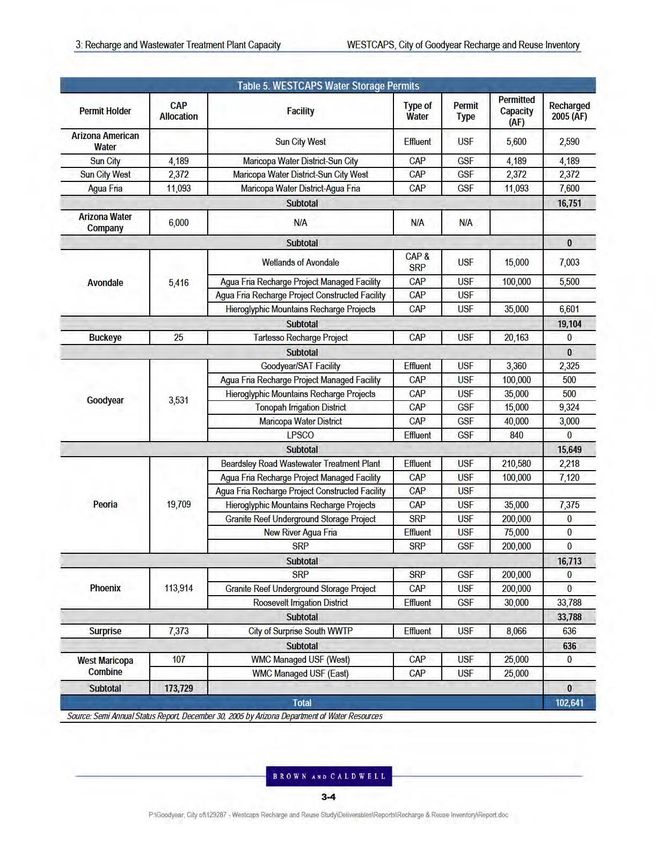
WESTCAPS, City of Goodyear Recharge and Reuse Inventory

                                             WESTCAPS
                        Recharge and Reuse Inventory
                                          November 2006

P:\Goodyear, City of\129287 - Westcaps Recharge and Reuse Study\Deliverables\Reports\Recharge & Reuse Inventory\Report.doc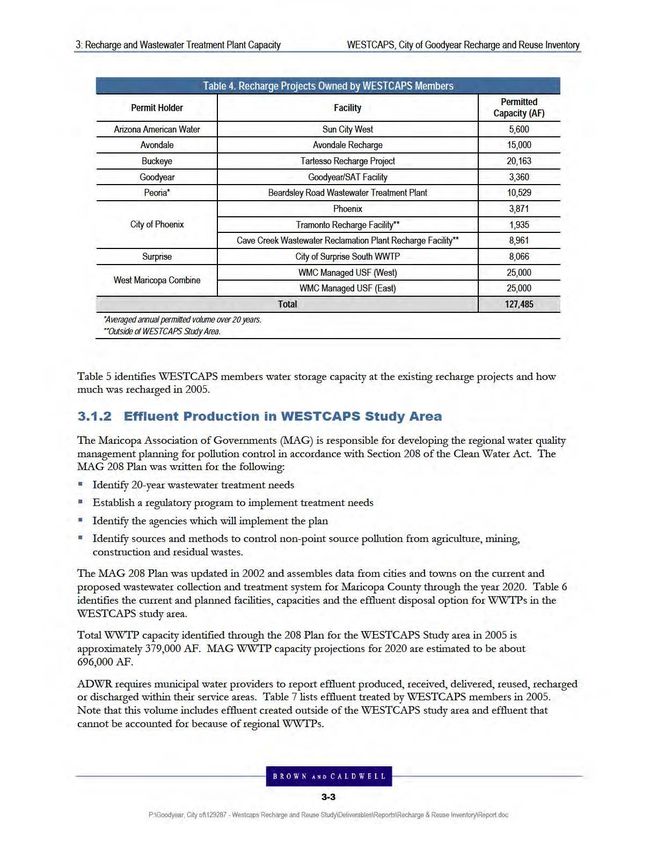
RECHARGE AND REUSE
                                             INVENTORY REPORT

                                                                                                                1. INTRODUCTION

The rapidly urbanizing West Salt River Valley (WSRV), historically dependent on groundwater, is facing
significant increases in water demand due to this growth. A 1995 study authorized by the Arizona legislature
showed that portions of the WSRV have experienced significant groundwater decline resulting in up to
17 feet of land subsidence. In response to this study, Central Arizona Project (CAP) subcontractors in the
WSRV formed the West Valley CAP Subcontractors (WESTCAPS) coalition in 1997 to identify and evaluate
options to allow its members to use CAP water to which they are entitled. WESTCAPS membership consists
of: Arizona American Water Company, Arizona Water Company, City of Avondale, Town of Buckeye, City
of Goodyear, City of Peoria, City of Phoenix, City of Surprise and West Maricopa Combine Water Company.
In total these members hold 173,729 acre-feet (AF) of CAP water allocations.
In 2001 WESTCAPS published their strategy for CAP utilization (Figure 1), which estimated approximately
104,000 AF per year (AF/yr) of additional renewable water supply would have to be secured by 2025 to meet
growing demands. The strategies to meet this growing demand include using existing water treatment plants
and constructing new water treatment plants for the direct delivery of CAP water. Additionally, the recharge
of CAP and effluent and reuse of effluent were noted as important water management tools to help water
providers to meet growing demands. Recharge is increasingly being used to augment supplies in times when
excess water supplies are available. Reuse of effluent decreases the overall potable water demand by
allocating effluent to non-potable demands.
In 2005 WESTCAPS members requested an inventory of recharge and reuse facilities in the WESTCAPS
study area to gain an understanding of how these facilities are being utilized to meet the renewable supply
deficit. The goals of this study are the following:
1. Review regulations governing recharge and reuse projects.
2. Identify existing recharge projects, including those not owned by WESTCAPS members, to quantify
   recharge capacity of the area.
3. Review wastewater treatment plant (WWTP) projects in the WESTCAPS study area, including those
   WWTPs not owned by WESTCAPS members, to identify total potential effluent capacity and disposal
   methods in the WESTCAPS study area.
4. Review available water resources plans to identify recharge and reuse utilization potential and plans for
   WESTCAPS members.
5. Summarize common issues WESTCAPS members face in fully using recharge and reuse capacity.
This study has identified that since the publication of the WESTCAPS Strategic Plan in 2001, WESTCAPS
members have steadily begun to directly use and recharge CAP water. In 2005 WESTCAPS members
exceeded their use of CAP water allocations through the purchase of excess CAP water, using approximately
192,600 AF for either direct use or recharge.
This study also identified that although WESTCAPS members are utilizing effluent for recharge or reuse,
approximately 107,600 AF is being discharged into the Gila River. Discharge of effluent is a lost opportunity
to help meet the goals of the Strategic Plan.

                                                                         1-1
               P:\Goodyear, City of\129287 - Westcaps Recharge and Reuse Study\Deliverables\Reports\Recharge & Reuse Inventory\Report.doc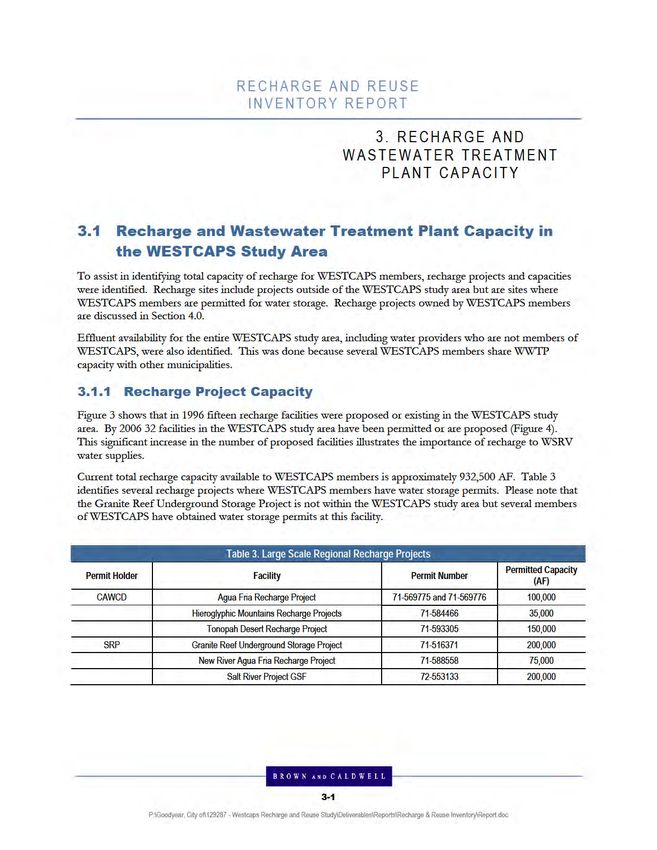
RECHARGE AND REUSE
                                             INVENTORY REPORT

                                                                                    2. REGULATORY ISSUES

2.1     Regulatory Issues Governing Recharge and Reuse
The Arizona Department of Water Resources (ADWR) administers the Underground Water Storage, Savings
and Replenishment (Recharge) Program for the recharge of CAP water. For the recharge of effluent, ADWR
coordinates with the Arizona Department of Environmental Quality (ADEQ) Aquifer Protection Permit
(APP) Program to protect groundwater aquifers. ADEQ also administers the reuse program, which allows
water providers to use effluent for non-potable uses and the Arizona Pollutant Discharge Elimination System
(AZPDES) program which allows a wastewater treatment plant to discharge effluent into waters of the
United States.

2.1.1 Arizona Department of Water Resources
The ADWR regulates the volume of groundwater pumped through the Groundwater Management Code of
1980 (Code). The Code was established to eliminate groundwater overdraft (groundwater mining) in areas
where groundwater pumping has led to severe declines in water levels and to provide means for allocating
groundwater resources for Arizona’s water demand needs. The Code established five Active Management
Areas within the state where groundwater level decline was most severe. The Code provided ADWR with
more regulatory power within an Active Management Area (AMA). The AMAs are: Phoenix, Tucson,
Prescott, Pinal and Santa Cruz.
The Code also created a system of groundwater rights that limits groundwater withdrawals; prohibits
development of new irrigated farmland; requires new developments to prove that a long term water supply is
available and dependable; and requires the measuring and reporting of groundwater uses for these rights.
Management goals were developed for each AMA and these goals were to be met with the implementation of
a series of five management plans, each one more stringent than the prior one. The management plans
consist of conservation requirements for industrial, municipal and agricultural groundwater users. Currently
the Code is operating in its Third Management Plan (TMP), which expires on December 31, 2009.
Other programs developed by ADWR include the Assured Water Supply (AWS) program and the Recharge
Program. The AWS Program evolved from the 1973 Water Adequacy Statute to ensure that new
developments would have water on a legal, physical and continual basis for 100 years. This program also
encourages the use of renewable water resources, such as surface water from the Colorado and Salt/Verde
Rivers in lieu of mining groundwater. Another source of water deemed as a renewable resource is effluent
that can be used for non-potable uses. Recharge assists the AWS program by replenishing groundwater
withdrawn with excess surface water such as CAP water or effluent.
The 1989 Arizona Supreme Court case of John F. Long versus City of Phoenix provided municipalities with
the legal basis for putting effluent to reasonable use, including recharge and reuse. The basis of this court
case determined that municipalities that treat and discharge wastewater into surface waters do not have to
continue to discharge effluent to meet downstream users’ needs. Thus, municipalities secured a renewable
water resource to use for non-potable purposes.

                                                                         2-1
               P:\Goodyear, City of\129287 - Westcaps Recharge and Reuse Study\Deliverables\Reports\Recharge & Reuse Inventory\Report.doc
2: Regulatory Issues WESTCAPS, City of Goodyear Recharge and Reuse Inventory
2.1.1.1 Recharge Program
The Recharge Program was developed as a means of storing excess water supplies when they are available so
that participants can recover and use water in the future when excess supplies are not available. Recharge is
also important for the Central Arizona Groundwater Replenishment District (CAGRD), who is responsible
for replenishing groundwater pumped by water providers under the AWS rules.
Recharge can occur through two primary methods: Groundwater Savings Facility (GSF) or Underground
Storage Facility (USF). A GSF works by having an irrigation district work with a CAP contractor to develop
a plan of operation to reduce groundwater pumping and utilize surface water “in-lieu” of pumping. The
supplier of the surface water thereby earns credits on the “saved” groundwater. The same concept can be
applied using effluent.
A USF works by physically adding water to the aquifer. There are two types of USFs: Constructed and
Managed. A “constructed” facility may utilize spreading basins or injection wells to artificially recharge water.
A “managed” facility is a recharge project located within a stream bed where water is allowed to infiltrate into
the aquifer at its own rate. A USF storing CAP water is exempt from the APP program, but a USF
recharging effluent must acquire an APP through ADEQ.
Considerations for permitting a USF are:
The applicant has technical and financial capability to construct and operate a facility
The proposed recharge is hydrologically feasible. Recharge is not limited because of geologic and
hydrogeologic features (i.e. hard rock, clay and water mounding)
Storage at the proposed facility will not cause unreasonable harm to surrounding land and water users.
A Water Storage permit is required to store at any permitted facility and allows for the accrual of recharge
credits. Water can be stored to earn long term storage credits (LTSC) or can be stored and recovered within
the same calendar year (annual credits), depending on the legal character of the stored water and other
requirements including whether or not the water could have been reasonably used directly. Waters eligible
for LTSC are CAP water and effluent. Surface water from the Salt River Project (SRP), composed of water
from the Salt and Verde Rivers, is not eligible for LTSC but may be stored and recovered annually.
Groundwater and storm water cannot be recharged for credits. Figure 2 shows how CAP water LTSC are
calculated.
Figure 2. LTSC Calculations
2-2
P:\Goodyear, City of\129287 - Westcaps Recharge and Reuse Study\Deliverables\Reports\Recharge & Reuse Inventory\Report.doc2: Regulatory Issues WESTCAPS, City of Goodyear Recharge and Reuse Inventory
Storers of effluent at a managed USF may only recover 50 percent of the water delivered to the managed
facility.
Recovery is the last component of the Recharge Program. Recovery Well permits are required to recover
LTSC or annual storage credits. Recovery can occur anywhere within the same AMA, as long as recovery
does not harm existing land and water users and recovery is consistent with the AMA management plan.
Therefore, recharge can occur outside of the WESTCAPS study area but water can be recovered within the
WESTCAPS study area.
2.1.2 Arizona Department of Environmental Quality
The ADEQ is mandated to protect and enhance public health and the environment in Arizona and
administers programs developed to protect air, land and water. With jurisdiction over safe drinking water and
wastewater programs, ADEQ works together with ADWR to ensure that safe quality water is available for the
future.
2.1.2.1 Aquifer Protection Permit
The APP Program was developed for protecting groundwater quality. Any facility that discharges directly
into an aquifer or land surface that has the potential to pollute an aquifer must operate in accordance with the
APP program. Facilities required to attain APPs include most septic tank and leach field systems, mines,
industrial facilities and most WWTPs. Effluent recharge facilities also require an APP. Only O ass A+, A,
B+ or B effluent can be recharged.
WWTP plants can be designed and permitted to treat wastewater to one of the five different classes as
illustrated in Table 1.
Table 1. Classes of Effluent
Class Chemical Characteristics
Secondary treatment to remove or deuce volume of organic material in sewage
through bacterial digestion
Nitrogen removal treatment to total nitrogen:2: Regulatory Issues WESTCAPS, City of Goodyear Recharge and Reuse Inventory
2.1.2.2 Reuse Permits
Reuse is the direct use of effluent for non-potable purposes such as irrigation of golf courses, agricultural
lands or constmction water purposes. Direct reuse of effluent recycles non-potable water for beneficial uses,
thereby conserving potable water resources for potable uses. The reuse program regulates the sites where
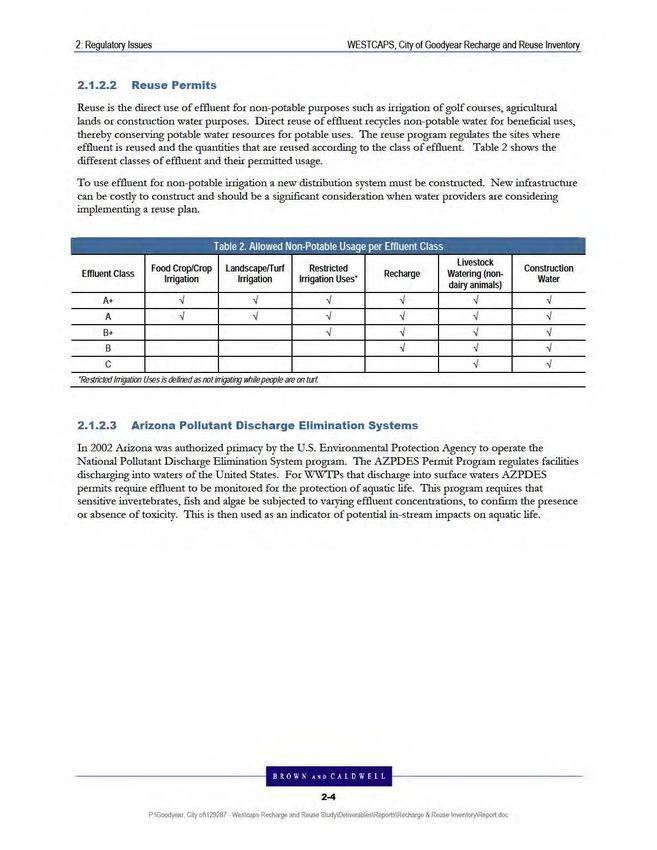
effluent is reused and the quantities that are reused according to the class of effluent. Table 2 shows the
different classes of effluent and their permitted usage.
To use effluent for non-potable irrigation a new distribution system must be constructed. New infrastructure
can be costly to constmct and should be a significant consideration when water providers are considering
implementing a reuse plan.
Table 2. Allowed Non-Potable Usage per Effluent Class
livestock
Food Crop/Crop l andscape/Turf Restricted Construction
Effluent Class Recharge Watering (non-
Irrigation Irrigation Irrigation Uses• Water
dairy animals)
A+
"" "" "" " "" ""
A
"
" " "
""
8+
B ..J ..J
c
·Restncted Irrigation Uses 1s defined as not irrigatmg while people are on turf.
..J
"
2.1.2.3 Arizona Pollutant Discharge Elimination Systems
In 2002 Arizona was authorized primacy by the U.S. Environmental Protection Agency to operate the
National Pollutant Discharge Elimination System program. The AZPDES Permit Program regulates facilities
discharging into waters of the United States. For WWI'Ps that discharge into surface waters AZPDES
permits require effluent to be monitored for the protection of aquatic life. This program requires that
sensitive invertebrates, fish and algae be subjected to varying effluent concentrations, to confirm the presence
or absence of toxicity. This is then used as an indicator of potential in-stream impacts on aquatic life.
BROV,N .-oCALDWELL
2-4
P:\Goodyear, City of\129287- Westcaps Recharge and Reuse Study\Derrverables\Reports\Recharge & Reuse lnven!ory\Report.doc3: Recharge and Wastewater Treatment Plant Capacity WESTCAPS, City of Goodyear Recharge and Reuse Inventory
Table 3. Large Scale Regional Recharge Projects
Pennitted Capacity
Pennit Holder Facility Permit Number
(AF)
MWD Maricopa Water District GSF 72-8558246 40,000
RID Roosevelt Irrigation District GSF 72-572386 30,000
Tonopah Tonopah Irrigation District GSF 72-534439 15,000
Total 830,000
Source: SemiAnnual Status Report. December, 2005 by Arizona Department of Water Resources
The location and other pertinent information pertaining to these sites are sununarized below:
• Agua Fria Recharge Project (AFRP). The AFRP is located near the City of Peoria approximately four
miles downstream of Lake Pleasant. The site is owned by the Central Arizona Water Conservation
District (CAWCD). The facility consists of a "managed" facility (4 mile stretch of the Agua Fria River)
with a "constmcted" facility consisting of a conveyance canal to route water to 100 acres of spreading
basins. The total permitted recharge capacity is 100,000 AF / yr. Planning for the AFRP began in 1996,
with operation beginning in 2001.
• Hieroglyphics Recharge Project (HMRP). The HMRP is owned by CAWCD and is located west of the
intersection of 163rd Avenue and the CAP canal. The project has an annual permitted recharge capacity of
35,000 AF/ yr. The HMRP project consists of three basins covering approximately 38 acres along the
CAP canal. This project was permitted in 2003.
• Tonopah Desert Recharge Project (IDRP). The TDRP is also owned by CAWCD and is located
approximately 40 miles west of the City of Phoenix. The TDRP consists of approximately 541.8 acres,
divided into nineteen basins adjacent to the CAP canal and is permitted for a maximum storage of
2,000,000 AF after 20 years. This project was permitted in 2005.
• Granite Reef Underground Storage Project (GRUSP) is located in the East Salt River Valley and is
permitted for 200,000 AF of CAP and Salt/ Verde River Waters. The cities of Peoria and Phoeni'{ have
water storage permits at this facility.
• New River Agua Fria Underground Storage Project (NAUSP). The NAUSP is expected to be completed
in 2006 and will be permitted to store 75,000 AF/ yr of Salt, Verde and CAP water along with effluent
from the cities of Glendale and Peoria. NAUSP is located within the Glendale city limits and consists of
7 basins covering 125 acres.
• Salt River Valley Water Users Association (SRVWUA) GSF. The SRVWUA GSF is located within the
bmmdaries of the SRVWUA irrigation district. This facility is permitted for recharge of 200,000 AF/ yr of
CAP water.
• Maricopa Water District (MWD) GSF. The MWD GSF is located within the boundaries of the MWD
irrigation district is permitted for recharge of 40,000 AF / yr of CAP water.
• Tonopah Irrigation District GSF is permitted for recharge of 15,000 AF / yr of CAP water.
• Roosevelt Irrigation District (RID) GSF is permitted for 30,000 AF / yr of effluent from the City of
Phoenix.
Table 4 identifies current recharge projects owned and operated by WESTCAPS members. These facilities
are discussed in further detail in Section 4.0.
BROV,N .- o CALDWELL
3·2
P:\Goodyear, City of\129287- Westcaps Recharge and Reuse Study\DeriVerables\Reports\Recharge & Reuse lnven!ory\Report.doc3: Recharge and Wastewater Treatment Plant Capacity WESTCAPS, City of Goodyear Recharge and Reuse Inventory
Table 4. Recharge Projects Owned by WESTCAPS Members
Permitted
Permit Holder Facility Capacity (AF)
Arizona American Water Sun City West 5,600
Avondale Avondale Recharge 15,000
Buckeye Tartesso Recharge Project 20,163
Goodyear Goodyear/SAT Facility 3,360
Peoria• Beardsley Road Wastewater Treatment Plant 10,529
Phoenix 3,871
City of Phoenix Tramonto Recharge Facility.. 1,935
Cave Creek Wastewater Reclamation Plant Recharge Facility" 8,961
Surprise City of Surprise South WWTP 8,066
WMC Managed USF (West) 25,000
West Marioopa Combine
WMC Managed USF {East) 25,000
Total 127,485 I
:4 veraged annual permitted volume over 20years.
..Outside of WESTCAPS Study A!C'a.
Table 5 identifies WESTCAPS members water storage capacity at the existing recharge projects and how
much was recharged in 2005.
3.1.2 Effluent Production in WESTCAPS Study Area
The Maricopa Associa.t ion of Governments (MAG) is responsible for developing the regional water quality
management planning for pollution control in accordance with Section 208 of the Clean \Vater Act. The
MAG 208 Plan was written for the following:
• I dentify 20-year wastewater treatment needs
• Establish a regulatory program to implement treatment needs
• Identify the agencies which will implement the plan
• I dentify sources and methods to control non-point source pollution from agriculture, mining,
construction and residual wastes.
The MAG 208 Plan was updated in 2002 and assembles data from cities and towns on the current and
proposed wastewater collection and treatment system for Maricopa County through the year 2020. Table 6
identifies the current and planned facilities, capacities and the effluent disposal option for WWTPs in the
WESTCAPS study area.
Total \VWTP capacity identified through the 208 Plan for the WESTCAPS Study area in 2005 is
approximately 379,000 AF. MAG WWTP capacity projections for 2020 are estimated to be about
696,000AF.
ADWR requires municipal water providers to report effluent produced, received, delivered, reused, recharged
or discharged within their service areas. Table 7 lists effluent treated by WESTCAPS members in 2005.
Note that this volume includes effluent created outside o f the WEST CAPS study area and effluent that
cannot be accounted for because of regional WWTPs.
BROV,N AN o CALDWELL
3·3
P·IGoodyear, City of\129287 · Westcaps Recharge and Reuse Study\Derrverables\Reports\Recharge & Reuse lnven!ory\Report.doc3: Recharge and Wastewater Treatment Plant Capacity WESTCAPS, City of Goodyear Recharge and Reuse Inventory
Table 5. WEST CAPS Water Storage Permits
Permitted
CAP Type of Pennit Recharged
Pennit Holder Facility Capacity
Allocation Water Type 2005 (AF)
(AF)
Arizona American
Sun City West Effluent USF 5,600 2,590
Water
Sun City 4,189 Maricopa Water District-Sun City CAP GSF 4,189 4,189
Sun City West 2,372 Maricopa Water District-Sun City West CAP GSF 2,372 2,372
Agua Fria 11,093 Maricopa Water District-Agua Fria CAP GSF 11,093 7,600
Subtotal 16,751
Arizona Water
6,000 N/A N/A N/A
Company
Subtotal 0
CAP&
Wetlands of Avondale USF 15,000 7,003
SRP
Avondale 5,416 Agua Fria Recharge Project Managed Facility CAP USF 100,000 5,500
Agua Fria Recharge Project Constructed Facility CAP USF
Hieroglyphic Mountains Recharge Projects CAP USF 35,000 6,601
Subtotal 19,104
Buckeye 25 Tartesso Recharge Project CAP USF 20,163 0
Subtotal 0
Goodyear/SAT Facility Effluent USF 3,360 2,325
Agua Fria Recharge Project Managed Facility CAP USF 100,000 500
Hieroglyphic Mountains Recharge Projects CAP USF 35,000 500
Goodyear 3,531
Tonopah Irrigation District CAP GSF 15,000 9,324
Maricopa Water District CAP GSF 40,000 3,000
LPSCO Effluent GSF 840 0
Subtotal 15,649
Beardsley Road Wastewater Treatment Plant Effluent USF 210,580 2,218
Agua Fria Recharge Project Managed Facility CAP USF 100,000 7,120
Agua Fria Recharge Project Constructed Facility CAP USF
Peoria 19,709 Hieroglyphic Mountains Recharge Projects CAP USF 35,000 7,375
Granite Reef Underground Storage Project SRP USF 200,000 0
New River Agua Fria Effluent USF 75,000 0
SRP SRP GSF 200,000 0
Subtotal 16,713
SRP SRP GSF 200,000 0
Phoenix 113,914 Granite Reef Underground Storage Project CAP USF 200,000 0
Roosevelt Irrigation District Effluent GSF 30,000 33,788
I
Subtotal 33,788
Surprise 7,373 City of Surprise South WWTP Effluent USF 8,066 636
Subtotal 636
West Maricopa 107 WMC Managed USF (West) CAP USF 25,000 0
Combine WMC Managed USF {East) CAP USF 25,000
Subtotal 173,729 0
Total 102,641
Source: Semi An/7llal Stab.Js Report December 30, 2005 by Arizona Department of Water Res()IJ(ces
BROWN .-oCALDWElL
3-4
P·IGoodyear, City ot\12.9287- Westcaps Recharge and Reuse Study\Defrverables\Reports\ReGharge & Reuse lnventory\Report.dc-cTable 6 Planned and Existing West Valley Wastewater Fac ilities
Capacity Capac ity Capac ity Capacity
Permit Holder Fac ility 2005 2020 2005 2020 Current or Planned Effluent Dis p o sal
(mgd) Cmadl CAF) (AF)
Sun City West 5 6.44 5,601 7,214 Groundwater recharge
Arizona American Water Co.
Verrado WRF 0.5 3.4 504 3,752 Landscape irriaation and recharae
Arizona Water Company N/A 0 0
Avondale WWTP 6 20 6,721 22,403 Discharge to the Agua Fria River
Avondale Northside Reclamation Plant 6 0 6,721 Landscape irriaation, aauifer storage/recovery
Package WWTP Plant south of the Gila River 1.0 0 1,120 Landscape irrigation, aquifer storage/recovery
Central Buckeye WWTP 1.5 16.6 1,680 18,594 Discharge to Arlington Canal, eventual reuse of 40 mgd
Trillium 0.32 11 358 12,322 Next upgrade is 3.2 mad to final of capacity of 11. Reuse/ Recharge
Tartesso 4 4 4,481 4,481 Landscape reuse/recharae for excess
Buckeye
Palo Verde Road WWTP 0.25 10.2 280 11,425 Irrigation/recharge
Sundance WWTP 2.3 8.2 2,576 9,185 Landscape irriaation, recharae, discharae to Roosevelt lrriaation District Canal
Festival Ranch WRF 1.0 4.0 1,120 4,481 Landscape irriaation/Recharae
El Mirage El Mirage WWTP 3.6 3.6 4,033 4,033 Reuse or discharge into Agua Fria
Arrowhead Ranch 4.5 4 .5 5,041 5,041 Landscaping irrigation; Recharge up to 2.3 mgd of excess effluent during winter
Glendale West Area WRF 4.3 15 4,817 16,802 Recharge to West Area Recharae Facility
Russell Ranch WWTP 0.06 0.4 67 448 Recharge/reuse for landscaping irrigation, merge to West Area WRF in future
Corgett Basin WRF 0.8 2.8 896 3,136 Landscape irrigation, groundwater recharge
Goodyear City of Goodyear WWTP 3 12 3,360 13,442 Landscape irrigation, aroundwater recharae
Rainbow Valley WRF 0.75 16 840 17,922 Landscape irrigation, groundwater recharge
Palm Valley WRF 4.1 8.2 4,593 9,185 Landscape irrigation, groundwater recharge
LPSCO
Sarival WRF 4.1 8.2 4,593 9,185 Landscape irriaation, aroundwater recharge
Beardsley Road WRF 3.0 16 3,360 17,922 Groundwater recharge
Peoria ButlerWRF 0.0 13 0 14,562 Recharge at NAUSP and on-site vadose zone wells
JomaxWRF 0.75 9.0 840 10,081 Groundwater recharge/surface discharae
Cashman Park 0 0
Cave Creek WRP 18.0 32 20,163 35,845 Deliver to golf courses and parks, or discharge to a tributary wash of Cave Creek Wash
North Gateway WRP 4.0 32 4,48 1 35,845 Discharge to Skunk Creek aauifer recharge and/or reused for turf irrigation
Phoenix 23rd Avenue WWTP 63 78 70,569 87,371 Discharge to a Roosevelt lrriaation District GSF canal or to the Salt River
91stAvenue WWTP Deliver to Palo Verde Nuclear Generating Station as cooling water and discharge to the Salt River for
179.25 179.25 200,786 200,786 delivery to Buck Irrigation Company for reuse
Desert Willow Park 0 0 Landscaping irrigation
South Water Reclamation Facility 3.2 36 3,584 40,325 Groundwater recharae
Desert Oasis WWTP 0.35 392 0 Reuse for on site disposal, decommissioned with SPA2 on-line
Surprise
SPA 2 Regional WRF 1.2 10.5 1,344 11,762 Groundwater recharge, landscaping irrigation
SPA 3 Regional WRF 1.8 30 2,016 33,604 Groundwater recharge and/or discharge or Agua Fria River
Tolleson Tolleson WWTP 17.9 24 20,051 26,883 Effluent sent to Palo Verde Nuclear Generating Station, 10% of effluent reused at WWTP
Source: 208 Water Quality Management Plan, Oct. 2002 338.48 621 .24 379,146 695,878
BROWN A~O
C A LDWE L L
P:\Goodyear. City ol\129287 -West~ Recharge and Reuse StUdy\[)eliverables\Reports\Recharge & Reuse lnventOfY\Table 6.xls TABLE 63: Recharge and Wastewater Treatment Plant Capacity WESTCAPS, City of Goodyear Recharge and Reuse Inventory
Table 7. WESTCAPS Members Effluent Production Reported to ADWR in 2005
WESTCAPS WWTP Effluent Produced (AF) Effluent Recharged (AF) Effluent Reused (AF)
Arizona American Water 2,590 2,590 0
Avondale 4,462 4,462 0
Buckeye 621 0 0
Goodyear 3,150 2,324 116
Peoria 2,307 2,189 81
Phoenix* 218,926 33,788 78,921**
Surprise 5,673 683 4,990
Total 237,729 46,037 84,108
·Includes etnuent quantities from Cmes of Glendale, Mesa, Scdtsdae, Tempe and Phoenix. Also indudes effluent from Ca~ Creek Water
Reclamation Facilly located outside of WESTCAPS sb.Jdy area.
··Majorityof effluent is used at the Palo Verde Nuclear Generating Station.
Effluent created outside of the \VESTCAPS study area is treated at the 91st Avenue WWTP, operated by the
City o f Phoenix. This plant treats Phoenix effluent along with effluent from the cities of Glendale, Mesa,
Scottsdale and Tempe. The City of Phoenix also treats effluent at the Cave Creek Water Reclamation Facility,
which is located outside of the WESTCAPS study area.
Effluent not accmmted for in Table 7 includes:
• E ffluent created from Arizona \Vater Company and \Vest Maricopa Combine water service areas (located
within Buckeye municipal boundaries) are treated by Buckeye.
• Arizona American Water owns and operates three service areas in the WESTCAPS study area, the Sun
City, Sun City West and Agua Fria service areas. Arizona American Water operates the Sun City West
WWTP and recharges this effluent. Wastewater from the Sun City service area is treated at the Tolleson
WWTP along with a portion of wastewater from the City o f Peoria. A portion of wastewater created in
the Agua Fria service area is treated at the Verrado WWTP but the remaining effluent is treated by the
City of Surprise.
BROV,N ANoCAlDWElL
3-5
P·IGoodyear, City ot\129287- Wes~caps Recharge and Reuse Study\Derrverables\Reports\Recharge & Reuse lnven!ory\Report.docRECHARGE AND REUSE
INVENTORY REPORT
4. WESTCAPS MEMBERS
CURRENT UTILIZATION
4.1 WESTCAPS Members Current Utilization of Recharge and
Reuse, and Future Plans
WESTCAPS members are currently using recharge and reuse of effluent to meet the goals of WESTCAPS
strategic plan. This section identifies how each member is currently using recharge and reuse and their future
plans for recharge and reuse.
4.1.1 Arizona American Water
Arizona American Water (AAW) operates Sun City, Sun City West and Agua Fria service areas in the
WESTCAPS study area. All of these service areas have CAP water allocations which are recharged at the
MWD GSF.
Effluent for the Sun City service area is treated at the Tolleson WWTP. The current contract is for 8 million
gallons per day (MGD) and will expire in 2016. AAW operates the Northwest Valley Water Reclamation
Facility which treats effluent for the Sun City West service area. Effluent from this facility is recharged
through 110 acres of recharge basins. Effluent from the portions of the Agua Fria service area located north
of Peoria Avenue goes to the City of Surprise WWTP. Effluent south of Peoria Avenue goes to either the
Litchfield Park Service Company WWTP or the Verrado WWTP.
Future plans for AAW’s CAP allocations are to continue to recharging CAP water at MWD until MWD is
urbanized. Once MWD is urbanized, AAW will contract with CAWCD to recharge at one of their WSRV
facilities. Timing of this change depends on how quickly MWD is urbanized. Future plans for AAW effluent
are to renew the contract with Tolleson WWTP after 2016 for Sun City service area effluent. Recharge of
effluent will continue within the Sun City West service area. At this time AAW only plans on using effluent
for reuse in the Verrado master planned community and plans to recharge in the winter months when
effluent is not being reused.
4.1.2 Arizona Water Company
Arizona Water Company (AWC) operates two potable water service areas in the Phoenix AMA. The AWC
White Tanks service area is located in the WESTCAPS study area and the Apache Junction service area is
located in the eastern part of the Phoenix AMA (outside of WESTCAPS study area). AWC has a 6,000 AF
CAP allocation which it uses for direct delivery in the Apache Junction service area. No current CAP
allocation is in place in the west valley. The White Tanks service area currently pumps groundwater.
AWC is strictly a water provider and does not recharge water or reuse effluent.
4-1
P:\Goodyear, City of\129287 - Westcaps Recharge and Reuse Study\Deliverables\Reports\Recharge & Reuse Inventory\Report.doc4: WESTCAPS Members Current Utilization WESTCAPS, City of Goodyear Recharge and Reuse Inventory
4.1.3 Avondale
Avondale has a CAP allocation of 5,416 AF and purchases an additional 5,000 AF in excess CAP water that is
recharged at CAWCD facilities (AFRP and HRP). Avondale also purchases excess CAP water for recharge at
the CAWCD facilities.
Avondale operates a 4 MGD WWTP that treats effluent to Class B+ standards. Avondale must discharge
1 MGD of its effluent into the Agua Fria River due to permitting issues with the Army Corp of Engineers in
order to maintain stream flow for vegetation. Remaining effluent and SRP water are recharged at the
Avondale Recharge facility. The facility is permitted for 15,000 AF and is composed of the Crystal Gardens
Wetlands facility that is used to treat high nitrate SRP water and 28 acres of recharge basins. Avondale is
located north of the area known as the “waterlogged area” per Section 2.3.10 of the ADWR TMP and
Arizona Revised Statute (A.R.S.) § 45-411.01. Depth to groundwater in this waterlogged area is as shallow as
10 feet below land surface and the TMP acknowledges that this area is has high concentrations of salinity
which can be over 2,500 mg/L. With its location adjacent to the waterlogged area, Avondale occasionally has
water levels mounding at the recharge facility with water levels reaching the alert level of fifteen feet below
land surface. The mounding issues prevent Avondale from expanding this facility or utilizing vadose zone
injection wells.
Avondale is planning to move its current recharge of SRP water storage from the Avondale Recharge facility
to the NAUSP. Avondale has tentatively discussed an additional recharge facility at the Agua Fria River and
Interstate (I) 10, but existing sand and gravel facilities located in the Agua Fria likely prevent further
development of the site.
Future expansion plans include upgrading the treatment plant to produce effluent to Class A+ standards with
a build out capacity of 14 MGD. Avondale is considering effluent reuse strategies for some regional parks,
one golf course within its service area and irrigation of common areas at a new master planned community
(pending WWTP producing Class A+ effluent). Providing effluent for reuse within existing communities’
common areas is not being considered due to the high cost of infrastructure to deliver relatively small
volumes of effluent.
4.1.4 Buckeye
Buckeye has a CAP allocation of 25 AF/yr and is not currently using or recharging this allocation. Recharge
within Buckeye town limits is currently limited because the majority of development exists south of I-10
which is in the “waterlogged area.”
Buckeye has plans on recharging and/or reusing all effluent generated within its town limits but to date has
not set this as Town of Buckeye code. It is anticipated that new WWTPs constructed in the rapidly
developing northern section of Buckeye will reuse effluent for the irrigation of golf courses or other common
areas. Recharge is planned for storage of effluent when demand for reuse is low (see Figure 4 for proposed
recharge locations).
4.1.5 Goodyear
Goodyear has a 3,531 AF allocation of CAP water that can be recharged at the MWD GSF, the Agua Fria
Recharge Project (AFRP), Hieroglyphic Mountain Recharge Project (HMRP) or Tonopah GSF. Additionally,
Goodyear purchases excess CAP water that is recharged at AFRP, HMRP or Tonopah GSF.
Goodyear’s 3 MGD Water Reclamation Facility (WRF) produces Class A+ effluent and is being expanded to
5 MGD. The majority of effluent produced at this WRF is recharged at the Goodyear Soil Aquifer
4-2
P:\Goodyear, City of\129287 - Westcaps Recharge and Reuse Study\Deliverables\Reports\Recharge & Reuse Inventory\Report.doc4: WESTCAPS Members Current Utilization WESTCAPS, City of Goodyear Recharge and Reuse Inventory
Treatment (SAT) recharge project. This facility is located north of the waterlogged area but does not
currently experience mounding issues, although brackish groundwater is encountered in the area.
A small portion of Goodyear effluent is reused at the Palo Verde Nuclear Generating Station and for
landscape irrigation at the WRF. Goodyear is planning expansion of reuse strategies within its service area.
4.1.6 Peoria
Peoria has a 19,709 AF allocation of CAP water of which some is directly treated and delivered for potable
purposes. CAP water that is not directly delivered is recharged at CAWCD’s AFRP or HMRP. Peoria has
about 9,000 AF per year of capacity at the AFRP and about 4,000 AF/yr at HMRP.
Wastewater from Peoria is treated at three WWTPs: the City of Tolleson WWTP, which serves the areas
south of Beardsley Road; the Beardsley Road WRF, which serves areas north of Beardsley Road and east of
the Agua Fria River; and the Jomax WRF, which serves areas west of the Agua Fria River.
Peoria owns 9.4 MGD of capacity in the Tolleson WWTP, but does not receive any benefits from water
reclaimed at the Tolleson facility either in revenues or from stored water credits. Consequently, Peoria is
planning to develop the Butler Drive WRF with a maximum capacity of 14,600 AF/yr. The initial capacity of
this project is 11,200 AF and is scheduled for completion in 2009. The Butler Drive WRF is being designed
to produce Class A+ effluent for reuse. Peoria’s excess water will be recharged at the NAUSP or onsite at
the Butler Drive WRF.
The Beardsley Road WRF also produces Class A+ effluent and has a current treatment capacity of 4,500 AF
per year. Build out capacity for this plant is 17,900 AF per year. Peoria currently recharges this water at the
Beardsley Road Recharge Facility and it is being expanded incrementally for the full capacity of the WRF.
The Jomax WRF has an initial capacity of 800 AF per year, with an ultimate capacity of 10,100 AF per year.
The amount of reclaimed water demand for direct reuse is projected to exceed the actual amount of
reclaimed water produced. Therefore, developing recharge facilities at Jomax is a lower priority than at the
Beardsley Road and Butler Drive WRFs
In the 2005 Water Resources Master Plan Peoria has listed several other potential options for maximizing
CAP and effluent in their service area, which include:
Opportunities to exchange reclaimed water with the CAGRD for CAP water
Develop infrastructure to distribute effluent to its places of use
Limit discharges to waters of the United States
Recharge or exchange all CAP water not treated and directly delivered as LTSCs to meet long term
demands
Build and participate in recharge facilities outside the Peoria boundaries (within the Phoenix AMA).
4.1.7 Phoenix
Phoenix has an allocation of 113,914 AF of CAP water, plus access to approximately 71,000 AF of CAP
through exchanges and Indian leases. Phoenix utilizes most of this water directly and recharges the
remainder of this water at the SRP GSF or the Granite Reef Underground Storage Project (located outside of
the WESTCAPS study area). Phoenix’s Water Resources Plan 2005 Update states that approximately
50,000 AF of CAP LTSC are in storage at various recharge projects.
Phoenix operates the 91st Avenue WWTP, 23rd Avenue WWTP and the Cave Creek Water Reclamation
Plant (CCWRP). Phoenix estimates that 30- to 40-percent of potable water from residential and non-
4-3
P:\Goodyear, City of\129287 - Westcaps Recharge and Reuse Study\Deliverables\Reports\Recharge & Reuse Inventory\Report.doc4: WESTCAPS Members Current Utilization WESTCAPS, City of Goodyear Recharge and Reuse Inventory
residential sources returns to one of these WWTPs and is available as effluent for reuse or recharge. A City
of Phoenix ordinance requires use of non-potable water by large turf facilities where practical but a direct
dedicated distribution system from WWTPs to turf facilities does not exist.
The 91st Avenue WWTP is the largest in the Phoenix metropolitan area and treats effluent from the cities of
Glendale, Mesa, Phoenix, Scottsdale and Tempe. The current capacity is 179 MGD and by 2020 the capacity
is expected to be 205 MGD. Ultimate buildout capacity is planned for 230 MGD in 2030. Effluent
commitments from this plant are approximately 173,000 AF/yr.
1. Use at the Tres Rios Demonstration Project (28,000 AF/yr)
2. Reuse within the Buckeye Irrigation District (35,000 to 40,000 AF/yr)
3. Reuse at Palo Verde (contracted for 105,000 AF/yr but currently only 75,000 AF/yr is used).
4. The remaining 30,000 AF of the effluent is discharged into the Salt River because there is not the ability to
reuse this water.
The 23rd Avenue WWTP has a current capacity of 63 MGD and a planned capacity of 75 MGD by 2020.
Effluent is recharged through the RID GSF.
The CCWRP, located outside of the WESTCAPS study area, produces Class A+ effluent and has a current
treatment capacity of 4 MGD. Buildout capacity for this plant in 2020 is 32 MGD. Effluent from this facility
is reused at nearby golf courses or is recharged.
The City of Phoenix is developing a plan for recharge of effluent in the proposed Agua Fria Linear Recharge
project. This project is anticipated to recharge between 60,000 and 100,000 AF of effluent in the Agua Fria.
It is unknown when this project will begin construction.
4.1.8 Surprise
Surprise has a CAP allocation of 7,373 AF/yr and does not currently directly use or recharge this water.
Surprise currently operates the South WWTP which has a capacity of 7 MGD. It is anticipated that the
maximum capacity of this plant will be 22 MGD at buildout. A portion of Surprise’s effluent (less than
1,000 AF/yr) is recharged via recharge basins located adjacent to the South WWTP and the remainder of the
effluent is reused by agricultural operations within Surprise.
Surprise is planning five additional WWTPs for the City as it continues to grow. The Surprise Water
Resources Master Plan indicates that recharge and reuse are very important components of Surprise’s water
resources portfolio. Both of these methods will be used at each plant.
The Surprise water department has indicated that reuse is preferred over recharge because clays in the soil
limit the volume of recharge in some areas of Surprise. In addition, reuse is preferable over recharge because
it reduces net demand of potable water that is used. Currently Surprise uses groundwater, which is high in
arsenic and therefore requires treatment prior to distribution. Staff identified that an impediment to direct
reuse is the cost of constructing infrastructure.
4.1.9 West Maricopa Combine
West Maricopa Combine Water Company (WMC) operates four potable water service areas in the Phoenix
AMA. The Water Utility of Greater Buckeye (WUGB), Water Utility of Greater Tonopah (WUGT) and the
Valencia Water Company service areas are located in the WESTCAPS study area and the Water Utility of
Northern Scottsdale service area is located in the eastern part of the Phoenix AMA. WUGB has a 43 AF
CAP allotment and WUGT has an allotment of 64 AF. These allotments are currently not used. WMC is a
water provider and does not recharge or reuse effluent.
4-4
P:\Goodyear, City of\129287 - Westcaps Recharge and Reuse Study\Deliverables\Reports\Recharge & Reuse Inventory\Report.doc4: WESTCAPS Members Current Utilization WESTCAPS, City of Goodyear Recharge and Reuse Inventory
WMC owns the WMC Pipeline to the Future, a managed USF project located in the Hassayampa River. The
project consists of two recharge permits with a total permitted capacity of 50,000 AF of CAP water. The first
permitted project is located on the west side of the Hassayampa River and is permitted for 25,000 AF. The
western facility is currently under construction and will be operational by January 2007. The eastern facility is
also permitted for 25,000 AF and the anticipated date for completion is January 2008.
4-5
P:\Goodyear, City of\129287 - Westcaps Recharge and Reuse Study\Deliverables\Reports\Recharge & Reuse Inventory\Report.docRECHARGE AND REUSE
INVENTORY REPORT
5. SUMMARY OF COMMON
ISSUES
5.1 Summary of Common Issues in Fully Utilizing Recharge
and Reuse
In general WESTCAPS members are directly using or recharging CAP water in accordance with the overall
plan developed in the 2001 WESTCAPS Strategic Plan. Table 8 shows WESTCAPS members are allocated
173,729 AF of CAP water but are using and/or recharging 192,000 AF of CAP water by purchasing excess
CAP water.
Table 8 also reveals the details of how WESTCAPS members are recharging and/or reusing effluent. From
the table and the totals provided, around 45 percent of the effluent being created is being discharged and is
not being recycled. As the demand for water increases over time the expectation is that the price for water
will rise accordingly. The expectation is that at some higher price the cost of reusing water begins to make
more economic sense than discharging it. Naturally the laws of supply and demand to some extent will
dictate the implementation of water recycling. To this end, WESTCAPS members may want to study further
the need for a regional reuse plan to fully utilize effluent and the cost savings associated with a regional
strategy.
To date approximately half of the WESTCAPS water providers have adopted a plan and are implementing a
strategy for recharging or reusing effluent. Another one-quarter of the water providers are planning a strategy
though the strategy has not yet been implemented.
The following is a common theme among WESTCAPS members with regard to recharging effluent:
Physical limitations to recharging due to geologic or hydrogeologic features (see Figure 5). (i.e., hard rock
or clay conditions or waterlogged areas such as the southwest portion of the West Salt River Valley.)
The cost associated with implementing a project due to further limitations on available land and the
increasing cost associated with land purchase. Other factors exacerbating the issue are surrounding land
uses, such as sand and gravel operations, which often limit the amount of recharge which can occur.
The cost of implementing new technologies is initially cost prohibitive. As an example, drilling vadose
zone wells is more expensive than using basins (assuming land is available).
The time associated for an employee to apply for and purchase permits is an expense also often
overlooked.
The expectation through previously completed WESTCAPS studies is that the use of effluent, either through
recharge or direct reuse, should increase substantially over the next 25 years. New technologies,
improvements and efficiencies in wastewater treatment and subsequent legislation allowing more flexibility in
reuse, will propel the use of effluent during the coming decades.
Although WESTCAPS has never formally adopted a reuse/recharge plan of operation, the data over time
provided in this report is proof that the general concept is well on its way as a strategy for decreasing demand
on potable supplies in the West Salt River Valley.
5-1
P:\Goodyear, City of\129287 - Westcaps Recharge and Reuse Study\Deliverables\Reports\Recharge & Reuse Inventory\Report.docWESTCAPS, City of Goodyear Recharge and Reuse Inventory
REFERENCES
Arizona Department of Water Resources Imaged Record Database website http://www.water.az.gov/dwr/Content/ImagedRecords/default.htm
Groundwater Documents/Water Providers 2005 Annual Reports, Recharge 2005 Annual Reports
Arizona Department of Water Resources, Semi Annual Status Report: Underground Water Storage, Savings and Replenishment (Recharge)
Program, December 30, 2005
Arizona Revised Statutes Title 45, Chapter 3.1 Underground Water Storage, Savings and Replenishment, 2004-2005 Edition
Arizona Revised Statutes Title 49, Sections 49-241 through 49-252
Burgess and Niple, City of Goodyear Draft Water Resources Master Plan, December 1, 2003
Central Arizona Project (http://www.cap-az.com/allocations), CAP Subcontracting Status Report, October 3, 2005
Central Arizona Project (http://www.cap-az.com/operations), Monthly Deliveries for Calendar Year 2005
City of Phoenix, Water Services Department, Water Resources and Development Planning Section. Water Resources Plan 2005 Update,
March 8, 2006
City of Surprise, Water Resource Master Plan, June 2004
Malcolm Pirnie, et. al., City of Peoria Water Resources Master Plan Final Report, January 2006
Maricopa Association of Governments, 208 Water Quality Management Plan Update, October 2002.
REF-1
P:\Goodyear, City of\129287 - Westcaps Recharge and Reuse Study\Deliverables\Reports\Recharge & Reuse Inventory\Report.docYou can also read


