Regression-based Spike Train Decoding in a Comprehensive Motor Program for Insect Flight
←
→
Page content transcription
If your browser does not render page correctly, please read the page content below
Regression-based Spike Train Decoding in a
     Comprehensive Motor Program for Insect Flight
                 Hengye Yang                                Joy Putney                        Usama Bin Sikandar
       Sibley School of Mechanical and               School of Physics and                  School of Electrical and
            Aerospace Engineering                      Biological Sciences                   Computer Engineering
              Cornell University                  Georgia Institute of Technology        Georgia Institute of Technology
               Ithaca, NY 14850                        Atlanta, GA 30332                      Atlanta, GA 30332
              hy469@cornell.edu                       jputney3@gatech.edu                      usama@gatech.edu

                 Pingping Zhu                            Simon Sponberg                            Silvia Ferrari
      Department of Computer Sciences                School of Physics and               Sibley School of Mechanical and
         and Electrical Engineering                    Biological Sciences                    Aerospace Engineering
            Marshall University                   Georgia Institute of Technology                Cornell University
          Huntington, WV 25755                         Atlanta, GA 30332                         Ithaca, NY 14850
             zhup@marshall.edu                        sponberg@gatech.edu                       ferrari@cornell.edu

   Abstract—Spike train decoding has been considered as one         challenges in reverse-engineering the neuromorphic perception
of the grand challenges in reverse-engineering neural control       and control systems in nature [6], [7], because sensory signals
systems. This paper presents a novel relative-time kernel design    are encoded in low-dimensional neural activities [8], and
that considers not only single spike train patterns, but also the
relative spike timing information by comparing every pair of        sparsity and compressive sensing are essential for biological
correlated spike trains across the population. The new relative-    decision-making processes [9]. To extract nonlinear dynamic
time-kernel-based spike train decoding method proposed in this      control strategies from biological neural systems and approx-
paper allows us to uncover the precise nonlinear mapping from       imate them via spiking neural network (SNN), we need to
the spike trains of ten primary flight muscles to the resulting     decode useful continuous-time signals from spike trains, which
aerodynamic forces and torques collected in hawk moth flower
tracking experiments. To benchmark the novel relative-time          can then be used for downstream control inputs [10], [11].
kernel design, we compare the prediction performance of our            Spike train decoding is a mathematical problem of infer-
new relative-time-kernel-based spike train decoder with that        ring external stimuli or biological control signals encoded
of traditional instantaneous-kernel-based and rate-coding-based     in sequences of spike timings [12], [13]. It is fundamental
decoders. Our new relative-time-kernel-based decoder captures       and essential for determining the complete biological neural
the data variance better and predicts the aerodynamic forces
and torques more accurately than the benchmark decoders.            control system that bridges the sparse sensory codes and motor
Furthermore, compared to force prediction, our relative-time        decoding strategy [14], [15]. However, there is still a debate
kernel has a much higher percentage improvement over the            in the neuroscience community on the precise spike train
instantaneous kernel in torque prediction.                          decoding approaches biological systems use. The traditional
   Index Terms—neural decoding, regression, kernel, spike train     rate coding method based on average firing rate has been
                                                                    predominant for long [16], [17]. However, it assumes that
                                                                    most information is encoded in average firing rate, and does
                      I. I NTRODUCTION
                                                                    not take into account any precise spike timing information
   Small insects, such as cockroaches and hawk moths, can           [18]. As demonstrated in [19], [20], spike timing encodes more
integrate information from multiple sensory modalities, and         information of the hawk moth’s turning behavior than spike
make rapid and coherent behavioral decisions in complex             count in tethered flight, and is essential for the coordination
environments [1], [2]. However, most existing artificial in-        of muscle pairs. In addition to the rate coding method, more
telligence systems rely on rich but separate modalities of          recent studies have identified and supported the temporal
sensory feedback. Typically, they are poorly integrated and         coding, which employs temporal features, such as time to the
predetermined for particular tasks, such as object recognition,     first spike and phase of firing, to uncover the mapping from
action recognition and target tracking [3]–[5]. Therefore, there    temporal patterns of spikes to continuous representations [21]–
is a massive untapped opportunity for us to reverse engineer        [23]. However, these traditional approaches do not actually
the hawk moth’s neural control system that bridges sensory          capture the extra information encoded in the relative spike
perception and motor control of its flapping flight. However,       timings between correlated muscles.
neural decoding has been considered as one of the biggest              In recent years, kernel tricks have been borrowed from the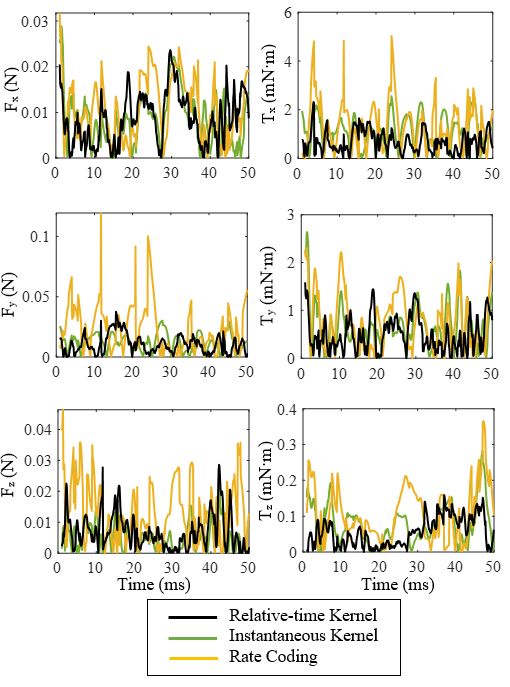
machine learning community and widely used by neurosci- decoders. Finally, the conclusion and future work are discussed
entists to represent spike trains as objects in Hilbert space, in Section V.
and decode the motor signals using well-developed regression
II. P ROBLEM F ORMULATION
methods [24]–[26]. In [24], the author proposed a reproducing
kernel Hilbert space (RKHS) framework that uses an instan- Given a hawk moth visually tracking a moving robotic
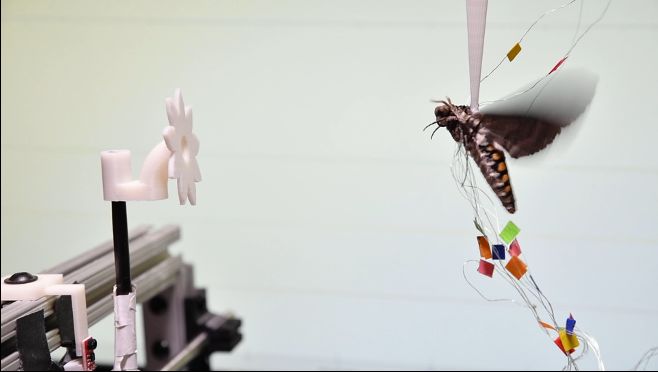
taneous kernel to determine similarities between single spike flower while tethered to a custom 6-axis F/T transducer in
trains directly. This RKHS framework can be formulated by Fig. 1, we aim to uncover the precise mapping from the
many types of spike train kernel designs, including count recorded spike trains of the 10 primary muscles actuating the
kernels [25], linear functional kernels [27], and nonlinear moth wings to the resulting aerodynamic forces and torques.
functional kernels [28]. Gaussian process regression, which The aerodynamic forces and torques, y ∈ R6 , are collected
assumes a prior Gaussian distribution with its covariance given at times t1 , t2 , · · · , tn , and then arranged into a matrix,
by the kernel, has also been widely used for spike train Y ∈ Rn×6 , such that
decoding [29], [30]. One distinct disadvantage of these kernel- Y = [y(t1 ) y(t2 ) · · · y(tn )]T (1)
based spike train decoding methods is that they only capture
the difference of either spike counts or exact spike timings To map a spike train containing a sequence of spike times
between spike trains from different muscles, and will not to a continuous variable that can be used for regression,
perform well especially in our case when the muscles actuating we represent the sequence of spike times as a binned spike
the hawk moth’s wings correlate with each other. Relative train that is changing over time as an user-defined sliding
spike timing information is quite essential for uncovering the window moves [32]–[34]. The larger the bin size is, the more
whole biological motor program, including the correlation information will be stored in the binned spike trains. But the
between muscle pairs [19], [31]. In this paper, we aim to regression algorithm will also become more computationally
discover the neural control policy for the flight of a tethered expensive. In this paper, the spike times ts within a certain
hawk moth visually tracking a moving robotic flower as bin size T before time t are stored in a binned spike train as
shown in Fig. 1. Unlike the traditional kernel-based approaches a set,
summarized above, the new RKHS framework proposed in
X(t) = {ts ∈ (t − T, t]}, s ∈ N∗ (2)
this paper is based on the kernel evaluation between every
pair of correlated spike trains across the entire flight muscle Similar to the aerodynamic forces and torques in (1), the
population. The novelty of this new relative-time kernel design binned spike trains of 10 primary flight muscles are then
is that it allows to take into account both single spike train collected at times t1 , t2 , · · · , tn , and arranged into a matrix,
patterns and relative spike timing information among multiple X ∈ Rn×10 , such that
neurons for the first time.
x(t1 )
1
X (t1 ) X 2 (t1 ) · · · X 10 (t1 )
x(t2 ) X 1 (t2 ) X 2 (t2 ) · · · X 10 (t2 )
X= . = . (3)
.. .. ..
.. .. . . .
x(tn ) X 1 (tn ) X 2 (tn ) · · · X 10 (tn )
where x(t) ∈ R10 denotes the output signal vector containing
10 binned spike trains at any given time t. In this paper, we
consider the problem of determining the decoding function,
f ∗ , that minimizes the difference between the predicted and
true aerodynamic forces and torques,
n
∗
X 2
f = argmin{ y(ti ) − f [X 1 (ti ), X 2 (ti ), · · · , X 10 (ti )] 2
f ∈H i=1
Fig. 1. Picture of a hawk moth visually tracking a moving robotic flower + λ∥f ∥2H }
while tethered to a custom 6-axis F/T transducer.
(4)
This paper is organized as follows. Section II first in- 1 2
where H denotes the Hilbert space, X , X , · · · , and X rep- 10
troduces how we collect the spike train and control signal resent the binned spike trains corresponding with 10 primary
data in flower tracking experiments. The spike train decoding muscles actuating the moth wings, and λ is a tuning parameter
problem is then formulated in this section, along with its for penalized regression.
basic assumptions. The new relative-time kernel design that
considers the extra information encoded in relative spike III. R ELATIVE - TIME K ERNEL D ESIGN
timings among multiple neurons is presented in Section III. In In general, a reproducing kernel Hilbert space (RKHS)
Section IV, the performance of the relative-time-kernel-based can be defined by a symmetric and positive definite Mercer
spike train decoder is demonstrated by comparing to that of kernel. The input sample, X, is first mapped to the RKHS as
benchmark instantaneous-kernel-based and rate-coding-based a function, K(X, ·), obtained by fixing the first coordinate.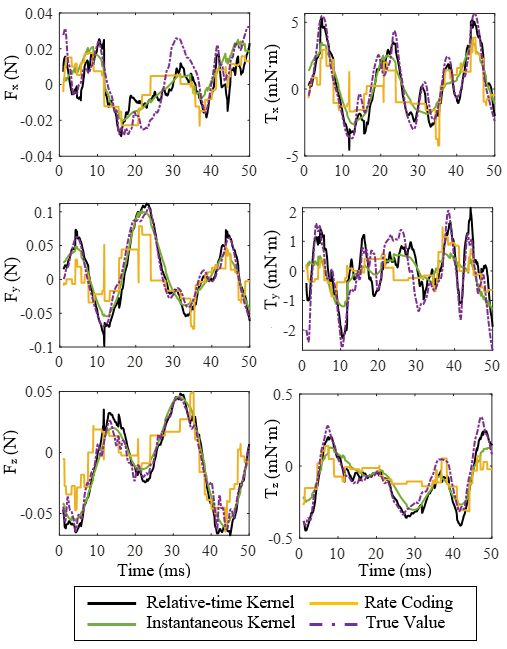
Then, the inner product of two functions in the RKHS can be
computed by a kernel evaluation in the input space,
                       ⟨X|X ′ ⟩H = K(X, X ′ )                         (5)
which brings computational simplicity. In our particular spike
train decoding problem, given a set of binned spike trains,
X i = {tik : k = 1, 2, · · · , mi }, i = 1, 2, · · · , 10, from 10
different primary muscles respectively, every pair of binned
spike trains, X i and X j , can be represented as a sum of two-
dimensional Dirac delta functions,
                            X
              xij (σ, τ ) =     δ(σ − tiki , τ − tjkj )         (6)          Fig. 3. An example of the multivariate Gaussian distribution containing the
                              ki ,kj                                         information of relative spike times between spike trains, X 1 and X 3 .
which can then be transformed into a continuous multivariate
function via convolution with a filter h,
                                X                                              For RKHS regression, the kernel evaluation between two
        fij (σ, τ ) = xij ∗ h =    h(σ − tiki , τ − tjkj ) (7)               pairs of spike trains can be defined as,
                                       ki ,kj                                                                Z TZ T
                                                                                          ′
                                                                                                       ′                        ′
where i and j denote two different muscles, and k represents                 K(X ij , X ij ) = ⟨fij , fij ⟩=        fij (σ, τ )fij (σ, τ )dσdτ
                                                                                                                     0   0
spike indices. In this paper, we choose a two-dimensional                                                                                           (9)
Gaussian filter h for the convolution above,
                                                                             where X ij denotes the two-dimensional Gaussian distribution
                                   1                                         determined by the pair of spike trains, X i and X j , the
                  h(v) = exp(− vT Σ−1 v)                          (8)
                                   2                                         superscript (·)′ refers to a different pair of spike trains, and T
where v denotes the mean vector, and Σ denotes the co-                       represents the bin size. Then, the final kernel function can be
variance matrix. For illustration purposes, Fig. 2 shows three               given by,
binned spike trains, X i = {tik : k = 1, 2, · · · , mi }, i = 1, 2, 3,                                      X                ′
collected in our flower tracking experiment. If we take two                                   K(x, x′ ) =       K(X ij , X ij )             (10)
binned spike trains, X 1 and X 3 , for example, the continuous                                                 i,j

multivariate function containing the information of relative                   Based on the representer theorem in [35], the prediction of
spike times between these two spike trains can be represented                the decoding function, f̂ , evaluated at binned spike trains, Z ∈
by a two-dimensional Gaussian distribution as shown in Fig. 3.               Rl×10 , from 10 muscles in the test data set can be obtained
                                                                             by taking linear combinations of the kernel,
                                                                                                       f̂ (Z) = K(Z, X)α                           (11)
                                                                             where X ∈ Rn×10 denotes binned spike trains used for
                                                                             training, Krs = K [z(tr ), x(ts )] ∈ Rl×n is the Gram matrix,
                                                                             and the coefficients, α ∈ Rn×6 , are given by,
                                                                                                 α = [K(X, X) + σn2 I]−1 Y                         (12)
                                                                             where Krs = K [x(tr ), x(ts )] ∈ Rn×n is the Gram matrix, σn2
                                                                             is the observation noise variance, and Y ∈ Rn×6 represents
                                                                             the corresponding aerodynamic forces and torques used for
                                                                             training. Then, we can use this RKHS regression approach
                                                                             to predict the output aerodynamic forces and moments at
                                                                             an arbitrary time. The prediction results are shown in the
                                                                             following section.
                                                                                                 IV. R EGRESSION R ESULTS
                                                                                In our experiment, the hawk moth visually tracks a robotic
                                                                             flower that oscillates with a 1-Hz sinusoidal trajectory, and
                                                                             its wing stroke is approximately 50 ms. Consequently, the
                                                                             size of the sliding window for spike train binning is chosen
Fig. 2. An example of three binned spike trains containing the information   to be 50 ms. To capture the stroke-to-stroke modulation, the
of exact spike times.                                                        training data used for RKHS regression should cover at least
                                                                             one second. Therefore, given that the sampling rate of moth
experiments is 104 Hz, we need to use 105 binned spike trains
from 10 primary muscles and 6 × 10⁴ output aerodynamic
forces and torques collected during the hawk moth’s flapping
flight for training. Given that the aerodynamic forces and
torques do not change dramatically, we decrease the resolution
of training data to reduce the computational complexity by
collecting the training data every 20 time steps. Then, we
obtain a sequence of binned spike trains from 10 primary
muscles at times t1 , t2 , · · · , t500 , arrange them into a matrix,
X ∈ R500×10 , and correspondingly collect the output forces
and torques, Y ∈ R500×6 , within one second as the training
data for RKHS regression. Finally, we test our new regression-
based decoder on a test data set, Z ∈ R500×10 , within an
arbitrary wing stroke.
To benchmark our new kernel design, we compare the per-
formance of our relative-timing-kernel-based regression with
that of both the traditional instantaneous-kernel-based regres-
sion [29] and rate coding [16], [17]. Fig. 4 shows the aero-
dynamic forces and torques predicted by relative-time-kernel-
based, instantaneous-kernel-based and rate-coding-based re-
gressions along with the true values measured in the moth
experiment. It can be seen from the relative-time-kernel-based
testing results that the aerodynamic forces and torques have
been predicted accurately within a permissible range of error.
The instantaneous kernel directly determines similarities be-
tween single spike trains, and does not capture relative timing
information [24], [25]. The rate coding method is based on the
assumption that average firing rate encodes most information. Fig. 4. Comparison of relative-time-kernel-based, instantaneous-kernel-based
Unlike these two traditional methods, our relative-time kernel and rate-coding-based predictions of aerodynamic forces and torques.
compares every pair of correlated spike trains across the
population, and considers the extra information encoded in 1
n
P
relative spike times among different spike trains. As shown in where ē = n ei . The lower the standard deviation of
i=1
Fig. 4, both the relative-time-kernel-based and instantaneous- the absolute error is, the better the model captures the data
kernel-based decoders outperform the rate-coding-based one variance. The R-squared score, R2 , is given by,
significantly. More importantly, the relative-time-kernel-based n
(yi − ŷi )2
P
decoder can capture small changes in forces and moments
2 i=1
better than the other two traditional methods, particularly for R (y, ŷ) = 1 − P n (15)
torque components, Tx and Ty . (yi − ȳ)2
In Fig. 5, we compare the absolute prediction errors i=1
of relative-time-kernel-based, instantaneous-kernel-based and n
1
P
rate-coding-based regressions. The absolute prediction error, where ȳ = n yi . The higher the R-squared score is, the bet-
i=1
e, is defined as, ter the model captures the data variance. In Table I, these two
performance metrics are used to quantitatively determine the
e = |y − ŷ| (13) accuracy of relative-time-kernel-based, instantaneous-kernel-
where y denotes the true value, and ŷ denotes the predicted based and rate-coding-based regressions. The percentage im-
value. It can be observed that the relative-time-kernel-based provement of relative-time kernel over instantaneous kernel is
decoder can predict the aerodynamic forces and torques more listed in the yellow shaded area. It can be observed that the
accurately than the other two traditional decoders, especially standard deviation of the absolute error of relative-time-kernel-
for the torque prediction. To determine how well the decoder based regression is smaller than that of instantaneous-kernel-
captures the variance in data, we use the standard deviation based one except for the force component, Fz . Furthermore,
of the absolute prediction error, σe , and R-squared score, R2 . the R-squared scores of relative-time-kernel-based regression
The standard deviation of the absolute error, σe , is given by, for the predictions of Fx , Fy , Tx , Ty and Tz are all higher than
v that of instantaneous-kernel-based regression. Compared to
u n
uX force prediction, our proposed relative-time kernel has a much
σe = t (ei − ē)2 (14) higher percentage improvement over the instantaneous kernel
i=1 in torque prediction. Therefore, having taken the extra infor-mation of relative spike times into account, the relative-time- V. C ONCLUSION
kernel-based decoder captures the variance in the aerodynamic This paper presents a novel regression-based spike train
forces and torques better than the traditional instantaneous- decoding method that uncovers the precise mapping from the
kernel-based and rate-coding-based decoders. spike trains of ten primary flight muscles to the resulting
aerodynamic forces and torques for the flight of a hawk moth
visually tracking a robotic flower. The new relative-time kernel
design proposed in this paper considers the extra relative spike
timing information among different spike trains by comparing
every pair of correlated spike trains across the flight muscle
population. The relative-time-kernel-based decoder captures
the data variance better and predicts the aerodynamic forces
and torques more accurately than benchmark instantaneous-
kernel-based and rate-coding-based decoders. Furthermore,
compared to force prediction, the proposed relative-time kernel
has a much higher percentage improvement over the instanta-
neous kernel in torque prediction. Regarding the future work
beyond the relative-time kernel design approach described
in this paper, we will use this new regression-based spike
train decoder to train the hawk moth’s spiking neural network
(SNN) model.
ACKNOWLEDGMENT
This work was supported by the Office of Naval Research
grant N00014-17-1-2614 and the Air Force Office of Scientific
Research grant FA9550-19-1-0396.
R EFERENCES
[1] J. A. Marshall, R. Bogacz, A. Dornhaus, R. Planqué, T. Kovacs, and
N. R. Franks, “On optimal decision-making in brains and social insect
colonies,” Journal of the Royal Society Interface, vol. 6, no. 40, pp.
1065–1074, 2009.
[2] A. B. Barron, K. N. Gurney, L. F. Meah, E. Vasilaki, and J. A.
Marshall, “Decision-making and action selection in insects: inspiration
from vertebrate-based theories,” Frontiers in Behavioral Neuroscience,
vol. 9, p. 216, 2015.
[3] M. Steinberg, J. Stack, and T. Paluszkiewicz, “Long duration auton-
omy for maritime systems: Challenges and opportunities,” Autonomous
Fig. 5. Comparison of the absolute prediction errors of the relative-time-
Robots, vol. 40, no. 7, pp. 1119–1122, 2016.
kernel-based, instantaneous-kernel-based and rate-coding-based regressions.
[4] K. Ebadi, Y. Chang, M. Palieri, A. Stephens, A. Hatteland, E. Heiden,
A. Thakur, N. Funabiki, B. Morrell, S. Wood et al., “Lamp: Large-scale
autonomous mapping and positioning for exploration of perceptually-
TABLE I degraded subterranean environments,” in 2020 IEEE International Con-
R EGRESSION PERFORMANCE COMPARISON . ference on Robotics and Automation (ICRA). IEEE, 2020, pp. 80–86.
[5] E. Yurtsever, J. Lambert, A. Carballo, and K. Takeda, “A survey of
Fx Fy Fz autonomous driving: Common practices and emerging technologies,”
Relative-time 0.0054 0.0071 0.0042 IEEE access, vol. 8, pp. 58 443–58 469, 2020.
Instantaneous 0.0056 0.0076 0.0040 [6] E. U. Jiménez, A. F. Caballero, F. M. Rueda, J. I. Giménez, and R. Oboe,
σe ↓ “Reverse-engineer the brain: Perspectives and challenges,” in Emerging
Rate coding 0.0066 0.0192 0.0093
% Improvement 3.6% 6.6% -5.0% Therapies in Neurorehabilitation. Springer, 2014, pp. 173–188.
Tx Ty Tz [7] N. Howard, “The future of the brain and beyond,” in 2019 IEEE
Relative-time 0.4350 0.3542 0.0397 18th International Conference on Cognitive Informatics & Cognitive
Instantaneous 0.6193 0.4535 0.0558 Computing (ICCI* CC). IEEE, 2019, pp. 2–2.
σe ↓ [8] J. L. Fox, A. L. Fairhall, and T. L. Daniel, “Encoding properties
Rate coding 0.9466 0.5545 0.0754
% Improvement 29.8% 21.9% 28.9% of haltere neurons enable motion feature detection in a biological
Fx Fy Fz gyroscope,” Proceedings of the National Academy of Sciences, vol. 107,
Relative-time 0.6477 0.9203 0.9133 no. 8, pp. 3840–3845, 2010.
Instantaneous 0.6369 0.9037 0.9477 [9] T. Gale, E. Elsen, and S. Hooker, “The state of sparsity in deep neural
R2 ↑ networks,” arXiv preprint arXiv:1902.09574, 2019.
Rate coding 0.4593 0.5639 0.7039
% Improvement 1.7% 1.8% -3.6% [10] T. S. Clawson, T. C. Stewart, C. Eliasmith, and S. Ferrari, “An adaptive
spiking neural controller for flapping insect-scale robots,” in 2017 IEEE
Tx Ty Tz
Symposium Series on Computational Intelligence (SSCI). IEEE, 2017,
Relative-time 0.8869 0.6609 0.8555
pp. 1–7.
Instantaneous 0.7151 0.4345 0.7133
R2 ↑ [11] X. Zhang, G. Foderaro, C. Henriquez, and S. Ferrari, “A scalable weight-
Rate coding 0.5244 0.1752 0.4626
free learning algorithm for regulatory control of cell activity in spiking
% Improvement 24.0% 52.1% 19.9%
neuronal networks,” International Journal of Neural Systems, vol. 28,
no. 02, p. 1750015, 2018.[12] E. N. Brown, R. E. Kass, and P. P. Mitra, “Multiple neural spike [35] B. Schölkopf, R. Herbrich, and A. J. Smola, “A generalized representer
train data analysis: state-of-the-art and future challenges,” Nature Neu- theorem,” in International conference on computational learning theory.
roscience, vol. 7, no. 5, pp. 456–461, 2004. Springer, 2001, pp. 416–426.
[13] S. Koyama, U. T. Eden, E. N. Brown, and R. E. Kass, “Bayesian
decoding of neural spike trains,” Annals of the Institute of Statistical
Mathematics, vol. 62, no. 1, pp. 37–59, 2010.
[14] V. Ventura, “Spike train decoding without spike sorting,” Neural Com-
putation, vol. 20, no. 4, pp. 923–963, 2008.
[15] Z. Chen, “An overview of bayesian methods for neural spike train
analysis,” Computational Intelligence and Neuroscience, vol. 2013,
2013.
[16] E. D. Adrian and Y. Zotterman, “The impulses produced by sensory
nerve-endings: Part ii. the response of a single end-organ,” Journal of
Physiology, vol. 61, no. 2, pp. 151–171, 1926.
[17] D. H. Hubel and T. N. Wiesel, “Receptive fields of single neurones
in the cat’s striate cortex,” Journal of Physiology, vol. 148, no. 3, pp.
574–591, 1959.
[18] T. S. Clawson, S. Ferrari, S. B. Fuller, and R. J. Wood, “Spiking neural
network (snn) control of a flapping insect-scale robot,” in 2016 IEEE
55th Conference on Decision and Control (CDC). IEEE, 2016, pp.
3381–3388.
[19] J. Putney, R. Conn, and S. Sponberg, “Precise timing is ubiquitous,
consistent, and coordinated across a comprehensive, spike-resolved flight
motor program,” Proceedings of the National Academy of Sciences, vol.
116, no. 52, pp. 26 951–26 960, 2019.
[20] J. Putney, T. Niebur, R. Conn, and S. Sponberg, “An information
theoretic method to resolve millisecond-scale spike timing precision in
a comprehensive motor program,” bioRxiv, 2021.
[21] L. Kostal, P. Lansky, and J.-P. Rospars, “Neuronal coding and spiking
randomness,” European Journal of Neuroscience, vol. 26, no. 10, pp.
2693–2701, 2007.
[22] T. J. Sejnowski et al., “Time for a new neural code?” Nature, vol. 376,
no. 6535, pp. 21–22, 1995.
[23] J. J. Hopfield, “Pattern recognition computation using action potential
timing for stimulus representation,” Nature, vol. 376, no. 6535, pp. 33–
36, 1995.
[24] A. R. Paiva, I. Park, and J. C. Principe, “A reproducing kernel hilbert
space framework for spike train signal processing,” Neural computation,
vol. 21, no. 2, pp. 424–449, 2009.
[25] I. M. Park, S. Seth, A. R. Paiva, L. Li, and J. C. Principe, “Kernel
methods on spike train space for neuroscience: a tutorial,” IEEE Signal
Processing Magazine, vol. 30, no. 4, pp. 149–160, 2013.
[26] L. Li, I. M. Park, S. Seth, J. S. Choi, J. T. Francis, J. C. Sanchez, and J. C.
Prı́ncipe, “An adaptive decoder from spike trains to micro-stimulation
using kernel least-mean-squares (klms),” in 2011 IEEE International
Workshop on Machine Learning for Signal Processing. IEEE, 2011,
pp. 1–6.
[27] B. Schrauwen and J. Van Campenhout, “Linking non-binned spike train
kernels to several existing spike train metrics,” Neurocomputing, vol. 70,
no. 7-9, pp. 1247–1253, 2007.
[28] I. Park and J. C. Prı́ncipe, “Quantification of inter-trial non-stationarity in
spike trains from periodically stimulated neural cultures,” in 2010 IEEE
International Conference on Acoustics, Speech and Signal Processing.
IEEE, 2010, pp. 5442–5445.
[29] E. Schulz, M. Speekenbrink, and A. Krause, “A tutorial on gaussian
process regression: Modelling, exploring, and exploiting functions,”
Journal of Mathematical Psychology, vol. 85, pp. 1–16, 2018.
[30] C. K. Williams and C. E. Rasmussen, Gaussian processes for machine
learning. MIT press Cambridge, MA, 2006, vol. 2.
[31] S. Nirenberg and P. E. Latham, “Decoding neuronal spike trains: how
important are correlations?” Proceedings of the National Academy of
Sciences, vol. 100, no. 12, pp. 7348–7353, 2003.
[32] M. M. Churchland and S. G. Lisberger, “Shifts in the population
response in the middle temporal visual area parallel perceptual and
motor illusions produced by apparent motion,” Journal of Neuroscience,
vol. 21, no. 23, pp. 9387–9402, 2001.
[33] A. B. Graf, A. Kohn, M. Jazayeri, and J. A. Movshon, “Decoding
the activity of neuronal populations in macaque primary visual cortex,”
Nature Neuroscience, vol. 14, no. 2, pp. 239–245, 2011.
[34] E. Salinas and L. Abbott, “Vector reconstruction from firing rates,”
Journal of Computational Neuroscience, vol. 1, no. 1-2, pp. 89–107,
1994.You can also read


