ROOFTOP PV GUIDELINES FOR SAFE AND LEGAL INSTALLATIONS IN CAPE TOWN - SSEG
←
→
Page content transcription
If your browser does not render page correctly, please read the page content below
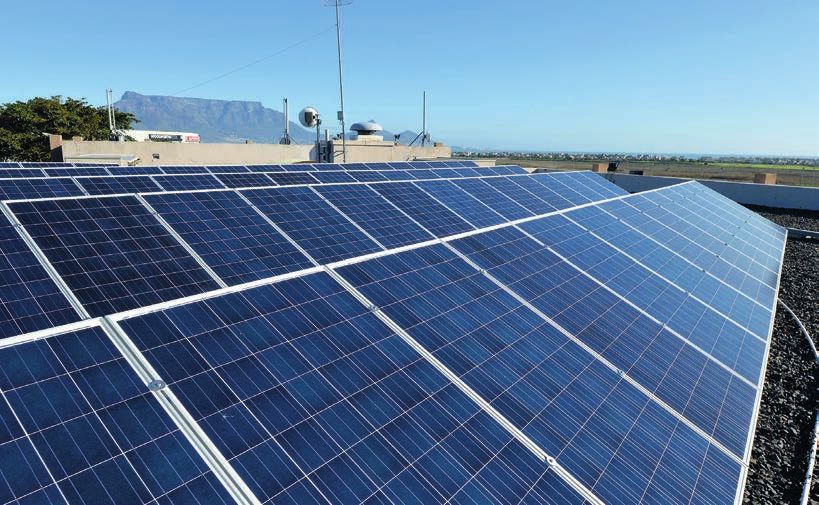
Photo credit: Bruce Sutherland, City of Cape Town.
   Grid-tied PV system at the City of Cape Town’s Royal Ascot building.

   ROOFTOP PV
   GUIDELINES FOR SAFE AND LEGAL
   INSTALLATIONS IN CAPE TOWN
   If you are considering installing a rooftop photovoltaic (PV) system, but you are not
   sure how to do it safely and legally, these guidelines will help you to:

      Make informed decisions                         Select the best        Understand all the key
       about what type of PV                          service provider.   requirements before, during
         system to install.                                                  and after installation.

REVISION 7 September 2018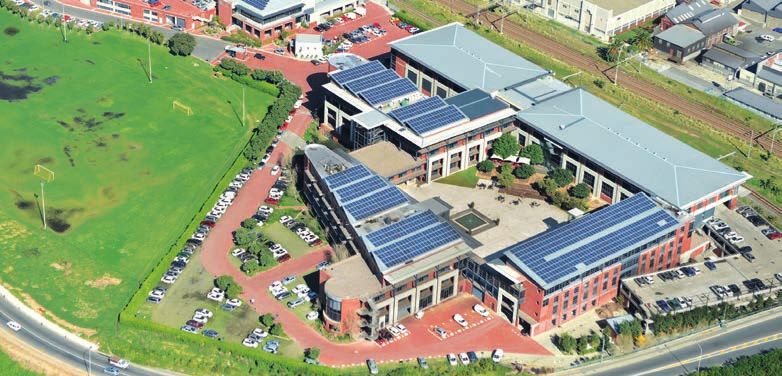
The City of Cape Town is encouraging the installation of private
Small-Scale Embedded Generation (SSEG) systems, particularly
rooftop Photovoltaic (PV) systems. This document provides important
information for installing a safe and legal rooftop PV system.
•    or more information about the SSEG application process in Cape Town,
    F
    go to http://www.capetown.gov.za/solarPV

•   For information about electricity saving PV and FAQs,
    go to savingelectricity.org.za

THINGS TO CONSIDER:                                                       While there are compulsory
                                                                          wiring standards for general
                                                                          electrical installations, there is
    1. SAFETY                                                             no dedicated national standard
                                                                          for PV installations yet.

                                                                          This does not mean that you
Poorly installed rooftop PV systems and illegal grid                      are not allowed to install a
connections are a safety concern:                                         PV system. But without these
                                                                          quality reference points, you need
                                                                          to know how to ensure a safe

       The household may be exposed to the risk of electrical fires
                                                                          installation and a good quality
       and electric shock
                                                                          product that complies with
      The safety and the power quality of the electricity grid may be   the law.
        compromised by connections that use the wrong equipment
        or by adding unplanned generation capacity to a part of the       For quality installations, make
        network not designed to carry it.                                 use of an installer accredited
      The safety of electricity staff working on the reticulation       by SAPVIA who can issue a
        network could be compromised by electricity feeding into the      GreenCard for your installation.
        grid from the illegally connected PV installations.
                                                                          See www.pvgreencard.co.za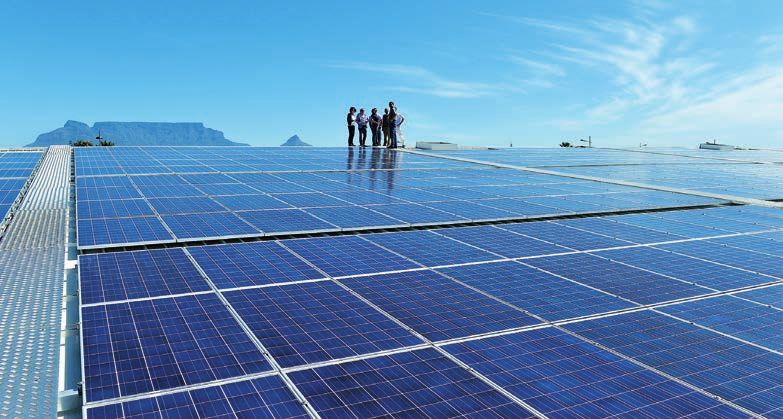
2. TYPES OF PV SYSTEMS
  THERE ARE FOUR TYPICAL CONFIGURATIONS FOR RESIDENTIAL AND COMMERCIAL PV SYSTEMS:

The most common installation types are options A and B: Grid-tied feed-in and grid-tied hybrid systems

A. G
    RID-TIED FEED IN PV SYSTEMS
Grid-tied feed in PV systems have PV
panels that are connected directly
to an inverter. The electricity it
                                                                                                Solar panels convert sunlight
generates is used locally on the                                                                into clean DC energy
property or fed back into the
electricity grid, when excess                                                                                      Existing
electricity is generated.                                                                                          electrical
                                                                                                                   distribution
                                  City of Cape Town                                                                board
                                  electricity grid

                                                                                                                   City-approved
                                                                                                                   inverter
                                                                                                                   converts
                                                                                                                   DC electricity
                                                                                                                   into useable
                                                                                                                   AC electricity

                                                                                                                New
                                                                                                                City-approved
                                                                                                                bi-directional
                                                                                                                electricity meter

                                                During peak                                  Exported electricity:
                                       consumption periods                         When the solar system generates more
                                   and at night, electricity is                    electricity than your building uses, the
                                     imported from the grid                       excess electricity goes back onto the grid

B. GRID-TIED HYBRID
                                                                                  and the City will credit you at a fixed rate

   PV SYSTEMS                                                                                 Solar panels convert sunlight
                                                                                              into clean DC energy
Grid-tied hybrid PV systems are
able to disconnect the incoming                                                                                    Existing
                                                                                                                   electrical
supply and connect the load                                                                                        distribution
to the PV system or stored                                                                                         board
energy in batteries. These
                                                                                                                    Hybrid
systems can operate            City of Cape Town                                                                    changeover
in load-shedding               electricity grid                                                                     switch
scenarios.                                                                                                         City-approved
                                                                                                                   inverter
                                                                                                                   converts
                                                                                                                   DC electricity
                                                                                                                   into useable
                                                                                                                   AC electricity

                                                                                                                    Battery is
                                                                                                                    charged
                                                                                                                    when solar
                                                                                                                    production
                                                                                                     New            is greater
                                                                                                City-approved       than
                                                                                                bi-directional      household
                                                                                               electricity meter    demand

                                                     During peak                         Exported electricity:
                                        consumption periods and         When the solar system generates more electricity than
                                            at night, electricity is   your building uses, the excess electricity goes back onto
                                          imported from the grid          the grid and the City will credit you at a fixed rate
C. G
    RID-TIED PV SYSTEMS WITH
   REVERSE POWER FLOW BLOCKING
Grid-tied PV systems with reverse power
blocking provide electricity to the property
when there is a demand for it, but blocks                                    Solar panels convert
any excess electricity generated from                                        sunlight into clean DC
                                                                             energy
feeding back onto the grid.
                                                                                               Existing
                                                                                               electrical
                                       City of Cape Town                                       distribution
                                       electricity grid                                        board
                                                                                               City-approved
                                                                                               inverter
                                                                                               converts
                                                                                               DC electricity
                                                                                               into useable
                                                                                               AC electriciy

                                    During peak consumption
                               periods and at night, electricity
                                     is imported from the grid

D. S
    TANDALONE (OFF GRID) PV SYSTEMS

Standalone or off grid PV
systems usually have batteries
and a charge controller. The                          No change to               Solar panels convert
system feeds electrical                                   existing               sunlight into clean DC
                                                    distribution board           energy
circuits on the property
that are wired completely
                          Existing electricity meter
electrically separate of
the electricity service              Electricity grid
provider’s grid.
                                                                                                 Charge
                                                                                                 controller
                                                                                                 PV system
                                                                                                 distribution
                                                                                                 board

                                                                                                 Battery bank

                                                                         Electricity circuit   Inverter
                                                                         completely            converts
                                                                         separated from        DC electricity
                                                                         any wiring            into usable AC
                                                                         connected to the      electricity
                                                                         electricity grid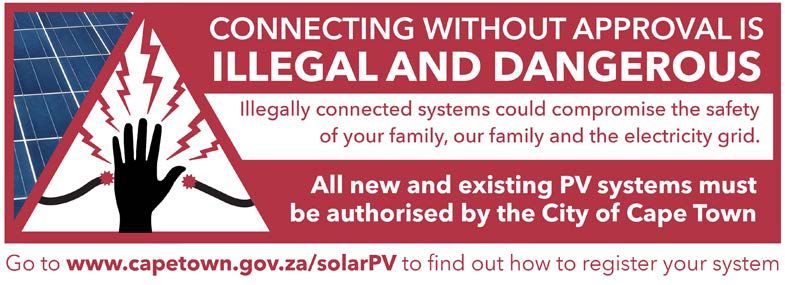
CCT      The City distributes electricity to 75% of
                                  ESKOM    Cape Town, while Eskom distributes
                                           electricity directly to the remaining 25%.
                                           Make sure you know who distributes electricity to your area: it will be
                                           on your electricity bill.
                                           Standalone PV installations are permitted in both areas. In addition the City
                                           allows you to connect your PV system to the grid and feed excess power
                                           back onto the grid. However, if you are in an Eskom area, your system may
                                           only be allowed to connect to the grid in certain cases. These regulations
                                           are currently changing so check with Eskom for the latest requirements.

                                            TYPE OF                PERMITTED IN                PERMITTED IN
                                            INSTALLATION           CCT AREA?                   ESKOM AREA?

                                            Grid-tied              Yes                         Enquire with Eskom

                                            Standalone             Yes                         Yes

     NOTE:

              If you live in a City of Cape Town distribution area, you may install a grid-tied system, but you
              will require prior written authorisation from the City of Cape Town’s Electricity Generation and
              Distribution Department. If you connect without notifying the City, you will be doing so illegally.
              To grid-tie and feed-in, you will require a specialised meter and you will be placed on a new tariff.
              To grid-tie with reverse power flow blocking, you must have a prepayment meter and will remain
              on your existing tariff. For details on how to grid-tie, consult the City’s Small-Scale Embedded
              Generation Requirements online:
              www.capetown.gov.za/SolarPV, under ‘Reference documents’.

               tandalone (off-grid) PV installations do not require authorisation from the City or Eskom. However,
              S
              the City requires off-grid PV installations to register before generating, verifying that the installation
              is connected and operated off-grid, as defined.

              Grid tied hybrid PV installations must be installed with ‘break before make’ grid connection switch
              system approved by the City.

                                                                                                                           Photo credit: Bruce Sutherland, City of Cape Town.

Grid-tied PV system at Black River Park.
3. C
HECKLISTS FOR SAFE AND LEGAL
ROOFTOP PV INSTALLATIONS
3.1. ENSURING A QUALITY INSTALLATION SERVICE
There are many PV service providers currently operating in Cape Town. This checklist
will reduce the risk of a poor or illegal installation.
BUSINESS PERFORMANCE electrical contractor by the Department of Labour.
Verify if the PV service provider has substantial prior Ask for proof of registration (also called a wireman’s
experience in PV installations and ask for references licence), and check that it is up-to-date.
with contact details. Establish whether the PV
service provider designed, supplied and installed This registration is critical because it means that:
the systems or only carried out one or two of these
- the electrician is proficient in the national wiring
steps.
codes SANS 10142-1:1200, and can install your
It is recommended that the PV service provider is PV system safely.
an accredited service provider under a third party
- the
electrician is permitted to issue a CoC for the
quality assurance programme such as:
installation, which will confirm that the installation
- PV Green Card: A SAPVIA (South African has been performed in compliance with the
Photovoltaic Association) endorsed programme national wiring codes.
to ensure the quality and safety of PV
If you are planning to install a grid-tied system, the
installations. www.pvgreencard.co.za
City also requires that your system is signed off by
- P4 Platform quality assurance program: An a professional electrical engineer or technologist
independent system that scores contractors on who is registered with the Engineering Council
performance, knowledge and best practice to of South Africa (ECSA). Check that the PV service
promote good practice in the PV sector. provider has such a person available.
www.pqrs.co.za/the-pv-quality-assurance-
program
REGISTRATION WITH THE SOUTH AFRICAN
Also request to see proof of electrical Certificates PHOTOVOLTAIC ASSOCIATION (SAPVIA)
of Compliance (CoCs) and/or professional engineer AND WITH THE ELECTRICAL CONTRACTORS
sign offs of previous installations. BOARD (ECB)
Find out if your PV service provider is a member of
STAFF QUALIFICATIONS ARE VERY IMPORTANT SAPVIA and the ECB. Although SAPVIA and ECB
Find out if the PV service provider employs or membership is not compulsory, it should be a good
subcontracts qualified staff to design and indication how committed the service provider is
install systems. If your installation’s maximum towards keeping abreast of industry best practice
supply voltage is less than 1 000 volts (most rooftop and complying with legislative requirements and
systems are), the system’s design and installation standards in the PV and broader electrical sectors.
can be done by a person deemed competent as an3.2. BEFORE APPROVING THE DESIGN AND PURCHASING A SYSTEM
Once you are satisfied that your PV service provider has the skills and experience to
perform the work, you may go ahead with planning the installation. Here are the key points
to follow at this stage:
EFORE INSTALLING A PV SYSTEM, BECOME
B NO NEED TO SUBMIT BUILDING PLANS
MORE ELECTRICITY-EFFICIENT There is no need to submit building plans to the City
Before installing a PV system, it makes economic for PV systems - unless the panels protrude more
sense to become more electricity-efficient. By doing than 600 mm above the highest point of the roof, or
so, you will reduce the size and cost of the PV system they are raised more than 1.5 m above any point on
you need. Consider installing an efficient water heater the roof, or if ground mounted, the panels in their
(solar water heater or heat pump), installing efficient installed position project more than 2,1 metres above
lighting and switching to gas for cooking and heating. the natural/finished ground level.
For tips go to www.savingelectricity.org.za.
BUY THE CORRECT INVERTER
OBTAIN AUTHORISATION FROM THE CITY If you are planning to install a grid-tied system,
If you are planning to install a grid-tied system, you ensure that you are using an inverter approved
need to obtain authorisation in writing from the City. by the City. You can find the list of approved
You will find all the necessary documentation at inverters at www.capetown.gov.za/SolarPV under
www.capetown.gov.za/SolarPV, under ’Reference Documents’.
‘Application form and supplemental contract for
installation of small scale embedded generation’.
CHECK PV PANEL STANDARDS
o not go ahead with the installation until you get
D
At the very least, ensure that the PV panels you will
written authorisation. Standalone systems must be
use have a Certificate of Compliance with the IEC
registered with the City but are not required to go
standard:
through the full authorisation process.
EC 61215 − Crystalline silicon terrestrial PV
modules.
OBTAIN A STRUCTURAL ASSESSMENT
IEC standards are the international version of the
Generally roofs can withstand the weight and wind SABS, and are a good indication of panel quality.
load of PV panels. However, it is advisable to obtain Ask your service provider for proof.
a structural assessment of the roof to determine
whether it can withstand these loads. Structural
STORE BATTERIES SAFELY
engineers can provide this service.
If you are installing batteries, make sure that they
are stored in a properly racked, well ventilated, dry
room, in accordance with the Occupational Health
and Safety (OHS) Act, Act 85 of 1993.
3.3. DURING INSTALLATION
ENSURE EFFECTIVE CONTROL ENSURE SPECIALISED DC CIRCUIT BREAKERS
Ensure that the electrician who will be signing off the ARE BEING USED
electrical CoC is in control on site and carries out or DC current from your PV panels requires specialised
supervises the work effectively. circuit breakers. Ensure that your service provider is
using these.
DON’T CONNECT TO THE GRID
If grid-tied, the system cannot be connected to the MANAGE HEALTH AND SAFETY ON SITE
grid before the City grants permission in writing. Ensure installers work according to national health
and safety codes, and hold Working at Height
training certificates. If working at heights above
CHECK PLACEMENT ON THE ROOF
3m, they must use some form of fall arrest system.
Ask the PV installer to demonstrate that the Personal protection equipment (hard hats etc.)
placement of the panels on the roof allows must be used at all times.
adequately for cleaning and also provides access for
the Fire Department.3.4. POST-INSTALLATION
REQUEST AN ORIGINAL ELECTRICAL
REQUEST QUALITY ASSURANCE CERTIFICATES
CERTIFICATE OF COMPLIANCE (CoC) Obtain a quality assurance certificate such as a
he Department of Labour-registered installation
T PV GreenCard. These documents include important
electrician who performs the installation must information on the equipment used and technical
supply you with a CoC after s/he has carried out the details of the installation which will be useful for
installation and completed the required tests and future reference.
checks. All grid-tied rooftop PV systems installed
in the City of Cape Town grid must be certified. CHECK FOR ROOF LEAKS
Commercial and industrial installations must be
Check the installation work has not caused leaks in
certified by an ECSA-registered professional
your roof.
engineer or technologist. Residential installations
may be certified as above or by ECSA-registered
professional technician. WARRANTEES AND MANUALS
Obtain all warrantees and guarantees on offer, both
Remember that as the property owner, you are for the installation as a whole and for its components
responsible for the safety of the electrical installation (solar modules, inverters, structural system). Also,
on your property in terms of the OHS Act. Without a check you have all operations and maintenance
valid electrical CoC, you will find it difficult to prove manuals.
that you have taken reasonable precautions should RECOURSE FOR POOR WORK
anything go wrong. Insurance companies might not
If you are not satisfied with the work, request an
pay out for damages; and if someone is injured or
independent inspection of the installation.
dies as a result of the installation, you could be held
In Cape Town, an organisation that carries out this
liable as the property owner.
work is the Electrical Approved Inspection Authority
of Southern Africa (EAIASA). Before it can carry out
If the PV installation is off-grid and the voltage is
an inspection, you must have the original CoC and
higher than 50V, the Department of Labour also
you will need to pay an inspection fee.
requires a CoC for the installations.
Photo credit: Bruce Sutherland, City of Cape Town.
Grid-tied PV system at Bayside Mall.
Produced by the City of Cape Town Energy Directorate
Please note that this document may be updated from time to time, so visit these websites to check for the most recent version:
www.capetown.gov.za/SolarPV and/or www.SavingElectricity.org.za.You can also read


