Rosetta ?omet-chasing probe wakes up, signals Earth - Phys.org
←
→
Page content transcription
If your browser does not render page correctly, please read the page content below

Rosetta ?omet-chasing probe wakes up,
signals Earth
20 January 2014, by Frank Jordans

                                                        were switched back on in preparation for the final
                                                        stage of its decade-long mission to rendezvous with
                                                        the comet named 67P/Churyumov-Gerasimenko.
                                                        Systems had been powered down in 2011 to
                                                        conserve energy, leaving scientists in the dark
                                                        about the probe's fate until now.

                                                        Because of the time it took Rosetta to wake up, and
                                                        the long distance between the spacecraft and
                                                        Earth, the earliest possible hour for a signal to
                                                        arrive was 6:30 p.m.

                                                        "I think it's been the longest hour of my life," said
                                                        Andrea Accomazzo, the spacecraft's operations
                                                        manager at ESA's mission control room in
                                                        Darmstadt, Germany. "Now we have it back."
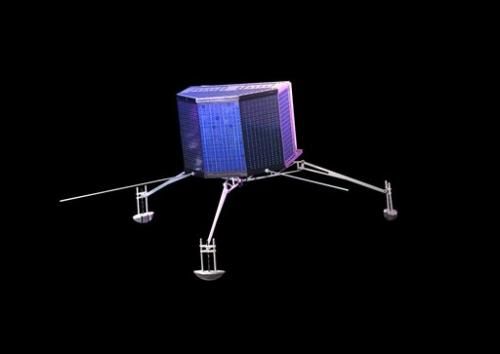
This undated image provided by the European Space
Agency ESA shows an artist's impression of the Philae
lander. Scientists at the European Space Agency are
expecting their comet-chasing probe Rosetta to wake
from almost three years of hibernation at 11 a.m.
Monday Jan. 20, 2014 (1000 GMT; 5 a.m. EST) and
phone home to say all is well. (AP Photo/ESA ATG
medialab , Astrium E, Viktor, File)

Waking up after almost three years of hibernation,
a comet-chasing spacecraft sent its first signal
back to Earth on Monday, prompting cheers from
scientists who hope to use it to land the first space
lander onto a comet.

The European Space Agency received the all-clear
message from its Rosetta spacecraft at 7:18 p.m.
(1818 GMT; 1:18 p.m. EST)—a message that had
to travel some 800 million kilometers (500 million
miles).

In keeping with the agency's effort to turn the tense
wait for a signal into a social media event, the
probe triggered a series of "Hello World!" tweets in
different languages.
                                                        This image provided by the European Space Agency
Dormant systems on the unmanned spacecraft              ESA shows an artist's impression of the Rosetta orbiter

                                                                                                         1/4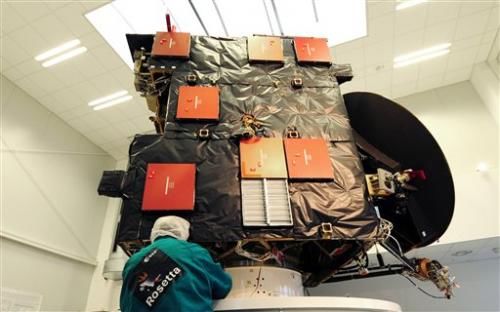
deploying the Philae lander to comet
 67P/Churyumov–Gerasimenko. The image is not to
 scale; the Rosetta spacecraft measures 32 m across
 including the solar arrays, while the comet nucleus is
 thought to be about 4 km wide. Scientists at the
 European Space Agency are expecting their comet-
 chasing probe Rosetta to wake from almost three years
 of hibernation at 11 a.m. Monday Jan. 20, 2014 (1000
 GMT; 5 a.m. EST) and phone home to say all is well. (AP
 Photo/ESA, C.Carreau, File)

Scientists will now take control of Rosetta again, a
procedure slowed by the 45 minutes it takes a
signal to travel to or from the spacecraft, he said.       A scientist of European space agency ESA stands at an
                                                           airworthy copy of space probe 'Rosetta' in the ESA
                                                           control center in Darmstadt, Germany, Monday, Jan. 20,
The wake-up call is one of the final milestones for
                                                           2014. Scientists at the European Space Agency are
Rosetta before it makes its rendezvous with comet          expecting their comet-chasing probe Rosetta to wake
67P in the summer. The probe will then fly a series        from almost three years of hibernation at 11 a.m. Monday
of complicated maneuvers to observe the comet—a            Jan. 20, 2014 (1000 GMT; 5 a.m. EST) and phone home
lump of rock and ice about four kilometers (2.5            to say all is well. The scientists are facing an agonizing
miles) in diameter—before dropping a lander called         wait of several hours until the first signal reaches Earth.
Philae onto its icy surface in November.                   (AP Photo/dpa, Daniel Reinhardt)

The lander will dig up samples and analyze them
with its instruments.
                                                           Comets are regarded as flying time capsules
Although the spacecraft was launched almost a              because they are essentially unchanged for the last
decade ago, the instruments aboard Rosetta and             4.6 billion years. Scientists have speculated that
the Philae lander are still considered cutting edge,       comets may be responsible for the water found on
said Joel Parker of the Southwest Research                 some planets. And like asteroids, comets also pose
Institute in Boulder, Colorado. The institute              a theoretical threat to life on Earth.
developed a specialized camera called ALICE that
can detect different chemicals in the comet.         "Over the millennia, comets have actually affected
                                                     our evolution," said Paolo Ferri, head of mission
Rosetta is named after a block of stone that         operations at the European Space Agency. "There
allowed archeologists to decipher ancient Egyptian are many theories about comets hitting the Earth
hieroglyphs. Scientists hope the space mission will and causing global catastrophes. So understanding
help them understand the composition of comets       comets is also important to see in the future what
and thereby discover more about the origins and      could be done to defend the Earth from comets."
evolution of our solar system.

                                                                                                              2/4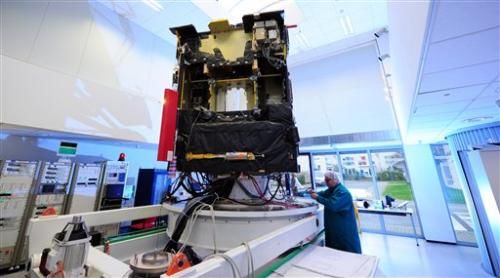
A scientist of European space agency ESA stands at an
                                                           airworthy copy of space probe 'Rosetta' in the ESA
                                                           control center in Darmstadt, Germany, Monday, Jan. 20,
                                                           2014. Scientists at the European Space Agency are
                                                           expecting their comet-chasing probe Rosetta to wake
                                                           from almost three years of hibernation at 11 a.m. Monday
                                                           Jan. 20, 2014 (1000 GMT; 5 a.m. EST) and phone home
                                                           to say all is well. The scientists are facing an agonizing
                                                           wait of several hours until the first signal reaches Earth.
                                                           (AP Photo/dpa, Daniel Reinhardt)

                                                         NASA is planning another space rock mission
                                                         between 2019 and 2021. The agency is looking into
                                                         sending a robotic spaceship to lasso a small
In this photo provided by the European Space Agency,
ESA, Monday Jan. 20, 2014 technicians celebrate after
                                                         asteroid and haul it close to the moon, where
receiving the Rosetta wake up signal in the control room spacewalking astronauts would explore it.
of ESA in Darmstadt, Germany. Waking up after almost
three years of hibernation, a comet-chasing spacecraft       More information: www.esa.int/rosetta
sent its first signal back to Earth on Monday, prompting
cheers from scientists who hope to use it to achieve the
first landing on a comet.The European Space Agency         © 2014 The Associated Press. All rights reserved.
received the all-clear message from its Rosetta
spacecraft at 7:18 p.m. (1818 GMT; 1:18 p.m. EST) -- a
message that had to travel some 800 million kilometers
(500 million miles). (AP Photo/ESA, Juergen Mai, File)

The mission is different from NASA's Deep Impact,
a spacecraft that fired a projectile into a comet in
2005 so scientists could study the resulting plume
of matter. NASA also managed to land a probe on
an asteroid in 2001, but comets are much more
volatile places because they constantly release
dust and gas that can harm a spacecraft.

                                                                                                              3/4
APA citation: Rosetta ?omet-chasing probe wakes up, signals Earth (2014, January 20) retrieved 25 May
                                   2019 from https://phys.org/news/2014-01-rosetta-omet-chasing-probe-earth.html

                                   This document is subject to copyright. Apart from any fair dealing for the purpose of private study or research, no
                                   part may be reproduced without the written permission. The content is provided for information purposes only.

                                                                                                                                                4/4

Powered by TCPDF (www.tcpdf.org)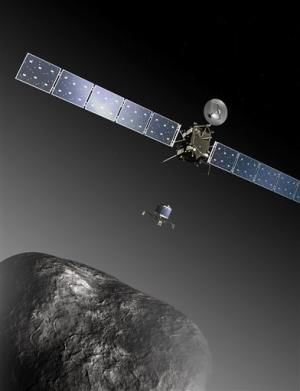
You can also read


