Route Services Strategic plan - Network Rail
←
→
Page content transcription
If your browser does not render page correctly, please read the page content below
Route Services
Strategic plan

                 1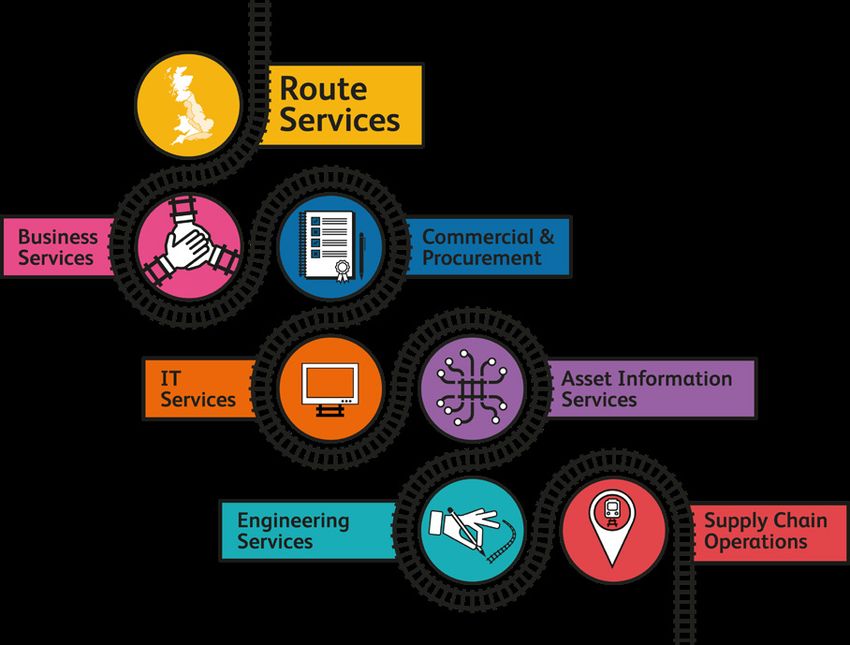
Contents
Foreword and summary                                3
Vision, values and purpose                          4
Our Leadership                                      6
Objectives                                          7
Delivery strategy                                   20
Headwinds and efficiency                            29
Risk and Financial Management                       30
Sign-off                                            32
Appendix A Scorecard                                33
Appendix B Stakeholder Engagement                   34
Appendix C Key assumptions                          35
Appendix D Glossary of terms                        37
Appendix E Service Catalogue and passenger impact   40

                                                         2
Foreword and summary
Since Route Services was established in       Today Route Services consists of 4,800 people and spends        This is to:
                                              £1.5bn per annum delivering or investing in our 60
2016, we have strived to create a business    services. We are committed to spending this money wisely,
                                                                                                              • be easy to do business with and behave like a service
that meets the needs of our route, region                                                                        organisation
                                              delivering best value to our customers and passengers.
and national customers. Over the past         In Control Period 6 (2019-2024), Route Services will directly   • provide a choice of business and operational services
                                              deliver £0.4bn of efficiency through a combination of              that are value-driven and commercially competitive
four years, Route Services has successfully
                                              transformational change and small, continuous business
integrated further teams and services,                                                                        • deliver service excellence in line with agreed customer
                                              improvements. Furthermore, we support and facilitate the
                                                                                                                 and passenger expectations
whilst improving performance.                 indirect spend of a further c.£5bn per annum across the
                                              wider business through our commercial and procurement           • advise and support our customers to make the best
                                              team. We do this with the same attention to delivering             service choice
                                              best value for the customer and passenger.                      • engage and empower our teams and protect their
                                              However, our customers continue to demand more from us,            safety and wellbeing.
                                              and we are developing our organisation to offer the high        We have a robust plan to transform our business to
                                              performing, cost-competitive and commercial approach            meet the changing needs of our customers through
                  Susan Cooklin,              that they expect. With this challenge in mind, embracing        Control Period 6 and into Control Period 7 (2024-2029),
                  Managing director,          the Network Rail vision and values, we have developed a         whilst delivering the value for money services that our
                                              revised Route Services offer for CP6.
                  Route Services                                                                              customers demand.

                                                                                                              Susan Cooklin,
                                                                                                              managing director, Route Services

“We will be our customers’ and suppliers’ trusted partner of choice:
one team continuously improving our delivery performance, quality
and cost-competitiveness for a better railway.”
                                                                                                                                                                           3
Vision, values and purpose
Route Services’ vision is the same                Always safe                                                    Having brought together experts in a broad
                                                  Safety is not negotiable. With clear accountabilities,         range of specialisms, including information
as that of Network Rail:                          we must challenge ourselves and our colleagues every           technology, logistics, commercial and
                                                  time we witness unsafe behaviour.                              procurement, engineering design, training
Route Services plays a vital role in the                                                                         and asset data management, we have
success of Network Rail achieving this            Care about people                                              a huge opportunity to collaborate as
vision for our passengers and freight             Respect, kindness and empathy are all part of treating         a team to create innovative changes and
                                                  others the way we wish to be treated. It is simply about       continuous improvements to our service
users. We need to be our customers’
                                                  asking ourselves ‘how can we better care for the               offerings for the benefit of our customers,
and suppliers’ trusted partner of choice:         passengers that we serve every day?’.                          passengers and freight users.
one team continuously improving our
delivery performance, quality and cost-           Teamwork is key
                                                  It’s about mutual support, no matter what. We pull
competitiveness for a better railway.             together as one rail industry, with the needs of passengers
                                                  and freight users at the heart of what we do.

                                                  Empowered to ACT
                                                  We’re empowered to do the right thing for those who use
                                                  the rail network. It is about removing barriers and ensuring
                                                  that we have what we need to be able to act, when and
                                                  where it’s required.

“A company that is on the side of passengers and freight users; that is easy
to engage with, an efficient and dependable partner; a company people
are proud to work for; instinctively recognised as the industry leader.”
Route Services’ vision

                                                                                                                                                           4
Route Services consists of six primary functions:
Supply Chain Operations delivers the logistics, materials,
components as well as rail and road fleet that enable the
maintenance and renewal of the railway, whilst
minimising disruption to passengers.
Commercial and Procurement (C&P) strategically sources
and manages contracts of scale in order to optimise value
across the network.
Information Technology (IT) shapes, builds and runs the
information technology services needed to support the
railway, now and into the future.
Business Services manages the support systems needed
to keep Network Rail working effectively, including Finance
and Human Resources services, Training, our National
Records Group.
Asset Information Services (AIS) collects, analyses and
shares data and intelligence about Network Rail’s infrastructure
assets and maintains key asset systems and tools.
Engineering Services (ES) provides the efficient and effective
delivery of multi-disciplinary design and engineering services.
Network Rail Design Delivery (NRDD) now forms a fundamental
part of this function.
These teams are supported by Finance and Business Support,
Route Services Transformation and Human Resources.
5Our leadership team
Susan Cooklin Nigel Ash
Managing Director, Route Services Managing Director, Network Rail Consulting*
Mark Lunn Rob Morton Mark Tarry Aidan Hancock Clive Berrington Jason Saxon
Engineering Services Supply Chain Business Services Chief Information Commercial & Asset Information
Director Operations Director Director Officer Procurement Director Services Director
Newly established Infrastructure, Construction Managing support systems – HR shared IT services and equipment and Commercial and Procurement manages AIS specifies, collects, evaluates,
service function responsible for and engineering, Fleet and services, training, National Records investments in strategic, innovative our wide range of contracts through collates, analyses and shares data
the engineering, design and Track Treatment and Group, financial systems and fit-for-purpose IT innovative strategies and and information about Network Rail’s
development service. Delivered Material. and processes. for the future. cost-effective solutions. infrastructure assets.
Mark Enright Louise Kavanagh Liz Zukowski
Transformation Finance & Business HR Director &
Director Support Director Head of HR
Supporting transformational change, Finance and Providing support on all people related
competitive services and making us Business support issues and responsible for attracting,
destination of choice for customer Route Services requirements recruiting and facilitating a safety
and supplier. efficiently, effectively and flexibly. conscious and high-performing workforce.
*Network Rail Consulting is a subsidiary of Network Rail Infrastructure Limited. Its Strategy Business Plan does not form part of this Route Services’ Strategic Plan. 6
To find out more about Network Rail Consulting please visit their website: networkrailconsulting.comObjectives
Safety vision Safety of our people Route Services – Locations
Route Services has a large, geographically dispersed
The Route Services vision is aligned to workforce who face many different safety hazards every
5.68%
Central Office
the Network Rail safety vision, Everyone day. There are 53 per cent of our people based in route
Depot - Frontline
Home Safe Every Day, and safety is offices and depots, with 40 per cent in central offices and
training centres. Front line employees make up 7 per cent Homebased
integral to everything that we do. We are
of our overall workforce. Through actively participating 39.62% 34.50%
uncompromising in our commitment to the within the Network Rail safety community, we can learn
Frontline Homebased
health, safety and wellbeing of our people, from and share best practice in making our people safer. Regional Office
passengers, customers, and supply chain. Previously the aim was for a LTIFR target of less than
13.48%
0.1 by the end of CP6, this will now be replaced with the Training Centre
Fatality Weighted Index (FWI) in line with the national 6.72%
In CP5 (2014-2019) Route Services achieved one of the scorecard measure, and we expect consistently good
lowest lost time injury frequency rates (LTIFR) in Network performance from all of our teams.
Rail. However, we recognise that this is just one dimension
of safety performance and this good performance is not Route Services’ health and safety strategy has been Supplier quality assurance (SQA)
consistent across all our teams, with some pockets of created to provide the vision and framework to drive
excellence, and other areas where improvement is required. Route Services is committed to providing our customers
continuous improvement in the health and safety of
We believe that incident free operation is possible and with quality products and services. We will add value for
our supply chain and staff. Whilst we have a low LTIFR
are focused on the challenge of driving a consistent our customers by delivering a robust, risk-based quality
we have has a number of accidents, events and significant
safety culture across a diverse Route Services workforce, assurance framework to assure products are delivered
near misses that highlight the need to focus on our
to make this a reality and deliver our safety vision. within engineering specification and provide services
control of work, and safety and compliance culture.
to high levels of service excellence by aiming to exceed
We will proactively support the safety taskforce and
customer expectations. Our focus through the Safety,
the national safety culture programme with the aim
Health, Environment and Quality (SHEQ) strategic key
of reducing our risk and delivering our safety vision.
themes is on safety and reliability via risk-based quality
assurance, prioritising safety critical products and
underpinning design for reliability.
7Customers and communities For these services we understand current levels of Our other services indirectly impact passenger or freight
performance and where required, establish targeted users. For a full list of services, see Appendix E.
Out of our 60 services, we have nine improvement plans so that our service performance
(listed opposite) that directly impact meets or exceeds passengers’ expectation. Route customers have clarity on how to engage with us,
and service levels are defined and reported across all our
passengers or freight users. • Lifts in stations services. Integral to the Route Services scorecard are our
customer and passenger led service performance measures.
• Escalators in stations
These are a selection of services identified with our route
• T
he operational property helpdesk – used to log a customers as being critical to their businesses’ success.
fault at a station, for example Our scorecard provides our people and customers with
clear line of sight, demonstrating how what Route Services
• D
igital signage – directly used by passengers, delivers aligns with our vision. Our scorecard for 2020/21
for example looking at screens at stations to can be found in Appendix A.
find out about engineering works
We are establishing the same level of accountability that
• P
ublic website – directly used by suppliers, industry a supplier would have to its customers in a commercial
partners and passengers for information environment. For some of our services the remit is wider
• T
D.Net – A Train Describer service which indirectly than only Network Rail customers, we also provide services
feeds customer information at stations to the wider rail industry. Route Services has a key role in
the running of the railway and as a result we manage a
• I ntegrated train planning system – indirectly provides diverse group of stakeholders. Our stakeholder engagement
timetable information to our passengers map can be found in Appendix B.
• V
ery short-term planning – a system to support last
minute changes to services
• T
rainbourne infrastructure monitoring – technology is
used to identify faults on the track.
8Customer Experience Programme
Our business change programme supports the
successful implementation and embedding
of a service excellence approach across the Colleague
entire service portfolio. enabling teams
The programme will aim to increase the understanding and Passenger
capability of Route Services’ executive, senior leadership enabling teams
James
group and team members in delivering service excellence. Customer
The programme will be fully aligned to the National Service Passenger
Excellence programme sponsored by Caroline Murdoch, facing teams
group communications director and managed by Andy Ali
White, customer services director. Measures of success will
Passenger Customer service
include a quantifiable improvement in customer feedback,
an increase in team engagement scores and the reduction
of anecdotal ‘poor service’ feedback received by members
of the Route Services team. Simon
Route Services – HO
We know we need to be easier to engage with, which is why
we have set up a dedicated Customer Service Experience
team. The team will equip leaders with the knowledge,
skills, content and resources to inspire their teams and Jenny
through developing a clear vision for customer service Route Services – C&P
for Route Services, one that’s aligned to the Network Rail
vision. We will develop customer service strategies based
on local insights and practical experience. We want all our
employees to think and behave like a service organisation,
living and breathing customer focused behaviours.
9People
Route Services understands that to deliver c) We regard everyone as ‘talent’ and wish to create e) W
e are investing in supporting our people through
great service we need to gain and sustain a climate where our people can play to their own organisational change, beginning with transparent
strengths, starting with our early entrants up to and timely communications delivered by the Route
the engagement and trust of our people. executive leadership levels. Our aim is to support Services leadership teams. This is followed by an
personal development to match our Route Services’ onboarding session that is tailored to each team’s
In providing support to our people, line managers and skills portfolio underpinned by client needs, at the same specific needs. We also provide opportunities for
employee representatives we aim to create a company time keeping a watchful eye on critical resources for the collaboration across our diverse service portfolio
our people are proud to work for, for example: purposes of succession for roles and sustainable service with the aim of Route Services continually improving
delivery for the future. service delivery to our route and region customers.
a) W
e place the safety of our passengers, workforce and
the public at the centre of what we do. At the same d) We are striving to broaden our already diverse
time, we emphasise the importance of behaviours to workforce profile. We have set ourselves positive
underpin our company values, displaying a combined action targets in areas of gender and BAME recruitment.
service and safety mindset measured by our scorecard We recognise the benefits colleagues bring from many
performance and individual performance objectives underrepresented groups for example, colleagues
throughout the year. with neuro-diverse cognitive abilities, we are striving
to attract them too. We are planning our resource
b) W
e invest in the development of our leaders so needs for the short, medium and long term, seeking
they can support our people and to encourage out the talent we need to support, not only our
teamwork and collaboration with colleagues in passengers directly, but also our passenger facing
pursuit of a caring, inclusive, efficient and productive and passenger enabling teams in the successful
employee environment. operation of the railway.
10Train service delivery
We know that passengers and freight users Direct services include the seasonal fleet, which forms Our new grinding and milling fleet that removes railhead
want a reliable train service. Our services a key part of Network Rail’s commitment to making defects is starting to perform really well and is a popular
our rail infrastructure resilient to the effects of weather. service with our route customers. In 2019/20 rail milling
contribute both directly and indirectly Indirect services include our materials delivery fleet, which has delivered an efficiency of nearly £20m and we expect
towards train service delivery. assists the regions to carry out work to the infrastructure, to achieve at least this level of saving every year for the
improving asset reliability and driving down service remainder of Control Period 6. We are finalising the details
affecting failures. of a new seasonal fleet for autumn, which is due for delivery
in 2020. These seasonal units will supplement our existing
fleet and provide improved service resilience for years to
Effective engagement with customers in the routes
come, whilst new leaf clearing technology is developed.
and regions provides an ever deeper understanding of
the challenges they face, so we can use our specialist
knowledge to identify how we can best respond. Already Stoneblowing machines, which make sure that track
this has led to initiatives such as improving timetable is aligned correctly and is level along the rail to ensure
resilience and access availability by reviewing and smooth, comfortable journeys, remain our weakest
recasting the timetable for our engineering train services performing assets. Our 20-year-old fleet is delivering a
and the development of an autumn season performance performance of around 95 per cent, significantly missing
improvement plan. our 99 per cent target. We have funding in Control Period
6 to replace this fleet with modern units, capable of
stoneblowing on both plain line track and switches and
The overall improvements to our services over the past two
crossings, these new trains are under construction.
years have continued through year one of Control Period 6
(2019-2020). Modernising our fleet and professionalising
our engineering services is delivering positive train We have now brought together our asset information
performance results. teams with our fleet engineering experts and the focus
will be on new and emerging technology to improve asset
information led decision making.
11Sustainable growth Sustainability in Route Services – Our Principles
As our customers’ businesses change and
evolve, our operating model and service
provision will need to continue to develop in
partnership with our customers to best meet
their needs and the needs of our passengers.
The increase in size of our service portfolio presents an
Innovate Integrate Collaborate Improve
opportunity to consider a more effective and efficient way
of delivering our services. By continuing to work closely We innovate to deliver We make sustainability a We collaborate with our
We continually improve our
sustainable benefits for core component of customers to realise their
with our customers, we will review the new portfolio to our customers everything that we do sustainability ambitions
sustainability performance
determine whether specific services are still required.
This will include agreeing whether further services
should be devolved to the route or regions’ customers. Route Services is a member of the Sustainable Growth Committee, the focus of this group We will actively sponsor
Page1 Putting passengers first
is on driving progress in the areas of bio-diversity, resource optimisation,1electrification, and/or deliver initiatives
We will look at redesigning existing services to improve capacity allocation, digital railway and the target for being carbon net-zero before the aligned to the Network
delivery for our route and region customers, for example government target of 2050. Rail environmental
the planned introduction of the Digital Factory, this is a strategy for example,
fast-paced IT delivery method that sees customer concepts leading on the strategy
Our focus for CP6 will be:
quickly turned into business IT solutions, delivering to reduce the carbon
immediate value to the customer. We will continually • Empowering our people to make a real difference on the sustainability agenda footprint of our road fleet
review our service mix and whether it is delivered internally • Deepening sustainability by design in our procurement and design processes and proactively engaging
or externally with a view to delivering the optimal balance with our supply chain to
to meet our customers needs. eing a trusted partner for Industry and Government, working collaboratively
• B deliver more innovative
on shared sustainability priorities and environmentally
• Being responsible custodians of our depots and facilities. sustainable services
It is essential that our decisions and activities that affect for the future.
the environment locally and globally reduce environmental
risk and increase business opportunities through
sustainable development.
12Financial
By the end of CP6 we will have delivered Route Services controls and influences a considerable Around 85 per cent of our direct spend is delivered through
efficiencies of £381m across our increased amount of money on behalf of Network Rail. Consequently, the supply chain and subject to competitive tender.
we have a critical role in ensuring value for money. We Our target is to enable between £350m and £450m
catalogue of services (£369m is the original directly manage £1bn of these services for the route of efficiencies opportunity for the regions and routes.
Route Services CP6 commitment, plus £12m businesses and other customers and procure a further
commitment by AIS). We will achieve our £2bn of spend per annum on behalf of the business. The tables below shows the breakdown of Route Services
expenditure (net of recharges to other business units).
CP6 year 1 targets for efficiency and spend. Details of gross costs can be found in Section 4 below.
Unit of CP6 (£m)
CP6 Total
Measure 19/20 20/21 21/22 22/23 23/24
Information Technology £m 95 120 106 109 110 540
Business Services £m 18 16 14 13 13 74
Commercial and Procurement £m 16 14 14 14 14 72
Engineering Services £m 0 0 0 0 0 0
Supply Chain Operations £m 5 1 -3 -1 -1 1
Asset Information Services £m 46 56 66 63 63 294
Other £m 9 12 17 14 19 71
Total Controllable costs £m 189 219 214 212 218 1,052
Headcount FTE
Permanent FTE 4,318 4,439 4,436 4,436 4,433
Agency FTE 222 163 137 137 137
13Renewals costs (post headwinds and efficiencies in cash prices)
Unit of CP6 (£m)
Other Renewals (National Functions) Funded by CP6 Total
Measure 19/20 20/21 21/22 22/23 23/24
Wheeled Plant and Track £m Renewals 66 64 126 162 173 591
IT and Business Services £m Renewals 150 90 83 94 94 511
Asset Information Services £m Renewals 1 3 13 11 3 31
Total Renewals £m 217 157 222 267 270 1,133
14Risks, opportunities, constraints and assumptions
Finance Deliver all CP6 commitments within the constraints of our agreed cash envelope whilst being able to demonstrate value for money.
Key constraints
Timescale
No. (C), risks (R), What we plan to do Owner
(end date)
opportunities (O)
IT – Chief
IT strategy is based on the early adoption of IT innovation services and disruptive technologies which offer
1 O: IT innovation Information Ongoing
the potential to transform IT operations and proactivity address the needs of Network Rail and GB Rail.
Officer
IT – Chief
Explicitly excludes business change costs related to the implementation of new technology (other than IT training
2 A: IT scope Information Ongoing
costs or business change which is introduced solely due to a Route Services IT led change initiative).
Officer
Due to restrictions in movement of funds between Opex and Capex, decisions could be skewed towards buying
R: Funding Route Services –
3 assets rather than service based delivery. This may create a conflict between the best value for money solution Ongoing
categories Finance Director
and most effective use of available funds.
Prior to any new purchase or renewal of wheeled plant fleet, a comprehensive review of market capability Supply Chain
4 O: Make versus buy and investment payback will be undertaken to ascertain the best funding vehicle (i.e. purchase or lease) – Operations July 2020
and investment level. Director
Development of the Route Services capital costs associated with Digital Railway (predominantly cab fitment Route Services
R: Digital Railway
5 and investment in information technology) is at a very early stage with high uncertainty. There is a risk – Managing Ongoing
funding
that funding will not be sufficient to cover those costs as they are incurred. Director
R/O: Foreign Material changes to foreign exchange rates could impact on funding required where Route Services buys Route Services –
6 Ongoing
exchange from companies based outside the UK. Finance Director
15Risks, opportunities, constraints and assumptions
Support the wider business and railway system to achieve improved overall performance. Understandably customer expectation is increasingly demanding and
Performance
therefore we must collaborate to implement changes necessary to meet this in a cost effective, structured and transparent manner.
Key constraints (C), risks Timescale
No. What we plan to do Owner
(R), opportunities (O) (end date)
Supply Chain
O: Delay Per Incident Continuous improvement approach to reducing delays per incident by reduction of fleet service delivery
1 Operations Ongoing
(DPI) failure and improved ability to affect service recovery following failure.
Director
R: Asset condition
deterioration with Improved information capture and condition monitoring with regular assurance programme. Leading Supply Chain
2 challenging age profile to more effective decisions about maintenance, enhancement, life extension and replacement. Operations Ongoing
of many assets and Flexibility in intervention through re-prioritisation of funding. Director
associated obsolescence.
Embed a consistent culture and process of designing to optimise asset reliability. Supply Chain
3 O: Design for reliability Improved quality of management information for the provision of service with agreed targets (KPI’s) Operations Ongoing
aligned with customer needs. Director
Supply Chain
O: Reliability centred Optimising maintenance so that it is centred on reliability through a systematic approach to inspection,
4 Operations July 2020
maintenance data, analysis and decision making.
Director
Increased planning integration with customers and suppliers (e.g. aligning NRT and RSIT planning Route Services
5 O: Planning processes) to deliver robust and timely plans which can be confidently executed. – Managing Ongoing
Develop a relationship where parties work as a single team with one focus. Director
Supply Chain
Identify and develop innovation that can deliver value for money performance improvement through
6 O: Innovation Operations Ongoing
exploration of alternative approaches.
Director
16Risks, opportunities, constraints and assumptions
Support the wider business and railway system to achieve improved overall performance. Understandably customer expectation is increasingly demanding and
Performance
therefore we must collaborate to implement changes necessary to meet this in a cost effective, structured and transparent manner.
Key constraints (C), risks Timescale
No. What we plan to do Owner
(R), opportunities (O) (end date)
Route Services
Further devolution where appropriate will enhance our ability to react and promote local accountability.
7 O: Devolution – Managing Ongoing
In turn this will drive delivery performance.
Director
Loss of line of sight from risk to control as a result of devolution where accountability is poorly defined Route Services
8 R: Devolution and not mandated. As part of the process of devolution it must be made clear where accountability and – Managing Ongoing
responsibility lie. Director
R: Sleeper supply
Construction of a new
Construction was originally scheduled to start in May 2018 and complete by December 2019,
sleeper factory was due
with production expected to be at capacity by August 2020. Due to technical and consent issues, Route Services
to commence in 17/18,
the development proposal was revised and planning permission is now expected in early 2020. – Supply Chain
with production expected
9 To meet foreseen demand, until the facility is operational (Jan 2022), a stockpile has been amassed Operations – August 2022
in 20/21. We will lose
and an interim supply contract tendered. These measures ensure there is adequate inventory to Materials &
production at Washwood
meet all of CP6 foreseen demand. This is revised and monitored each period. Washwood Heath Logistics Director
Heath (the facility this is
is no longer producing sleepers for Network Rail as of November 2019.
intended to replace) in
18/19 to a PCO.
There is a risk of hostile or malicious acts exploiting vulnerabilities in Network Rail's cyber IT – Chief
10 R: Cyber Security systems leading to loss, compromise or disruption impacting the operational railway, Information July 2020
business services and supporting processes. Officer
17Risks, opportunities, constraints and assumptions
Improvement across Route Services of the safety, health and environment of the workforce, passengers and public to increase safety
Safety
maturity and deliver our vision of everyone home safe every day. Advance our environmental performance and leave a sustainable legacy.
Key constraints
Timescale
No. (C), risks (R), What we plan to do Owner
(end date)
opportunities (O)
Hierarchy of control measures for design, maintenance, inspection and operation for risks such as working at height,
Route Services
R: Workforce protection of staff from moving equipment and electrical risks. Embedding an inclusive and mature safety culture
1 – Managing Ongoing
safety (safety hour, safety campaigns linked to key safety risks and the Home Safe Plan, and robust safety leadership). Effective
Director
application of managing occupational road risk policy and support the role out of Vehicle Tracking Systems.
R: Workforce Reducing occupationally induced ill-health through initiatives for HAVs, WBVs, manual handling, noise, fatigue,
Route Services
occupational respiratory hazards and poor ergonomics. Effective application of managing occupational road risk policy and support
2 – Managing Ongoing
health and the role out of Vehicle Tracking Systems. The provision of adequate and appropriate welfare facilities for staff. The
Director
wellbeing embedding of an inclusive working environment, that delivers positive mental health and wellbeing of individuals.
Predict and prevent accelerated and/or unexpected asset degradation or failure through information capture and
R: Workforce, Route Services
condition monitoring leading to effective asset plans. Regular assurance programme to confirm asset condition.
3 passenger – Managing Ongoing
Flexibility in intervention through re-prioritisation of funding. Safety and reliability by design. Lead on risk-based
and public Director
supplier quality assurance to assure and deliver a high-quality supply chain.
Challenge barriers of legacy equipment, regulations, cost effective technological limitations, culture and funding Route Services
C: Barriers to
4 through a behaviour of structured continuous improvement and innovation that can deliver incremental changes – Managing Ongoing
improvement
that can create transformation. Director
R: Environment Initiatives to reduce our supply chains carbon footprint and sustainably manage the fleets (engine emissions, release Route Services
5 and sustainable of harmful substances to the environment, disposal of life expired assets). Wider integration of our corporate social – Managing Ongoing
development responsibility obligations in to our contracting strategies by building in sustainability by design. Director
O: Workforce, Route Services
Enhanced health and safety across all products and services through sustainability by design in our supply chain
6 passenger and – Managing Ongoing
management and creating innovative solutions to eliminating and mitigating health and safety risks.
public Director
18Risks, opportunities, constraints and assumptions
Achieving our targets and aspirations in the realms of safety, performance and finance will enable Route Services to support the wider business to run a safe,
Reputation reliable, efficient and growing railway, and contribute significantly to achieving Network Rail’s over-arching strategic objective of delivering a better railway
for a better Britain. This will support and enhance Network Rail’s reputation, increasing confidence in us from our suppliers, customers and the regulator.
Key constraints (C), risks Timescale
No. What we plan to do Owner
(R), opportunities (O) (end date)
Should a failure on the part of Route Services contribute to a major safety incident resulting in injury Route Services
R: Workforce, passenger
1 or death to our workforce, passengers or the public, ongoing negative media coverage will impact our – Managing Ongoing
and public
stakeholders, customers and create a negative perception of Network Rail among public and passengers. Director
Route Services
R: Workforce, passenger By sharing the positive ways in which Route Services works to protect people in terms of safety the overall
2 – Managing Ongoing
and public perception of Network Rail improves.
Director
The risks presented by ballast dust/particulate inhalation and other workforce safety hazards could Route Services
R: Workforce occupational
3 leave the business vulnerable to legal challenges such as a class action or prosecution, with negative – Managing Ongoing
health and wellbeing
accompanying media coverage. Director
By meeting our delivery targets and contributing to handing the railway back in a safe state Route Services Route Services
O: Supporting timetable,
4 contributes to the smooth running of the timetable and service provision, creating more opportunities for – Managing Ongoing
trains on time – reliability
positive media coverage. Director
Running the railway includes some activities which pose a real threat to the environment, such as disposal
Route Services
O: Environment and of waste, fuel storage, increased emissions. The work being undertaken across Route Services in recycling,
5 – Managing Ongoing
sustainable development sustainable sourcing of materials, environmental impact studies and mitigations, provide opportunities for
Director
positive reporting.
The stockpile, interim supply and close monitoring of supply and demand have mitigated the reputational Route Services
6 R: Sleeper Supply risk of running out of sleepers. There remains reputational risk form the build-out of the facility, as there is – Managing Ongoing
an opposition campaign mobilised that can stimulate local media and political interests. Director
The part Route Services plays in supporting the apprenticeship scheme, building a diverse and inclusive Route Services
7 O: Social Responsibility workforce, care for our lineside neighbours, and in safety initiatives, such as improving driver safety, all – Managing Ongoing
positively contributes to our reputation as a good corporate citizen. Director
19Delivery strategy
Supply Chain Operations
Our core CP6 plan focuses on optimising our Engagement with the regions that places them CP6 – Supply Chain [£4,334m] Gross
current portfolio of services and the seamless at the heart of decision-making will align service
provision with passenger and freight user needs.
introduction of new areas including the transfer Supply Chain Operations has a net Opex budget of Heavy Materials
of High Output Track into Route Services and zero, with the budget for all products and services 536
Haulage
the addition of train borne rail milling. held within the individual regional businesses.
427 1,246
Indirect Spend
Base cost for CP6 Scope / CP6 CP6 Post 629 Track Treatment
Head-winds Efficiency
based on 2018/19 Volume pre-efficient Efficient
(£m) (£m)
spend (£m) Changes (£m) (£m) 815 OTM
681
Gross Opex 4,202 (247) 3,955 586 (207) 4,334
Other
Scope/volume changes Efficiencies
There was significant scope/volume change during CP5, We have committed to delivering a gross efficiency of £207m
principally driven by changing operating models, devolution of over CP6 (5% of gross Opex spend) which is a direct saving
activities, as well as variability of demand across financial years, for our customers and embedded in the regional business
leading to increased spend through under-utilised resources plans. Delivery of this efficiency is underpinned by the Supply
and reduced realisation of contract efficiencies. Despite this, we Chain Operations’ transformation themes and supported by
delivered our CP5 efficiency target, which provides confidence the benchmarking outcomes. It includes the exploitation of
in our ability to do the same in CP6. The wheeled plant Capex synergies across the supply chain for a number of our key
fund is impacted by a £167m non-cyclical impact in CP6 due services and the optimisation of our High Output maintenance
to the nature of a number of its core assets requiring renewal and operations model. This is offset in part by our need to
and the introduction of new assets to the category. It has recognise headwinds including market conditions increasing
been agreed with the regions to devolve On Track Plant (OTP) supply chain costs and the impact of inflation.
funding to align with asset ownership and decision making.
20Supply Chain Operations – Capex
CP5 total CP6 total Variance
Category Comments
(£m) (£m) (£m)
Overhaul of the required BCS, TRS and OTM fleets which also partly addresses fleet reliability concerns.
High Output 123 102 (21)
Enhancement of HOOB’s / maintenance facilities.
Incident Response 0 6 6 Rationalisation and renewal of recovery cranes and support vehicles.
Infrastructure Renewal of the life expired slow speed fleet as foreseeable technology will remain speed constrained thus precluding
16 44 28
Monitoring potential TOC/FOC fitment. Overhaul of remainder to maintain capability.
Intervention 128 123
Rail Profile New milling capability to support turnkey service to treat increasing heavy and severe (RCF) on the network which
(32)
Treatment unless treated would require a significant programme of re-railing. Overhaul of grinding fleet
Renewal of life expired plain line machines. Modern equivalent replacement will additionally provide S&C capability.
Stoneblowing 50
Increased Route demand as treatment enables life extension rather than renewal of the track.
MMT 9 Overhaul of the Mobile Maintenance Train (MMT) fleet and reliability improvements
OLE Support
(32) Consolidation of High Output Plant System (HOPS) and Overhead Conditions Renewals (OCR) trains with mandatory overhauls.
Trains
Overhaul of class 97 locomotives which provide pilot services on the ERTMS fitted Cambrian lines and renewal of ageing
Locomotives 1 6 5
locomotives used to support IM with repowered versions.
Rail and S&C 36 55 19 Renewal of the rail delivery fleet with some overhaul to maintain capability during transition. Overhaul of tilting wagons.
Materials delivery 17 11 (6) Overhaul of various wagon types and wagon conversions.
Completion of deferred CP5 works. Overhaul and renewal of various OTP asset types to maintain capability.
On Track Plant (OTP) 58 1 (57)
Additional new requirements in certain Routes. Funding transferred to Regions
Commence renewal of life expiring seasonal Multi-Purpose Vehicles (MPV). Overhaul of various Seasonal assets
Seasonal 8 59 51
(e.g. Rail Head Treatment Trains).
Fleet Support 26 53 27 Pan fleet facility overhauls/renewal, innovation and policy compliance.
Road Fleet 17 0 (17) Change of operating model for road fleet (ownership to lease) during CP5
Digital Railway 0 108 108 See Section 4.7
Total scope change 139
Headwinds 74 74
Total efficiencies (64) (64)
Total spend 430 579
21Information Technology
The CP6 IT plan is centred on the introduction As part of our critical renewal activities in early CP6 CP6 – IT Opex [£540m]
we are undertaking a major transformation of both
of new digital technologies, new IT delivery our backend data centre provision and our end user 22 10 8
methods and investment in new skills, which 28 Supplier Management
computing service. Our IT delivery transformation
will collectively unlock improvements for programme has now concluded and has led to Technical Operations
our customers, drive efficiencies and deliver early realisation of financial efficiencies. 57
Service Operations
improved performance and reliability of
our core IT services. Information Systems
415 Strategy
Base cost for CP6 Scope / CP6 CP6 Post Other (Strategy/leadership)
Head-winds Efficiency
based on 2018/19 Volume pre-efficient Efficient
(£m) (£m) Service Management
spend (£m) Changes (£m) (£m)
13.48%
Gross Opex 349 138 515 74 (21) 540
Scope/volume changes
IT asset volumes and headcount are forecast to grow
in CP6 in line with supporting a larger Network Rail
population and offering additional services in areas
such as innovation, data science and digital technologies.
It also reflects a change in accounting treatment for
licences (Capex to Opex).
22Information Technology – Capex
CP5 total CP6 total Variance
Category Comments
(£m) (£m) (£m)
Includes the renewal of mission critical systems and the consolidation and rationalisation of legacy applications
Renewals: Application 42 80 38 (e.g. rationalisation of Remote Condition Monitoring applications). The planned volume of IT application renewal
activity in CP6 is higher than CP5 to enable an improvement in the technical currency of IT asset base.
Includes the renewal of the core IT hardware and infrastructure supported by IT and the enterprise platforms provided
Renewals: IT Hardware
147 154 7 by IT (e.g. Business Intelligence, Enterprise Resource Platform.) The planned volume of IT Infrastructure and Hardware
and Infrastructure
Renewal activity in CP6 is higher than CP5 levels to enable an improvement in the technical currency of IT asset base.
This reflects the change in accounting treatment of our licence costs from Capex in CP5 to Opex in CP6.
Renewals: IT Licences 136 0 (136)
The anticipated level of IT license renewal has grown to accommodate additional scale of delivery.
Includes the set of investments in information technology required in support of customer requirements, the delivery of the IT
Transformation Programme, and the implementation of new capabilities in areas such as the Digital Business Platform, Digital
IT Improvements 276 227 (49)
Factory and Innovation Services. The planned volume of IT improvements is lower in CP6 compared to CP5 as the IT Transformation
Programme is anticipated to deliver significant efficiency savings across the CP6 timeframe which will offset the reduction.
Capex requirements in CP6 have reduced to reflect a planned transition to a service (i.e. Opex) based delivery model.
Total scope change (140)
Additionally, CP6 investment in IT Licenses will be treated as Opex spend (not Capex as CP5).
Efficiencies (31) (31) All efficiencies are associated with the implementation of a new IT delivery lifecycle.
Headwinds 37 37 Headwinds are associated with the impact of inflation on the cost base.
Total spend 601 467 (134)
Out of scope The IT transformation plan for CP6 equates to 3. Development of world class customer technologies
efficiencies of £52m across both Opex and Capex. and decommissioning of existing hardware –
The submission does not include provision for
The efficiencies relate to: MyIT (£5m)
Network Rail Telecommunications, mobile and
tablet device costs, business change costs related 1. H
ow and where we host our IT Infrastructure – 4. S ervice transformation – Operational Excellence (£3m).
to the implementation of new technology, delivery Project Noah (£13m)
of operational technology capabilities, or any build, IT’s capability to achieve transformative outcomes
2. A
change in the delivery of our IT projects through
deployment, integration and operational support costs through effective strategic change is now established
a new procurement framework and structured
for non-IT managed transformation programmes and to date £3.9m of the anticipated efficiencies
change management (£31m)
intending to deliver IT change. have been realised.
23Business Services
Our CP6 plans focus on an enhanced service The Business Services’ change plan focuses on CP6 – Business Services [£367m]
three core areas of its service offering: shared
provision with a lower cost base to provide services, national records group and training
value to our customers. Shared Services
delivery. These will bring significant financial 42
57
benefits as well as a better level of service. 15 CI, Assurance, Sentinel
Training delivery
Base cost for CP6 Scope / CP6 CP6 Post 65
Head-winds Efficiency National Records Group
based on 2018/19 Volume pre-efficient Efficient
(£m) (£m)
spend (£m) Changes (£m) (£m) 188
Training, Apprentices,
Gross Opex 411 (6) 405 5 (43) 367 Leadership, Westwood &
Net Opex 118 (6) 112 5 (43) 74 incl efficiencies
Capex 0 10 10 1 – 11
Total 118 4 122 6 (43) 85
Scope/volume changes
The scope/volume changes from CP5 into CP6 relates to The majority of the CP6 efficiencies within Business
the devolution of training budgets within CP5, impacting Services are underpinned by the Network Rail Training
the whole CP6 control period plus the change in how the Modernisation programme. The programme is focused
apprenticeship programme is funded (devolved rather on offering training in locations suitable for the evolving
than held centrally). The efficiency programme in CP5 business, utilising the apprenticeship levy and improving
has also seen the gross costs of shared services reduce the way that training is planned, administered and
by 18 per cent and the efficiency flows through into CP6. delivered to benefit the whole business.
24Asset Information Services
Asset Information Services (AIS) is responsible Our services include the collection of asset condition CP6 – Asset Information Services [£294m]
data through train-borne systems, plain line pattern
for enabling and providing asset data, recognition (PLPR) and aerial surveys, the management
intelligence and insight through the delivery Data Collection
and maintenance of systems and registers including the 32
of key services across three centres of geospatial Track Centre Line model, the Asset Data Store 12 Data Management
excellence – data collection, data and the corporate works management system Ellipse,
and the provision of over 140 corporate, regulatory and 26 Data Services
management and data services. safety-related reports each period.
225 Other Areas
Base cost for CP6 Scope / CP6 CP6 Post
Head-winds Efficiency
based on 2018/19 Volume pre-efficient Efficient
(£m) (£m)
spend (£m) Changes (£m) (£m)
Gross Opex 411 (6) 405 5 (43) 367
Net Opex 118 (6) 112 5 (43) 74
Capex 0 10 10 1 – 11
Total 118 4 122 6 (43) 85
Scope/volume changes Efficiencies
The scope/volume changes from CP5 into CP6 relate to In CP6 we are focusing on priorities which will improve our This customer focus and responsiveness will be further
the activities we are undertaking in CP6 to improve the supply chain capability, review how to get infrastructure enhanced by developing the data management and
flexibility, resilience and performance of our existing information from service trains using digital solutions – analysis services we offer to the routes and the wider
services (e.g. capital investment in renewing obsolete reducing the need for a dedicated infrastructure condition rail community to enable the more efficient operation
systems and equipment) and introduce new and enhanced monitoring fleet – and timetable impact. of the railway asset base.
services to better meet our customer’s needs (e.g. aerial
survey, rail depth measurement). By extending AIS’s management of data to all asset and We will demonstrate value for money by increasing the
operational data and information that has a defined value cost efficiency, resiliency and sustainability of our systems
to the customer we will demonstrate greater customer and services, thereby reducing risk to the business.
focus and how our portfolio of services is responsive to
customer need.
25Commercial and Procurement
The core CP6 plan is predicated on delivering The transformation programme is on-track for CP6 – Network Rail Third Party Spend
completion in March 2020. It will support and enable [Est. Total Procured spend £35bn]
an enhanced service through a more flexible the delivery of the commercial efficiencies within the
and responsive approach aligned with our regional and functional CP6 Strategic Business Plans
Infrastructure
customer’s business objectives. (SBP) across third-party Opex and Capex spend. 2.6
3.2 Materials, Operations &
2.1 11.7 Logistics
Base cost for
CP6 Post Corporate Services
CP6 based on Scope / Volume CP6 Head-winds Efficiency
Efficient
2018/19 spend Changes pre-efficient (£m) (£m) (£m) 6.9
(£m) Technology
(£m) 9.1
62 5 49 5 – 72 Signalling & Electrification
Track
The implementation of the optimum operating model is In further support of Putting Passengers First, the teams
well underway with new teams now in place for Category are assisting the set-up of the regional commercial
Management and Supplier Management, which are working functions. Through establishing a commercial community
alongside a revamped Sourcing team to unlock value across across Network Rail with common ways of working, this will
all stages of the commercial lifecycle. In support of benefits further align with our customer and passenger objectives,
identified through the Putting Passengers First programme, unlocking increased value and performance against
commercial teams from Infrastructure Projects (IP), Digital Network Rail’s commercial and operational objectives
Railway and Telecoms are now integrating into Commercial working in partnership with the supply chain.
& Procurement, which will facilitate a more comprehensive
and coordinated service offering to the regions. The Commercial & Procurement function will facilitate
regions and business functions in procuring an estimated
£35bn of third party spend across 7 distinct category areas.
The commercial efficiencies enabled by the Commercial &
Procurement function will be realised within our customer’s
cost base.
26Engineering Services
Engineering Services is a newly created function Scope/volume changes Engineering Services – split of service provision
in Route Services with the objective to improve The award of the Design Services Framework (DSF) in
January 2020 allows NRDD to offer an integrated design
performance and reduce risk through efficient service to the regional teams increasing capacity, agility Signalling
and effective delivery of multi-disciplinary and supplementing internal delivery benefits. The DSF 4% 4%
design and engineering services throughout has the potential to add up to £80m per annum to our 9% Buildings and Civils
internal delivery of c£50m.
the project lifecycle. 35%
Electrification and Plant
11%
Engineering Services will provide professional
Network Rail Design Delivery (NRDD) now form a engineering, safety and sustainability leadership Project Management
fundamental part of this function following recent to Route Services. 13% Support
changes as part of the Putting Passengers First programme.
24% Track
Efficiencies
NRDD provide design and supporting services to a range
NRDD recovers all costs by provision of their services on
of internal customers via regional multi-discipline teams Level Crossings
a neutral net opex basis. The effective delivery of design
supplemented by national specialist skills. NRDD deliver
and associated services provides safety, sustainability Systems
regional customer focus with strategic national oversight to
and best value solutions to capital programmes
manage resources around workbank and business priorities,
and minimises the risk of costly late changes in
and to holistically engage with the supply chain to provide
implementation.
an integrated service.
Any increase in volume by integration of supply chain
through the DSF will allow NRDD to provide additional
benefits to our customers by providing consistency and
control of supply chain management, reducing interface
risk and costs.
Following the transition into Route Services we are
reviewing the NRDD operating model to ensure that
our rates provide best value to our customers and that
we are structured to provide the most efficient cost
management and project delivery.
27Digital Railway strategy
Included within the Route Services’ capex Fitment of our fleet with ETCS will enable us to gain
the benefits of the Digital Railway as schemes are
submission is £140m in relation to Digital completed. In addition, Network Rail Training will have
Railway to cover European Train Control a significant role to play in ensuring that our employees
System (ETCS) fitments on wheeled plant, are appropriately trained in a timely manner for new
technology as it is deployed across our network. Due
IT system requirements and capital costs to the stage of development of the Digital Railway
of fitting our training centres for whole life projects, there is a high level of uncertainty in relation
support costs to the routes. to these costs.
Fund CP6 total (£m) Comments
Fitment of European Train Control System (ETCS) to wheeled plant vehicles is an essential enabler to support the deployment of
Digital Railway technology. The wheel plant fitment is a national programme which will be co-ordinated and delivered to align with the
infrastructure deployment of ETCS across the network, whilst at the same time mitigating impact to service delivery of the fleet. The
first phase of this fitment in CP6, which will enable the benefits realisation of the East Coast Digital Programme, includes First in Class
Wheeled Plant 108 fitment to 19 vehicles and fleet fitment to a further 26 vehicles. We have taken an opportunity that arose during the development of the
project to accelerate the fitment of four multi-purpose stoneblowers as they were being built, rather than retro-fitment. The contracting
strategy is still being finalised for ETCS fitment to the remaining machines within the scope of this project. Costs have been agreed for
GRIPs 1 – 3 to enable the devolvement phases of the project to be undertaken, with the full business case to support delivery of GRIPs 4
– 8 expected to be approved by January 2021. All changes shall be managed through our governance process over the project lifecycle.
Impact of Digital Railway in CP6 is not assumed to have a significant impact on the operating costs of IT as the bulk of these IT changes
are seen as extensions to the signalling systems and therefore owned and managed by the routes.
IT 3
There will still be IT requirements for information to flow from these route signalling systems via Network Rail Telecoms (NRT) through
to the corporate Route Services IT systems. As such there is a small amount of CP6 investment requested specifically for Digital Railway.
To support CP6 Programmes such as Digital Railway, Intelligent Infrastructure and Operational People Capability, NR Training must
Digitisation of
keep pace with the rate of change of new equipment and new ways of working on the operational network.
Network Rail 29
This workstream seeks to reduce the cost of installing physical assets by fitting out the training centres with a virtual learning
Training Assets
environment supported by digital training assets. i.e. Simulators for Initial Signaller Training.
Total 140
28You can also read


