Science Syllabus Lower Secondary - Normal (Technical) - NIE Library
←
→
Page content transcription
If your browser does not render page correctly, please read the page content below
Science Syllabus
                       Lower Secondary
                          Normal (Technical)

© Copyright 2007 Curriculum Planning & Development Division.
This publication is not for sale. All rights reserved.
No part of this publication may be reproduced without the prior permission of the Ministry of Education,
Singapore.
Year of implementation: from 2008
ISBN 978-981-05-7761-2
CONTENTS
                                                  Page

  1   OVERVIEW
        • Science Curriculum Framework             1
        • Aims                                     4
        • Syllabus Framework                       5

  2   TEACHING AND LEARNING
        • Teaching and Learning through Inquiry    10
        • Assessing Teaching and Learning          15

  3   SYLLABUS CONTENT                             17

  4   GLOSSARY OF TERMS                            33

  5   ACKNOWLEDGEMENTS                             34
PREAMBLE
This Lower Secondary Science Normal (Technical) Syllabus The aims spelt out in the syllabus provide the guiding principles
covers the first two-years of a four-year syllabus designed to for the suggested teaching approaches and evaluation methods.
provide secondary school students in the Normal (Technical)
Course with the necessary foundation in science for post- Teachers are advised not to follow the syllabus too rigidly but to
secondary technical courses. exercise their professional judgement in implementing it.
Schemes of work should be developed with the interests and
This syllabus is also a further development of the Primary abilities of the students uppermost in mind. Teachers are
Science Syllabus. Based on the notion of a spiral curriculum, encouraged to use a variety of approaches in their teaching and
fundamental concepts introduced at the primary school level are to incorporate ideas and materials from various sources, in order
built upon and treated in greater depth at the lower secondary to enhance the learning of science.
level. The content knowledge and the learning approach of this
subject consolidate and build on what the student has acquired
through science in the primary school. A student who has
completed primary school education in any of the streams will be
adequately prepared to study this subject.
This syllabus is based on the Science Curriculum Framework
and emphasises the need for a balance between the acquisition
of science knowledge, skills and attitudes. In addition, the
knowledge and skills to be acquired in this subject have direct
relevance to technical courses. Many of these skills and much
of this knowledge are in the physical sciences. Topics which are
aimed at developing an interest in and a positive appreciation of
science and technology have also been included. In addition,
some topics on the human body and healthy lifestyles have
been included to prepare the students for adult life.Lower Secondary Science Syllabus N(T)
SCIENCE CURRICULUM FRAMEWORK
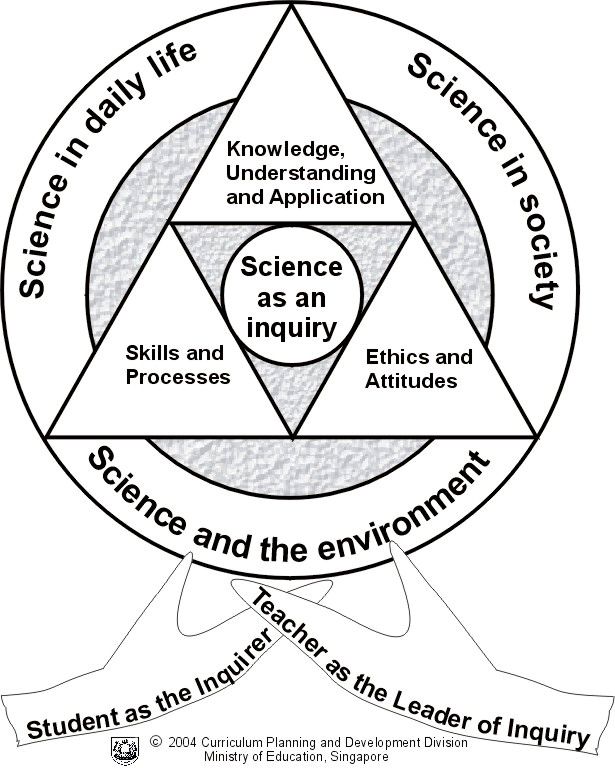
The Science Curriculum Framework is derived from the Policy
Framework for the Teaching and Learning of Science. It
encapsulates the thrust of science education in Singapore to
prepare our students to be sufficiently adept as effective
citizens, able to function in and contribute to an increasingly
technologically-driven world.
Central to the curriculum framework is the inculcation of the
spirit of scientific inquiry. The conduct of inquiry is founded on
three integral domains of (a) Knowledge, Understanding and
Application, (b) Skills and Processes and (c) Ethics and
Attitudes. These domains are essential to the practice of
science. The curriculum design seeks to enable students to
view the pursuit of science as meaningful and useful. Inquiry is
thus grounded in knowledge, issues and questions that relate to
the roles played by science in daily life, society and the
environment.
1Lower Secondary Science Syllabus N(T)
The science curriculum seeks to nurture the student as an Knowledge, Skills and Ethics and
inquirer. The starting point is that children are curious about and Understanding Processes Attitudes
want to explore the things around them. The science curriculum and Application of
leverages on and seeks to fuel this spirit of curiosity. The end quantities and • Formulating
goal is students who enjoy science and value science as an units) hypothesis
important tool in helping them explore their natural and physical • Scientific • Predicting
world. instruments and • Analysing
apparatus • Elaborating
The teacher is the leader of inquiry in the science classroom. including • Verifying
Teachers of science impart the excitement and value of science techniques of • Generating
to their students. They are facilitators and role models of the operation and possibilities
inquiry process in the classrooms. The teacher creates a aspects of
learning environment that will encourage and challenge students • Defining the
safety problem
to develop their sense of inquiry. Teaching and learning • Scientific
approaches centre around the student as an inquirer. quantities and Processes
their
The following table shows the description of each domain which • Planning
determinations
frames the practice of science: investigation
• Creative
Knowledge, Skills and Ethics and problem solving
Understanding Processes Attitudes
and Application of
• Scientific Skills • Curiosity
phenomena, • Using apparatus • Creativity
facts, concepts and equipment • Objectivity
and principles • Posing • Integrity
• Scientific questions • Open-
vocabulary, • Observing mindedness
terminology and • Classifying • Perseverance
conventions • Comparing • Responsibility
(including • Communicating
symbols, • Inferring
2Lower Secondary Science Syllabus N(T)
The domains are contextually linked to the roles played by
science to establish its relevance and relationship to modern-
day living:
Science in daily Science in society Science and the
life environment
- Personal - Social perspective - Naturalistic
perspective focusing on human perspective
focusing on the interactions focusing on man-
individual nature relationship
• Showing • Becoming • Demonstrating
curiosity, interest confident, safety
and enjoyment in responsible and consciousness
science productive and safe
• Applying citizens in a practices, e.g.
scientific technological when using
concepts and world apparatus and
skills to daily life • Showing equipment
• Making informed awareness of • Showing care
decisions that are science and and concern for
related to the technology on the environment,
social, society, industry, e.g. importance
environmental, business, home of conserving
economic and and leisure, e.g. energy, reducing
technological sensitivity to the pollution
aspects of benefits and
science, e.g. abuses of the
lifestyle choices applications of
that affect science
personal health
3Lower Secondary Science Syllabus N(T)
AIMS
The Lower Secondary Science Normal (Technical) (vi) promote an awareness of the importance of the
Syllabus aims are to: use of IT for communications and as a tool for data
collection and analysis of experimental results.
(i) enable students to acquire knowledge and
understanding so as to It is hoped that teachers will incorporate the social,
• be suitably prepared for post-secondary environmental, economic and technological aspects of
technical courses; science wherever possible throughout the syllabus (see
• become confident citizens in a technological Aims (iv) and (v)). Where appropriate, students should
world. also have opportunities to discuss the ethical implications
of science and technology.
(ii) enable students to develop abilities and skills that
• will be relevant and useful in the workplace
and daily life;
• encourage safety consciousness and safe
practices.
(iii) develop attitudes which
• are relevant to the study of science such as
concern for accuracy and precision;
• will enable the students to be responsible
and productive citizens.
(iv) stimulate
• curiosity, interest, and enjoyment in science;
• care and concern for the environment.
(v) promote an awareness of the impact of science
and technology on society, industry, business,
home and leisure.
4Lower Secondary Science Syllabus N(T)
SYLLABUS FRAMEWORK To help teachers and students appreciate and understand
1
the units, some key inquiry questions are included for
The Lower Secondary Science Normal (Technical) Syllabus each unit. These questions can guide teachers and
comprises: engage students in uncovering the important ideas at the
The knowledge, skills and attitudes that all students should
heart of each unit. They can also use these questions to
acquire, which are designed for 85% of the curriculum time. raise more specific questions for the respective topics
under each unit.
The 15% freed up curriculum time, known as the white
space, to enable teachers to use more interactive and For example, in the unit on Introducing Science and
engaging teaching and learning approaches, and/or to Technology, students are introduced to the essence of
implement school-based curriculum. This flexibility enables science, its measurement, and the impact of science and
teachers to better cater for the range of abilities, interests technology on society. Another central concept in science
and needs of their students, so long as the aims of the that students learn about in this unit is energy. Our life
syllabus are met. depends a lot on energy as energy is needed to make
things work. In doing work, energy is changed from one
form into one or more forms. For this unit, the key inquiry
A Knowledge, Understanding and Application questions are:
The syllabus is organised around big ideas that students can • What is science and how does it work?
relate to in their everyday experiences and the commonly • Why do we need to measure things?
observed phenomena in nature.
• What are the different forms of energy?
The big ideas are presented as six Core Units in the syllabus.
The six Core Units are compulsory for all students. Other
They are Introducing Science and Technology, Investigating
than the unit on Introducing Science and Technology
Life Processes, Investigating Matter, Investigating Forces,
which is to be taught first, there is no particular order in
Investigating Electricity and Investigating Heat. These units
which the units are to be taught. Teachers are
have been chosen because they provide a broad-based
encouraged to determine the order based on the abilities
introduction to both the life and physical sciences. The topics
and current interests of the students.
under each unit are not to be viewed as compartmentalised
blocks of knowledge.
1
Reference: Wiggins, J and McTighe, J. (1998). Understanding by Design.
Alexandria, Va.: Association for Supervision and Curriculum Development.
5Lower Secondary Science Syllabus N(T)
B Skills and Processes Comparing
This is the skill of identifying the similarities and
In this syllabus, teachers are encouraged to provide differences between or among objects or entities.
opportunities for students to use concepts and integrate
skills and processes to inquire about science around Communicating
them. This is the skill of transmitting and receiving information
presented in various forms - verbal, tabular, graphical or
Skills pictorial.
Using apparatus and equipment Inferring
This is the skill of knowing the functions and limitations of This is the skill of interpreting and explaining
various equipment and apparatus, and being able to observations, data or information gathered.
select and handle them appropriately for various tasks.
Formulating hypothesis
Posing questions This is the skill of making a general explanation for a
This is the skill involving the clarification of issues and related set of observations or events. It is an extension of
meaning through inquiry. Good questions focus attention inferring.
on important information and are designed to generate
new information. Predicting
This is the skill of assessing the likelihood of an outcome
Observing based on prior knowledge of how things usually turn out.
This is the skill of using our senses to gather qualitative
as well as quantitative information about a particular Analysing
object, event or phenomenon. This also includes the use This is the skill of clarifying information by examining
of instruments to extend the range of our senses. parts and relationships contained in the information.
Classifying Elaborating
This is the skill of grouping objects or events according to This is the skill of providing details, examples and other
common attributes or properties. relevant information so as to make one’s ideas more
comprehensible to others.
6Lower Secondary Science Syllabus N(T)
Verifying requirements. This thinking process is used whenever
This is the skill of confirming or proving the truth of an one faces obstacles and wishes to overcome them so as
idea, using specific standards or criteria of evaluation. to arrive at a practical and workable solution.
Generating possibilities It must be pointed out that there is also no one definite
This is the skill of exploring all the alternatives, sequence of priority among the skills and processes listed
possibilities and choices beyond the obvious or preferred above. For example, observation may lead to
one. hypothesising but at other times a hypothesis can lead to
observation. All the skills and processes listed above are
Defining the problem seen as part of the total process of scientific inquiry.
This is the skill where one makes conscious effort to
clarify situations that are puzzling in some way. The In science teaching and learning, effort should initially be
extent, scope and nature of the problem are identified directed at teaching explicitly each of the skills through
and clarified. the use of appropriate activities. Later, effort should be
directed to helping students integrate some or all of the
Processes skills in scientific inquiry.
Processes are complex operations which call upon the C Ethics and Attitudes
use of several skills.
In scientific inquiry, the adoption of certain mental
Planning Investigation attitudes such as curiosity, creativity, objectivity, integrity,
This process involves formulating questions or open-mindedness, perseverance and responsibility is
hypotheses for investigating and devising ways to find advocated. Attempts should also be made to promote
answers. It also involves deciding on the type of safety consciousness among students and to encourage
equipment required, and measurements to be made, as students to adopt safe practices.
well as identifying the variables involved and manipulating
the variables so that the effect of only one variable can be Curiosity
observed in any one experiment. This is the attitude of desiring to explore the environment
and question what they find.
Creative problem solving
This is the process of thinking through a problem and
choosing an innovative solution that meets the
7Lower Secondary Science Syllabus N(T)
Creativity
This is the attitude of seeking innovative and relevant Table 1 shows an overview of the Lower Secondary
ways to solve problems. Science Normal (Technical) Syllabus.
Objectivity
This is the attitude of seeking data and information to
validate observations and explanations objectively.
Integrity
This is the attitude of handling and communicating data
and information with integrity.
Open-mindedness
This is the attitude of accepting all knowledge as tentative
and the willingness to change our views if the evidence is
convincing.
Perseverance
This is the attitude of pursuing a problem until a
satisfactory solution is found.
Responsibility
This is the attitude of showing care and concern for living
things and awareness of our responsibility for the
sustainability of the environment.
Opportunities should be provided in the classroom for
students to ask questions. Students should be
encouraged to ask both closed and open questions.
From the type of questions asked by the students,
teachers could gather information on their ‘frame of mind’
and the quality of their understanding.
8Lower Secondary Science Syllabus N(T)
Table 1: Overview of Lower Secondary Science Normal (Technical) Syllabus
s
Designed for 85% of the curriculum time.2 White Space
1 Introducing Science and 2 Investigating Life Processes 3 Investigating Matter The 15% freed up
Technology Digestion Properties of matter curriculum time is to enable
What is science and Reproduction Solids, liquids and gases teachers to use more
technology? Other life processes Water, solutions and interactive and engaging
Physical quantities and Abuses to life suspensions teaching and learning
measurement Air pollution approaches, and/or to
Energy as a resource Water pollution implement school-based
curriculum. This flexibility
enables teachers to better
cater for the range of
4 Investigating Forces 5 Investigating Electricity 6 Investigating Heat
abilities, interests and
Force What is electricity? Temperature and
needs of their students, so
Machines Currents and circuits thermometer
long as the aims of the
Sources of electricity Heating and cooling matter
syllabus are met.
Conductors and insulators
Electrical safety
2
There is no change in the recommended curriculum time, which remains as 4 periods per week (each period is 35-40 minutes).
9Lower Secondary Science Syllabus N(T)
TEACHING AND LEARNING THROUGH INQUIRY What are some characteristics of teaching and learning
of science as inquiry?
What is scientific inquiry?
Inquiry-based learning may be characterised by the degree of
Scientific inquiry may be defined as the activities and responsibility students have in posing and responding to
processes which scientists and students engage in to study questions, designing investigations, and evaluating and
the natural and physical world around us. In its simplest form, communicating their learning (student-directed inquiry)
scientific inquiry may be seen as consisting of two critical compared to the degree of responsibility the teacher takes
aspects: the what (content) and the how (process) of (teacher-guided inquiry). Students will best benefit from
understanding the world we live in3. experiences that vary between these two inquiry approaches.
Teaching science as inquiry must therefore go beyond merely Essential More Amount of Student Self-Direction Less
presenting the facts and the outcomes of scientific features of
Less Amount of Guidance from Teacher More
investigations. Students need to be shown how the products science as
or Material
inquiry
of scientific investigations were derived by scientists and be
provided opportunities to: ask questions about knowledge and Question
issues that relate to their daily lives, society and the
Students engage pose a select among sharpen or accept given
environment; be actively engaged in the collection and use of with an event, question questions clarify question
evidence; formulate and communicate explanations based on phenomenon or question
scientific knowledge. problem when provided
they …
Through inquiry learning, students will be able to acquire Evidence
knowledge and understanding of their natural and physical
Students give determine are directed are given are given data
world based on their own investigations, apply the skills and priority to what to collect data and and told how
processes of inquiry and develop attitudes and values that are evidence when constitutes certain data asked to to analyse
essential to the practice of science. they … evidence and analyse
collects it
3
Reference: Chiappetta, E. L., Koballa, T., Collette, A. T. (2002). Science
instruction in the middle and secondary schools. Upper Saddle River, NJ:
Merrill/Prentice Hall.
10Lower Secondary Science Syllabus N(T)
Essential More Amount of Student Self-Direction Less What are some strategies for conducting inquiry-based
features of
Less Amount of Guidance from Teacher More learning and teaching?
science as
inquiry or Material
A primary purpose for inquiry-based instruction is for students
Explanation to learn fundamental science concepts, principles, and
Students formulate their are guided in are given are provided
theories as well as to develop science process skills and
construct own process of possible ways with evidence attitudes that are essential for scientific inquiry. Science
explanations explanation formulating to use evidence teachers are already using a variety of teaching strategies in
when they … after explanation to formulate
summarising from evidence explanation
their lessons.
evidence
To further emphasise the learning of science as inquiry,
teachers can incorporate in these strategies the essential
Connections
features of Question, Evidence, Explanation, Connections
Students examine other are directed are given are provided and Communication and provide students with experiences
evaluate their resources and toward sources possible with
explanations
that varies between guided (partial) and open (full) inquiry.
form links to of knowledge connections connections
when they … explanations
To meet the learning styles of the students, teachers should
carry out the inquiry-based approach through hands-on
4
Communication learning . Hands-on learning experiences should also be
situated in realistic contexts, so that students can make
Students form are coached in are provided are given steps
communicate reasonable development of guidelines for and procedures
connections with their own lives and the environment in which
and justify their and logical communication communication for they live. In this way, students become engaged and excited
explanations argument to communication about what they are studying, and they then become
when they … communicate motivated to learn.
explanations
Teachers are also encouraged to use a variety of strategies to
facilitate the inquiry process. Selected strategies are
Adapted from Inquiry and the National Science Education Standards,
National Research Council (2000). highlighted below to help teachers plan and deliver lessons
4
Inquiry-based approach and hands-on learning are not synonymous.
Hands-on learning is any educational experience that actively involves
students in handling, manipulating or observing a scientific process to gain
knowledge or understanding.
11Lower Secondary Science Syllabus N(T)
that will engage students in meaningful learning experiences
and cultivate their interest and curiosity in science. These Games
strategies can be mixed and matched. A brief description of Games engage students in play or simulations for the
learning of concepts or skills. This is useful in helping
each of these strategies is also given below: students to visualise or illustrate objects or processes in the
real world.
Brainstorming
Brainstorming is a strategy for generating creative ideas Investigation
and solutions. i In scientific investigation, students engage in activities that
mirror how scientists think and what they do in a decision
Case Study making process, such as asking or posing questions and
The case study approach is a strategy which uses real and planning or designing investigations.
hypothetical cases to help students develop critical skills
such as analysing, inferring and communicating. Learning Centres
Learning centres are various stations at which individuals
Concept Mapping or groups of students carry out selected activities. The
Concept mapping is a strategy to present meaningful activities may be designed to accommodate a variety of
relationships among concepts. Concept maps are useful learning styles and challenge multiple intelligences.
in organising and linking concepts or ideas.
Mindmapping
Cooperative Learning A mind map radiates from a central image or key word.
In cooperative learning, activities are structured such that The branches connect related concepts and ideas to the
each student assumes certain responsibilities and central image. Every word and image is itself a potential
contributes to the completion of tasks. In working with sub-centre of ideas or concepts. The visual presentation of
others, students are exposed to different points of views related information enhances understanding. The
and solutions in accomplishing a common goal. association would be to facts as well as relationship
between the facts.
Demonstration
Demo Demonstration is commonly used to scaffold the learning Model Building
process. This approach is recommended when the Model building is an activity in which students design and
learning activity is not safe or too complex for students to construct a representation of a concept or object.
set up on their own.
Problem Solving
Field Trip Problem solving engages students in finding solutions to
A field trip is any learning activity outside the school. It problems by applying scientific knowledge and skills.
provides opportunities for students to explore, discover and
experience science in everyday life.
12Lower Secondary Science Syllabus N(T)
which can be used to support inquiry-based learning
Projects activities. Appropriate IT devices such as datagloggers
Projects are learning activities that require students to find and other hand-held devices can be used to enhance data
out about an object, event, process or phenomenon over a collection and speed up data analysis. Abstract concepts
few weeks or even months. in science can also be made more comprehensible with
the use of simulations, scenarios and animations.
Questioning National Education (NE)
? Questions are useful tools in the scientific inquiry process.
Both teachers and students should engage in cycles of NE National Education is infused into the curriculum to allow
students see how scientific phenomenon and
questions-answers-questions throughout the learning
developments can contribute to or affect the nation.
process.
Where appropriate, students should have opportunities to
R D Role Play, Drama, Dance and Movement develop attitudes which are relevant to the study of science.
Role play, drama, dance and movement allow students to
D M express their understanding of scientific concepts and Teachers are also encouraged to incorporate the ethical
processes in a creative way. aspect of science wherever possible throughout the syllabus.
Strategies for Active and Independent Ethics and Attitudes
Learning (SAIL) In scientific inquiry, the adoption of certain mental attitudes
The SAIL approach emphasises learning as a formative such as curiosity, creativity, objectivity, integrity, open-
and developmental process in which instruction and mindedness, Perseverance and Responsibility is
assessment point the way for students to continuously learn advocated. Students can also discuss the ethical
and improve. Learning expectations and rubrics are used to implications of science and technology.
describe what students should know and be able to do.
This would help students know where they are in the
learning process and how they can improve.
Teachers are also encouraged to leverage on the planned
learning activities to infuse Information Technology and
National Education.
Information Technology (IT)
When used as a tool to support appropriate teaching
strategies, IT can enhance the teaching and learning
process and lead to engaged learning. For example,
teachers can tap on the Internet for alternative resources
13Lower Secondary Science Syllabus N(T)
What are some features of an inquiry classroom? What are some misconceptions about inquiry-based
learning and teaching?
An inquiry classroom is visibly different from a traditional
classroom in the following ways: 1: All science subject matter should be taught through
student-directed inquiry.
Traditional Inquiry Whereas student-directed inquiry will provide the best
Students often work alone Students often work in groups
opportunities for cognitive development and scientific
reasoning, teacher-guided inquiry can best focus learning on
Emphasis on mastery of facts Emphasis on understanding of key the development of particular science concepts. Thus,
concepts
students will best benefit from experiences that vary between
Follows a fixed curriculum closely Allows for pursuit of student these two inquiry approaches.
questions
Activities rely mainly on textbooks Activities rely on primary sources 2: Inquiry cannot be carried out by students effectively as they
and workbook materials will not be able to discover anything worthwhile.
Although it is important that students are provided with
Students are viewed as “blank Students are viewed as thinkers opportunities to pursue their own questions and discover
slates” with their own theories about the
world
some things for themselves, scientists and students often
engage in inquiry to solve problems or understand events by
Teachers tend to disseminate Teachers facilitate an interactive reading relevant materials such as science magazines
information to students learning environment
/journals and online scientific literature, and seeking advice
Teachers tend to seek correct Teachers seek to understand
from experts in the specific field. They may be engaged in
answers student learning inquiry without actually making their own discoveries.
Assessment tends to be separate Assessment is interwoven with 3: Inquiry teaching occurs whenever students are provided
from teaching teaching with hands-on activities.
Although participation by students in hands-on activities is
Adapted from In search of understanding: the case for constructivist
desirable, it is equally important that they are mentally
classrooms, Brooks & Brooks (1993).
engaged with scientific reasoning and methods. Research
indicates that science process skills are best learnt when
used to understand specific scientific content. Understanding
content without process or vice versa is insufficient to nurture
students as inquirers.
14Lower Secondary Science Syllabus N(T)
ASSESSING TEACHING AND LEARNING • Assessment provides feedback to schools. The
information gathered facilitates the placement of
Assessment is an integral part of the teaching and learning students in the appropriate stream or course, and the
process. It involves gathering information through various promotion of students from one level to the next. It
assessment techniques and making sound decisions. also allows the schools to review the effectiveness of
Assessment provides information to the teacher about their instructional programme.
students’ achievement in relation to the learning objectives.
With this information, the teacher makes informed decisions • Assessment provides feedback to parents, allows them
about what should be done to improve teaching methods and to monitor their children’s progress and achievement
enhance the learning of the students. through the information obtained.
Why Assess? What to Assess?
Assessment measures the extent to which desired The aims of the Lower Secondary Science Normal
knowledge, skills and attitudes are attained by students. (Technical) Syllabus deal with the acquisition of knowledge,
While it complements the teaching and learning process, it understanding and application of the science concepts, the
also provides formative and summative feedback to teachers, ability to use process skills, and the development of attitudes
students, schools and parents. important to the practice of science. The assessment
objectives of the syllabus are aligned to the three domains in
• Assessment provides feedback to students, allows the Science Curriculum Framework as shown below:
them to understand their strengths and weaknesses.
Through assessment, students can monitor their own i. Assessment of Knowledge, Understanding and
performance and progress. It also points them in the Application of Science Concepts
direction they should go to improve further. ii. Assessment of Skills and Process
iii. Assessment of Ethics and Attitudes
• Assessment provides feedback to teachers, enables
them to understand the strengths and weaknesses of
their students. It provides information about students’
achievement of learning outcomes as well as the
effectiveness of their teaching.
15Lower Secondary Science Syllabus N(T)
How to Assess?
Assessment measures the extent to which desired Teachers can also assess students through the use of
knowledge, skills and attitudes are attained by students. As it portfolio. It is a systematic collection of students’ work and
serves many purposes, it is important to match the type of provides a comprehensive picture of their achievement. The
assessment to the specific purpose for which it is intended. work collected provides a continuous record of the students’
Before making an assessment about a certain aspect of development and progress in the acquisition of knowledge,
students’ performance, the teacher should ensure that the understanding of scientific concepts, application of process
assessment mode used will generate information that reflect skills, and development of attitudes. It also provides
accurately the particular aspect of performance the teacher opportunity for the students to have self-evaluation and
intends to assess. reflections by revisiting their own portfolio.
In an inquiry-based classroom, the assessment can take The assessment modes listed above are by no means
many forms. In addition to the written tests, teachers can exhaustive. Adopting a variety of assessment modes enables
also conduct performance based assessment using the the teachers to assess different aspects of teaching and
following modes: learning.
• Practicals Guidelines for Assessment
• Projects
• Teacher observations It is essential for assessment to be aligned to the teaching
• Checklists and learning process. School-based assessment, both
• Reflections / Journals formative and summative in nature, should be used to provide
• Model-making a complete picture of the students’ performance and
• Posters progress, and the effectiveness of the teaching and learning
• Games and quizzes process.
• Debates
• Drama / Show and Tell
• Learning Trails
16Lower Secondary Science Syllabus N(T)
SYLLABUS CONTENT
CORE UNIT 1: OVERVIEW KEY INQUIRY QUESTIONS
INTRODUCING In this unit, students are introduced to the essence of science, its • What is science and how does
SCIENCE AND measurement, and the impact of science and technology on society. it work?
TECHNOLOGY Another central concept in science that students learn about in this unit • Why do we need to measure
What is science is energy. Our life depends a lot on energy as energy is needed to things?
and technology? make things work. In doing work, energy is changed from one form into • What are the different forms of
Physical one or more forms. energy?
quantities and
measurement It is recommended that this unit be taught first, as it contains basic
Energy as a concepts that will have to be mastered by students to facilitate learning
resource in other units.
Topic/ Learning Outcomes
Key Concepts Knowledge, Understanding and Skills and Processes Ethics and Attitudes
Application
What is science discuss the uses and benefits acquire the skills of conducting recognise that the study and
and technology? of science and technology to simple investigations practice of science involve
science is the society three major elements:
study of nature attitudes, processes or
and how it methods, and products
affects us and develop an awareness that
the environment science is not confined to the
technology is laboratory, but is manifested in
the application all aspects of the world
of scientific develop sensitivity to the
knowledge benefits and abuses of the
applications of science
17Lower Secondary Science Syllabus N(T)
Topic/ Learning Outcomes
Key Concepts Knowledge, Understanding and Skills and Processes Ethics and Attitudes
Application
Physical quantities use the appropriate units for value teamwork and individual
and measurement length, mass and time effort
A physical interpret and use the
quantity is made appropriate prefixes milli-, centi-
up of two parts: or kilo- in relation to the units of
a number or length and mass
quantity and a determine appropriate derived
unit units for area and volume
Accurate acquire, during appropriate
measurements activities throughout the course,
of physical the following skills:
quantities form - use of common laboratory
the basis of apparatus correctly with due
scientific consideration to safety
knowledge (especially in relation to
heating of solids and liquids)
- use of the following
measuring instruments:
measuring cylinder, metre
rule and measuring tape,
spring balance, electronic
balance, stop clock or stop
watch, thermometers,
voltmeters, ammeters,
multimeters
- estimation of and
measurement of length,
area, volume, mass and
time (excluding the volume
18Lower Secondary Science Syllabus N(T)
Topic/ Learning Outcomes
Key Concepts Knowledge, Understanding and Skills and Processes Ethics and Attitudes
Application
and mass of gases)
Energy as a outline the utilisation of energy compare the different sources appreciate that fossil fuels are
resource in society, e.g. in home, work, of usable energy viz. biomass, exhaustible and the need and
energy is industry, leisure and transport fuel cells, solar energy, fossil ways to reduce energy
needed to make give examples of devices and fuels (e.g. coal, oil and natural wastage
things work processes in everyday life gas), and their limitations appreciate the importance of
there are which use energy and describe conserving energy because
different forms the change in the form of Singapore is totally dependent
of energy energy on imported fossil fuels to
meet its energy needs
19Lower Secondary Science Syllabus N(T)
CORE UNIT 2: OVERVIEW KEY INQUIRY QUESTIONS
INVESTIGATING LIFE In this unit, the study of the human body focuses on the maintenance of • How does the body keep itself
PROCESSES good health. Students learn about the major body systems that carry healthy?
Digestion out various life processes, such as digestion, reproduction, breathing, • What can I do to keep my
Reproduction respiration, transport and excretion, and their role in the healthy body healthy?
Other life functioning of the body.
processes
Abuses to life Students also learn that unhealthy lifestyles can lead to diseases which
prevent the body systems from carrying out life processes. This helps
students appreciate how lifestyle choices can affect personal health.
Topic/ Learning Outcomes
Key Concepts Knowledge, Understanding and Skills and Processes Ethics and Attitudes
Application
Digestion explain what is meant by investigate the role played by value science for its usefulness
food must be digestion enzymes in the digestion of in providing an understanding
digested before explain why a digestive system food (names of enzymes are of everyday phenomena
our body can is necessary not required) and communicate value teamwork and individual
make use of it describe briefly how the findings effort
different parts of a digestive
system helps in the digestion
of food
Reproduction describe the functions of the interpret and communicate appreciate the importance of
reproduction is various parts of the human data on the physical changes sample size in obtaining
an essential life male and female reproductive that occur during puberty and reliable evidence
process for the systems early adolescence appreciate the harmful
continuity of the describe briefly the menstrual compare a temporary and a consequences of sexually
human species cycle and fertilisation permanent method of birth transmitted infections like
lifestyle choices show an awareness of some control syphilis, gonorrhoea and AIDS
can affect forms of facilitated appreciate the consequences
personal health reproduction in humans, e.g. relating to abortion and pre-
20Lower Secondary Science Syllabus N(T)
Topic/ Learning Outcomes
Key Concepts Knowledge, Understanding and Skills and Processes Ethics and Attitudes
Application
in-vitro fertilisation and artificial marital sex
insemination
Other life processes describe briefly the following appreciate the ways that
the human body processes: technology can remedy
systems work - breathing and respiration malfunctions of vital organs
together to - transport (e.g. drugs, transplants,
maintain the - excretion artificial organs, life support
health of the and state their importance in systems)
individual the maintenance of the body value teamwork and individual
state briefly that malfunctions effort
of vital organs can be caused
by various factors (e.g.
unhealthy lifestyles, diseases,
heredity; unhealthy lifestyles
include lack of exercise, lack of
sleep and unbalanced diet)
Abuses to life list some drugs and inhalants investigate how lifestyle appreciate the harmful effects
lifestyle choices that are commonly abused choices, i.e. drug abuse, and consequences of drug
can affect list some harmful substances consumption of alcohol and abuse such as depression,
personal health in tobacco smoke e.g. nicotine, smoking, can affect personal hallucination, addiction and
carbon monoxide gas, tar and health and communicate related social problems like
other cancer-causing findings crimes and transmission of
substances AIDS
appreciate the possible harmful
effects of consumption of
alcohol on the individual, his
family and society
21Lower Secondary Science Syllabus N(T)
Topic/ Learning Outcomes
Key Concepts Knowledge, Understanding and Skills and Processes Ethics and Attitudes
Application
appreciate the possible harmful
effects of smoking or passive
smoking on a person’s health
such as bronchitis, lung cancer
and heart disease
appreciate ways to avoid being
addicted to drugs, alcohol and
smoking
22Lower Secondary Science Syllabus N(T)
CORE UNIT 3: OVERVIEW KEY INQUIRY QUESTIONS
INVESTIGATING This unit presents the common physical properties of matter. • What is matter?
MATTER Knowledge of properties of matter and its composition helps students • How can matter be classified?
Properties of understand matter’s varied uses, availability, and limitations in our • What impact do humans have
matter world, such as air and water pollution. on the environment?
Solids, liquids
and gases Because everyone has experience with matter in a variety of forms,
Water, solutions matter is a topic that is amenable for basic exploration and for bringing
and out students’ prior knowledge about the physical world. The most
suspensions successful way we can explore concepts about matter is therefore
Air pollution through concrete examples, direct experience and simple investigations
Water pollution that students can carry out.
Topic/ Learning Outcomes
Key Concepts Knowledge, Understanding and Skills and Processes Ethics and Attitudes
Application
Properties of matter describe materials in terms of compare materials in terms of appreciate the need to
materials can be physical properties such as their physical properties organise scientific knowledge
classified in a hardness, elasticity, solubility, classify materials into different in a systematic manner
variety of ways density, boiling/melting point, groups (e.g. metals and non-
according to electrical and thermal metals; ceramics, plastics and
their properties conductivities fibres)
the physical relate knowledge of the
properties of a properties of materials to their
material everyday use
determine how
we can make
use of it
Solids, liquids and distinguish between the three observe and record the appreciate the need to
gases states of matter in terms of changes that take place when organise scientific knowledge
23Lower Secondary Science Syllabus N(T)
Topic/ Learning Outcomes
Key Concepts Knowledge, Understanding and Skills and Processes Ethics and Attitudes
Application
matter can exist properties, e.g. density, matter is heated/cooled in a systematic manner
in three states compressibility, maintenance
of shape and volume
Water, solutions explain what is meant by the deduce the nature of solutions appreciate that science and
and suspensions terms solute, solvent and and suspensions by simple technology have contributed to
to make a solution laboratory test (e.g. passing a the development of a variety of
solution, we recognise that water dissolves beam of light, filtering using products that we depend on
need a solute many substances filter paper) and use each day
and a solvent give examples of uses of investigate the factors that
solvents and solvents and solutions in the affect the solubility of materials
solutions are home, industry and medicine (e.g. type of solute/solvent,
useful temperature) and communicate
substances findings
investigate the factors that
affect the rate of dissolving
(e.g. temperature, surface
area, stirring) and
communicate findings
Air pollution state the names and sources of investigate the effects of acid appreciate that air is an
air pollution common air pollutants (carbon rain on the environment and important type of matter that
harms both monoxide, sulphur dioxide and communicate findings can be polluted as a result of
plants and oxides of nitrogen) Man’s activities
animals list the possible harmful effects appreciate that clean air is
air pollution can of air pollutants introduced into important for Singapore to be a
be prevented or the atmosphere through human good home to four million
reduced activities (acid rain, greenhouse people who have to live, work
effect and smoke haze from and play in the same small
24Lower Secondary Science Syllabus N(T)
Topic/ Learning Outcomes
Key Concepts Knowledge, Understanding and Skills and Processes Ethics and Attitudes
Application
forest fires) space
discuss some ways to reduce
air pollution
Water pollution state common types and investigate the effects of water appreciate that water is an
fresh water is sources of water pollution pollution on living things and important type of matter that
limited in supply discuss some methods of water communicate findings can be polluted as a result of
and can be pollution control Man’s activities
depleted or state that used water can be appreciate that controlling
polluted, converted into drinkable water, water pollution is essential if
becoming e.g. NEWater Singapore is to have a clean
unavailable or supply of water in the future
unsuitable for value teamwork and individual
life effort
water pollution
can be
prevented or
reduced
25Lower Secondary Science Syllabus N(T)
CORE UNIT 4: OVERVIEW KEY INQUIRY QUESTIONS
INVESTIGATING In this unit, students learn about forces and their effects. There are many What are the effects of a
FORCES forces acting around us. (Forces are generally classified as a push or a force?
Force pull; some common forces around us are gravitational, frictional and How can machines help us
Machines magnetic forces.) Forces are needed for objects to start moving and stop make work easier?
moving, to move faster or slower, and to change the direction of motion.
We cannot see forces but we can see and feel the effects of forces.
Students then increase their understanding of forces by studying simple
machines. Emphasis is placed on investigating a variety of simple
machines and recognising that simple machines are examples of
technologies that help humans make work easier, thereby developing
positive attitudes towards technology uses that increase productivity.
Topic/ Learning Outcomes
Key Concepts Knowledge, Understanding and Skills and Processes Ethics and Attitudes
Application
Force give examples of different infer the effects of forces such value science for its
a force can be a forces: pushing, lifting, as: usefulness in providing an
push or a pull stretching, twisting, pressing, - change in state of rest or understanding of everyday
a force can gravitational, frictional and motion of a body phenomena
change the magnetic forces - change in size and/or shape
shape, size, use newton as the unit of force of a body
state of rest, predict changes in movement of
and motion of a a body as a result of the
body application of two or more forces
in a straight line
use a forcemeter or spring
balance to measure force
26Lower Secondary Science Syllabus N(T)
Topic/ Learning Outcomes
Key Concepts Knowledge, Understanding and Skills and Processes Ethics and Attitudes
Application
Machines list the advantages of using investigate the effort used when appreciate that technology
simple simple machines (levers, the following is used to raise a develops in response to
machines make inclined planes, pulleys, wheel load and communicate findings: human needs and wants
work easier and axle, and gears) and give - lever value teamwork and
everyday examples of their use - inclined plane individual effort
- pulley
investigate how the following
works to make objects move and
communicate findings:
- wheel and axle
- gears
27Lower Secondary Science Syllabus N(T)
CORE UNIT 5: OVERVIEW KEY INQUIRY QUESTIONS
INVESTIGATING Electricity is one of the most useful forms of energy. It is very important in How is electricity helpful and
ELECTRICITY our daily life. Our homes have many appliances that use electricity. harmful?
What is However, electricity can be very dangerous if it is not used properly. We How many different ways
electricity? cannot see electricity but we know it is present from the work that it does. can we make a circuit to light
Currents and a bulb?
circuits In this unit, students explore current electricity, investigate series and What safety features are
Sources of parallel circuits, and make connections to daily life. In the process, designed into electric
electricity students appreciate the importance of electricity in everyday life, recognise circuits?
Conductors the importance of energy conservation, and understand the need for safe
and insulators practices when using electricity.
Electrical
safety
Topic/ Learning Outcomes
Key Concepts Knowledge, Understanding and Skills and Processes Ethics and Attitudes
Application
What is electricity? describe electricity as a useful appreciate the importance of
electricity is a form of energy in our life conserving energy because
useful form of state the importance of Singapore is totally
energy that reducing electrical energy dependent on imported fossil
should not be wastage fuels to meet its energy
wasted needs
value teamwork and
individual effort
Currents and explain what is meant by use voltmeter/ value science for its
circuits current, voltage and resistance ammeter/multimeter for electrical usefulness in providing an
electrical and state their units measurements understanding of everyday
components can identify series and parallel draw and interpret circuit phenomena
be connected in circuits diagrams and set up circuits
28Lower Secondary Science Syllabus N(T)
Topic/ Learning Outcomes
Key Concepts Knowledge, Understanding and Skills and Processes Ethics and Attitudes
Application
series or parallel explain why parallel circuits are comprising electrical sources
circuits widely used in household while (cell and battery), switches,
series circuits are not lamps, resistors (fixed),
ammeters and voltmeters
compare different types of
lamps/bulbs and their energy
consumption
Sources of outline the process from the appreciate the importance of
electricity production of electricity to using conserving energy because
electricity is it in our home with reference to Singapore is totally
generated at the energy conversions that dependent on imported fossil
power stations take place fuels to meet its energy
batteries are state the importance of needs
portable sources batteries as a source of
of electricity electricity, giving some
examples of their use
Conductors and relate the conducting properties investigate to classify a variety of appreciate the need to
insulators of materials to their use in the materials as insulators or organise scientific knowledge
both conductors various parts of electrical conductors and communicate in a systematic manner
and insulators appliances/circuits findings
are usually
present in
electrical
appliances
29Lower Secondary Science Syllabus N(T)
Topic/ Learning Outcomes
Key Concepts Knowledge, Understanding and Skills and Processes Ethics and Attitudes
Application
Electrical safety state the hazards of: appreciate the importance of
it is always - damaged insulation observing electrical safety
important to - overloaded circuit precautions when using
observe - damp conditions electricity
electrical safety identify a fuse and its rating
precautions state how a fuse works and the
when using effect or danger of using one of
electricity incorrect rating
identify a circuit breaker and
state its function
list some precautionary
measures to ensure the safe
use of electricity
30Lower Secondary Science Syllabus N(T)
CORE UNIT 6: OVERVIEW KEY INQUIRY QUESTIONS
INVESTIGATING HEAT Heat is very important to life. Heat is a form of energy. When energy What is temperature and
Temperature transformation takes place, it usually involves the gain or loss of heat. In how is it measured?
and fact, other forms of energy can be converted into heat energy. How does heat change
thermometer matter?
Heating and Interactions between energy and matter account for changes observed in
cooling matter everyday events. Understanding how heat energy and matter interact
helps students understand a wide variety of physical changes.
Topic/ Learning Outcomes
Key Concepts Knowledge, Understanding and Skills and Processes Ethics and Attitudes
Application
Temperature and explain what temperature is use liquid-in-glass laboratory and
thermometer show an awareness that there clinical thermometers (Six’s
temperature is a are other types of thermometer is excluded)
measure of how thermometers, e.g. digital
hot or how cold thermometer, temperature
an object is sensor
a thermometer
is used to
measure
temperature
accurately
Heating and cooling explain that heat is a form of infer that generally, solids, liquids value science for its
matter energy, giving some examples and gases expand when heated usefulness in providing an
heat is a form of of the sources and the energy and contract when cooled understanding of everyday
energy conversions that take place infer that a change of state is phenomena
solids, liquids state the importance of heat brought about by adding or
and gases energy in our life removing heat energy without
expand when describe some common any change in temperature
31Lower Secondary Science Syllabus N(T)
Topic/ Learning Outcomes
Key Concepts Knowledge, Understanding and Skills and Processes Ethics and Attitudes
Application
heated and situations and applications to
contract when illustrate when too much heat is
cooled undesirable and how the
excess heat is removed
recognise that when the
temperature of a substance
increases, the substance has
absorbed heat; when the
temperature of a substance
decreases, the substance has
lost heat
describe some everyday
examples/applications involving
the removal/addition of heat
energy in the change of state
describe some consequences
and applications of expansion
and contraction in everyday life
32Lower Secondary Science Syllabus N(T)
GLOSSARY OF TERMS
S/No Term Description of term
1. appreciate to recognise the value of a concept or situation
2. describe to state in words (using diagrams where appropriate) the main points of a topic
3. discuss to give a critical account of the points involved in the topics
4. distinguish to identify and understand the differences between objects, concepts and processes
5. explain to give reasons or make some reference to theory
6. identify to select and/or name the object, event, concept or process
7. investigate to find out by carrying out experiments
8. list to give a number of points or items without elaboration
9. outline to give the main or essential points of the concepts, processes
10. recognise to identify facts, characteristics or concepts that are critical (relevant/appropriate) to
the understanding of a situation, event, process or phenomenon
11. relate to identify and explain the relationships between objects, concepts or processes
12. show an awareness to have superficial knowledge of the concepts or processes
13. show an understanding to recall, explain and apply information
14. state to give a concise answer with little or no supporting argument
15. suggest to provide ideas to a problem or a situation, or apply knowledge to a ‘novel’ situation
(there is no unique answer)
33Lower Secondary Science Syllabus N(T)
ACKNOWLEDGEMENTS
Members of the Lower Secondary Science Normal (Technical) Syllabus Review Committee (2004-2005) are:
1. Mdm Chua Mui Mui Linda, Head Sciences, Curriculum Planning & Development Division
2. Mr Lee Siew Lin, Head Sciences, Curriculum Planning & Development Division (2004)
3. A/P Foong See Kit, Natural Sciences and Science Education, National Institute of Education
4. A/P Yap Kueh Chin, Natural Sciences and Science Education, National Institute of Education
5. Dr Ivan Tam Chi Keung, Singapore Maritime Academy, Singapore Polytechnic
6. Ms Karen Cheng Yau Kit, Curriculum and Educational Development Division, Institute of Technical Education
7. Mr Richard Lee Peng Siong, Curriculum and Educational Development Division, Institute of Technical Education
8. Miss Goh Hong Tiam, Assessment Officer, Singapore Examinations and Assessment Board
9. Miss Tan Poh Hiang, Assessment Officer, Singapore Examinations and Assessment Board
10. Mdm Azlin Abdul Majid, Teacher, Ahmad Ibrahim Secondary School
11. Ms Ooi Kai Li, Teacher, Jurongville Secondary School
12. Mrs Shanthimalar Somasundram, HOD Science, Bowen Secondary School
13. Mrs Wong-Koh Seok Hua, HOD Science, Fuchun Secondary School (2004)
14. Mrs Yeo-Chua Chiew Ping, HOD Science, Zhenghua Secondary School
15. Mdm Aw Wai Lin Alice, Master Teacher, Schools Division, MOE
16. Ms Elsie Mathews, Educational Technology Officer, Educational Technology Division, MOE
17. Mr Lee Seng Hai, Curriculum Planning Officer, Curriculum Planning & Development Division, MOE
18. Mdm Leau Wan Hwee, Curriculum Planning Officer, Curriculum Planning & Development Division, MOE
19. Mr Ow Mun Hoe, Curriculum Planning Officer, Curriculum Planning & Development Division, MOE
The Ministry of Education also wishes to acknowledge all Principals, Heads of Department/Subject Heads/Level Heads (Science)
and teachers for their invaluable feedback and contributions in the development of this syllabus.
34You can also read


