Short-term Forecasts of Left-Moving Supercells from an Experimental Warn-on-Forecast System
←
→
Page content transcription
If your browser does not render page correctly, please read the page content below
Jones, T. A., and C. Nixon, 2017: Short-term forecasts of left-moving supercells from an experimental Warn-on-Forecast system.
                J. Operational Meteor., 5 (13), 161-170, doi: https://doi.org/10.15191/nwajom.2017.0513

            Short-term Forecasts of Left-Moving Supercells from
                an Experimental Warn-on-Forecast System
                                                         THOMAS A. JONES
                Cooperative Institute for Mesoscale Meteorological Studies, University of Oklahoma, Norman, Oklahoma

                                                              CAMERON NIXON
                                                     Texas Tech University, Lubbock, Texas

                                       (Manuscript received 10 March 2017; review completed 23 June 2017)

                                                                 ABSTRACT
      Most research in storm-scale numerical weather prediction has been focused on right-moving supercells as
    they typically lend themselves to all forms of high-impact weather, including tornadoes. As the dynamics behind
    splitting updrafts and storm motion have become better understood, differentiating between atmospheric
    conditions that encourage right- and left-moving supercells has become the subject of increasing study because
    of its implication for these weather forecasts. Despite still often producing large hail and damaging winds, left-
    moving (anticyclonically rotating in the Northern Hemisphere) supercells have received much less attention.
      During the 2016, NOAA Hazardous Weather Testbed, the NSSL Experimental Warn-on-Forecast System
    for ensembles (NEWS-e) was run in real-time. One event in particular occurred on 8 May 2016 during which
    multiple left- and right- moving supercells developed in western Oklahoma and Kansas—producing many
    severe weather reports. The goal of this study was to analyze the near storm environment created by NEWS-e
    using wind shear and other severe weather parameters. Then, we sought to determine the ability of the NEWS-e
    system to forecast storm splits and the persistence of left- and right- moving supercells through qualitatively
    analyzing tracks of forecast updraft helicity. Initial results show that the NEWS-e system analyzed several
    areas favorable for left- and right-moving supercells during which the system forecasted storm splitting and the
    persistence of both storm types. In particular, hail-producing left-moving supercells were accurately forecast
    in central and northern Oklahoma while a tornado-producing right-moving supercell was forecast in southern
    Oklahoma.

1. Introduction                                                               in any severe weather environment corresponding
                                                                              with a curved hodograph as winds tend to veer with
    The basic theory of supercell storm splitting
                                                                              height and strengthen especially in the lowest 3 km
in an idealized environment is well understood.
                                                                              AGL (Davies-Jones 1985). However, in cases with
Given a straight-line hodograph representative of a
                                                                              more straight-line or even counterclockwise-turning
unidirectionally sheared environment, substantial shear
                                                                              hodographs, anticyclonic rotation (i.e., left-moving
for supercells will ensure that both counterclockwise
                                                                              supercells) may become favored (Bunkers 2002; Fig.
(cyclonic) and clockwise (anticyclonic) rotating updrafts
                                                                              1). Many instances of left-moving supercells have been
are equally favored (e.g., Klemp and Wilhelmson 1978;
                                                                              documented over the years (e.g., Grasso and Hilgendorf
Wilhelmson and Klemp 1978; Brown and Meitín
                                                                              2001; Monteverdi et al. 2001; Bunkers 2002; Dostalek
1994; Bunkers et al. 2000; Bunkers 2002). For typical
                                                                              et al. 2004; Edwards et al. 2004; Edwards and Hodanish
upper-level wind patterns in the Northern Hemisphere,
                                                                              2006; Smith et al. 2012), whose primary severe
cyclonic (right moving) supercells are generally favored
                                                                              weather threats include large hail and damaging winds.

Corresponding author address: Dr. Thomas A. Jones, Cooperative Institute for Mesoscale Meteorological Studies, University of Oklahoma,
and NOAA/OAR/National Severe Storms Laboratory, 120 David L. Boren Blvd., Norman, OK 73072
E-mail: Thomas.Jones@noaa.gov
                                                                        161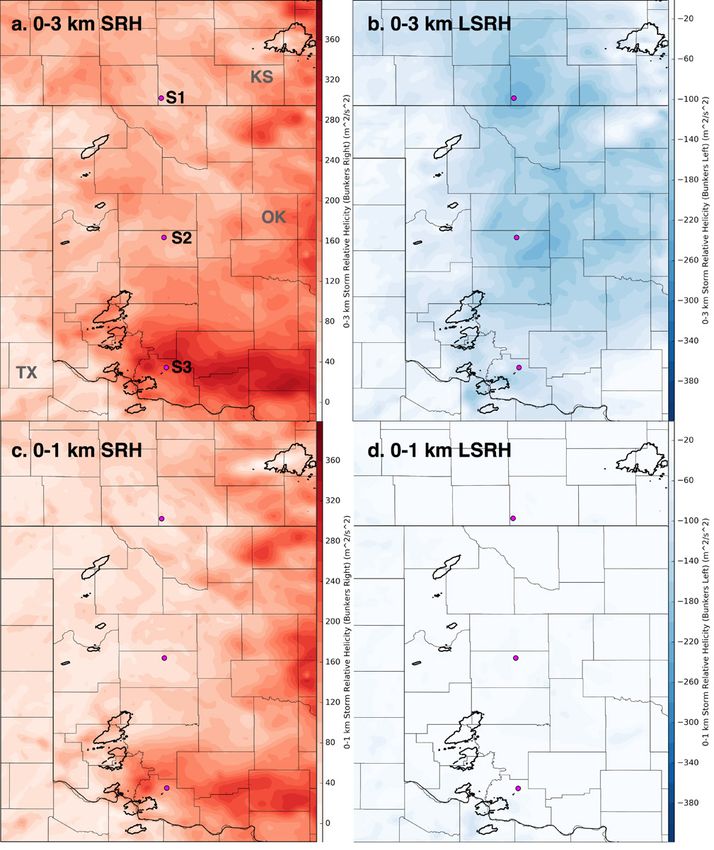
Jones and Nixon                             NWA Journal of Operational Meteorology                           5 September 2017

                                                                    environment is conducive for rotating, supercell storms.
                                                                    One such parameter, storm-relative helicity (SRH), is
                                                                    related to the potential for midlevel rotation through
                                                                    tilting and stretching of vorticity by a storm updraft
                                                                    (Davies-Jones et al. 1990; Brooks et al. 1994; Dostalek
                                                                    et al. 2004). Note that SRH can change in magnitude
                                                                    or sign owing to changes in the speed and direction of
                                                                    a storm’s motion; thus, a storm motion to the left of the
                                                                    deep-layer shear vector typically implies that it ingests
                                                                    negative values of SRH. Low-level (0–1 km) SRH
                                                                    generally is positive because of (i) natural veering of the
                                                                    winds with height in warm-air advection regimes and
                                                                    (ii) strengthening of the wind with height as the impact
                                                                    of surface friction decreases. In cases where the veering
                                                                    ceases, SRH for the left-moving storm motion vector
                                                                    becomes negative, enabling deep-layer anticyclonic
Figure 1. Idealized straight-line hodograph with                    rotation to be sustained. The magnitudes of SRH
Bunkers right- (red) and left- (blue) moving storm                  suggesting “favorable” conditions for each direction of
motions shown (using a 0–7-km mean wind). Click                     storm rotation may not be equal. In a sample of cyclonic
image for an external version; this applies to all figures          and anticyclonic supercell environments, the median
hereafter.                                                          SRH for cyclonic supercells was 187 m2 s–2, while the
                                                                    median value for anticyclonic supercells was only –51
                                                                    m2 s–2. To complicate matters, the median SRH was
However, tornadoes also have been shown to occur                    25% of right-moving supercells and
with left-moving supercells under ideal circumstances               positive for >25% of left-moving supercells (Bunkers
(e.g., Monteverdi et al. 2001).                                     2002).
    This research assesses whether or not a Warn-                        In addition to SRH, the supercell composite
on-Forecast (WoF) system (Stensrud et al. 2009,                     parameter (SCP) was created to further assess supercell-
2013)—such as the NSSL Experimental WoF System                      supportive conditions (Thompson et al. 2003, 2004b).
for ensembles (NEWS-e)—can accurately forecast the                  SCP represents a combination of convective available
evolution of both left- and right-moving supercells                 potential energy (CAPE), effective SRH (ESRH), and
within an environment favorable for severe weather that             effective bulk wind difference (EBWD) over the lower
occurred on 8 May 2016. The specific goal of this study             half of the expected storm depth. When combined,
was to determine the ability of the NEWS-e system to                these variables form a unitless parameter that measures
predict these storms between 2130 and 0030 UTC using                the favorability of the environment for the formation
forecasts initiated at 2130 and 2300 UTC covering the               and sustainability of left- and right-moving supercells.
period from near convective initiation to after when                Values of SCP generally range between –20 and 20,
the storms became well established. Following the                   with positive values being associated with right-moving
introduction, section 2 describes various severe weather            supercells and negative values associated with left-
parameters used in this study. Section 3 discusses the              moving supercells.
WoF data assimilation and forecasting system, and                        UH is used as a proxy for tracking potential
section 4 discusses the evolution of storms on 8 May                supercells in convection-permitting model output.
2016. Section 5 describes the near storm environment                It is calculated here using the ensemble mean layer-
for selected analysis times, while section 6 discusses              averaged relative vertical vorticity from the model
short-term (90 min) updraft helicity (UH) forecasts from            levels between approximately 2 and 5 km and then
these analyses. Conclusions are provided in section 7.              multiplied by the individual layer depth (Kain et al.
                                                                    2008). This output has become increasingly utilized
2. Severe weather parameters                                        in storm-scale forecasting; however, UH is generally
   Several analysis and forecasting parameters have                 displayed in the form of maximum or positive-only
been developed that can be used to determine if an                  values, characteristic of standard cyclonically rotating,

ISSN 2325-6184, Vol. 5, No. 13                                162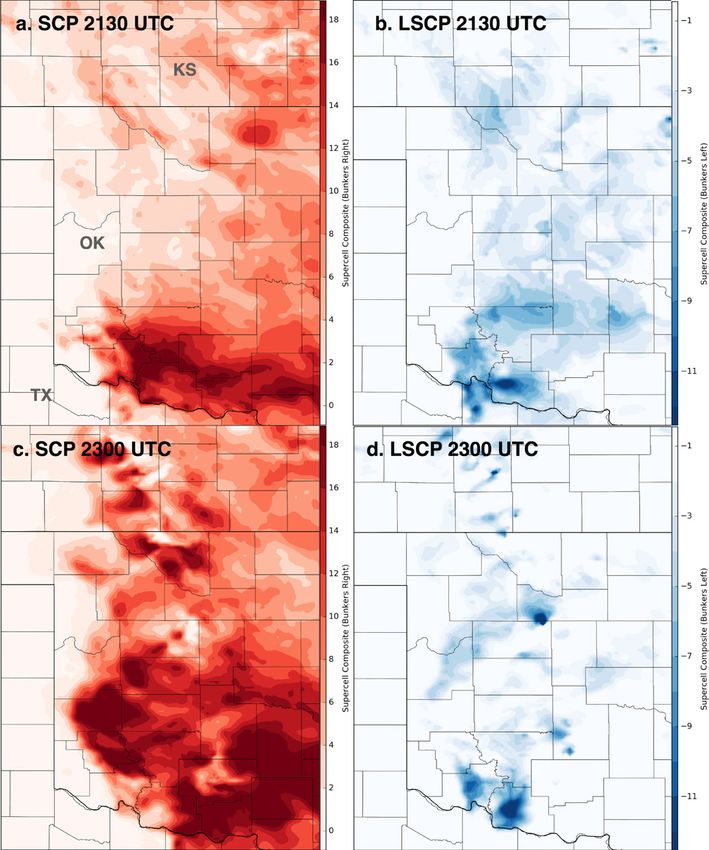
Jones and Nixon                            NWA Journal of Operational Meteorology                        5 September 2017

right-moving supercell storms. The same method also                at 5-min intervals over the duration of the forecast
works for anticyclonic rotation, but UH values become              period. Additional details concerning the NEWS-e
negative instead of positive. Thus, the magnitude of               system (including localization radii, additive noise,
negative UH can be used to track anticyclonic rotation             adaptive inflation, observation errors, and model
in much the same manner as it is currently used for                physics) can be found in Wheatley et al. (2015) and
cyclonically rotating storms.                                      Jones et al. (2016). This system was successfully tested
                                                                   in real-time operations as part of the 2016 Hazardous
3. Warn-on-Forecast system                                         Weather Testbed during May 2016, including the 8 May
                                                                   event discussed here (e.g., Jirak et al. 2014).
     This research uses the ensemble data assimilation
system—described in detail by Wheatley et al. (2015) and
                                                                   4. Observed storm evolution on 8 May 2016
Jones et al. (2016)—known as the NSSL experimental
WoF System for ensembles (NEWS-e). The NEWS-e                           To assess the ability of numerical weather
uses the Advanced Weather Research and Forecasting                 prediction systems to forecast left-moving supercells,
model (WRF-ARW) version 3.6.1 (Skamarock et al.                    an event is required where the synoptic and mesoscale
2008), coupled with the parallel ensemble adjustment               environment are favorable for their occurrence and
Kalman filter in the Data Assimilation Research                    appropriate data are available to analyze the developing
Testbed (Anderson and Collins 2007; Anderson et al.                convection. These conditions were met for an event
2009), to assimilate observations at 15-min intervals in           on 8 May 2016 when several supercells developed
a 36-member ensemble. Initial and boundary conditions              along a dryline in western Oklahoma and Kansas in
are provided by an experimental 20-member ensemble                 response to an incoming upper-level trough coupled
High Resolution Rapid Refresh (HRRR-e) model. The                  with surface based CAPE (SBCAPE) in excess of 3000
HRRR-e is an extension of the operational HRRR model,              J kg–1. The first storm complexes (A, B) developed in
which is an hourly cycled, 3-km convection permitting              far southwestern Oklahoma by 2130 UTC (Fig. 2a),
model that generates 18-h forecasts from each analysis             with additional development extending farther north
time (Benjamin et al. 2016). The NEWS-e system was                 by 2200 UTC that generated storm complexes C and
initialized at 1800 UTC each day using 3-h forecasts               D. (Fig. 2b). By 2230 UTC, the southernmost cluster
generated from the first 18 members of the HRRR-e.                 gave rise to a long-lived right-moving supercell (A1)
The NEWS-e system also is run at 3-km grid spacing,                that generated the sole tornado report associated with
but over a smaller domain so that 15-min cycling was               this event along with a swath of damaging wind (Fig.
possible with available computing resources. Both the              2c). The corresponding left-moving supercell (A2)
HRRR-e and NEWS-e systems have 51 vertical levels                  generated several reports of severe hail [diameter
extending from the surface to 10 hPa. Different sets               ≥1.0 in (2.5 cm)], including one significant hail report
of WRF model physics options are applied to each                   [diameter ≥2 in (5.1 cm); Fig. 2b,c; Table 1]. At 2300
ensemble member to introduce the required model                    UTC, another left-moving supercell, A3, split off A1
spread (e.g., Stensrud et al. 2000). All members use the           and proceeded to generate additional hail reports during
Thompson cloud microphysics (Thompson et al. 2004a,                the next hour (Fig. 2d).
2008); no cumulus parameterization is applied on the                    Out of the B complex, a storm split resulted in a
storm-scale grid (Wheatley et al. 2015). The NEWS-e                right-moving supercell (B1) that quickly dissipated;
system assimilates Weather Surveillance Radar-1988                 however, a long-lived left-moving supercell (B2)
Doppler radial velocity and reflectivity observations,             eventually produced severe hail up to 7.0 cm (2.75 in)
Geostationary Operational Environmental Satellite                  in diameter (Fig. 2b–e; Table 1). Along the Oklahoma/
(GOES)-13 satellite cloud water path (CWP) retrievals              Kansas border, a long-lived right- and left-moving
(Jones et al. 2015), and Oklahoma mesonet data.                    pair formed (C1, C2), with both producing severe hail
All available observations are assimilated at 15-min               (Fig. 2c–f). The right-moving supercell (C1) eventually
intervals continuously from 1800 until 0300 UTC the                merged with the long-lived left-moving supercell (B2)
next day. For the 8 May event, emphasis is placed on               in north-central Oklahoma (Fig. 2f), and both dissipated
the analysis and forecasts generated between 2130 and              shortly thereafter. Slightly farther north, one more
0030 UTC covering the time during which convection                 right- and left-moving pair developed (D1 and D2),
initiated, supercell storms split, and most of the severe          with the right-moving supercell (D1) merging into the
weather reports occurred. Forecast output is generated             left-moving supercell (C2) that was coming up from

ISSN 2325-6184, Vol. 5, No. 13                               163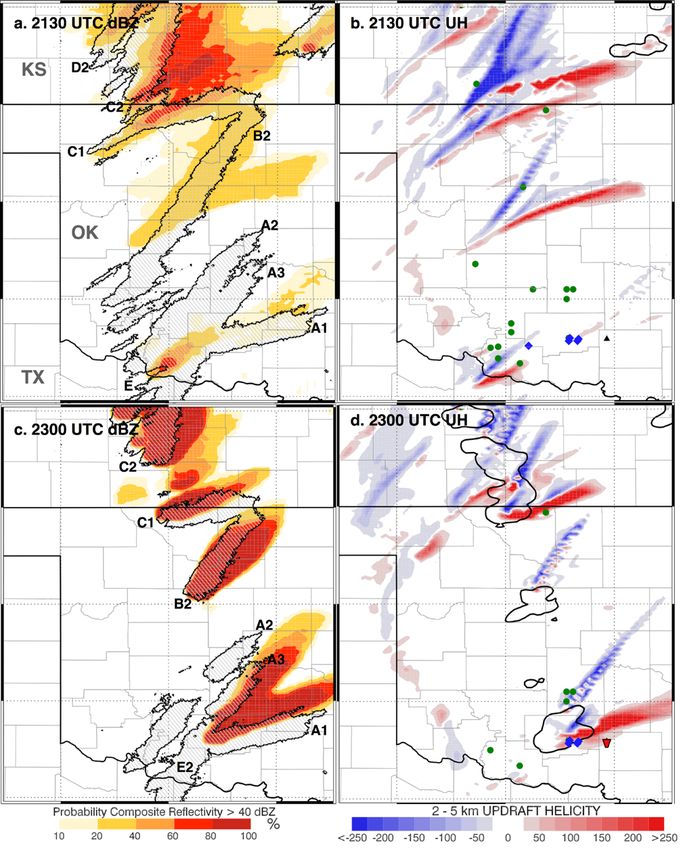
Jones and Nixon                             NWA Journal of Operational Meteorology                           5 September 2017

Table 1. Severe weather reports associated with each storm complex between 2000 and 0100 UTC 8 May 2016.
Significant (Sig) hail is defined as hail with a diameter ≥5.1 cm (2 in) and significant wind is defined as straight-line
wind ≥33.4 m s–1 (65 kt).

                                                                    supercells accounted for all three significant hail reports
                                                                    and >50% the total hail reports (Table 1).

                                                                    5. Environmental analysis
                                                                    a. 2130 UTC
                                                                         The favorability of the modeled environment towards
                                                                    left- and right-moving supercells can be determined
                                                                    by analyzing the wind-shear characteristics generated
                                                                    by the model. Recall that convection developed by
                                                                    2130 UTC in western and southwestern Oklahoma,
                                                                    representing the precursors to storm complexes A, B,
                                                                    and C (Fig. 2a). Splitting of the developing convection
                                                                    into left- and right-moving supercells occurred over the
                                                                    next hour (Fig. 2c). Each storm moved into a unique
Figure 2. Multi-radar multi-sensor (MRMS) 3-km AGL                  environment that was supportive of either or both storm
reflectivity analyses at 2130 (a), 2200 (b), 2230 (c),              types.
2300 (d), 2330 (e), and 0000 (d) UTC 8–9 May 2016.                       Figure 3 shows the ensemble mean 0–3- and 0–1-
Letters denote individual storm complexes with A1, B1,              km SRH and left-moving SRH (LSRH) for left- and
C1, D1, and E1 being right-moving supercells and A2,                right-moving supercells, respectively, at 2130 UTC
A3, B2, C2, D2, and E2 being left-moving supercells.                8 May over western Oklahoma and southern Kansas.
Severe storm reports (green = hail, blue = wind, and                Cyclonic (or right moving) SRH is calculated assuming
red = tornado) within ±15 min of each analysis time are             a Bunkers storm motion of 7.5° right of the mean 0–6-
overlaid.                                                           km shear vector through the 0–6-km mean wind. LSRH
                                                                    is similar, but uses a storm motion 7.5° left of the mean
                                                                    shear vector. The model results show that the 0–3-km
the Oklahoma/Kansas border, while the left-moving                   SRH is ≥100 m2 s–2 over much of western Oklahoma
supercell (D2) produced significant severe hail up to 7.6           and southern Kansas, with a band of >250 m2 s–2 located
cm (3 in) in diameter (Fig. 2c,d; Table 1). Finally, an             in southern Oklahoma (Fig. 3a). Thus, the entire region
additional splitting storm complex (E1, E2) moved into              is moderately favorable for right-moving supercells,
the southwestern portion of the domain after 2230 UTC               with the area in southern Oklahoma being the most
(Fig. 2c–f). The left-moving supercell (E2) generated               favorable. The corresponding LSRH differs in that
≥2 diameter hail reports in southern Oklahoma before                the absolute maximum (i.e., most negative) values are
weakening after 0000 UTC. Note that left-moving                     located in central Oklahoma and northward, with much

ISSN 2325-6184, Vol. 5, No. 13                                164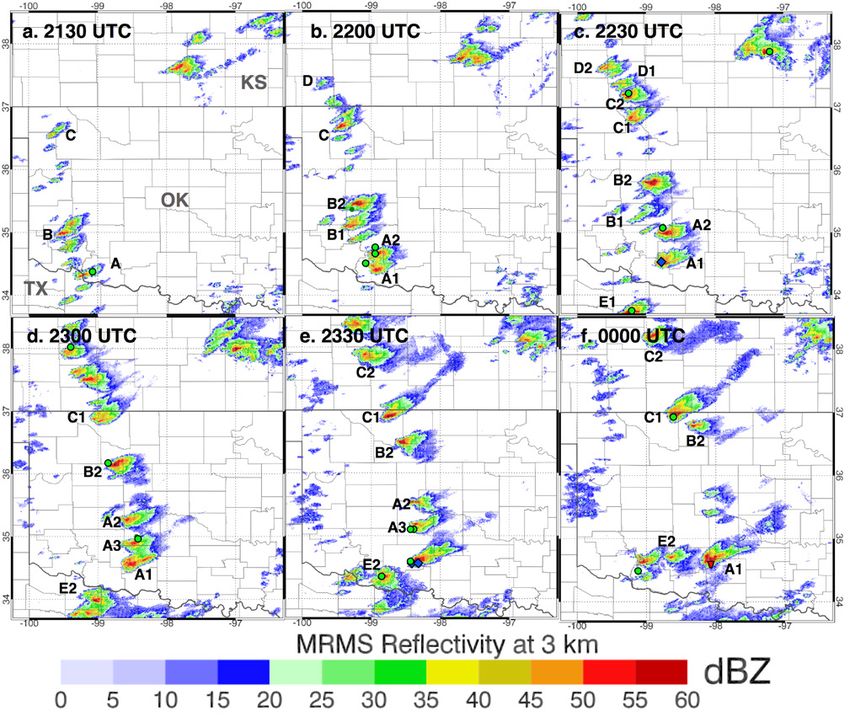
Jones and Nixon                            NWA Journal of Operational Meteorology                         5 September 2017

                                                                   the wind shear at this location, left-moving supercells
                                                                   would be favored over their right-moving counterparts.
                                                                   However, the analyzed conditions still indicate the
                                                                   possibility of severe weather-producing right-moving
                                                                   supercells in this region.
                                                                       Farther south in central Oklahoma at location S2,
                                                                   the environment remains favorable for left-moving
                                                                   supercells, but also is increasingly favorable for right-
                                                                   moving supercells with 0–3-km LSRH and SRH
                                                                   being –165 and 109 m2 s–2, respectively (Fig 4c, Table
                                                                   2). Also, the 0–1-km wind shear is similar to that
                                                                   at location S1, being weakly favorable for cyclonic
                                                                   rotation. The southernmost location at S3 is located in
                                                                   the environment much more favorable for right-moving
                                                                   supercells. The change in hodograph curvature because
                                                                   of the stronger southwesterly ground-relative winds

Figure 3. Ensemble mean 0–3-km (a,b) and 0–1-km
(c,d) storm-relative helicity (SRH, left column) and
left-moving SRH (LSRH, right column) at 2130 UTC.
MRMS 3-km AGL reflectivity >25 dBZ is overlaid with
black lines. Pink dots (S1, S2, S3) indicate locations of
hodographs shown in Fig. 4a–c.

lower values in southern Oklahoma (Fig. 3b). Thus,
long-lived left-moving supercells are possible in the
northern half of the domain.
     To further understand the wind shear characteristics
in various parts of the domain, hodographs and
corresponding severe weather parameters were
generated from the ensemble mean analysis at 2130
UTC for three locations (S1, S2, and S3; Fig. 4).
These locations were selected to represent the near
storm environment of storm complexes C/D, B, and
A, respectively. Overall, the wind shear environment
throughout western Oklahoma appears supportive of
left-moving supercells with LSRH often ≤100 m2 s–2
when assuming the Bunkers storm motions. At the
northernmost location (S1), the overall wind profile               Figure 4. Ensemble mean hodographs at 2130 UTC
above 1 km favors left-moving supercells with an LSRH              for locations S1 (a), S2 (c), and S3 (e) and 2300 UTC
of –211 m2 s–2, compared to an SRH of only 75 m2 s–2               for locations S4 (b), S5 (d), and S6 (f). Colors indicate
(Fig. 4a, Table 2). However, the 0–1-km wind profile               height above surface: pink (0–500 m), red (500–1000
remains weakly favorable for cyclonic rotation with an             m), green (1–3-km), yellow (3–6-km), and cyan
SRH of 38 m2 s–2, but with an LSRH of 0. Based on                  (6–12-km). Red and blue dots represent right- and left-
                                                                   moving Bunkers storm motions, respectively.

ISSN 2325-6184, Vol. 5, No. 13                               165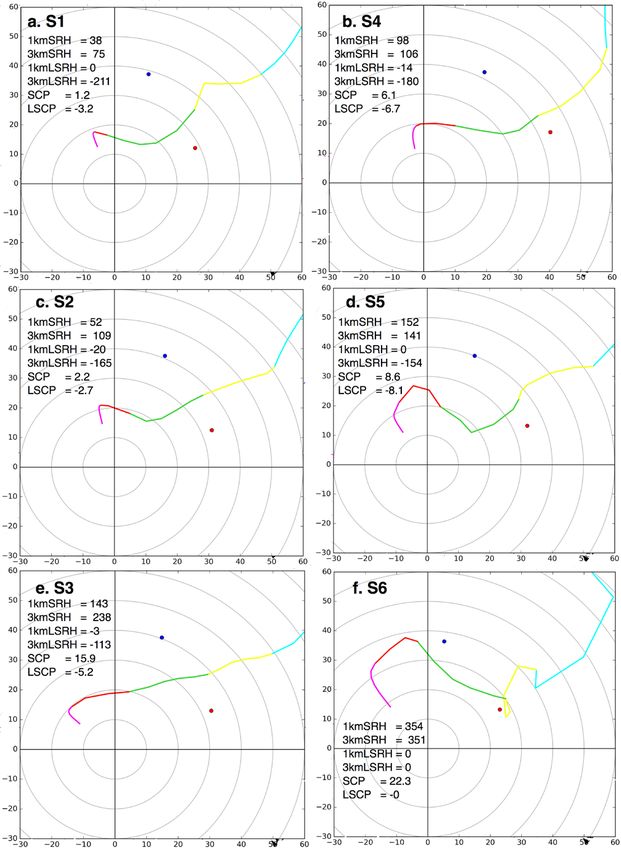
Jones and Nixon                             NWA Journal of Operational Meteorology                         5 September 2017

at S3 compared to the S1 and S2 locations reduces                   the near storm environment associated with B2 with
LSRH and increases SRH at these levels (Fig. 4e).                   an LSRH of –180 m2 s–2, but only an SRH of 106 m2
Also, 0–1-km SRH is larger (143 m2 s–2), indicating                 s–2. As before, the 0–1-km wind shear favors cyclonic
a greater favorability of tornado-producing, right-                 rotation while the 1–3-km shear is more favorable for
moving supercells. The corresponding 0–1-km LSRH                    anticyclonic rotation (Fig. 4b). A similar pattern exists
is very small. Overall, the wind shear environment is               in the environment around storms A2 and A3, which
most supportive of left-moving supercells in northern               is shown by the hodograph at S5 (Fig. 4d). Here, the
Oklahoma, while stronger, right-moving supercells                   0–1-km wind shear is much more pronounced with an
are more likely to occur and persist in far southern                SRH value of 152 m2 s–2 (Table 2). Above 1 km, shear
Oklahoma.                                                           becomes favorable for anticyclonic rotation again with
    Finally, it also is necessary to consider                       LSRH of –154 m2 s–2 whereas SRH is only 141 m2 s–2.
thermodynamic conditions in these regions to determine              Both A2 and A3 form and persist in this environment.
whether or not convection is likely to develop and                  The locations of S4 and S5 are close enough to the
persist in regions otherwise favorable for left- and                storms that the analyzed LSRH may be increased
right-moving supercells. At all profile locations,                  over the background value owing to an increase in
SBCAPE exceeds 3000 J kg–1 with little convective                   the surface wind speeds from storm inflow. The most
inhibition (CIN), indicating an atmosphere primed for               favorable environment for cyclonic supercells remains
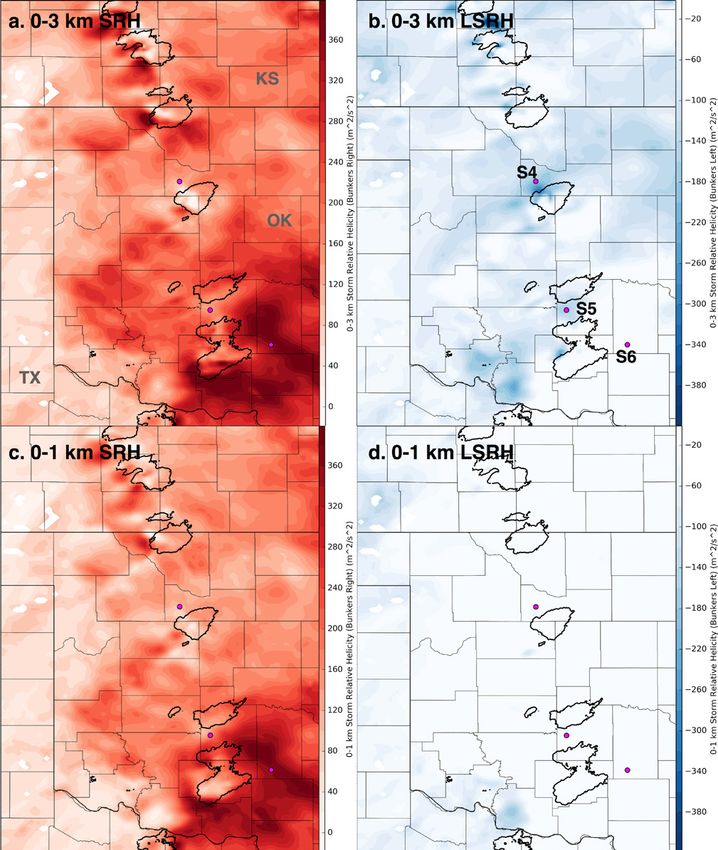
the severe convection (Table 2). Figure 5a shows SCP,               in southern Oklahoma, with location S6 placed east of
which combines wind-shear and instability parameters                the tornado-producing right-moving supercell (A1, Fig.
into a single variable that represents the favorability of          4f). The hodograph shows an environment much more
the atmosphere for right-moving supercells. At 2130                 favorable for low-level cyclonic rotation in the lowest
UTC, the ensemble mean SCP is maximized in southern                 1 km of the atmosphere. Both 0–1- and 0–3-km SRH
Oklahoma with values in excess of 15 (Fig. 5a).                     exceed 350 m2 s–2, which is more than adequate for
Farther north, SCP is much smaller in the vicinity of               tornado development (e.g., Davies-Jones et al. 1990).
developing storm complexes B and C. For anticyclonic,                    The overall atmospheric conditions indicated by
or left-moving SCP (LSCP), negative values indicate                 the SCP and LSCP paint a similar picture. At 2300
an environment conducive for left-moving supercells.                UTC, the SCP has increased substantially over much of
The highest absolute values of LSCP are located in a                Oklahoma with values in southern Oklahoma exceeding
small region in southwestern Oklahoma, with local                   15 in many places (Fig. 5c). The corresponding LSCP
maximums that are likely enhanced by convective cold                has decreased to near zero in many areas except near
pools and/or subtle storm boundaries that may be less               regions of large LSRH and on the north side of the E
representative of the overall environment (Fig. 5b).                complex. In the case of storm complex E, there are
Larger areas of negative LSCP are present in a zonal                multiple storm cells and leftover boundaries from the
band along the dryline just north of the area of highest            previous storms that result in non-continuous LSCP
SCP, with another region of enhanced negative LSCP                  values.
present in far northern Oklahoma and southern Kansas.
                                                                    6. Short-term forecasts
b. 2300 UTC
                                                                         Assessment of the model environment at 2130
    Several changes to the environment occur by 2300                and 2300 UTC indicates regions where left- and
UTC that impact the evolution of the convection.                    right-moving supercells may occur. To determine the
Both 0–3- and 0–1-km SRH increase over most of the                  capability of the NEWS-e system to forecast splitting
domain compared to 2130 UTC, indicating additional                  supercells, 3-h forecasts of reflectivity and UH were
favorability towards right-moving supercells (Fig.                  calculated for the first 18 ensemble members beginning
6a,c). The greatest SRH is again located in southern                at 2130 UTC, followed by 90-min forecasts beginning at
Oklahoma near and ahead of storm complex A while                    2300 UTC. Figure 7a shows the probability of simulated
LSRH has decreased in most areas (Fig. 6b,d). Some                  composite reflectivity >40 dBZ for the 3-h forecast
areas of high LSRH remain, especially to the northeast              period beginning at 2130 UTC. In northern Oklahoma
of left-moving supercells A2, A3, and B2. This is                   and southern Kansas, several northeastward-moving
evident from analyzing ensemble mean hodographs at                  reflectivity swaths are present associated with storm
locations S4 and S5 (Fig. 4b, d). Location S4 represents            complexes C and D. At least one north-northeast swath

ISSN 2325-6184, Vol. 5, No. 13                                166
Jones and Nixon NWA Journal of Operational Meteorology 5 September 2017
Table 2. Severe weather parameters at 2130 or 2300 UTC for selected locations shown in Figs. 3a and 6b.
Figure 5. Ensemble mean SCP and LSCP at 2130 UTC Figure 6. Same as Fig. 3 except for 2300 UTC.
(a,b) and 2300 UTC (c,d). Hodograph locations (S4, S5, S6) are denoted by pink
dots.
is present that roughly corresponds to C2. Farther south,
a lower probability reflectivity swath exists associated central Oklahoma corresponding to complex B, with
with storm complex B with both left- and right-moving both left- and right-moving supercells being maintained
supercells evident. In southern Oklahoma, only a short for the duration of the forecast. In reality, only the left-
northeastward-moving swath is present with no sign of moving supercell persisted out to 2300 UTC (Fig. 2). In
splitting. To determine the rotational characteristics of northern Oklahoma, a splitting supercell was forecast
these storms, the ensemble mean 2–5-km UH at 5-min to form, but both members dissipated in the model
intervals for the duration of each forecast is shown in Fig. after 45 min. However, the model has yet to analyze
7b. The tracks of both cyclonically and anticyclonically any convection at this time, so its ability to develop the
rotating supercells are evident in several locations. In correct convective mode on its own is seen as a very
northern Oklahoma and southern Kansas, both left- positive result.
and right-moving supercells are present and roughly By 2300 UTC, convection associated with each
corresponding to storm complexes C and D; these storm complex except E is now analyzed by the model,
persist for the duration of the forecast in this region. with many 90-min reflectivity swaths with >80%
Farther south, a single splitting supercell is forecast in probability present (Fig. 7c). In southern Kansas,
ISSN 2325-6184, Vol. 5, No. 13 167Jones and Nixon NWA Journal of Operational Meteorology 5 September 2017
the corresponding right-moving supercell now gone
from the model forecast. A2 is rather poorly analyzed
and has no corresponding negative UH track. Finally,
A1 continues to exhibit a well-defined positive UH
track that passes near the single tornado report of the
event at 0003 UTC 9 May. Finally, no UH tracks were
forecast corresponding to storm complex E. This storm
was located near the southern boundary of the domain
and was poorly initialized throughout the period. By
0000 UTC, left-moving supercells A2, A3, and B2
were all weakening rapidly as they moved into central
Oklahoma (Fig. 2f)—where convective inhibition
increased. Forecasts tended to extend the UH tracks
somewhat past the actual time of dissipation for both
left- and right-moving supercells. Overall, the splitting
characteristics of the remaining storm complexes were
well forecast at both times and were generally consistent
with the analyzed atmospheric conditions.
7. Conclusions
Overall, the goal of this study was to determine if
the NEWS-e system could produce accurate forecasts
of cyclonic and anticyclonic supercells for an event on
Figure 7. Probability of simulated composite reflectivity 8 May 2016 and to determine if the simulated supercells
>40 dBZ for 3-h forecasts beginning at 2130 UTC (a) fit within our current scientific understanding of the
and 90-min forecasts beginning at 2300 UTC (c). Black synoptic and mesoscale environment that produces
contours in (a) and (c) indicate location of MRMS them. The 8 May 2016 event featured a very clear-cut
composite reflectivity >40 dBZ for the duration of the evolution of long-lived splitting supercells, making it an
forecast period. Note that the contours for storms A and ideal event for which to conduct this study. Examined
E overlap each other. Ensemble mean 2–5-km updraft alongside modeled hodographs and environmental
helicity (UH, m2 s–2) forecasts beginning at 2130 maps, the model’s “choice” in sustaining left- and right-
UTC (b) and 2300 UTC (d) with the ensemble mean moving supercells could often be explained with various
simulated composite reflectivity >25 dBZ shown at SRH and storm composite parameters for right or left
the analysis time. Severe weather reports covering the motion similar to those examined in previous studies.
duration of the forecasts (blue = wind, green = hail, and In general, right-moving supercells were favored in
red = tornado) are shown in panels (b) and (d). Letters modeled environments with high right-moving SRH
denote individual storm complexes as in Fig. 2. and left-moving supercells in regions of highly negative
LSRH.
Probabilistic reflectivity and ensemble mean UH
several north-northeastward-moving tracks are present forecasts showed a generally accurate prediction of the
associated with storms C2 and D2. C1 also is evident, occurrence of splitting supercells—even prior to the
but with lower probabilities. Farther south, additional time that convection had been fully assimilated into
north-northeastward-moving tracks associated with B2 the model analysis. Once enough assimilation cycles
and A3 also are present. Finally, A1 also is analyzed had occurred so that convection was fully analyzed,
in southern Oklahoma. Both left- and right-moving the forecast tracks of supercells from reflectivity and
UH tracks are forecast in northern Oklahoma and UH became much more defined. Analyzing the model’s
southern Kansas corresponding to storm complexes C output qualitatively and at a detailed level proved to
and D, and negative UH tracks associated with both be an effective way to determine the performance
C2 and D2 also are evident (Fig. 7d). The negative of the NEWS-e system, which is a vital step in the
UH track associated with B2 also is well forecast, with process of verification and understanding strengths,
ISSN 2325-6184, Vol. 5, No. 13 168Jones and Nixon NWA Journal of Operational Meteorology 5 September 2017
weaknesses, and biases. For this case, the NEWS-e Davies-Jones, R., 1985: Dynamical interaction between an
generated the environment favorable for left- and isolated convective cell and a veering environmental
right-moving supercells, and accurately predicted the wind. Preprints, 14th Conf. on Severe Local Storms,
location and movement of resulting supercells within Indianapolis, IN, Amer. Meteor. Soc., 216–219.
that environment. ____, D. Burgess, and M. Foster, 1990: Test of helicity as a
tornado forecast parameter. Preprints, 16th Conf. on
Severe Local Storms, Kananaskis Park, AB, Canada,
Acknowledgments. This research was supported by Amer. Meteor. Soc., 588–592.
the NOAA National Environmental Satellite, Data, and Dostalek, J. F., J. F. Weaver, and G. L. Phillips, 2004: Aspects
Information Service as part of the GOES-R program. of a tornadic left-moving thunderstorm on 25 May 1999.
Partial funding for this research also was provided Wea. Forecasting, 19, 614–626, Crossref.
by the NOAA/Office of Oceanic and Atmospheric Edwards, R., and S. J. Hodanish, 2006: Photographic
Research under NOAA–University of Oklahoma documentation and environmental analysis of an intense,
Cooperative Agreement NA11OAR4320072, under anticyclonic supercell on the Colorado plains. Mon.
the U.S. Department of Commerce. Initial conditions Wea. Rev., 134, 3753–3763, Crossref.
for the NEWS-e system were provided by the Global ____, R. L. Thompson, and C. M. Mead, 2004: Assessment
Systems Division through an experimental HRRR of anticyclonic supercell environments using close
ensemble run during the 2016 Spring Experiment. proximity soundings from the RUC model. Preprints,
22nd Conf. on Severe Local Storms, Hyannis, MA,
The NEWS-e design was developed and refined by the
Amer. Meteor. Soc., P1.2. [Available online at
NSSL Warn-on-Forecast group in Norman, Oklahoma, ams.confex.com/ams/pdfpapers/81328.pdf.]
and tested during the 2016 Hazardous Weather Testbed. Grasso, L. D., and E. R. Hilgendorf, 2001: Observations of
Finally, satellite CWP retrievals were provided in real- a severe left moving thunderstorm. Wea. Forecasting,
time by the NASA Langley Research Center. 16, 500–511, Crossref.
Jirak, I. L., and Coauthors, 2014: An overview of the 2014
________________________ NOAA Hazardous Weather Testbed Spring Forecasting
Experiment. Preprints, 27th Conf. on Severe Local
REFERENCES Storms, Madison, WI, Amer. Meteor. Soc., 46. [Available
online at ams.confex.com/ams/27SLS/webprogram/
Anderson, J. L, and N. Collins, 2007: Scalable Manuscript/Paper254650/SLS2014_SFE2014_
implementations of ensemble filter algorithms for data Overview_Ext_Abstract_Final.pdf.]
assimilation. J. Atmos. Oceanic Technol., 24, 1452– Jones, T. A, D. Stensrud, L. Wicker, P. Minnis, and R.
1463, Crossref. Palikonda, 2015: Simultaneous radar and satellite data
____, T. Hoar, K. Raeder, H. Liu, N. Collins, R. Torn, and storm-scale assimilation using an ensemble Kalman filter
A. Avellano, 2009: The Data Assimilation Research approach for 24 May 2011. Mon. Wea. Rev., 143, 165–
Testbed: A community facility. Bull. Amer. Meteor. Soc., 194, Crossref.
90, 1283–1296, Crossref. ____, K. Knopfmeier, D. Wheatley, G. Creager, P. Minnis,
Benjamin, S. G., and Coauthors, 2016: A North American and R. Palikonda, 2016: Storm-scale data assimilation
hourly assimilation and model forecast cycle: The Rapid and ensemble forecasting with the NSSL Experimental
Refresh. Mon. Wea. Rev., 144, 1669–1694, Crossref. Warn-on-Forecast system. Part II: Combined radar and
Brooks, H. E., C. A. Doswell III, and J. Cooper, 1994: On satellite data experiments. Wea. Forecasting, 31, 297–
the environments of tornadic and nontornadic 327, Crossref.
mesocyclones. Wea. Forecasting, 9, 606–618, Crossref. Kain, J. S., and Coauthors, 2008: Some practical
Brown, R. A., and R. J. Meitín, 1994: Evolution and considerations regarding horizontal resolution in the first
morphology of two splitting thunderstorms with generation of operational convection-allowing NWP.
dominant left-moving members. Mon. Wea. Rev., 122, Wea. Forecasting, 23, 931–952, Crossref.
2052–2067, Crossref. Klemp, J. B., and R. B. Wilhelmson, 1978: Simulations
Bunkers, M. J., 2002: Vertical wind shear associated with left- of right- and left-moving storms produced through storm
moving supercells. Wea. Forecasting, 17, 845–855, splitting. J. Atmos. Sci., 35, 1097–1110, Crossref.
Crossref. Monteverdi, J. P., W. Blier, G. Stumpf, W. Pi, and K. Anderson,
____, B. A. Klimowski, J. W. Zeitler, R. L. Thompson, and 2001: First WSR-88D documentation of an anticyclonic
M. L. Weisman, 2000: Predicting supercell motion using supercell with anticyclonic tornadoes: The Sunnyvale–
a new hodograph technique. Wea. Forecasting, 15, 61– Los Altos, California, tornadoes of 4 May 1998. Mon.
79, Crossref. Wea. Rev., 129, 2805–2814, Crossref.
ISSN 2325-6184, Vol. 5, No. 13 169Jones and Nixon NWA Journal of Operational Meteorology 5 September 2017
Skamarock, W. C., and Coauthors, 2008: A Description of
the Advanced Research WRF Version 3. NCAR Tech.
Note NCAR/TN-475+STR, 125 pp, Crossref.
Smith, B. T., R. L. Thompson, J. S. Grams, C. Broyles, and
H. E. Brooks, 2012: Convective modes for significant
severe thunderstorms in the contiguous United States.
Part I: Storm classification and climatology. Wea.
Forecasting, 27, 1114–1135, Crossref.
Stensrud, D. J., J.-W. Bao, and T. T. Warner, 2000: Using
initial condition and model physics perturbations in
short-range ensemble simulations of mesoscale
convective systems. Mon. Wea. Rev., 128, 2077–2107,
Crossref.
____, and Coauthors, 2009: Convective-scale Warn-on-
Forecast system: A vision for 2020. Bull. Amer. Meteor.
Soc., 90, 1487– 1499, Crossref.
____, and Coauthors, 2013: Progress and challenges with
Warn-on-Forecast. Atmos. Res., 123, 2–16, Crossref.
Thompson, G., R. M. Rasmussen, and K. Manning, 2004a:
Explicit forecasts of winter precipitation using an
improved bulk microphysics scheme. Part I: Description
and sensitivity analysis. Mon. Wea. Rev., 132, 519–542,
Crossref.
____, P. R. Field, R. M. Rasmussen, and W. D. Hall, 2008:
Explicit forecasts of winter precipitation using an
improved bulk microphysics scheme. Part II:
Implementation of a new snow parameterization. Mon.
Wea. Rev., 136, 5095–5115, Crossref.
Thompson, R. L., R. Edwards, J. A. Hart, K. L. Elmore,
and P. Markowski, 2003: Close proximity soundings
within supercell environments obtained from the Rapid
Update Cycle. Wea. Forecasting, 18, 1243–1261,
Crossref.
____, ____, and C. M. Mead, 2004b: An update to the
supercell composite and significant tornado parameters.
Preprints, 22nd Conf. Severe Local Storms, Hyannis,
MA, Amer. Meteor. Soc., P8.1. [Available online at
ams.confex.com/ams/pdfpapers/82100.pdf.]
Wheatley, D. M., K. H. Knopfmeier, T. A. Jones, and G. J.
Creager, 2015: Storm-scale data assimilation and
ensemble forecasting with the NSSL Experimental
Warn-on-Forecast System. Part I: Radar data
experiments. Wea. Forecasting , 30, 1795–1817,
Crossref.
Wilhelmson, R. B., and J. B. Klemp, 1978: A numerical study
of storm splitting that leads to long-lived storms.
J. Atmos. Sci., 35, 1974–1986, Crossref.
ISSN 2325-6184, Vol. 5, No. 13 170You can also read


