SINGLE SIGN-ON ADMINISTRATOR GUIDE - LAST REVISED FEBRUARY 15, 2018 VERSION 1.7 - 2018 LINKEDIN CORPORATION, ALL RIGHTS RESERVED - LINKEDIN ...
←
→
Page content transcription
If your browser does not render page correctly, please read the page content below
Single Sign-On
                      Administrator Guide

                          Last Revised February 15, 2018
                                    Version 1.7

© 2018 LinkedIn Corporation, All Rights Reserved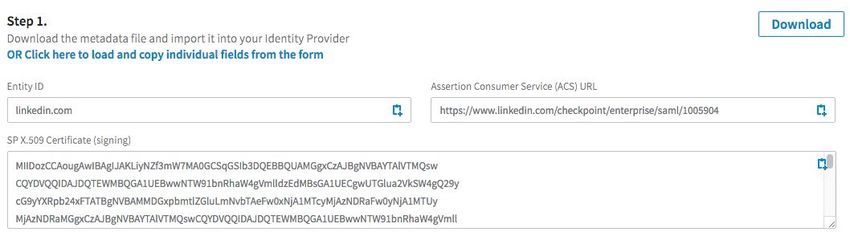
Disclaimer
© 2018 LinkedIn Corporation, All Rights Reserved

LinkedIn Corporation
1000 W. Maude Ave.
Sunnyvale, CA 94085

This document may contain forward looking statements. Any information in this document is
subject to change without notice. The software (and related documentation) may be used or
copied only in accordance with the terms of your license agreement with us. No part of the
software or documentation may be reproduced, transmitted, or translated in any form or by any
means, electronic, mechanical, manual, optical, or otherwise, in part or in whole, except in
accordance with the terms of your license agreement with us.

LinkedIn Corporation and the LinkedIn Corporation logo are trademarks, servicemarks, or
registered trademarks of LinkedIn Corporation in the United States and other countries. All
other brand, service or product names are trademarks or registered trademarks of their
respective companies or owners.

 © 2018 LinkedIn Corporation, All Rights Reserved

Contents

Disclaimer

Contents

Overview
   Prerequisites
   About Single Sign-On (SSO)
   Why Should you use Single Sign-On?
   Supported SSO Protocols

Configuring Single Sign-On (SSO)
   Getting Started with SSO
   Connecting to your Identity Provider
       Downloading a File
       Working with Individual Fields
   Configuring your Identity Provider
       Requirements for Just-in-Time (JIT) Provisioning
             Email Address (Required)
             First Name (Optional)
             Last Name (Optional)
             Additional Optional Attributes
             Example
       Uploading a File
       Entering Values Manually
   Assigning Licenses
   Enabling Single Sign-On
       Enable Options
   Verifying your Setup

Support
   Supporting Documentation
   Technical Issues
   LinkedIn’s Privacy and Data Security Policy
   LinkedIn Security Contacts

 © 2018 LinkedIn Corporation, All Rights Reserved
Overview
Employee Database Integration (EDI) allows your company to integrate its HRIS employee data
into LinkedIn applications. The integration includes an optional configuration for Single Sign-On
with your SSO solution. In this case, the administrator for your company account can configure
your company to authenticate to a LinkedIn platform application using SSO through integration
with the enterprise platform.
The integration is configured through the LinkedIn Account Center and is only available for
some paid LinkedIn applications.
Prerequisites
● Company account
● Full administrator privileges
● Identity Provider (IdP) administrative privileges
About Single Sign-On (SSO)
Enterprise Single Sign-On (SSO) allows your company’s employees to sign into supported
LinkedIn applications using their corporate credentials instead of their LinkedIn credentials.
Using SSO and integrating with an SSO provider is not required to use LinkedIn applications. If
SSO is not configured, your employees can authenticate themselves using their current personal
LinkedIn credentials or create a new member account.
Why Should you use Single Sign-On?
● Leverage your existing company’s authentication
● Better security when employees use your company’s established password protocols
rather than their individual accounts
● Easier user management when employees leave your company
Supported SSO Protocols
We currently support SAML version 2.0.
© 2018 LinkedIn Corporation, All Rights ReservedConfiguring Single Sign-On (SSO)
Getting Started with SSO
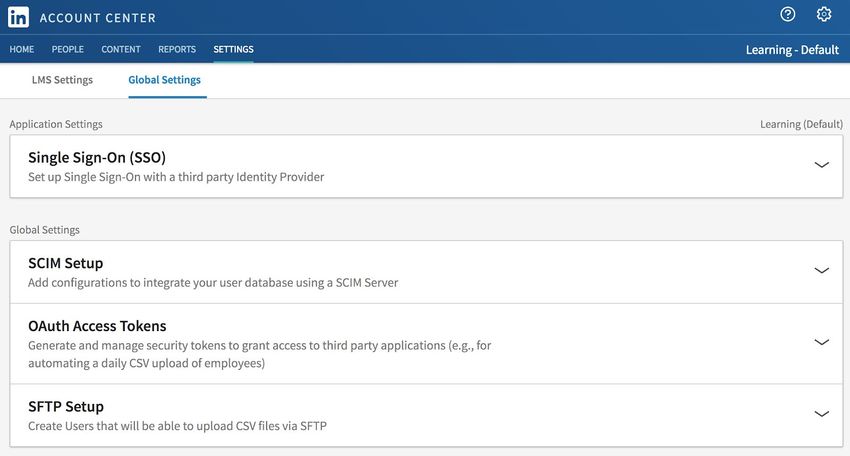
1. Access the Account Center using the following link:
http://www.linkedin.com/enterprise/accountcenter/settings
Note: Some applications also have an access point from their application settings. For
example, in Learning you can click Go to Admin in the banner and select Settings >
Global Settings.
The application settings for SSO reflect the application you have accessed.
© 2018 LinkedIn Corporation, All Rights Reserved2. Open the Single Sign-On (SSO) panel. © 2018 LinkedIn Corporation, All Rights Reserved
3. Select your SSO options.
a. Sign AuthnRequest:
■ Yes (default)
■ No
b. Authentication Request Signing Algorithm:
■ SHA1 (default)
■ SHA256
c. SAML Request Binding:
■ HTTP-Redirect (default)
■ HTTP-Post
d. AuthnContextClassRef:
■ Don’t send this value (default)
■ urn:oasis:names:tc:SAML:2.0:ac:classes:PasswordProtectedTransport
■ urn:oasis:names:tc:SAML:2.0:ac:classes:kerberos
■ urn:federation:authentication:windows
■ PasswordProtectedTransport and windows
■ urn:oasis:names:tc:SAML:2.0:ac:classes:X509
■ urn:oasis:names:tc:SAML:2.0:ac:classes:TLSClient
e. Custom Attribute Mapping. You can specify custom name mappings to
correspond to IdP settings (rather than using the default mappings). Enter your
custom attribute and select the attribute to map it to. The following fields can be
mapped to custom, user-provided attributes.
■ First Name
■ Last Name
■ Primary Email Address
■ Mobile Phone Number
■ Work Phone Number
■ Work Title
■ Job Function
■ Manager
■ Department
■ Job Level
■ Worker Type
■ Worker Status
■ Building Code
■ Desk Location
See Requirements for Just-in-Time (JIT) Provisioning for more information about
the default attributes.
© 2018 LinkedIn Corporation, All Rights Reserved4. (Optional) Click Go to SAML validator to specify whether to sign SAML requests. Paste
in the SAML response and click Validate.
5. (Optional) If you need to configure multiple application instances, you can select the
- menu in the banner, then select the instance you
want to configure. For example, in Learning you might be selecting the Learning -
Default menu (as shown in the screenshot in Step 1).
Note: Application instances in the menu are organized by application, so if you have
access to multiple instances of the same application (for example, two Recruiter
instances), then you see a header for Recruiter followed by the names of the individual
application instances.
Connecting to your Identity Provider
If your identity provider supports metadata, and if you've configured SAML using version 2.0,
you can download an XML configuration file to send them, which they can then upload to
automatically configure their settings for connecting to your LinkedIn products.
Determine if you can download a metadata file or if you need to work with individual fields,
then follow one of the procedures in the next sections.
Downloading a File
1. Click Download to download a metadata file you can use with your Identity Provider
system. The metadata.xml file downloads through your browser.
2. Verify that the metadata file contains the following:
3. Access your Identity Provider system.
4. Upload the metadata file.
Note: You might not be able to import this file into your Identity Provider. For example,
Okta does not have this functionality.
5. Return to the SSO setup.
6. Click OK on the upload dialog, then see Configuring your Identity Provider.
© 2018 LinkedIn Corporation, All Rights ReservedWorking with Individual Fields
1. Click the link to load and copy individual fields from the form in your Identity Provider.
2. Copy and paste the fields you want to include.
Configuring your Identity Provider
Configure your Identity Provider to talk with LinkedIn’s platform. Determine if you can upload a
metadata file from your Identity Provider or if you need to enter values manually, then follow
one of the procedures in the next sections. If you aren’t using JIT, proceed to Uploading a File
or Entering Values Manually.
Requirements for Just-in-Time (JIT) Provisioning
One reason SAML 2.0 has become so popular is its flexibility when sending extra information to
the service provider. When an identity provider sends an assertion, it includes attributes
describing the user. These attributes allow LinkedIn to both identify the user and automatically
provision users. A few of the possible attributes are described in this section.
Email Address (Required)
Every user is required to have a valid email address, even when using SSO.
Note: When testing with multiple IdP identities, email addresses must be unique.
Because the identity provider is responsible for managing user information, it must send the
user's email address in its assertion. Identity providers use different naming conventions, so
LinkedIn looks for an email address in the following attribute names sequentially:
● EmailAddress
● email
● Email
● Mail
● emailAddress
● User.email
● http://schemas.xmlsoap.org/ws/2005/05/identity/claims/emailaddress
© 2018 LinkedIn Corporation, All Rights ReservedFirst Name (Optional)
Just like email addresses, identity providers might send the first name in several common fields.
To provide out-of-the-box compatibility with most identity providers, LinkedIn tries to find the
first name in the following attribute names:
● FirstName
● first_name
● firstname
● firstName
● User.FirstName
● http://schemas.xmlsoap.org/ws/2005/05/identity/claims/givenname
Last Name (Optional)
LinkedIn looks for the last name in the following attribute names:
● LastName
● last_name
● lastname
● lastName
● User.LastName
● http://schemas.xmlsoap.org/ws/2005/05/identity/claims/surname
Additional Optional Attributes
You can provide additional information, including the following attribute names.
Note: While these attributes are stored by LinkedIn, they are currently not visible from the UI
to use for user management.
Attribute Supported Variations
Name
Department ● departmentName
● department
● User.Department
Manager ● Manager
● manager
● User.Manager
Mobile Phone ● mobilePhoneNumber
Number ● PhoneNumber
● phone
© 2018 LinkedIn Corporation, All Rights Reserved● phoneNumber
● User.PhoneNumber
● http://schemas.xmlsoap.org/ws/2005/05/identity/claims/mobilephone
Work Phone ● WorkPhoneNumber
Number ● Workphone
● workPhoneNumber
● User.WorkPhoneNumber
● http://schemas.xmlsoap.org/ws/2005/05/identity/claims/otherphone
Work Title ● workTitle
● Title
● WorkTitle
● User.WorkTitle
Job Function ● jobFunction
● JobFunction
● User.JobFunction
Job Level ● JobLevel
● jobLevel
● User.JobLevel
Worker Type ● WorkerType
● workerType
● User.WorkerType
Worker ● WorkerStatus
Status ● workerStatus
● Status
● User.WorkerStatus
Building Code ● buildingCode
● building
Desk ● deskLocation
Location ● desk
© 2018 LinkedIn Corporation, All Rights ReservedExample Email: jdoe@company.com First name: Jane Last Name: Doe Mobile Phone Number: 5551234567 Title: Manager, Software Engineering Department: Software Applications Start Date: 03/07/16 Job Level: Individual Contributor Worker Type: employee Worker Status: active or inactive Manager: dsmith Uploading a File 1. Click Upload XML file to add the metadata file from your Identity Provider. 2. Select the file and click Open. If successful, the fields display filled with the metadata. Entering Values Manually 1. Use the Click here link to add information manually. © 2018 LinkedIn Corporation, All Rights Reserved
2. Enter the following information:
○ Issuer String or Entity ID: must match the md:EntityDescriptor entityID field
○ Budget group: group to use to assign licenses using just-in-time provisioning.
○ Redirect URL: must match the md:SingleSignOnService location field
■ Note: LinkedIn currently only supports the
urn:oasis:names:tc:SAML:2.0:bindings:HTTP-Redirect binding.
○ SAML identity location: This is the field used to identify the employee identity
stored in your Identity Provider with the employee identity stored through the
EDI process at LinkedIn. LinkedIn uses the following rules to identify the
employee:
■ If the SAML Authentication response provides a SAML assertion
containing a set of attributes, you can provide the SAML attribute name
of the attribute containing the employee’s identity in this text field. For
example, if an integer employeeId is sent in a SAML attribute called
employeeId, you could insert employeeId into the SAML identity
location field, and LinkedIn uses the employeeId sent in each assertion
to look up the employee identity. To enable this, you must upload the
employeeId of each user in the EDI process.
■ If nothing is specified in this field, LinkedIn looks up the employee by the
value of the NameId sent in the . This field must be
the primary email address of the user, as uploaded during the EDI
process.
○ If we cannot find the user by either the attribute set in the SAML identity
location field or by the primary email address, as set in the NameId in the
, LinkedIn does not authenticate the user.
○ Public Certificate: LinkedIn verifies the validity of the SAML assertion sent in the
SAML authentication response using the x.509 certificate used for signing by
your Identity Provider. If we cannot validate the signature of the authentication
response, your user is not authenticated.
3. Click Save SSO Configuration.
Assigning Licenses
You can automatically assign licenses to your employees by toggling Automatically assign
licenses. When enabled, users are automatically granted a license if they don’t already have
one.
Note: User attributes required on the Identity Provider side display when you enable automatic
licenses.
Note: Automatically assigning licenses is not currently supported for Sales Navigator.
© 2018 LinkedIn Corporation, All Rights ReservedEnabling Single Sign-On
After you have completed your configuration, enable SSO. Click the Authenticate users with
SSO toggle. See the Enable Options table for information about when to use the available
options.
Enable Options
Status Description
Off ● No SSO implementation setup required.
● Users can sign in to assigned licenses with their LinkedIn-based logic.
Test ● SSO is set up and configured.
● Test mode enforces SSO for IdP-initiated flows for employees given
access through the IdP, but still allows normal LinkedIn-based sign in
for SP-initiated flows. It does not require users to authenticate through
the IdP to sign in. They can access the application directly through
LinkedIn.
● This is useful when configuring SSO for the first time, or if your IdP
only supports IdP-initiated flows.
On ● SSO is set up and enabled.
● Users must sign in through the IdP-initiated flow or SP-initiated flow
(unless IdP only supports IdP-initiated flow, in which case they do not
have SP-initiated). Regardless of which method is used, authentication
is required.
Warning: When selecting On after initial setup, do not close the window until
you are sure SSO is working properly; otherwise, you will need to contact
customer support to disable SSO on your account. It’s recommended that you
use the Test option to validate your IdP-initiated flow before setting SSO to
On.
● IdP-Initiated Flow: When a user starts in their Identity Provider (such as Okta, AAD, or
Ping) to access an application.
● SP-Initiated Flow: When a user goes directly to the application or service provider to
access their license.
© 2018 LinkedIn Corporation, All Rights ReservedVerifying your Setup
Note: Before verifying your setup, you must have your binding completed. For information and
steps on binding, see LinkedIn’s Privacy and Security Whitepaper: Account Center Employee
Database Integration (EDI) and Single Sign-On (SSO).
Verify that you’re correctly integrated with your Identity Provider and have the following in
place:
● Have a LinkedIn application with your enterprise identity added (for example, through a
CSV upload)
● SSO is enabled
● An application configured in your Identity Provider, corresponding to the LinkedIn
application, configured as previously instructed
Test using:
● Your Identity Provider initiated sign in
● LinkedIn’s referral page, then sign in
© 2018 LinkedIn Corporation, All Rights ReservedSupport
Supporting Documentation
● Adding Employee Data Administrator Guide
● Privacy and Security Whitepaper: Account Center Employee Database Integration (EDI)
and Single Sign-On (SSO)
● Tutorial: Azure Active Directory integration with LinkedIn Learning
● Tutorial: Azure Active Directory integration with LinkedIn Sales Navigator
● Tutorial: Azure Active Directory integration with LinkedIn Elevate
Technical Issues
If you have technical issues with the SSO setup, contact your account team or application
support team through the help center.
LinkedIn’s Privacy and Data Security Policy
https://www.linkedin.com/legal/privacy-policy
LinkedIn Security Contacts
If you have any security questions or you would like to report a security issue, write to us at
security@linkedin.com.
© 2018 LinkedIn Corporation, All Rights ReservedYou can also read


