RUSHCLIFFE SPENCER ACADEMY - Sixth Form Prospectus Entry 2022
←
→
Page content transcription
If your browser does not render page correctly, please read the page content below

Sixth Form Prospectus
           Entry 2022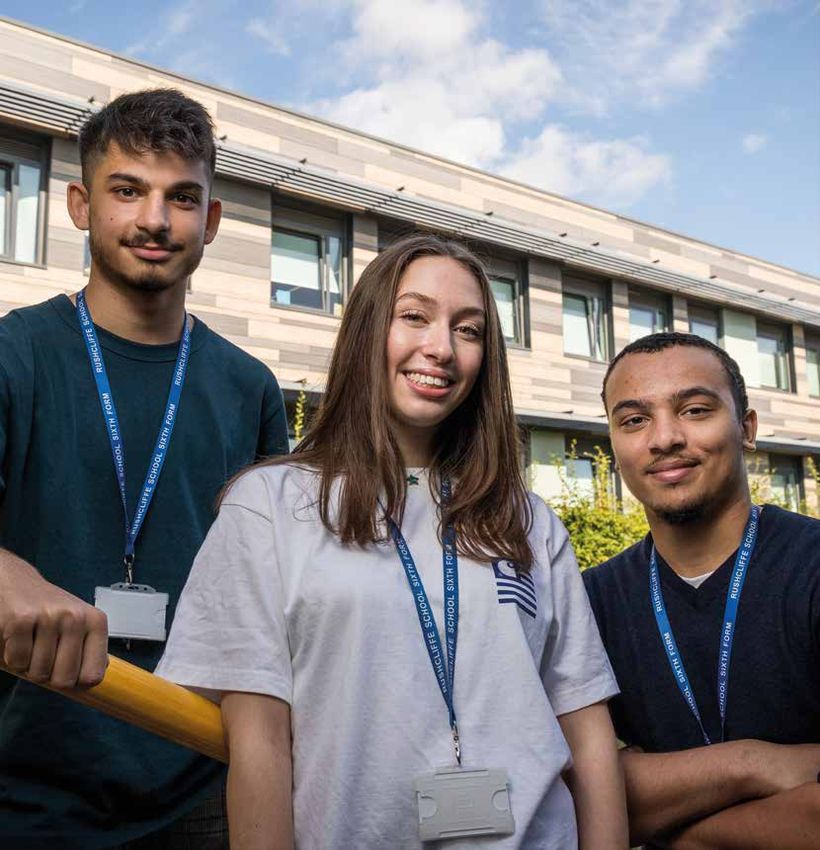
“Welcome to Rushcliffe
    Spencer Academy’s Sixth
    Form. Starting post 16
    education is an exciting
    time in your life and it is
    very important that the
    choice of where to study
    is right for you.

    It is my pleasure to welcome you to the Rushcliffe Sixth Form. At
    Rushcliffe, we have a simple core purpose that underpins everything
    we do: everyone will be given the chance to shine brightly. We want
    every young person, no matter what their background or future
    aspirations, to be successful – during their time at Rushcliffe and in
    the many years beyond.

    Academic excellence is at the heart of all we do and we are
    rightly proud of the outstanding achievements of our students.
    However, we are very clear that there is more to education than
    great qualifications. We want Rushcliffe students to develop into
    well-rounded young people who are kind to others, open-minded
    and able to lead happy and healthy lives when they leave us. We
    want our students to be a generation who make the world a better
    place. Consequently, we provide extensive pastoral and wellbeing
    support in the Sixth Form. We also offer a broad range of enrichment
    opportunities and encourage students to take part in as much as they
    can.

    We have high expectations of everyone in the school community. This
    leads to an environment where students work hard, show respect and
    courtesy and are expected to try their best in all that they do. We are
    a happy and harmonious community where talents are nurtured.

    We have a skilled and highly committed staff team. They will go the
    extra mile to support, nurture and challenge our students. We work
    with other schools, employers, universities and a number of other
    organisations to learn from the latest research and bring the very best
    practice to Rushcliffe.

    I hope that, having learned more about what we offer, you decide that
    the Rushcliffe Sixth Form is the right place for you to continue your
    education.

    Damian Painton
    Principal

2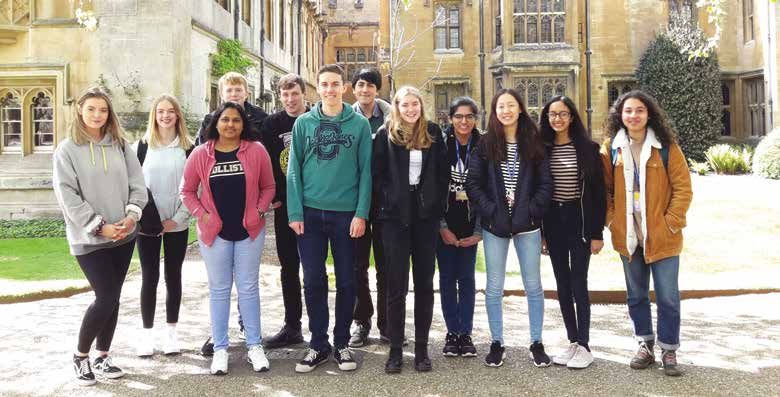
The core values of Rushcliffe Spencer Academy drive everything            We keep each other informed – we pride ourselves on forging
we do in the sixth form. We believe that everyone should have the         positive relationships with our students and parents/carers and in
chance to shine brightly and the values below guide us to enable          ensuring communication is timely and effective. It is important that we
students to achieve their best academically and to be ready for           share relevant information and keep everyone informed about student
challenges that lie ahead - whether that is going to university, taking   progress, opportunities to enhance learning and all aspects of sixth
a gap year, embarking on a Higher Apprenticeship or moving into the       form life.
world of work.
                                                                          We are proud to be part of the school – our students never cease
We try our best – Rushcliffe sixth form students receive quality          to amaze us. We are truly proud of both their academic and extra-
teaching and excellent pastoral support that leads to them to make        curricular achievements. The opportunities given to young people
sustained progress. The impressive exam results achieved by our           during their time here are fully exploited by them. They are proud of
students are the result of continued effort and commitment.               their school and we are proud of the young adults they become.

We support each other – we have an inclusive ethos, recognising           We care for our world – Rushcliffe students are aware of and
and celebrating diversity whilst coming together as one community.        understand the wider world and their place in it and we encourage
Our Heads of Year 12 & 13, Tutors, Sixth Form Mentor and support          them to develop the knowledge, skills and values they need to be
staff all work collaboratively to ensure students receive the support     global citizens who can effect positive change. Our students accept
they need to be successful.                                               responsibility and are willing to take action to make our planet more
                                                                          peaceful, sustainable and fairer.
We listen to different opinions – our students are involved in
key decisions regarding the organisation of the sixth form and we         Each year we enrol increasing numbers of students from schools
encourage all to become involved in school council, community and         across Nottinghamshire and beyond, and we warmly welcome all
charity committees. Students’ views on teaching and learning allow        applications – an application form can be found on our website at
us to continuously develop our practice and we make sure that their       http://www.rushcliffe.notts.sch.uk/.
voice is heard.
                                                                          I hope this prospectus will provide you with the information you need;
                                                                          should you have any questions please do not hesitate to contact
                                                                          school. Thank you for your interest in Rushcliffe Sixth Form.
“The excellent exam                                                       Ruth Frost
                                                                          Assistant Principal (Post 16)
results achieved by our
students are the product
of continued effort and
commitment.”
                                                                                                                            Ben Roberts
                                                                                                                      Head of Sixth Form

Sixth Form Prospectus                                                                                                                               3
Life at Rushcliffe Sixth Form
    The Curriculum

    Our individualised student learner programmes constitute a
    combination of qualification and non-qualification hours.

    Qualifications

    Rushcliffe Spencer Academy offers a wide range of A levels and
    vocational Level 3 courses (each equivalent to 1 A level):

    Mathematics                           Humanities

    Maths                                 Philosophy & Ethics
    Further Maths                         History
                                          Geography
                                          Business Studies
    Sciences                              Applied Business Studies
                                          Economics
                                                                      The subjects available are dependent on class sizes and uptake each
    Biology                               Politics
                                                                      year.
    Chemistry                             BTEC Health & Social Care
    Physics                               Psychology
                                                                      The majority of our students select three Level 3 courses with a small
    BTEC Applied Science                  Sociology
                                                                      number choosing to study four (students achieving mostly grades 8/9
    Applied Diploma Food Science
                                                                      at GCSE).
    & Nutrition
    PE                                    Performing Arts
                                                                      All A level courses are now linear. This means that students will
    Computer Science
                                                                      study each subject for two years, at the end of which they will sit A
    Cambridge Technical IT                Drama and Theatre
                                                                      Level public examinations. The vocational Level 3 courses combine
                                          Music
                                                                      elements of assessed coursework with final exams – please see the
                                                                      specific course information for details.
    English
                                          Art and Innovations
                                                                      To monitor progress and enable success, students complete internal
    Media
                                                                      assessments in all subjects throughout Y12 and Y13. All students sit
    English Lang & Lit                    Fine Art
                                                                      Y12 exams and mock exams in early spring of Y13. Termly Progress
    Eng Lit                               Product Design
                                                                      Reviews in Y12 and Y13 are sent home to parents/carers, reporting
                                          Textiles
                                                                      on behaviour for learning, in addition to target and predicted grades,
                                                                      as such student progress is carefully monitored and intervention is
    Languages
                                                                      timely and appropriate.
    Spanish
    French
                                                                      Sixth Form entry requirements

                                                                      •    A minimum of five GCSEs at grades 4-9 including English and
                                                                           Maths.
                                                                      •    A grade 6 in the subject selected for A level if studied at GCSE.
                                                                      •    For each course please see the specific requirements
                                                                           summarised in the table at the back of and on the course
                                                                           information pages of this prospectus

                                                                      Please note: meeting requirements for any course does not
                                                                      automatically guarantee an offer of a place on that course.

                                                                      If your predicted grades do not meet our entry requirements for your
                                                                      preferred options please talk to us regarding possible pathways.

                                                                      Enrichment

                                                                      Rushcliffe Sixth Form provides a wealth of stimulating and engaging
                                                                      opportunities beyond the core curriculum subjects to broaden a
                                                                      student’s perspective and develop skills for further study, employment
                                                                      and adult life. In view of this aim, students are timetabled for one hour
                                                                      each week to take part in an enrichment activity. What we offer may
                                                                      vary each year and is dependent on student choices. Typically our
                                                                      timetabled programme includes a range of qualification and non-

4
qualification elements for example:

                                •    Extended Project Qualification* : taught elements and project
                                     supervision
                                •    Young Enterprise Award
                                •    Duke of Edinburgh – Gold award
                                •    Functional ICT
                                •    Mandarin (for beginners)
                                •    Arts in Education
                                •    Community First
                                •    Sports Leaders Award (Level 2)

                                *The Extended Project Qualification (EPQ) is offered as part of our
                                Enrichment Programme. Completion of an EPQ project develops
                                independent study skills and demonstrates an interest, knowledge
                                and aptitude outside of A level course requirements. The EPQ is very
                                well received by universities and is worth half an A level, graded A*
                                to E.

                                Tutorial programme

                                Our experienced team of tutors are the first point of contact and
                                support during a student’s time in sixth form. Students follow a
                                comprehensive tutorial programme delivered to cross curricular tutor
                                groups each morning in ‘form time’. Form time activities will include:

                                •    Transition programme: bridging the gap from GCSE to Level 3
                                     studies
                                •    Study skills - with a focus on independent learning
                                •    Careers education, information, advice and guidance
                                •    Essential IT skills
                                •    Sessions on health and well – being
                                •    Developing self-confidence, team building and leadership skills
                                •    Mentoring : group and 1:1 sessions
                                •    Post 18 pathways

                                Bright Days

                                In addition to the tutorial programme Bright Days see the whole
                                school ‘off timetable’ four times during the academic year to focus on
                                issues and themes relevant to each year group. The themes for sixth
                                form Bright Days include:

                                •    Personal health and well-being including the dangers of drug
                                     and substance abuse, alcohol awareness, driver awareness and
                                     sexual health
                                •    Mental well-being
                                •    Revision & Study Skills for lifelong learning
                                •    Developing a Growth Mindset: resilience, team work,
                                     communication and personal organisation
                                •    Progression Post 18: where next? (Apprenticeships, Higher
                                     Apprenticeships, gap years, direct routes to employment and
                                     Higher Education)
                                •    University visits & UCAS: managing the university admissions
                                     process
                                •    The world of work : skills acquisition and work experience
                                     preparation

                                Personal Support and Guidance

                                We want our students to shine brightly in all aspects of their academic
                                studies and to achieve their full potential. If there are times when
                                a student needs more support and guidance, our highly developed
“We want our students to        systems of monitoring and intervention aim to get them quickly back

shine brightly in all aspects   on track. Form tutors and HOY work closely with students, including
                                1:1 mentoring sessions.

of their academic studies       The sixth form team includes a dedicated mentor (full time, non-
and to achieve their full       teaching member of staff), experienced and skilled in working with 16-
                                18 year olds facing academic and /or personal challenges. The school
potential.”                     also benefits from two qualified counsellors who work with students in
                                need of professional guidance and coping strategies. Level 3 studies
                                are demanding and we encourage all of our students to seek support
                                when necessary.

Sixth Form Prospectus                                                                                     5
enrich learning. Within subject areas there are opportunities for
                                                                              students to participate in residential visits to expand their breadth
                                                                              of understanding beyond the curriculum specification. To name but
                                                                              a few, the Physics/Mathematics trip to CERN in Switzerland, the
                                                                              Spanish Exchange to Madrid, the History trip to Moscow and St
                                                                              Petersburg and Geography field trip to Borth are all very popular.
                                                                              There are also other opportunities which are not subject specific – for
                                                                              example a visit to Auschwitz with the Holocaust Education trust for
                                                                              two Year 12 students.

                                                                              Extracurricular opportunities

                                                                              Rushcliffe Sixth Form offers many exciting opportunities which
                                                                              allow students to develop a range of valuable skills to support their
                                                                              transition into Higher Education and the world of work.
    Careers and progression post 18
                                                                              School council and sixth form committee
    All of our year 12 students undertake a week’s work experience in
    the spring term – this gives them the opportunity to develop essential    Two Student Presidents, elected by staff and students, are supported
    communication and workplace skills and to gain an insight into            by two Deputies and two form representatives from each tutor group
    the reality of a particular profession or career. Their experiences,      in year 12 and 13 and together constitute the sixth form committee.
    observations and reflections help to shape their future ambitions and     Under the leadership of the Student Presidents their collective
    ensure a focus on progression post 18.                                    responsibilities include:

    Whichever post 18 pathway our students choose, they will be able          •    Representing the school at key events such as Open Evenings
    to draw on the breadth of expertise offered by their Form Tutors,              and Achievement evenings
    Learning Mentor, Heads of Year and a dedicated Careers Advisor for        •    Meeting with the Assistant Principal (Post 16) to communicate
    expert and specialist advice. Whilst some of our students opt to take          concerns/raises issues on behalf of their peers
    a gap year, some secure apprenticeships and others go directly into       •    Leading the School Council – representing pupils in years 7-13
    employment, the vast majority choose to go to university on leaving            and liaising with the school’s Senior Leadership Team and
    Rushcliffe. We have considerable experience in advising students               Governors
    and supporting them through the UCAS application process and in           •    Organising and running fundraising events for the school’s
    making successful applications for all types of course including highly        nominated charity
    competitive courses such as Medicine, Law, Dentistry and Oxbridge         •    Managing the common room and sixth form areas
    entry. With a number of HE institutions nearby we work in partnership     •    Organising the Year 13 prom and sixth form social events
    with the University of Nottingham, Loughborough University and
    Nottingham Trent University. Rushcliffe Spencer Academy also has          Subject Ambassadors programme
    established links with Magdalen College, Oxford and Peterhouse
    College, Cambridge.                                                       Students can become an ambassador for any of the subjects they
                                                                              study. Often they may feel passionate about a particular subject area
    Learning beyond the classroom                                             and intend to study it at university. As an ambassador, students take
                                                                              on a range of responsibilities including supporting teachers during
    The school recognises the importance of field work to develop and         open evenings, mentoring students in lower school, contributing to

6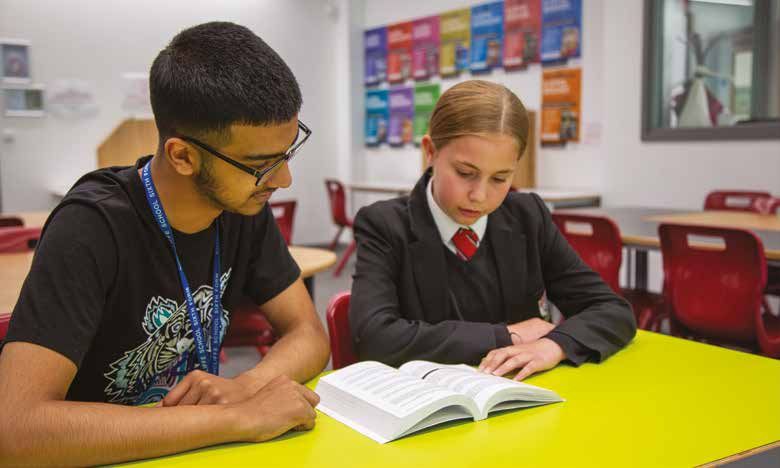
discussions regarding teaching and learning and helping to run extra-     Rushcliffe Sixth Form Community Award
curricular clubs.
                                                                          At Rushcliffe we believe it is important to foster a sense of community
Befriender Scheme                                                         and responsibility and to celebrate the contributions young people
                                                                          make to society. The Rushcliffe Sixth Form Community Award
Rushcliffe Sixth Form works closely with the charitable organisation      formally recognises all the extracurricular activities students take part
YOPEY (Young Person of the Year) to support our students to               in outside of academic lessons and study. This might include sporting
volunteer in a local care home for elderly people including those         commitments and representation, environmental work, fundraising,
with dementia. In December 2019 we were delighted to receive the          community work, membership of a musical or theatre group – the
Nottinghamshire Live Education Community Champion Award for this          list of their talents and interests is endless! The award is given at
project. Students are given the training they need to befriend their      bronze, silver, gold and platinum levels and celebrates the valuable
elderly companion and make a real impact on their lives. Our students     contributions made by our students across the school, their local
find this a rewarding and insightful experience. Many use this work       communities and beyond. Ultimately, the award allows students to
experience to support applications to study medicine, nursing,            log their extracurricular activities and gain formal recognition so that
midwifery, physiotherapy and other health care courses.                   they can easily reference them in applications for work, university and
                                                                          training.

                                                                          “We believe academic
                                                                          success should go hand
                                                                          in hand with personal
Reading & wellbeing Mentors

Many of our Sixth Form students volunteer as reading mentors to
pupils in year 7 and 8, to boost literacy skills and offer 1:1 support.
This develops empathy and important communication and leadership          development and skills for
                                                                          life.”
skills. Additionally year 12 and 13 students may be asked by Heads of
Years 7-9 to provide mentoring support for pupils who are struggling
with friendship issues, self-confidence or particular health concerns.
Pupils are matched carefully to their mentor and the partnerships
work well. The support of the sixth form mentors is invaluable and it
is wonderful to see our oldest and youngest pupils forging bonds.

Sixth Form Prospectus                                                                                                                                 7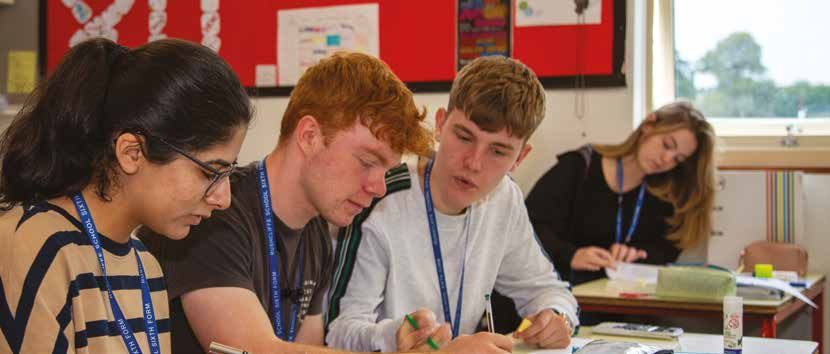
Mathematics

    Aims of the course                                                               Careers in Mathematics

    These include encouraging students to:                                           Mathematics is a ‘facilitating subject’ and therefore opens many
                                                                                     doors in Higher Education and beyond. In particular, it is needed
    •       understand mathematics and mathematical processes in a way               for Mathematics and related degrees e.g. Engineering, Sciences,
            that promotes confidence, fosters enjoyment and provides a               Computing, Finance/Economics, etc. Important for careers in
            strong foundation for progression to further study                       finance and banking, natural and life sciences, operational research,
    •       extend their range of mathematical skills and techniques                 mathematics and statistical research, engineering, insurance,
    •       understand coherence and progression in mathematics and how              information technology, education, medicine, defence and the military,
            different areas of mathematics are connected                             space and astronomy and intelligence services.
    •       apply mathematics in other fields of study and be aware of the
            relevance of mathematics to the world of work and to situations          Further Information
            in society in general
    •       use their mathematical knowledge to make logical and reasoned            www.aqa.org.uk
            decisions in solving problems both within pure mathematics and
            in a variety of contexts, and communicate the mathematical
            rationale for these decisions clearly.

    What is the outline of the course content?

    The areas of study are proof, algebra and functions, coordinate
    geometry in the (x,y) plane, sequences and series, trigonometry,
                                                                                     “A Level Maths will take
                                                                                     your learning experience
    exponentials and logarithms, differentiation, integration, numerical
    methods, vectors, statistical sampling, data representation and
    interpretation, probability, statistical distributions, statistical hypothesis
    testing, quantities and units in mechanics, kinematics, Forces and
    Newton’s laws, and moments.                                                      to another level. You will
    What key skills will I learn?
                                                                                     be tested with difficult yet
    Mathematical argument, language and proof, e.g. construct and                    engaging topics which
                                                                                     will intrigue your mind.”
    present mathematical arguments through appropriate use of
    diagrams. Mathematical problem solving, e.g. construct extended
    arguments to solve problems presented in an unstructured form,
    including problems in context. Mathematical modelling, e.g. translate
    a situation in context into a mathematical model, making simplifying
    assumptions.

    Entry Requirements                                                               Grades

        •     5 GCSE grades 4-9 including English                                        Year       Exam Board          A* A      B   C    D   E    U
        •     Grade 6 Mathematics
                                                                                         2020       AQA                 18 13 14 9         2 3      0
                                                                                         2019       AQA                 15 14 10 5         10 2     0
                                                                                         2018                           18 14 13 9         2 4      0

8
Further Maths

Aims of the course                                                       Further Information

These are the same as the Mathematics A level plus the study of          www.aqa.org.uk
Further Mathematics provides a chance to explore new and/or more
sophisticated concepts, to distinguish you as an able mathematician
in the university and employment market, and to ease transition into
a mathematics-related university course. This qualification is both
deeper and broader than A level Mathematics. It is studied in addition
to A level Mathematics.
                                                                         “Further Maths opens
What is the outline of the course content?

The core content within Further Mathematics comprises of two-thirds
                                                                         up new and exciting
of the specification. This includes proof, complex numbers, matrices,
further algebra and functions, further calculus, further vectors,        challenges. The maths
                                                                         department are always so
polar coordinates, hyperbolic functions and differential equations. In
addition to this we have to choose two areas of applied mathematics -
and currently these studied are discrete mathematics and mechanics.

                                                                         supportive, whether in or
What key skills will I learn?

Mathematical argument, language and proof, e.g. construct and
                                                                         out of lessons.”
present mathematical arguments through precise statements
involving correct use of symbols and connecting language.
Mathematical problem solving, e.g. recognise the underlying
mathematical structure in a situation to enable problems to be solved.
Mathematical modelling, e.g. interpret the outputs of a mathematical
model in the context of the original situation.

Careers in Mathematics

Further Mathematics is a ‘facilitating subject’ and therefore opens
many doors in Higher Education and beyond. In particular, it is
needed for Mathematics and related degrees e.g. Engineering,
Sciences, Computing, Finance/Economics, etc. It is important for
careers in finance and banking, natural and life sciences, operational
research, mathematics and statistical research, engineering,
insurance, information technology, education, medicine, defence and
the military, space and astronomy, and intelligence services.

Entry Requirements                                                       Grades

  •    5 GCSE grades 4-9 including English                                  Year      Exam Board   A* A    B   C   D   E   U
  •    Grade 7 Mathematics
                                                                            2020      AQA          4   2   2   1   1   0   0
                                                                            2019      AQA          5   3   1   0   0   0   0
                                                                            2018                   3   5   3   1   0   0   0

                                                                                                                               9
Biology

     Aims of the course                                                       What key skills will I learn?

     Biology A level is designed to provide students with the opportunity     The course content allows students to develop skills in
     to explore a wide range of biological concepts, both theoretically and   communicating scientific ideas using appropriate language,
     experimentally. Throughout the course, students will be given the        application of theory, collecting primary scientific data, presenting
     opportunity to develop a wide range of skills including experimental     and processing both primary and secondary data, data analysis
     techniques, analytical and evaluative skills and independent research    and evaluation of experimental technique. There is an emphasis on
     skills. The course aims to develop awareness of current biological       mathematical skills in biology including statistical analysis of data.
     issues and up to date theories.                                          Students will also be able to develop their independent research
                                                                              skills. There is the opportunity to participate in a residential fieldtrip
                                                                              to Malham Tarn field centre in the Yorkshire dales in the summer of
     What is the outline of the course content?                               year 12. This enables the students to complete the practical ecology
                                                                              element of the course and to enhance their learning experience.
     Development of practical skills in Biology: skills of planning,
     implementing, analysis and evaluation including microscopy drawing
     and dissection. This element is no longer assessed as practical          Careers in Biology
     coursework but will be examined in the written papers. Students who
     demonstrate competency in all practical skills areas will be awarded     Students use Biology A Level is a route into Medicine, Physiotherapy,
     the Practical Endorsement element of the course.                         Nursing, Veterinary Science, Veterinary Nursing, Optometry, Dentistry,
                                                                              Conservation, Marine Biology, Horticulture, Medicinal Research,
     Foundations in Biology: cell structure, biological molecules,            Pathology, Forensic Science and many more.
     nucleotides and nucleic acids, enzymes, biological membranes, cell
     division, cell diversity and cellular organisation.
                                                                              Further information
     Exchange and transport: exchange surfaces, transport in animals
     and transport in plants.                                                 www.ocr.org.uk/qualifications/type/gce/science/biology/index.html

     Biodiversity, evolution and disease: communicable disease,
     disease prevention and the immune system, biodiversity, classification
     and evolution.

     Communications, homeostasis and energy: communication                    “The highlight has been
                                                                              the evolution module with
     and homeostasis, excretion as an example of homeostatic control,
     neuronal communication, hormonal communication, plant and animal
     responses, photosynthesis and respiration.

     Genetics, evolution and ecosystems: cellular control, patterns           the visit to Malham Tarn.”
     of inheritance, manipulating genomes, cloning and biotechnology,
     ecosystems, populations and sustainability.

     Entry Requirements                                                       Grades

       •    5 GCSE grades 4-9                                                     Year        Exam Board            A* A      B    C    D    E    U
       •    Grade 5 Mathematics & English
       •    Grade 6 Biology or performance at Grade 6 in the Biology              2020        OCR                   12 9 13 7 1 1                 0
            papers in combined Science                                            2019        OCR                   3 10 10 12 11 1               0
                                                                                  2018                              3 5 7 7 8 4                   1

10
Chemistry
Aims of the course What key skills will I learn?
Chemistry affects the whole world around us and there are very few In addition to chemical knowledge, the course will also develop
products in the world that do not involve chemists in some way. This skills that are valued by universities and employers. These include
can range from biochemists developing new drugs to cure diseases problem solving, practical skills, working safely, numeracy, literacy,
to materials chemists developing the fabrics of the future. Additionally, communication, thinking in 3D and teamwork.
chemistry is required for a number of non-chemistry degree courses
such as medicine and dentistry.
Careers in Chemistry
The aim of the A level Chemistry course is to give students an
understanding of how substances behave and interact on an atomic There are hundreds of career sectors that look for students with A
scale and how this can be applied to the real world. level Chemistry, ranging from Agro Chemistry to Textiles. There are
many you would not even know existed. Even if you do not choose a
career in chemistry, employers know and trust the qualification as a
What is the outline of the course content? good indicator of intellect and work ethic.
Over the two years the chemistry course will cover the
following areas: Further information
Physical chemistry: atomic structure, amount of substance, http://www.aqa.org.uk/subjects/science/as-and-a-level/
bonding, energetics, kinetics, equilibria, redox equations, chemistry-7404-7405
thermodynamics, rate equations, electrochemical and acids and
bases.
Inorganic chemistry: periodicity, the alkaline earth metals, the
halogens, period 3 elements and their oxides, transition metals and
reactions of ions in aqueous solution. “Chemistry has given
Organic chemistry: alkanes, halogenoalkanes, alkenes,
alcohols, organic analysis, optical isomerism, aldehydes,ketones,
me a real insight into the
carboxylic acids, aromatic chemistry, amines, polymers, amino acids,
proteins, DNA, organic synthesis, nuclear magnetic resonance world around us. Both fun
spectroscopy and chromatography.
Incorporated into these areas is also practical chemistry, where
and informative - this year
students will develop the practical skills that will enable them to
independently investigate chemical applications and produce has been fantastic.”
accurate results.
Entry Requirements Grades
• 5 GCSE grades 4-9 Year Exam Board A* A B C D E U
• Grade 5 Mathematics & English
• Grade 6 Chemistry or performance at Grade 6 in the 2020 AQA 11 18 10 5 5 1 0
Chemistry papers in combined Science 2019 AQA 2 7 19 7 5 5 0
2018 5 8 7 10 11 6 0
11Physics
The Course What key skills will I learn?
Our Physics course is a must for inquisitive students who need to Physics is fundamentally an experimental subject. This course
know “Why?” It sets itself the lofty challenge of understanding the provides numerous opportunities to use practical experiences to link
universe and everything in it. We strive to deliver the course in a way theory to reality, and equip students with the essential practical skills
which helps students interpret the physical world around them and they need. The course also develops mathematical and problem
inspires them to pursue the big questions. solving skills. All of these skills are highly valued by employers and
universities.
The Physics course provides a seamless transition to A Level from
GCSE and provides a route to university courses in physics and other
subjects in which physics is a key component. Careers in Physics
More than 50% of all qualified physicists work in Research and
What is the outline of the course content? Development, Engineering, and Information Technology. Some
work on problems at the frontiers of knowledge; others tackle the
Over the 2 years, students will cover the following topics: challenging problems which arise in the application of physics to
industrial and engineering problems.
• Measurements and their errors: skills of analysing data and
manipulating results. These skills are assessed as practical
coursework (part of the Practical Endorsement Certificate) and
will be examined in the written papers.
• Particles and radiation: quantum particles, unstable nuclei,
particle classification and the photoelectric effect.
• Waves: Wave properties, superposition, stationary waves, total
•
internal reflection and double-slit interference.
Mechanics and materials: momentum, collisions, explosions,
density and elasticity.
“A Level Physics is really
• Electricity: current, potential difference, resistivity, internal
resistance and potential dividers.
intriguing and gives a
wider in depth knowledge
• Further mechanics and thermal physics: circular motion, simple
harmonic motion, internal energy and changing state.
• Fields and their consequences: gravitational fields, field strength,
•
electric potential, electric fields, capacitance and magnetic fields.
Nuclear physics: radioactive decay, decay modes, binding
for science in general.”
energy, fusion and fission.
• Engineering physics: rotational dynamics, moment of inertia,
thermodynamics and engines.
Entry Requirements Grades
• 5 GCSE grades 4-9 Year Exam Board A* A B C D E U
• Grade 5 English
• Grade 6 Mathematics 2020 AQA 6 8 9 3 1 1 0
• Grade 6 Physics or performance at Grade 6 in the Physics 2019 AQA 1 10 10 1 3 1 0
papers in combined Science 2018 4 9 7 8 6 3 0
12BTEC Applied Science
BTEC National in Applied Science – Extended Certificate What skills will I learn?
This is a two year course equivalent in size to 1 A level. This type The requirements of the qualification will mean that you develop
of course requires you to be well organised and able to work to the transferable and higher order skills which are valued by higher
deadlines; you will be a student who achieves through continuous education and employers. For example, the study of Applied Science
assessment. particularly encourages development of skills such as evaluation,
analysis and synthesis. You will learn how to think and work like
a scientist in a practical environment. You will develop written
Aims of the course communication skills when producing lab reports and analysing data.
You will understand a range of scientific techniques across all three
This course aims to give you the opportunity to pursue your sciences and develop competency in working with a wide variety of
passion for Science whilst developing your skills, knowledge and lab equipment.
understanding. It does this by giving you the chance to experience
a range of contexts in Physics, Chemistry and Biology. Scientific
practical investigations are a very important aspect of the course Careers/Further Education
and you will develop your ability to communicate science in written
coursework and examinations. The course supports progression to Higher Education (universities
and colleges) and carries equivalent UCAS Points to a single
A-Level. This is also a great course for supporting entry to a Higher
Outline of course content: Apprenticeship or employment in the science sector. Students taking
Applied Science may go on to study a wide range of degree courses
1. Unit 1 - Principles of Applied Science: including Physical Science, Psychology, Forensics, Biomedical
This unit covers some of the key science concepts in biology, sciences and Nursing.
chemistry and physics.
2. Unit 2 - Practical Scientific Procedures and Techniques.
Learners will be introduced to quantitative laboratory techniques,
calibration, chromatography, calorimetry and laboratory safety, which
are relevant to the chemical and life science industries.
3. Unit 3 - Science Investigation Skills.
“Develop your ability to
communicate science in
This unit involves students planning and carrying out extended
investigations and writing a detailed lab report.
4. Additional Unit – TBC.
A coursework based unit exploring an area of science in more detail. written coursework and
Again, skills will be developed which are relevant to the chemical and
life science industry. examinations.”
Entry Requirements Grades
• 5 GCSE grades 4-9 including English 2021 Results: 50% Merit, 50% Distinction
• Grade 4 or 4-4 in Combined Science
13Applied Diploma Food Science &
Nutrition
Level 3 Applied Diploma in Food Science and Nutrition Unit 3:
Experimenting to Solve Food Production Problems (Optional –
This is a two year course and is equivalent to one ‘A’ level and coursework project)
accrues UCAS points for university applications.
This units focuses on the properties of food, planning and carrying
out experiments or practical work to demonstrate the properties
Aims of the course of food, using results of experiments or practical work to propose
options to solve food production problems. This is a 12 hour
Students will have the opportunity to learn about the relationship assessment / food science experiment.
between the human body and food as well as developing practical
skills linked to experimental work and the cooking and preparation of Unit 4:
food using a wide range of complex skills. Current Issues in Food Science and Nutrition (Optional – coursework
project)
Outline of the course content: The unit requires students to develop skills to plan, carry out and
present a research project on a current issue related to consumer
Unit 1: food choice. This is a 14 hour assessment on current issues in food
Meeting Nutritional Needs of Specific Groups. (Mandatory – Exam science and nutrition - a written report is produced.
and coursework)
This unit teaches an understanding of nutrients, their functions in the What key skills will I learn?
body and how nutritional requirements vary in different situations.
Students use this understanding to critically assess diets of specific Students will enhance practical culinary skills through problem
target groups and plan changes needed to ensure a nutritional solving whilst applying knowledge of nutritional and dietary health.
balance is maintained. They will acquire skills to plan and cook Opportunities to work alongside other healthcare and industry
nutritionally balanced / complex dishes, whilst demonstrating an professions will help develop a range of generic and transferable
understanding of the importance of food safety. Unit 1 is worth 50% skills whilst encouraging an independent and analytical mind. The
of the qualification. There is an externally marked exam (1.5 hrs) ability to communicate and present findings in a variety of formats is
and a timed assessment (9.5 hours), which includes a practical exam an important aspect of this course.
based on a scenario set by the exam board.
Unit 2: Careers / Further Education
Ensuring Food is Safe to Eat (Mandatory – Case study exam)
An understanding of food science and nutrition is relevant to many
This unit gives students an understanding of hazards and risks industries and job roles. Care providers and nutritionists in hospitals
in relation to storage, preparation and cooking of food in different use this knowledge, as do sports coaches and fitness instructors.
environments and the control measures needed to minimise these Hotels and restaurants, food manufacturers and government agencies
risks. They will be able to use this understanding to be able to also use this understanding to develop menus, food products and
produce guidance material to facilitate the training of new food policies that support healthy eating initiatives. Together with other
handlers, recommend control measures that need to be in place in relevant qualifications such as ‘A’ levels in Biology, Chemistry,
given environments, to ensure that food is safe to eat. It is assessed Sociology and PE students will be able to use the qualification to
by a written assignment, (8 hrs). support entry to higher education courses.
Entry Requirements Grades
• 5 GCSE grades 4-9 including Mathematics & English No historical data – new course for 2020
• Grade 4 in Biology/Chemistry/Physics Grade 4 or 4-4 in
Science
14Physical Education
Aims of the course What goes well with Physical Education?
This course offers an in-depth insight into the world of sport and Physical Education would complement any other subject; it is
all of its associated facets. It is a cross curricular A level with a a cross curricular A level. Preferences in the past have been
scientific, sociological, historical and psychological base. It is an Psychology, Human Biology, Sociology, History, Geography and
expanding market with several avenues to follow. It has clear Design Technology.
relevance and application to you.
Careers in Physical Education
What is the outline of the course content?
Future career paths include those in coaching or outdoor pursuits
as well as careers such as PE Teacher, Primary Teacher, Sports
Content Overview Assessment Overview
Administrator, Sports Development Officer, Physiotherapist,
• Anatomy and Physiological factors affecting 30% of Osteopath, Sports Therapist, Journalist, Sport Psychologist. PE
physiology performance (01) total A A level is relevant to any career where interpersonal or leadership
• Exercise physiology 90 marks level skills are required.
• Biomechanics 2 hour written paper
• Skill acquisition Physiological factors affecting 20% of
• Sports psychology performance (02) total A Further Information
60 marks level
1 hour written paper www.ocr.org.uk
• Sport and society Socio-cultural issues in 20% of
• Contemporary physical activity and sport (03) total A
issues in physical 60 marks level
activity and sport 1 hour written paper
• Performance or Performance in PE (one sport) 30% of
Coaching (04) total A
“PE has opened up more
• Evaluation and 60 marks level
Analysis of Practical assessment
Performance for
Improvement (EAPI)
doors than I could have
What key skills will I learn? imagined.”
Studying Physical Education will provide an excellent opportunity
for students to enhance their practical performance. They will be
given opportunities to develop and refine independent research
skills and to develop an inquisitive and analytical mind. PE will
allow students to develop their skills in analysis of performance
and communication.
Entry Requirements Grades
• 5 GCSE grades 4-9
• Grade 5 Mathematics & English Year Exam Board A* A B C D E U
• Grade 6 PE
• Applicants without a GCSE in PE, but with relevant sporting 2020 OCR 2 4 2 1 0 0 0
experience and a grade 5 in Science (55 for Combined 2019 OCR 3 4 7 5 1 0 0
Science or 5 in Biology) may be considered at interview 2018 2 3 5 1 0 0 0
15Computer Science
A-Level Computer Science ( OCR ) • Fundamentals of communication and networking
• Fundamentals of databases
Aims of the course • Fundamentals of functional programming
• Computational Thinking
This course has been designed for students who wish to go on • Non-exam assessment - the computing practical project
to higher education courses or employment where knowledge of
Computing would be beneficial. Students can study Computing and Careers in Computing
go on to a career in Computing, Medicine, Law, Business, Politics or
any type of Science. The focus of the skills acquired is programming and, as such, can
be critical in giving students and advantage in a technical career,
whichever field it may be in. This course also provides the ideal
What is the outline of the course content? foundation for those students who wish to pursue Computing or ICT
at degree level or as a career- which could be in cybersecurity, games
Paper 1- Computer Systems design, software engineering, web-design, network management,
40% of A-Level systems architecture and many more.
Written exam: 2 hours 30 mins
Computer systems component (01) contains the majority of the Further Information
content of the specification and is assessed in a written paper
recalling knowledge and understanding. https://www.ocr.org.uk/qualifications/as-and-a-level/computer-science-
h046-h446-from-2015/
Paper 2-Algorithms and programming
40% of A-Level
Written exam 2 hours 30 mins
Algorithms and programming component (02) relates principally to
problem solving skills needed by learners to apply the knowledge and “We are living in a world
understanding encountered in Component 01.
Practical Problem 20% of A-Level
which is becoming
increasingly reliant on
Programming project component (03) is a practical portfolio based
assessment with a task that is chosen by the teacher or learner and
is produced in an appropriate programming language of the learner’s
or teacher’s choice.
technology so it’s inevitable
What key skills will I learn?
• Fundamentals of programming
that in any career computer
•
•
Fundamentals of data structures
Fundamentals of algorithms science will come in
• Theory of computation
•
•
Fundamentals of data representation
Fundamentals of computer systems
useful.”
• Fundamentals of computer organisation and architecture
• Consequences of uses of computing
Entry Requirements Grades
• 5 GCSE grades 4-9 including English
• Grade 6 in Mathematics Year Exam Board A* A B C D E U
• Grade 6 in Computing/Computer Science
• Applicants who can demonstrate a genuine interest in 2020 OCR 5 0 5 3 1 0 0
computing who have not studied this subject at GCSE may 2019 OCR 0 0 1 2 2 0 1
be considered at interview 2018 AQA 0 1 5 2 1 1 0
16Cambridge Technical IT
OCR Level 3 Cambridge Technical Introductory Diploma 4. Games Design and prototyping.
in IT This unit will help you develop skills in designing and developing a
prototype for a simple game. It will enable you to consider the logic of
This is a 2 year course equivalent in size to 1 A level. The course the programming structures required, as well as the interface design.
comprises of two externally examined units and a choice of three You will then build a prototype in order to demonstrate an element of
further units which are either examined or centre-assessed and your game.
moderated by OCR. 5. Web Design.
Organisations are increasingly reliant on their websites to market
goods or services and interact with clients and customers. You will
Aims of the course research, design and produce an interactive, responsive website that
is specific to a client’s needs, culminating in presenting the concept
This course is suitable for learners of the website using the prototype to the client. You will learn about
• who want to gain a Level 3 qualification to progress to Higher the security risks in website design and how to minimise these
Education (University) to study IT - it is recognised for UCAS threats. This unit will also allow you to incorporate existing interactive
points elements, as well as prototyping your own website.
• studying to prepare for employment in the IT sector
• who want to progress into IT-related apprenticeships
Careers in IT
What key skills will I learn? A career in IT or telecommunications is a great choice, as
professionals in this field are constantly in demand in many different
A specialist pathway of Application Developer will be followed. Five environments. Typical job roles within this pathway include; Web
units of work will be completed: Application Developer, Software Engineer, Mobile Application
1. Fundamentals of IT. ( Understanding how Computers and Developer, Application Developer or Software Analyst.
Networks operate )
Information learnt in this unit will provide a solid foundation in the
fundamentals of hardware, networks, software, the ethical use of Further Information
computers and how business uses IT.
2. Global Information. ( Understanding how data used stored, www.ocr.org.uk/qualifications/cambridge-technicals/it-2016-
shared and used ) suite/#level-3
The purpose of this unit is to demonstrate the uses of information
in the public domain, globally, in the cloud and across the internet,
by individuals and organisations. You will discover that good
management of both data and information is essential, and that it can
give any organisation a competitive edge.
3. App Design. “A career in IT or
telecommunications is a
The world is increasingly reliant on applications that help individuals,
businesses and organisations achieve specific activities or purposes.
In this unit you will explore potential ideas for a new application and
develop the fundamental design for it. You will then develop the
designs for an application and how users will interact with it. You will great choice”
have the opportunity to present your ideas, prototype them, and gain
feedback before refining your design.
Entry Requirements Grades
• 5 GCSE grades 4-9 including English No historical data – new course for 2020
• Grade 5 in Mathematics
• Grade 5 in IT (if studied)
17Media Studies
Aims of the course Careers in Media Studies
Media and the Creative Industries is one of the biggest growth Media planner; Multimedia Specialist; Programme Researcher; Public
industries in the UK today. Being ‘media literate’ is essential in Relations Officer; Social Media Manager; Television/Film Producer;
our modern society, so media students are encouraged to explore Advertising Account Executive; Broadcast Journalist; Editorial
and reflect critically on how we are presented with different social Assistant; Events Manager; Information Officer; Magazine Journalist;
issues, politics and representations across a wide range of media Market Researcher; UX Designer; Writer; Actor; Director; Digital
platforms (TV, film, radio, music videos, newspapers, magazines, Marketing Manager; Product Manager; Radio Production; Music
advertisements, gaming and social media). Publishing; Newspaper Editor; Scriptwriter.
This exciting course enables learners to develop and apply their
understanding of the media industries through both analysing and Further information
producing media products. A variety of teaching methods allows
students to engage in debates and enhance both their academic www.aqa.org.uk
skills, while offering the chance to get creative and become a
“Media is such a huge
Producer.
What is the outline of the course content?
part of our daily lives...
The course is centred on four key concepts: media language, media
representation, media industries and media audiences. Students will understanding how we are
have the opportunity to acquire and apply their theoretical knowledge,
practical skills and an up-to-the-minute awareness of the media
industry in both an examination and non-examination context. There
influenced by this powerful
are two examinations, each worth 35% of the A Level qualification;
the non-examination assessment is worth 30% (Internally assessed industry gives us the life
skills to make sense of our
and externally moderated).
What key skills will I learn?
complex world; to develop
The examinations will focus on skills of evaluation and in-depth
critical analysis, independent research, problem-solving skills, informed views on a range
debating, critical thinking and essay writing. Students will gain an
awareness of the world around them and the ever-evolving media
landscape.
of important global issues”
Students will extend their practical skills in their chosen medium
for the non-examination assessment, building their capacity for
independent research whilst having the opportunity to become
producers and create their own media texts.
Entry Requirements Grades
• 5 GCSE grades 4-9 Year Exam Board A* A B C D E U
• Grade 5 Mathematics & English
• Grade 6 Media Studies (if studied) 2020 AQA 2 7 4 4 1 0 0
2019 AQA 2 4 5 2 0 0 0
2018 0 2 3 2 1 0 0
18English Language and Literature
Aims of the course Careers in English
The English Language and Literature course is a stimulating course Students who study A Level English Language and Literature go
which blends critical analysis of literary texts and their contexts with on to pursue careers in writing, journalism, editing, publishing, law,
an appreciation of the linguistic techniques utilised by writers to teaching, broadcasting, media, psychology and social work.
create effects. Alongside more traditional novels, plays and poetry,
students will also engage with a rich vein of multi-modal texts and
work creatively to produce and critique their own creative writing. “The study of English
What is the outline of the course content? Language and Literature
• Paper 1: Telling Stories 40% – Remembered Places: analysing
multi-modal representations of Paris in an anthology of texts.
is the gateway to
Imagined Worlds: perspective, narrative structure and contexts in
‘Dracula’. Poetic Voices: expression of ideas through form in a
selection of poems by Seamus Heaney
understanding linguistic
• Exploring Conflict 40% – Writing about Society: creative
concepts, cultures and
interpretations and critical commentary based on ‘The Kite
Runner’. Dramatic Encounters: analysing dramatic form and
representation in Shakespeare’s ‘Othello’
unlocking creativity.
• Making Connections 40% – The non-exam assessment is an
English Language and
analytical investigation on a chosen theme and texts focussed
on the use of language to represent themes/ character/ narrative
in a range of literary and non-literary modes.
Literature encourages
literary detection at its
finest - an awareness and
What key skills will I learn?
Students will engage critically and creatively with a wide range of
texts with a focus on how language creates and communicates
meaning. The course also aims to build critical awareness of the
appreciation of how the
intricacies of language
social, cultural and historical contexts in which texts are produced as
well as their audiences and purposes. Students will gain an expansive
vocabulary and understanding of linguistic and literary techniques
as well as strengthen their written communication and expression.
Crucially, students will learn not only to become critical readers of builds meaning, mood
and message.”
texts but also effective producers and interpreters, reflecting on their
own processes of production.
Entry Requirements Grades
• 5 GCSE grades 4-9 including Mathematics Year Exam Board A* A B C D E U
• Grade 6 in English
2020 AQA 0 4 5 4 1 1 0
2019 AQA 1 0 6 5 0 0 0
2018 1 3 2 1 1 1 0
19English Literature
Aims of the course
The English Literature course is challenging, but rewarding with a real
focus on developing students’ interest and enjoyment of literature.
Students will engage critically with a wide range of texts and develop
“Without doubt, literature
their knowledge of genre and literary theory. An integral part of
the course is for students to pursue their own areas of interest in
is both the preserver and
literature with a focus on independent wider reading.
creator of a language.
What is the outline of the course content?
To study it can do
nothing other than fill
• Literary Genres: Aspects of Tragedy (40%) Othello, Death of a
Salesman and a selection of Keat’s poetry
• Texts and Genres: Elements of Political and Social Protest
Writing (40%) The Handmaid’s Tale, The Kite Runner and a
one with wisdom and
understanding... who
selection of Blake’s poetry
• Non – Exam Assessment: Theory and Independence Non-
Exam Assessment (20%) Independent choice of novel and
poetry collection wouldn’t seize such an
What key skills will I learn?
opportunity?”
The ability to read critically, analyse and evaluate whilst exploring
multiple interpretations and making connections between texts.
Undertaking independent research is fundamental to this course. The
course is also designed to enhance debating skills and academic
essay-writing.
A Level English Literature provides essential preparation for
undergraduate study of English.
Careers in English
English Literature is a facilitating subject which is highly regarded at
universities. Students who study English Literature go on to pursue
careers in journalism, editing, publishing, law, teaching, broadcasting
and the media.
Entry Requirements Grades
• 5 GCSE grades 4-9 including Mathematics Year Exam Board A* A B C D E U
• Grade 6 in English
2020 AQA 6 6 3 0 0 0 0
2019 AQA LitB 4 4 3 2 0 0 0
2018 4 3 2 0 0 0 0
20Spanish
Aims of the course • Spain: transition to democracy and coming to terms with the
past.
You will become accurate and fluent in speaking Spanish; you will
learn about the culture of the diverse and exciting Spanish speaking e) The short novel ‘Requiem por un campesino español’ based
countries; you will acquire analytical and critical thinking skills which on the Spain of the pre-civil war.
are essential to be successful at any university course.
f) The film Pan’s Labyrinth based on the Spanish post-civil war.
Spanish A level is a facilitating subject. This means studying Spanish
will keep your options open when choosing a degree and you will be a You will also have the privilege to develop your speaking skills by
preferred candidate for the top universities. having one-to-one conversation lessons with our native Spanish
language assistant from Peru.
What is the outline of the course content?
What key skills will I learn?
The course for A level Spanish is varied and inciting. You will learn
about a wide range of interesting topics related to the culture and • You will equip yourself with transferable skills such as
history of the Spanish speaking countries. You will also study a film autonomy, resourcefulness, creativity, critical thinking, excellent
and a novel in Spanish. communication skills, cultural and cognitive flexibility that will
enable you to proceed to further study or to employment.
Spanish A level topic areas: • You will find your confidence builds as you will be able to transfer
these skills into other subjects.
a) Being a young person in Spanish-speaking society: • You will also open your mind to other cultures and ways of living
• Social issues: changing family structures, relationships with which will make you a more broad-minded individual.
others and peer pressure.
• How young people respond to fashion and modern technology. At Rushcliffe we provide a wide range of extra-curricular activities to
• Education and employment. hone students’ skills and passion for Spanish language learning:
b) Understanding the Spanish-speaking world: • We organise regular cultural experience trips, such as cinema
• Culture and heritage in Spain and Spanish-speaking countries. trips and theatre, music and dance shows.
• Customs and traditions including festivals. • We also run a successful Language Leader and Ambassador
• Historical sites; art, film and music in the Spanish-speaking Programme that allows students to develop leadership,
world. communication and organisational abilities.
c) Diversity and difference:
• Migration and integration: factors that make migration and
integration easy/difficult.
• Discrimination and diversity: life for those who are discriminated
against; the positive aspects of a diverse society.
d) An insight into the recent history of Spain:
• ‘The two Spains: from the Spanish Civil War in 1936 onwards.
• Post-civil war: Control, repression and daily life in Franco’s
Spain.
Entry Requirements Grades
• 5 GCSE grades 4-9 including Mathematics Year Exam Board A* A B C D E U
• Grade 5 in English
• Grade 6 in Spanish 2020 EDUQAS 2 1 1 3 0 0 0
2019 EDUQAS 0 2 3 3 1 0 0
2018 0 2 4 1 0 0 0
21French
Aims of the course (b) Political, intellectual and artistic culture France 1940-1950: The
Occupation and post-war years
The course for A level French is designed to continue to build on • From June 1940 – May 1945: Life in occupied France; the
your interest in, and enthusiasm for language learning. You learn French Resistance
to communicate your ideas and points of view on an interesting • The cultural dimension in occupied France: The political context
and exciting range of topics in a confident and effective manner. of theatre and cinema productions
Furthermore, as the course provides an excellent basis for the further • 1945-1950: Rebuilding and restructuring society in post-war
study of languages at degree level, we encourage you to consider years
degrees in the French language or the highly popular combined
Honours degrees, and the possibilities of using French in future Alongside these topics you also study the film ‘Intouchable’ (Year 12)
employment, either in the UK or oversees. and the novel ‘No et moi’ (Year 13). You study the different characters,
themes and developments and tasks and questions you undertake
What is the outline of the course content? are designed to support you in forming a critical and intelligent point
of view which you need to express in essay form for the written exam
In Year 12, you cover the following topics: in Year 13.
a) Being a young person in French-speaking society and what that
means in terms of: What key skills will I learn?
• Families and citizenship: Changing family structures; the
changing nature of marriage and partnership; being a good During the French A level course you will work on a wide range
citizen of skills in a variety of settings using, for a large part, authentic
• Youth trends and personal identity: Trends in fashion; how young resources to enhance knowledge and understanding of the French-
people respond to modern technology; relationships with others speaking world. The EDUQAS A Level French course enables you to:
and peer pressure • enhance your linguistic skills and develop language learning
• Education and employment opportunities: The education system skills and strategies;
and student issues; work and travel opportunities and changing • develop knowledge and understanding about matters central
work scene to the society and culture of France and French speaking
b) Understanding the French-speaking world, communities, past and present;
• Regional culture and heritage in France, French-speaking • engage critically with intellectually stimulating texts, films,
countries and communities: Festivals; customs and traditions; literature and other materials in the original language;
historical sites; museums and galleries • equip yourself with transferable skills such as autonomy,
• Media, art, film and music in the French-speaking world: Trends resourcefulness, creativity, critical thinking, and linguistic, cultural
in media and art; film and music and cognitive flexibility that will enable you to proceed to further
study or to employment
In Year 13, you cover the following topics:
a) Social issues and trends: Diversity and difference Careers in French
• Migration and integration: Reasons for migration; factors which
make migration/integration easy/difficult Giving up on languages too soon is a regret that many people
• Cultural identity and marginalisation: Reasons for have when they enter the world of work, and find their ambitions
marginalisation; ways to eliminate marginalisation curtailed by the fact that they can only communicate in English. In our
• Cultural enrichment and celebrating difference: The positive increasingly competitive global marketplace, the demand for language
aspects of a diverse society skills is ever present, and employers are recognising the value of
• Discrimination and diversity: Life for those who are discriminated multi-lingual employees who have the skills and flexibility to operate in
against international environments.
Entry Requirements Grades
• 5 GCSE grades 4-9 including Mathematics Year Exam Board A* A B C D E U
• Grade 5 in English
• Grade 6 in French 2020 EDUQAS 2 0 0 0 0 0 0
2019 EDUQAS 0 2 0 2 0 0 0
2017 WJEC 1 2 3 1 1 0 0
22You can also read


