SKIN MANIFESTATIONS IN YOUNG MILITARY PERSONNEL DIAGNOSED WITH COVID-19, PERU - SciELO
←
→
Page content transcription
If your browser does not render page correctly, please read the page content below
ISSN Versión Online: 2308-0531
                Rev. Fac. Med. Hum. January 2021;21(1):206-211.
                                                                                                                               Facultad de Medicina Humana URP
                DOI 10.25176/RFMH.v21i1.3310
                CLINICAL CASE

                SKIN MANIFESTATIONS IN YOUNG MILITARY PERSONNEL
                         DIAGNOSED WITH COVID-19, PERU
                          MANIFESTACIONES CUTÁNEAS EN PERSONAL MILITAR JOVEN CON DIAGNÓSTICO COVID 19 - PERÚ
                                                          Richard J. Febres-Ramos1,a, Stephany Keila Vilchez-Bravo2,b

                  ABSTRACT
                  COVID-19 is a highly contagious respiratory tract infection caused by severe acute respiratory syndrome coronavirus 2.
                  The infection has been reported to demonstrate different types of skin manifestations including urticarial, maculopapular,
                  papulovesicular, purpuric, livedoid, and thrombotic-ischemic lesions. Given the high mortality rate of the infection, timely
                  and accurate identification of relevant skin manifestations can play a key role in early diagnosis and management.
                  Skin manifestations, a well-known effect of viral infections, are beginning to be reported in patients with COVID-19
                  disease. These manifestations most often are morbilliform rash, hives, vesicular rashes, acral lesions, and livedoid rashes.
                  Some of these skin manifestations arise before the signs and symptoms most commonly associated with COVID-19,
                  suggesting that they may be showing signs of COVID-19
                  Bibliographic reports showed great heterogeneity in the skin manifestations associated with COVID-19, as well as in their
         CASE
CLINICAL CASE

                  latency periods and associated extracutaneous symptoms. Pathogenic mechanisms are unknown, although the functions
                  of an overactive immune response, complement activation and microvascular injury have been hypothesized. Based on
                  our experience and bibliographic data, we subdivide reported skin lesions into six main clinical patterns: (I) urticarial rash;
                  (II) erythematous-maculopapular-morbilliforma confluent rash; (III) papulovesicular exanthemum; (IV) chilblain-like acral
                  pattern; (V) livedo reticularis–livedo racemosa-like pattern; and (VI) purpurico "vasculytic" pattern. These six patterns can
                  be fused into two main groups: the first – inflammatory and exanthemum – includes the first three groups mentioned
                  above, and the second includes vasculopathic and vasculytic lesions of the last three groups.
                  We can conclude that skin manifestations are similar to skin involvement that occurs during common viral infections.
                  Key words: Skin manifestations; Itching; Coronavirus infection; COVID-19 (source: MeSH NLM).

                  RESUMEN
                  La enfermedad por coronavirus es una infección del tracto respiratorio altamente contagioso causado por el coronavirus
                  del síndrome respiratorio agudo grave 2. La infección se ha divulgado para demostrar diferentes tipos de manifestaciones
                  cutáneas incluyendo lesiones urticariales, maculopapulares, papulovesiculares, purpuricas, livedoides, y trombótica-
                  isquémica. Dada la alta tasa de mortalidad de la infección, la identificación oportuna y precisa de las manifestaciones
                  cutáneas puede desempeñar un papel clave en el diagnóstico y manejo tempranos.
                  Las manifestaciones cutáneas son comunes en infecciones virales, en el caso de la enfermedad por coronavirus se han
                  reportado diversas manifestaciones, entre ellas las más comunes son: erupción morbilliforme, urticaria, erupciones
                  vesiculares, lesiones acrales, y erupciones livedoides. Algunas de estas manifestaciones cutáneas surgen antes de los
                  signos y síntomas más comúnmente asociados con COVID-19, lo que sugiere que podrían estar presentando signos de
                  COVID-19.
                  Los informes bibliográficos mostraron una gran heterogeneidad en las manifestaciones cutáneas asociadas a COVID-19,
                  así como en sus períodos de latencia y los síntomas extracutáneos asociados. Se desconocen los mecanismos patógenos,
                  aunque se han hipotetizado las funciones de una respuesta inmune hiperactiva, la activación del complemento y la
                  lesión microvascular. Basándonos en nuestra experiencia y los datos bibliográficos, subdividimos las lesiones cutáneas
                  notificadas en seis patrones clínicos principales: (I) erupción urticarial; (II) erupción eritematosa-maculopapular-
                  morbilliforme confluente; (III) exantema papulovesicular; (IV) patrón acral similar a la chilblain; (V) patrón livedo
                  reticularis–livedo racemosa-like; y (VI) patrón "vasculítico" purpúrico. Estos seis patrones se pueden fusionar en dos grupos
                  principales: el primero - inflamatorio y exantematoso - incluye los tres primeros grupos mencionados anteriormente, y el
                  segundo incluye las lesiones vasculopáticas y vasculíticas de los últimos tres grupos.
                  Podemos concluir que las manifestaciones cutáneas son similares a la afectación cutánea que ocurre durante las
                  infecciones virales comunes.
                  Palabras clave: Manifestaciones cutáneas; Prurito; Infección por coronavirus; COVID-19 (fuente: DeCS BIREME).

                 1 Universidad Peruana Los Andes, Huancayo-Perú.
                 2 Universidad Continental, Huancayo-Perú.
                 ª Surgeon.
                 b
                   Surgeon, Pharmaceutical Chemist.
                 Cite as: Richard J. Febres-Ramos, Stephany Keila Vilchez-Bravo. Skin manifestations in young military personnel diagnosed with COVID-19 -
                 Peru. Rev. Fac. Med. Hum. January 2021; 21(1):206-211. DOI 10.25176/RFMH.v21i1.3310

                Journal home page: http://revistas.urp.edu.pe/index.php/RFMH
                  Artículo publicado por la Revista de la Facultad de Medicina Humana de la Universidad Ricardo Palma. Es un artículo de acceso abierto, distribuído bajo los
                  términos de la Licencia Creative Commons: Creative Commons Attribution 4.0 International, CC BY 4.0 (https://creativecommons.org/licenses/by/4.0/), que
                  permite el uso no comercial, distribución y reproducción en cualquier medio, siempre que la obra original sea debidamente citada. Para uso comercial, por favor
                  póngase en contacto con revista.medicina@urp.pe

                Pág. 206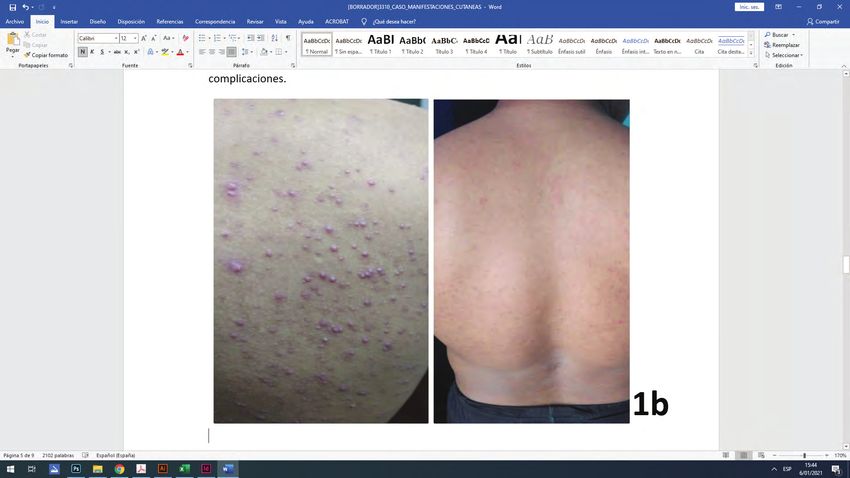
Rev. Fac. Med. Hum. 2021;21(1):206-211.                                           Skin manifestations in young military personnel

INTRODUCTION                                             the reports and new studies about this disease are of
                                                         great help(5).
On March 11, 2020, the World Health Organization
(WHO) declared a worldwide pandemic due to a new         Next, three cases of patients who were positive
disease denominated COVID-19, a virus which was          for COVID-19 by immunochromatographic test
described as causing pneumonia of unknown origin,        are reported that presented very similar skin
in Wuhan, China in December 2019, later named            manifestations, had a favorable evolution and did
SARS-CoV-2(1).                                           not present complications.
COVID-19 is a respiratory tract infection highly
contagious caused by SARS-CoV-2. Viral infection has
                                                         DESCRIPTION OF CLINICAL CASES
been divulged to demonstrate different types of skin     CASE 1
manifestations, including urticarial, maculopapular,
                                                         It is presented as the case of a 24-year-old male
papulovesicular, purpuric, livedoid, and thrombotic-
                                                         patient without significant history, in his second
ischemic lesions. Given the high mortality rate of
                                                         year of military service, denies allergies. An
the infection, timely identification of diverse skin
                                                         immunochromatographic test in blood where
manifestations may play a key role in the diagnosis
                                                         reactive IgM was obtained. He presented mild

                                                                                                                                    CLINICAL CASE
and management of the disease as well as the
                                                         symptoms as sore throat and nasal congestion,
identification of disease state or phase(2).
                                                         he also received symptomatic treatment with
Skin manifestations, a well-known effect of viral        paracetamol, performed social isolation on Centro
infections, are starting to be seen in adult patients    de Salud Militar for 14 days, on its fifth day of isolation
with COVID-19 disease. These manifestations most         presented diverse skin eruptions in the dorsal
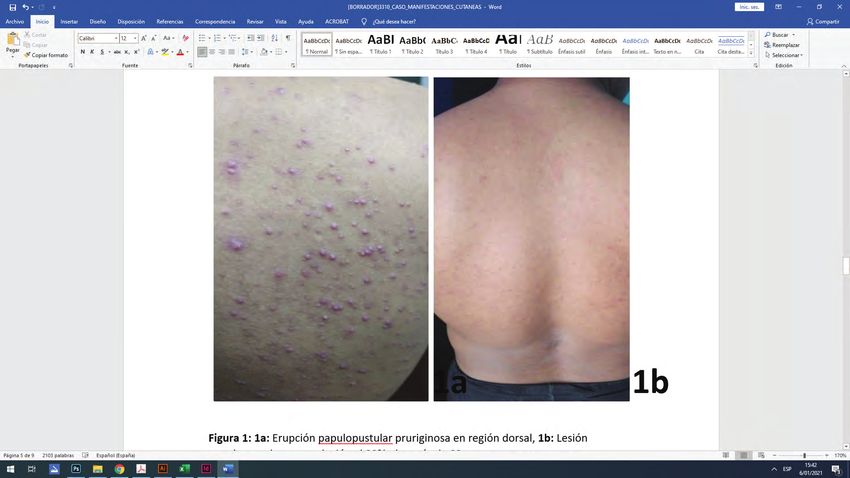
often are morbilliform rash, hives, vesicular rashes,    region, including pruritic papulopustular (Figure 1a),
acral lesions, and livedoid rashes. Some of these skin   chlorphenamine and dicloxacillin were administered
manifestations arise before the signs and symptoms       orally and symptomatology improved. After the first
most commonly associated with COVID-19,                  week of treatment, dermal lesions improved and the
suggesting that they may be showing signs of             patient no longer presented itching, which is why
COVID-19(3).                                             the treatment was suspended, after three months
                                                         the dermal lesions have decreased by 80% (Figure
Bibliographic reports showed great heterogeneity in
                                                         1b). The patient did not present other complications.
the skin manifestations associated with COVID-19,
as well as in their latency periods and associated       CASE 2
extracutaneous symptoms. Pathogenic mechanisms
                                                         A 24-year-old male patient, with no significant
are unknown, although the functions of an overactive
                                                         history, in his second year of military service with
immune response, complement activation and
                                                         COVID-19 diagnosis by immunochromatographic
microvascular injury have been hypothesized(4).
                                                         test with reactive IgM, presented on his fifth day
The intensity of viral infections in the skin and        of illness papulopustular skin rashes in the dorsal
mucosa depends on many factors such as gender,           region and pustular lesions in the genian, (Figure 2a
age, comorbidities, immune status, etc. This skin        and 2b) received treatment with chlorphenamine
infection, when replicating exponentially, can           for 05 days improving symptoms, another
generate cell destruction and tissues hyperplasia,       immunochromatographic test was performed at
evident in the various lesions it generates, many        21 days where reactive IgG is evidenced, after 03
aspects of coronavirus disease are still unknown, it     months the lesions have improved but have not yet
is not ruled out that after a period of time they may    disappeared (Figure 2c), the patient was discharged
reactivate and generate new lesions skin, that is why    without presenting complications.

                                                                                                                     Pág. 207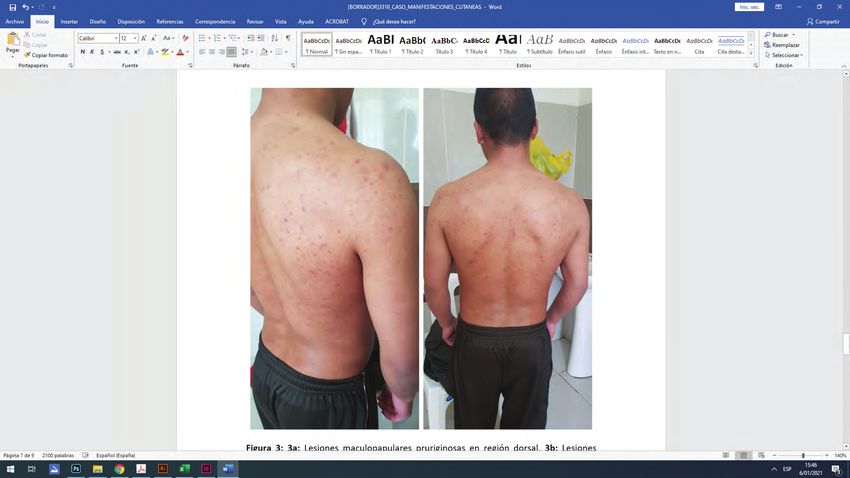
Rev. Fac. Med. Hum. 2021;21(1):206-211.                                                             Febres R et al

                 A                                                        B
CLINICAL CASE

                Figure 1. (A) Pruritic papulopustular eruption in the dorsal region. (B) Papulopustular lesion resolving at
                80%, after 03 months.

                CASE 3
                We present the case of a 20-year-old man, with no         in the dorsal region (Figure 3a), he only received
                significant history, without comorbidities, in his        oral chlorphenamine treatment for 03 days and
                first year of military service, denies allergies with a   dicloxacillin for 05 days, symptoms improve but
                diagnosis of COVID-19 by immunochromatographic            lesions do not disappear, patient he was discharged
                test. He presented mild symptoms receiving only           without presenting complications; after 03 months
                symptomatic treatment, on his seventh day of              lesions do not disappear (Figure 3b).
                illness he presented pruritic maculopapular lesions

                Pág. 208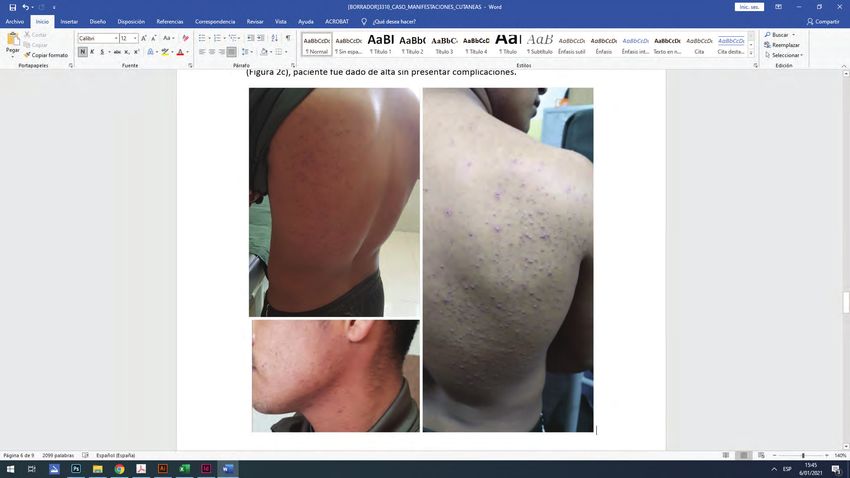
Rev. Fac. Med. Hum. 2021;21(1):206-211.                                          Skin manifestations in young military personnel

  A                                                        C

                                                                                                                                   CLINICAL CASE
  B

Figure 2. (A) Pruritic papulopustular eruption in dorsal region. (B) Pustular lesion in the genian region.(C)
Papulopustular lesion in dorsal region, after 03 months

DISCUSSION
It shall be noted that earlier and timely identification   1a) that began on the fifth day after the diagnosis
of skin manifestations may perform a key role in the       was made with a reactive immunochromatographic
early diagnosis and management of the disease,             test: IgM, which with antihistamine treatment
thus identifying the stage or phase in which the           and antibiotic therapy have decreased the lesions
disease is found(2). In Case 01 presented, clinical skin   by 80% at 03 months (Figure 1b). These dermal
manifestations are pruritic papulopustular-type            lesions are mostly accompanied by intense itching,
cutaneous clinical manifestations are evident (Figure      thus generating scratching leads to excoriative

                                                                                                                    Pág. 209
Rev. Fac. Med. Hum. 2021;21(1):206-211. Febres R et al
A B
CLINICAL CASE
Figure 3. (A) Pruritic maculopapular lesions in dorsal region. (B) Maculopapular lesions in dorsal region by
resolution, after three months.
lesions, which can later become infected, so timely with antihistamines, in this way symptomatology.
management is crucial(3). After three months, lesions improved but still
In Case 02, after diagnosis by persist (Figure 2c). Pathogenic mechanisms of
immunochromatographic reactive test: IgM skin manifestations are still unknown, in this way
on the fifth day presented skin eruption of different hypotheses have been postulated, for
papulopustular type in dorsal region and pustular instance: overactive immune response, complement
lesions in genian region (Figures 2a and 2b). As activation and microvascular injury(4).
it is described in bibliographic research, skin Case 03 shows a patient with
manifestations associated with COVID-19 present immunochromatographic test diagnosis who
a high heterogeneity(4). He received treatment presented pruritic maculopapular lesions (Figure
Pág. 210Rev. Fac. Med. Hum. 2021;21(1):206-211. Skin manifestations in young military personnel
3a). According to bibliographic data, we may rate or manifest at the cutaneous-mucosal level as part
this type of lesion in clinical pattern type II: confluent of a general picture(6).
er ythematous-maculopapular-mor billifor m
Maintaining a healthy lifestyle, adequate control of
eruption, this clinical pattern belonging to the
comorbidities and an adequate immune status will
Group: inflammatory and exanthematous(4). He
reduce the intensity of viral infections of the skin
received antihistamine treatment and antibiotic
and mucosa.
therapy. As a result, the symptomatology improved
and there were no complications. Lesions are still
CONCLUSION
presented after three months (Figure 3b).
It is concluded that the cutaneous manifestations
Finally, it is important to remember that the intensity
can be multiple, both as initial, intermediate and
of viral infections in the skin and mucosa depend on
final symptoms of the Covid-19 disease, to be taken
many factors such as gender, age, comorbidities,
into account for the evaluation of patients with
immune status, etc.(5). As were the cases reported
in these three young patients belonging to the infection by the Sars-cov2 virus, which in its great
Peruvian army, without comorbidities and who are Most respond favorably to the use of antihistamines
in good physical condition, all these aforementioned and antibiotics, the timely management of these
CLINICAL CASE
factors prevented future complications. skin lesions is very important to avoid later
complications. It is also important to know the skin
The skin, including the mucous membranes, is an manifestations of Covid-19, since this helps to know
organ that very frequently presents viral infections. the totality of clinical manifestations of this new
These infections can be located primarily in the skin disease.
Authorship contributions: The authors made the Conflict of interest: The authors declare that they
generation, collection of information, writing and have no conflicts of interest in the publication of
final version of the original article. this article.
Financing: Self-financed. Received: October 02, 2020
Approved: December 17, 2020
Correspondence: Richard Jeremy Febres Ramos
Address: Pje. Alejandro O´ Deustua N° 138, Huancayo-Perú.
Telephone number: +51 990009956
E-mail: richardfr.94@gmail.com
BIBLIOGRAPHIC REFERENCES
1. Genomic characterisation and epidemiology of 2019 novel 4. Marzano AV, Cassano N, Genovese G, Moltrasio C, Vena GA. Cutaneous
coronavirus: implications for virus origins and receptor binding - The manifestations in patients with COVID-19: a preliminary review of an
Lancet [Internet]. [citado 7 de septiembre de 2020]. Disponible en: emerging issue. Br J Dermatol. 1 de junio de 2020;
https://www.thelancet.com/article/S0140-6736(20)30251-8/fulltext
5. Obaya Rebollar JC. Cutaneous manifestations of COVID infection 19.
2. Elmas ÖF, Demirbaş A, Özyurt K, Atasoy M, Türsen Ü. Cutaneous About a case. Med Clin (Barc). 10 de 2020;155(1):50.
manifestations of COVID-19: A review of the published literature.
Dermatol Ther. 27 de agosto de 2020;n/a(n/a):e13696. 6. G M, José M. Infecciones virales en piel y mucosas. Rev Médica Clínica
Las Condes. 1 de noviembre de 2011;22(6):795-803.
3. Young S, Fernandez AP. Skin manifestations of COVID-19. Cleve Clin J
Med. 14 de mayo de 2020;
Pág. 211You can also read


