Smoking Products Retailer Guide - Public Health Services July 2020 - TAS Health
←
→
Page content transcription
If your browser does not render page correctly, please read the page content below
Smoking Products
  Retailer Guide

      Public Health
      Services

                 July 2020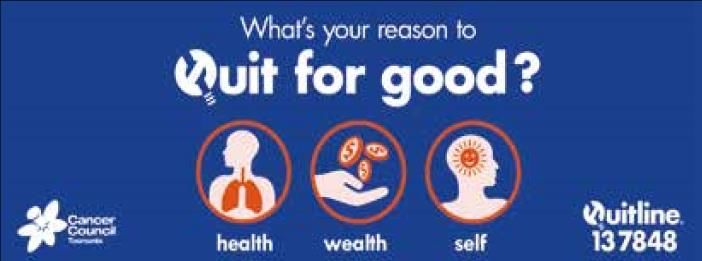
This guide describes what retailers must do to sell smoking products in Tasmania.
These obligations are contained in the Public Health Act 1997 and Guidelines for the
Sale of Smoking Products. If you intend to sell any smoking products in Tasmania,
make sure you know your legal responsibilities.

   Smoking Products Retailer Guide   2
Message from the
Director of Public
Health
This guide helps retailers comply with the provisions in the Public Health Act 1997 and
the Guidelines for the Sale of Smoking Products, about the sale and display of smoking
products in Tasmania. Smoking products include tobacco, personal vaporisers and e-
cigarettes. Please read this guide carefully. In addition, a Tasmanian ‘Responsible
Service of Tobacco’ course is also available online. I encourage you and your staff to
complete the course.
Smoking is a leading cause of illness and early death in Australia. It kills more than 500
Tasmanians every year. These harms ripple through families and communities. Nearly
one in five Tasmanian adults smoke daily or occasionally. This is the second highest
rate in Australia and compares unfavourably with the national rate of fewer than one
in six.
Fortunately, most young Tasmanians don’t smoke, but some still take it up.
That is why many of Tasmania’s smoking control laws aim to reduce the appeal,
visibility and availability of smoking products to young people, and discourage young
Tasmanians from smoking. It is illegal to display or advertise smoking products in
shops, or to supply smoking products to children in Tasmania.
Retailers, your actions can help younger generations of Tasmanians grow up to enjoy
being adults, unaffected by the harms of smoking or the loss of friends and family from
cancers or lung and heart diseases caused by smoking. Thank you for trading legally
and responsibly. If you need help with any matters in this booklet, please contact your
local tobacco control officer.

Dr Mark Veitch
Director of Public Health

Smoking Products Retailer Guide   3
Contents
Message from the Director of Public Health ...................................................................... 3
CONTENTS................................................................................................................................ 4
1. What is a Smoking Product? ............................................................................................... 4
2. Licensing .................................................................................................................................. 5
    Do I need a licence to sell smoking products? ............................................................... 5
    Who can get a licence? ........................................................................................................ 5
    What if I sell without a licence? ......................................................................................... 6
    How do I apply for a licence? ............................................................................................. 6
    If I sell my business, can I sell or transfer my licence as well? .................................... 6
    Do I need to display my licence? ....................................................................................... 6
    Are there products I can’t sell, even with a licence? .................................................... 7
    Can an employee under the age of 18 years sell smoking products? ....................... 7
    What sales information must I collect? ............................................................................ 8
    How do I report my sales information? ........................................................................... 9
3. Storing and Displaying Smoking Products .................................................................... 10
    Where can I store smoking products ........................................................................... 10
        What is a concealed storage facility? ........................................................................ 10
        What is a plain sales unit? ............................................................................................ 10
    Where can I put my sales unit? ....................................................................................... 11
    Can I display smoking products for sale? ...................................................................... 12
    What information can a general retailer display? ....................................................... 13
    Product Availability Notice (PAN) ................................................................................. 14
    Price Board .......................................................................................................................... 15

      Smoking Products Retailer Guide       4
Price Tickets ........................................................................................................................ 17
Specialist Tobacconists...................................................................................................... 18
Vending Machines ............................................................................................................... 18
5. Promotions, competitions, samples and try-before you-buy................................... 19
Can I run competitions involving smoking products? ................................................ 19
Can I provide free samples of smoking products to customers? ........................... 19
Can I show customers how to use smoking products in store?............................. 19
Can I offer prizes, gift vouchers, discounts, or other benefits? .............................. 22
Can I use other marketing schemes? ............................................................................. 22
6. Notices that must be displayed ....................................................................................... 23
Notice A ............................................................................................................................... 24
Notice B ............................................................................................................................... 25
Notices C, D, and E ........................................................................................................... 26
7. Selling Smoking Products to Children ........................................................................... 27
What happens if I sell or permit the sale of smoking products to a child? .......... 28
Can I sell lighters and matches to a child? .................................................................... 28
What information must I give my employees? ............................................................ 29
Responsible Service of Tobacco ..................................................................................... 30
8. Enforcement ........................................................................................................................ 31
What happens if I do not comply with the smoking laws? ....................................... 32
Providing false information about smoking laws ......................................................... 32
9. Glossary ................................................................................................................................ 33
10. More Information ............................................................................................................. 39
Disclaimer ............................................................................................................................ 40
Smoking Products Retailer Guide 51. What is a
Smoking Product?
A smoking product is any tobacco or personal vaporiser product. This
includes items in the diagram below.
Figure 1: The range of smoking products covered by Tasmania’s Public Health Act 1997.
Any product that
Cigarettes contains tobacco Personal
& cigars vaporisers
Shisha that SMOKING E-cigarettes
contains tobacco and e-juices
PRODUCTS
Vaping equipment
Products for use (including spare &
with tobacco Packets containing
tobacco products second-hand parts)
Exemptions
Smoking products do not include:
1. Devices for delivering oxygen to a person
2. Devices for delivering controlled substances within the meaning of the
Misuse of Drugs Act 2001 to a person
3. Therapeutic or medical devices included in the Australian Register of
Therapeutic Goods
Smoking Products Retailer Guide 42. Licensing
Do I need a licence to sell smoking
products?
Yes. If you sell smoking products (that is, any tobacco products and/or
personal vaporiser products) in Tasmania you must:
• hold a licence under the Public Health Act 1997 authorising the sale of
the product(s) or
• be employed by a licence-holder.
If you want to sell smoking products from more than one premises you
must submit a separate application and hold a licence for each premise.
Licence-holders have considerable responsibilities. If a licence holder
or a person acting on their behalf does not comply with laws and
licence conditions, the Director of Public Health may cancel your
licence.
Who can get a licence?
Individuals aged 18 years or older can apply for a licence. Companies or
other groups cannot apply, and a licence cannot be issued for public
events. A licence to sell personal vaporiser products cannot be issued for
specialist tobacconist premises.
In assessing an application, the Director of Public Health is to consider
whether you are a ‘fit and proper’ person to hold a licence. In doing so, the
Director may make enquiries with government agencies across Australia
and obtain police reports. If you do not consent to a police check the
Director may refuse to consider your application.
Smoking Products Retailer Guide 5What if I sell without a licence? You are breaking the law if you sell any smoking products in Tasmania without a licence. You may be issued with an infringement notice or be taken to court. If you sell without a licence, any future application by you for a licence to sell smoking products in Tasmania may be refused. How do I apply for a licence? You can only apply and renew for a Smoking Product Licence online at https://tobaccolicence.health.tas.gov.au/. Applications can take up to three weeks to be processed, you are not able to sell smoking products until your licence is approved. If I sell my business, can I sell or transfer my licence as well? No. A licence cannot be sold or transferred between people, businesses, or premises. Do I need to display my licence? No. You do not need to display your licence. You should keep a copy of the licence on your premises as proof you have a licence to sell smoking products. Smoking Products Retailer Guide 6
Are there products I can’t sell, even with a
licence?
Yes. The following products cannot be sold, displayed or supplied even if
you have a licence:
 • personal vaporiser products containing nicotine
 • toys or confectionery that resemble or are intended to represent a
   tobacco product
 • tobacco products (including cigarette papers) that are fruit or
   confectionery flavoured or scented
 • single cigarettes or packages/packets containing less than 20 cigarettes
 • cigarette packets that are designed to be, or can easily be, split into
   smaller packets that contain less than 20 cigarettes.

Can an employee under the age of 18
years sell smoking products?
Yes. A person under the age of 18 years can legally sell smoking products
as part of their employment with a licence-holder. However, the
Department advises caution in allowing minors to sell.
The less children are exposed to smoking products the less likely they are
to view smoking as a normal activity.

                                                        Smoking Products Retailer Guide   7
What sales information must I collect?
You must collect information about all the retail sales of smoking products
from 1 June to 30 June every year. You don’t have to collect or report
information about e-cigarette devices, papers, filters or any other ancillary
items.
What sales information must I keep?
For every smoking product you sell product type, brand name, product
description, and quantity sold.
What is a product description?
• Cigarettes are counted in pack size, not cartons.
• Loose and pipe tobacco is reported in grams per pouch.
• Cigars and Cigarillos are reported in the number per pack.
• Single use e-cigarettes, cartridges or pods are reported singularly.
• E-juice is reported in milliliters describing the size of the bottle.
Smoking Products Retailer Guide 8How do I report my sales information?
You must report the number of products you sell in the month, as
described in the image below.
To report your sales information go to My Licence at
https://tobaccolicence.health.tas.gov.au/, on or before the date you renew
your licence. You must use the online form or upload a comma separated
values (csv) file using a template.
What is the quantity I must report?
The quantity is how many of each item you sold in the month.
How will my sales information be used?
Your retail sales information will be combined with other retailers’
information and used to inform preventative health planning.
Smoking Products Retailer Guide 93. Storing and
Displaying Smoking
Products
Where can I store smoking products?
All smoking products held for sale must be kept in a concealed storage
facility or plain sales unit. This applies to all retailers, including specialist
tobacconists.
What is a concealed storage facility?
A concealed storage facility is an enclosed space (for example a storeroom
or cellar) or a cupboard, locker or drawer that the public cannot access. It
must be kept closed except when there is an immediate need to put things
in, or take things out, of it. When closed, its contents must not be visible to
the public.
What is a plain sales unit?
A plain sales unit is a sales unit that meets certain ‘plain’ criteria.
A sales unit is any shelving, receptacle, or electronic dispensing unit from
which smoking products are dispensed when sold. It includes a cigar
humidor. It does not include a vending machine unless the premises are
licensed to sell alcohol under the Liquor Licensing Act 1990.
An electronic dispensing unit is a machine designed to dispense smoking
products and be operated by an electronic keypad. A vending machine is
any other machine to dispense smoking products. Neither machine can be
operated by any member of the public.
Smoking Products Retailer Guide 10To be a plain sales unit, the sales unit must not:
• have any words or images on it, except those in the Guidelines for the
Sale of Smoking Products
• have colour or design that makes the unit stand out
• have any enhancements such as lights, mirrors, holograms, turntables,
moveable parts, or spotlights
• have on it any wording, trademarks or colour schemes usually used in
the packaging of smoking products.
Where can I put my sales unit?
A plain sales unit can only be placed in the service area. The service area is
the area where sales take place, which the public does not normally have
access to.
In premises licensed to sell alcohol, one vending machine may be used as a
sales unit. It can only be placed in the service area, where a person under
the age of 18 years cannot enter.
All sales units must also be placed:
• at least 75 centimetres away from any confectionery or product that is
designed or marketed for the use of children
• so it does not face towards a window or public entrance (unless at a
right angle or at least two metres away)
• at least five metres away from colours used on smoking product
packaging.
Smoking Products Retailer Guide 11Can I display smoking products for sale? No. If you are a general retailer (not a specialist tobacconist) you must not display any smoking products, including empty packages. A specialist tobacconist may display ancillary tobacco products (devices designed or intended only for use in connection with tobacco) including cigarette papers, cases, and ashtrays. Only one example of each product line can be displayed, up to a maximum of four square metres. A specialist tobacconist may also display matches, cigarette and pipe lighters outside this area. All retailers may incidentally and fleetingly show up to one square metre of smoking products when: • stocking or replenishing a plain sales unit • removing the products from a plain sales unit for immediate sale • stocktaking the products • moving the products to a concealed storage facility or place off-site in order to clean, service, repair, relocate or replace the sales unit, or repair or refurbish the premises • removing the products from a concealed storage facility to a place off- site • receiving a consignment (or delivery) of the products, as long as the delivery is placed immediately in a concealed storage facility. The actions listed above must be completed promptly and the sales unit and concealed storage facility must not be left open if staff are interrupted. Visitors to the premises are not in breach of the law if they have personal quantities of smoking products for their own use. People working at the premises may also have personal quantities in their possession (but not on display). Smoking Products Retailer Guide 12
4. Advertising and
Product / Price
Information
All advertising of smoking products is banned except for product and price
information that complies with the Guidelines for the Sale of Smoking Products.
The product and price information allowed for each type of retailer is
described below.
You must not otherwise display, publish or broadcast an advertisement that
can be seen or heard in or from a public place, for any smoking products.
You can sell smoking products at discounted prices but you cannot
advertise this.

What information can a general retailer
display?
If you are a general retailer, which is a retailer who is not a specialist
tobacconist or does not have a vending machine, you may (but do not have
to) display:
 • one ‘product availability notice’ (PAN) as set out on page 14 or
 • one price board as set out on page 15 and
 • price tickets as set out on page 16.

                                                       Smoking Products Retailer Guide   13
Product Availability Notice (PAN)
If you choose to display a PAN, you must not display a price board.
Your PAN must:
• only include the following words: ‘Smoking Products Sold Here’. These
words may only be written once on one side of the notice exactly as
shown or in all lowercase text
• only use black text in plain (no bold, italics or underline) Arial font on a
white background
• use a font size no larger than 160 points (or four centimetres high)
• not use any colour, lines, images or other markings
• only be placed on a plain sales unit or, if a concealed storage facility is
used instead of a plain sales unit, in the service area of the premises.
An example PAN is shown below.
Figure 2: Product Availability Notice (PAN)
Smoking Products Retailer Guide 14Price Board
If you choose to display a price board, you must not display a product
availability notice (PAN).
Your price board must:
• be no larger than 100 centimetres by 75 centimetres
• only use black text in plain (no bold, italics or underline) Arial font on a
white background
• use a font size no larger than 80 points (or two centimetres high)
• place text on one side only (that is, not on the back and front)
• limit the text to:
- the brand name (mentioned only once)
- no part of the brand name may appear more than once
- the product name, size and price
- headings relating to this information
• not use any colour, lines, images or other markings
• only be placed on a plain sales unit or, if a concealed storage facility is
used instead of a plain sales unit, in the service area of the premises.
Smoking Products Retailer Guide 15As part of a brand name cannot be repeated on a price board, the display of
information about more than one product line sold under a single brand
name can be included as shown in the example below.
Figure 3: A price board showing multiple products sold under a single brand.
BRAND NAME PRODUCT SIZE PRICE
LINE
BRAND NAME A Yellow 20 $0.00
Yellow 30 $0.00
Yellow 40 $0.00
Blue 50 $0.00
BRAND NAME B 25 $0.00
BRAND NAME C Ryo 25gm $0.00
Ryo 50gm $0.00
BRAND NAME D Red 20 $0.00
Smoking Products Retailer Guide 16Price Tickets
You may choose to use price tickets for smoking products. Only one price
ticket per product line is allowed.
Price tickets cannot be on display. Up to one square metre of price tickets
can be visible fleetingly and incidentally when you are selling, restocking or
doing one of the activities where showing smoking products is allowed (see
the list on page 12)
• Your price ticket must:
- be placed immediately next to the related product - limit the text to:
› the brand name (mentioned only once)
› a barcode (or other number/alphabet code)
› one symbol identifying the country of origin
› packet and carton prices and quantities
› headings relating to this information.
- only use black text in plain (no bold, italics or underline) Arial font
- use a font size no larger than 80 points (or two centimetres high)
- place the text on one side only (that is, not on the back and front)
- only use coloured text and background when this is consistent with
all price ticketing in the store; use no more than two colours which
do not correlate with colours used on smoking product packaging -
not use any other colour, lines, images or markings.
An example price ticket is shown below.
Figure 4: A price ticket for a smoking product
2 cm
$19.80
Product line 30s
Smoking Products Retailer Guide 17Specialist Tobacconists As described on page 12, specialist tobacconists may display ancillary tobacco products in certain circumstances. Specialist tobacconists may choose to use one or more of the following options for product and price information: • up to four square metres of price tickets that relate to ancillary tobacco products on display. The price tickets must comply with the requirements for price tickets starting on page16 (except for the display aspects) • up to one square metre of price tickets that relate to other tobacco products held for sale. The price tickets must comply with all of the requirements for price tickets starting on page 16 • one price board that complies with the requirements for price boards starting on page 15. A product availability notice is not permitted in specialist tobacconists. Vending Machines As described on page 11, if you are licensed to sell alcohol under the Liquor Licensing Act 1990 you may use one vending machine as a sales unit in a restricted area of the premises. If you have a vending machine, you cannot display a product availability notice (PAN) or a price board. You can choose to display product and price information in the form of price tickets. The price tickets must comply with the requirements for price tickets starting on page 16– except they can only be placed on the front surface of the vending machine. Smoking Products Retailer Guide 18
5. Promotions,
competitions,
samples and try-
before you-buy
Can I run competitions involving smoking
products?
No. Running competitions involving smoking products is illegal in Tasmania.

Can I provide free samples of smoking
products to customers?
No. Providing free samples of smoking products to customers is illegal in
Tasmania.

Can I show customers how to use smoking
products in store?
No. All smoking in smoke-free areas is banned. This includes
demonstrating how to smoke/vape a personal vaporiser product in your
store. If a person wants to try a smoking product before buying it, they will
need to move to an area where smoking is not banned.

                                                      Smoking Products Retailer Guide   19
Can I offer prizes, gift vouchers, discounts, or other benefits? No. It is illegal to offer any benefits to customers for buying smoking products. This includes any type of business loyalty program. This does not include programs that reward customers for the method of payment, for example credit or debit card reward schemes. Can I use other marketing schemes? No. It is illegal to use any marketing device, plan, or scheme except for price discounting (which, if used, cannot be advertised).
6. Notices that
must be
displayed
Retailers must display notices in the form and manner
approved by the Director of Public Health. For information,
the notices and instructions on how to display them are set
out below. Copies of the notices for display are available from
a Tobacco Control Officer.
In summary:
 • all retailers must display Notice A (under 18 warning)
 • a retailer with a vending machine or a retailer that is a
   specialist tobacconist must also display Notice B (graphic
   health warning)
 • a retailer of tobacco products who displays a price board
   must also display Notice C or Notice D or Notice E (Quit
   health notices).
Notice A
Notice A is a warning about the ban on selling or supplying
smoking products to a person under 18 years of age.
All retailers selling any smoking product must display
Notice A on the front surface of the plain sales unit (including a
vending machine or electronic dispensing unit) or concealed
storage facility.
If the sales unit or concealed storage facility is not in public
view, Notice A must be placed in the service area so it can be
easily seen and read by staff and the public.

                 If you give or sell smoking
               products to anyone under 18
                  you are breaking the law.

                       You could be fined.
Notice B
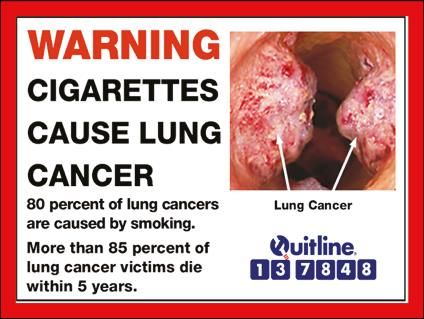
Notice B is a graphic health warning.
If you are a specialist tobacconist, you must display Notice
B on the front surface of the sales unit or concealed storage
facility so it can be easily seen and read by staff and the public.
If the sales unit or concealed storage facility is not in public
view, Notice B must be placed in the service area so it can be
easily seen and read by staff and the public.
If you have a vending machine, you must display Notice B
directly on the front surface of your vending machine so it can
be easily seen and read by staff and the public.
Notice BNotices C, D, and E
Notices C, D, and E are Quit health notices.
If you hold a licence to sell tobacco products and you
display a price board, you must also display Notice C or
Notice D or Notice E.
The notice must be displayed directly next to or on the front
surface of the price board so that it can easily be seen and read
by staff and the public.
Notice C
Notice D
Notice E7. Selling
Smoking
Products to
Children
It is against the law for anyone to sell, lend, give or supply (or
offer to sell, lend, give or supply) any smoking product or non-
tobacco cigarette to, or for the use of, a person under 18 years
of age.
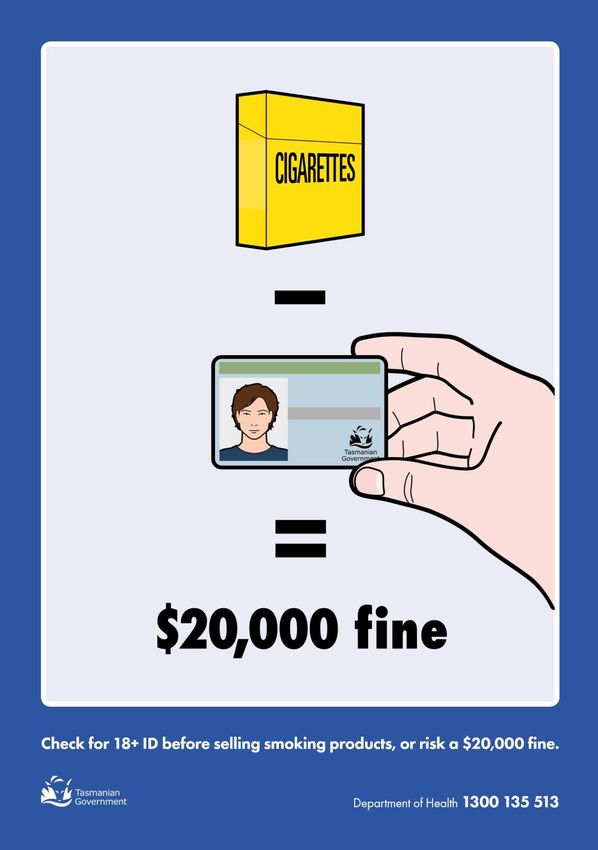
We strongly recommend you ask for proof of age before selling
smoking products to any young person, especially if you are
unsure of their age.
There are five acceptable ‘proof-of-age’ documents people can
use:
1. A current driver licence
2. A current passport
3. A current photographic keypass identification card
4. A current firearms licence issued under the Firearms Act
1996
5. A current Tasmanian Government personal information
card. A student identification card issued by a school is not
acceptable proof of age.When you view proof-of-age identification, inspect it closely to ensure the photo shows the person attempting to buy smoking products. Check that the photo and other details (including the year of birth) have not been tampered with. It is also against the law for the holder of a licence to permit the sale, loan, gift or supply of any smoking product to, or for the use of, a person under 18 years of age. Employers who do not hold a licence to sell smoking products must not permit any employee on or within 100 metres of their premises to sell, lend, give or supply any smoking product to, or for the use of, a person under 18 years of age. What happens if I sell or permit the sale of smoking products to a child? If you sell or permit the sale of smoking products to a child you may be taken to court. The maximum fine for these offences increased in 2017. It is around $20 000 for a first offence, $41 000 for a second offence, and $61 000 for a subsequent offence. The person who sold the smoking product will be responsible and the person holding a licence to sell smoking products may also be charged. The licence holder may also have their licence cancelled which means they will no longer be able to sell smoking products in Tasmania. Can I sell lighters and matches to a child? A child can legally purchase lighters and matches, although many retailers voluntarily choose not to sell these items to children.
What information must I give my
employees?
A person in charge of any premises from which smoking
products are sold must give information about the sale and
supply of smoking products to children to all employees before
each employee commences employment.
The Department recommends you provide the information
every six months. This information may be provided verbally.
Responsible Service of Tobacco
The Department recommends you provide staff with an easy
way to understand their legal obligations.
The Tasmanian Department of Health provides a Responsible
Service of Tobacco online course for you and your employees.
The free course is available at https://www.tobaccotas.com.au/
The course covers:
  a. You must not sell, lend, give or supply any tobacco
     product or personal vaporiser product (including
     electronic or e-cigarettes) to, or for the use of, a person
     under 18 years of age.
  b. You must not offer to do those things.
  c. If you do these things, you have broken the law.
     Enforcement action can be taken against you. You will be
     required to appear in court where a magistrate can impose
     a large fine. Your employer may also be fined.
  d. You have broken the law even if the under-age customer
     says the product is for a person over 18 years of age.
  e. If you are unsure whether or not a customer is over 18
     years of age, you should ask to see their ‘proof of age’
     identification. The only acceptable proof of age
     identification is:
       i. a driver licence ii. a passport
       iii. a photographic Keypass identification card iv. a
       firearms licence issued under the Firearms Act 1996
       v. a Tasmanian Government Personal Information Card.
  f. some important elements of this guide for tobacco
     retailers and their employees.
8. Enforcement The Department employs tobacco control officers to enforce the smoking laws under the Public Health Act 1997. These officers visit retailers to check compliance with the laws (including the ban on selling to children) and to ensure you are aware of your obligations when selling smoking products. They have legal powers to enter and inspect areas where smoking products are sold. A person must not assault, abuse, threaten, hinder, obstruct or delay a tobacco control officer from attempting to exercise their powers under the Public Health Act 1997.
What happens if I do not comply
with the smoking laws?
If you do not follow the laws that apply to you, you are
committing an offence.
Tobacco control officers may:
 • deliver a verbal warning
 • issue a warning letter
 • issue an infringement notice
 • commence court proceedings.
The amount a person can be fined in an infringement notice and
by a court can differ for each offence. It is set in the Act or in
Regulations made under the Act. These are available at
www.legislation.tas.gov.au.
If you have failed to comply with the law, the Director of Public
Health may cancel or place extra conditions on your licence.
If you apply to renew your licence the Director can consider
whether you have acted illegally in the past when deciding
whether to grant you another licence.

Providing false information about
smoking laws
It is against the law to provide false information about any laws
across Australia for smoking or smoking products.
It is also an offence for any manufacturer, retailer or supplier of
tobacco products to provide incorrect information about the
health effects of tobacco products.
9. Glossary
Act: the Public Health Act 1997

Ancillary tobacco products: cigarette papers, cases, ashtrays
and similar items, except:
  a. tobacco in any form
  b. a product of which tobacco is an ingredient
  c. a package or cigarette shipper containing a thing referred
     to in paragraph (a) or (b) of this definition.

Business loyalty program: a program or arrangement, other
than a business transactions program, that rewards its
customers or clients of a business for their patronage;

Business transactions program: a program or arrangement
that rewards the customers or clients of a business for using a
particular means of payment to purchase its goods or services
or not using a particular means of payment to purchase its good
or services.

Carton: a package that contains more than one packet of
cigarettes.

Cigarette shipper: packaging that contains more than one
carton.

Concealed storage facility: a storeroom, cellar or other
enclosed place or a cupboard, locker or drawer that:
  a. is inaccessible to the public
b. is kept closed, except when there is an immediate need to
put things in it or take things from it
c. when closed, cannot be seen into by the public.
Confectionery:
a. Sweets, chocolates and candy
b. Popcorn and other snack foods containing potato, nuts or
cereal
c. Confectionery novelties
d. Muesli bars, fruit bars, health food bars and other similar
products.
Department: the Tasmanian Government department
responsible for tobacco control – the Department of Health
and Humans Services at the time of publication of this guide.
Electronic dispensing unit (EDU): a machine that is
designed to dispense smoking products and be operated by
means of an electronic keypad, whether or not the machine is in
working order.
Exempt device: a device that is not included as a smoking
product under the Act.
External window of premises: a window through which a
person standing outside the premises can see into the premises
(or any part thereof).
Guidelines: Guidelines for the Sale of Smoking Products
Package:
a. A box, carton, cylinder, packet, pouch, tin and wrapping
b. The material or substance from which a package is made.Packet: an individual packet containing a smoking product/s.
Penalty units: as set by the Penalties Units and other Penalties
Act 1987. For more information, go to www.justice.tas.gov.au
Personal Vaporiser Product: electronic cigarette or other
device capable of heating any substance to be inhaled,
substances, and parts including: a. battery
b. electronic heating element
c. cartridge or container capable of holding the substance.
Plain sales unit: a sales unit that:
a. does not display any wording or imagery that contravenes
the Guidelines
b. does not have any mirror or other reflective device
c. does not have any interior or exterior lighting
d. does not have any lighting directed specifically at it,
whether from a spotlight, down light or otherwise and
whether the illumination is constant or intermittent
e. is not fitted with or connected to any device capable of
causing the sales unit (or any part of it) or its contents (or
any of its contents) to move in a way that is visible to the
public
f. does not display any wording, trademarks or colour
schemes usually used in the packaging of any smoking
products held in it
g. does not display any partial wording or imagery of any
packaging of smoking products held in it
h. has no lines, border or other visual design effects that
make it stand outi. is not linked to any hologram.
Product line (in relation to a smoking product): a kind of
smoking product distinguishable from another kind of smoking
product by any one or more of the following characteristics:
a. its length, mass or volume
b. its content
c. its brand name or trade mark
d. in the case of a packet of cigarettes or cigars, the number
of cigarettes or cigars in the packet.
Proof-of-age document: a class of document specified in the
guidelines for the purpose of this definition, including:
a. current driver’s licence
b. current passport
c. current photographic keypass identification card
d. current firearms licence issued under the Firearms Act 1996
e. current Tasmanian Government personal information card.
Restricted area of a licensed premises: an area of premises
that is designated under section 84(1) of the Liquor Licensing Act
1990 as an area in which a person under the age of 18 years
cannot enter or remain.
Sales unit:
a. In the case of specialist tobacconist premises: a receptacle,
area of shelving, electronic dispensing unit or other thing
from which tobacco products are dispensed when sold.
b. In the case of retail premises other than specialist
tobacconist premises: a receptacle, area of shelving,vending machine, electronic dispensing unit or other thing
from which tobacco products are dispensed when sold.
Sell:
a. dispose by any method for valuable consideration
b. barter or exchange
c. dispose to an agent for sale on consignment
d. offer or expose for sale
e. keep or have in possession for sale
f. agree to sell
g. send, forward or deliver for sale
h. dispose by way of raffle, lottery or other game of chance
i. provide a sample.
Service area: an area of premises:
a. from where sales of smoking products are ordinarily
effected
b. to which the public does not normally have access.
Smoke:
a. any smoke or fumes vapour from a smoking product,
including nontobacco cigarette, e-cigarette, cigar and pipe
b. inhale, puff, draw or vape from a smoking product
c. hold or have control over a smoking product.
Smoking product:
a. tobacco in any form
b. any product of which tobacco is an ingredientc. any device designed or article designed or intended only
for the use in connection with tobacco
d. any personal vaporiser product
e. any prescribed product
f. any package, or cigarette shipper, containing a thing
referred to in paragraph (a), (b), (c) or (d).
g. a smoking product package that has been emptied of its
contents.
Smoking product advertisement: writing, still or moving
picture, sign, symbol or other visual image or message or
audible message, or a combination of two or more of them, that
gives publicity to, or otherwise promotes or is intended to
promote:
a. the purchase or use of smoking product
b. the trademark or brand name, or part of a trademark or
brand name, of a smoking product.
Specialist tobacconist premises: premises that, under
section 72B of the Act, are determined to be specialist
tobacconist premises.
Specialist tobacconist premises are operated independently and
apart from any other retail business and where only tobacco,
tobacco products, matches and cigarette or pipe lighters are
sold.
Vending machine: a machine, other than an electronic
dispensing unit, designed to dispense tobacco products, whether
or not, at a given time, the machine is in working order.10. More Information Tobacco Control Department of Health Level 3/25 Argyle Street HOBART Tas 7000 Phone (toll free) 1800 671 738 Email tobacco.control@health.tas.gov.au Website https://www.health.tas.gov.au/ Tobacco Control Officer North/North West Tasmania Phone (03) 6777 1979 Tobacco Control Officer Southern Tasmania Phone (03) 6166 0656 Tobacco Licensing State-wide Phone (03) 6166 6665 Responsible Service of Tobacco online course is available at www.tobaccotas.com.au/ Apply or Manage your Smoking Product licence https://tobaccolicence.health.tas.gov.au/ Public Health Act 1997 can be viewed at www.legislation.tas.gov.au Guidelines for the Sale of Smoking Products can be viewed at www.health.tas.gov.au/publichealth/public_health_act2
Disclaimer
The information in this Guide has been prepared in good faith
but is not to be taken as an expression of the law. Legal
obligations arise under the Public Health Act 1997 and relevant
guidelines issued by the Director of Public Health. This Guide
is not a substitute for legal or other professional advice with
respect to the obligations arising under the Public Health Act
1997. The Crown in Right of Tasmania, its officers,
employees and agents do not warrant the accuracy or
completeness of this Guide and will not be responsible for
any loss howsoever arising from the use of or reliance on it.
Contact Details:
Public Health Services
GPO Box 125
Hobart TAS 7001
1800 671 738
tobacco.control@health.tas.gov.au
www.health.tas.gov.au
You can also read


