Spring 2018 IVVCC - DEDICATED TO PRESERVING IRELAND'S MOTORING HERITAGE Affiliated to FIVA - The International Federation for Historic Vehicles ...
←
→
Page content transcription
If your browser does not render page correctly, please read the page content below
Celebrating Italian Car Design at the
Carole Nash RIAC Classic Car Show
RDS Simmonscourt 10-11 March                   Spring 2018
IVVCC - DEDICATED TO PRESERVING IRELAND’S MOTORING HERITAGE
     Affiliated to FIVA – The International Federation for Historic Vehicles
Classic Car insurance
that comes with a
well-polished service
        Your Classic Car insurance policy includes:
        Free agreed value1

        Salvage retention rights1

        Up to 15% off for membership of a recognised
        owners club1

        Irish & European accident breakdown recovery,
        including Homestart assistance worth over €100

        Up to €100,000 legal protection in the event of an
        accident which is not your fault

        European travel cover up to 45 days1

        Dedicated Irish call centre2

1800 930 801
 Accept nothing less, call for a Classic Car insurance quote

Classic Bike                   Multi-Bike                  Custom Bike               Performance Bike             Scooter & Moped

carolenash.ie                                                                            / insidebikes         @insidebikes

1        2        IVVCC                    SPRING 2018
  Subject to Terms & Conditions, call forldetails. 2 Whilst most calls are handled in Ireland sometimes your call may be answered by our UK call centre.
Carole Nash Insurance consultants Ltd is authorised and regulated by the Financial Conduct Authority, firm reference number 307243. Carole Nash is a trading style of Carole Nash Insurance Consultants Ltd,
registered in England and Wales No 2600841. In Ireland, it is subject to the Central Bank of Ireland’s conduct of business rules.
Contents
4 President’s Message
6 Secretary’s Report
8 The ’57 Mille Miglia
10 Calendar of Events
12 The R-R Merlin
8. A 1957 Mille Miglia Story 12. R-R Merlin Engine Uncovered 14 Shock Absorbers
17 News from the Auctions
18 Museum Review
20 Back to the Future
21 Bill Pegum
22 From the Back Seat
23 Book Reviews
14. The Ups & Downs of Shock Absorbers 18. The Kilgarvan Motor Museum 24 Memory Lane
26 Irish-built Cars
28 The Duesenberg
30 Letters
31 For Sale
32 ARM Section
34 Motor Log
36 Competitions
38 The MG Date Debate
28. Duesenberg - The Second Coming 38. The Great MG Date Debate
President: Club Meetings:
Shane Houlihan Every first Monday of the month
087-2520787 (second Monday if first falls on a public holiday)
shane.houlihan@gmail.com
Venue:
Membership Secretary: West County Hotel, Chapelizod,
Jean Morton Old Lucan Road, Dublin 20
Rockwood Cottage, Mount Venus Road Time: 8.00pm
Woodtown, Dublin 16
Cover:
01-4931794/087-2565211
Shane Houlihan’s
rockwoodcottage@hotmail.com
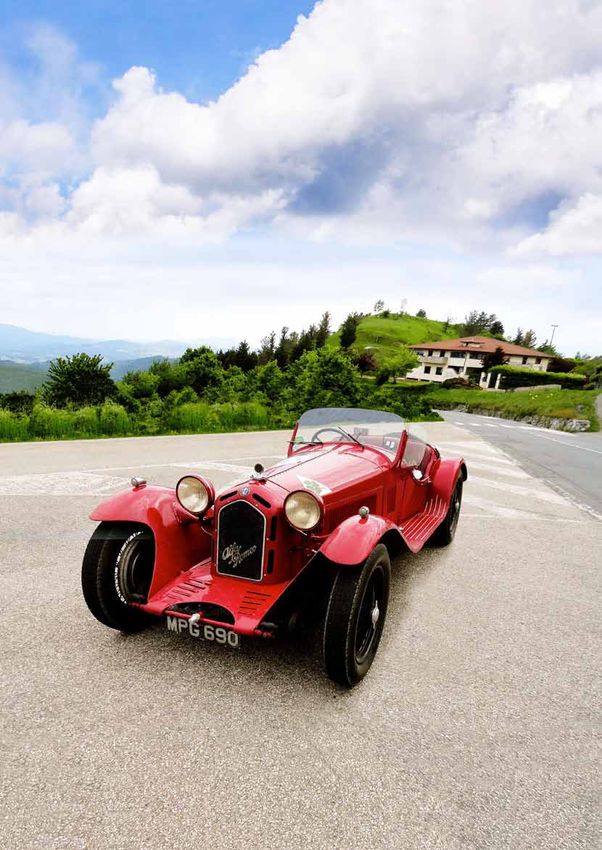
1932 Alfa Spider
Editor:
Anselm Aherne Club Website:
Car Design at
the
63 Granitefield, Dun Laoghaire www.ivvcc.ie
Spring 2018
Celebrating Italian
RDS Simmonsco
DEDIC
Classic Car Show
Carole Nash RIAC 10-11 March
urt
ATED TO PRESE
MOTORING HERIT
AGE
RVING IRELAND’Stion for Historic Vehicles
Co Dublin A96 D4E7. 086-2491043 IVVCC l SPRING 2018 3
- ational Federa
anselm@eircom.net
IVVCC FIVA – The Intern
Affiliated to
Message from
the President
Dear Members
As we head into spring we look forward to the longer evenings
and especially the opportunity to start using our cars again.
That being said, I must say it doesn’t feel like spring as it is
snowing in the Sunny Southeast as I write this message.

We must remain optimistic and think positive thoughts about               Entries are open for the annual International Gordon Bennett
the good weather ahead however. In the meantime we have                Rally from 8th to 10th June. Entries are ahead of pervious years
the indoor Carole Nash RIAC National Classic Car Show to               at this time and I would ask – If you are regular attendee or
look forward to. This is to be held once again in the RDS              even if this your first Gordon Bennett – it would be very helpful
Simmonscourt complex, Ballsbridge, Dublin, on the weekend of           to the organisers to have your entry in asap. The event this year
March 10-11. Doors will open at 10am and run until 6pm. The            is once again based in the Mount Wolseley Hotel, Tullow, County
IVVCC will occupy its usual position inside the main door and          Carlow. This is the premier event in the IVVCC calendar and I
I would like to take this opportunity to invite you to visit us.       would like to encourage all of you that have eligible pre-1930
We have an interesting and varied display of cars to interest (I       cars to come along as you will be most welcome.
hope) everyone.
                                                                         In the meantime, I hope you are all taking the opportunity
   Plans are well underway for the Percy French run for pre-war        to repair those niggly jobs that you have been putting on the
cars, which is a joint event with the Ulster Vintage Car Club          long finger – so that your cars will be humming down the road
and the IVVCC. This event is based in Carrickmacross, County           when Mother Nature decides in her own good time for spring to
Monaghan, from Friday 11th to Sunday 13th May. The event will          officially appear.
take in routes both north and south of the border, and we will
visit some interesting landmarks. We are very limited on spaces        Best Wishes and Safe Motoring,
(50 in total) due to hotel constraints, with only a few spaces left.   Shane Houlihan
If you are interested please enter as soon as possible to avoid
disappointment.

4      IVVCC         l   SPRING 2018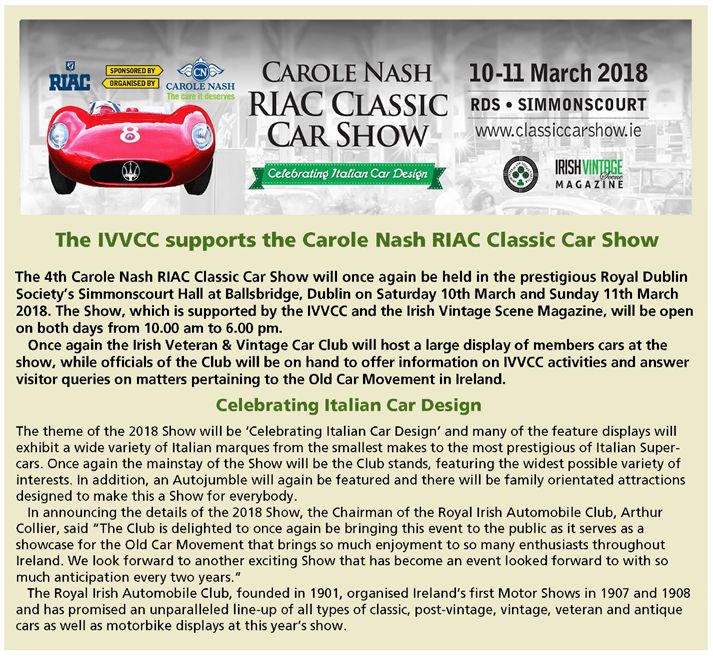
IVVCC l SPRING 2018 5
Secretary’s
Report
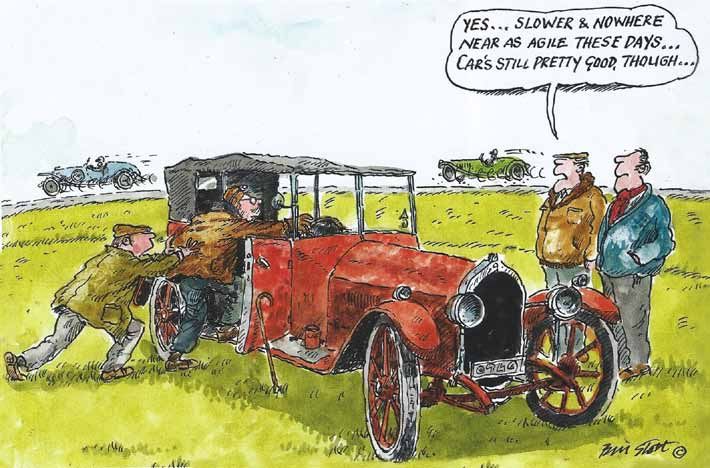
Greetings and best wishes to all our members and the members
of our associated clubs for a enjoyable and successful motoring
year in 2018. Traditionally the winter months are a quiet time
for our historic vehicles. It is a good time to catch up on those
mechanical jobs you have put off all year or perhaps the minor
bodywork issue or the annoying door or window rattle needing
attention. Hopefully, most of you managed to escape that
dreaded flu. Those cold garages that many of us have are
no addition in the very cold weather.

Although the winter months are a quiet time for events the club      any event, there was little pleasure in trying to drive on heavy
directors continue to meet regularly as is the custom throughout     traffic, and stopping and starting every few yards at red traffic
the year. Apart from the planned regular meetings, the directors     lights. The consensus is that our vehicles will continue to be
held an additional planning workshop on a Saturday in January        seen on our roads for many decades to come. That said we must
to consider the challenges facing the club in the coming year.       be vigilant and ensure that new legislation will not restrict the
The President, Shane Houlihan, will talk about some of these         enjoyment of our historic vehicles. In Europe the changes in
issues at the First Monday meeting on the 9th April. (Please         legislation are most likely to emanate from the congested cities
note that Monday 2nd April is a Bank Holiday). The February          in France and Germany. For this reason it is important that the
and March First Mondays will consist of demonstrations by            national federations on these countries along with FIVA keep us
trade exhibitors.                                                    informed of emerging trends.

  A question many of us ask ourselves from time to time: What          The future however is not bleak, on the contrary it is
does the future hold for our historic vehicles?                      promising. In recent times the importance of the motor
                                                                     vehicle and in particular the recognition of our mobile
  During the course of the 2017 FIVA General Assembly one of         heritage has come to pass following its acknowledgement by
the expert presenters spoke of how the use of our cars might         UNESCO (United Nations Educational, Scientific and Cultural
be affected by the changes in technology and legislation. He         Organization). UNESCO is responsible for coordinating
outlined a challenging vision of what the future might hold for      international cooperation in education, science, culture and
us. At some time in the future he envisaged a scenario with          communication. The recognition of the importance of mobile
four cars at traffic lights. Three of the cars would transpire to    heritage by UNESCO is of great significance and will help to
be all electric. Not only that but two of the three electric cars    ensure that our vehicles will continue to be recognised as
would be driverless. This is not an entirely unrealistic scenario.   important part of our heritage and worthy of preservation.
However FIVA are continually working on the international            This was to a great extent due to the work of the Cultural
stage to ensure that historic vehicles remain a presence on our      Commission of FIVA.
roads. Many large European cities have started to enforce low
emission zones and FIVA have developed a ‘tool kit’ to assist          As many of you know I have represented the club at FIVA
national federations to ensure that historic vehicles are not        General Assemblies for a number of years and this year I have
entirely excluded from these cities.                                 been asked to join the FIVA Cultural Commission. When I gain
                                                                     a greater understanding of the work involved I will update
  More recently I listened to a YouTube debate from the USA          members on the deliberations of the Commission. n
hosted by one of the leading classic insurance providers in
America. There was an acceptance that restrictions will in time
                                                                     Peadar Ward
be put in place to help reduce emissions in congested inner
                                                                     Honorary Secretary
city locations in the USA. However they predicted that historic
                                                                     February 2018
vehicles will continue to be widely used outside of these
congested cities with restricted zones. They argued that, in

6      IVVCC         l   spring 2 0 1 8
IVVCC l SPRING 2018 7

By Pat Meehan

A BAD DAY for a GOOD CAR
The Jaguar D-type of the Écurie Ecosse racing team in the Mille Miglia of 1957
Pat Meehan, long-time IVVCC member and also a founder member of the ARM, recalls here his involvement as
a motor racing mechanic with the Écurie Ecosse team in the 1950s. Following a famous ’56 victory at Le Mans,
Pat recalls the days of the dramatic Mille Miglia Race of 1957, with Ron Flockhart at the wheel of the team’s
Jaguar D-Type.

The Jaguar D-type Reg. No. MWS 301                       nose ex-works cars. It was to win again            inserted in the rear end and ramps that
was supplied to David Murray’s Écurie                    at Le Mans that year. Ron Flockhart was            enabled one car to be driven in and
Ecosse racing team in 1955 and                           number one Écurie Ecosse driver, so for            then raised by the ramps and a second
entered by them for the Le Mans 24 Hour                  as the team had a number one driver.               car to be driven in below it. Apart from
Race in 1956. Against all the odds it won                                                                   Murray and Wilkinson, there were three
the race – with drivers Ron Flockhart and                Flockhart, born in Edinburgh on 16th               mechanics at the race, Sandy
Ninian Sanderson – an amazing result                     June 1923, raced motorcycles originally,           Arthur, Ron Gaudion and Pat Meehan.
for a young team working out of a mews                   but then took up four-wheel racing with            The team stayed at Count Maggi’s villa.
garage in Edinburgh.                                     MG and Cooper-Vincent cars in 1948. He             Ron reconnoitered as much of the circuit
                                                         bought Raymond Mays’ famous black                  as he could in a Jaguar Mark Vll saloon,
The following year MWS 301 was entered                   ERA D type R4D in 1952 and enjoyed a               accompanied by Wilkinson, but he drove
for the Mille Miglia, the famous 1,000-                  prolifically successful season with it the         single-handed in the race.
mile race around Italy for sports cars,                  following year before becoming a works
with Flockhart driving by himself (no                    BRM driver. He drove a works Austin-               On the day of the race Pat Meehan drove
navigator). With its race number 518,                    Healey 100S in the 1955 Mille Miglia and           Flockhart to Brescia, retrieved the D-type
the D-type left the start at Brescia at 18               started to drive for Écurie Ecosse in 1956.        from its lock-up garage, carried out a final
minutes past 5.00am. As recorded in Tony                 Flockhart yearned to race in the Mille             pre-race check, saw Flockhart on to the
Pritchard’s book “Racers”, the following                 Miglia again and he persuaded Murray               starting ramp and watched him go off.
are my recollections of a bad day for the                to run him in the 1957 race with one of            Flockhart was car number 518, leaving at
Jaguar:                                                  the team’s D-types. The team still retained        5.18am. As had been discussed between
                                                         the 1956 Le Mans winner, a so-called               them, he accelerated away gently, for
The extracts below are taken from                        ‘production’ car, but the team’s chief             they had both seen an earlier starter gun
“Racers - Memoirs of the Gentleman                       engineer ‘Wilkie’ Wilkinson had carried            his car down the ramp only to break a
Drivers” by Anthony Pritchard, and based                 out extensive development work and it              half-shaft yards from the start.
on his discussions with Pat Meehan of                    was now generally agreed to be a more
the Écurie Ecosse racing team:                           practical proposition than one of the              Pat Meehan then caught a train to
In 1956-57 David Murray’s Écurie Ecosse                  long-nose ex-works cars. Everyone knew             Bologna where with the help of the
team, running D-type Jaguars, was at the                 that Flockhart would not win, but a good           local Esso representative they set up the
peak of its power. lt had won Le Mans                    effort would bring excellent publicity.            pit for Flockhart’s final refuelling stop.
in 1956 with one of its original 1955                                                                       All he had to do then was to wait for
‘production’ D-types and following the
                                                         Team Mechanics                                     car number 518 to arrive. But later, Ron
                                                         Écurie Ecosse took the D-type to Italy             Gaudion travelled from his pit in Rome
withdrawal of Jaguar from racing at the
                                                         in one at their transporters, a prewar             to report that Flockhart had retired. He
end at 1956 the team was racing long-
                                                         Leyland Tiger coach with a big door

 Ron Flockhart during the 1957 Mille Miglia, while his Écurie Ecosse D-type Jaguar   Pat Meehan works on the Titterington/Sanderson D-type during the 1955
                           was well up with the leaders                                                   9-hour race at Goodwood

8      IVVCC             l    spring 2 0 1 8
A young Pat Meehan (right) celebrates an early race win with team-mates

   Pat Meehan, standing centre, with three Écurie Ecosse racers and the team
                        transporter in the background
                                                                                The Mille Miglia Écurie Ecosse D-type Jaguar – sold in 2016 for d21 million

had gone well during the first half of the            the pits was electric,” Pat recalls, “with        1956 the works team drove the complete
race, rising as high as filth place, but on the       hundreds of ltalian enthusiasts shouting          entry on the road to the Nürburgring. So
twisting mountain roads near L’Aquila the             and clapping. The noise of the open               what had happened to Flockhart’s D-type
fuel tank and rear bodywork broke away                exhausts as the cars accelerated away             seemed uncharacteristically severe.
from the main structure of the car and                and the smell of petrol, oil and overheated
collapsed on to the back axle. The D-type was         rubber was intoxicating.” This eyewitness         The mechanics loaded it on to the
undrivable and retirement was inevitable.             account sinks the story that de Portago           transporter and drove with it to the
                                                      refused a tyre change at Bologna to save          Nürburgring where Pat Meehan
Drama at the Pits                                     time – which, by implication, led to his          photographed it before it was repaired
Meehan and Gaudion stayed at Bologna                  accident.                                         in time to run in the 1,000km race at
watching the rest at the runners scream                                                                 the German circuit – another circuit for
into the pits area. Pat remembers the                 Although the Jaguar D-type was built              which the car was totally unsuitable.
Marquis de Portago standing up in the                 for the smooth surfaces at Le Mans and            Nevertheless Ninian Sanderson and Dick
cockpit at his works Ferrari and shouting             Reims, several D-type drivers, including          Steed drove it into 16th place overall. n
at the mechanics as they refuelled the car            Duncan Hamilton and Bob Berry, regularly
and changed the wheels. “The drama in                 drove their cars on the road. As late as

[Permission to use the above extracts from the late Anthony Pritchard’s book, “Racers - Memoirs of the Gentleman Drivers” has been kindly
granted to IVVCC News by Palawan Publishing.]

Footnotes:
Ron Flockhart died on April 1962 at the controls of his P51D Mustang aircraft when it broke up in severe turbulence over the
Dandenong Mountains near Melbourne while he was testing the plane prior to a Sydney-London record attempt.

MWS 301 was sold in 2016 by Bonhams to an American enthusiast for $21 million. So…hang on to your old race cars!

See the 1957 Mille Miglia on film – check out MotorClips on page 36 in this issue

                                                                                                      IVVCC            l    SPRING 2018                       9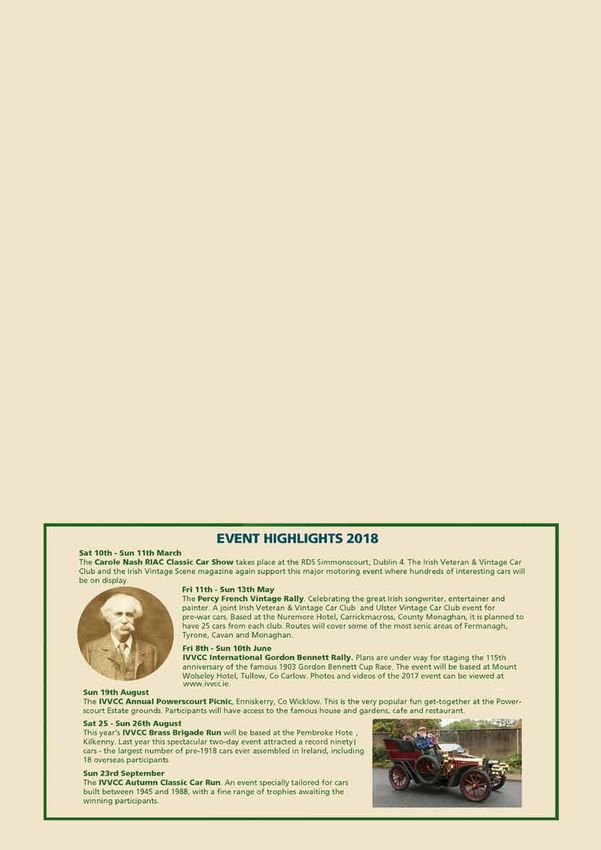
CALENDAR OF EVENTS 2018
All event details subject to final confirmation. For further information visit www.ivvcc.ie

                                                                      MARCH
Mon 5             IVVCC First Monday Meeting                          West County Hotel, 8.30pm
Sat 10 - Sun 11   Carole Nash RIAC Classic Car Show                   IVVCC participating - RDS Dublin 4
Mon 19            Garden of Ireland Club                              Poker Run / Lunch & Grand National Sweepstakes
Sun 25            Irish Model T Ford Club                             Annual General Meeting – Maldron Hotel

                                                                        APRIL
Mon 2             Garden of Ireland Club                              Easter Egg Hunt
Mon 9             IVVCC First Monday Meeting                          West County Hotel, 8.30pm
Fri 13 – Mon 16   Garden of Ireland Club                              Trip to Wales
Sun 15            Irish Model T Ford Club                             First Spring Run

                                                                         MAY
Sun 6             Celtic Old Vehicles Owners Club (COVOC)             Norman Pratt Run
Fri 11 - Sun 13   Percy French Rally - for Pre-War Cars               Joint IVVCC/UVCC event - based at Nuremore Hotel, Carrickmacross
Sun 13            Irish Model T Ford Club                             Kilkenny Spring Run
Mon 14            IVVCC First Monday Meeting                          West County Hotel, 8.30pm
Sun 20 - Wed 23 Shamrock Vintage Challenge                            Irish Racing Green event for pre-war cars. www.irishracinggreen.ie/shamrock
Sun 20            Blessington Vintage Car & Motorcycle Club           Spring Run

                                                                        JUNE
Fri 8 - Sun 10    IVVCC International Gordon Bennett Rally            Mount Wolseley Hotel, Tullow, Carlow
Sun 17            Irish Model T Ford Club                             West Cork Run
Mon 18            IVVCC Annual General Meeting                        West County Hotel, 8.00pm

                                                                         JULY
Sun 1             Irish Jaguar & Daimler Club Show                    Annual Car Show – Terenure College, Dublin 6
Mon 2             IVVCC First Monday Meeting                          Social Run
Sun 8             Garden of Ireland Club                              Tom Kennedy Memorial Show
Sat 14 – Sun 15 Irish Model T Ford Club                               29th Annual Club Rally – County Kerry
Sun 29            Lakelands Vintage Club                              Annual Car Run

                                                                     AUGUST
Sun 5             Irish Model T Ford Club                             Stradbally August Bank Holiday Event
Mon 13            IVVCC First Monday Meeting                          Social Run
Sun 19            IVVCC Powerscourt Estate Picnic                     Enniskerry, Co Wicklow
Sat 25 - Sun 26   IVVCC Brass Brigade Event                           2-day event for cars up to 1919 - Pembroke Hotel, Kilkenny

                                                                  SEPTEMBER
Sat 8 - Sun 9     Garden of Ireland Club                              Liam Kelly Memorial Run
Sun 16            Blessington Vintage Car & Motorcycle Club           Autumn Run
Sun 16            Irish Model T Ford Club                             Autumn Run
Sun 23            IVVCC Autumn Run for Classic Cars                   Event for cars 1945 to 1988

                                                                    OCTOBER
Mon 1             IVVCC First Monday Meeting                          West County Hotel, 8.30pm
Sun 7             Garden of Ireland Club                              Event TBA

                                                                   NOVEMBER
Mon 5             IVVCC First Monday Meeting                          West County Hotel, 8.30pm
Mon 19            Garden of Ireland Club                              Annual General Meeting

                                                                   DECEMBER
Mon 3             IVVCC First Monday Meeting                          West County Hotel, 8.30pm

10         IVVCC           l    SPRING 2018
IVVCC l SPRING 2018 11
By Ray Cowan

                     HISTORY UNEARTHED
The story of a lost power unit from a WWII Hurricane Fighter, recovered from an Antrim peat bog

Following from a letter received from Ray Cowan that appeared in our Winter 2017 issue about the remains of
a Rolls-Royce Merlin aircraft engine, Ray has now provided, courtesy of Raymond McMullen of Ballinderry, the
interesting story of the engine’s recovery from deep within a peat bog in County Antrim. The engine had been
powering a Hurricane fighter that crashed near Cushendall shortly after the Battle of Britain. Hurricane fighters
were in fact responsible for most of the German aircraft losses in that four-month campaign. More robust than
the Spitfire, the Hurricane’s re-arming and refueling turn-around time was also far quicker – only 9 minutes as
against 26 minutes for the Spitfire.

The Ulster Aviation Society have details of all the wartime crash sites in Northern Ireland and over the years have managed to
salvage some important wartime aircraft remains from Lough Neagh and Ulster bogs. The crash site of this Hurricane fighter was
approximately known but the cause of the crash remained a mystery as the engine was buried so deep in the peat that it wasn’t
recovered at the time. The recovered engine is now on display at the Ulster Aviation Society’s workshops. A plaque with the engine sets
the scene:
ROLLS-ROYCE MERLIN ENGINE
   “On 30 November 1940, a Hurricane fighter of No.245 Squadron based at Royal Air Force Aldergrove crashed into a peat bog near
Cushendall from a high altitude. Its Polish pilot, Sergeant Franciszek Pretiewicz was killed on impact and was subsequently buried in
the Roman Catholic graveyard in Glenavy, Co. Antrim. Because the RAF salvage party which went to the crash site in the immediate
aftermath of the tragedy failed to remove the engine in the bottom of a deep impact crater, the Court of Inquiry could only speculate
about the cause. It was only after the engine was excavated from the bog with the permission of the Ministry of Defence, dismantled
and examined by the Ulster Aviation Society in 1984 that the primary cause of the tragedy was determined beyond doubt. Failure of
oil supply to the main bearings had caused them to seize and forced a con-rod through the crankcase resulting in engine breakdown.
Being remarkably rust free – a tribute to the preservative qualities of peat – the engine was subsequently cleaned and rebuilt to the
condition seen here.”

Raymond was one of the eight Ulster           helicopter to lift it free and carry it across   that time was in Langford Lodge near
Aviation Society hardies who set out that     the mountain and over to their base at           Glenavy. Today it is housed in the Ulster
day in 1984 to try to salvage the engine.     Ballykelly. So now with the engine safely        Aviation Society’s workshops in an ex-
Not only did they need permission from        retrieved and in storage, they still had to      WWII hangar at Long Kesh near Lisburn
the Ministry of Defence but also the          get it from there to Raymond’s workshop          (on the site of the old prison).
local landowner also needed to agree          in Upper Ballinderry. An old T.K Bedford            The Rolls-Royce Merlin is in V12
to let them excavate his bog. It took         flat-bed was commissioned and once               format – a 12 cylinder, 27-litre engine,
two weekends trekking around the              more the Lynx was pressed into service.          which was developed from 1,000hp
mountain bogs between Cushendun               Though the army guys really knew how             before the war to some 2,650hp with a
and Cushendall over the Antrim plateau        to pilot a helicopter it wasn’t every day        two-stage supercharger, which can be
before they managed to locate the crash       they had to transport a Merlin engine            seen at the rear of the engine. The con-
site. It is a very wet and foggy landscape    and the lads were seriously concerned            rod arrangement is interesting, having
and the Hurricane wasn’t the first plane      for the safety of the Bedford. However           fork and blade, two con-rods piggy-
that went missing there between the           everything went according to plan.               backing on each journal which shortens
Glens. Anyway, Raymond and a friend              The journey from Ballykelly back to           the engine equivalent to the length of
persevered, went back and found the           Raymond’s workshop was uneventful                a six-cylinder unit. The piston Raymond
crash site on the second weekend. It was      and with the engine safely delivered he          brought down to the Brass Brigade Run
half a mile up an old farm track and a        set about washing the peat off before            in Dungarvan especially to show Jim
further half mile through heavy gorse to      starting to dismantle the beast, which           Boland is 5.25” in diameter (the alleged
the bog.                                      they found had thrown two connecting             ‘lawnmower’ piston that he was trying
  The aircraft had speared the bog at         rods, with fatal consequences. The Air           to pass off on Jim, knowing full well that
roughly 60 degrees, with the propeller        Speed indicator was frozen at 400mph.            Jim would be equal to the challenge –
about 12 feet down, but they managed          The pilot didn’t stand a chance.                 and he was). Some lawnmower that.
to clear around the wreckage enough             They washed the engine down and                   Having previously visited Jim’s fantastic
to thread a strap under the engine. They      reassembled as much as possible, built           collection of cars in Naas and knowing
had a great relationship with the Army        a suitable trolley and conveyed it to            that he shared Raymond’s interest in
Air Corp, who agreed to provide a Lynx        the Ulster Aviation Society, which at            things mechanical – and, even though

12      IVVCC         l   SPRING 2018
Cutaway illustration of the The Hurricane’s Merlin engine
Rolls-Royce V12 Merlin Engine following its recovery from the peat bog
Raymond McMullen offers the Merlin piston to Jim Boland for inspection
Jim is a world-renowned expert plus military helicopters, engines,
in Rolls-Royce engines, Raymond artifacts and rare aviation reference
wondered whether he had actually materials – all with strong links to
handled a Merlin aircraft engine aviation within Ireland, North and
piston before. Well, he has now! South. All visits must be organised
By way of a footnote, Raymond by prior arrangement and they are
suggests that if the IVVCC haven’t open from March to September.
already been to Long Kesh, in peace- For more information, or to join the
time of course, to view the Ulster society, contact Ernie Cromie on
Aviation Society collection, it is a visit 00447974502319 or Roy Burrows on
he thoroughly recommends. 048 (from south) 90480747. www.
The Ulster Aviation Society is a ulsteraviationsociety.org
diverse group of enthusiasts working We are greatly indebted to
on a voluntary basis to further Raymond McMullen for the detailed
public education in the history of information he has provided for this
aviation. They have more than 30 article. Raymond participated in Tricky handling operation – a Lynx helicopter loads the
aircraft ranging from vintage WWII last year’s IVVCC Brass Brigade Run Merlin on to a Bedford TK truck
fighters through to the Cold War era, based in Dungarvan, Co Waterford,
including fast jets, Shorts-designed driving his splendid 1912 Flanders
& built aircraft, civilian aircraft, open tourer. n
Raymond McMullen with his 1912 Flanders on the 2017 Brass Brigade Run
IVVCC l SPRING 2018 13By Martin de Little
Shock Absorbers
…and the mysterious world of the ‘Unsprung Mass’
Martin de Little is a regular contributor to the Traction Owners Club magazine on pre-war car
related topics. His past contributions include an interesting article on the workings of shock
absorbers, specifically those fitted to vintage cars – which he has now kindly allowed to be
republished in IVVCC News.
“Can you do something for the next issue?” said the editor. “How about shock absorbers,” I
said? Long pause…sound of air passing through his dentures. “Can you, eh, sex it up a little
bit?” he said. So here goes...
The principle purpose of automotive shock
absorbers is to allow the wheels to freely move
up (against the springs) and down relatively
slowly (assisted by the springs). The effect is to
reduce the amount of bounce in the wheels and
car and ideally to keep the tyres firmly in contact
with the ground.
Sinusoidal Movement
Consider for a moment the pendulum of a
clock as it swings rhythmically from side to
side, a smooth and repetitive oscillation. This
is sinusoidal movement, with all manner
of mathematical properties. In principle an
automotive wheel also moves in a sinusoidal
fashion but its movements are very irregular. This
travel, at differing rates up and into the body of
the car, makes it particularly difficult to control.
Those parts of the car between the springs
and the road are known as the ‘unsprung’
mass. Mass is not weight. Mass is the amount
of material in something. Factor in the effect of
gravity on mass and you have weight. A given
mass will be heavier on earth than if it were
on the moon. The body of a car is sprung (the
sprung mass) but the material between body
and the road is not. When a car is travelling
along a road, the unsprung mass is free to
bounce up and down depending upon its mass
and how much force is being applied to it. Wire
wheels were for a time hugely popular because
their mass was much less than that of solid disc running across the front, and the back axle was pretty a
wheels. Then, of course, came aluminium alloy wheels. hefty piece of steel as well. Much of that weight is in the
unsprung mass of the solid steel disc wheels, the axles
Hefty pieces of Steel and cart springs. Once these large masses were moving at
Early motor cars had a massive drop forged steel axle speed, it was always going to be difficult to control them in
14 IVVCC l SPRING 2018any meaningful way. overcome, then there is a lesser but constant resistance to
As the speed of motor cars slowly increased in the the wheel as it rises up and into the car, the same constant
Edwardian era, there was a growing awareness that not resistance is then applied as the wheel descends.
only was the ride uncomfortable, but also an appreciation What does this mean in practice you ask? Well, even
that all the time one or more wheels were in the air, they while negotiating speed humps in, say, a pedestrianised
were not where they should be. shopping car park at funereal speed, our 24 hp Citroën
Early efforts at managing this problem were basic. On car will leap into the air like a scalded cat and then crash
the 1922 Citroën Type C, for example, there were no shock back to earth – and that is only the front axle. On the open
absorbers as such. Instead Citroën fitted 2 x different sets road the car lurches around all the time and that can be
of leaf springs - as a single entity - to each corner of the very unnerving for driver and passengers alike. Imagine
car. Because of their different springing characteristics, pounding around Brooklands race track in the 1920s at
the general effect was for one spring set to damp down high speeds and on suspension like that. Brave drivers
the other. By 1925 Citroën was fitting Hartford style shock indeed, it simply does not bear thinking about.
absorbers to the B2, but only to the rear axle. This early
shock absorber design was the first effort by automotive Adjusting Hartford Shock Absorbers
engineers to produce a purpose built damping device. In principle the ‘damping’ effect on these Hartford style
shock absorbers can be adjusted. But as you might imagine,
‘Stiction’ Resistance in only a limited fashion. The best information I have been
In operation there is an initial resistance to movement - given to date on their adjustment goes as follows:
also known as ‘stiction’. Think of stiction in terms of trying With the car standing on level ground, back off and then
at home, say, to move a chest of drawers away from the tighten up the central bolt on each of the shock absorbers.
wall. Initially the chest resists your efforts but once you With a jack underneath the chassis at any one corner raise
have it moving the required effort becomes less. With these the car to a point where the wheel is a few inches off the
clamped shock absorbers, there is an initial resistance to be ground. Back off the central bolt on the shock absorber
We’re Looking For Drivers
Who Love To Read…
And Save
Money
Launched just last Autumn,
The Classic Motoring Review
has proven Britain’s most
distinctive periodical for
those who love proper
cars, proper motoring and
enjoy reading. And not
just bite-sized chunks of
text pandering to short
attention spans, but engrossing, long-form articles
that enlighten, inspire and entertain.
That’s a rarity these days, but if it’s what you miss,
and you love old cars and the world they were and
remain part of, then IVVCC members can get a
£3.50 discount on a year’s subscription. Sample
some great motoring writing on our website
and enter the code IVVCC2 in the box on the
Subscription Checkout page, before April 1st.
www.classicmotoringreview.uk
IVVCC l SPRING 2018 15‘NO SALE’ FOR
DICTATOR’S CAR
Scottsdale, Arizona… Worldwide
Auctioneers held their much anticipated
auction on 17th January – the star
attraction being Adolf Hitler’s 1939
Mercedes-Benz 770K “Grosser Offener
Tourenwagen”.
until the force of the spring begins to push the axle downwards. Tighten that
central bolt. Job done.
And the Sexy Bit…
You have waited patiently for the sexy bit. And so here it is: Years ago it was In the event, with bids eventually hitting the
required viewing for aspirant mechanical engineers to watch a film that $7 million mark, the auction was marked as a
showed the sinusoidal wave movements of the upper part of the female “No Sale”. The sale price had been expected
to reach around $10 million. However post-
anatomy in fast and slow motion, and to compare with the remarkably auction negotiations between the highest
similar sinusoidal wave movements of automotive shock absorbers on bidder and the unnamed European owner of
different road surfaces. the car continued after the auction closed.
Ten percent of the final sale price has been
Repeated viewings (many times, many many times) would usually help promised to Holocaust education programmes.
better understand the theory, I found. In both cases, the pitiless work of the Described as “The most historically
engineer has forever been to devise ways and means to control extreme significant automobile ever offered for
movements in such situations; in later years it did occur to me that I had public sale”, the car was custom built for the
German dictator and was extremely expensive,
probably gone for the wrong job. Just one of many opportunities lost! n obsessively engineered and robustly
constructed. Weighing in at 5 tons, the car
is powered by a 7.7-litre straight eight OHV
engine. With its supercharger engaged the
engine delivers up to 230hp.
The limousine was used by Hitler in
propaganda parades – including one during
which the Italian dictator Benito Mussolini
accompanied the German dictator in the
vehicle. In 1946 it was bought by Arizona
industrialist Tom Austin, who is said to have
acquired it in exchange for $1,800 worth of
tobacco from a Belgian whose family operated
a cigarette factory, tobacco being a scarce
commodity in post-war Europe. Since then the
Mercedes has passed through several hands.
According to Worldwide Auctioneers, this
Mercedes-Benz is one of five surviving Grosser
Offener Tourenwagens built for captains
of industry and heads of state. Two other
examples are still in private hands.
Bomb and bullet-proofing included
30-millimetre laminated glass, armour-plating
on the sides and undercarriage, an armour-
plated panel at the rear of the car that could
be raised during an attack, and bullet-proof
tyres. With all this, the car could reach speeds
of 100 miles per hour.
Photo: Worldwide Auctioneers
16 IVVCC l SPRING 2018By Eric Byrne
News from the Auction Houses
The latter half of 2017 saw an increased number
of sales taking place in the UK with lots of
interest for Irish buyers and sellers.
Bonhams held their London Olympia sale on the 6th December.
The following are some of the eclectic collection of cars that
found new homes on the day:
A fully restored 1961 Fiat Multipla LHD fetched an astonishing
£34,500 and a 1971 Bentley T series two-door saloon sold for
£39,100 including premium.
An Irish registered Jaguar MK11 2.4-litre, which was estimated This 1910 International Harvester High Wheeler fetched £38,080 at Brightwells.
between £10,000 - £15,000 and said to be in very good condition
but requiring further re-commissioning, failed to find a new
home.
The 1977 Porsche 911SC was in very nice condition having had
a major bodywork rebuild in 2009. It sold for £28,750 (f32,910)
which seemed like a bargain.
A 1952 Jaguar XK120 which was fully restored and upgraded
by Fender Broad sold for £89,980 (f103,026) including premium.
Brightwells had their sale on 25th October at Bicester Heritage
Centre in Oxfordshire (the UK’s hub for historic motoring
excellence) where they sold a large number of pre-war cars.
A 1910 International Harvester High Wheeler fitted with an
electric starter fetched £38,080 and £11,760 was paid for a 1917 £13,440 was paid for this 1935 Railton Deluxe saloon with coachwork by Carbodies.
Dodge Roadster in good condition.
The 1920 Ford Model T centre-door saloon made £11,200 and
a 1924 Austin 12 Tourer, restored in the 1990s, sold for £19,600,
and £10,080 was paid for an MG M type in restored condition
but with a seized incorrect engine. There was a very nice little MG
PA that sold for £28,112.
£13,440 was the price paid for a 1935 Railton Deluxe saloon
with coachwork by Carbodies and a 4,168cc straight eight
engine, and a 1949 Bentley MK V1 which had restoration work
carried out on it to the tune of £50,000, only fetched £25,760.
There were several restoration projects in the sale including a
1953 Morgan Plus Four in need of total restoration at £4,256,
and a 1950 Lagonda 2.6-litre saloon which sold for £3,920.
This 1957 Alvis with rare Willowbrook bodywork was sold for £59,360 at
Richard Edmonds Auctions.
Richard Edmonds in Wiltshire held a three day sale on the 26th–
28th October last. The first two days were taken up with the sale
of spare parts and automobilia and the third day was for cars.
An Alvis of 1957 vintage with rare bodywork by Willowbrook,
one of only four survivors, sold for £59,360. The 1925 Citroen
5CV Cloverleaf Tourer was an unfinished restoration project but
had a rebuilt engine and transmission. It sold for £3,760.
Richard Edmonds
A very nice looking 1926 Austin Seven Chummy fetched also auctioned off an
£13,161 and the 1936 Riley Nine Tourer in restored condition, but extensive range of
requiring new weather equipment to finish, sold for £11,760. automobilia.
A left hand drive 1955 MG TF with a rebuilt engine and in
excellent all round condition, went for £22,960. n
IVVCC l S pring 2 0 1 8 17By Maureen Blevins Kilgarvan Motor Museum During her trip to Ireland last October, Maureen Blevins - editor of DASHBOARD, the magazine for the Greater Illinois Region of the Classic Car Club of America – took time to visit the Kilgarvan Motor Museum in County Kerry. Maureen recounts her impressions in the current issue of Dashboard - as reproduced here. While in Ireland, I managed to fit in more than one auto related activity. Besides participating in the Brass Run, the Kilgarvan Motor Museum was another stop. Kilgarvan is a tiny village located between Killarney and Cork, and not too far off the beaten path, so when I spotted the sign, I took the turn-off. Driving the country roads in Ireland is a bit of a challenge for someone used to paved roads, two lanes, and street signs but with a trusted GPS, it can be done. After several miles driving between hedge growth taller than the car I was in, a few houses began to appear. As usual, when I was about out of faith/patience, I arrived. A Nice Spot for Tea and Rest It was a fairly small place, one large building with a sunroom at the back, which turned out to actually be the entrance. It would be a nice spot to rest and have some tea before going on one’s way again. The door was locked, but a young woman with two children in tow came down from the house to open up and let me in. Inside were racing cars, motorbikes, a few tractors, army vehicles and a surprising number of Classics. Most of the cars are used during the year for rallies, shows etc. so most are drivable. Several of the cars had signs indicating that they had been used in a movie or television series. Although the bulk of the cars were right hand drive, a couple of them did have the steering wheel on the left. Signs and assorted antique automobilia lined the walls and shelves, including a number of model cars and two shelves full of trophies and awards. Opened in 1985 John and Joan Mitchell opened the Kilgarvan Motor Museum in 1985, having begun collecting and restoring as a hobby, starting in 1974 with the Armstrong Siddely Lancaster. Today, their sons Trevor and Alan are also involved in the museum. Most of the cars were acquired locally, many of them in very bad condition, which the Mitchells themselves restored over the years. They also do repairs on client’s vehicles, both classic and modern. Being out of the way as it was, and October - not exactly high tourist season - I had the place to myself, but the museum draws visitors from all over the world and various car clubs have made this a stop on their tours. Unfortunately, the Mitchells were gone that day so I did not get to meet them but spent about an hour perusing the cars. It was raining as I headed out towards the main road, remembering, by now, to keep left. n Photos: Maureen Blevins www.kilgarvanmotormuseum.com www.girccca.com 18 IVVCC l SPRING 2018
The Adler Triumph       Bentley and Rolls-Royce exhibits

1950 Armstrong Siddeley           A true oldtimer

                          IVVCC           l    S P ring 2 0 1 8   19
By Anselm Aherne
BACK TO THE It’s true what they say: there’s
FUTURE
nothing new under the sun!
Not surprisingly, the hype surrounding developments in the automobile industry – such
as hybrid drive systems and driverless cars – is consuming acres of space in the print and
digital auto media. All interesting stuff. But wait...
In the motoring press and from global car time when electric forklifts were already triple-hybrid drives, hydrostatics, lithium-
manufacturers we hear of features such in common use for some 30 years. And ion technology and three-phase AC
as fast-charging electrics, regenerative getting on for half a century ago in Japan, electric drive power – as well as highly-
braking, electric steering, foam-filled the first AGV (automated guided vehicle) efficient clean diesel engines that don’t
tyres (à la the latest R-R Phantom): forklift truck rolled off the Nichiyu even require particulate filters, and so can
‘virtual’ rear-view mirrors, cameras production line. Indeed, AGVs have been be deployed in fully enclosed workplaces
and radar sensors for self-driving cars happily tootling around huge warehouse such as warehouses and production areas.
and robotic functionality. Each being distribution centres all on their own for Indeed, all the technological advances
hailed as a great advance in automobile years, without a driver in sight. achieved over the years that are specific
engineering. But wait… In the world Nearly 40 years ago, regenerative to materials handling applications –
of materials handling equipment – braking appeared in the German- such as those that apply to load lifting,
specifically in forklift trucks – all these manufactured Still electric-powered handling and safety – are altogether too
technologies have been commonplace for forklift. Ten years later warehouse trucks numerous to list.
years. In fact, for decades. were available with joy-stick steering.
For most of their time, forklift trucks (a In the ‘90s a warehouse forklift model The Flying Forklift?
subject close to my heart) work “under for wheelchair users was produced by Okay, needless to say, some automobile
the radar” that is to say, out of view of Jungheinrich. These are just a few of a technologies, such as the promised
the general public. But look around you: multitude of innovations launched by the ‘flying car’, are somewhat beyond the
practically every inanimate object you handling industry designed to improve remit of forklift design engineers. Mind
see – or components of it – will have safety, driver comfort and productivity. you, while the ‘flying forklift’ may be
been moved by a forklift truck, usually totally pie-in-the-sky, we mustn’t forget
very many times, during its manufacture, Alternative Energy Systems all those logistics companies who are
storage and transportation. As regards the development of alternative currently developing – and implementing
energy drive systems, all the major – deliveries by drone.
Electrics and Automation players in the global forklift truck industry So it just goes to prove…there’s
The first diesel-electric hybrid forklift truck are already well advanced. Such systems nothing new under the sun. n
was produced back in 1952 – this at a include hydrogen fuel-cell powered trucks,
1976…A driverless forklift at work in Japan 1998…the STILL prototype forklift from Germany
20 IVVCC l SPRING 2018By Alan Donaldson
BILL PEGUM …Vintagent
At a recent A.G.M. the thorny subject of what has become known as ‘The
Pegum Legacy’ was referred to. Now, I don’t wish to become embroiled in
any way whatsoever in that complicated saga, so like a good politician I’ll
say nothing on the matter.
Whilst in conversation with
a friendly board member he
mentioned that he had never
met Bill Pegum as he had died
before his joining the club. It
struck me then that except for
a few ‘real oldies’ the majority
of our members must have
little knowledge of this fine
character, who was one of our
founding fathers.
The first thing that must
be said of Bill is that he was
a ‘Ford man’ through and
through. I think his love and
boundless enthusiasm for the
marque stemmed from the fact
that his mother drove a Model
A, which he inherited and
campaigned for many years
“What is this?” … Athy, Co Kildare, and the late Bill Pegum puzzles over a Sunbeam, with David Dunne at the wheel of his
with his charming wife Vera. entrant for the 1963 Gordon Bennett Rally Photo: George Stuart
I had a personal connection
with Vera which I discovered on our being introduced, as long, moustaches. I recall Lesley being less than happy when I once
long ago, when they were very young, she and my father went parked my strange old Roller next to his magnificent example!
out together. She surprised me by always referring to him as As I’ve said, Bill was a Ford aficionado. Besides his mother’s
“Charlie”. I had never in my life heard him called by that name A, he had an ex-Garda 1940s V8 on his driveway in Goatstown,
and only ever knew of him as “Jack”. Just one of those things! a Model T at a garage in Ranelagh, and I was later to learn of a
Happily the Model A is now the ‘Club Car’ and should be known Model B and a 1932 V8 two-seater in sheds only a stone’s throw
to all members. I have written before about how I joined the from where I lived at the time in Dundrum.
club in 1970 on the advice of my dear friend the late Tony Colley. The ’32 was much modified by a former owner, its engine having
Bill was the club secretary at the time and I spoke to him on the been replaced by a 10hp but with the two gearboxes being
telephone about joining. He was most welcoming but said that retained. This allegedly gave the car six forward gears and two
my car, the 1949 Rolls, was not old enough to be eligible – but reverse gears, with many bizarre combinations! His ‘day-to-day’
that a move was afoot to form a category called ‘Post vintage was a rather Oily Rag Capri, in which he never failed to turn up to
thoroughbred’ and I would be catered for then. see off all runs and rallies.
Bill Pegum, and Lesley Thorne, the club president at the It was on account of Bill’s boundless enthusiasm that the
time, were stereotypical ‘Vintagents’ - a name coined by Bill Pegum Cup was instigated. Life was less than kind to him in his
Boddy, editor of Motor Sport. I’m not sure if they had military later years, with the loss of his beloved Vera, his health and his
backgrounds but they certainly had that bearing and air about employment, all in quick succession.
them, with great booming posh voices and both sporting splendid Still ‘The Legacy’ lives on. n
IVVCC l S P ring 2 0 1 8 21Reflections on the
old car scene – from
an occasional backseat
rallier
“I confess to being a hoarder, dogged by a
weakness I suspect many IVVCC members share
(I must keep that nut...you never know when it
might be useful)”
Gazing down the barrel of my three- many of IVVCC members share. (“I must of collecting and restoring cars survive into
score-and-ten, it is natural that I would keep that nut...you never know when it the future when the software that makes
look on life from a particular perspective. might be useful”). them run is verging on obsolescence and is
As I write, debate is raging around the not ‘supported’ any longer?
A by-product of my hoarding habit is the
fact that parents are afraid to deny their
fact that I have kept every computer I ever Just as cohabitation is sounding a
8-year olds use of a smart phone. Wow! I’m
owned. Sadly, I cannot fire them up or copy death knell for the family tree business,
wondering, what kind of children did we
what they all contain; they don’t talk to computerisation, embedded technology
raise? My parents would never have been
one another any more. I might as well have and diagnostics are doing the same for
so reluctant!
put a match to them! do-it-yourself engineering and the vintage
I offer these words of introduction so you car collector.
Knowing this, I ask myself: what lies in
might know I am not a modern thinker.
store for future generations as far as the Sadly, our world has become one in
Partly for that reason, I am especially
preservation of classic cars is concerned? which very little is being kept or preserved.
praising of the work IVVCC members do
Will they be interested or able to do the This prompts me to wonder where future
to preserve our classic cars heritage. While
things you do? Are they up for cleaning generations (those who are interested) will
you may do it for enjoyment, I wonder
and polishing? Will they burn midnight oil go to source
where the world would be were you not to
getting her ready for the Gordon Bennett? a service
show that commitment? The same applies
Will they undertake the countless hours of manual
to those who preserve old buses, trucks,
motorcycles, farm and military vehicles, as
maintenance that old cars demand? Will for those “We’re living in a
they even have the skill that it requires? wonderful disposable era. Little
well as old construction plant.
Indeed, will there be cars that are worthy cars you
is being safely stored
Just as children of being collected in the future? drive?
of my generation (Please, think or preserved for future
Where are the collectibles over which generations. Instead…
spent hours of posterity
“I shudder to think future owners and onlookers will swoon
playing with their
and drool? Surely it won’t be those ghastly
and be it’s into the dustbin,
what the future has Meccano, Hornby careful to
Chelsea tractors – who would ever wish down to the scrapper
in store for today’s and Dinky toys – store them in
to collect SUVs? As for cars powered by or off to the recycling
young people. so kindling within
battery and electricity, I cannot imagine any
a safe place).
themselves an centre.
of them appearing at an IVVCC parade. As one who
interest in things
has an eye-watering collection of movies
mechanical and There is the matter of engineering.
on VCR and albums of old rockers on vinyl
thus igniting the spark that led them to Engineered cars can be engineered back to
discs and cassette, I know what I’m talking
collect, restore and maintain old cars – I health. Parts can be obtained, exchanged
about. And in that vein, it’s worth listening
shudder to think what the future has in or even made. This won’t apply in future.
to is a popular radio commercial being
store for today’s young people. A mechanic told me recently he had spent
aired at present in which a man with a fake
almost three days trying to pinpoint a
We are living in a disposable era. Little Louth accent says: “Who says the CD is
computer fault in a car...and failed. I’ve
is being safely stored or preserved for dead? Why, only the other day, I sold two
even known faulty dashboard lights to
future generations. Instead, it’s into the Kenny Rogers and a Bayonse (sic) to a lad
come on that took months to repair.
dustbin, down to the scrapper or off to the in an old car”. Could the buyer have been
recycling centre. I however confess to being Computer-based technology has a very an IVVCC member, I wonder? ¢
a hoarder, dogged by a weakness I suspect short shelf life. How, therefore, will the art
22 IVVCC l S pring 2 0 1 8Book Reviews NUTS & BOLTS
The Classic SHAMROCK VINTAGE CHALLENGE
Motoring Review
A brand new articles in the 120-page first issue
classic motoring is a fascinating interview with Enzo
magazine called Ferrari in his 80th year, which first
‘The Classic appeared in the August 1977 issue
Motoring of Car magazine. Another article
Review’ has just by the renowned motoring writer The countdown for the 3½ day Shamrock
become available. L.J.K Setright, chats the follies, the Vintage 2018 in Ireland is on for May 20-23,
The publication – ambiguities and shifting nature of the with few places remaining.
which is certain relationship between cars, consumers The event for pre-war cars will have tests,
to be savoured and governments. but with smooth roads and no night driving.
for its in-dept The Classic Motoring Review comes The all-inclusive entry fee is c3,700, which
articles, rich in atmosphere and high- out four times per year and is available includes hotels B&B, lunches, coffee halts,
quality writing – is unusual in that it for ordering via the website – www. an evening at Castle Blunden, Kilkenny, and
comes in A5 ‘book’ style format. Classic classicmotoringreview.uk. The annual a prize-giving gala dinner. Details: info@
Motoring review is published and subscription for Europe, including irishracinggreen.ie
edited by Mark Williams, who himself Ireland, is £49.50 but Mark has kindly
has contributed to many motoring agreed to give our IVVCC members RALLY TO THE CAUCASUS
publications over past decades. a special discount of £3.50 (adjusted Rally organizer Via Flaminia is planning a
Welcoming readers to his first issue, for euro on payment) on the yearly ‘Peaks of the Caucasus’ rally, Oct 1-14 2018.
Mark says the magazine “will regularly subscription charge. To take advantage Georgia was once part of the Persian Empire,
re-publish book extracts and great of this offer, enter the code “IVVCC2” then the Greek Empire, and of course more
articles from what I believe to be the in the box on the Subscription recently part of the Soviet Union. The rally
glory days of motoring journalism.” Checkout page, before 1st April. is supported by the Government of Georgia
Amongst a host of interesting and the country’s largest bank.
Cost is c7,970, which includes 14 nights
in excellent hotels; dinners and lunches;
technical and medical assistance; third
THE MAGNIFICENT 7 party insurance; commemorative photo
60 years of the Lotus & Caterham Seven book; winners’ prizes; Via Flaminia clothing;
By Chris Rees roadbooks and rallyshields. Details at: www.
Quiller Print December 2017 via-flaminia.com
Hard Cover RRP: £35.00
FIRST LAND ROVER FOUND
The fourth Caterham Seven range, not a single
edition of component remains from the original
the Seven Lotus.
‘bible’: by In this new book, author Chris Rees
Chris Rees, is details the rich evolution of the Lotus
now available, and Caterham Seven, with every single
with added variant of the Seven having its own
details of entry in the book, from the very first Ford
every version sidevalve Lotus of 1957 to the latest
of the Seven 2018 Caterham Supersprint. If you want Land Rover is to mark its 70th anniversary
produced in to tell the difference between a 485S with a series of events and celebrations in
the last five years. and a Superlight R, this book has all 2018 – along with the restoration of the
Few cars can claim to have been the detail you could ever wish for. Each vehicle that started it all.
in continuous production for over 60 model listing has the in-depth inside For years the whereabouts of the pre-
years, but the Seven – conceived by story, plus specifications, production production Land Rover was a mystery. It
Colin Chapman of Lotus in 1957 – is figures and identifying features, as spent 20 years in a Welsh field and was
considered the purest sports car ever well as driving impressions, tuning and
later discovered just a few miles outside of
built. However in those 60 years it has restoration. The book can ordered now at
Solihull, where the car was built. Previous
evolved so much that, in the current www.quillerprint.co.uk
owners of the historic vehicle are being
invited to Jaguar Land Rover Classic Works
facility to witness its restoration.Memory Lane By Colm O’Neill
In a new year in which Ireland prepares for a major church-and-state occasion given the expected
visit by Pope Francis next August for the World Meeting of Families, the picture recalls another
church-and-state occasion from a more deferential era. The caption explains the context succinctly.
The location is the original crescent-shaped Dublin Airport terminal building designed by Desmond
FitzGerald and opened in 1942.
Closest to the camera is a left-hand drive Lincoln presidential 1949 Rolls-Royce Silver Wraith ZJ 5000. Long
Cosmopolitan of 1951, judging by the style of front associated with Eamonn DeValera throughout his two
wing moulding. Whose car was it? Perhaps the US terms as President, the car was ordered for President
Ambassador’s? Next to it is a long wheelbase Packard Sean T. O’Kelly and supplied with landaulette coachwork
Super 8 limousine in right-hand drive of about 1949/50. by Hoopers. O’Kelly was rather partial to travelling about
Possibly used by Archbishop John Charles McQuaid, it in an open carriage but in an increasingly motorised
would have been supplied by McEntaggart Brothers, who age, this was becoming more impractical and while the
were the agents for this make as well as for Standard- government sought a suitable open-topped ceremonial
Triumph. car, none was immediately available, and so finally a car
was ordered from Rolls-Royce and it was delivered in
The third car in the enclosure formed by the spectators
September 1949 with a fold-down section in the roof over
and a line-up of Irish Army motorcyclists is of course the
the rear passengers. Almost certainly, it is the only car
24 IVVCC l S pring 2 0 1 8 *Photo reproduced by kind permission of Irish Photo Archive.ieYou can also read


