State of the Infrastructure - Bente Maegaard, Franciska de Jong Vice Executive Director / Executive Director 9 October 2018 - clarin eric
←
→
Page content transcription
If your browser does not render page correctly, please read the page content below
State of the Infrastructure

 Bente Maegaard, Franciska de Jong
        Vice Executive Director / Executive Director
                                    9 October 2018
Overview

Strategic planning 2018 - 2020
Achievements in 2018
Performance measurement
Governance

                                 2
3
Strategic Planning 2018-2020

Four priority areas
•   Uptake by researchers
•   Technical infrastructure
•   Knowledge Sharing Infrastructure
•   Sustainability

CLARIN’s Strategic Planning webpage:
https://www.clarin.eu/content/vision-and-strategy

                                                    4
Uptake by researchers
Where we stand
• The communities supported by CLARIN: researchers,
students, educators, developers, policy makers,
citizen-scientists.
• Current availability and maturity of the infrastructural
support varies greatly across languages and domains
in (digital) humanities, social sciences, and beyond.
• For various research scenarios specific workflows are
available.
5Uptake by researchers
Where we want to go
• User requirements and user experience:
Further insight into requirements that would enable researchers to integrate the
use of CLARIN resources in the emerging Advertise success stories based on
use of the infrastructure and methodological frameworks.
Create a high-level task-based inventory of datasets and tools.
Expand the detailed overviews and access pages to the Families of Resources.
• Promotion within current and new user communities:
Wider outreach to user communities in the (digital) humanities, social sciences,
and beyond through existing international networks, associations and fora.
Foster trans-national collaboration and knowledge sharing among researchers
working resources and tools for data types relevant for a wide range of
disciplines.
Announce improved functionality realized in response to user feedback
Advertise success stories based on use of the infrastructure and
support visibility of researchers that contribute.
• Monitoring and evaluation:
Monitor the user experience through surveys with potential new user
communities.
Explicit support for scientific reproducibility and results reliability by ensuring
the transparency of tools on offer, in line with the Open Science agenda.
6Uptake by researchers
Achievements in 2018 (highlights)
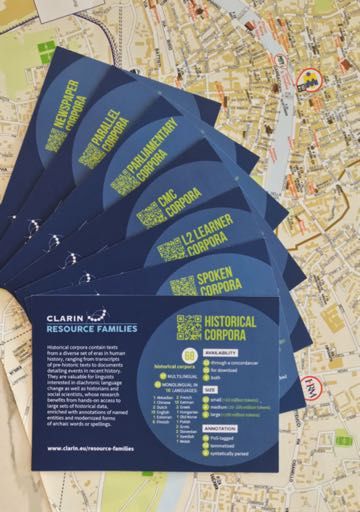
• The CLARIN Resource Families have become a salient thread in
the outreach to new communities. It has inspired work on
requirements and on the visibility of data sets.
• Tour de CLARIN has become a flagship
activity for promoting the national consortia,
their resources, tools, events and researchers
within and outside the CLARIN network.
• At least one UI event has been organised in
each of the CLARIN member countries
(except in Croatia which joined in March 2018
only), and even in France (an observer country).
7Technical infrastructure
Where we stand
• Adherence to the FAIR principles (findability,
accessibility, interoperability and reusability) is leading
in the design of all data services.
• Many tools and workflows have been incorporated into
the infrastructure, while there is potential for further
integration.
• Password-protected data and tools that rely on a local
username and password are connected to the
CLARIN single-sign on system for user-friendly
authentication.
• On request CLARIN's Legal Issues Committee (CLIC)
provides guidance/expertise on the matters of
Intellectual Property Right issues and licenses, privacy
protection, and ethical issues.
8Technical infrastructure
Where we want to go
• Working with CLARIN tools:
Aim to describe all relevant datasets and tools with high-quality CMDI
metadata to optimize their retrieval via the Virtual Language Observatory
(VLO).
All suitable corpus search engines at the CLARIN centres should be
connected to the Federated Content Search (FCS) service.
Clear recommendations are available as to the choice of standards for
datasets, as well as clear guidelines for developers on how to make tools
CLARIN-compatible.
• Workflows and interoperability
Develop and support high-quality matching functionality that couples
specific data to relevant tools
Dedicated support for projects that come with requirements related
to multilinguality.
Increased usability of web services for non-technical researchers.
• Access regulations and repositories
Provide at least one CLARIN-compatible depositing service for each
country.
Promote depositing of data resulting from public funding.
9Technical infrastructure
Achievements in 2018 (highlights)
NB. Detailed presentation on Day 3 by Dieter Van Uytvanck
Centres, data, services
Regular centre assessments
As planned, 2 assessment rounds were organised. Out
of 47 registered CLARIN centres, 21 have been certified
as B-centre.
Access to persistent identifier services
CLARIN ERIC became a non-allocating member of the
European Persistent Identifier Consortium (EPIC).
Closer integration of data and tools
Achieved in part by connecting more tools to the
Language Resource Switchboard and by performing
related checks and experiments.
10Knowledge Sharing Infrastructure
Where we stand
• The CLARIN website is the channel for the dissemination
of all types of information and audiences.
• There is support for training, networking and outreach, for
which grants can be made available: CLARIN for
Researchers.
Various types of workshops to build strategic connections
between tools and software developers on the one hand and
users on the other hand.
A VideoLectures channel offers tutorial materials for some of
the resources and tools in the CLARIN infrastructure.
• A network acknowledged K-centres
• Mobility Grants can be applied for to
enhance the integration within CLARIN
at the level of human expertise.
11Knowledge Sharing Infrastructure
Where we want to go
• Central website:
Take into account the diversity in the communities and enlarge the
volume of visual formats.
Support the promotion of advanced CLARIN tools for human
language processing across SSH domain and beyond.
• Training and education:
Provide dedicated training material (user guides, video tutorials,
showcases, exercise materials) for the key components of the
CLARIN infrastructure.
Develop best practices for enhancing MA and PhD programmes to
teach about how to use the CLARIN tools and resources, and
promote integration of CLARIN-related topics into academic
curricula.
Extend the use of mobility grants and funding schemes for User
Involvement events and workshops to reinforce the connection
between the creators of CLARIN tools and data and the various
communities of use.
12Knowledge Sharing Infrastructure
Achievements in 2018 (highlights)
• Annual conference: more participants, more papers, PhD
session
• The number of K-centres has grown from 9 to 11; `
2 more applications under assessment.
• More promotion for mobility grants
• Instruments for training:
VLO screencast, webinars and
• A workshop is planned by the end of 2018 on the impact of the
new General Data Protection Regulation (GDPR) on personal
data in the field of language resources and tools. Collaboration
with the CLIC committee and invited legal experts.
• Citable papers on how CLARIN complies with FAIR and
FACT: https://www.clarin.eu/faq/how-can-i-cite-clarin
13Sustainability
Where we stand
• In 2018 the revised statutes entered into force.
• At the end of 2017 CLARIN ERIC had
19 members (18 countries and 1 international
organisation), plus 2 observers and 1 third party.
• The CLARIN website contains an information page
for newcomers and potential new members.
14Sustainability
Where we want to go
• Support for national teams in identifying possibilities for
the acquisition of funding for activities at the national level
that contribute to the integration of (aspects of) the country’s
infrastructure into the CLARIN research infrastructure.
• Alliances with organisations that may be beneficial for the
acquisition of income on top of the membership fees will be
further explored and extended, in particular with the aim to
reinforce the link with other research infrastructures in SSH
and the emerging European Open Science Cloud.
• CLARIN ERIC will develop an 'adoption strategy': a model
for shared responsibility for data and services that are
considered crucial for the overall CLARIN mission.
15Sustainability Achievements in 2018 (highlights) Extension of the ERIC membership Croatia (HR) became the twentieth member of CLARIN ERIC. A workshop is being planned for December 2018 for consortia from the countries that recently joined and for representatives of countries that have an interest in joining. 16
Sustainability
Crossing Borders
• Active contribution to the discussion regarding the EU landscape of
  RIs and the establishment of European Open Science Cloud (EOSC).
• Current EU projects
      PARTHENOS, a thematic cluster around European RIs in the
      humanities;
      DSI-4 - Collaboration with Europeana;
      EOSC-hub that started in January 2018.
• New EU projects (start in 2019)
      ERIC Forum, collaboration with the other ERICs;
      SHHOC, towards a Social Sciences and Humanities Open Cloud; till
      April 2022. The CLARIN contribution to SSHOC will be realised by the
      central organisation and six CLARIN nodes;

      Room for focus on migration studies, requirements for qualitative data
      analysis, support for processing interviews and heterogeneous data.
                                                                        17
Sustainability
Alliances
• CLARIN maintains strong collaborative ties with sister
RIs, in particular with DARIAH-EU
• Agreements aiming at collaboration are in place with:
META-NET/Cracker
LIBER
EUDAT-CDI
new: ELRA
18Sustainability
Performance measurement
• Key Performance Indicators (KPIs) – draft proposal (see slides)
• Visits to the central CLARIN website (see slides)
Governance
• New statutes have been prepared and approved; new model of
collaboration between BoD and NCF has been implemented;
SAMBA established (see slides)
19Key Performance Indicators
• Until now CLARIN progress has been measured in
relation to the strategic planning and/or workplans.
• But current thinking is that one should rather relate to the
objectives of the RI as set out in the statutes.
• In 2017 Steven Krauwer and Bente Maegaard made an
overview of all the performance indicators they and
anyone else could come up with, 70-80.
• In 2018: careful check if they are candidate KPIs: i.e.
checking if they are measurable in a reasonably
straightforward way, checking their relationship to the
objectives etc, and comparison with approached adopted
by other RIs and related organisations.
• Difference between Offer and Use. Tried to focus on
Use. Collaboration is a third aspect.
20KPIs
(E indicates that a KPI is mostly applicable at the ERIC level, N
at the National level, and E/N at both levels)
• Number of members (E)
• Number of certified B-centres (N)
• Number of publications (written by CLARIN and non-
CLARIN people) (N)
• Average number of website visits /month (E)
• Federated login in all countries and for all relevant users (N)
• Collection of standards and mappings (E)
• Number of certified K-centres (N)
• Number of face to face participants in workshops (E/N)
• Number of views of tutorials and videos (E/N)
• Collaboration with RIs (E)
• Global relations, international collaboration (E)
• Good collaboration with libraries, archives, museums, e.g.
number of national consortia including at least one member
of this type or having collaboration. (N)
21KPIs next step
• Has been discussed with the NCF.
• Final version is under development.
• Your NCF representative has a link to the preliminary
document if you are interested.
• Fast comments can still be integrated.
22NCF Strategy and Management Board
(SAMBA)
• Subcommittee of the NCF
• Platform for exchange between the NCF and the BoD
For two reasons: size of NCF, NCF chair no longer part of
BoD
• Membership, 2 members from each group
Group 1: Germany, Italy, and The Netherlands. (EH, JO)
Group 2 - Western Europe, Scandinavia and Baltic countries:
Denmark, DLU, Estonia, Finland, Latvia, Lithuania, Norway,
Sweden. (KL (chair), KV)
Group 3 - Central Europe and Southern Europe: Austria,
Bulgaria, Croatia, Czech Republic, Greece, Hungary, Poland,
Portugal, and Slovenia. (KS, MP)
• Tasks
Prepare discussions and decisions of the NCF in strategic
and financial matters
• Meetings: 4 per year
23National Coordinators'
Forum
NCF Chair Maciej
Piasecki
NCF Vice-chair Krister Lindén
24Strategy and Management Board
Erhard Hinrichs Maciej Piasecki
Krister Lindén Kiril Simov
Jan Odijk Kadri Vider
25Board of Directors
Franciska de Jong Dieter Van Uytvanck
Bente Maegaard Darja Fišer
General Assembly
Ursula Brustmann, president
26see you @ bmaegaard@hum.ku.dk f.m.g.dejong@uu.nl
You can also read


