STRATEGIC PLAN 2020-25 - Department of Justice and Constitutional Development Strategic Plan 2020/25
←
→
Page content transcription
If your browser does not render page correctly, please read the page content below

STRATEGIC PLAN
                2020-25

   Department of Justice and Constitutional Development Strategic Plan 2020/25   1
Department of Justice and Constitutional Development

STRATEGIC PLAN / 2020-25

RP

ISBN:

Tel: 012-315-1111

Private Bag X81, Pretoria, 0001

www.justice.gov.za

2       Department of Justice and Constitutional Development Strategic Plan 2020/25
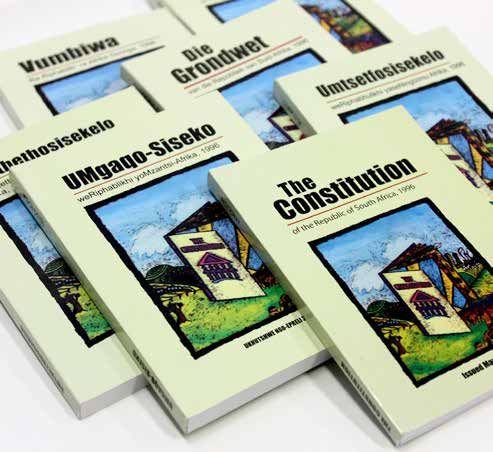
TABLE OF CONTENTS
   foreword by the minister							6
   foreword by the DEPUTY minister					                                                       8
   foreword by the accounting officer					                                                    10
   official sign-off								12

   part a: our mandate								14
   1. constitutional mandate							14
   2. legislative mandates							14
   3. institutonal policy and strategies over the five-year 		                                16
		planning period
   4. relevant court rulings							17

   part b: our strategic focus						19
   5. vision										19
   6. mission									19
   7. values									19
   8. situational analysis							19
      8.1      external environment analysis				19
      8.2      internal environment analysis				                   20
      8.2.1    service delivery improvement programme			           20
      8.2.2    masters’ services						                             21
      8.2.3    constitutional development					                     21
      8.2.4    Constitutionalism, respect for Human Rights and     22
               the rule of law.
      8.2.5    transformation of state legal services			           22
      8.2.6    providing disability friendly facilities			         22
      8.2.7    legislative development					                        23
      8.2.8    accessibility of information in braille and audio		 23
      8.2.9    gender‐based violence and femicide				              24
      8.2.10   audit outcomes							25
      8.2.11   financial								25
      8.2.12   human resources						26
      8.2.13   information technology					                         27

   part C: strategic objectives						28
   9.	institutional performance information				28
   10. key risks and mitigation						                                                         38
   11. public entities								44

   part d: technical description table					 45
   annexures to the strategic plan						59
   annexure a: district development model				                                                 59

                      Department of Justice and Constitutional Development Strategic Plan 2020/25    3
LIST OF ACRONYMS
APP		        Annual Performance Plan
AVR          Audio visual recording
BAS		        Basic accounting system
CCTV		       Closed-circuit television
CPA		        Criminal Procedure Act
CRT		        Court Recording Technology
CSO		        Civil Society Organisation
DG		         Director-General
DIRCO		      Department of International Relations and Cooperation
DPWI		       Department of Public Works and Infrastructure
DoJ&CD       Department of Justice and Constitutional Development
ECMS		       Electronic case management system
ENE		        Estimates of National Expenditure
GBVF		       Gender-based violence and femicide
HR           Human Resources
ICMS		       Integrated Case Management System
ICT		        Information and Communication Technology
IJS          Integrated Justice System
IT		         Information Technology
JCPS		       Justice, Crime Prevention and Security
JMIS		       Justice Management Information System
JYP		        Justice Yellow Page
Legal Aid SA Legal Aid South Africa
LGBTI		      Lesbian, gay, bisexual, transgender and intersex
MC     	Magistrates’ Court
MOVIT		      Masters’ Own Verification Technology
MOU		Memorandum of Understanding
MTEF		       Medium-Term Expenditure Framework
MTSF		Medium-Term Strategic Framework
NAP		        National Action Plan
NDP		        National Development Plan
NPA		        National Prosecuting Authority
NPS		        National Prosecutions Service
NRSO		       National Register for Sex Offenders
NTT		        National Task Team
OCSLA        Office of the Chief State Law Adviser
OSD		        Occupation-specific dispensation
OWP 	Office for Witness Protection
PAIA		       Promotion of Access to Information Act
PAJA		       Promotion of Administrative Justice Act
PDI          Previously disadvantaged individual

4      Department of Justice and Constitutional Development Strategic Plan 2020/25

PEAS		    Paperless Estate Administration System
PEPUDA    Promotion of Equality and Prevention of Unfair Discrimination Act
PFMA		    Public Finance Management Act
SALRC		   South African Law Reform Commission
SAPS		    South African Police Service
SCA		     Supreme Court of Appeal
SIU       Special Investigations Unit
TCC		     Thuthuzela Care Centre
TRC		     Truth and Reconciliation Commission

                       Department of Justice and Constitutional Development Strategic Plan 2020/25   5
FOREWORD BY
                                                             Our priority is to advance constitutionalism
                                                             and the rule of law and to create an accessible,

THE MINISTER                                                 modernised and people-centred justice system.
                                                             We are improving access to justice at all our
                                                             service points through modernised processes
                                                             which will improve the quality and speed of
                                                             our services.      The transformation of state
                                                             legal services and the creation of effective and
                                                             efficient state legal services has been prioritised
                                                             through the creation of the Office of the Solicitor
                                                             General. Looking forward, we seek to reduce
                                                             the state’s contingent liability which has been
                                                             a huge drain to the fiscus by implementing a
                                                             comprehensive state litigation strategy under
                                                             the leadership of the recently appointed
                                                             Solicitor General. In addition we will seek to
                                                             reform our criminal justice system in order to
                                                             comprehensively address matters affecting
                                                             women (GBV), children and the vulnerable. In
                                                             this regard we will conduct a comprehensive
                                                             review of the CPA of 1977 in order to bring it in
                                                             line with the Constitution.

                                                             Our programmes to address nation building
                                                             and social cohesion remain a focal point in
                                                             this administration. We will prioritise the
                                                             review, repeal and replacement of all colonial
The Department of Justice and Constitutional
                                                             and apartheid legislation. It is an affront to
Development is constitutionally mandated to
                                                             South Africans that more than a quarter of a
administer justice and to act as the custodian of
                                                             century post democracy our statute books
our Constitution. We have come a long way since
                                                             still contain the laws that dehumanised the
the dawn of democracy. In the last 25 years, my
                                                             majority of our people.
predecessors in the previous five administrations
have laid a solid foundation for the administration          Corruption including white collar and commercial
of justice: As we begin the next 5 years which               crime remains a challenge, both in the public and
is an electoral mandate, we are building on this             private sector and directly affects state capacity
solid foundation. To this end, we have identified            to deliver much needed services to the poor and
specific areas that we seek to consolidate in this           the vulnerable. We are working to rebuild the
period. In doing so, we are mindful of the lingering         National Prosecution Authority to be an effective,
challenges in the criminal justice system which              efficient and ethical prosecutorial organisation
are the result of the last 10 years. As we move              that prosecutes without fear, favour or prejudice.
forward, it is important to rebuild capacity and             Our people should feel safe and secure. We
reverse these deficiencies. We are confident that            anticipate that our anti-corruption efforts will be
this Strategic Plan provides a solid basis that will         boosted by the work of the various commissions
advance this important work.                                 of enquiry currently underway.

6        Department of Justice and Constitutional Development Strategic Plan 2020/25
Our Constitution has served us well over more              We will align the structure of the Department
than two decades and has proven to be resilient,           to our vision and our priorities. We will put in
robust and dynamic. We will continue to deepen             place systems to ensure accountability, good
the culture of respect for our constitutional values,      governance compliance with statutory prescripts
human rights and the rule of law as fundamental            such as the PFMA and other regulatory
to our constitutional democracy. It is important           instruments. Our goal is to achieve a clean audit.
that every South African has a full understanding          We aspire to make the Department of Justice
and appreciation of their constitutional and               and Constitutional Development an employer of
human rights. Public education is essential. For           choice that attracts the best, skilled, talented and
our constitutional democracy to thrive, we need            committed individuals as we work collectively
an active citizenry to act as a bulwark against the        to achieve our vision of creating an accessible
erosion of fundamental rights and freedoms. As we          justice system and advancing constitutionalism,
work to promote human rights, we will continue to          human rights and respect for the rule of law.
provide all the support that we are constitutionally
required to provide to the judiciary.

In order to carry out our vision and priorities
for the next 5 year MTSF period, we require a              ______________________
department that is fit for purpose, dynamic and            Mr. Ronald Lamola, MP
suited to current conditions in the country.               Minister of Justice and Correctional Services

                                Department of Justice and Constitutional Development Strategic Plan 2020/25   7
FOREWORD BY
Vision 2030 and the seven electoral priorities
adopted by government. These priorities will
THE DEPUTY inform the interventions and programmes to
achieve the NDP Vision 2030.
MINISTER The work of the Department of Justice and
Constitutional Development is key in making
these priorities a reality.
A number of political imperatives remain high on
our Department’s agenda, such as intensifying
our efforts to make justice more accessible to
all in our country and ensuring that people who
commit crimes are brought to justice.
Access to justice is not only the ability to obtain
legal redress and assistance, but also having
one’s dispute resolved speedily and efficiently.
We need to continue to work towards a more
efficient system in the criminal and civil courts
by way of various initiatives, such as, for
example, increasing the number of our Regional
Civil Courts.
Our legislative programme remains an integral
part of what we do and spans a number of
different justice areas, with new or amended
legislation covering Commissions of Inquiry, the
review of the Criminal Procedure Act, a Land
Court Bill, amendments to the Sheriffs Act, the
The National Development Plan’s Vision 2030 Debt Collectors Act, and the Legal Practice Act,
sets out a very clear picture of the South Africa to name but a few.
that we want to build.
The Information Regulator is empowered to
The next ten years will be crucial in determining monitor and enforce compliance by public
whether or not we achieve that vision. and private bodies with the provisions of the
Protection of Personal Information Act, 2013
The Department of Justice and Constitutional
(the PPI Act) and the Promotion of Access to
Development’s Strategic Plan is closely aligned
Information Act, 2000 (PAIA). The PPI Act aims to
to the Medium-Term Strategic Framework (MTSF
promote the protection of personal information
2019-2024). The MTSF is the manifestation of an
processed by public and private bodies to allow
implementation plan for the NDP Vision 2030 and
for the lawful processing of such information by
for the implementation of the electoral mandate
way of establishing minimum requirements.
of the sixth administration of democratic
government. The MTSF lays out the package of It is important to note that the Information
interventions and programmes that will achieve Regulator will become fully functional in the
outcomes that ensure success in achieving period covered in the Strategic Plan.
8 Department of Justice and Constitutional Development Strategic Plan 2020/25The work of our Department is also informed by the In his State of the Nation Address this year, the
continuous advancement of constitutionalism, President announced that we will amend the
respect for human rights and for the rule of law. Domestic Violence Act to better protect victims
in violent domestic relationships and that we
A vital part of this vision is supporting and
will pass a law to tighten bail and sentencing
strengthening our courts and working closely
condition in cases that involve gender-based
with other stakeholders in the justice system.
violence. We are therefore preparing three
Access to courts as well as the optimal amendment Bills proposing amendments to
functioning of our courts are both imperative in the Criminal Law (Sexual Offences and Related
the transformation of our judicial system. Matters) Amendment Act, the Domestic Violence
Act, the Criminal Procedure Act and legislation
The introduction of Bills to replace the regulating minimum sentencing.
Magistrates Act, 1993, and the Magistrates’
Courts Act, 1944, remains an absolute priority In addition, we shall continue to roll out sexual
for 2020/21. We will intensify our support to the offences courts and Thuthuzela Care Centres so
Magistrates Commission in the filling of vacant as to provide much needed support services to
offices of magistrates to further enhance and survivors of gender-based and sexual violence
strengthen capacity at our lower courts. and continue our efforts in the establishment of
a Femicide Watch.
We are looking forward to the finalisation of the
major review by the Independent Commission As part of our aim to further advance
on the Remuneration of Public Office-Bearers constitutionalism and human rights, our
into the remuneration of the judiciary – for both Department will be continuing with various
magistrates and judges. constitutional awareness and human rights
education programmes, protecting the rights of
It is of critical importance that the rationalization LGBTI persons by way of the work being done
of magisterial districts and aligning the by our National Task Team and further advance
jurisdiction of magistrates’ courts with municipal the implementation of the National Action
and provincial boundaries be finalised. It will not Plan to combat Racism, Racial Discrimination,
only provide certainty and closer and more direct Xenophobia and Related Intolerance.
access to justice services for communities, but
will also enable us to align and re-describe Our Department remains committed to ensuring
service areas of sheriffs and advertise vacant that Vision 2030 becomes a reality for all in our
offices. It is envisaged that vacant offices of country.
sheriff will be filled by the end of 2020. This will
strengthen the sheriffs’ profession and further
enhance service delivery. ______________________
John Jeffery, MP
The fight against the scourge of gender-based Deputy Minister of Justice and Constitutional
violence and femicide continues to be a priority. Development
Department of Justice and Constitutional Development Strategic Plan 2020/25 9FOREWORD BY
efficiency in finalising maintenance orders.
Targets over the MTSF period have been set.
THE ACCOUNTING
Similarly, finalisation of cases of children whose
families are in distress are included in the
Strategic Plan and the Annual Performance Plan.
OFFICER In improving accessibility, we will continue to
roll out new court buildings in line with our plans
and budgets. For example, the long-outstanding
Mamelodi Magistrates’ Court, which is due to
be finalised during the 2020/21 financial year, is
one of the eight courts that are planned to be
delivered within the next three financial years.
With regards to refurbishment and upgrading of
facilities, we plan to deliver nine of these projects,
which include Groblershoop Magistrates’ Court,
Umbumbulu Magistrates’ Court and the burnt
Pretoria Magistrates’ Court.
The department struggled with unplanned
maintenance, such as fixing of broken windows,
due to issues related to the availability of
contractors in far-flung courts. A plan has been
put together to address day-to-day maintenance
work to ensure speedy resolution of minor works
while complying with the PFMA’s principles of
cost-effective and transparent procurement.
The term contract solution to address minor
maintenance issues will be rolled out to courts in
order to bring them to full functionality speedily.
The DoJ&CD provides support to the courts
towards the finalisation of criminal and civil
The department continues with its goal of people- cases. Monitoring of daily progress of cases
centred justice services that are accessible, will continue to ensure that the department
reliable and efficient. performs its functions in terms of our mandates
and in line with the resources allocated to us.
Our initiatives on a people-centred justice service In particular, the department will continue to
will include the speedy rollout of Sexual Offences monitor postponements made in criminal courts
Courts, in line with government’s programme on that are due to our own administrative delays.
Gender-Based Violence and Femicide. A further
42 Regional Court rooms will be upgraded into The department will deliver in line with
Sexual Offences Court rooms, in line with the government’s five-year plan. With regards to
approved model and available resources. An fraud and corruption, the department will assist
ongoing project to evaluate the functionality of in the rollout of Commercial Crimes Courts,
these courts will be undertaken throughout the where these are needed, and will continue to
MTSF period. support other JCPS cluster organisations in the
infrastructure needed for initiatives related to the
Maintenance and other issues related to children SIU’s tribunal as well as the NPA’s Investigative
are of major interest to the department. While Directorate.
major improvements have been done in the
processes related to maintenance applications, The department will continue to use information
the department plans to improve speed and technology to improve service delivery and
10 Department of Justice and Constitutional Development Strategic Plan 2020/25customer experience within our service points. Intolerance. The department will work with
Over the MTSF period, projects will be rolled other departments and non-governmental
out, in line with budgets and other resources. For players to help address the ongoing issues of
example, user-friendly online application forms xenophobia and other related intolerances in
will be implemented during 2020/21 and, where our country. In addition, the department will
appropriate, service will move beyond just having continue to champion rights within the LGBTI
application forms, towards online processing of community as well as lead the monitoring of
services. To further improve client experience, hate crime cases committed against the LGBTI
the department is committed to developing a call community. Government launched the National
centre over the MTEF period. Policy Framework (NPF) on the Prevention
and Combating of Trafficking in Persons on 25
Information technology initiatives that will enable April 2019. The NPF’s Objectives include: the
us to improve efficiencies include implementing establishment of a coordinated and cooperative
a foreign language interpretation hub to reduce institutional anti-trafficking framework involving
expenses related to interpreting and using all relevant stakeholders; raising public
audio visual remand systems to deal with awareness and preventing human trafficking;
postponements without transporting awaiting- improving knowledge on human trafficking; and
trial inmates to courts. ensuring that victims of trafficking have access
The State Attorney environment continues to to comprehensive assistance programmes.
present us with several challenges. The first Implementation of the NPF will receive our
that will be addressed in 2020/21 will be the attention in the fight against human trafficking.
appointment of senior leadership within different We will give attention to the regulation of
offices of the State Attorney. The second will be paralegals working in community advice offices
the implementation of processes and procedures and creating a funding model for community
towards a fully-functional State Attorney advice offices.
environment that will manage litigation costs and
address pervasive issues of poor management In the last few years, the department has been
of cases. In this regard, a new case management qualified on the Vote Account as well as on
system will be rolled out over the MTSF period. performance information. All initiatives that
were implemented in the past did not take into
While addressing these matters, the department consideration the root causes of the problem,
will continue its focus on growing the pool of legal hence the department continues to run the risk
practitioners from previously disadvantaged of repeat findings.
backgrounds
The department will put in place appropriate
Within Programme 3, targets have been set in controls but, more importantly, ensure that we
line with budget and other resources. have the appropriate organisational structure
The Office of the Chief Master will continue to and appropriately trained employees to
deliver on matters related to deceased estates, deliver on our core mandate and maintain
trusts, the Guardian’s Fund and insolvencies and/ consistent unqualified audit opinions within
or liquidations. The Office of the Chief State Law their administrative responsibilities. In addition,
Adviser will continue to finalise legal opinions a culture of accountability within our structures
on draft legislation and bilateral agreements as will be strengthened to ensure a well-functioning
well as issue certificates on draft legislation and administration.
translate legislation, where required. Legislative
Development will continue to draft legislation.
Key projects that are planned within Constitutional
Development include the implementation and ______________________
monitoring of the cabinet-approved National Adv JB Skosana
Action Plan (NAP) to Combat Racism, Racial Acting Director-General: Department of Justice
Discrimination, Xenophobia and Related and Constitutional Development
Department of Justice and Constitutional Development Strategic Plan 2020/25 11OFFICIAL SIGN-OFF
It is hereby certified that this Strategic Plan:
• Was developed by the management of the Department of Justice and Constitutional Development,
under the guidance of the Minister of Justice and Correctional Services, Ronald Lamola, MP;
• Takes into account the relevant policies, legislation and other mandates for which the Department
of Justice and Constitutional Development is responsible; and
• Accurately reflects the impact and outcomes which the Department of Justice and Constitutional
Development will endeavour to achieve over the period 2020-2025.
Mr. Donald Mpholo Signature: .......................................................
Acting Head Corporate Services
Mr. TZ Malema Signature: .......................................................
Acting DDG: Court Services
Ms Susan Masapu Signature: .......................................................
Acting DGG: Office of the Chief State Law Adviser
Ms Theresia Bezuidenhout Signature: .......................................................
Acting Chief Master
Ms Kalayvani Pillay Signature: .......................................................
DDG: Legislative Development
Ms Gabriela La Foy Signature:.......................................................
DDG: Constitutional Development
12 Department of Justice and Constitutional Development Strategic Plan 2020/25Mr Johan Johnson Signature:.......................................................
Acting Chief Financial Officer
Mr. Fhatuwani Gelebe. Signature: .......................................................
Acting Chief Director: Strategy, Monitoring and Evaluation
Ms K Van Rensburg Signature:.......................................................
Chief Executive Officer: National Director of Public Prosecution
Advocate S Batohi Signature:.......................................................
National Director of Public Prosecution
Advocate Jacob Skosana Signature:.......................................................
Acting Director-General: Justice and Constitutional Development
Mr. John Jeffery Signature:.......................................................
Deputy Minister: Justice and Constitutional Development
Approved by
Mr. Ronald Lamola, MP Signature: .......................................................
Minister of Justice and Correctional Services
Department of Justice and Constitutional Development Strategic Plan 2020/25 13PART A: OUR MANDATE
1. CONSTITUTIONAL MANDATE
The department’s mandate, deriving from the Constitution, is two-fold. Firstly, it seeks to provide
a framework for the effective and efficient administration of justice. Secondly, it seeks to promote
constitutional development through the development and implementation of legislation and programmes
that seek to advance and sustain constitutionalism and the rule of law. This is done through the
implementation of programmes to deepen and nurture our constitutional democracy. Following the
transfer of superior courts to the Office of the Chief Justice, the department will continue to support
lower courts, in line with its current constitutional mandate.
2. LEGISLATIVE MANDATES
The department derives its statutory mandate from various statutes and subordinate legislation. Most
of these Acts impact, in some way or other, on the daily functioning of the department, but, in the
context of the priorities of government, the following legislative instruments are particularly relevant:
2.1 Legislation providing for the establishment and functioning of the superior courts,
magistrates’ courts and other courts, the most important of which are the following:
a. Superior Courts Act, 2013, (Act No. 10 of 2013)
b. Magistrates’ Courts Act, 1944 (Act No. 32 of 1944
c. Small Claims Courts Act, 1984 (Act No. 61 of 1984)
2.2 Legislation providing for the appointment of judges and other judicial officers, their
conditions of service, discipline and training:
a. Judges’ Remuneration and Conditions of Employment Act, 2001 (Act No. 47 of
2001)
b. Judicial Service Commission Act of 1994 (Act No. 9 of 1994)
c. South African Judicial Education Institute (SAJEI) Act, 2008 (Act No. 14 of 2008):
d. Magistrates Act, 1993 (Act No. 90 of 1993)
2.3 Legislation relating to the prosecution of offenders and combatting of crime:
a. National Prosecuting Authority Act, 1998 (Act No. 32 of 1998)
b. Criminal Procedure Act, 1977 (Act No. No. 51 of 1977)
c. Prevention of Organised Crime Act, 1998 (Act No. 121 of 1998)
d. Special Investigation Units and Special Tribunals Act, 1996 (Act No. 74 of 1996)
e. Witness Protection Act, 1998 (Act No. 112 of 1998):
f. Implementation of the Rome Statute of the International Criminal Court Act, 2002 (Act No. 27
of 2002)
14 Department of Justice and Constitutional Development Strategic Plan 2020/25g. Protection of Constitutional Democracy against Terrorist and Related Activities Act, 2004
(Act No. 33 of 2004)
h. Prevention and Combating of Corrupt Activities Act, 2004 (Act No. 12 of 2004)
i. Criminal Law (Sexual Offences and Related Matters) Amendment Act, 2007 (Act No. 32 of
2007) (Sexual Offences Act)
j. Child Justice Act, 2008 (Act No. 75 of 2008)
k. Prevention and Combating of Trafficking in Persons Act, 2013 (Act No. 7 of 2013):
2.4 Legislation providing for the establishment and functioning of bodies responsible for legal
aid, law reform and court rules:
a. Legal Aid South Africa Act, 2014 (Act No. 39 of 2014)
b. South African Law Reform Commission Act, 1973 (Act No. 19 of 1973)
c. Rules Board for Courts of Law Act, 1985 (Act No. 107 of 1985)
2.5 Legislation providing for the administration of estates:
a. Insolvency Act, 1936 (Act No. 24 of 1936)
b. Administration of Estates Act, 1985 (Act No. 107 of 1985)
2.6 Legislation on the administration of legal services to government departments:
State Attorney Amendment Act, 2014 (Act No. 13 of 2014)
2.7 Legislation relating to the promotion, protection and enforcement of human rights:
a. Promotion of Administrative Justice Act, 2000 (Act No. 3 of 2000)
b. Promotion of Access to Information Act, 2000 (Act No. 2 of 2000)
c. Promotion of Equality and Prevention of Unfair Discrimination Act, 2000 (Act No. 52 of 2000)
2.8 Legislation relating to extraditions in relation crime occurred beyond the border of the
Republic
Extradition Act of 1962 (Act No. 627 of 1962)
2.8 Legislation which protect personal information
Protection of Personal Information Act of 2013 (Act No. 4 of 2013)
2.10 Legislation governing the legal profession, sheriffs and debt collectors
a. Legal Practice Act, 2014 (Act No. 28 of 2014)
b. Sheriffs Act, 1986 (Act No. 90 of 1986)
c. Debt Collectors Act, 1998 (Act No. 114 of 1998)
Department of Justice and Constitutional Development Strategic Plan 2020/25 153. INSTITUTIONAL POLICY AND STRATEGIES OVER THE FIVE-YEAR
PLANNING PERIOD
The Department of Justice and Constitutional Development will develop and implement the listed
below institutional policies, bills and strategies during the five-year Strategic Plan period (2020-2025).
3.1 List of policies
a. Policy on Community Courts
b. Policy on Judicial Governance and Court Administration
c. Court Interpretation Foreign Language Policy
d. Guidelines on the appointment of acting Judges in the Republic of South Africa
e. Guideline on the conferral of Senior Counsel status
f. Policy recommendations to reform the criminal justice system and the Criminal Procedure Act
g. Policy to reform the civil justice system
h. National Action Plan to combat xenophobia, racism and related intolerances
i. Policy on Insolvency
3.2 Some of the Bills that the department plans to introduce into Parliament during the MTSF
period
a. Commissions of Inquiry Bill
b. Criminal Procedure Bill
c. Land Court Bill
d. Lower Courts Bill
e. Magistrates’ Court Bill
f. Insolvency Bill,
g. Community Advice Offices and Paralegals Bill,
h. Domestic Violence Amendment Act,
i. Criminal Law (Sexual Offences and Related Matters) Amendment Act,)
j. the Sheriffs Bill,
k. The Small Claims Court Bill and
l. the Administration of Estates Bill
3.3 Key strategies that the department will focus in the next five years
a. Implementation of the Integrated Criminal Justice System (ICJS)
b. Litigation Strategy
16 Department of Justice and Constitutional Development Strategic Plan 2020/254. RELEVANT COURT RULINGS
4.1 Ramuhovhi and Others v President of the Republic of South Africa and Others 2017 ZACC 42
Section 7(1) of the Recognition of Customary Marriages Act, 1998 (Act No. 120 of 1998) (Customary
Marriages Act) was declared unconstitutional and suspended for 24 months to afford Parliament
an opportunity to correct the defect giving rise to the constitutional invalidity. Section 7(1) of the
Customary Marriages Act provides that “The proprietary consequences of customary marriages
entered into before the commencement of this Act continue to be governed by customary law”.
4.2 Levenstein and Others v Estate of the Late Sidney Lewis Frankel and Others 2018 ZACC 16
Section 18 of the Criminal Procedure Act, 1977 (Act No. 51 of 1977) (the CPA) was declared
unconstitutional and suspended for 24 months to afford Parliament an opportunity to enact
remedial legislation. Section 18 of the CPA provides that the right to institute a prosecution for all
sexual offences other than rape or compelled rape is limited to a period of 20 years from the time
when the offence was committed.
4.3 My Vote Counts NPC v Minister of Justice and Correctional Services and Another 2018 ZACC 17
The Promotion of Access to Information Act, 2000 (Act No. 2 of 2000) (PAIA), was declared
invalid and unconstitutional to the extent of its inconsistency with the Constitution by failing to
provide for the recordal, preservation and reasonable disclosure of information on the private
funding of political parties and independent candidates. Parliament must amend PAIA and take
any other measure it deems appropriate to provide for the recordal, preservation and facilitation
of reasonable access to information on the private funding of political parties and independent
candidates within a period of 18 months.
The court declared that information on the private funding of political parties and independent
candidates is essential for the effective exercise of the right to make political choices and to
participate in the elections. The court declared further that information on private funding of political
parties and independent candidates must be recorded, preserved and made reasonably accessible.
4.4 Moosa and Others v Minister of Justice and Correctional Services and Others 2018 ZACC 19
Section 2C (1) of the Wills Act, 1953 (Act No. 7 of 1953) (the Wills Act) was declared unconstitutional
and is to be read as including the following underlined words:
“If any descendants of a testator, excluding a minor or a mentally ill descendant, who, together
with the surviving spouse of the testator, is entitled to a benefit in terms of a will, renounces his
right to receive such benefit, such benefit shall vest in the surviving spouse. For the purposes of
this sub-section, a ‘surviving spouse’ includes every husband and wife of a monogamous and
polygamous Muslim marriage solemnised under the religion of Islam.”
The declaration of invalidity operates retrospectively with effect from 27 April 1994 except that it does
not invalidate any transfer of ownership that was finalised prior to the date of this order of any property
pursuant to the application of section 2C(1) of the Wills Act, unless it is established that, when the
transfer was effected, the transferee was on notice that the property in question was subject to a legal
challenge on the grounds upon which the applicant brought the present application.
Department of Justice and Constitutional Development Strategic Plan 2020/25 174.5 Minister of Constitutional Development and Another v South African Restructuring and
Insolvency Practitioners Association and Others 2018 ZACC 20
The court found that the policy in respect of the appointment of provisional trustees, in terms of
the Insolvency Act, 1936 (Act No. 24 of 1936), is not reasonably capable of achieving equality
due to the paucity of information regarding its implementation and that the insolvency industry
will not be transformed by this initiative. The Master is to relook the policy to address the gaps
highlighted in the judgment.
4.6 Corruption Watch NPC and Others v President of the Republic of South Africa and Others
2018 ZACC 23
Section 12(4) and 12(6) of the National Prosecuting Authority Act, 1998 (Act No. 32 of 1998) (the
NPA Act), was declared unconstitutional and suspended for 18 months to afford Parliament an
opportunity to correct the constitutional defect.
Section 12(4) of the NPA Act deals with the extension of the term of office of an NDPP who is
otherwise liable to retire on grounds of age and section 12(6) provides for the indefinite suspension
of an NDPP by the President without pay or with such pay as the President may determine.
4.7 Minister of Justice and Constitutional Development and Others v Prince; National Director of
Public Prosecutions and Others v Rubin; National Director of Public Prosecutions and Others
v Acton and Others 2018 ZACC 30
Sections 4(b) and 5(b) of the Drugs and Drug Trafficking Act, 1992 (Act No. 140 of 1992), were
declared unconstitutional to the extent that they criminalise the use or possession in private or
cultivation in a private place of cannabis by an adult for his or her own personal consumption in
private and was suspended for a period of 24 months from the date of the handing down of this
judgment to enable Parliament to rectify the constitutional defects.
4.8 Bukelwa Nolizwe Holomisa v Sango Patekile Holomisa and Another 2018 ZACC 40
Section 7(3) of the Divorce Act, 1979 (Act No. 70 of 1979) (the Divorce Act), was declared
unconstitutional to the extent that it excludes a spouse married out of community of property
who has not entered into an antenuptial contract or an express declaration in terms of section
39(2) of the now repealed section 39 of the Transkei Marriage Act, 1978 (Act No. 21 of 1978)
(Transkei Marriage Act), from its ambit. It was suspended for 24 months to allow Parliament to
remedy this defect.
The case concerns the discriminatory oddity that women married out of community of property
under the Transkei Marriage Act do not enjoy the protection, on divorce, of section 7(3) of the
Divorce Act which empowers a court granting a decree of divorce in respect of a marriage out of
community of property to order a redistribution of assets where it considers it just and equitable
to do so, taking into consideration the contribution, monetary and otherwise, of the parties to the
marriage.
18 Department of Justice and Constitutional Development Strategic Plan 2020/25PART B: OUR STRATEGIC FOCUS
5. VISION
An accessible justice system in a vibrant and evolving constitutional democracy
6. MISSION
Enabling access to justice, advancement of constitutionalism, respect for human rights and the
rule of law.
7. VALUES
• Commitment to constitutional values and a culture of human rights
• Promotion of the rule of law
• Batho Pele
• Good governance
• Ubuntu
• Professionalism and continuous improvement
• Transparency
8. SITUATIONAL ANALYSIS
South African government planning subscribes to evidence-based decision-making. This is
demonstrated by a requirement that strategic plans and annual performance plans should be
preceded and informed by a situation analysis. The department’s situational analysis examines
both external and internal factors that are likely to influence the performance of the organisation,
and thus service delivery.
8.1 External environment Analysis
Economy
During the 2019 Medium-Term Budget Statement, the Minister of Finance revised the economic
growth forecast to 0.5% from the 2019 forecast of 1,5% announced during the Budget speech
in February 2019. The economic outlook has changed since the 2019 MTBS. The gross
domestic product (GDP) growth forecast for 2020 is revised to 0.9% rising to 1.6% in 2022.
The weak economic growth resulted in a high unemployment rate and revenue collection
shortfall. The unemployment rate for quarter 3 and Quarter 4 of 2019 was of 29.1%. During
the Budget speech, the Minister of Finance adjusted downward the tax revenue target by
R10.7 billion, as a result of poor economic growth. The South African Revenue Services
collected an amount of R1 355,9 billion in the financial year ending 31 March 2020. This
revenue has a deficit of R66 billion as measured against the 2019 budget estimate of R1
422,2 billion and R.3 billion as measured against the 2020 budget estimate of R1 359 billion.
Revenue shortfalls will affect the budget allocation of government departments, and this may
have a negative impact on service delivery. The department should come up with plan on
how it could continue to provide its services within the constrained financial environment.
Department of Justice and Constitutional Development Strategic Plan 2020/25 19The department should devise a human resource development plan to capacitate and reskill
its personnel in order to meet service delivery demands and the unchanged mandate the
department is expected to meet. The department should also start a department renewal
programme which will ensure that its macro structure is reconfigured in line with its strategy.
On 15 March 2020, a National State of Disaster was declared in terms of the Disaster
Management Act, 2002. On 22 March 2020 the President announced that there will be a
national lockdown to disrupt the spread of further Covid-19 pandemic infections. The
lockdown period commenced on 26 March until the end of April 2020. Just as we and the
world at large are grappling with COVID-19, South Africa suffered a severe blow following
the downgrading of the country’s credit rating to sub-investment grade Moody’s credit rating
agency. A few days’ later ratings agency Fitch downgraded South Africa’s credit rating to BB
from BB+. The downgrades came at a critical time as the country is also under lockdown as
part of the measures to curb the further spread of the COVID-19.
The current lockdown is estimated to affect South Africa’s gross domestic product negatively
over the five-week lockdown period. The cost of the coronavirus pandemic will depend on the
length and severity of the virus and the success of various economic resilience and recovery
strategies. The other impact of COVID-19 will be on tax revenue targets if the economy
comes to a halt. Without a doubt, the curtailment of normal business activity as a result of
the state of national disaster and the subsequent national lockdown, as well as the economic
downturn, impact heavily on business sustainability, especially on small businesses. Some
of those business enterprises may not be able to implement effective business continuity
measures to recover from the devastating impact of COVD-19 and the economic downturn,
and could face adversity, some to a point of complete extinction. Some small law firms fall
within the category of small business that could face the danger of extermination. These
firms may not be able to afford the overheads and salaries of the staff in their employment.
8.2 Internal environment analysis
8.2.1 Service Delivery Improvement Programme
The Public Service Regulations (PSR), 2016, dedicates Part 3 to service delivery
improvement in the public service; and requires that an executive authority establish or
maintain an operations management framework. The framework is aimed at improving
efficiencies and effectiveness in service delivery to all citizens as planned in the NDP. To
realise the provisions of the PSR, the department has:
• A 2018/21 Service Delivery Improvement Plan (SDIP) in place. The plan aims to provide
a focused approach to continuous improvement of key services i.e. Maintenance,
Litigation as well as the Guardian’s Fund. Effectively managing the SDIP requires
credible performance information, and this continues to be a challenge.
• Reviewed the Service Delivery Charter and distributed to service points. Monitoring
and implementation of the Service Delivery Charter remains a challenge and will be
monitored as part of the combined assurance approach.
• The following strategies will be implemented:
20 Department of Justice and Constitutional Development Strategic Plan 2020/25• Awareness campaigns on the Service Delivery Charter to ensure that citizens hold us
accountable, where necessary.
• Reviewing of service standards in line with the approved Service Delivery Model.
The department will continue to identify opportunities for service delivery improvement,
and mapping business processes as well as developing standard operating procedures.
An increasing number of public complaints have prompted the need to explore a coordinated
approach to complaints management. The lack of responsiveness by officials, among
others, not only has a negative impact on the public confidence but has a direct correlation
to complaints being escalated to the Executive and Top Management. The department
will seek to provide a strategic platform that can be used to enhance the relationship
between the department and the public; and to provide a single point for customer contact
particularly for service delivery complaints and enquiries.
8.2.2 Masters’ services
The Paperless Estates Administration System (PEAS), which computerises the
administration process related to deceased estates, has successfully been rolled out and
is being used by all 15 Masters’ offices countrywide, as well as 280 magistrates’ offices
linked with the relevant Masters’ offices. During the 2020/21 financial year, further rollout
of the Paperless Estate Administration System (PEAS) to remaining service points of the
Master of the High Court will be undertaken. This will also ensure that citizens receive the
same quality of Masters’ services within Magistrates’ Courts. The Branch is planning to roll
out 25 more offices over the MTSF period.
The integration system with the Department of Home Affairs, which allows the Masters’
offices to extract details of a deceased person directly from the database of the Department
of Home Affairs, is well entrenched within the Masters’ environment. This ensures that
details are captured correctly, curbs any fraudulent activities and ensure citizens receives
the same service and can lodge their applications in the area where they reside, without
the need to travel long distances. The deployment and use of the Masters’ Own Verification
Information Technology (MOVIT) has been rolled out successfully and is being used by all
15 Masters’ offices countrywide, as well as in 301 Magistrate’s Courts. There is a plan to
roll out the MOVIT system to an additional 25 service points over the MTEF period.
The Branch has been in the forefront of automation with regards to Deceased Estates and
Trusts. During 2019/20 Insolvency registration and appointments are also being automated.
It is envisaged that Trust online services will be implemented in the next financial year.
8.2.3 Constitutional Development
One of the key deliverables is the implementation of the National Action Plan to Combat
Racism, Racial Discrimination, Xenophobia and Related Intolerances (NAP). The
Department will take the lead in the coordination and implementation of NAP with the
assistance of the key stakeholders. In line with this, the department will champion the
establishment of the governance structure, and the funding model aimed at assisting in
the implementation of the NAP. The Branch will also be responsible for the development an
Department of Justice and Constitutional Development Strategic Plan 2020/25 21inter-sectoral integrated system on Trafficking in Persons (TIP). The system will be used to
provide an intersectoral data on the prevalence of TIP, as required by the UNODC, SADC
and other international organisations.
8.2.4 Constitutionalism, respect for Human Rights and the rule of law.
It is more than quarter of a Century since South Africa became a non-racial, non-sexist,
United and democratic state. Our Constitutional democracy underpinned by a progressive
world class constitution remains resilient, robust and evolving. Our Constitution, regardless
of the challenges that the Nation has experienced over the past years has served our
people well. The commitment to build and deepen Constitutionalism, respect for Human
Rights and Rule of law continues. Next year marks 25 years since the adoption and final
certification of our Constitution. This historic milestone presents our Nation an opportunity
to reflect and take stock of how far we come as a Nation in implementing the priorities and
objectives of our Constitution. It is an opportunity to review how the resilience and strength
of our Constitutional order has been tested. Since our Constitution is a living document and
social contract between the state and the people, it was not meant to be static but dynamic,
robust and evolving. Programs will be put in place to observe this historic milestone and
have the Nation engage in a conversation about the state of our Constitutional order. In
the next five years efforts will be made to increase and deepen the Constitutional and
human rights awareness of the citizenry. South Africa has over the past 25 years become
a signatory to many International and regional human rights instruments and has complied
with obligations emanating from instruments. The Department will towards finalisation
of accession to outstanding international instruments including the Convention on the
declaration of Apartheid as crime against humanity, enforced disappearances and many
relevant others. At the core of our Constitution is the fight against impunity for violations
of human rights. The Department will work reviewing, modernising and improving our
Extradition regime and the Mutual legal assistance framework to ensure effectiveness and
enhance collaboration with other States in the fight again crime in general
8.2.5 Transformation of State Legal Services
The transformation towards a law firm of choice for the State will be undertaken through
the implementation of outstanding provisions of the State Attorney Amendment Act of
2014. The Act came into effect from 7 February 2020. The Act makes provision for the
appointment of a Solicitor-General to oversee state litigation, and finalisation of policies
that will culminate in the lowering of costs of litigation and the building of capacity to
handle complex legal matters and establish well-run offices for the State Attorney. Policy
documents planned for finalisation include the Briefing Policy, the Tariff Policy and the
Mediation Policy, among others. Targets on the finalisation of these policies as well as the
development of a State litigation strategy and the appointment of the permanent Solicitor-
General will be the department’s priority during the current MTSF period.
8.2.6 Providing disabled-friendly facilities
As per building regulations, the Department of Justice and Constitutional Development
is committed to providing facilities (offices/courts/service points) that are accessible to
22 Department of Justice and Constitutional Development Strategic Plan 2020/25people with disability. Appreciating that some of the facilities are very old and were initially
not intended to be used as justice service points, a special project to make the facilities
of DoJ&CD accessible to people with disability was embarked upon in 2010. About 531
courts were identified for this project. The project was done in two phases and it intended
to do the following: at least one disability parking, access to the building (ramps) and at
least one courtroom and toilet on the ground floor, lifts with voice and Braille and accessible
counters. Presently 69 projects are remaining to be implemented. These projects will be
executed in the next five years. The department has made it a practice since 2010 that all
projects that go through refurbishments and additions and all the new projects do include
the specification for access for people with disability.
8.2.7 Legislative Development
During the 2021 financial year, the branch Legislative Development and Law reform
committed to develop a project plan which outlines the plan for the repeal of justice-
related apartheid era legislation which will be repealed or replaced. While Project 25 of the
SALRC focused on identifying legislation that were in violation of the equality clause of the
Constitution, other pieces of legislation that were emanated from the apartheid and colonial
era which were intended to stifle political activity and free speech, among others, have not
as yet been repealed. This project will focus on identifying and repealing those pieces of
legislation and replacing it with legislation that uphold our constitutional democracy. Over
the MTEF period, about 13 justice related apartheid era legislations will be repealed or
replaced. This includes, among others, the Intimidation Act, the Trespass Act and the
Riotous Assemblies Act. During the same period, the department will develop 60 courts
rules, the focus of which will be to enhance access to justice and efficiency in the courts.
The SALRC plan to develop 33 research papers. Investigations into Alternative Dispute
Resolution, Maintenance, Matrimonial Property Act, sexual Offence (child pornography)
are some of the projects, which part of the programme of the SALRC, which are expected
to be finalized. With regard to the Promulgation of Chapter 5 of the Promotion of Equality
and Prevention of Unfair Discrimination Act (Equality Act), it is estimated that the DOJ&CD
will submit the draft Amendment Bill to Cabinet during the 2020/21 financial year.
8.2.8 Accessibility of information in Braille and audio
Since 2012/2013, the department has been providing Braille public education material
on the Children’s Act No 38 of 2005, Domestic Violence Act No 116 of 1998 and the
Maintenance Act No 99 of 1998. In the previous financial year, public education booklets
on Domestic Violence and the Older Person’s Act were also produced in 18 Font size and
in all official languages to make them accessible to partially blind victims. These are made
available at the lower courts.
The DoJ&CD has also printed copies of the Constitution in Braille. The printing started
late due to shortages of service providers who can print in Braille and, as a result, only
1 000 copies were printed. The copies were distributed to DoJ&CD workshops, offices
of organisations dealing with persons with disabilities and some libraries. The demand
will guide as to how many copies will be printed going forward.
Department of Justice and Constitutional Development Strategic Plan 2020/25 238.2.9 Gender-based violence and femicide
In response to the MATTSO1 Report recommendation, in February 2020 the statutory
Sexual Offences Courts were promulgated into law in terms of section 55A of the Criminal
Law (Sexual Offences and Related Matters) Amendment Act, 2007 (Act No 32 of 2007).
From the MATTSO Sexual Offences Court Model, the Department further developed
Regulations relating to Sexual Offences Courts, which were also signed into law and
gazetted in February 2020. The Regulations set out a home-grown catalogue of support
services intended to create a justice system that is quick, responsive, caring and effective
for victims of sexual offences. It is through these statutory Sexual Offences Courts that the
Department intends to curb the increasing levels of sexual violence in the country.
As from 2020/2021 financial year, the Department plans to have the existing 100 regional
courts that were previously referred to as the ‘MATTSO Sexual Offences Courts’ designated
into statutory Sexual Offences Courts by the Minister in terms of section 55A(1) of the Act.
Each court will have to fully comply with the specifications set by the Regulations before it
is designated as the Sexual Offences Court.
The Department further recognizes the need for the equitable provision of support services
to the victims of gender-based violence, irrespective of their geographical location. This is
a constitutional imperative that must be met. It is also a requirement expressed by the 2019
Presidential Summit Declaration against Gender-based Violence and Femicide (GBVF) to
ensure the establishment of a criminal justice system free from secondary victimisation.
By 2022/2023 financial year, over 40 magisterial district courts will therefore be upgraded
into victim-centric courts- offering a range of support services to victims of gender-based
violence. The aim is to create a court environment that is more accessible, easy to navigate,
caring and non-traumatizing.
In furthering the implementation of the 2019 Presidential Summit Declaration and its
National Strategy Plan, by 2022/2023 the Department intends to finalise the amendment
of certain legislation relating to GBVF to make it victim-centric and more effective. The
amendments of the Domestic Violence Act, 1998 (Act No 116 of 1998), the chapter dealing
with the National Register for Sex Offenders (NRSO) in the Criminal Law (Sexual Offences
and Related Matters) Amendment Act, 2007 (Act No 32 of 2007) and certain provisions of
the Criminal Procedure Act, 1977 (Act No 51 of 1977) dealing with bail and sentencing in
matters relating to gender-based violence and femicide, have already commenced and are
planned to be finalised in 2020/2021 financial year. This includes the amendment of the
National Policy Framework on the Management of Sexual Offences Matters to align it with
the Presidential Summit Declaration.
In improving the country intervention against the femicide pandemic, the Department will
continue with the establishment of the Femicide Watch in phases. Phase 2 of the Femicide
Watch development process was finalised in 2019/2020 financial year, and it included
the development of the Femicide Watch Dashboard and the system’s user-testing. By
2022/2023, the Department plans to finalise Phase 5 of the Femicide Watch which will entail
the operation of an integrated Femicide Watch- drawing data of new GBV-related femicide
1 2013 Ministerial Task Team on the Adjudication of Sexual Offences Matters Report
24 Department of Justice and Constitutional Development Strategic Plan 2020/25cases from SAPS and DoJ&CD. By the end of this phase, for the very first time the country
will have a disaggregated data set of reported GBV-related femicide cases which will guide
the country to better interventions against femicide epidemic. Further developmental phases
will continue after Phase 5 until a fully-fledged Femicide Watch is established in the country,
as required by the 2019 Presidential Summit Declaration against GBVF.
By the end of 2019/2020 financial year, the Department had vetted 12 747 government
officials against the NRSO. These are persons working in environments that give them
direct access to children and persons with mental disabilities. The vetting process will
continue beyond the government sector to restrict access to children and persons with
mental disabilities by registered sex offenders, particularly at childcare facilities, schools,
clinics, disability care centres, etc.
8.2.10 Audit Outcomes
The department received qualified audit opinions in respect of the vote account and pre-
determined objectives over the past successive three financial years. The main findings
on vote account were on management of contingency liability and assets while issues
on predetermined objectives were about the accuracy and reliability of data to support
reported performance. The department will implement radical interventions, including
a turnaround and stabilisation plan, as part of its efforts to address the audit negative
outcomes and challenges relating to governance and accountability. These inventions
include among others, the full involvement of all assurance units such as Risk Management
and Internal Audit. The department hopes that these interventions will address challenges
and weaknesses experienced during the three successive previous financial years which
led to audit qualifications. In this strategy, the department sets out to implement all the
interventions to ensure that it achieves an unqualified audit outcome on previously qualified
accounts and pre-determined objectives in the 2020/21financial year and sustained it in
the subsequent years.
8.2.11 Financial
Within the context of the current global economic dynamics and the poor performance of
South Africa on the latest World Corruption Index, the Department of Justice and Constitutional
Development (DoJ&CD) remains committed to improved accountability, fiscal discipline and
stewardship of its resources. The focus is on ensuring that all decisions taken when funding,
enabling and executing departmental strategy are grounded in sound financial criteria and
supporting the core mandate of the department. The department strives to remain realistic
when funding its activities – specifically considering the operational dynamics of its activities.
Given the current financial constraints, the objective of the department is to achieve efficiency
gains in processes through modernisation. Investment of resources is directed towards
significant contributors that will ensure the achievement of the NDP and especially addressing
the needs of the most vulnerable in society. The resourcing of value-chain functions through
an effective and integrated JCPS cluster is required to reduce crime. It is important that the
justice cluster is seen to increase prosecution on corruption cases, with emphasis on the
cases disclosed at the State Capture Commission, and continuous realignment of funding
will be done accordingly.
Department of Justice and Constitutional Development Strategic Plan 2020/25 25You can also read


