The Audi TT Coupé Self-Study Programme 207
←
→
Page content transcription
If your browser does not render page correctly, please read the page content below
Service.

              The Audi TT Coupé

              Design and Function

                         Self-Study Programme 207

For internal use only.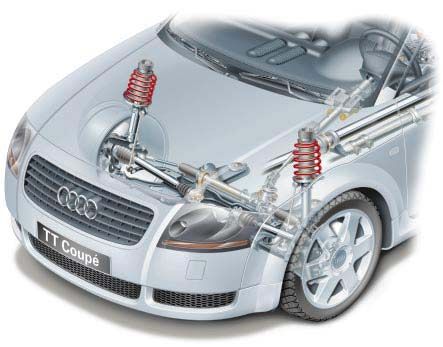
The plant – the plants

                                   Ingolstadt plant
                                   The model series Audi A4 and Audi A3 are produced in Ingolstadt.
                                   A separate production line has been set up for the body in white of
                                   the Audi TT Coupé.
                                   The head office of Technical Development is also located in Ingol-
                                   stadt.

                                                 Special trucks were developed for transferring the body-
                                                 shells to Györ for final assembly.

                                   High-tech from Györ
                                   Qualified specialists and a good infrastructure are key factors for the
                                   Audi production shop in Györ.
                                   Audi has been manufacturing four-cylinder 5V, V6 and V8 engines
                                   here since 1997. Final assembly of the TT has also been taking place
                                   here since 1998.

    Axle and steering geometry measurement       100% reliability is ensured through a series of systema-
                                                 tic checks integrated in the production process.

                       Watertightness test

                                               Functional tests are an integral part of the production
                                               process
                                                Mounted parts are tested for accuracy of fit, build quality
                                                and functionality after each stage of assembly.

                                               Quality that is measurable
                                                 After final assembly, extensive tests and adjustments
    Electrical function test                     are carried out on every single Audi.

                         Roller dynamometer

                    Exhaust emission test and optimal setup

                                                 Acoustic test bench

2
Contents
                                                                 Page
A brief introduction to the TT . . . . . . . . . . . . . . . . . . . . 4
Design needs no explanation
Vehicle dimensions
Vehicle identification
Environmentally-friendly production

Body . . . . . . . . . . . . . . . . . . . . . . . . . . . . . . . . . . . . . . . . 9
Special features

Vehicle safety . . . . . . . . . . . . . . . . . . . . . . . . . . . . . . . . 14
Occupant protection
Fuel cut-off

Drive units . . . . . . . . . . . . . . . . . . . . . . . . . . . . . . . . . . 18
Engine and gearbox combinations
1.8-ltr. 132 kW 5V turbocharged engine AJQ
1.8-ltr. 165 kW 5V turbocharged engine APX

Subsystems of the Motronic . . . . . . . . . . . . . . . . . . . 37
Lambda control in the EUIII
Torque-oriented engine management
Accelerator position sender
Electrically-activated throttle valve

Fuel system . . . . . . . . . . . . . . . . . . . . . . . . . . . . . . . . . 42

Power transmission . . . . . . . . . . . . . . . . . . . . . . . . . . 48
5-speed manual gearbox
6-speed manual gearbox
Haldex viscous coupling

Running gear . . . . . . . . . . . . . . . . . . . . . . . . . . . . . . . . 56
Steering
Front axle
Rear axle
Brake system

Electrics . . . . . . . . . . . . . . . . . . . . . . . . . . . . . . . . . . . . 64
Vehicle electrical system
Interior monitoring
Immobiliser
Sound system

Heating/air conditioning system . . . . . . . . . . . . . . . . 76
Overview
Expansion valve

Service . . . . . . . . . . . . . . . . . . . . . . . . . . . . . . . . . . . . . 84
Flexible service interval indicator
Oil level sensor
Specifications
Special tools

                                                                                         New.      Important.
                                                                                                   Note.
The Self-Study Programme provides you with information
regarding design and function.

The Self-Study Programme is not a Workshop Manual.

Please refer to the Service Literature for all the relevant
maintenance and repair instructions.
                                                                                                                3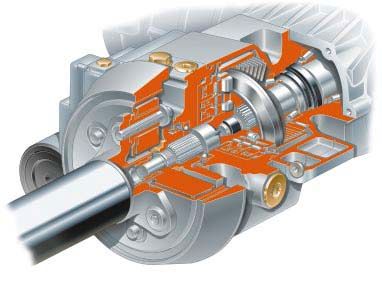
A brief introduction to the TT

    Design needs no explanation                       The interior styling matches the exterior per-
                                                      fectly - a fact reflected in the features of the
    The name alone suggests that this is an Audi      dash panel, the styling of the instruments, the
    with a difference. The Audi TT was named          air nozzles and controls.
    after the legendary Tourist Trophy race on the    The styling of some parts has also been influ-
    Isle of Man - the only one of its kind in the     enced by the use of aluminium.
    world.
    The Audi TT is equally as unique as its legen-
    dary namesake.

    Engines

    As befits a sports car, the Audi TT is
    powered by a four-cylinder 5-valve
    turbocharged engine developing
    180 bhp with a sports gearbox in
    the front-wheel drive and quattro
    versions. A four-cylinder 5-valve
    turbocharged engine
    developing 225 bhp is
    available for the
    quattro version.

    Running gear

    The running gear also underscores Audi’s
    total commitment to the sports car concept.
    The front axle kinematics were revised with
    regard to steering quality and response.
    This, in combination with the Audi TT’s sporty,   The basic version is equipped with 16-inch
    stiff suspension tuning, ensures excellent        wheels shod with size 205/55 R 16 tyres.
    handling and a high standard of driving safety.   A 17-inch suspension is standard with the
                                                      quattro and available as optional equipment
                                                      for all other engine variants.
4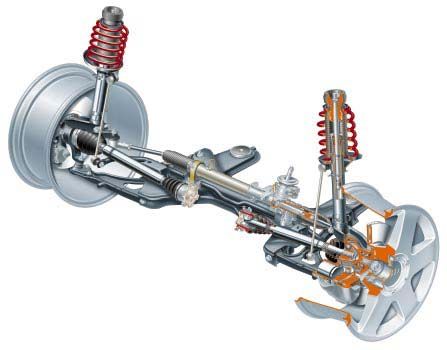
There is no doubt that the real highlight of the
                                                  Audi TT is its emotive design, both on the
                                                  exterior and in the interior. The engineers at
                                                  Audi had an ambitious development goal: to
                                                  meet all functional and quality standards as
                                                  well as the latest statutory requirements and
                                                  Audi’s high standards of safety without com-
                                                  promising the design concept and while retai-
                                                  ning the car’s full viability for everyday use.

                                                  Quattro power train

                                                  The TT will feature a new generation of Audi
                                                  technology and the new Haldex viscous cou-
                                                  pling, further emphasising the vehicle’s sporty
                                                  character.

                                 SSP207/1

Safety                                            Design

Safety is paramount:                              We at Audi firmly believe that the most
That’s why the TT is equipped with front air-     important thing about designing is that
bags for the driver and front passenger.          actions speak louder than words. Suffice to
The TT already complies with the new Euro-        say, a good design speaks for itself.
pean safety laws which will come into effect in   The TT has a “wheel-hugging” design, that is
the year 2003 as well as the tougher require-     to say the entire body is styled around the
ments according to the US Head Impact Pro-        wheels. That also goes for the front and rear
tection Act.                                      bulges as well as the roof and window lines
                                                  and the low-slung passenger cabin.

                                                                                                     5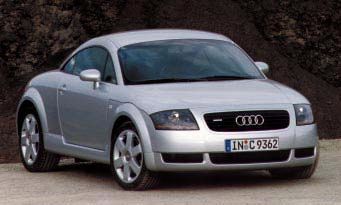
A brief introduction to the TT

    Vehicle dimensions

                                         1354

                        1525                                             1507 (quattro 1503)
                        1764                                                   1856

        The “+ and –“ dimensions are refe-                      Track width
        rence values compared to the Audi A3                    Front:     +12 mm
                                                                Rear:      +12 mm
        Length:         –111 mm                                            + 8 mm quattro
        Width:          +45 mm                                  Wheelbase: –93 mm
        Height:         –69 mm                                             –85 mm quattro
                                                                828
                                                    959

                                                                                                    762

                  876                     2419 (quattro 2427)                          746
                                                                                    (quattro 738)
                                                4041

                                                                           1209
                                                                                  950
                                                       1412

                                                                  1221

                                                                                        900

6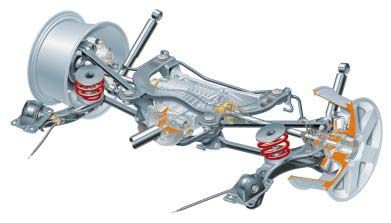
Vehicle identification

         AUDI HUNGARIA MOTOR KFT
                          2111008
                                1
                             1000

TRUZZZ8NZX1000301
      1765 kg
           kg
1-    1015 kg
2-     850 kg
Typ 8N

                                    TRUZZZ8NZX1000301
                                *                            *

 Key of manufacturing                    World manu-         Part describing vehicle              Part identifying vehicle
 plants within the Group                facturing code
 in digit position 11:
 A Ingolstadt                                                    Filler                                Model year, alphanumeric as prescri-
 N Neckarsulm                                                    constant = Z                                       bed by law
 1 Györ                                                               Digits 1 + 2 vehicle                      Manufacturing plant within
 X Poznan                                                             class. acc. to struc-                      the Group (as at 04/94)
 K Karmann/Rheine                                                     ture table
                                                                                                                      Serial No. beginning
                                                                                                                              with:
                                         1    2    3     4        5    6      7      8        9   10     11    12    13      14   15   16   17
 Audi Hungaria Motor Kft:
 TT/TTS                             *    T    R    U     Z        Z    Z      8     N         Z    X     1      0    0       0    0    0    1
 Audi AG:
 A3                                 *   W     A    U     Z        Z    Z      8      L        Z    X     A      0    0       0    0    0    1
 A4                                 *   W     A    U     Z        Z    Z      8     D         Z    X     A      0    0       0    0    0    1
 A6 (incl. SKD Poland)              *   W     A    U     Z        Z    Z      4      B        Z    X    N/X     0    0       0    0    0    1
 A8                                 *   W     A    U     Z        Z    Z      4     D         Z    X     N      0    0       0    0    0    1
 Cabrio                             *   W     A    U     Z        Z    Z      8     G         Z    X     K      0    0       0    0    0    1
 Audi 100 (C3, CKD)                 *   W     A    U     Z        Z    Z      4      4        Z    X     A      0    0       0    0    0    1

   *       Vehicles to US specification
           (USA, Canada, Saudi Arabia, tourists)
           On the VIN (behind the windscreen), the certification label and on official documents, the fillers (Z) are repla-
           ced by a vehicle code (digits 4-8) or by a test mark (digit 9). This (18-digit) number is the official vehicle identi-
           fication No. (VIN) in the countries listed above.

                                                                                                                                                 7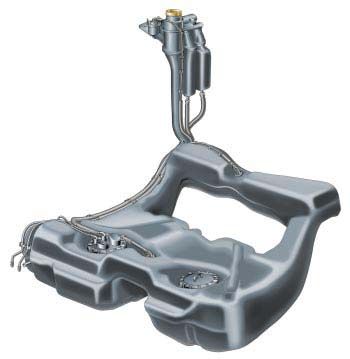
A brief introduction to the TT

    Environmentally-friendly
    production
                                                      Produce locally - think global:
    Environmental protection is firmly rooted in
    Audi’s corporate strategy. During the vehicle     Audi lays great store by waste avoidance,
    development process, all environmental crite-     reduction and recycling.
    ria are incorporated into the product and pro-
                                                      –   Almost all production resources and
    duction concept from the outset. Economic
                                                          supplied parts are delivered in re-usable
    goals and ecological needs are balanced so
                                                          packaging.
    that no conflicts of aims arise.
                                                      –   Most sheet-metal blanks are designed so
                                                          as to minimise cutting waste after
                                                          pressing.

                                                      Recycling
                                                      The recycling rate at Audi is now about 94%
                                                      by weight. Metal cuttings from the press plant
    Waste avoidance and reduction                     are used to manufacture small parts as far as
                                                      possible. The resulting scrap is returned to the
    From 1998 onwards, Audi will use only water-      steelworks, where steel and zinc are separated
    soluble paints in a effort to make its produc-    from one another.
    tion process more environmentally-friendly.
    This step will see a dramatic reduction in sol-   Other waste materials such as paper, card-
    vent emissions. Today’s fillers and base coats,    board, timber, polystyrene, etc. are collected
    for example, contain up to 45% solvent. By        separately and fully recycled .
    comparison, the solvent content in water-solu-
    ble systems is only about 6%.

8
Body

Special features
Front bumper

                                                                          SSP207/74

The front bumper comprises two parts: the        The guide profiles attached to the left and
cover panel and a decorative grille. The bum-    right wings ensure an even gap all round.
per carrier is made of aluminium and bolted to   A zero joint is created by attaching the bum-
the side members by impact absorbing ele-        per to the wing by means of threaded bolts as
ments.                                           well as nut and washer combinations.

Rear bumper

                                                                          SSP207/75

The rear bumper comprises a total of 4 parts:    The rear cover is available in two versions
the bumper panel, the rear cover, the alumi-     depending on engine variant (TT has one
nium cross-member and the central locating       tailpipe, the TTS two). A seamless transition to
element.                                         the body side section (zero joint) is produced
                                                 by means of 2 bolts on each body side section.

                                                                                                    9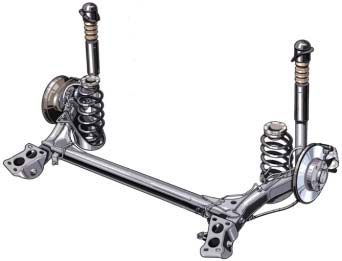
Body

     Bonnet

                              The bonnet is made of aluminium to save
                              weight.

                SSP207/78

     Tailgate

                              The tailgate can only be opened from the
                              interior by means of the switch in the central
                              console or by radio-wave remote control. The
                              tailgate does not have a lock cylinder or a
                              handle.

                              The tailgate has a single-joint hinge.

                  SSP207/77

                                     If the electrical system fails, the tail-
                                     gate can be released in an emergency
                                     by means of the cable pull located
                                     below the rear central console cover.

                SSP207/76
10
Doors
SSP207/47
The door component carrier is made of alumi-
nium and can be adjusted for length, height
The doors of the Audi TT Coupé are frameless and inclination.
and of two-piece construction.
The door panel is made of steel with a bolted Additional side protection pads protect the
high-strength side reinforcement integrated in pelvis area.
the door.
Fuel filler flap
The fuel filler flap is made of aluminium. It can
only be opened electrically via a switch in the
central console.
The fuel filler flap is attached from the exterior
with three anti-theft-protected bolts plus four
decorative bolts.
If the electrical system fails, the fuel filler flap
can be opened via an emergency release
mechanism in the luggage compartment. For
this purpose, it is necessary to open the flap in
the side trim panel on the right-hand side of
the luggage compartment and pull the cable
in the direction indicated on sticker.
SSP207/72
Taillights
To replace the filament lamps, the complete
taillight unit is removed without needing any
tools. Flaps are attached to the luggage com-
partment linings on the left and right. The
light cluster is secured on the inside by means
of 2 captive knurled bolts. On the outside, the
taillight is engaged in a ball head.
The light cluster can be adjusted along
the vehicle’s longitudinal axis by
means of the threaded sleeves.
SSP207/56
11Body
Dash panel
When removing the cross-tube,
please note that one of the faste-
ning bolts is located on the outside
in the plenum chamber. To remove
SSP207/79
this bolt, it is necessary to remove
the wiper linkage.
Structure
SSP207/15
The vehicle front-end area deforms in a prede- The body structure of the vehicle rear-end
fined manner, absorbing the impact energy area is designed in such a way that, firstly, the
without impairing the stability of the occupant integrity of the fuel system remains largely
cell. The side members are manufactured intact and, secondly, the load on the
from 2-, 3- and 1.5-mm-thick mash-welded occupants is kept to a minimum even in
metal plates. In the case of a side impact, the serious accidents.
strong cross members will also deform on the The Audi TT Coupé therefore complies with
side of the body facing away from the impact the statutory crash requirements as well as
to absorb some of the impact energy. the laws relating to frontal and side impacts
due to enter into effect in the EU and USA.
12B-pillar
To absorb the load resulting from a side
impact, the body structure is extremely rigid
even though the B-pillar is not continuous. An
additional transverse support extending from
base of the B-pillar to the rear seat cross-
member minimises cell deformation and the
rate of intrusion into the side structure. This
leads to low occupant loads.
SSP207/9
Side reinforcements in the doors Since the deformation path for energy absorp-
tion is very limited during a side impact,
various design measures are necessary to per-
form this task effectively.
These include the side reinforcements made
of high-strength extruded aluminium sections
in the doors. The double-rectangular section
can absorb large mounts of energy .
During a side impact, the forces acting on the
vehicle are distributed via the side reinforce-
SSP207/5 ments in the doors to the sill and the A- and B-
pillars.
Door sill The strong sill also absorbs energy and simul-
taneously transmits this energy to the stable
floorpan assembly.
The sill trim is made of steel and is secured to
the sill with 17 bolt + washer combinations.
Be careful when placing the car on
a lift support, otherwise the door
sill may become dented.
SSP207/45
13Vehicle safety
Occupant protection The Audi TT Coupé has head-thorax side air-
bags for the driver and front passenger.
These side airbags are integrated in the seat
backrests and extend from the rib cage area
up to the head when inflated.
When the side airbag is tripped, the head and
neck areas are thus provided with better pro-
tection.
In the Audi TT Coupé, the belt tensioners can
be fired independently of the airbags depen-
ding on how the trigger criteria are defined.
SSP207/80
The Audi TT Coupé has a disable function for
deactivating the front passenger airbag.
When using Reboard child seats on the front
passenger seat, the driver must disable the
front passenger airbag with the vehicle key via
the key switch located inside the glove box
(see Operating Manual Audi TT Coupé).
A yellow indicator light in the
central console indicates when
SSP207/81
the airbag is deactivated.
14During a side impact, the vehicle occupant is
inevitably subjected to a relative movement
towards the force application point and away
from the deformation path.
Therefore, it is very important to ensure that
the contact surface between the occupant and
the vehicle is large and energy-absorbing.
The side protection paddings made of plastic
foam protect the vehicle occupants in the pel-
vis and rib cage areas.
SSP207/6
Deformation element Roof padding
For protection of the head, a padding is also
integrated in the roof area.
An additional deformation element has been
welded onto the A-pillar.
These measures have enabled Audi to comply
with the new US head impact laws for the first
time.
SSP207/7
The rear seat has been approved as a Group 3
child seat (approx. 6 - 12 years) and is compli-
ant with ECE-R44. Children of heights ranging
from 1.30 m to 1.50 m without raised seat
swab.
SSP207/73
15Vehicle safety
To minimise the risk of foot injuries in serious
head-on collisions, the brake pedal is swung
away from the foot area by means of a collap-
sing support if severe deformation of the
vehicle occurs.
This function is determined by deformation of
the engine bulkhead and is not dependent on
operation of the brake pedal.
In the event of a frontal crash, the foot con-
trols are displaced towards the central tube.
This causes the collapsing support to deflect
and the piston rod to buckle.
The pedal footplate is swung up to 170 mm
away from the foot area.
The buckling of the piston rod and the defor-
mation work resulting from this dampens the
angular movement of the braking foot. This
reduces the acceleration forces (braking foot)
which normally arise considerably.
SSP207/126
16Fuel cut-off
The fuel tank is made of plastic and is housed The central locking control unit receives this
in a protected position in front of the rear axle. signal simultaneously and unlocks the vehicle
doors. The hazard warning lights are activated
automatically and the interior lighting is swit-
ched on.
The Audi TT Coupé is the first Audi to A restart function enables the engine to be
be equipped with a fuel cut-off. restarted after an accident and it can be
In connection with an airbag trigger moved from the danger zone under its own
mechanism (crash signal output), the power.
Motronic control unit switches the fuel
pump off.
J234 J220 J17
Airbag Motronic
Fuel relay
control unit control unit
J379
Central locking control
unit and anti-theft
warning system
E3 F220...223 G6
Hazard Door locking Interior
warning Fuel pump
unit lighting
switch
17Drive units
Engine and gearbox combinations
Engine Gearbox Code
MQ 250 5-speed front 02J.N
DZF
1.8-ltr. 5V turbocharged AJQ
132 kW/180 bhp
SSP207/53
MQ 350 5-speed quattro 02M.3
DXW
SSP207/13
SSP207/33
1.8-ltr. 5V turbocharged APX
165 kW/225 bhp
MQ 350 6-speed quattro 02M.1
DQB
SSP207/33
SSP207/14
181.8-ltr. 5V turbocharged engine
132 kW AJQ
Specifications
Engine code: AJQ
Type: 4-cylinder 5-valve
four-stroke petrol engine
with exhaust gas
turbocharger
Valve timing: Double overhead
camshaft (DOHC)
Displacement: 1781 cm3
Bore: 81 mm
Stroke: 86.4 mm
Compression
ratio: 9.5 : 1
Torque: 235 Nm
at 1950 - 4700 rpm
Rated output: 132 kW/180 bhp
at 5500 rpm
Engine management: ME 7.5
Fuel: Premium unleaded 98 RON
(RON 95 can be used, but
SSP207/13
reduces power output)
200 400 Technical modifications:
Basic 110 kW (150 bhp)
180 360
– EU II + D3
160 320 – electronic throttle control
– “Tumble“ duct
Torque [Nm]
140 280 (For details of the tumble duct in the intake
Output [kW]
system, refer to SSP 198)
120 240 – Engine control unit (characteristic curves
adapted)
100 200 – CAN-BUS with TCS/EDL/ESP
– electr. activated air divert control valve
80 160
60 120
40 80
20 40
0 0
1000 2000 3000 4000 5000 6000 7000
Engine speed [rpm] SSP207/62
19Drive units
System overview – 1.8-ltr. 132 kW 5V turbocharged
Sensors
Hot-film air mass meter G70
Engine speed sender G28
Hall sender G40
Lambda probe G39
Throttle valve control unit J338
with angle sender G187 for
throttle valve gear G186
Intake air temperature sender G42
Coolant temperature sender
G2 and G62
Knock sensor 1 (cyl. 1 - 2) G61
Knock sensor 2 (cyl. 3 - 4) G66
Accelerator pedal module with accele-
rator position sender G79 and G185
Brake light switch F and brake
pedal switch F47
Clutch pedal switch F36
Auxiliary signals:
Pressure switch for power steering F88
Cruise control
Intake manifold pressure sender G71
20Actuators
Fuel pump relay J17 and
fuel pump G6
Injection valves N30, N31, N32,
N33
Power output stage N122 and
ignition coils N (1st cyl.),
N128 (2nd cyl.),
N158 (3rd cyl.)
and N163 (4th cyl.)
with integrated power output
stage
Solenoid valve for activated
charcoal canister N80
Solenoid valve for charge pres-
sure limitation N75
Throttle valve control unit J338
with throttle valve gear G186
Air recirculation valve for turbo-
charger N249
Heater for lambda probe Z19
Fault lamp for electronic throttle
EPC control K132
Auxiliary signals
SSP207/46
21Function chart
Turbocharged 1.8-ltr. 132 kW 5V engine
Motronic ME 7.5
Components Auxiliary signals
A Battery
E45 Switch for cruise control system CAN-BUS H =
E227 Button for cruise control system CAN-BUS L = } Databus drive
F Brake light switch
F36 Clutch pedal switch A Engine speed signal (out)
F88 Power steering (pressure switch) B Fuel consumption signal (out)
G6 Fuel pump C Road speed signal (in)
G28 Engine speed sender D Air-conditioner compressor signal (in-out)
G39 Lambda probe E Air conditioning ready (in)
G40 Hall sender with quick-start sender F Crash signal (in) from airbag control
wheel unit
G42 Intake air temperature sender G Alternator terminal DF/DFM (in)
G61 Knock sensor 1 W- line (in-out)
G62 Coolant temperature sender
G66 Knock sensor 2
G70 Air mass meter
G71 Intake manifold pressure sender
G79 Accelerator position sender
G186 Throttle valve gear
(electronic throttle control)
G187 Throttle valve drive angle sender 1
For the applicable Fuse No. and
G888 Throttle valve drive angle sender 1 amperage, please refer to the current
J17 Fuel pump relay flow diagram.
J220 Motronic control unit
K132 Fault lamp for electronic throttle
control
M9/10 Stop lights
N Ignition coil
N30...33 Injection valves
N75 Solenoid valve for charge pressure
Input signal
limitation
N80 Solenoid valve for activated charcoal
Output signal
canister
N128 Ignition coil 2
Positive
N158 Ignition coil 3
N163 Ignition coil 4
Earth
N249 Air recirculation valve for
turbocharger
Bidirectional
P Spark plug socket
S Fuse
Q Spark plugs
Z19 Heater for lambda probe
2230 30
15 15
86 30
J17
4
85 87
Q Q Q Q
P P P P
S S S S S S S S S
N N128 N158 N163
E45 E227 F F36
N80 N75 N249 A B C D
Z19 G39 G70
λ
N30 N31 N32 N33
+ M9/10
15 55 49 14 9
A J220J220
+ - - + +
A -
M + +
P
E F G
- - K132
G186 G187 G188 G79 G71 G40 G62 F88 G28 G61 G66 G42
CAN - BUS H
CAN - BUS L
M G6
31 31
SSP207/25
23
Dieses Dokument wurde erstellt mit FrameMaker 4.0.4.Drive units
Charging
Direction of travel
5V Turbo
energised
de-energised
N249
SSP207/20
The turbocharging system comprises the follo- The result is an increase in power output for the
wing components: same displacement and engine speed.
– Exhaust emission turbocharger In the case of the 1.8-ltr. 5V turbocharged
– Charge air cooler engine, turbocharging is also used to provide
– Charge pressure control high torque from the bottom end to the top end
– Air divert control in overrun of the rev band.
The flow energy of the exhaust emissions is Charge pressure increases in proportion to the
transferred to the fresh air entering the exhaust turbocharger speed. The charge pressure is
gas turbocharger. In the process, the air required limited to prolong the life of the engine. The
for combustion is compressed and the volume charge pressure control performs this task.
of air entering the cylinders per working cycle is
thus increased. The air divert control prevents the turbocharger
slowing down unnecessarily if the throttle valve
The air temperature, increased by compression, closes suddenly.
is again reduced in the charge air cooler. Since
the density of the cooled air is higher, the
amount of fuel-air mixture entering the engine is
greater, too.
24Charge pressure control
J220
N75
Waste gate valve
G70 G28 G69
5V Turbo
energised
de-energised
N249
SSP207/22
The engine control unit calculates the charge If the control fails, the maximum charge pres-
pressure setpoint from the engine torque sure is limited to a basic charge pressure
request. (mechanical charge pressure).
The engine control unit regulates the charge If the bypass is closed, the charge pressure rises.
pressure as a function of the opening time of the In the lower engine speed range, the turbochar-
solenoid valves for charge pressure limitation ger supplies the charge pressure required to
N75. For this purpose, a control pressure is develop high torque or the required volume of
generated from the charge pressure in the com- air.
pressor housing and the atmospheric pressure.
As soon as the charge pressure has reached the
This control pressure counteracts the spring calculated charge pressure, the bypass opens
pressure in the charge pressure control valve and a certain quantity of exhaust gas is ducted
(vacuum box) and opens or closes the waste past the turbine. The turbocharger motor speed
gate valve in the turbocharger. decreases, and so too does the charge pressure.
In the de-energised state, the solenoid valve N75 For more detailed information regarding charge
is closed and the charge pressure acts directly pressure control, please refer to SSP 198.
on the vacuum box. The charge pressure control
valve opens at low charge pressure.
25Drive units
Air divert control in overrun
Air recirculation valve
(pneumatic)
5V Turbo
energised
de-energised
N249
SSP207/23
When the throttle valve is closed, it produces As soon as the throttle valve is closed, the air
a backpressure in the compressor circuit due recirculation valve briefly closes the compres-
to the charge pressure still present. This cau- sor circuit.
ses the compressor wheel to decelerate
rapidly. When the throttle valve is opened, the The vacuum counteracts the spring in the
speed of the turbocharger must again be valve. The valve opens, and the compressor
increased. The air divert control in overrun and intake sides of the compressor circuit
prevents turbo lag, which would otherwise close for a short period of time. There is no
occur. deceleration of the compressor wheel.
The air recirculation valve is a mechanically When the throttle valve re-opens, the intake
activated and pneumatically controlled spring manifold vacuum drops. The air recirculation
diaphragm valve. It is also activated via an valve is closed by the spring force. The com-
electrically activated air recirculation valve for pressor circuit no longer closes briefly. Full
turbocharger N249. This, in connection with charger speed is available immediately.
the vacuum reservoir, enables the air recircu-
lation valve N249 to operate independently of For more detailed information regarding the
the intake manifold pressure. If the air recircu- air divert control in overrun, please refer to
lation valve fails, control takes place as a SSP 198.
result of the engine vacuum downstream of
the throttle valve.
261.8-ltr. 5V 165 kW APX
turbocharged engine
Specifications
Engine code: APX
Type: 4-cylinder 5-valve
four-stroke-petrol engine
with exhaust gas
turbocharger
Valve timing: Double overhead
camshaft (DOHC)
Displacement: 1781 cm3
Bore: 81 mm
Stroke: 86.4 mm
Compression ratio: 9 : 1
Rated output: 165 kW at 5900 rpm
max. torque: 280 Nm at 2200 to
5500 rpm
Engine management: ME 7.5
Fuel: Premium unleaded 98 RON
SSP207/14 Exhaust gas
treatment: Twin-flow catalytic
converter, one heated
lambda probe upstream
and downstream of the
catalytic converter
200 400 Technical modifications:
Basic 132 kW (180 bhp)
180 360
– Cooling water afterrun pump (approx. 10 min)
160 320 – Secondary air system
– Piston (modified), thus changing the
Torque [Nm]
140 280 compression ratio to 9.0 : 1 from 9.5 : 1
Output [kW]
– Manifold (new exhaust and flange)
120 240 – When EU III takes effect, there will be a 2nd
lambda probe downstream of catalytic
100 200 converter for catalyst monitoring
– 2 in-line charge air coolers
80 160 – Injection valves (higher flow)
– Quick-start sender wheel
60 120 – Piston cooling by oil injectors
(volumetric flow adaptation)
40 80 – Hot-film air mass meter with reverse flow
detector HFM5 integrated in the intake air
20 40 filter upper section
– Single-flow throttle valve unit integrated in
0
1000 2000 3000 4000 5000 6000 7000
0 the electronic throttle control positioner
Engine speed [rpm] SSP207/63
27Drive units
Extended system overview - 1.8-ltr. 165 kW 5V engine
Lambda probe down-
stream of catalytic con-
verter G130 when EU III
takes effect
Motronic control unit J220
Secondary air pump motor V101
Secondary air pump relay J299
Secondary air injection valve N112
Heater for lambda probe
SSP207/103
down-stream of catalytic
converter Z29
when EU III takes effect
The secondary air system in the 1.8-ltr. 5V
engine developing 165 kW ensures that the
exhaust emissions comply with the EU III+D3
standard.
A probe will be installed downstream of the
catalytic converter to meet the requirements
stipulated in EU III.
28Extended function diagram - 1.8-ltr. 165 kW 5V engine
30
J17
S
S
J299 V101
Z29 G130 N112
λ M
J220
H K
31
SSP207/27
As of series production launch, the 1.8-ltr. Legend
165 kW engine will be equipped with extended G130 Lambda probe downstream of
catalytic converter when EU III comes
system components to ensure it complies
into effect
with European exhaust emission standard J17 Fuel pump relay
EU II + D3. J299 Secondary air pump relay
N112 Secondary air injection valve
V101 Secondary air pump motor
The basic version is equivalent to the engine
Z29 Heater for lambda probe downstream
management system used in the 1.8-ltr. of catalytic converter when EU III
engine developing 132 kW (refer to function comes into effect
diagram). H Air conditioning PWM signal
K Fault lamp
29Drive units
Quick-start sender wheel
The quick-start sender wheel is attached to the On previous systems, it was not possible to
camshaft. It supplies a signal which enables initiate the first combustion cycle until a crank
the engine control unit to determine the posi- angle of approx. 600˚ - 900o was reached. The
tion of the camshaft relative to the crankshaft quick-start sender wheel enables the engine
more quickly and, in combination with the control unit to recognise the position of the
signal which the engine speed sender supp- crankshaft relative to the camshaft after a
lies, to start the engine more quickly. crank angle of 400˚ - 480o.
This allows the first combustion cycle to be
initiated sooner and the engine to start more
quickly.
Track 1
Twin-track sender wheel Track 2
Tooth
Gap
Hall device
Track 1
Hall device
Track 2
SSP207/84
Hall sensor
The quick-start sender wheel comprises a
twin-track sender wheel and a Hall sensor. The
sender wheel is designed so that two tracks
are located side by side. In the position where
there is a gap in one track, there is a tooth in
the other track.
30The control unit compares the phase sensor
signal with the reference mark signal and thus
ascertains the working cycle currently taking
place in the cylinder.
Low phase signal = Compression cycle
High phase signal = Exhaust cycle
SSP207/85
The signal which the engine speed sender G28
supplies enables the injection cycle to be
initiated after a crank angle of approx. 440o.
SSP207/86
Electrical circuit
The Hall sender G40 is connected to the sen-
J220 sor earth terminal of the engine control unit.
G71
2 1 Even if the Hall sender fails, it is still
possible to start the engine.
G40
3 SSP207/87
31Drive units
Cooling circuit
Coolant afterrun pump
Coolant temperature
sender G2/G62
Heating heat exchanger
Exh. gas turbocharger
Expansion
tank
Cylinder head
Coolant pump
Coolant regulator
Oil cooler
Coolant afterrun
pump V51 Thermoswitch for
radiator fan F18/F54
SSP207/37
Cooler
The exhaust gas turbocharger is water-cooled The coolant afterrun pump protects the coo-
and integrated in the cooling circuit. lant against overheating, e.g. after turning off
a hot engine.
When the coolant regulator is open, the coo-
lant flows back to the cooler or coolant pump
via cylinder head, exhaust gas turbocharger
and coolant afterrun pump, among others.
32Coolant afterrun pump V51
SSP207/38
Function in vehicle with air conditioning
The coolant afterrun pump V51 is atta- The pump starts via radiator fan control unit
ched to the radiator fan housing. J293 when the ignition is turned “On“. A timer
module integrated in the control unit J293
ensures that the pump V51 runs on for
To counteract the thermal loads, and in parti- approx. 10 min after the ignition has been
cular at the exhaust gas turbocharger, the switched off.
pump V51 starts up when the ignition is tur-
ned “On“. In vehicles without air conditioning, these
functions are implemented by means of a
timer relay.
33Drive units
Charging
5V Turbo
SSP207/24
To increase the power output and torque of Since the previous charge air cooler was no
the 1.8-ltr. 5V engine to 165 kW, it was neces- longer capable of effectively cooling down the
sary to make various design modifications to increased air flow through the exhaust gas
the basic engine of the Audi TT Coupé turbocharger, it was necessary to accommo-
developing 132 kW. date a second, parallel charge air cooler on
the left-hand side of the vehicle.
A characteristic feature of the engine is its
higher air demand, making it necessary to
enlarge the diameter of the intake port and
exhaust gas turbocharger.
34Vacuum box for charge
Secondary air system pressure control valve
Combi-valve
5V Turbo
energised
de-energised
G39 G62
J299
V101
N122
J220
SSP207/21
The vacuum box for the charge pressure con-
In the cold start phase, the exhaust trol valve is controlled in the cold start phase
gases contain a high proportion of by the electro-pneumatic secondary air con-
uncombusted hydrocarbons. trol valve N112 while the secondary air system
is in operation.
To improve the exhaust gas composition,
these constituents must be reduced. The control pressure acts on the turbocharger
The secondary air system is responsible for waste gate, and the exhaust gas flow is routed
this task. past the turbine wheel up to the upper load
range.
The system injects air upstream of the outlet
valves during this phase, thus enriching the The hot exhaust gases help the secondary air
exhaust gases with oxygen. This causes post- system to quickly heat the catalytic converter
combustion of the uncombusted hydrocar- up to operating temperature during the cold
bons contained in the exhaust gases. start phase.
The catalytic converter reaches operating tem-
perature more quickly due to the heat released
during postcombustion.
35Drive units
Secondary air injection valve N112
The secondary air injection valve is an electro-
pneumatic valve. It is switched by the Motro-
nic control unit and controls the combi-valve.
To open the combi-valve, the secondary air
injection valve releases the intake manifold
vacuum.
SSP207/16 To close the combi-valve, the secondary air
injection valve releases atmospheric pressure.
Secondary air pump V101
The secondary air pump relay J299 which the
Motronic control unit drives switches the elec-
tric current for the secondary air pump motor
V101. The fresh air which is mixed with the
exhaust gases is drawn out of the air filter
SSP207/17
housing by the secondary air pump and
released by the combi-valve.
The combi-valve
The combi-valve is bolted to the secondary air This valve also prevents hot exhaust gases
duct of the cylinder head. entering and damaging the secondary air
The air path from the secondary air pump to pump.
the secondary duct of the cylinder head is
opened by the vacuum from the secondary air
injection valve.
Valve opened Valve closed
Atmospheric pressure
in control line from
Vacuum in control line
secondary air injection
from secondary air
valve
Fresh air from injection valve
secondary air pump
SSP207/19 Exhaust gas SSP207/18
To secondary air
port
36Subsystems of the Motronic
Lambda control in EU III 165 kW
Lambda control in the EU III
An additional lambda probe (G130), which is
located downstream of the catalytic converter,
was integrated in the system to comply with
EU III. Its purpose is to test the function of the
catalytic converter.
Depending on vehicle type, the connectors,
plug colours and fitting locations are different
to help identify the connectors correctly.
SSP207/100
What is the purpose of the EU III test? Catalytic conversion diagnosis
An aged or defective catalytic converter has a During the diagnosis, the engine control unit
lower oxygen storage capacity, which also compares the probe stresses upstream and
means that its conversion efficiency is poorer. downstream of the catalytic converter probe
If the applicable limit values for hydrocarbon and calculates an upstream-to-downstream
content in the exhaust gases are exceeded by ratio.
a factor of 1.5 in the course of a statutory If this ratio deviates from the nominal range of
exhaust emission test, this must be identified values, the engine management recognises
via the fault memory. that the catalytic converter has malfunctioned.
After the fault conditions have been fulfilled,
the appropriate fault code is saved to the fault
memory.
Electrical circuit Effects of signal failure
The engine lambda control also operates if the
J220
probe downstream of the catalytic converter
fails.
The only function which is unavailable if the
probe fails is the catalytic converter function
+ test.
In this case, the Motronic cannot execute a
functional test on the probe upstream of the
1 2 3 4 catalytic converter either.
See SSP 175 – On-Board
Diagnosis II.
G130 SSP207/101
37Subsystems of the Motronic
Torque-oriented engine
management
The Motronic ME 7.5 has a torque-ori- External and internal torque requests are co-
ented functional structure. ordinated by the engine control unit, making
The new electronic throttle control allowance for efficiency and implemented with
function makes this possible. the available manipulated variables.
Internal
torque requests
• Start
• Idling control
• Catalytic converter
heating
• Power output
External torque requests limitation
• Driving comfort
• Component
protection
• Driver input • Engine speed Torque-influencing manipula-
limitation ted variables
Throttle valve
Co-ordination of tor- angle
• Driving
dynamics que and efficiency
requests in the engine
control unit
Charge pressure
• Driving
comfort
Ignition angle
• Cruise control Cylinder suppres-
system sion
Injection time
SSP207/96
38Torque-oriented
functional structure
In contrast to previously known systems, the All - internal and external - torque requests are
ME 7.5 is not limited to the output of torque combined to form a nominal torque.
variables to the networked control units (ABS,
automatic gearbox). Instead it refers back to To implement the nominal torque, the manipu-
the basis of this physical variable when it cal- lated variables are co-ordinated, making allo-
culates the manipulated variables. wance for consumption and emission data so
as to ensure optimal torque control.
Charge torque
setpoint Setpoint charge
Conversion of
Charge path prio-
torque into
ritisation
charge
Throttle valve
Throttle position angle
calculation
Actual charge Intake manifold
pressure setpoint
External and Calculation of
internal tor- efficiency and tor- Charge pressure
que requests que reference control
variables Charge pressure
(waste gate)
Ignition angle
Calculation
Prioritisation of of crankshaft-
crankshaft-syn- synchronous
chronous path Cylinder sup-
initiations
pression
Injection time
Inner torque SSP207/97
setpoint
39Subsystems of the Motronic
Accelerator position senders G79
and G185
The accelerator position sender transmits the The accelerator position sender transmits to
driver inputs to the Motronic. the Motronic an analogue signal correspon-
ding to the accelerator pedal position. To
ensure the functional reliability of the electro-
nic throttle control, the accelerator position
SSP207/102 sender has two independent potentiometers
G79 and G185.
Resistance in Ω
G79 The characteristics are different (refer to dia-
gram).
G185
The control unit monitors the function and
plausibility of the two senders G79 and G185.
If a sender fails, the other sender acts as a
LHD Accelerator pedal travel back-up.
Module housing
Housing cover
with sensors
The electronic throttle control function is used
to reduce and increase torque without adver-
sely affecting the exhaust emission values.
SSP207/98
Torque reduction Torque increase
• Traction control • Speed control
• Engine speed limitation • Engine braking control
• Speed limitation • Dash pot function
• Power output limitation • Idling control
• Cruise control system • Driving dynamics control systems
• Driving dynamics control systems
40Electrically actuated throttle valve
(electronic throttle control function)
With Motronic ME 7.5, there is no longer a The engine control unit positions the throttle
mechanical throttle control cable between the valve via an electric motor. The engine control
accelerator pedal and throttle valve. This has unit is provided with continuous feedback on
been replaced by an electronic control unit the throttle valve position.
(drive-by-wire).
Extensive safety measures have been imple-
The driver input at the accelerator pedal is mented in the hardware and software. For
registered by the accelerator position sender example, dual senders, a safety module and a
and transmitted to the engine control unit. self-monitoring processor structure are inte-
grated in the electronic throttle control
function.
The system comprises the following compon-
ents:
– Accelerator position sender
– Engine control unit
– Throttle valve control unit
Throttle valve control
unit J338
Engine control unit
Throttle valve
drive G186
Input signals Output signals
Accelerator position sender
CPU*
SSP207/99
Accelerator pedal posi- * Control Processing Unit Angle senders for
tion senders G79 and throttle valve drive
G185 G187 and G188
Safety module
41Fuel system
Fuel tanks for vehicles with front-wheel drive
and quattro power train
Different fuel tanks are used in the front-wheel The filler neck cannot be separa-
drive and quattro versions of the Audi TT. ted from the fuel tank.
Both fuel tanks are made of plastic and have a
capacity of 55 ltr. and 62 ltr. in the front-wheel
drive and quattro versions respectively.
Air vent valve for vehicles with front-wheel
drive and quattro power train
Bypass duct
Housing for gra-
vity float valve Activated by
unleaded fuel
valve
Air vent valve
Filler neck
Filler expansion tank
Main expansion
chamber
SSP207/116
When refuelling the vehicle, the unleaded fuel In the US version and after EU III
valve activates the air vent valve. The valve takes effect, fuel vapours will be
seals the main expansion chamber so that no routed to the ACF system by an
fuel vapour can escape from this tank when additional vent line connected to
the vehicle is being refuelled. the air vent valve while the
The filler expansion chamber is vented by the vehicle is being refuelled.
filler neck.
42Gravity float valves for vehicles with front-
wheel drive and quattro power train
Filler expansion cham-
ber
Main expansion
chamber
to ACF system
SSP207/117
The gravity float valve prevents fuel from The filler expansion chamber as well as the
entering into the ACF system when cornering main expansion chamber are combined at the
at high speed or if the vehicle rolls over. filler neck upper section and purged via the
gravity float valve by the ACF system.
43Fuel system
Fuel tank for front-wheel drive version
Air vent valve
Gravity float valve
Filler expansion
chamber
Filler neck
Main expan-
sion chamber
to activated charcoal filter
Filler breather
Main breather
SSP207/118
When refuelling the fuel tank, the gas mixture The vapours are conveyed to the activated
is conveyed via the filler breather directly into charcoal filter via the closed filler neck, the
the filler expansion chamber and from here bypass at the air breather valve and the gra-
via the filler neck into the atmosphere. vity float valve.
Heat-induced fuel vapours are channelled
through the operating vent and collected in
the main expansion chamber at the filler neck
upper section.
44The fuel is transferred to the engine by a high-
performance fuel pump with a pressure
increase from 3 to 4 bar.
In the event of a crash, the fuel pump is swit-
ched off by the fuel pump relay.
A single-stage fuel pump is used in vehicles
with front-wheel drive.
SSP207/119
Electrical circuit Components
30 30 G Fuel gauge sender
15 15
X X G1 Fuel gauge
31 31
G6 Fuel pump
J17 J17 Fuel pump relay
J218 Combi processor in dash panel insert
J220 Motronic control unit
S Fuse
J220
S
G1
J218
G6 M G
31 31
SSP207/55
45Fuel system
Fuel tank for quattro vehicles
The breather system is designed in the same
way as for front-wheel drive vehicles.
Air vent valve
Filler expansion
chamber
Gravity float valve
Main expansion
chamber
Filler neck
Main breather
Filler breather
SSP207/120
Located in the quattro fuel tank on the left-
hand side is a suction jet pump which pumps
the fuel from the left-hand fuel tank part upst-
ream of the baffle housing of the fuel delivery
unit.
46SSP207/121
The suction jet pump is driven by the two- The fuel lines and left-hand tank sender are
stage fuel pump. connected to the baffle housing in the tank.
The suction jet pump can only be removed
after de-taching the fuel lines and tank sender
from the baffle housing.
Electrical circuit Components
30 30 G Fuel gauge sender
15 15
X X G1 Fuel gauge
31 31 G6 Fuel pump
J17 G169 Fuel gauge sender 2
J17 Fuel pump relay
J218 Combi processor in dash panel insert
J220 Motronic control unit 2
S Fuse
J220
S
G1
The tank senders are connected in series.
R1 + R2 = Rtotal
Signals are evaluated in the dash panel insert
G169 microprocessor.
J218
G6 M G
The senders can be accessed via
two openings below the rear
seat.
31 31 For removing and installing the
SSP207/82 senders, please follow the
instructions given in the Work-
shop Manual.
47Power transmission
Three gearbox variants are used for power
transmission:
132 kW AJQ 5-speed front-wheel drive 2-shaft gearbox 02J.N
5-speed quattro drive 02M.3
165 kW APX 6-speed quattro drive } 3-shaft gearbox
02M.1
Technical features of the gearboxes
The 5-speed and 6-speed quattro gearboxes 5-speed manual gearbox
are identical as regards their design, whereby
the change gear for 6th gear in the 5-speed Compared to the standard version (A3), the 5-
gearbox has been replaced with a spacer speed front-wheel drive version has a modi-
sleeve. fied ratio, a re-inforced differential with flange
shaft adaptation and triple roller joint shaft.
4 manual shift gates are used for the 5- and 6- The gearbox was modified in the selector
speed variants (an optimal layout is possible shaft area (standardised gear change linkages
for both versions). used), and the gear lever of the sporty version
of the TT has been adapted.
SSP207/124
486-speed manual gearbox
3 shafts
The triple-shaft design permits a space-saving The use of magnesium as a housing material
and highly compact design. results in a weight reduction of 30% due to its
lower density (aluminium has a density of
A distinction is made between two gearbox 2.695 g/cm3 and magnesium has a density of
variants, the variant for vehicles with front- 1.738 g/cm3).
wheel drive and the variant for vehicles with
four-wheel drive (quattro). Both variants differ
from one another as regards their attachment
points and oil penetration points.
SSP207/54
49Power transmission
3-shaft gearbox MQ 350 in 6-speed version
Reverse gear
2nd drive shaft
Gears 5-6
1st drive shaft Engine drive
Gears 1-4
Spur gear
SSP207/122
The spur gear is riveted to the differen- For more detailed information on the manual
tial. If repair work is necessary, the gear-boxes, see SSP 205.
spur gear must be bolts.
50Notes
51Power transmission
Haldex viscous coupling
The four-wheel power train used in the Audi
TT Coupé quattro is a logical progression on
the proven four-wheel drive concept.
A new feature of the power train is the slip-
dependent force distribution control on both
axles by means of a Haldex viscous coupling.
The manual gearbox transmits the engine out-
SSP207/28 put directly to the front axle and simultane-
ously via an angle gear and the propshaft to
the Haldex viscous coupling flanged to the
rear axle drive.
The rear axle drive is composed of the Haldex
viscous coupling, the axle drive and the diffe-
rential.
The transmitted torque is dependent on the
speed difference between the front and rear
axles.
Also, the torque transmission parameters are
defined in the software (variable torque trans-
mission control adapted to the driving situa-
tion).
SSP207/29
Advantages of the Haldex viscous coupling:
– Permanent four-wheel drive is fully – Acceleration with high directional stability
automatic for the driver
– Handling is neutral with a slight tendency
– Permanent four-wheel drive at engine to understeer
speeds higher than 400 rpm
– No restrictions on towing when the axle is
– Controllable four-wheel drive system, the raised off the ground
characteristic curve is not constant
– Communication via CAN-BUS
– High rear axle drive torque of up to
3200 Nm
52The system configuration
Plate coupling
Coupling output end (rear
axle differential input)
Working piston Piston of SSP207/11
Input end
annular piston pump
(propshaft)
The Haldex viscous coupling is accommoda- The housing is filled with oil and hermetically
ted in a closed housing and mounted in front sealed against the atmosphere.
of the rear axle drive.
The plate coupling which runs immersed in oil
The input shaft and the output shaft are sepa- represents a closed system.
rate.
It has its own oil circuit, hydraulic compon-
These shafts are connected via a plate cou- ents, an electrohydraulic control valve and an
pling running in oil. electrical control unit.
The coupling package comprises inner and The system is electrically linked to the on-
outer plates, which are connected to the input board CAN databus.
shaft and output shaft respectively.
The rear axle is a rear differential.
Arranged around the shaft at the coupling
input end are a working piston and two paral-
lel annular piston pumps with a single annular
piston each.
53Power transmission
The hydraulics
Working piston Plate set
Two parallel annular
piston pumps
Pre-pressurising
pump
M
Input Output
Cam disc
Safety valve Oil filling
Control valve
SSP207/12
Torque is transmitted to the rear axle drive by In the event of a breakdown, this means that
means of the plate coupling . the vehicle can be towed without the engine
running and with the axle raised off the
The necessary coupling pressure is generated ground.
via the two annular piston pumps. The annu-
lar piston (also known as axial piston) is Torque is developed at the coupling depen-
driven by an axial piston pump. ding on the driving situation.
The speed at which this pump rotates is the Pressure modulation is induced by means of
difference between coupling input and output the control valve (hydraulic proportional
speeds. valve), whose opening cross-section is altered
by a slide valve.
An even pressure curve is ensured by three
phase-shifted pump strokes. The slide valve is activated by a rack and a
stepping motor.
The annular pistons runs in floating bearings.
They are driven by the pressure generated by The control unit together with its software are
the pre-pressurising pump (an electrically located in the immediate vicinity of the step-
driven gear pump). ping motor.
The pre-pressurising pump only operates if A safety valve opens at very higher inner pres-
the ignition has been turned on and engine sure to prevent the coupling from being
speed is greater than 460 rpm. damaged.
54The control system
Low coefficient of friction
Wheel speed front right > front left Wheel speed rear right > rear left
Engine control unit
MB Haldex
control
MA MA unit
Md Haldex
viscous
coupling
ABS/EDL
hydraulic unit MA
MA
SSP207/10
Motive force, front Motive force, rear
High coefficient of friction
ABS/EDL control unit
The Haldex viscous coupling does not have Legend
any sensors of its own apart from a tempera- ABS/EDL sensor line
ture sensor (necessary for compensating for ABS/EDL control line
temperature-dependent oil viscosity). Brake line, pressurised
Brake line, depressurised
The system conditions the signals which the MA Drive torque per wheel
CAN-BUS supplies (ABS/EDL control unit, MB Brake torque per wheel
engine control unit). Md Engine torque
Accelerator pedal position,
These are Engine torque,
– speed of each individual wheel Engine speed
– engine torque Wheel speeds
– engine speed
– driving condition (straight-ahead driving, If faulty signals are generated or if CAN mes-
thrust, braking, ABS)
sages cannot be received, the vehicle switches
– accelerator pedal position/throttle valve
to emergency mode.
If speed signals are missing, the coupling is
The control system can recognise corners,
opened fully for safety reasons.
manoeuvring mode, acceleration phase and
different wheel circumferences. The stiffness
of the Haldex viscous coupling is adjusted
according to the recognised driving conditi- The Haldex viscous coupling is inte-
ons. grated in the vehicle self-diagnosis.
Address word: 22 – 4wd electronics.
55Running gear
Steering
The safety steering column is adjustable for
rake and reach as standard.
SSP207/2
The maintenance-free rack and pinion steering The vibration-optimised attachment of the
gear is power-assisted. The steering gear steering column to the dash panel cross-mem-
stroke is transmitted directly to the swivel bea- ber keeps the steering wheel free of undesira-
ring due to the fact that the track rods are opti- ble vibrations.
mally attached to the steering arm.
Consequently, the steering is direct.
A steering damper reduces the influence of
impacts and vibrations which are transmitted
from the wheels to the steering gear.
56Pressure switch for power steering
The pressure switch for power steering is
located on the vane pump. It informs the
engine control unit when the vane pump is
subjected to a load.
The vane pump is driven by the engine by
means of a the ribbed V-belt. At full steering
lock, the vane pump generates a pressure.
This also places a higher load on the engine,
and idling speed can drop sharply. The signal
which the pressure switch generates enables
the engine control unit to recognise engine
loading in time and to regulate engine torque
at idling speed.
SSP207/113
This is how it works:
As steering forces increase, the pressure The ME 7.5 determines itself how engine tor-
switch closes and sends a signal to the engine que is to be increased at idling speed, in order
control unit. to counteract the load (e.g. ignition angle cor-
rection towards “retard“).
Without steering wheel movement, the pull-
up integrated in the engine control unit is at
+5 V.
When the pressure switch is closed, the
engine is connected to earth.
Electrical circuit Components
J220 Engine control unit
F88 Pressure switch for power steering
F88
1 2
J220
SSP207/83
57Running gear
Front axle
Incorporating double wishbones, subframe To enhance track stability, newly developed
and transverse anti-roll bar, the McPherson cast steel-swivel bearing with modified track
strut axle is designed as a sports suspension. rod attachments as well as a new forged
cross-member are used.
Coupling link bet-
ween suspension
strut/anti-roll bar
Track rod joint
Subframe
Ball joint
Steering gear
The features of the front axle are:
– Track rod joints (larger diffraction
angle)
SSP207/3
– Ball joint is reinforced by thicker
journals
– The subframe is rigidly bolted to the
aluminium bush
– The suspension strut attachment to
the anti-roll bar ensures better
response
58Rear axle
Front-wheel drive
Torsion beam axle with anti-roll bar
Wheel housing support
Wheel bearing
Double ball
bearing
requiring no
adjustment
Positioning 25°
inclined 25o
25°
SSP207/115
– Track width: 1507 mm The shock absorbers are supported in the
wheel housing and the coil springs are sup-
– Modified axle plates for increased camber ported below the side member.
and modified toe-in
The axle is stabilised by a tubular anti-roll bar.
– Track-correcting axle bearing
The self-steering effect of the rear axle is more
favourable thanks to the bearing inclination
of 25o.
Due to the rear axle inclination, the side forces Due to the separate layout of the
which occur when cornering are transmitted springs and shock absorbers, the ve-
favourably to the bearing and from the bea- hicle has a large luggage compartment
ring to the body. and driving noise inside the passenger
cabin is reduced (sound insulation).
59You can also read


