THE FF LENS MODELLING COMPARISON PROJECT! THE ARES AND HERA SIMULATIONS - MASSIMO MENEGHETTI - JPL PRIYA NATARAJAN - YALE UNIVERSITY DAN COE - STSCI
←
→
Page content transcription
If your browser does not render page correctly, please read the page content below
The FF lens modelling comparison project!
The Ares and Hera simulations
Massimo Meneghetti - JPL

Priya Natarajan - Yale University
Dan Coe - STScI
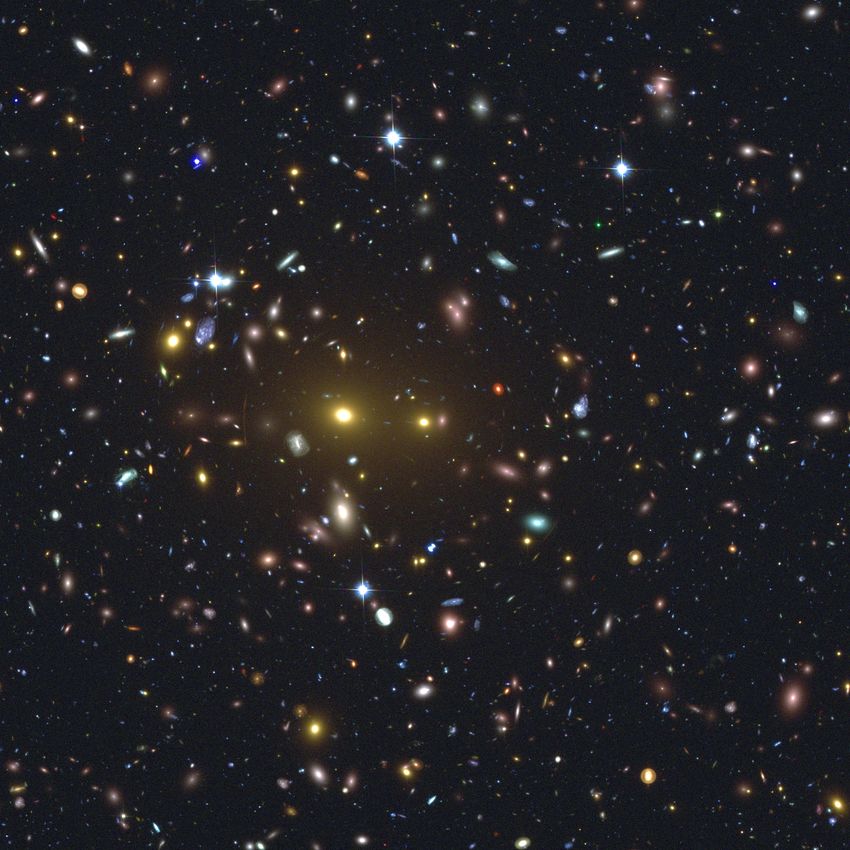
Our
deepest
views
of
galaxies
to
date
HST Frontier Fields! (intrinsic
AB
mag
>
31)
P.I. Matt Mountain, Jen Lotz 840
HST
orbits
(director’s
discre6onary)
Fall
2013
–
Fall
2016
h"p://www.stsci.edu/hst/campaigns/fron6er-‐fields
Bologna Lens Factory
A project started within the Euclid SLSWG (MM, Ben Metcalf, C. Giocoli, F.
         Bellagamba, J. P. Kneib, R. Gavazzi, E. Jullo, A. Atek,… )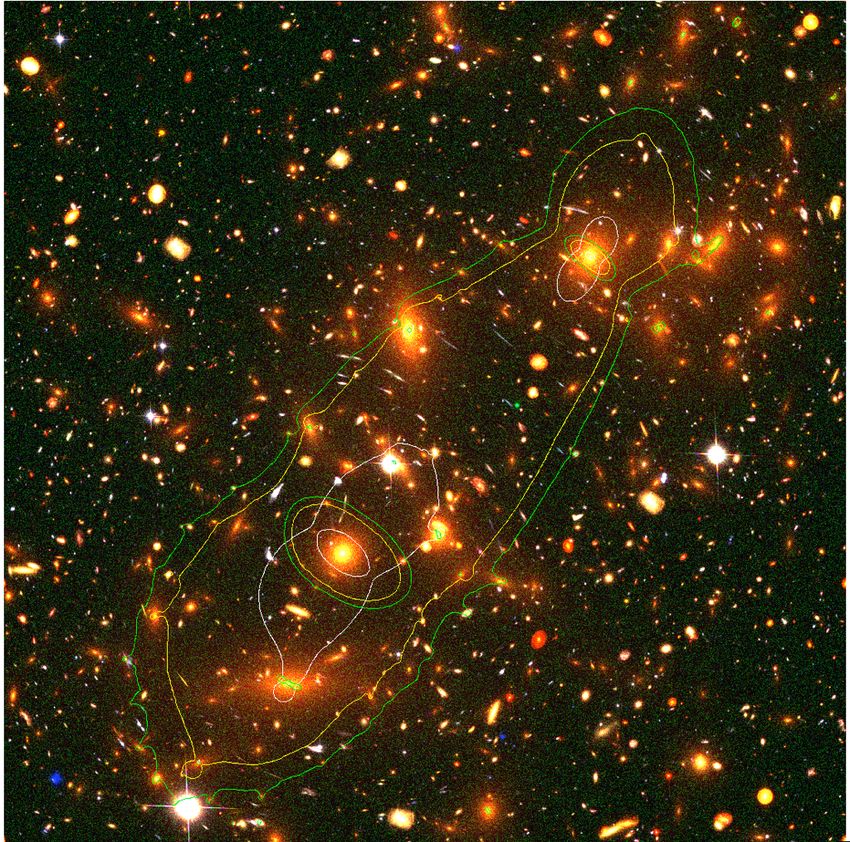
login: FFmodeler
password: FFmagnify
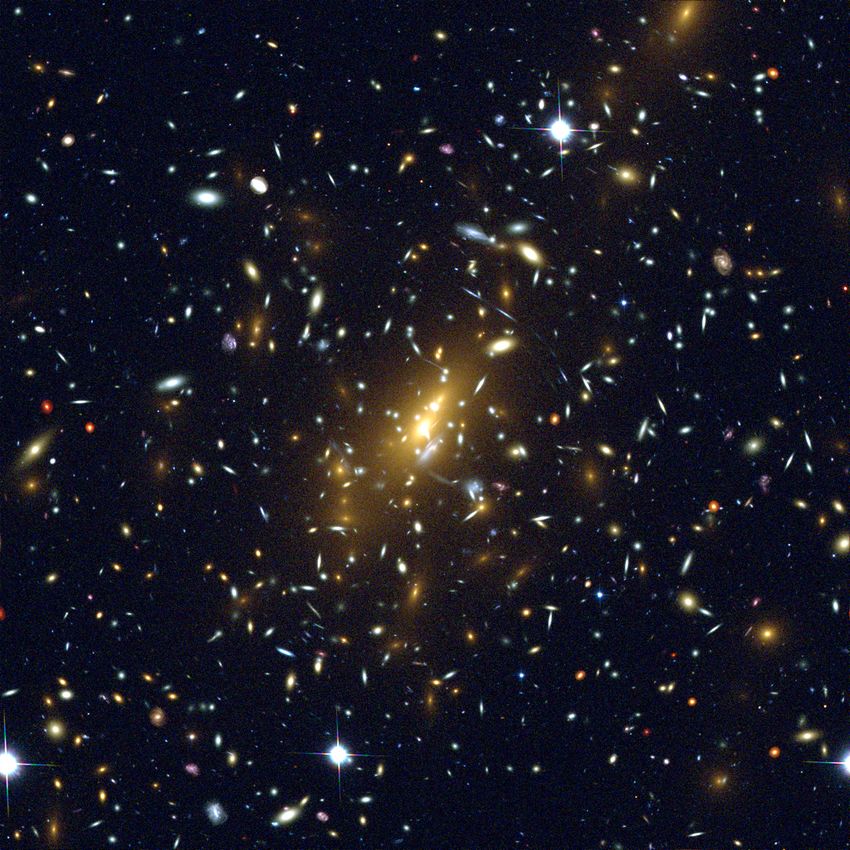
The idea

• create specific simulations to mimic

• the complexity of the FF targets

• the depth of the FF observations

• the filters used in the FF observations

• provide these simulations to the FF teams so that they can:

• perform reconstructions

• return their models for comparison to the input mass distributions
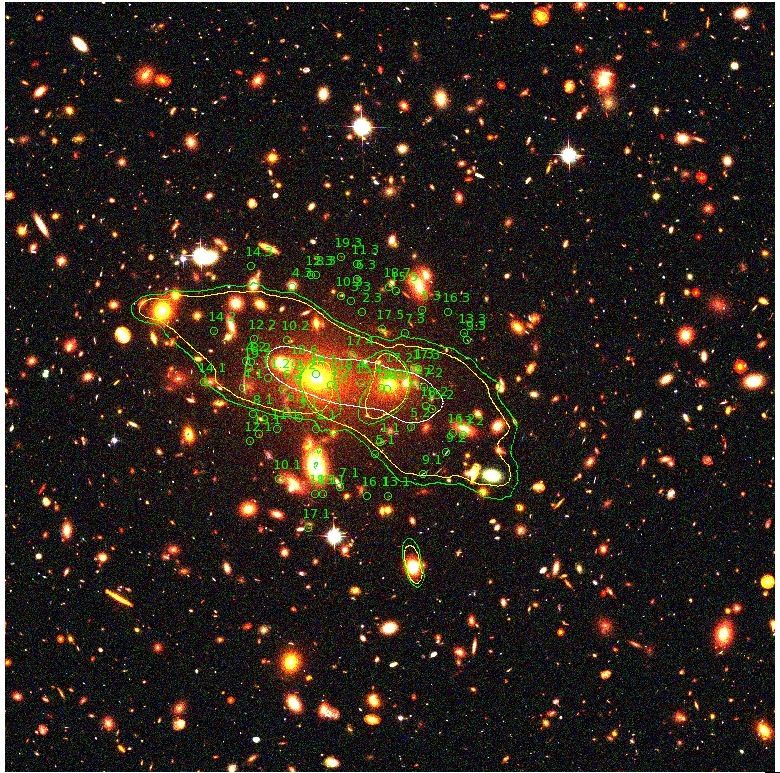
The approach: simulate observations!
https://github.com/pmelchior/skylens
• SkyLens code: creates
  simulated patches of the sky
  using real galaxies from the
  HUDF (Meneghetti et al. 2008,
  2010)
• Includes lensing effects
  produced by any mass
  distribution (e.g. from numerical/
  hydrodynamical simulations)
• Can simulate observations with
  virtually any telescope. Used to
  simulate observations with ACS,
  WFC3@HST and SC@Subaru.
• Galaxies have measured SEDs
  and redshifts (Coe et al. 2006)
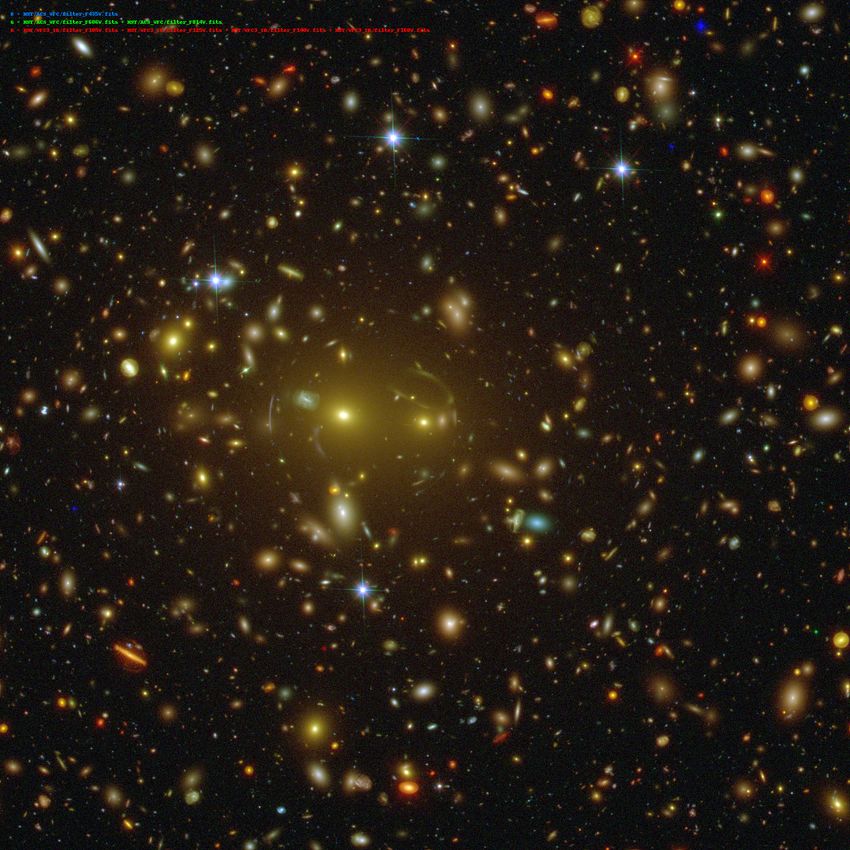
                                       ACS@HST F425W+F606W+F814W
                                               Subaru B+V+I, 2000s exp.
                                                                     (1+1+2 orbits)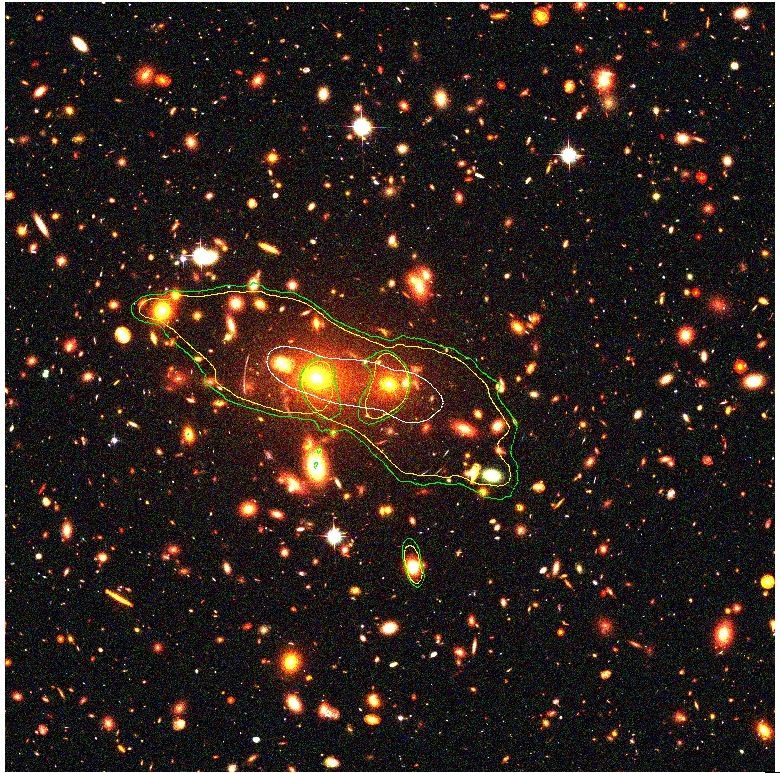
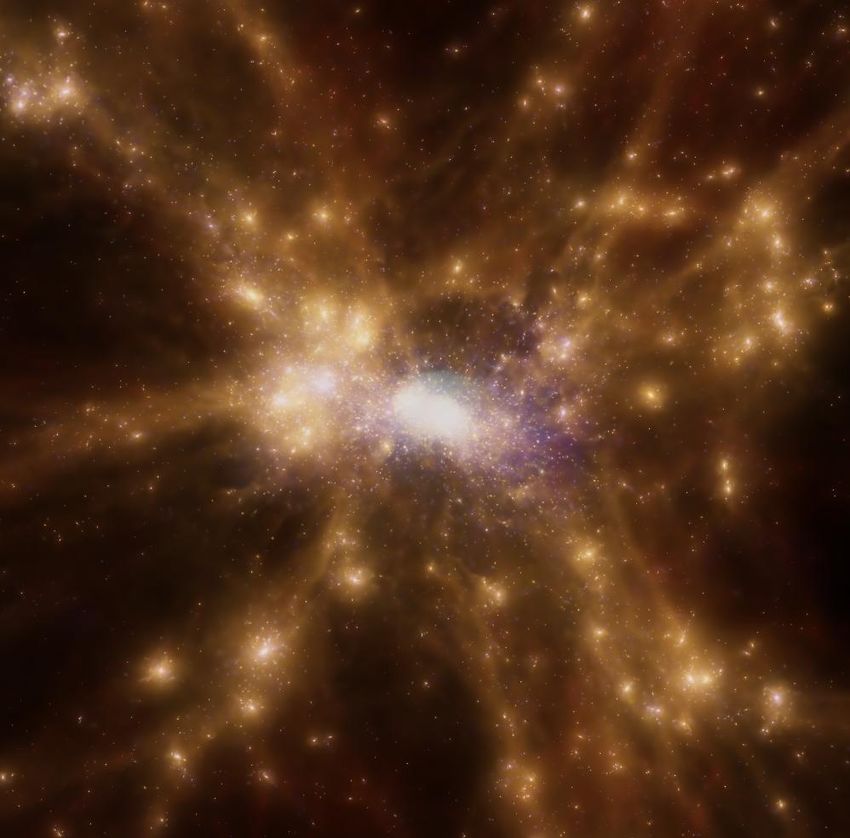
Ares, z=0.5
 The Ares simulation
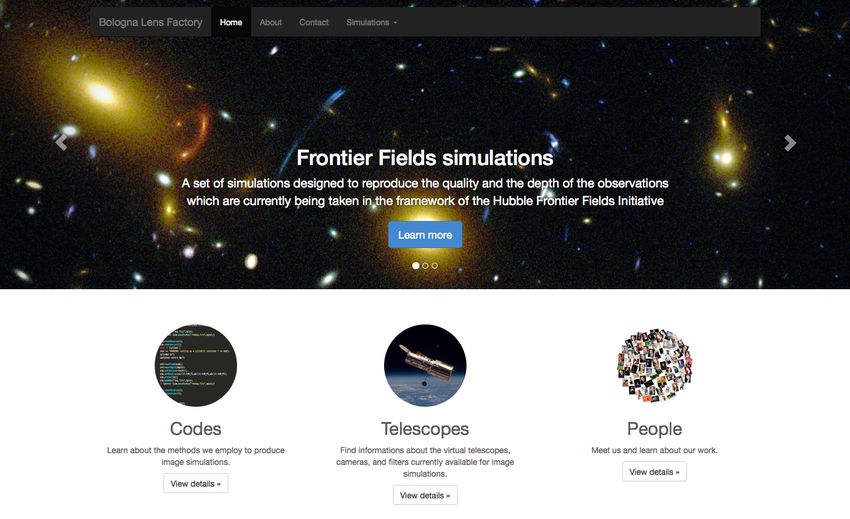
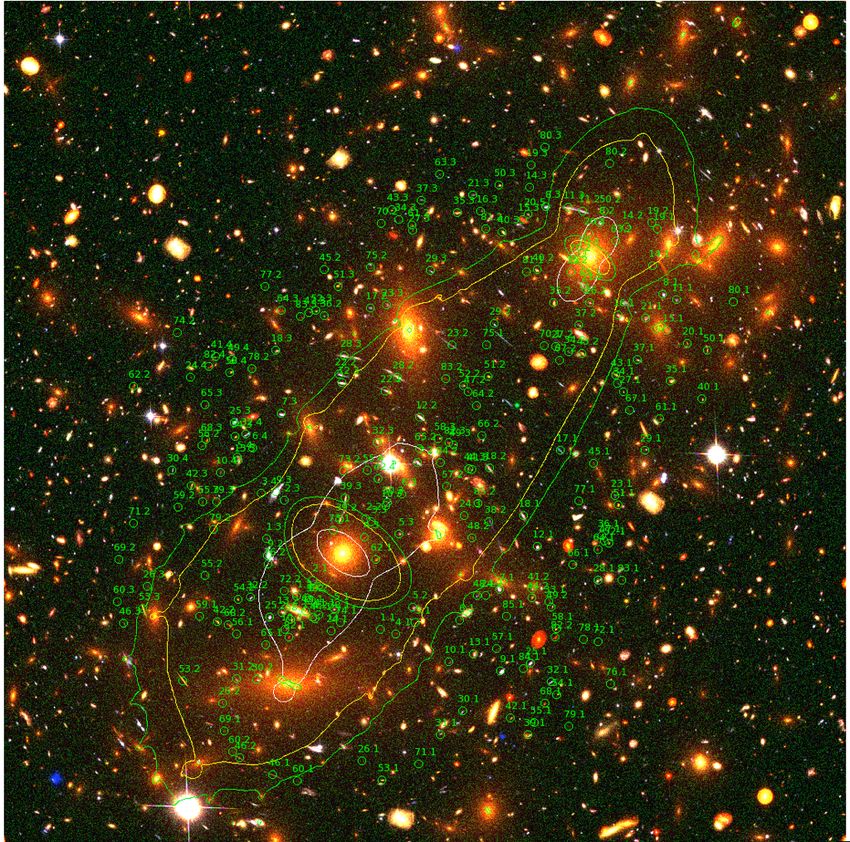
Hera, z=0.507
  The Ares simulation
242 images from 85 sources
65 images from 19 sources
Einstein radius and multiple images
The main ingredient: the lens mass distribution

                                odels
                     er i cal m
                  um                                  Parametric codes may perform better to
      g h - res. n
    Hi                                                       reconstruct these halos

                                        Sem
                                           i-an
                                               alyt
                                                   ical
                                                          “MO
                                                                KA”
                                                                    mode
                                                                        ls

                         ag
               o f K. Dol
       tes   y
   Cour

                                                                           Gio
                                                                              coli
                                                                                     et a
   Non-parametric better to do the job with                                              l. 20
                                                                                              12
     the numerically simulated clusters?
MOKA!
Giocoli, Meneghetti, Bartelmann, Moscardini, Boldrin, 2012
Halo (smooth) BCG: Substructures:
component: • Hernquist or Jaffe den. profile • truncated spheres with NFW or SI
• NFW or gNFW • galaxy properties based on profiles (Tormen et al. 1998)
density profile semi-analytical methods (Wang et • Mass function and radial
• Triaxial shape al., 2006) distribution follow recipes based on
• follow c-M relation • Triaxial shape (correlated to that numerical simulations (Gao et al.)
• adiabatic contr. of the smooth halo) • L, Mstar, Mgas
Blumenthal et al. 1986Ares unveiled...
Bimodal mass
distribution
Smooth mass
components:
triaxial ellipsoids
(with NFW density
profile)
Substructure:
singular
isothermal profile
Complexity
increased by
introducing twisting
of the iso-density
contours (35 degs -
20 degs)Bimodal mass
distribution
Ares unveiled...
Obtained with
MOKA
Smooth mass
components:
triaxial ellipsoids
(with NFW density
profile)
Substructure: HOD
approach, singular
isothermal profile
Complexity
increased by
introducing twisting
of the iso-density
contours (35 degs -
20 degs)Ares unveiled
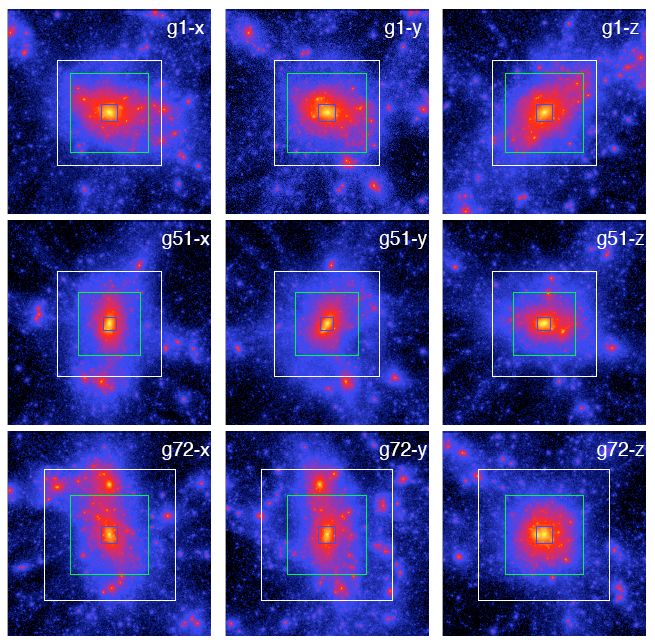
“Dianoga” cluster simulations (S. Borgani’s group)
       1Gpc3
   cosmologi             DM “standard”, “high” &
                          “ultra-high” resolution
     cal box              (1x10 , 1x10 , 1x10  9         8         7

                                 Msun/h)
     WMAP7
   cosmology
29 most massive clusters   GAS: non radiative
            at z=0

                                    GAS CSFCW: cooling, SF,
Re-simulation of regions
                                     chemical enrichment,
corresponding to 5xRvir,
                                     energy driven galactic
   including baryons
                                      winds v=500 km/s

140 “clean” clusters with             GAS CSFW_AGN: as
   M_vir>5e13 Msun                   CSFW but including AGN
                                           feedback

Details in: Bonafede et al 2011; Fabijan et al. 2011; Rasia et al. 2011
Hera unveiled...
Hera unveiled
• N-body simulation
• Bimodal mass distribution
• Cluster halo of M~1015 Msun/h extracted from a cosmological box of 1 Gpc
  side length and re-simulated at high mass resolution (mDM=1x10⁸ Msun/h)
Mass profiles
Substructure content
Galaxies in Hera…
                    • Cluster members are modeled
                      using semi-analytic models (G. De
                      Lucia, E. Contini)
                    • based on substructures resolved in
                      the simulations and on their orbits
                    • recipes to calculate gas in disks,
                      gas ejected, gas that cools and
                      form stars.
                    • IMF+stellar population synthesis
                      for calculating magnitudes
                    • positions, luminosities, bulge/disk
                      decompositions
…and in Ares
Ma & Ebeling, 2010Reconstructions!
Based on HST + Subaru data, redshifts and cluster members provided
Ares Hera
• CATS (Lenstool, 2 models) • CATS (Lenstool)
• J. M. Diego • J. M. Diego (3 models)
• D. Coe (LensPerfect, 4 models) • A. Hoag - M. Bradac
• A. Hoag - M. Bradac • M. Ishigaki (GLAFIC)
• M. Ishigaki (GLAFIC) • T. Johnson- K. Sharon (Lenstool)
• T. Johnson- K. Sharon (Lenstool) • L. Williams (GRALE)
• L. Williams (GRALE) • A. Zitrin (LTM)
• A. Zitrin (2 LTM, PIEMDeNFW)Results • Mass profiles • Critical lines • Convergence maps • Magnification maps
Mass profiles: Ares

      Parametric      Non-parametric
Mass profiles: Hera
Critical lines and Einstein radii: Ares
        CATS            Coe             Diego    GLAFIC

       GRALE      Hoag-Bradac   Johnson-Sharon   Zitrin LTM
Critical lines and Einstein radii: Hera
CATS Diego GLAFIC Hoag-Bradac
Johnson-Sharon GRALE Zitrin LTMLTM vs PIEMDeNFW: what is the correct lens
ellipticity?
Zitrin LTM Zitrin PIEMDeNFWConvergence maps: Ares
Convergence maps: Hera
Magnification maps
Magnification maps: Ares
Magnification maps: Ares
outskirts     cores

Convergence maps: Hera
                                     Meneghetti et al. 2010
Magnification maps: Hera
Magnification errors: Ares vs Hera
Magnification errors: Ares vs Hera
Discussion

• testing ideal situations so far: know redshifts, known multiple images, known cluster members,
  no LSS noise. Shall we make things more complicated?

• parametric methods: do they perform better than non parametric for reconstructing
  convergence and magnification maps?

• variation of ellipticity as a function of radius in Hera seems to be an problem (particularly for
  parametric models). Do we need to parametrised it?

• why are almost all models failing to capture the correct ellipticity of Ares?

• why are there differences between CATS, Johnson-Sharon, GLAFIC (and Zitrin PIEMDeNFW)?

• additional recipes to create mock lenses?

• simulate complementary observations to anchor the models at large scales?
Next steps

• Shall we release the input models for Ares and/or Hera and let you tune your
  methods such to improve the current reconstructions?

• Would you be interested in further testing?

   1. inclusion of matter along the line of sight

   2. search for multiple images, realistic errors on the redshifts

   3. explore different geometries of the lenses [probably not a priority for the
     FF
Substructure?
Green: true critical lines @z=10
Cyan, Magenta, Yellow: reconstructed critical lines
Summary

• we provided to the FF teams simulations to test their methods for
  reconstructing the lens mass distributions and derive the magnification maps.

• they have analyzed 1 on the simulations we provided

• despite the high number of constraints available (85 mult. image systems,
  with spec-z), the different reconstructions exhibit quite significant differences
  with regards to the magnification maps

• we will discuss these results with the lens modelers, to better understand the
  origins of the differences and improve the reconstructions

• additional simulations need to be analyzed
You can also read


