Sustainability planning - it takes two (or more) - Franciska de Jong executive director CLARIN ERIC - Ceric-eric
←
→
Page content transcription
If your browser does not render page correctly, please read the page content below

Sustainability planning – it takes two (or more)

                                               Franciska de Jong
                                  executive director CLARIN ERIC
                                                          f.m.g.dejong@uu.nl

                      Planning for Sustainability of Research Infrastructures
                                  ACCELERATE-ERIC Forum Event, 25 May 2021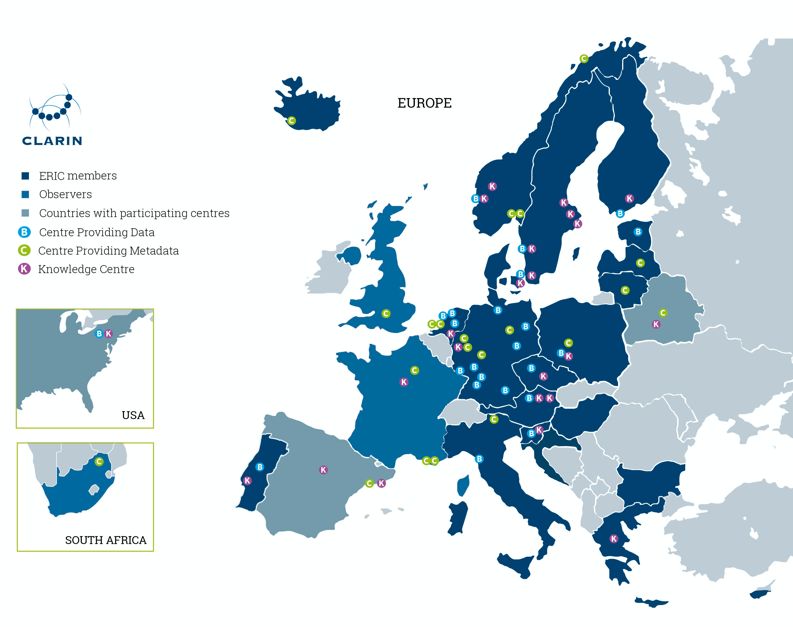
Artist impression of the future of
the Royal Palace in Amsterdam
                        Dirk Tuinder 2021

                                            2
CLARIN in eight bullets (for more detail: www.clarin.eu)
• CLARIN is the Common Language Resources and Technology
Infrastructure
• ESFRI ERIC status since 2012, Landmark since 2016
• that provides easy and sustainable access for scholars in the
humanities and social sciences and beyond
• to FAIR digital language data (in written, spoken, video or multimodal
form)
• and advanced tools to discover, explore, exploit, annotate, analyse or
combine them, wherever they are located
• through a single sign-on environment
• that serves as an ecosystem for knowledge exchange
• with some services already integrated in EOSC Portal (link)
3CLARIN ERIC – a distributed research infrastructure for language resources After 10 years: a consortium of • 21 members • 3 observers • 1 linked party A distributed network of >60 centres 25 CTS certified data centres, strong focus on FAIRness & interoperability • federated login: • central metadata harvesting for easy discovery: • chained services:
CLARIN data types and communities of use in SSH and beyond
  •   Newspaper archives      •   Digital humanities
  •   Parliamentary records   •   Linguistics and Philology
  •   Literary texts          •   Data Science /AI
  •   Historical letters      •   Translation and Lexicography
  •   Broadcast archives      •   Literary Studies
  •   Oral History data       •   History
  •   Social Media data       •   Political and Social Sciences
  •   L-2 Learner Resources   •   Media Studies
  •   Survey data             •   Culture, Folklore, Anthropology
  •   Patient recordings      •   Speech therapy
  •   Excavation reports      •   General Public

                                                                    5
Purpose of the plan
(business/sustainability/strategy/financial plan)
Objectives
• Delivery in line with the Value Proposition
• Strengthened conditions for long-term sustainability
• Scenarios for handling future dynamics
Elements of current strategy (2021-2023)
• Consolidating / reinforcing the collaboration in science cluster
and research teams in the domains of SSH and Data Science/Artificial Intelligence
• Innovation / business development and collaboration with GLAM sector
• Monitoring and anticipating needs in less well connected communities of use, at
country level, wider RI ecosystem
• Monitoring KPIs, multiannual financial planning for central RI operation tasks
6Approach adopted 1/2
(how did you decide on the elements)
Information collected and plans resulting from
H2020 project CLARIN-PLUS (INFRADEV, 2015-2018)
• Mapping of potential new memberships
• Future scenarios, addressing
- Withdrawal from countries: less in-kind contributions
- Fall-back service offering from nodes
- Reduced income from membership fees for central activities
- Mininal human resources/budget needed to maintain services for key
data assets
7Approach adopted 2/2
(how did you decide on the elements)
More recent insights stemming from monitoring
• Dynamics in RI ecosystem
- national infrastructure policies (roadmaps, horizons for RI membership fees
- emerging European Open Science Cloud
- impact on from cluster structure (adopted in the context of ESFRI / ERIC Forum/
INFRAEOSC)
• Interest among nodes fromother continents in joining CLARIN
• Impact expectations, such as
- UN Sustainable Development Goals
- Horizon Europe missions
- potential for aligning agendas with excellent science teams
• Technology watch:
- tools enabling FAIRness, machine-actionable digital objects
- AI, data science
8Main elements
Elements of current strategy (2021-2023)
• Collaboration in context of SSS RI cluster
- Project SSHOC (Social Sciences and Humanities Open Cloud)
- Cluster representation (EOSC Future, ERIC Forum, exchange with ESFRI)
- Excellent research teams in SSH domain
• Innovation / Business development
- Alignment with initiatives focussed on link academia with LT/AI industry
- Active involvement in H2020 project ENRIITC
- Plans for dedicated sections on website explaining the innovation potential
• Collaboration with GLAM sector
- national archives/ libraries as member of national consortia
- MoU with LIBER (training, RDM)
- exchange with initiatives for digital Cultural Heritage
• Monitoring what is needed in the countries, national consortia and other
stakeholders (EC, ESFRI, citizens)
• Monitoring KPIs, multi-annual financial planning for central RI operation tasks
9Usefulness of plan
How well are we prepared to handle what is still uncertain?
• International perspectives (models for collab needed)
• How to bridge Open Science policy and potential for uptake by industry
• Future of HE funding
- Support for individual RIs
- Funding for cluster activities
• Diversity in support for national consortia
- What do nodes have to prepare for role in fall-back scenario
• Clarity on stakeholder priorities:
- multiple voices from EC
- national investments versus support for domain-driven dynamics
- responsibility for pan-European priorities and potential societal impact
- …
Sustainability planning – it takes two (or more)
10see you @
www.clarin.eu
or
f.m.g.dejong@uu.nlYou can also read


