Bluesky (et al.) at the APS - Bluesky Satellite workshop at 2018 EPICS Collaboration Meeting - Argonne National Laboratory
←
→
Page content transcription
If your browser does not render page correctly, please read the page content below
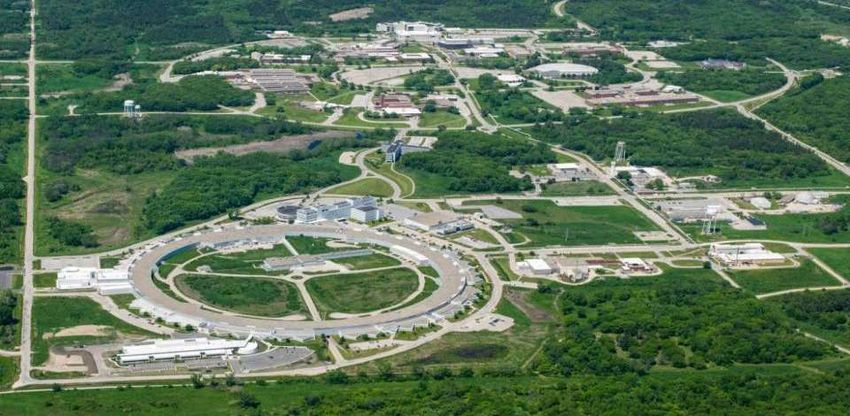
Bluesky Satellite workshop at
             2018 EPICS Collaboration Meeting

                Bluesky (et al.) at the APS

erhtjhtyhy

             Pete Jemian
                                                measurement workflow
             BCDA group
             X-ray Science Division
             Advanced Photon Source
             Argonne National Laboratory

             2018-06-11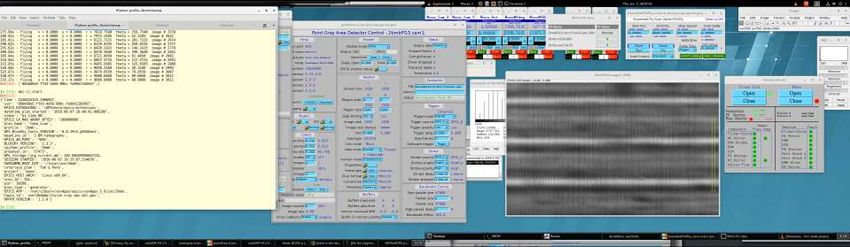
Topics
Bluesky (et al.) at the APS
APS beam line control environment
Bluesky software installation
User operating environment
Results from 2018-06-07 beam time
Conclusion
2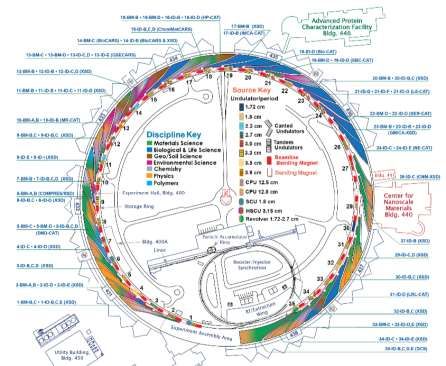
APS beam line control environment
APS is very diverse
More than 60 beam lines in operation
More than half are facility-managed
EPICS used at most, not all, beam lines
Data acquisition code is diverse
Multiple tools used together, segmented decisions, deep investment
Data retention policies are diverse
Yet: Facility is operating and publishing
New software should be compelling and provide what is not already possible (or
easy). Be easy to use. And, most important, without any flaws. A tall order.
APS-U upgrade offers ripe opportunity to advance the data acquisition code suite
Early demos of Bluesky capabilities are most persuasive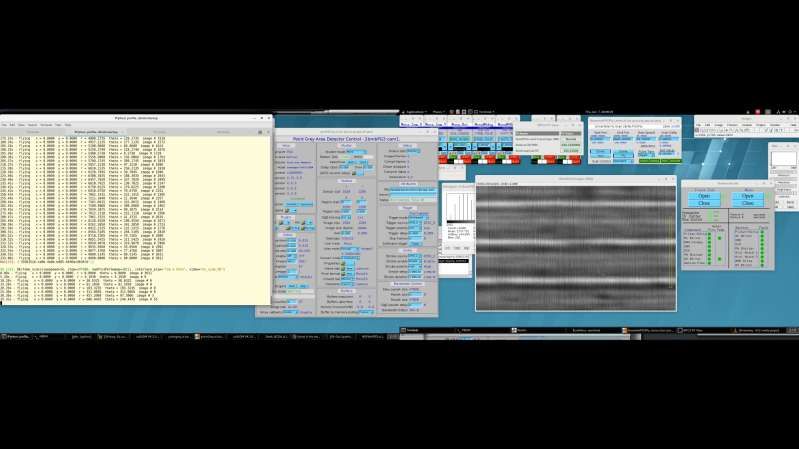
Bluesky software installation
Database
One mongodb server for each sector or beamline
Will monitor disk usage
Q: Any advantage to coordinate these servers?
Common Python software managed by BCDA support group
Common read-only installation for all beam lines
(updated via nightly rsync same as other beam line control software)
Local installation for exceptional needs
Don’t rely on virtual environments
Install additional tools as needed
Keep public HISTORY.txt file of all updates
Instrument-specific software
Default ipython profile
Jupyter notebooks to document or build tutorials
GitHub use
Use GitHub organizations to provide version control for beam line configurations.
Naming convention
Create a GitHub organization with name like: APS-SSS-GGG
SSS: sector, beam –line, and station (such as 2BM)
GGG: operating group (such as MIC for the Microscopy group)
Within each organization, create a repository: ipython-username
ipython: the text ipython
username: instrument account, such as instruser
Consistent naming makes similar work easier to locate
facilitates sharing of common code
Similar to pattern established by NSLS-II DAMA team
https://github.com/BCDA-APS/use_bluesky/wiki
GitHub APS beam line organizations
Typical ipython layout
User operating environment
Challenging
Deploying new ipython profiles
Keeping existing ipython profiles consistent with updates
Using common tools for new deployments
https://github.com/BCDA-APS/use_blueskyAPS Bluesky tools
Starter script: use_bluesky.sh [profile] for interactive use
Runs Python software and correct ipython profile
https://github.com/BCDA-APS/use_bluesky/tree/master/bin
Common code for APS:
Caveat: Much of this existing code needs to be update for ophyd v1.0
Code: https://github.com/BCDA-APS/APS_BlueSky_tools
Docs: http://aps-bluesky-tools.readthedocs.io
Devices: shutters, attenuation filters, APS info (e.g., SR current)
Callbacks: write scan data to SPEC file
Plans: TuneAxis so each motor can know how to be tuned
https://github.com/APS-USAXS/ipython-usaxs/blob/master/profile_bluesky/startup/29-axis_tuning.pyExample Bluesky session
various GUIs
ipython
console caQtDM MEDM PyQt ImageJ
text editor (minimized)Camera
2-BM-B
Mono
Sample APS 2-BM
tomo
Camera trigger encoder Motor PV
FPGA
controller controller gateway
IOC IOC IOC IOC IOC
CA & PVA CA CA CA CA
CA PVA PVA
ALCF
Bluesky
and other Verifier
Proxy Visualization
experiment (QA) firewall
controls Reconstruction2018-06-07 beam time at 2-BM-B
MONA project
Monitor, Optimize, Navigate and Analyse
experimental conditions and progress on-the-fly
Interlaced Fly Scan Tomography
with real-time data streaming to QA,
reconstruction, and visualization
• Bluesky directs the measurement
• Motor controller triggers camera via FPGA 24 rotations, 12.5s per full rotation
10 ms per image, 1920x1200, 16-bit
• Images as EPICS 7 PVaccess structures 95.6 ms & 2.8695° between images
• Images also written to local HDF5 file (one file) 30°/s, 3011 images
• QA code can stop experiment if data bad PointGrey Grasshopper3, USB
• Reconstruction code on remote cluster (ALCF) Aerotech Ensemble motor controller
• Sinogram visualization softGlueZynq FPGAAPS Fly scans in
Bluesky
Only core components shown
Data typically recorded externally
Each busy record calls one or more
sseq records which perform sequence
of data acquisition steps
Fly scans are often hardware-assisted
and unique to each instrument
Bluesky must interface to existing code
Awkward to implement as ophyd Flyer
(data collected externally)
We’re still learning 30s preparation phase
Console session, 16x 300s fly scan, 3011 frames
~120s finish writing HDF5 data 300s fly scan, 3011 frames Reconstruction, 16x 1 sinogram shown
MONA team acknowledgements
APS MONA team APS support LBL
Doga Gürsŏy, Fred Carter Harinarayan Krishnan
project lead Mark Engbretson Dinesh Kumar
Tekin Bicer Patricia Fernandez Ronald Pandolfi
Barbara Frosik Troy Lutes Dilworth Parkinson
Arthur Glowacki Tim Mooney James Sethian
Pete Jemian Kevin Peterson
Nicholas Schwarz Giampiero Sciutto NSLS-II DAMA
Roger Sersted Dan Allan
2-BM-B Tomo Instrument Ron Sluiter Tom Caswell
Xianghui Xiao Stefan Vogt Julien Lhermitte
Pavel Shevchenko Maksim Rakitin
Francesco de Carlo Argonne ALCF
William ScullinConclusion
Thank you for your attention

                               http://sas2018.anl.gov

www.anl.gov
You can also read


