THE MONEYBALL MOMENT FOR MARKETING IN CANADA: LEVERAGING TV TO DRIVE IMPROVED MEDIA SPEND PERFORMANCE
←
→
Page content transcription
If your browser does not render page correctly, please read the page content below

THE MONEYBALL
MOMENT FOR
MARKETING IN
CANADA:
LEVERAGING TV TO DRIVE IMPROVED
MEDIA SPEND PERFORMANCE

                Commissioned by   1
EXECUTIVE SUMMARY

    MARKET CONTEXT
    Moneyball, the book by Michael Lewis, documents
    how a professional baseball team used data
    and analytics to fundamentally change the way
    the team’s management evaluated players and
    executed strategies, moving away from traditional
    statistics in favour of new metrics correlated
    highly with “what produces wins.”

    A recent study conducted by Accenture Strategy,
    commissioned by thinktv in Canada, has
    uncovered a ‘Moneyball moment’ for Canadian
    advertisers. With a focus on producing insights
    to help marketers rethink their approach to
    evaluating media performance, the study shows
    how advertisers can use analytics to improve
    the way they allocate and measure how media
    investments produce sales.

    The key takeaway from our study is that Canadian
    advertisers can amplify the effectiveness of their
    overall media investments and drive increased
    sales by exploring how to rebalance their media
    allocations towards Multiplatform TV
    (TV and long-form digital video content).

2
FIVE IMPORTANT INSIGHTS
FROM OUR RESEARCH:
1. Canadian companies can justify an increase in their overall media spend:
   Canadian companies on average spend 1.7% of their revenue on media. This
   investment generates a 10% higher sales return than that of US companies
   who spend nearly twice the percentage of revenue in the industry categories
   evaluated. Given that both the US and Canada are expecting a 3.0-3.5%
   annual GDP growth over the next three to five years, Canadian companies can
   increase their overall media spend to capture this growth1.

2. Major brands are underinvesting in TV in Canada: Our analysis found that
   advertisers can maximize the yield on their media investments by increasing
   budget allocations to TV by 5%. Based on the last 12 months of sales data,
   such an increase would yield a 4% increase in annual sales generated by
   media, amounting to C$1.4 billion in incremental revenue in the industries
   we assessed. The gap between optimal and current TV advertising spend
   varies across industries and is more pronounced in Telecommunications and
   Automotive at 7% and 6% respectively.

3. T
    V has a material Halo Effect on digital media: The Halo Effect is the ability
   of TV advertising to amplify advertising effectiveness in multi-channel
   campaigns. This sales ROI boost from TV to digital is often hidden when
   measuring ad effectiveness. Our research shows that accounting for the Halo
   Effect increases TV’s sales ROI by 23%, giving it the highest attributed ROI of
   any media channel. Further, when the impact of TV is attributed correctly in
   an integrated campaign, TV amplifies the sales ROI of digital by 19%.

4. TV provides a strong upside for the next dollar spent: The next dollar spent
   on TV will outperform the next dollar spent on any other media channel across
   each industry we assessed. Given TV’s higher marginal return, our analysis
   found that for new investments in media, allocating approximately 50% of
   that incremental spend on TV would drive the highest yield for the media
   budget overall.

5. The untapped value of Long-Form Digital Video Content (LFVC) in Canada:
   We define LFVC as advertising against broadcaster-owned digital video
   content greater than 15 minutes, viewed online or via mobile devices and
   often sold separately from TV. Our analysis reveals that LFVC generates 2x the
   average sales ROI of digital media. However, as LFVC viewership has rapidly
   increased in Canada, the media spend has not followed. Our dataset showed
   limited spend in LFVC in Canada despite its strong sales ROI. This disconnect
   creates a valuable opportunity for both marketers and broadcasters
   moving forward.

1
 International Monetary Fund (IMF), 2018
                                                                                     3
WHAT THIS MEANS FOR
    ADVERTISERS
    The findings show that advertisers can improve their
    advertising investment yield in a material way by leveraging
    analytics more effectively. We propose the following actions
    for Canadian marketers:
    1. Re-evaluate Overall Spend. Our Canadian and US studies support increased
        media spend in Canada. The amount of increase will vary for each advertiser,
        but our findings show that sales ROI from media spend is more pronounced
        in Canada than in the US. And, when Canadian advertisers consider the
        nearly 12x sales ROI their media investments deliver, it makes sense to look at
        increasing the budgetary allocation to media over other areas of investment.

    2. Re-evaluate Media Allocation to Drive Improved Return. Our analysis
       identified TV as an undervalued media channel. Advertisers should rebalance
       media investments accordingly, by evaluating performance based on
       attributed sales ROI measures and not just on impression reach, frequency
       and cost.

    3. Leverage Attribution Analytics Continuously. For Consumer Packaged Goods
        (CPG), Over-the-Counter (OTC) Pharmaceuticals and Automotive, we used
        third-party data sources to conduct this analysis. Given the availability of
        data, Canadian advertisers should invest in media attribution analytics to
        use these findings continually and ensure their ongoing ability to optimize
        media yield.

    4. Take Advantage of LFVC. Invest more in LFVC as available inventory increases
        and audiences move more towards this format. LFVC has remarkably high
        sales ROI and is underutilized in the marketplace.

    The spirit of Moneyball suggests that with every market inefficiency comes
    an opportunity. For the 2002 Oakland Athletics, a new way to evaluate player
    performance led to an historic string of victories that propelled the team into
    playoff contention, despite having the third smallest payroll in baseball that
    year. For advertisers in Canada willing to embrace the same strategic thinking
    that led to Oakland’s success, there is an opportunity to improve yield from
    advertising investments and sales ROI. Our analysis has identified and quantified
    this opportunity – it is now up to marketers to take advantage.

4
INTRODUCTION
One of the most significant and scrutinized discretionary budget items for
most organizations is the marketing budget. Canadian companies spend over
C$13.5 billion annually placing advertisements on various media channels,
and marketers are under increasing pressure to deliver results from these
investments.

While overall media spend has not grown much over the years (i.e. 1.8%
compound annual growth rate (CAGR) since 20122), there has been a notable
shift in the way marketers allocate their budgets across media types.
Investments in digital channels such as display, paid search and social have
nearly doubled in size in the past six years. This growth has come largely at
the expense of print, while spending on TV, radio and out-of-home (OOH) has
remained relatively flat.

Considering the current situation, we conducted this study to answer the
following questions:

    • 	Which media channels are driving the best return on investment (ROI)
         in Canada?

    • 	Do different media channels impact each other in a way that contributes to
        their overall performance?

    • 	What is the impact different levels of media investment across channels have
        on overall performance?

    • 	 Are advertisers maximizing their overall media mix in Canada?

Until now, answering these questions with any accuracy was challenging
and expensive. Many media channels have difficulties linking advertising
spend directly to sales ROI. As a result, many advertisers equate advertising
effectiveness with impression volume and cost, which are important, but not as
compelling as sales ROI measures.

Our study links media spend, TV viewership and sales data to analyze the
effectiveness of media spend across all channels, ultimately showing how
rebalancing media spend can drive increased sales. Our robust data set
includes over four years of data (January 2014 to mid-2018), covering 105
brands across four industries: Automotive, CPG, OTC Pharmaceuticals and
Telecommunications. We assessed over $3 billion of total media spend over four
years, which makes up over 5% of spend in the Canadian market.

thinktv Net Advertising Volume report, 2018; Accenture analysis
2

                                                                                        5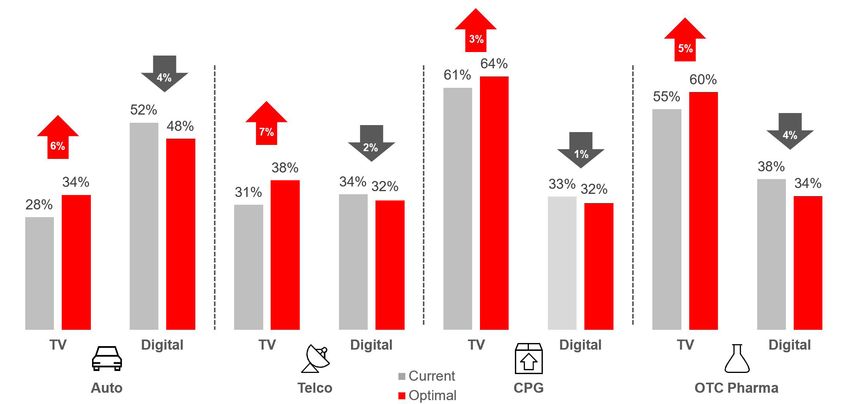
KEY FINDINGS
    FINDING #1:

    CANADIAN COMPANIES CAN
    JUSTIFY AN INCREASE IN
    OVERALL MEDIA SPEND
    Canadian companies spend 1.7% of total revenue on media. By comparison, US
    companies spend nearly twice this percentage on media. There is a compelling
    case for Canadian companies to increase their overall media spend, given that
    it drives strong sales ROI. On average, we see a 12x sales ROI for media spend in
    Canada, which is approximately 10% higher than the U.S. Notably, media spend
    in Canada drove 21% of the overall sales we measured in our study, compared to
    approximately 19% in our US studies.
    Figure 2.
    Figure 1

                     MEDIA SPEND AS A % OF REVENUE

                 1.7%                                   3.1%

                Canada Average                            U.S. Average

6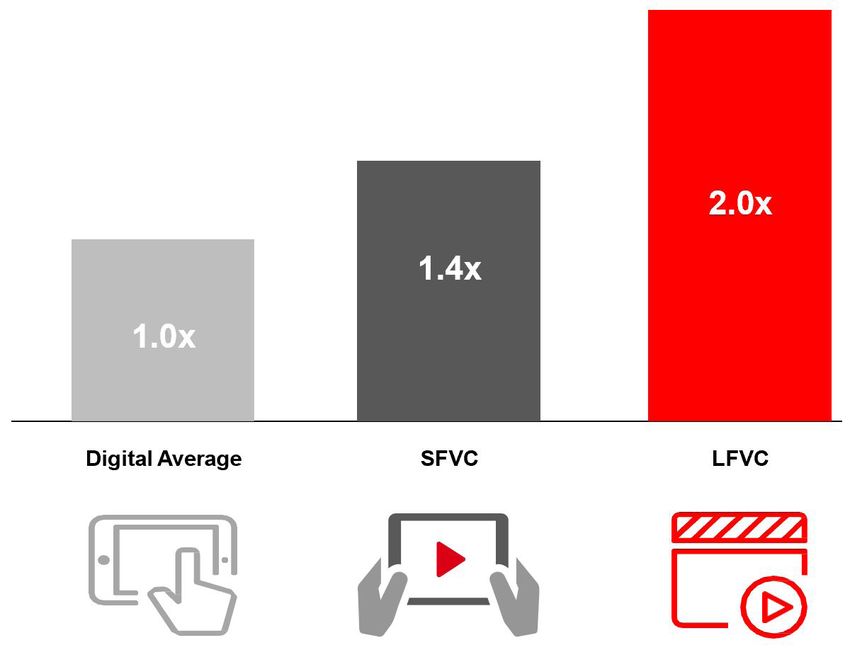
FINDING #2:

MAJOR BRANDS ARE
UNDERINVESTING IN TV
IN CANADA
Advertisers in Canada should rebalance media spend toward
TV to maximize sales
We looked to identify the allocation of spend across all media channels which
would drive the maximum sales ROI for Canadian advertisers. Our analysis shows
that TV is underinvested by 5% of total media spend. Closing this gap will allow
advertisers to maximize the sales ROI driven by their media budgets.
Figure 2.
Figure 2

               CURRENT VS. OPTIMAL MEDIA SPEND

             42% +5% 47%
                                 TV % of Total
               Current           Media Spend           Optimal

                 Marketers currently underinvest in TV by 5%

            40%                                     37%
                                 -3%
                               Digital % of Total
               Current          Media Spend            Optimal

                Marketers currently overinvest in Digital by 3%
                                                                                   7
The gap between current and optimal allocations is clear across each of the
four industries studied (see Figure 3). Telecom and Automotive have the largest
gaps in TV allocation at 7% and 6%, respectively. Also, despite already investing
over 60% of media spend in TV, we found that CPG also had a TV allocation
gap of 3%.
Figure 2.
Figure 3
CURRENT VS. OPTIMAL % OF TOTAL SPEND, BY VERTICAL
+3%
-4% +5%
64%
61% 60%
55% -4%
52% -2% -1%
48% +7%
+6%
38% 38%
34% 34%32% 33% 32% 34%
31%
28%
TV Digital TV Digital TV Digital TV Digital
Current
Auto Telco Optimal CPG OTC Pharma
Figure 2.
What are the implications of this media allocation gap?
Our analysis reveals that on average national brands have potentially missed
out on 4% in annual sales generated by media spend. For the industries in our
study, this amounts to C$1.4 billion in annual revenue. The Halo Effect and
Next Dollar Spent analyses in the following two sections of this report help to
explain the media mix imbalances we found. The lost revenue opportunity was
more significant in Telecom (4.5%) and Automotive (3.8%). Moving forward, early
adopters who work quickly to close this media allocation gap could realize the
significant benefits of increased market share and sales revenue growth.
8TV HAS A MATERIAL
HALO EFFECT ON OTHER
MEDIA CHANNELS
TV spend drives the ROI of Digital channels
When evaluating media channel performance, marketers often fail to account
for the full impact that top-of-the-funnel advertising has on digital channels,
also known as the Halo Effect. Upper-funnel TV spend materially amplifies
the performance of investments in digital and other media, and the absolute
return on a media channel is often quite different from the attributed return on
a channel. Given the way consumers consume media and advertising, and the
power of effective media investments to drive sales, it is critical that advertisers
understand these implications to maximize yield.
Our study quantified the impact of the Halo Effect, and determined that TV
amplified the sales ROI of digital by 19%; the performance of TV increased
by 23% compared to its non-attributed value; and TV delivered the highest
attributed sales ROI of any media channel (see Figure 4).
9Figure 4
ATTRIBUTED SALES ROI BY MEDIA CHANNEL
+23%
Halo Effect -15%
-21%
Adjustment
-19%
-16%
+13%
$14.34 $13.52
$11.79 $12.71
$11.45
$9.99
$6.95
Overall TV Display & Other Search Social SFVC Other Media
Overall TV Display & Other Search Social SFVC Other Media
Media Spend:
Media Spend: 42% 18% 14% 6% 2% 18%
Note: Other Media includes Out of Home, Radio, Newspaper and Magazine. Radio & OOH spend
reflected in the study includes only National Buys, suppressing the overall value contributed by those
channels due to the exclusion of local buys.
We found comparable results in the US market, where TV amplified the sales ROI
of digital by 18%. When we properly attributed that back to TV, TV’s sales ROI
increased by 10%. This lower percentage impact on TV is due to the higher base
of TV spending in the US.
The Halo Effect of TV should not be surprising considering how TV advertising
interacts with key digital channels. For example, it is well-established that
branded paid search volume and conversion peak when running as part of an
integrated campaign that includes TV. As consumers move down the purchase
funnel, they are more receptive to paid search during and after viewing TV
advertising. Similarly, higher click-through and conversion rates should be
expected across display, social and other digital channels when aided by the
awareness generated by TV advertising. Failing to account for this impact
will result in an overstatement of the value of these digital channels, and an
underestimation of the value of TV. Any resulting decreased investment in TV
would ultimately lead to weaker performance by the digital platforms.
10FINDING #4:
TV PROVIDES A STRONG UPSIDE
FOR THE NEXT DOLLAR SPENT
Marginal returns on TV provide the highest ROI
A key question for our study was where best to spend the next dollar of media
to maximize sales ROI. Our research revealed that while digital channels supply
the highest contribution to sales at lower levels of media investment, TV drives
higher incremental sales per dollar when invested at higher levels. At current
media spend levels, Canadian marketers see greater returns from an additional
dollar spent on TV advertising than one spent on other media channels.
Why do we see this variation in performance across different spend levels?
At lower levels of media spend, the strengths of digital are most pronounced.
Digital media’s ability to target audiences and drive conversion creates strong
returns on initial spend levels. As spend levels increase, however, and premium
inventory within a channel becomes saturated, several challenges arise. In paid
search, for instance, a finite number of keywords are most effective in driving
sales, after which spend goes toward generic keywords that deliver weaker
returns. In channels like social and display, there are limits to the number of
premium digital publishers and performance across non-premium publishers
is weaker.
Our analysis shows that TV offers a linear value proposition that is far more
resistant to diminishing returns. Impressions matter, and as spend increases, a
broader base of potential customers is reached which can then be converted
down the marketing funnel.
11The response curves below illustrate how these findings materialized across
the four industries we examined.
Figure 5
ADVERTISING SPEND VS. SALES RESPONSE CURVES
AUTO CURVES TELCO CURVES
TV TV
(in $M)
Display
& Other
Revenue
Search Revenue
Revenue (in $M)
Search
Revenue
SFVC Display & Other
SFVC
Social Social
Spend Spend
CPG CURVES OTC PHARMA CURVES
TV TV
Display
(in $M)
& Other
Revenue
Revenue
Display
Revenue (in $M)
& Other
Search
Revenue
Search
Social Social
SFVC SFVC
Spend Spend
Note: The circle on each response curve represents the current spend levels in the corresponding
media channel
12As budgets increase, how should incremental media spend be allocated to
maximize sales ROI? To answer this question, we tested different allocation
scenarios to understand the impact of a 5% increase in the current media
budgets of the companies studied. Our analysis shows that advertisers can
maximize their sales ROI by investing just over half of incremental media spend
in TV (see Figure 6).
Figure 6
OPTIMAL ALLOCATION OF 5% INCREMENTAL SPEND
8% 1%
8% TV
9% 9% SEARCH
DISPLAY
& OTHER
15% 15% 53%
53%
RADIO
SOCIAL
15%
15%
OTHER
FOR MAXIMIZED SALES ROI, TV SHOULD CAPTURE 53%
OF INCREMENTAL MEDIA SPEND COMPARED TO 40%
FOR ALL DIGITAL CHANNELS COMBINED.
13FINDING #5:
THE VALUE OF LONG-FORM
DIGITAL VIDEO CONTENT
Underinvestment in LFVC presents a large opportunity in the
Canadian marketplace.
While our study focused primarily on understanding the performance of current
media spend, we also looked at areas where there may be untapped value
for advertisers. One area stands out from our analysis: long-form digital video
content. LFVC encompasses all broadcaster-owned digital video content that
is greater than 15 minutes, viewed online or via mobile devices and often sold
separately from TV.
Overall, the LFVC spend that we assessed outperformed all other digital
channels by 2x.
Figure 7
RELATIVE ATTRIBUTED PERFORMANCE
2.0x
1.4x
1.0x
Digital Average SFVC LFVC
LFVC is 2x as effective as the average of all digital channels on an attributed sales ROI basis. It also
outperforms the highest performing digital channel, short-form digital video content (SFVC) by
approximately 45%.
14This media channel stands out because significant increases in LFVC viewership
in the Canadian market have not been met with corresponding increases in
media spend. While LFVC viewership has grown at a 20% CAGR from 2012 to
2017, advertising investment in the channel has grown at only an 8% CAGR over
the same period3. This disconnect in the market creates a significant opportunity
for advertisers, especially considering the strong sales ROI of LFVC.
We believe that LFVC performs better because it engages viewers through
sight, sound and motion more effectively than search, display, social and SFVC.
In addition to being targetable, LFVC delivers the high engagement levels of
audiences who have typically sought out the content they watch. The impact
of a LFVC ad is most comparable to a TV ad, and as such should be used and
evaluated similarly. Moreover, LFVC inventory supplies access to viewers who
consume more of their video content online.
However, there is an issue which has been suppressing LFVC media spend in
the Canadian marketplace: inventory is scarce. LFVC spend was available in only
one of the four industries we analyzed (Automotive) and spend in that industry
was less than 1% of the mix. In the US, where the LFVC market is much larger, we
saw similarly high sales ROI, however, it was often muted when agencies ran the
same creative for digital pre-roll video as they used for TV.
Based on the above indicators from the Canadian market, and the broad-based
evidence from our U.S. studies, we see a distinct opportunity for broadcasters
to increase their efforts to offer additional LFVC inventory, and for advertisers to
leverage this valuable inventory more aggressively as part of their media plans.
3
CRTC Communications Monitoring
Report 2018; Accenture Analysis
15CALL TO ACTION FOR
MARKETERS
Marketers must act now to capitalize on this market imbalance. The goal of
media is to drive brand awareness, brand affinity, and ultimately, sales. Our
study showed that when looking at the effectiveness of media in driving sales,
traditional metrics do not always paint a clear picture. It takes attribution-
oriented analytics – like those used in sports – to understand what each media
channel contributes to sales growth. Much like the analytics for baseball
described in Moneyball, media is at a critical juncture where new statistics and
analytics methods are needed for advertisers to carve out an advantage that
delivers ongoing sales growth in both the short and long terms.
We propose the following actions for Canadian marketers:
1. Re-evaluate Overall Spend. Our Canadian and US studies show a
case for increased media spend in Canada. The amount of increase
will vary for each advertiser, but our findings show that sales ROI
from media spend is more effective in Canada than in the US.
And, when advertisers consider the 12x sales ROI they get from
their media investments, it makes sense to look at increasing the
budgetary allocation to media over other areas of investment.
2. Re-evaluate Media Allocation to Drive Improved Return. Our
analysis identified TV as an undervalued media channel. Advertisers
should rebalance media investments accordingly, by evaluating
performance based on attributed sales ROI measures and not just
impression reach, frequency and cost.
3. L
everage Attribution Analytics Continuously. For CPG, OTC
Pharmaceuticals and Automotive, we used third-party data sources
to conduct this analysis. Given the availability of data, Canadian
advertisers should invest in media attribution analytics to leverage
these findings continually and ensure their ongoing ability to
optimize media yield.
4. Take Advantage of LFVC. Invest more in LFVC as available inventory
increases and audiences move more towards this format. LFVC has
remarkably high sales ROI and appears to be underutilized in the
marketplace.
16ABOUT THE STUDY
Our study linked media spend, TV viewership and sales data in the Canadian
market. It provides advertisers with analysis of the effectiveness of spend
across all media channels, showing how rebalancing that spend to TV can drive
increased sales.
The study is based on the following data sources:
• Our data set included over four years of data (January 2014 to mid-2018),
covering 105 brands across four industries: Automotive, Consumer
Packaged Goods (CPG), Over-the-Counter (OTC) Pharmaceuticals and
Telecommunications.
• We assessed over $3 billion of total media spend over four years, which
makes up over 5% of spend in the Canadian market. This gave us a
statistically significant data set with which to work.
• Data was sourced from seven syndicated and non-syndicated sources.
Syndicated sources included DesRosiers Automotive Consultants for
Automotive sales data, and Numerator for TV viewership data.
We leveraged the following analytics approach:
• We categorized all media spend into a standard set of traditional and
digital media channels: traditional included TV, Radio, OOH, magazine,
and newspaper; while digital included paid search, display & other, social
and SFVC.
• Our analytics techniques extended beyond a typical Media Mix Modelling
(MMM) exercise. We first conducted an MMM analysis on the data set to
establish baseline performance by media channel. We decomposed these
MMM outputs further to understand the interrelated impacts of different
marketing tactics (i.e. the impact that TV spend has on digital spends such
as search or display). This enabled us to attribute value back to channels
that amplify the effectiveness of other channels, which would otherwise be
missed in a siloed, channel-by-channel analysis.
• Finally, we modelled the response curves of each media channel by industry
to understand the expected incremental value associated with increased
spend. From these models, we conducted scenario analyses to determine a
marketing mix that optimized for revenue.
An important note: While media channels like newspaper, magazine, OOH, and
radio were included in our calculations, our primary focus was to analyze the
effects of TV and digital channels.
We believe the data used and the analytics employed effectively describe the
Canadian media marketplace as outlined in this document.
17METHODOLOGY
Marketing spend
For this study, we analyzed more than $3 billion in anonymized marketing
and media spend data between 2014 and 2018 spanning 105 brands across
four categories, including Automotive, CPG, Telecommunications and OTC
Pharmaceuticals.
Accenture leveraged econometric modelling techniques to isolate the multi-
channel impacts of marketing spend, including Hierarchical Bayesian
Regression, State Space, Unobserved Component Models and SEM (Structural
Equation Modelling) to isolate the impact of marketing investments on sales
outcomes. These modelling techniques attribute the impact of multiple
marketing levers by relating them to shifts in monthly patterns of sales volume,
while simultaneously controlling for all other key variables that might impact
sales volume, including but not limited to macro-economic factors, seasonality,
trends and competitive actions. Accenture’s approach to evaluating marketing
effectiveness and multi-channel attribution incorporates longstanding modelling
and advertising impact concepts.
Marginal returns
To determine the marginal returns, implicit in understanding Halo Effect, we
leveraged “diminishing return analysis” to understand how sales change with
changes in media investment, assuming finite levels of effective media. Media
transformations are selected based on their “best fit” (a statistical technique
used to determine the best mathematical equation represented by the data)
but have an implicit diminishing marginal returns component. This rate of
decline between Average ROI and the Marginal ROI is critical to understanding
the impact of the next best dollar spent, and the non-linear optimization that
simulates the impacts of marketing budget shifts. We looked at brand sales data
covering four years from 2014-2018.
Brand sales were broken out as follows:
1. Incremental sales: captures the short-term impact of all marketing investment
(e.g. television, print, paid search, display, radio, and trade promotions).
2. Base sales: the sales a company continues to accrue in the absence of
all marketing investment. Base sales are influenced by macroeconomic
factors, distribution strength, brand equity, and other factors. Over time,
base sales have been shown to erode in the absence of marketing activity.
18DETAILED CHANNEL
DESCRIPTIONS
DISPLAY & OTHER is advertising against content on websites or in apps, whether
in static or rich media form. Inclusions in this category are the following:
• Pure Play Content (core business is online/mobile content of all types)
• Ad Network / Ad Exchange (Properties that aggregate inventory and audiences
from many sources or supply a tech-platform for automated auction-based
buying in real-time)
• Mobile Ad Network / Ad Exchange (same as above but for mobile inventory)
• Print – Digital (Digital content of traditional print media properties)
• Other Digital (Other digital spend which does not fall into the above
sub-categories)
PAID SEARCH is advertising that increases the visibility of brand websites in paid
search engine result pages.
SOCIAL is advertising bought through social media networks.
SHORT-FORM DIGITAL VIDEO CONTENT (SFVC) is advertising against digital
videos that are typically under 15 minutes in duration.
TELEVISION (TV) is advertising against conventional and specialty television
content, including live TV as well as personal video recorder (PVR) and set top box
(STB) on-demand content.
LONG-FORM DIGITAL VIDEO CONTENT (LFVC) is advertising against broadcaster-
owned long-form digital video content which holds an ad load distinct from the
standard TV buy.
MULTI-PLATFORM TV is advertising against the combination of TV and LFVC
grouped into one category.
19CONTACT AUTHORS ABOUT ACCENTURE
Accenture is a leading global professional services
LEAD AUTHORS company, providing a broad range of services and
solutions in strategy, consulting, digital, technology
Sanjay Dhar and operations. Combining unmatched experience
Managing Director and specialized skills across more than 40 industries
Accenture Strategy, Communications, and all business functions — underpinned by the
Media and Technology world’s largest delivery network — Accenture works
sanjay.dhar@accenture.com at the intersection of business and technology to
help clients improve their performance and create
Craig Macdonald sustainable value for their stakeholders. With
Managing Director 469,000 people serving clients in more than 120
Accenture Interactive countries, Accenture drives innovation to improve
craig.macdonald@accenture.com the way the world works and lives. Visit us at www.
accenture.com.
Josef Hrebik
Senior Manager ABOUT ACCENTURE RESEARCH
Accenture Strategy, Communications, Accenture Research shapes trends and creates
Media and Technology data driven insights about the most pressing issues
josef.hrebik@accenture.com global organizations face. Combining the power
of innovative research techniques with a deep
Michael Corridore understanding of our clients’ industries, our team
Consultant of 300 researchers and analysts spans 20 countries
Accenture Strategy, Communications, and publishes hundreds of reports, articles and
Media and Technology points of view every year. Our thought-provoking
michael.corridore@accenture.com research—supported by proprietary data and
partnerships with leading organizations, such as MIT
CANADA GO TO MARKET CONTACT and Harvard— guides our innovations and allows us
to transform theories and fresh ideas into real-world
Brent Chaters solutions for our clients.
Managing Director For more information, visit:
Accenture Interactive http://www.accenture.com/research
brent.chaters@accenture.com
INDUSTRY PRACTICE LEAD ABOUT ACCENTURE STRATEGY
Accenture Strategy operates at the intersection of
Andrew W. Marchant business and technology. We bring together our
Managing Director capabilities in business, technology, operations and
Communications, Media and function strategy to help our clients envision and
Technology Lead execute industry-specific strategies that support
Accenture Canada enterprise wide transformation. Our focus on issues
andrew.w.marchant@accenture.com related to digital disruption, competitiveness, global
operating models, talent and leadership help drive
both efficiencies and growth. For more information,
follow @AccentureStrat or visit http://www.
accenture.com/strategy
JOIN THE CONVERSATION
Copyright © 2019 Accenture. @AccentureCanada
All rights reserved. @AccentureStrat
Accenture, its logo, and High Performance www.linkedin.com/company/accenture-strategy
Delivered are trademarks of Accenture.
20You can also read


