The New Normal for Mobile Communications Under COVID-19 - The Leap into the Video and Gaming Age - PI Works
←
→
Page content transcription
If your browser does not render page correctly, please read the page content below

The New Normal for Mobile Communications
           Under COVID-19
                        The Leap into the Video and Gaming Age

@2020 The New Normal for Mobile Communications Under Covid-19 | Page 1
Introduction
                                                             #StayConnected! As the hashtag says, ensuring seamless connectivity for
                                                             a variety of services is one of the main priorities for mobile operators during
                                                             the COVID-19 outbreak. With the pandemic spreading rapidly throughout
                                                             the world, the only way to keep it under control is to stay isolated in our
                                                             homes as much as possible. But this isolation brings changes to our daily
                                                             routines in terms of the way we live our daily life and conduct our business.
                                                             These changes have had a knock-on effect in the way we consume mobile
                                                             services and the investment priorities for the telecom industry.

                                                             Our key findings are summarized below.

                                                                    •     Shifts in the Consumption of Mobile Services: There is a clear shift
                                                                          in the usage of various services due to the changes in our daily
Changes in our daily                                                      routines. In many of the countries we analyzed, there was
                                                                          significant increase in both fixed and mobile broadband usage -
routines have had a
                                                                          fixed broadband having the highest increase. There was up to
knock-on effect in                                                        75%1 increase in online gaming which has driven both fixed and
the way we consume                                                        mobile data traffic. Mobile data traffic showed an increase at
                                                                          different levels depending on the country and user behavior. Voice
mobile services and
                                                                          services also faced an increased demand. Voice traffic showed
the investment                                                            increases up to 50%2, whereas mobility needs of the users started
priorities for the                                                        to diminish in countries that announced a lockdown or curfew.
telecom industry.
                                                                    •     The State of 5G Rollouts and Deployments: In some regions,
                                                                          especially in Europe, we would expect some delays in frequency
                                                                          auctions and 5G deployments. Standard bodies also give similar
                                                                          signals. Yet, on the other hand, the slowdown in 5G rollouts will be
                                                                          compensated by the increased investments in the efficiency of the
                                                                          existing 3G and 4G networks. Some operators reiterated that they
                                                                          will drive their Zero Touch vision more aggressively, since it will
                                                                          bring significant operational efficiency gains while preparing for
                                                                          5G.

                                                                    •     Operators’          Approach          to        Capacity   Planning   and   Network
                                                                          Investments: The changes in the location of users have clear
                                                                          implications on the utilization of the network. The shift in mobile
                                                                          data from non-residential to residential areas has affected the
                                                                          short-term capacity investment decisions of mobile operators.
                                                                          Operators are now revisiting their investment plans and looking
                                                                          into how they can organize their financial and physical resources
                                                                          more accurately.

       1 https://www.hollywoodreporter.com/news/gaming-usage-up-75-percent-coronavirus-outbreak-verizon-reports-1285140
       2 https://www.fiercetelecom.com/telecom/spainish-carriers-see-a-40-spike-network-traffic-due-to-covid-19

@2020 The New Normal for Mobile Communications Under Covid-19 | Page 2
•     Operator Driven Initiatives to Support Customers: Operators
                                                                            around the world have implemented focused programs to enable
                                                                            customers to access educational and entertainment contents,
                                                                            while providing flexible payments options for small businesses to
                                                                            ensure the continuity of economic activities.

                                                               Further details can be found in the following sections.

Shifts in the Consumption of
Mobile Services
                                                               The mobile data and voice traffic had a notable increase over the last two
                                                               months. Yet, if we look at the mobile trends alone, it will not give us the
                                                               whole picture. The lockdown in certain countries and the increase in the
                                                               number of people who stay home for self-isolation against Covid-19 have
                                                               driven the use of fixed broadband services. Additionally, as a second
                                                               alternative, Fixed Wireless Access (FWA) devices started to be demanded
                                                               – a trend that is likely to continue. For example, China used 5G FWA to
                                                               quickly deploy necessary wireless broadband infrastructure at the Wuhan
                                                               Leishenshan Temporary Hospital for 25,000 users 3. The deployment was
                                                               completed in less than 24 hours. On the other hand, in some of the
  Isolation against                                            developing countries, lacking sufficient fiber optic infrastructure has
  Covid-19 has                                                 hampered FWA deployments over the past few years, which would have
  driven the use                                               been a viable option during the outbreak for broadband access in
                                                               residential areas.
  fixed broadband,
  FWA along with                                               Mobile data usage has increased between 5% to 15% for most of the
  various mobile                                               operators. As a result, some of these operators are now dealing with the
  services, creating                                           capacity related challenges. Of course, residential and non-residential
                                                               areas face significant differences in the voice and data consumption due to
  capacity related                                             their demographic characteristics. Below you can find a summary of typical
  challenges.                                                  traffic changes.

                                                                      •     In residential areas including urban, sub-urban and rural areas,
                                                                            data traffic increase seems a lot higher and has gone up to 25%.
                                                                            In general, voice calls have increased around 30%. Yet, as
                                                                            mentioned in the introduction section, we have seen operators
                                                                            which have reported up to 50% increase in the voice traffic.

       3 https://www.mobileworldlive.com/huawei-updates/addressing-current-connectivity-challenges-by-accelerating-the-deployment-of-fixed-wireless-broadband-solutions/

@2020 The New Normal for Mobile Communications Under Covid-19 | Page 3
•      In non-residential industrial areas and point of interest locations
                                                                          such as coffee shops, shopping malls, and school districts, we’ve
                                                                          seen an opposite trend. As much as 10% decrease in mobile data
                                                                          and more than 11% decrease in voice calls have been noted. Yet,
                                                                          this doesn’t change the fact that there is a clear increase in the
                                                                          overall voice and data traffic.

                                                              Figure 1, Traffic Comparison for Residential and Non-Residential Areas

Up to 25% increase
has been observed in
mobile data traffic in
residential areas,
mainly due to work
from home, online
education, and online
gaming.                                                      Source: Combination of data from P.I. Works and online sources

                                                             In Europe and APAC, we’ve seen 10 to 30% increases in 3G and 4G
                                                             downlink data volume across Tier-1 operators. As expected, voice call
                                                             volumes have shown an increase up to 30% during this period in residential
                                                             areas.

                                                             In North America, like Europe, broadband traffic has increased, driven by
                                                             gaming and streaming services. T-Mobile and Verizon reported 45% and
                                                             75% increase in online gaming respectively. Additionally, Americans
                                                             started to spend more time on mobile voice calls. T-Mobile in the US
                                                             reported that the amount of time people spend on calls has increased 17% 4
                                                             nationwide. This indicates that people are now spending more time on their
                                                             phone.

                                                             Google’s Community Mobility report, combined with P.I. Works’ own
                                                             analysis, shows a clear decline in the mobility activities around the world -
                                                             Americas region showing relatively lower decline. This means, for
                                                             example, more users are mobile in the Americas region compared to
                                                             Europe.

       4 https://www.t-mobile.com/news/keeping-customers-connected-24-7

@2020 The New Normal for Mobile Communications Under Covid-19 | Page 4
Table 1, Mobility Comparison Report Based on Google Maps Data

                                                    Source: Google’s Community Mobility report

  Although mobility                                 When we analyze the country-specific trends, it will be fair to say that, in
                                                    some cases, even operators in the same country might face slight
  trends differ from                                differences in mobile voice and data consumption trends. This is due to the
  country to country,                               demographic structure of their subscribers and the type of services
  at a high-level,                                  demanded by them. Also, as shown in table 2, mobility trends differ from
                                                    country to country, which would result in differences in operators’ response
  operators’ coping                                 to the outbreak. Yet, at a high-level, country specific mobile traffic trends
  mechanisms with                                   and operators’ coping mechanisms show similarities across the world.
  the demand shift
                                                    The mobile traffic spike is expected to reach plateau in April, since this will
  show similarities
                                                    be our new normal, hopefully for a short period of time.
  across the world.
                                                    It is important for operators to monitor their networks on a real time basis
                                                    and take automated actions to support the unexpected traffic changes
                                                    dynamically. This way operators can manage the demand shift between
                                                    residential and non-residential areas more effectively. For example,
                                                    countries that build hospitals to help the growing number of patients,
                                                    creates traffic spike that has never seen before in a specific location. Such
                                                    drastic changes can only be managed through dynamic and automated
                                                    management of the network.

@2020 The New Normal for Mobile Communications Under Covid-19 | Page 5
The State of the 5G Rollouts
and Deployments
                                                               5G investments have been continuing at a steady pace since 2018 and
                                                               some of the Tier-1 operators in South Korea, China, US, Europe and
                                                               Middle East have already started deploying 5G NSA (non-standalone)
                                                               into their networks. We were expecting more deployments in 2020. But
                                                               due to the pandemic, it seems that the 5G investments will have to be
                                                               delayed by another year.

                                                               Standards bodies like 3GPP have already announced5 three months of
                                                               delay for the latest two batches of 5G protocols. It seems that 5G SA
                                                               (standalone) standardization will be pushed back to the end of the year.
                                                               P.I. Works, being a part of the 3GPP SA5 working group, will continue to
                                                               contribute to the standardization efforts of the 5G protocols and keep
                                                               mobile operators informed on the progress.

                                                               Regulatory bodies are also experiencing a similar delay. Most of the
Operators’ focus will                                          European telecoms regulators have delayed the 5G frequency auctions
temporarily shift from                                         that would normally take place in April 2020 or over the next couple of
5G rollouts to driving                                         months. Those countries include France, Spain, Netherlands, Austria6 and
                                                               Poland so far7. Along with the Europe, US is taking a similar step. US
efficiency and quality
                                                               Federal Communications Commission (FCC) postponed8 the auction of
of the 3G / 4G                                                 spectrum in the 3.5GHz band from 25 June to 23 July.
networks and dealing
                                                               These delays will result in a change in operators’ investment plans as they
with the congestion
                                                               will focus more on resolving the capacity related issues and driving
problems.                                                      efficiency of their existing 3G and 4G networks. This means operators must
                                                               manage their network capacity more effectively and use advanced
                                                               automation techniques to deal with the demand shift in a dynamic manner.

       5 https://www.mobileworldlive.com/featured-content/home-banner/latest-5g-standards-delayed-by-pandemic/
       6 https://www.reuters.com/article/us-health-coronavirus-austria-5g/austria-to-postpone-5g-frequency-auction-rtr-idUSKBN21D1F6
       7 https://www.telecompaper.com/news/more-eu-5g-auctions-face-delays-netherlands-and-poland-to-go-ahead-by-june--1332664
       8 https://www.mobileworldlive.com/featured-content/top-three/fcc-delays-3-5ghz-auction/

@2020 The New Normal for Mobile Communications Under Covid-19 | Page 6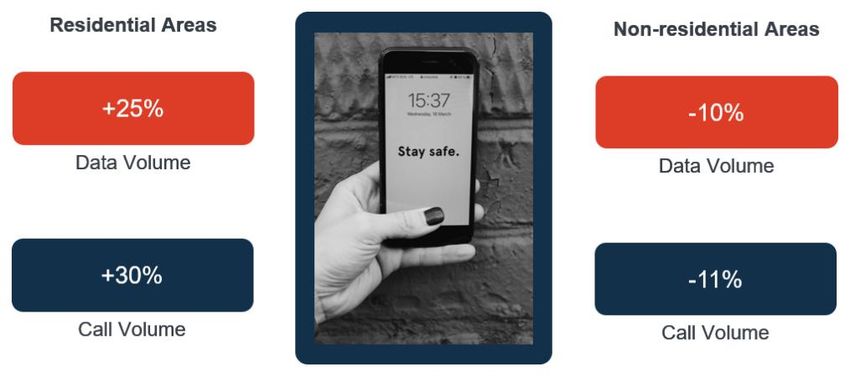
Operators’ Approach to Capacity
Planning and Network Investments
                                                                 The lockdowns and self-isolations have changed the way consumers
                                                                 behave, which consequently increased use of various mobile services, and
                                                                 the locations of the users. For operators, this trend has triggered the need
                                                                 for revisiting the capacity investment plans.

                                                                 Some operators’ networks have seen up to 30%9 decline in the number of
                                                                 handover actions, which reflects the slowdown in the mobility of users. And
                                                                 as mentioned, the source of the traffic shifted to urban and rural areas.
                                                                 These locations face an enormous spike during work hours and almost
                                                                 none of the capacity expansion plans have been made based on today’s
                                                                 reality.

                                                                 Now it’s time for operators to shift from typical, long-term planning
                                                                 approach to proactive planning.

                                                                 Some operators have already started to increase their investment budget
Some operators,                                                  for 2020. For example, Australian operator Telstra 10 is bringing forward
such as Verizon,                                                 $500 million of capital expenditure planned for 2021 into 2020. Same as
Telstra, have                                                    Telstra, Verizon has also increased 2020 investments by $500 million.

increased their
                                                                 Additional investment budget will certainly help operators to solve some of
investment budget                                                the capacity problems, however there are three key elements that should
for 2020 to support                                              be considered for using this budget more effectively.

their subscribers and
                                                                        •      It is recommended to implement capabilities that will enable
the society during                                                             dynamic, automated management of the existing network
the outbreak.                                                                  capacity. This will be the starting point as the capacity expansions
                                                                               would only make sense if you are using your network in the most
                                                                               efficient way possible.

                                                                        •      Sometimes a network audit would also help operators in the initial
                                                                               stage, which is the second key element. Based on the results of
                                                                               the audit process, you can decide the need for additional capacity
                                                                               investments.

                                                                        •      Last but not least, operators who need to invest in their network
                                                                               can use a third-party solution and / or a service, to identify capacity
                                                                               requirements and prioritize the capacity expansion areas based on
                                                                               the available budget and the customer behavior.

       9 Calculated by combining various operators’ data
       10 https://exchange.telstra.com.au/getting-through-covid-19-together/

@2020 The New Normal for Mobile Communications Under Covid-19 | Page 7
Operator Driven Initiatives to
Support Customers
                                                                 Changing customer behavior has also transformed users’ needs and we
                                                                 see that some operators doing their best to support their customers.
                                                                 Below you can see some examples of the operator driven initiatives.

                                                                       •      Operators from all around the world have renamed their network
                                                                              to “Stay Home”, have been running online campaigns to raise
                                                                              public awareness.

                                                                       •      Veon Group introduced group-wide measures in ten markets
                                                                              including free access to emergency health care and in specific
                                                                              markets they are offering free access to remote educational
                                                                              system or free access to their IPTV platform for the quarantined
                                                                              people11.

                                                                       •      DISH has announced that it is providing its entire portfolio of 600
                                                                              MHz spectrum to T-Mobile at no cost for 60 days. The step was
                                                                              taken to support mobile users, as they increasingly turn to mobile
                                                                              networks for work and personal use12.

                                                                       •      Ooredoo Group has implemented number of initiatives across the
                                                                              group. For example, to support business customers in their efforts
                                                                              to work efficiently and effectively, Ooredoo Myanmar is
                                                                              accelerating the launch of online video conferencing solutions and
                                                                              a Work-From-Home Internet solution, while Indosat Ooredoo has
                                                                              designed a special mobile package for businesses13.

                                                                       •      In coordination with the UK government, O2 UK, Vodafone UK,
                                                                              3UK and EE have pledged their commitments to removing data
                                                                              caps and to enable all customers to connect the internet whenever
                                                                              they want. And they also agreed to support customers who are
                                                                              struggling to pay their bills14.

                                                                       •      Similar to the UK, US Federal Communications Commission
                                                                              (FCC) launched the “Keep Americans Connected” initiative to
                                                                              support people and small businesses to stay connected even if
                                                                              they are having difficulties in paying their bills. More than 550
                                                                              companies have joined the initiative so far15.

       11 https://www.veon.com/
       12 https://www.prnewswire.com/news-releases/covid-19-response-dish-lends-critical-spectrum-to-t-mobile-in-effort-to-bolster-nationwide-wireless-capacity-to-help-
       consumers-301023321.html
       13 https://www.ooredoo.com/en/social-responsibility-esg/our-response-to-covid-19/
       14 https://www.mobileworldlive.com/blog/covid-19-industry-impact-february-to-march/
       15 https://www.fcc.gov/keep-americans-connected

@2020 The New Normal for Mobile Communications Under Covid-19 | Page 8
Solutions to Tackle the
Challenge
The COVID-19 pandemic has forced us all to change our routines and
become more digital to ensure continuity. Even after the pandemic, the use
of digital productivity tools and other communication services are not
expected to turn back to their initial state. Mobile networks should be
autonomous and dynamically adapt to such changes to ensure availability
of critical communication services, business continuity and operational
agility.
In order to support mobile operators and their customers, P.I. Works is
ready to provide the following solutions to enable remote, flexible
operations of mobile networks:
✓ 24/7 automated network optimization to handle traffic increases
in network layers
✓ Multi-vendor network monitoring with dashboards and alarms
✓ Remote network audit and optimization services to solve quality
issues and ensure efficient utilization of the network resources
✓ Smart network planning for more accurate & dynamic investment
decisions
Mobile operators who are interested in adopting such capabilities, please
do not hesitate to contact us at: contact@piworks.net
@2020 The New Normal for Mobile Communications Under Covid-19 | Page 9About P.I. Works
P.I. Works is the leading provider of AI-driven mobile network
planning, management and optimization solutions. P.I. Works
combines field-proven expertise with its award-winning product
portfolio and services. These solutions empower Mobile
Operators to accelerate network transformation, improve
network quality and reduce network management costs on the
way to 5G. P.I. Works has deployed its solutions at 49 mobile
network operators in 36 countries. P.I. Works also plays an
important role in the development of key standards that define
the future of mobile networks. We actively contribute to the
ETSI, GTI, 3GPP standardization forum and Open Source
initiatives.
For more information, please visit http://www.piworks.net/ or send
e-mail to sales@piworks.net
Copyright© 2020 P.I. Works. All Rights Reserved.
...unlocking the full potential
of mobile and redefining the
mobile experience worldwide.
@2020 The New Normal for Mobile Communications Under Covid-19 | Page 10You can also read


