The value creation journey A survey of JSE Top-40 companies' integrated reports - An analysis of company reporting in terms of the IIRC's ...
←
→
Page content transcription
If your browser does not render page correctly, please read the page content below

An analysis of company reporting in terms
of the IIRC’s Consultation Draft of the
International  Framework.
August 2013

The value creation journey
A survey of JSE Top-40
companies’ integrated reports

                                            www.pwc.com/corporatereporting
This publication has been prepared for general guidance on matters of interest
only, and does not constitute professional advice. You should not act upon the
information contained in this publication without obtaining specific professional
advice. No representation or warranty (express or implied) is given as to the accuracy
or completeness of the information contained in this publication, and, to the extent
permitted by law, PricewaterhouseCoopers Inc, its members, employees and
agents do not accept or assume any liability, responsibility or duty of care for any
consequences of you or anyone else acting, or refraining to act, in reliance on the
information contained in this publication or for any decision based on it.

Contents

           Foreword                                                   4
           Executive summary                                          6
              Introduction                                            7
              Research methodology                                    7
              Overview of findings                                    8
              Emerging themes                                         8
           Communicating value in the 21st century                   10
              Developments in integrated reporting                   11
           Findings                                                  14
              Organisational overview and external environment       15
              Governance                                             18
              Opportunities and risks                               21
              Strategy and resource allocation                      23
              Business model                                        25
              Performance                                           29
              Future outlook                                        34
           Appendix 1: Companies surveyed                           38
           Contacts                                                 40

                                                                 PwC | 3
Foreword

4 | The value creation journey

The creation of value is at the heart of     But what of the outcome of its product?
integrated thinking with the outcome         In this regard, if it is alleged that the
being the annual integrated report. The      beverage causes obesity the amelioration
process is known as integrated reporting.    or eradication of such an outcome
                                             should be included in the long-term
The integrated reporting process consists    strategy of the company.
of integrated thinking which embraces:
the resources used by the company;           This is an example of how integrated
its ongoing relationships with its key       thinking must be from the input of the
stakeholders; its business model; its        resources used by the company, the
output being its products or services; and   relationships with its stakeholders, and
the impact that its products or services     the outcomes of its products. It also
have on society, the environment and         illustrates the interconnectedness and
its key stakeholders, such as customer       interdependency of the resources used
satisfaction.                                by the company and its relationships
                                             with its stakeholders with regard to its
This interconnection and                     functions and operations.
interdependency between the resources
used by a company and its relationships      This survey by PwC on value creation
with its stakeholders, is critical in        illustrates how the concept of value has
developing strategy.                         changed in the 21st century. It has to be
                                             accepted that corporate reporting as we
At the beginning of the 21st century it      have known it for years is no longer fit
was appreciated that some 80% of the         for purpose because it does not deal with
value of companies was not represented       the total value of a company.
by additives in a balance sheet according
to international financial reporting         Integrated thinking deals with value
standards. To understand value,              creation short, medium and long term
therefore, there had to be a shift in        and the integrated report tells the story
thinking from a focus in value being seen    of this value creation in clear, concise
in the context of future cash flows. Value   and understandable language.
embraces the impact of the financial
aspects on the non-financial aspects and     This survey will be extremely helpful
vice versa and how a board has applied       to managers and directors in applying
its collective mind to the material          integrated thinking and in preparing an
sustainability issues of a company in its    integrated report.
long-term strategy.

For example, a beverage manufacturer
would have, as its long-term strategy,
reducing, reusing, replenishing and
recycling water, being the scarcest
natural asset. By embedding this
conservation of water into its strategy,
the company shows the investor that it       Mervyn King SC
has a long-term plan to create value.        Chairman of the International Integrated
                                             Reporting Council

                                               Integrated thinking deals with value creation
                                               short, medium and long term and the
                                               integrated report tells the story of this value
                                               creation in clear, concise and understandable
                                               language.

                                                                                           PwC | 5
Executive summary

6 | The value creation journey
PwC’s model for integrated reporting
vers
Introduction
dri St
Corporate reporting is an ever-evolving l r
na
at
field as companies continually strive to Governance
eg
ter
improve their communication with their Technological
y
stakeholders. Societal Economic
Ex
Strategy &
One of the most important ways of doing objectives
so is through the annual integrated Geopolitical Competitive
report, which seeks to align relevant Environmental Remuneration Risk
information about an organisation’s
strategy, governance systems,
performance and future prospects
Corporate
ips
in a way that reflects the economic, contribution KPIs
environmental and social impact it has
Consumption -financial reso
Performance
Value drivers
on
on the environment in which it operates.
nsh
n
Social contribution
urc
Strategy
es
fin a n ci al r e
Business
Funding
model
For over a decade, we have invested
Pe
hip s
tio
Wealth creation
significant resources in understanding:
ns
ou ti o
rc e s
s
r ela
rf
la
or
• The information needs of preparers
re
and users; an
m
n d
ce
sa
• The economic benefits of
transparency; and
r ce
• Up-to-date reporting and best Resou
practices from around the world in
order to provide practical insights into
the critical building blocks of effective Source: PwC
corporate reporting.
Our focus has been on aligning the
interests of those who report on Research methodology
performance with those who use the
information to make critical investment
The mission of the IIRC is to create a The questions were based on the Content
decisions.
globally accepted integrated reporting Elements for an integrated report
framework that assists organisations presented in the IIRC’s Consultation
Our model has been developed following to recognise and present material Draft of the International
extensive stakeholder research and is information about their strategy, Framework.
closely aligned with the International governance, performance and prospects
Integrated Reporting Council (IIRC) in a clear, concise and comparable Each assessment was reviewed by an
Framework. format. experienced reviewer before being
approved for inclusion in the overall
We conducted our survey on the Top survey results.
40 companies listed on the FTSE/JSE
as at February 2013. For each of the
companies comprising the Top 40 (see
Appendix A), a detailed assessment of
110 questions was performed.
PwC | 7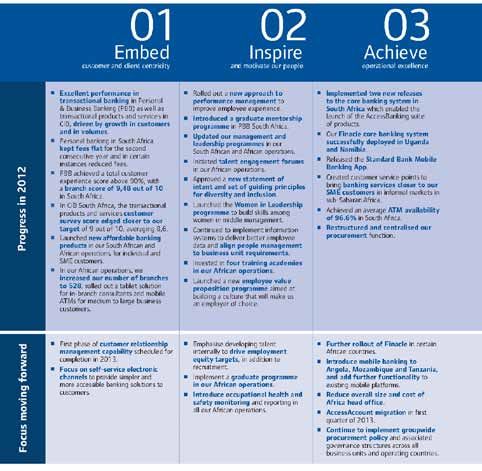
Overview of findings
          Survey findings by content element

                       Future outlook          23%                                      64%    13%
                                                                                                      Emerging themes
                        Performance     13%                                                  81% 6%   Storytelling through
                                                                                                      images
                      Business model 6%                                    59%                 35%
                                                                                                      Companies showed a definite willingness
                                                                                                      to tell their value creation stories in
      Strategy and resource allocation 3%                                              81%     16%
                                                                                                      non-traditional ways. Use of information
                                                                                                      graphics and images that combined
               Opportunities and risks 3%                                  65%                 32%    words and pictures were common
                                                                                                      throughout the reports.
                         Governance                      39%                             58% 3%
                                                                                                      Governance in action
onal overview and external environment 6%                                        71%           23%
                                                                                                      There was a definite tendency toward
                                                                                                      ‘constrained’ governance reporting.
                                          Effective communication                                     Companies seemed more comfortable
                                                                                                      reporting on board charters and terms
                                          Potential to develop reporting
                                                                                                      of reference, rather than the actual
                                          Clear opportunities to develop reporting                    activities undertaken by the board and
                                                                                                      committees during the year.
          Source: PwC analysis
                                                                                                      Avoiding the ‘crystal ball’
                                                                                                      Historical reporting remains the focus,
          Findings were grouped by Content               The most effective communication             with companies shying away from
          Element and then evaluated according to        was found in reporting on strategy and       broaching the topic of what the future
          three broad categories:                        resource allocation, as well as reporting    may hold for them.
                                                         on business models.
          • Clear opportunities to develop
            reporting;                                   Reporting on governance activities           ‘Silo’ reporting
                                                         showed the greatest room for                 It is evident that many companies
          • Potential to develop reporting; and
                                                         improvement.                                 are still taking their first steps on the
          • Effective communication.                                                                  integrated reporting journey. Stand-
                                                                                                      alone sections of reporting often
                                                                                                      provide excellent communication,
                                                                                                      but opportunities to connect this
                                                                                                      information to other areas in the report
                                                                                                      are often missed, especially in the
                                                                                                      segmental review.

         8 | The value creation journey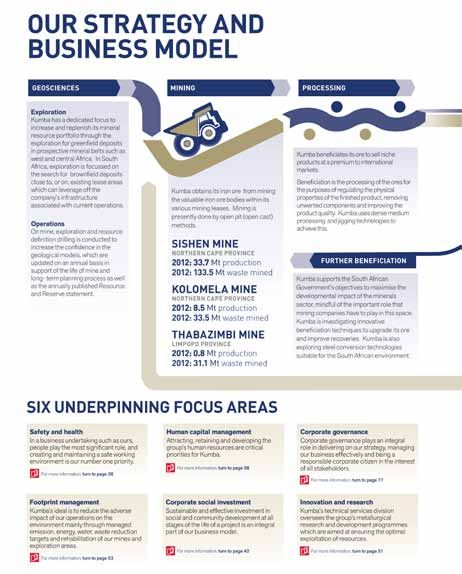
Identify one or        Report priorities         Report their        Integrate their risks
more material          for their non-financial   principal risks     into other areas of
capitals               capitals                                      their reporting

            55%                    52%                      97%                  52%
Explicitly identify    Average number of         Discuss future      Link market
their key              measures                  market trends       discussion to
performance
measures
                                  22%                                strategic choices

                       Align measures with
                       strategy
           84%                     35%                      90%                  61%
Make reference to      Integrate the             Include strategic   Base reporting on
their business model   business model into       priorities          strategic themes
                       other areas of their
                       reporting                                                 21%
                                                                     Embed sustainability
                                                                     in strategy
            71%                   60%                       77%                 29%

                                                                                       PwC | 9
Communicating value in
the 21st century

10 | The value creation journey
Framework finalisation process

                                                         1st half 2012          2nd half 2012         1st half 2013         2nd half 2013

                                                      • Discussion                •   Prototype      16 April – 15 July:      December:
Developments in                                         Paper
                                                        responses
                                                                                  •
                                                                                  •
                                                                                      Examples
                                                                                      Benefits
                                                                                                       Framework
                                                                                                       consultation
                                                                                                                              Framework
                                                                                                                              version 1 launch
integrated reporting                                  • Framework outline         •   Topics

Integrated reporting has been a
buzzword in recent years, but never
                                                      Pilot Programme (extended into 2014): Companies and investors
more so than in the first half of 2013.
The International Integrated Reporting
Council (IIRC) launched the eagerly-
anticipated Consultation Draft of the                 Engagement with regulators and other stakeholders
International  Framework in April,
with 15 launch events held around the
globe.                                             Source: Adapted from the Consultation Draft of the International  Framework

The comment period for the
Consultation Draft closed in July 2013
and the IIRC is currently reviewing                What’s the big deal?                              What are the benefits
comment letters in preparation for
the launch of the first version of the             The world is changing at a rapid                  for businesses?
Framework in December 2013.                        pace and the global context in which
                                                                                                     The organisations participating in the
                                                   businesses operate is changing along
                                                                                                     Business Network have already begun
                                                   with it. The economic crisis was a sharp
What is the IIRC?                                  reminder that financial measurement
                                                                                                     to see the benefits of applying the
                                                                                                     principles of integrated reporting in
The IIRC brings together leaders from all          alone cannot provide sufficient insight
                                                                                                     their businesses. Organisations have
the major international standard-setting           into business performance.
                                                                                                     benefitted from improving their ability
and regulatory bodies with companies,                                                                to tell their own stories and define what
investors and other key representatives            Investors and other stakeholders are              the business is trying to do through
to develop an internationally accepted             now demanding that management teams               management’s eyes.
integrated reporting framework.                    provide clear, unambiguous information
                                                   about issues such as external drivers
                                                                                                     The application of integrated thinking
The IIRC’s mission is “to create the               affecting their business, their approach
                                                                                                     inside organisations has been a
globally accepted International                    to governance and managing risk, and
                                                                                                     significant benefit for many businesses,
 Framework that elicits from                   how their business model really works.
                                                                                                     challenging them to question their own
organisations material information                                                                   internal decision-making processes
about their strategy, governance,                  This paradigm shift is necessitating              and break down silos within their
performance and prospects in a clear,              businesses and other organisations to             organisations.
concise and comparable format.”1                   consider more than just the traditional
                                                   financial focus of thinking and reporting.
Since October 2011 the IIRC’s Pilot                                                                  Why stakeholders like it
Programme Business Network,
comprising more than 90 businesses
                                                   What is integrated                                The Consultation Draft of the
                                                                                                     International  Framework
from 24 countries has been putting the             reporting?                                        identified investors, or ‘providers
principles of integrated reporting into                                                              of financial capital’, as the primary
                                                   Integrated reporting is “a process that
practice.                                                                                            audience for an integrated report, but
                                                   results in communication, most visibly a
                                                   periodic integrated report, about value           emphasised that other communications
The Business Network has been                      creation over time. An integrated report          resulting from integrated reporting
supported by more than 30 investor                 is a concise communication about how              would be of benefit to all stakeholders
organisations that comprise the Pilot              an organisation’s strategy, governance,           interested in an organisation’s ability to
Programme Investor Network.                        performance and prospects lead to the             create value over time.
                                                   creation of value over the short, medium
                                                   and long term.”2                                  The Pilot Programme Investor Network
                                                                                                     has told the IIRC what they want: They
                                                   Integrated reporting is not just about            want to see how companies perform
                                                   producing an integrated report; it is             against their strategy and how strategic
                                                   about the journey that an organisation            objectives actually support the long-term
                                                   has embarked on to create value.                  creation of value.

1+2
      “Consultation Draft of the International  Framework”, IIRC, http://www.theiirc.org/wp-content/uploads/Consultation-Draft/Consultation-
      Draft-of-the-InternationalIRFramework.pdf (accessed August 2013)

                                                                                                                                        PwC | 11
Organisational capital
Financial capital Manufactured capital
Includes cash, debt and equity that Includes physical objects such
enable an organisation to produce as buildings, equipment and
Only approximately 20% of the market goods or provide services. infrastructure.
value of a company today relates to
its tangible assets and investors want
businesses to account for the 80%
intangible value as well.
Intellectual capital Human capital
What does the Includes knowledge-
based intangibles of
Financial Includes people’s
competencies and
capital
Framework say? an organisation. capabilities.
Fundamental concepts Manufactured
capital
The Draft Framework focuses on Intellectual Human
the various forms of capital that an capital capital
Social and
organisation uses and affects, the relationship
organisation’s business model and the capital
creation of value over time.
Natural
The business model is the vehicle capital
through which an organisation uses its
capital to create value.
Social and relationship capital Natural capital
Includes the relationships between Includes all renewable and
Value in the context of is not an organisation and communities non-renewable environmental
limited to monetary or financial value, and other stakeholders. resources.
or a set time frame. Value can be tangible
or intangible, it can be created over the
short, medium and long term, and is not
Source: Adapted from the Consultation Draft of the International Framework3
limited to the organisation but can be
created for others as well. It is important
to acknowledge that value creation is Guiding Principles and The Framework provides the following
Content Elements:
complex and arises from the interaction Content Elements
between a wide range of factors.
While the purpose of the Framework is • Organisational overview and external
to assist organisations with the process environment
of integrated reporting, the requirements
of the Framework are principles • Governance
based and do not focus on rules for • Opportunities and risks
measurement or disclosure of individual
matters or the identification of specific • Strategy and resource allocation
key performance indicators. • Business model
The Framework puts forward Guiding • Performance
Principles and Content Elements to give • Future outlook
direction to the content of an integrated
report. The Guiding Principles inform These elements are not intended to
the content of the report as well as how appear as independent sections of
the information is presented. the report. Rather, the purpose of the
report is to integrate these elements
The Content Elements outline the in a meaningful way by answering the
categories of information required question posed by each element.
to be in an integrated report in order
to communicate the organisation’s
particular value creation story.
3
Copyright © April 2013 by the International Integrated Reporting Council. All rights reserved. Used with permission of the International
Integrated Reporting Council. Permission is granted to make copies of this work to achieve maximum exposure and feedback.
12 | The value creation journeyGuiding Principles and Content Elements
The information in an An should provide An should show a
should be insight into the comprehensive value
presented on a basis organisation’s strategy creation story, the
that is consistent over and how that relates to combination,
time and in a way that its ability to create inter-relatedness and
enables comparison with value in the short, dependencies between
other organisations to medium and long term. the components that
the extent it is material to are material to the
the organisation’s own organisation’s ability to
value creation story create value over time.
Strategic focus and future orientation
ity
bil
Co
ra
n
pa
ne
om
Organisational
cti
vit
overview and
dc
Governance
yo
external
an
f in
environment
cy
for
ten
ma
sis
tio
n
Co
n
Strategy and
Opportunities Business model resource
and risks
Re
ss
allocation
ne
liab
ive
ility
ns
po
a
nd
es
Co
rR
mp
lde
let
ho
Performance Future outlook
en
ke
es
Sta
s
Materiality and Conciseness
An should An should provide
include all material insight into the quality of the
matters, both organization’s relationships
An should provide
positive and with its key stakeholders
concise information that
negative, in a and how and to what extent
is material to assessing
balanced way and the organisation
the organisation’s ability
without material understands, takes into
to create value in the
error. account and responds to
short, medium and long
their legitimate needs,
term.
interests and expectations.
Source: Adapted from the Consultation Draft of the International Framework4
4
Copyright © April 2013 by the International Integrated Reporting Council. All rights reserved. Used with permission of the International
Integrated Reporting Council. Permission is granted to make copies of this work to achieve maximum exposure and feedback.
PwC | 13Findings 14 | The value creation journey
Organisational overview and external environment

                                                                                          61%
                                              What it means
  An integrated report                        Communicating the context within
  should answer the                           which an organisation operates is often
                                              the first step in enabling stakeholders
  question:                                   to understand how that organisation
                                              creates and sustains value.                 of companies linked
  What does the                               An integrated report should therefore       strategic choices to
  organisation do                             communicate information to enable
                                              stakeholders to understand the markets      external drivers
  and what are the                            the organisation competes in, why it
                                              has chosen to compete in that market,
  circumstances under                         and the impact of trends that are
  which it operates?                          driving strategic choices. This involves    Reporting on organisational overview
                                              communicating about the general             and external environment
  Source: Consultation Draft of the           market environment including the key
  International  Framework para           markets and environments that an
  4.6                                         organisation operates in, key underlying
                                                                                                                 6%
                                              drivers of market growth historically
                                              and in the future, and the organisation’s
                                              competitive landscape. An organisation           23%
                                              should recognise the opportunities and
                                              risks presented by the external market
                                              that, through its strategic choices, the
                                              organisation is adapting itself to meet.

                                              Findings
                                                                                                                      71%
                                              The majority of companies surveyed
                                              displayed potential to develop their
                                              reporting further.

                                                                                             Effective communication
     Principle in practice                                                                   Potential to develop reporting
                                                                                             Clear opportunities to develop reporting
     Good reporting should provide insight into:
                                                                                          Source: PwC analysis
   • The organisation’s:
     –– culture, ethics and values;                                                       Some of the most important information
     –– ownership and operating structure;                                                lacking in this area is comprehensive
     –– principal activities, markets, products and services;
                                                                                          quantification of data such as expected
                                                                                          market trends or rates of market growth.
     –– competitive landscape and market positioning (considering factors such            This indicates that while companies
        as the threat of new competition and substitute products or services,             explain how markets have changed and
        the bargaining power of customers and suppliers, and the intensity of             grown historically, often only limited
        competitive rivalry);                                                             information is provided on the key
   • Key quantitative information (e.g. the number of employees, revenue and              factors that will impact them in the
     number of countries in which the organisation operates), highlighting, in            future.
     particular, significant changes from prior periods; and
   • Significant factors affecting the external environment.

Source: Consultation Draft of the International  Framework para 4.7

                                                                                                                              PwC | 15
The competitive landscape is explained
39% 42% 20% 6%
Not accomplished To some extent Accomplished Exemplary
Source: PwC analysis
Competitive advantage What good reporting looks like
A tendency to avoid comprehensive
discussion of companies’ competitive
landscape was also identified. Less than Example 1: Discovery
a quarter (19%) of companies surveyed
succeeded in explaining market share, Operating structure, principal
Company culture is demonstrated activities, products and services are
positioning within key markets and
by explaining core values. illustrated in one graphic.
barriers to entry in specific markets.
Many companies shied away from
identifying key competitors.
Most companies surveyed did, however,
provide valuable information on how
strategic choices are directly linked to
external drivers and trends.
How reporting can be
developed
While it is often difficult to identify
forward-looking information and
quantify industry trends, this
information is crucial to investors in
assessing an organisation’s ability to
create value over the medium and long
term, as opposed to providing short-term
returns. Companies can therefore seize
the opportunity by including robust
reporting on the factors that may impact
on their ability to create value in the
longer term, as well as being specific
about the competitive landscape.
Key quantitative information.
Ownership percentage is disclosed
for each business unit.
Source: Discovery Integrated Annual Report 2012
16 | The value creation journeyExample 2: Aspen Pharmacare
Identity of competitors.
Market position
Comparison to peers
Source: Aspen Pharmacare Holdings Annual Report 2012
PwC | 17Governance
39%
What it means
Integrated reports “An organisation’s ability to create and
should answer the sustain value is determined inter alia by
how it’s led and its governance.”5
question:
Governance reporting provides the nexus
between the social, environmental,
of companies showed
“How does the economic and financial issues that clear opportunities to
organisation’s impact on the organisation’s business
and the development of strategy. develop governance
governance structure
support its ability to Effective communication about reporting
the governance of an organisation
create value in the is therefore integral to the user’s
appreciation of how those charged with
short, medium and governance are creating value. Reporting on governance
long term?”
Findings 3%
Source: Consultation Draft of the
International Framework para In analysing our overall results, the
4.10 governance element emerged as an area
where reporters did not provide much
insight into their governance practices. 58%
16%
The overall finding was that the majority
of reporters provide ‘boiler plate’
disclosures of their corporate governance 39%
practices, which do not reflect what
those charged with governance have
actually done in adding value to the
of companies describe company.
the actual activities Companies assessed are comfortable
reporting on board charters and terms Effective communication
of the board and of reference. There is an opportunity to
Potential to develop reporting
integrate the reporting of the actions
committees and responsibilities of those charged Clear opportunities to develop reporting
with governance with the operations and
strategies of the company to provide a Source: PwC analysis
holistic view of governance.
How integrated is the
Principle in practice governance reporting?
Good reporting should provide insight into: The integration of governance reporting
within the integrated reports was
assessed. Our research found that just
• An organisation’s leadership structure, including the diversity and skills of
more than half (55%) of integrated
those charged with governance;
reports were assessed to have not
• Specific processes used to make strategic decisions and to establish and accomplished integration as there was
monitor the culture of the organisation; minimal linkage between the narrative of
• Particular actions those charged with governance have taken to influence and the integrated report and the governance
monitor the strategic direction and risk management approach; reporting.
• How the organisation’s culture, ethics and values are reflected in its use of
and effect on the various forms of capital, including its relationships with key The balance of the reports were
stakeholders; and assessed to be linked to some extent
as cross references were provided to
• How remuneration and incentives are linked to value creation.
other aspects of the integrated report,
including risk management and strategy.
Source: Consultation Draft of the International Framework para 4.11
5
“Consultation draft of the international Framework”, IIRC, http://www.theiirc.org/wp-content/uploads/Consultation-Draft/Consultation-
Draft-of-the-InternationalIRFramework.pdf (accessed August 2013)
18 | The value creation journeyAre boards reporting on what
Governance reporting integrated into other reporting
they’re actually doing?
An emphasis has been placed on
reporting on the actual activities 55% 45%
undertaken by management and the
Not accomplished To some extent Accomplished Exemplary
board in discharging its responsibilities
rather than reporting on the
responsibilities, terms of reference and
charters of the board and its committees.
Source: PwC analysis
Thirty-five percent of reports disclosed
only the responsibilities of the board and Targets for gender diversity on the board are discussed
its committees and terms of reference
and therefore did not accomplish
effective reporting of governance 48% 39% 13%
practices.
Not accomplished To some extent Accomplished Exemplary
Some description of the actual activities
undertaken by the board was provided Source: PwC analysis
by 48% of reporters, while 16% of
reports were assessed as having
accomplished good reporting practice
by reporting the actual activities of the
board and providing examples or case
studies of these activities.
A word on gender diversity How reporting can be
In terms of providing more than basic Gender and race are important factors to developed
disclosures about the board effectiveness consider in achieving board diversity. In Organisations that integrate governance
review, 16% of reports were assessed as assessing the organisation’s leadership reporting into their integrated report
having accomplished good reporting. structure, we reviewed integrated provide a more holistic view of the
These reports included disclosure on reports to determine if policies and importance of governance to a business.
the logistics and process undertaken in targets for gender diversity have been
assessing the effectiveness of the board disclosed. Reporting on actual activities
as well as extensive disclosure of the undertaken by the board and the
outcomes of the review. No mention of a policy or a target for outcomes of these activities is more
gender diversity could be found in 48% insightful than simply providing
Brief mention of the logistics and the of reports, while 39% of reports provided information about committee agendas
process of assessment of the board’s brief reference to supporting policies on and charters.
effectiveness was made by 32% of gender diversity.
reporters, while the remaining 52%
of reporters were assessed as not Reporting assessed as accomplished
accomplished and provided a description in this area provided insight into the
of logistics, the process and a limited company’s policy, evidence of actions
discussion of the outcomes of the review. taken and targets set to achieve gender
diversity. This was demonstrated in13%
of the reports.
PwC | 19What good reporting looks like
Example 3: British American Tobacco
Summary terms of reference of the
board committee are provided and
are supplemented with details of the
actual activities of the board.
Board committees undergo an Actual activities undertaken by the
effectiveness review and the results board committee during the year
of the review are disclosed. have been disclosed.
Action points that have emerged
from the committee effectiveness
review have been provided.
Source: British American Tobacco Annual Integrated Report 2012
Example 4: FirstRand
An integrated approach to
governance of financial and non-
financial capitals is demonstrated
Source: FirstRand Annual Integrated Report 2012
20 | The value creation journeyOpportunities and risks
48%
What it means
An integrated report Value creation is significantly affected
should answer the by an organisation’s ability to embrace
opportunities and effectively manage
question: risk. An integrated report should
identify these opportunities and risks,
and explain the strategic direction the
of companies integrated
What are the specific organisation has chosen and the actions risks into other aspects
it has undertaken to manage these.
opportunities and of the report
risks that affect the Effective communication in this area
includes providing insight into the risk
organisation’s ability identification and management process Reporting on opportunities and risks
of an organisation, the specificity of the
to create value over risks identified to the organisation and
3%
the short, medium and clear discussion of the implications of 16%
the identified risks on the organisation’s
long term, and how ability to create value.
is the organisation
dealing with them? Findings
The vast majority of companies surveyed
Source: Consultation Draft of the showed potential to develop their
International Framework para
integrated reporting further.
4.13
81%
Principle in practice
Good reporting should provide insight into: Effective communication
Potential to develop reporting
• The specific source of opportunities and risks, which may be internal, external Clear opportunities to develop reporting
or, commonly, a mix of the two;
• The organisation’s assessment of the likelihood that the opportunity or risk Source: PwC analysis
will come to fruition and the magnitude of its effect if it does. This includes
consideration of the specific circumstances that would cause the opportunity While most companies included
or risk to come to fruition; and narrative information about identified
• The specific steps being taken to create value from key opportunities and to risks specific to the company, only 10%
mitigate or manage key risks, including the identification of the associated supported the discussion with quantified
strategic objectives, strategies, policies, targets and performance indicators. information, such as through key
performance indicators (KPIs).
Source: Consultation Draft of the International Framework para 4.15 Risk dynamics
A mere 13% of companies provided good
insights into the dynamics of their risk
Insights into the dynamics of the risk profile are provided
profiles by including information about
the impact and probability of identified
risks, as well as how risk profiles may
74% 13% 13%
change over time.
Not accomplished To some extent Accomplished Exemplary
Source: PwC analysis
PwC | 2123%
How reporting can be
developed
Opportunities and risks are fundamental Companies that include information
and pervasive to organisations’ value about the potential impact and
creation activities. It is therefore probability of risks occurring provide
paramount to integrate discussions stakeholders with valuable information of companies make
relating to opportunities and risks about those risks that may influence the
throughout the integrated report and company’s ability to create value over specific reference to risk
avoid limiting risk reporting to a stand- the short, medium and long term. This
alone section. could also include linking risks to KPIs or appetite
quantifying risks in a meaningful way.
What good reporting looks like
Example 5: SABMiller
Source of the risk is explained Risks specific to the company are Risks are linked to strategic
identified priorities
Impact on the business is identified Actions taken to mitigate the risks
are explained
Source: SABMiller Annual Report 2012
Example 6: Gold Fields
Risks are specific to the company
Risks are plotted based on severity
and probability
Only most material risks are
included
Source: Gold Fields Limited Integrated Annual Review 2012
22 | The value creation journeyStrategy and resource allocation
39%
What it means
An integrated report The importance of an organisation’s
should answer the strategy is highlighted by the fact that
strategic focus is one of the guiding
question: principles of the Framework, as
well as a Content Element.
of companies discussed
Where does the A good strategy is the frame of reference targeted time frames for
for all the value creation decisions and
organisation want activities that an organisation may implementing strategic
to go and how does it engage in. An organisation should
communicate what it is trying to achieve, objectives
intend to get there? where it is trying to compete, how it will
achieve its goals and how it will measure
Source: Consultation Draft of the progress.
International Framework para
4.18
Principle in practice
Good reporting should provide insight into:
Findings
Nearly half of companies surveyed • The organisation’s short, medium and long-term strategic objectives;
demonstrated effective communication • The strategies it has in place, or intends to implement, to achieve those
relating to strategy and resource strategic objectives;
allocation.
• The resource allocation plans it has in place, or intends to put in place, to
implement its strategy; and
Reporting on strategy and resource
allocation • How it will measure achievements and target outcomes for the short, medium
and long term.
6%
Source: Consultation Draft of the International Framework para 4.19
35% Almost all companies (97%) surveyed More than half (64%) of companies
made some kind of statement relating surveyed reported on the outcomes of
to overall ambition, and nearly three strategic activities and clearly set out
quarters (74%) of companies surveyed performance measures that management
59% had comprehensive discussion use to monitor whether these are being
surrounding how strategic priorities are achieved.
aligned to overall goals.
Outcomes of strategic priorities are reported on
Effective communication
Potential to develop reporting 19% 17% 16% 48%
Clear opportunities to develop reporting Not accomplished To some extent Accomplished Exemplary
Source: PwC analysis
Source: PwC analysis
PwC | 23What good reporting looks like
Example 7: British American Tobacco
How reporting can be Performance measure is linked to Medium and long-term goals are
developed strategic objective of “Responsibility” communicated
Incorporating strategic priorities as a
common theme throughout a report
demonstrates how integrated strategy is
in a company’s value creation journey.
Including time frames and targets
for achieving strategic priorities also
enables stakeholders to assess whether
companies are making progress towards
achieving their ambitions.
48%
of companies reported
on specific actions Measure and rationale for use is
explained
Current year measure as well as
comparison to past
taken to achieve
strategic priorities Source: British American Tobacco Annual Report 2012
Example 8: Standard Bank Group
Strategic objectives are clearly
identified
Outcomes of specific actions taken in
the current year
Specific actions planned for the future
Source: Standard Bank Group Annual Integrated Report 2012
24 | The value creation journeyBusiness model
55%
What it means
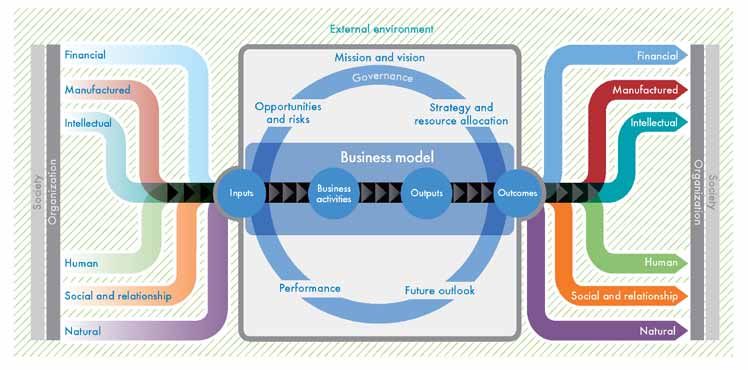
An integrated report The business model is at the heart of
should answer the an organisation and draws from the
different capitals as inputs and converts
question: them into outputs by means of the
organisation’s business activities. of companies identify
What is the This process leads to outcomes that in and describe material
turn impact on the capitals, which are
organisation’s business not necessarily identical to those used in capital imputs into the
model and to what the input phase.
business model
extent is it resilient? This complex interconnection between
an organisation and its environment is An organisation should explain the
Source: Consultation Draft of the the core of value creation. resources and relationships that it relies
International Framework para on to deliver its strategy, how dependent
4.21 it is on them, how it manages them and
how it monitors success.
The value creation process
Source: Consultation Draft of the International Framework6
6
Copyright © April 2013 by the International Integrated Reporting Council. All rights reserved. Used with permission of the International
Integrated Reporting Council. Permission is granted to make copies of this work to achieve maximum exposure and feedback.
PwC | 25Principle in practice
Good reporting should provide insight into:
• Key inputs and how they relate to the capitals from which they are derived;
Findings • Key business activities, considering such factors as:
Most companies accomplished effective –– How the organisation differentiates itself in the market place;
reporting at some level. While the –– The extent to which the business model relies on revenue generation after
majority still have potential to develop, the initial point of sale;
a large number of companies clearly –– How the organisation approaches the need to innovate;
demonstrated effective communication.
–– How the business model has been designed to adapt to change;
Reporting on the business model • Key outputs, explaining the products and services that the organisation places
in the market, and material by-products and waste;
• Key outcomes in terms of the capitals, including both internal outcomes and
3% external outcomes.
Source: Consultation Draft of the International Framework para 4.22
32%
Insights given into dependency on certain resources and relationships
65%
23% 58% 19%
Not accomplished To some extent Accomplished Exemplary
Source: PwC analysis
Effective communication
Potential to develop reporting
Clear opportunities to develop reporting
Thoughts on dependency Many organisations neglect to discuss
the role of the corporate centre in the
Source: PwC analysis Less than a quarter (19%) of companies delivery of strategy. How an organisation
gave insight into their dependency on functions on a central level may provide
Many companies (55%) identified certain resources and relationships insights into how the different elements
material capital inputs into the business inherent in the business model. More of the business model are managed
model, as well as the differentiators than 90% of companies integrated their and monitored, as the corporate
and value-adding activities within the discussion of the business model with centre is often the main driver of the
business model used to execute strategy other elements of the report. different value-creating activities of an
and implement priorities. organisation.
How reporting can be
developed
Given the complexity of organisations’
45%
relationships with the external
environment, resources and
relationships, organisations should
carefully consider the communication
of this complexity to stakeholders. This
is especially true where organisations
are dependent on scarce resources or
of companies integrated significant relationships to create value.
discussion of their
business model with
other elements of the
report
26 | The value creation journeyKey inputs into the
Material capital inputs business model are Processes and outputs Key outcomes are identified
are addressed described are explained Example 9: Kumba Iron Ore
What good reporting looks like
Source: Kumba Iron Ore Limited Integrated Report 2012
How the company differentiates itself in
the market place Future plans are discussed
PwC | 27Example 10: Massmart
Role of the corporate centre is
described
Inputs and outputs are identified
Products that the company places into Clear description of the business
the market are identified activities of the company
Explanation of how the company
differentiates itself in the marketplace
Source: Massmart Annual Report 2012
28 | The value creation journeyPerformance
51%
What it means
Integrated reports Underpinning the focus on integrated
should answer the reporting is a strong appreciation
that the success of organisations
question: is inextricably linked to three
interdependent factors: society, the
environment and the global economy.
of companies provide
“To what extent has clear alignment
Performance reporting has similarly
the organisation evolved from reporting on financial between KPIs and
achieved its strategic measures of success to a more holistic
approach that includes reporting on remuneration policies
objectives and what are social and environmental performance.
its outcomes in terms
Findings Reporting on performance
of the effects on the
The overall results indicate that
capitals?” with only 6% of reporters effectively 6%
13%
communicating their holistic
Source: Consultation Draft of the performance to users, there is great
International Framework para potential to improve performance
4.27 reporting in integrated reports.
Principle in practice 81%
Good reporting should provide insight into:
• Quantitative indicators with respect to targets, value drivers, and opportunities
and risks, explaining their significance and implications and the methods and
assumptions used in compiling them; Effective communication
• The organisation’s effects (both positive and negative) on the capitals, Potential to develop reporting
including material effects on capitals up and down the value chain; and
Clear opportunities to develop reporting
• Linkage between past and current performance, and between current
performance and future outlook.
Source: PwC analysis
Source: Consultation Draft of the International Framework para 4.28 Quantitative measurement
Quantitative indicators of performance
KPIs are explicitly identified such as KPIs can help increase
comparability and are particularly
helpful in expressing and reporting
16% 84% against targets.
Not accomplished To some extent Accomplished Exemplary
Our research found that 84% of
companies explicitly identified KPIs. On
Source: PwC analysis average, companies reported 24 KPIs in
their integrated reports, of which eight
were financial KPIs, 10 were operational
and six related to sustainability.
KPIs: Quantity vs quality
While inclusion of quantitative KPIs may
create the impression that performance
has been well disclosed, it is important to
assess the usefulness and quality of the
KPIs identified.
PwC | 29KPIs are aligned to strategic objectives
6% 43% 16% 35%
In providing a context for the KPIs Not accomplished To some extent Accomplished Exemplary
reported on, 81% of reports showed
room for improvement both in
Source: PwC analysis
qualitatively defining the KPIs and
providing a rationale for their use. The
remaining 19% of reports defined their
KPIs and explained within the context of Trend and comparable benchmark data Our overall assessment of KPIs indicates
their business why they had been used. is recognised as providing useful context that while most organisations are
for the results of the KPIs reported explicitly identifying KPIs and disclosing
It is encouraging to note that almost on. The majority of reports (84%) a large number of KPIs, the KPIs reported
half of all KPIs reported are aligned do provide trend data for their KPIs, on are not communicated on in the
to strategic priorities(51% of reports allowing users to make year-on-year context of the business.
assessed) that reinforce the principle comparisons.
of integrated thinking. Of these, three- Linking performance and
quarters explicitly linked their KPIs However, only 3% of the reports
to their strategic priorities and were provided industry benchmark data
remuneration
assessed as exemplary reporters. against which users can assess the A greater emphasis has been placed
performance of the company. on aligning KPIs with remuneration
policies to enhance the transparency of
71%
In the majority of cases, where trends management and board remuneration.
have been established, information has
not been provided regarding the reasons KPIs should be aligned to strategic
for movements from the prior year, priorities, which in turn drive the
particularly where targets have not been remuneration policies of the company.
met.
of KPIs are quantified Future targets for KPIs reported
on enhance the accountability of
management. An overwhelming majority
of reports (90%) do not provide future
targets for KPIs, or only partly provide
future targets for KPIs. Just 10% of
reports provide quantified future targets
for all KPIs.
Enhancing the quality of KPIs
• Tailor KPIs to be relevant to the organisation;
• Report KPIs that are consistent with measures used by those charged with
governance in assessing the performance of the organisation;
42%
• Present KPIs with targets, forecasts or projections over the short and medium-
term;
• Present for past periods to establish a trend and with industry benchmarks;
• Present against previously reported targets, forecasts or projections to
enhance accountability;
• Report consistently over periods;
of companies provide • Present measurement techniques and assumptions made with qualitative
information; and
comparable benchmark • Report on reasons for significant variations from targets, trends or benchmarks
data for KPIs and why they are or are not expected to reoccur.
30 | The value creation journeyHow reporting can be
Alignment of KPIs with remuneration policies
developed
Organisations can enhance the quality
35% 43% 16% 6% and usefulness of KPIs reported by
making them specific to their business
Not accomplished To some extent Accomplished Exemplary
and providing clear targets and industry
benchmarks against which they can be
Source: PwC analysis measured.
Where trends are provided to assist in
year-on-year analysis, management
An analysis of our findings found that Clear alignment between KPIs and commentary should accompany these
35% of integrated reports show no remuneration policies was demonstrated trends to enable users to understand the
meaningful alignment between KPIs in only 16% of reports. However, only movements in KPIs.
and remuneration policies, while 43% 6% of the reports assessed provided
demonstrate only some KPIs that align progress reports on whether targets Providing a clear link between KPIs
with remuneration policies. were actually achieved and if targets and the organisation’s strategy and
were not achieved, the reasons for the remuneration policies will enhance
underperformance. the quality of disclosure around
remuneration.
What good reporting looks like
Example 11: Gold Fields
Integrates the strategic requirement,
key stakeholders who would
be affected, stakeholder risk or
opportunity with performance,
strategic actions to be undertaken in The context of the KPI reported on is
the following year and remuneration in provided as well as its importance to KPIs are explicitly identified and
a format that is easy to follow. the organisation. quantified.
Reports on the key stakeholders Explains how the relative strength
driving the prioritisation of each of its value-adding activities and
strategic requirement. measures of success are determined,
i.e. use of performance measures and
the quantification of these.
PwC | 31Example 11: Gold Fields (cont.)
Trend data is provided for KPIs Strategic actions to be undertaken Explicit linkage is made between
reported on. in the following year have been achieving strategic priorities and KPIs
disclosed. and CEO remuneration
Source: Gold Fields Integrated Annual Report 2012
Example 12: Aspen Pharmacare
KPIs are explicitly identified. The implication of the actual performance as
per the disclosed indicator on the business
has been provided.
The relevance of the performance indicator for KPIs are quantified. A trend has been provided for the KPIs
the business has been discussed as well as an with at least two previous years of
explanation of what the KPI means. data reported on.
Source: Aspen Pharmacare Annual Integrated Report 2012
32 | The value creation journeyExample 13: Vodacom
Progress reported on targets identified As competitive performance is a
with an explanation of why results measure that may be subjectively
were ahead of targets. calculated, the report states what
competitive performance is in the
context of the results.
Weighting of targets is explicitly
provided
Description Financial targets used in
of how calculating remuneration,
bonuses are aligning strategic priorities
calculated is and remuneration are
provided explained
Source: Vodacom Annual Integrated Report 2012
PwC | 3329%
Future outlook
What it means of companies provided
Integrated reports In developing the Framework, it a comprehensive
should answer the was recognised that much of what is
currently reported tends to be backward- discussion of strategy
question: looking and fails to provide stakeholders
with sufficient information to make and priorities to ensure
What challenges and
a meaningful assessment regarding
the organisation’s ability to create and
the long-term viability
uncertainties is the
sustain value over the short, medium
and long term.
of the business.
organisation likely to Therefore, in addition to reporting
What is material?
encounter and what on performance during the reporting To provide a context for the future
period, the integrated report should viability of the organisation, it is
are the potential include a forward-looking statement important to understand the process
implications for its concerning the organisation’s
anticipated activities and performance
undertaken by management in
identifying material issues affecting its
business model and objectives, informed by its assessment of future viability.
recent performance and understanding
future performance? of trends in the external and internal A fifth (23%) of reports analysed did
environment, including stakeholder not discuss how material issues were
Source: Consultation Draft of the
expectations. identified, while 35% provided some
International Framework para
4.33 discussion of how material issues are
Findings identified.
Our research found that 13% of reporters The remaining 42% of reports provided
provided effective communication comprehensive reporting on identifying
of their future outlook and how the key issues such as descriptions of
company plans to create and sustain stakeholder engagement processes and
value over the medium and long term, outcomes.
while 87% of reports have the potential
to develop their reporting in this area. Reporting on the future outlook
Principle in practice 13%
23%
Good reporting should provide insight into:
• Anticipated changes over time;
• Information, built on sound and transparent analysis, about:
–– The expectations of senior management and those charged with
governance about the external environment the organisation is likely to face
in the short, medium and long term;
–– How that will affect the organisation; and
–– How the organisation is currently equipped to respond to the critical 64%
challenges and uncertainties that may arise.
Source: Consultation Draft of the International Framework para 4.34 Effective communication
Potential to develop reporting
The process for identifying material issues that impact future viability is Clear opportunities to develop reporting
explained
Source: PwC analysis
23% 35% 42%
The time frames of issues affecting future
Not accomplished To some extent Accomplished Exemplary viability and targets that an organisation
should consider in its reporting will
vary depending on its business and
Source: PwC analysis investment cycles, industry context,
strategies adopted and stakeholder
expectations.
34 | The value creation journeyWhile 32% of reports provided time
frames that are unclear, 68% do attempt Discussion of the future availability of material capital inputs
to identify the time frame in which future
viability has been considered, bearing
in mind the nature of the company’s 10% 71% 13% 6%
business and industry.
Not accomplished To some extent Accomplished Exemplary
Providing a future perspective
In assessing whether management Source: PwC analysis
discusses the expected availability
and its future access to the material
non-financial capital inputs that the The majority of reports assessed (71%) How reporting can be
organisation relies on to create value, provided only some or no information
only 6% of reports provided exceptional
developed
regarding specific strategic actions
disclosure and a comprehensive required to address future availability of The integrated report should provide
discussion of all material inputs material capital inputs. The remaining a clear and appropriate demonstration
supported with quantified data. 29% provided a comprehensive of the time frame over which future
explanation of strategy and priorities viability has been considered, in the
One fifth (19%) of reports provided a to ensure the long-term viability of the context of the nature of the company’s
discussion of all material inputs that the business. business and industry.
organisation is reliant on to create value,
while 71% of reporters provided limited Overall, the results of the future outlook Disclosing the specific strategic
or no discussion of the material inputs assessment show that integrated reports actions to be undertaken to address
and the availability of these, on which currently tend to provide information the availability of material non-
the organisation is reliant on to create that is mostly backward looking and financial capitals and provide future
value. which is of limited relevance to users. KPIs for strategic objectives identified
communicates the future prospects
and viability of an organisation to its
stakeholders.
What good reporting looks like
Example 14: AngloGold Ashanti
Where targets have not been reported on (social Explicit targets against The targets are aligned to strategy
performance), an explanation has been provided which KPIs are and cross-referenced to strategy
as to why the target has not been reported on and measured. disclosure.
when reporting on these targets will commence.
An explicit
time frame has
been provided
for achieving
the targets
identified.
Focus areas address both financial KPIs related to each focus area are
and non-financial strategic priorities. explicitly identified.
PwC | 35You can also read


