Thermal solar energy Pressure Temperature Level Calibration
←
→
Page content transcription
If your browser does not render page correctly, please read the page content below
Pressure
                Temperature
                Level
                Calibration

Thermal solar energy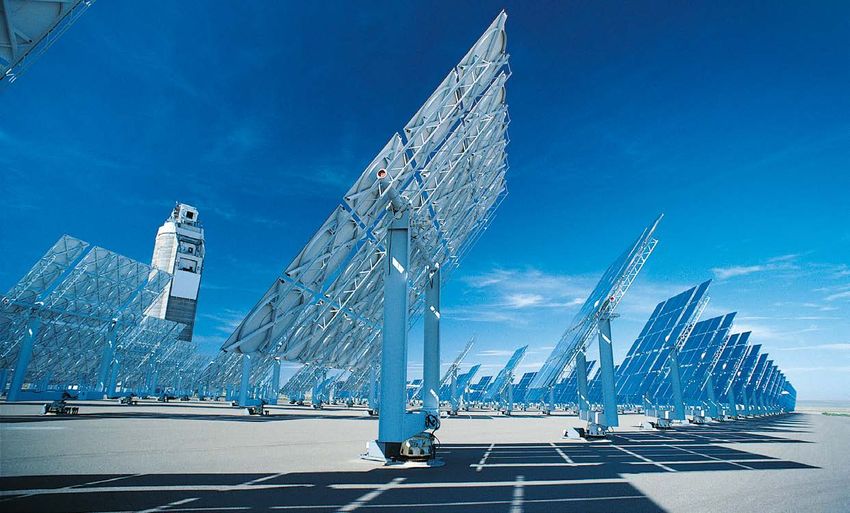
Alexander Wiegand
                                                             Chairman and CEO WIKA

Over the past 60 years WIKA Alexander Wiegand SE &           Within the WIKA Group 7.300 employees are dedicated
Co. KG has built a reputation as a renowned partner and      to maintaining and improving technology in pressure
competent specialist for any task in the field of pressure   and temperature measurement. Over 500 experienced
and temperature measurement. On the basis of steadily        employees of the sales department consult the
growing efficiency, innovative technologies are applied      customers and users competently on a partnership
when developing new products and system solutions.           basis.

The reliability of the products and the readiness to face    More than 300 engineers and technicians are searching
all challenges of the market have been the key factors for   continually on behalf of WIKA to provide solutions for
WIKA to achieve a leading position in the global market.     innovative products, improved materials and more
                                                             economical production methods. In close co-operation
                                                             with renowned universities, institutes and industrial
                                                             companies, solutions for specific applications are
                                                             developed and designed.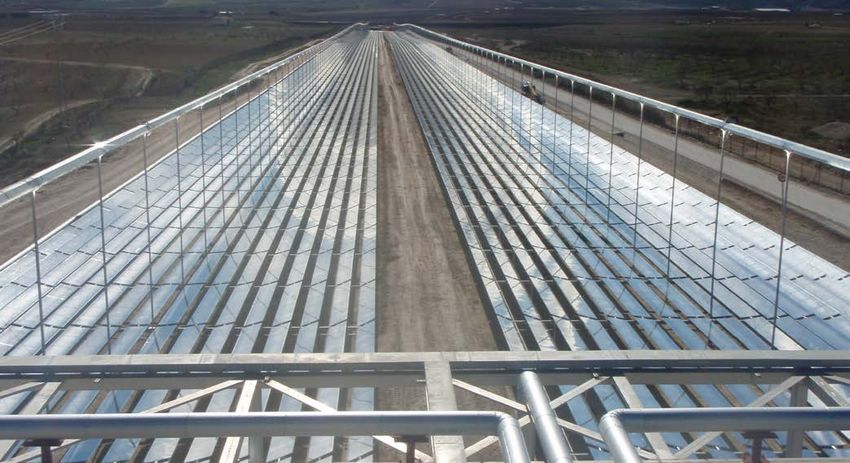
Contents
    Unlimited opportunities                                     4

    Collector field                                             8

    Power block                                                12

    Thermal storage                                            14

    Water treatment                                            16

    Service                                                    18

    References                                                 19

    Pictures:
    Page 6:     Solar Millennium AG
    Page 8:     Solar Millennium AG, Paul Langrock
    Page 9:     Abengoa
    Page 11:    ©2009   NOVATEC BIOSOL AG
    Page 14:    Solar Millennium, AG
    Page 19:    Solar Millennium, AG, fotosearch.de, Abengoa

                                                                    3
Unlimited opportunities

    The sun generates 400,000,000,000,000,000,000,000,000       The advantages of solar energy are impressive:
    Watts and will continue to do so for the next 5 billion
    years. More energy reaches the earth in 30 minutes          n Unlimited availability
    than mankind can use in an entire year. The sun is          n No pollutant emissions
    the source of life; without it our ecological system        n No climate damage due to greenhouse effects
    could not exist.
                                                                The reduction in CO2 emissions is the main benefit of
    Our energy consumption has nearly tripled over the last     this technology. Over the past 50 years, CO2 content
    30 years and approximately 80 % of this energy is gained    in the atmosphere has increased by roughly 20 % and
    from fossil fuels - largely oil.                            intensified the negative effects of greenhouse gases on
    The debate on energy focuses mainly on three essential      our climate and the planet's ecological system.
    criteria: The safety factor, CO2 emissions and production
    costs.

4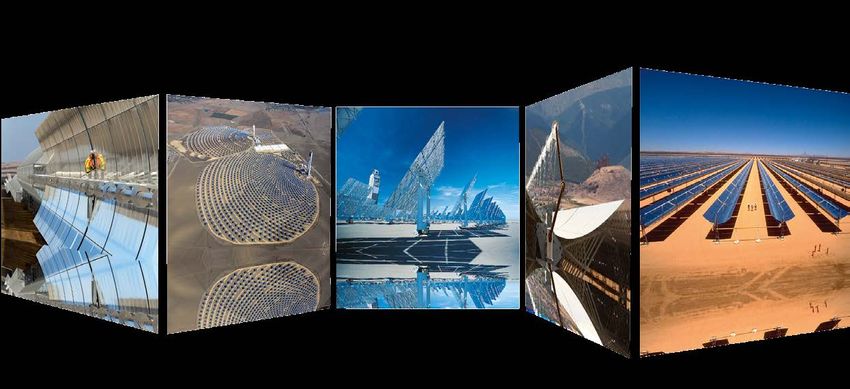
Unlimited opportunities

Security against uncontrollable failures is as good or         These technologies store energy during sunny periods
even better than for other technologies. However, the          and pass it into the mains network when there is no
disadvantages of this alternative soon become clear            sunshine.
when we look at reliable and continuous supply, as this
is only guaranteed so long as the sun shines, and is           At present the costs for gaining energy from solar sources
interrupted at night or on cloudy days with little sunshine.   are still higher than for conventional power generation;
                                                               nonetheless, we are looking at a technology with tremen-
In order to ensure uninterrupted supply, we need modern        dous potential. It should also be noted that a direct cost
technologies for thermal storage.                              comparison with conventional energy does not take into
                                                               account the environmental damage the latter creates.

                                                                                                                            5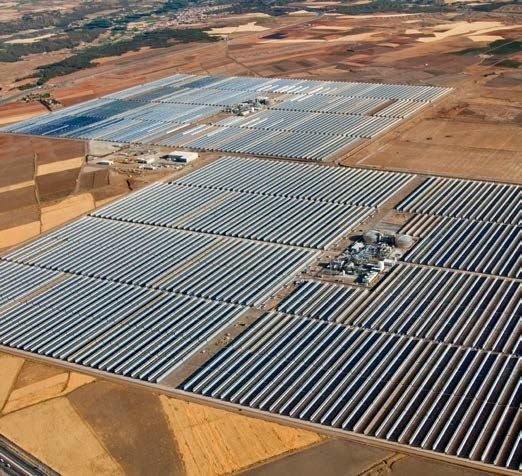
Suitability of locations for solar thermal power plants

          very good
          good
          suitable
          unsuitable

    Solar energy is best exploited in the “sunbelt”.              At present there are two technologies for generating
    This zone has up to 2,600 kWh/m2/year available,              solar energy: Photovoltaic and solar thermal systems.
    compared to approx. 1,000 kWh/m2/year in Central
    Europe.                                                       In photovoltaic energy generation, a solar module
                                                                  consisting of a group of semiconductor layers releases
    This sunbelt is located in the regions between latitude       electrons. These solar modules are generally employed
    40 degrees north and latitude 40 degrees south,               in (semi) independent units, such as pocket calculators,
    e.g. between southern Spain and South Africa. One             sensors, transmitters, satellites, batteries, as well as on
    thousandth of the desert area would itself be sufficient to   roofs or in the modules installed in solar complexes.
    cover energy requirements with solar plants alone.

6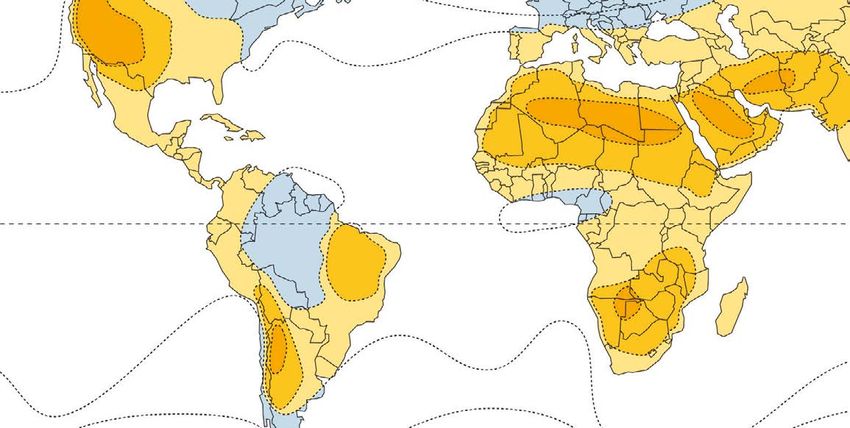
Unlimited opportunities

Solar modules convert sunlight directly into electricity,
whereas solar thermal systems concentrate sunlight to
heat thermal carriers up to 400 to 800 °C. At the moment,
solar thermal systems are the only solar energy form that
can compete with nuclear power plants or fossil fuels.

The experiences gained with plants in Spain and the
USA are future-oriented. According to a study by Green-
peace and the European Solar Thermal Industry Asso-
ciation (ESTIA)*, by 2040 these plants will be supplying
more energy than nuclear and hydro power plants put
together.

*Concentrated Solar Thermal Power - Now, Greenpeace, ESTIA, Solarpaces; Brussels, September 2005
                                                                                                                             7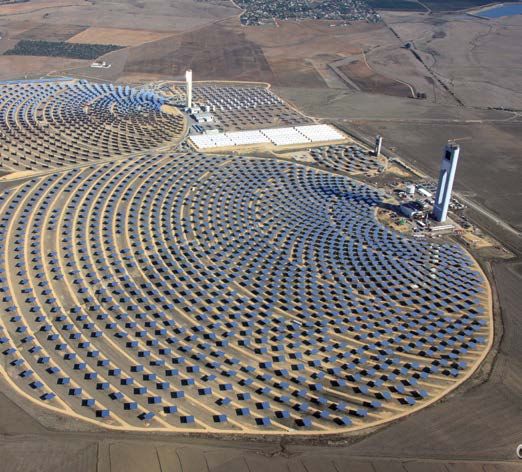
Collector field

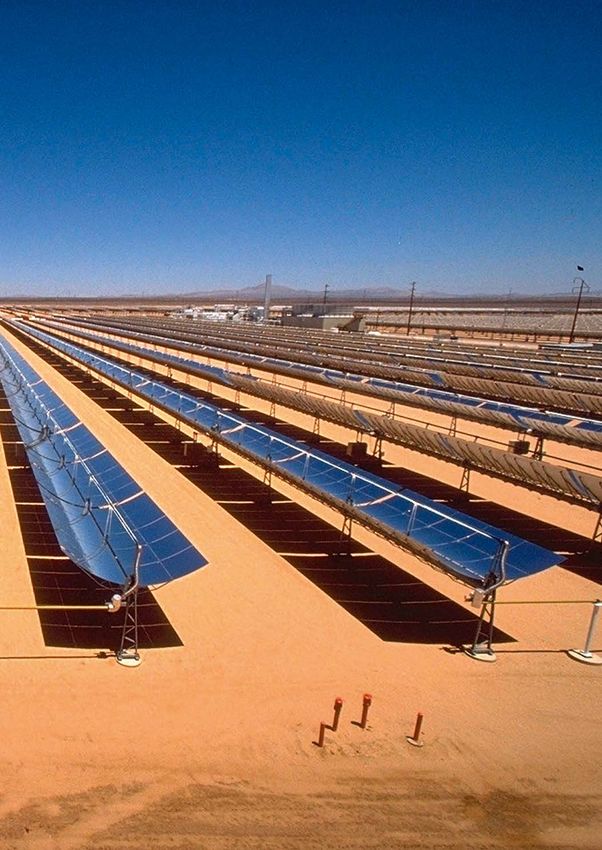
           Parabolic trough power plant

    Solar thermal energy is based on the principle of              Parabolic trough power plant
    radiation concentration to heat a thermal carrier
    fluid, which is then used to generate steam. This              This technology employs curved mirrors which are set,
    steam is then used to generate electrical energy.              using hydraulic devices, at ideal angles to the sun. In
                                                                   the focal line of these mirrors are located high-efficiency
    Using special mirrors, the collector fields capture sunlight   tubes, in which the thermal carrier fluid (synthetic oil) is
    and reflect it onto fluid-filled tubes (parabolic trough       heated to temperatures of approx. 400 °C.
    power plant, Fresnel reflectors), a tower (solar tower
    power plant) or a motor (Stirling Dish plant).                 This oil is pumped into a series of heat exchangers to
                                                                   generate steam. The steam drives a turbine which in turn
                                                                   generates electrical energy.

8
Collector field

          Solar tower power plant

Solar tower power plant

A solar tower power plant consists of a heliostat field,
which is computer-controlled to face the sun in order to       Temperature measurement of the HTF
capture maximum solar radiation. The mirrors reflect the
radiation and guide the rays to a receiver at the top of the   The state-of-the-art HTF oils (heat transfer fluid) are
tower.                                                         thermal oils which can be heated up to 400 °C. If this
                                                               temperature is exceeded, the oil is split into carbons
The thermal carriers are air, steam, oil, liquid sodium        and hydrocarbons by cracking. These products reduce
or liquid salt. As with conventional plants, the heat          the thermal carrier capacity.
dissipated by these media is used to generate electrical
energy via steam turbines.                                     WIKA sensors, temperature transmitters and
                                                               thermowells are specifically designed to ensure
                                                               accurate, quick and reliable temperature
                                                               measurement for the HTF. This increases the
                                                               efficiency and safety of the system.

                                                                                                                         9
Stirling Dish plant                                                   Fresnel reflectors

     Stirling Dish plant                                           Fresnel reflectors

     Stirling Dish plants are particularly suited to decentral-    Fresnel reflectors guide sunlight to a permanently
     ised energy generation. This plant uses mirrors with a        installed receiver. These flat reflectors allow for wide
     diameter of 3 to 25 m and produces outputs up to 50 kW.
                                                                   opening angles and short focal points at far lower weight
     The parabolic mirror tracks the position of the sun and       and volume compared to the parabolic versions.
     focuses the radiation onto a receiver in the focal point of
     the dish. A thermal carrier, usually helium or hydrogen, is   The design of this system is simpler and less expensive
     heated at this point.                                         than any other system as the receiver is not mounted
                                                                   on the mirror and does not require a hydraulic system to
     A Stirling motor converts the heat into mechanical
                                                                   track the sun. To improve efficiency several receivers can
     energy and then, employing a generator, into electrical
     energy.                                                       be installed which bundle the radiation at preset intervals.

10
Collector field
Solar thermal power plant with Fresnel technology in Puerto Errado (direct steam generation)
Pressure measurement of the HTF
To avoid the oil solidifying, which would lead to a block-
age in the HTF system, the oil must be kept permanently
in circulation.
WIKA diaphragm seal assemblies (with process trans-
mitter in picture) ensure the precise measurement of
pump pressures at process temperatures up to 400 °C.
11Power block
Turbine
Steam
Generator
Heat exchanger
Water-steam circuit Steam turbine
The water-steam circuit transports steam from the point Over 70 % of electrical energy generated worldwide is
of generation (heat exchanger unit) to the steam turbine produced with steam turbines. In these, the water-steam
and returns the condensate to the boiler. circuit and the auxiliary turbine systems need to be
monitored and controlled precisely.
Steam is used as thermal carrier for the following
reasons: It is an inexpensive medium and available Pressure, temperature and level measurement
virtually everywhere. Due to the relationship between its technology is employed in the steam and condensate
pressure and temperature, the temperature can be set circuits for lubrication of the turbine, speed control, and
with high precision and modulated via control valves. the systems for steam extraction.
Furthermore, it enables the transport of large amounts of
energy from the point of generation over great distances
to the point of use.
12Power block
Level measurement
For safety reasons, the tanks of the steam and conden-
sate circuits require robust, reliable level control, in many
cases supplemented by redundant systems.
Bypass systems provide local displays with analogue
output signals and/or alarm contacts. These are low-
maintenance mechanical systems which can withstand
process temperatures up to 400 °C.
Temperature measurement
The monitoring of temperature in the power
block is essential for constant energy generation
at maximum output.
Temperature sensors with local displays
and HART® protocol are integrated into the
monitoring system of the plant.
The thermowells for the
temperature sensors are
designed in accordance with the
ASME 'Performance Test Codes
19.3. Rev. 2010' standard.
13Thermal storage
During the daytime the collector field provides sufficient energy During nighttime the hot salt is pumped into the tank contain-
to cover the daily requirements and for storage in salt tanks. ing cold salt via a heat exchanger and transfers heat to the
medium. This medium generates steam which is converted into
electrical energy using a turbine.
Liquid salts for thermal storage
The most modern method for thermal storage is based In this type of plant design, the liquid salts are stored in
on the use of liquid salts as a storage medium in special two tanks: a hot and a cold tank. A heat exchanger heats
tank vessels. the salts during daytime on their transfer to the hot stor-
age tank.
A solar power plant with thermal storage has the ad-
vantage of also being able to generate electricity using When thermal energy is required, the salts are again
the heat stored during daytime in those parts of the day passed through the heat exchanger to heat a thermal
without sunshine (up to 8 hours). carrier oil up to 400 °C.
14Thermal storage
Surface measurement Multi-point measurement
The liquid salt tanks are made In order to measure the temperature in the cold and hot
of temperature-resistant carbon salt tanks at various points, “multi-point” thermocouples
steel or stainless steel. are used.
“Skin-point” temperature sen- These are employed to measure temperatures at various
sors are suitable for monitoring points of the cold and hot salt tanks. These measure-
the temperatures at the tank walls by measuring at differ- ments, together with heating resistors connected via a
ent points. This enables recording the mechanical stress control circuit, prevent a drop in the temperature of the
of the tank walls which is induced by thermal expansion. salt to the solidification point of approx. 250 °C.
15Water treatment
Geographical areas offering the most sunshine are Power plants require filtered water, osmosis water, and
also those suffering from the largest shortages of demineralised water for operation.
water. A thermal solar plant with parabolic troughs
requires approx. 3,000 litres of water per generated The filtered water is used as industrial water for the
MWh, and a solar tower plant requires approx. 1,900 cooling tower and for the fire-extinguishing systems. The
litres. osmosis water is used for cleaning the mirrors of the
parabolic troughs or heliostats. The demineralised water
The largest part of the water is consumed by the wet is employed to operate the circuit and the closed cooling
cooling system of the power block. In comparison, water system.
thermal solar power plants based on Stirling Dish
technology are the most economical, requiring only
80 litres per MWh.
16Water treatment
Pressure transmitters
WIKA pressure transmitters are used in various process
stages of the water treatment plant. The untreated water
contains numerous solids and sludge, which might block
the pressure-channel holes in the instrument. For this
reason, process connections with flush diaphragms or
diaphragm seals are used.
17Service
Consulting and training
We not only manufacture instruments, but also offer
training, locally or in our facilities, based on the extensive
knowledge and experience of our team.
In our training we confer our know-how to the operating
personnel and explain the correct handling of pressure,
Calibration temperature and level measuring instruments.
The reliability and reproducibility of the instruments is
essential for the correct and efficient operation of solar
thermal power plants. Regular calibration of the instru-
ments is needed to ensure correct operation of the plant.
WIKA has calibration laboratories for pressure and
temperature, as well as offering an on-site calibration
service. Furthermore, we supply a comprehensive range
of portable and stationary calibration instruments for use
in laboratories.
Commissioning
Correct installation and commissioning of the instruments
are essential for their reliable operation. We offer quali-
fied and experienced personnel who would be pleased
to support you with the start-up in your plant.
18References
Realised projects
Spain:
ANDASOL I, Guadix PUENTE ERRADO II, Calasparra
ANDASOL II, Guadix SAMCASOL I, La Dehesa
ANDASOL III, Aldeire SAMCASOL II, La Dehesa
ASTEXOL II, Badajoz SOLABEN III, Logrosán
EXTRESOL I, Torres St. Miguel SOLACOR I, Córdoba
EXTRESOL II, Torres St. Miguel SOLACOR II, Córdoba
GEMASOLAR, Fuentes SOLNOVA I, Sanlúcar
HELIOENERGY I, Écija SOLNOVA III, Sanlúcar
HELIOENERGY II, Écija SOLNOVA IV, Sanlúcar
IBERSOL, Puertollano VALLE I, San José, Cádiz
LEBRIJA, Sevilla VALLE II, San José, Cádiz
MAJADAS, Majadas del Tietar
MANCHASOL I, Ciudad Real Other countries:
MANCHASOL II, Ciudad Real BENI MATHAR, Morocco
MORON, Sevilla COALINGA, USA
ORELLANA, Orellana la Vieja HASSI R‘MEL, Algeria
PALMA DEL RIO I, Córdoba KURAYMAT, Egypt
PALMA DEL RIO II, Córdoba SHAMS, VAE
PS 10, Sanlúcar la Mayor SOLANA, USA
PS 20, Sanlúcar la Mayor
19WIKA worldwide
Europe North America Asia
Austria Romania Canada Azerbaijan Taiwan
WIKA Messgerätevertrieb WIKA Instruments Romania S.R.L. WIKA Instruments Ltd. WIKA Azerbaijan LLC WIKA Instrumentation Taiwan Ltd.
Ursula Wiegand GmbH & Co. KG 050897 Bucuresti Head Office Caspian Business Center Min-Tsu Road, Pinjen
Perfektastr. 83 Calea Rahovei Nr. 266-268 3103 Parsons Road 9th floor 40 J.Jabbarli str. 32451 Taoyuan
1230 Vienna Corp 61, Etaj 1 Edmonton, Alberta, T6N 1C8 AZ1065 Baku Tel. +886 3 420 6052
Tel. +43 1 8691631 Tel. +40 21 4048327 Tel. +1 780 4637035 Tel. +994 12 49704-61 Fax: +886 3 490 0080
Fax: +43 1 8691634 Fax: +40 21 4563137 Fax: +1 780 4620017 Fax: +994 12 49704-62 info@wika.com.tw
info@wika.at m.anghel@wika.ro info@wika.ca info@wika.az www.wika.com.tw
www.wika.at www.wika.ro www.wika.ca
China
Belarus Russia Mexico WIKA Instrumentation Suzhou Co., Ltd. Thailand
WIKA Belrus ZAO WIKA MERA Instrumentos WIKA Mexico 81, Ta Yuan Road, SND WIKA Instrumentation Corporation
Ul. Zaharova 50B, Office 3H Wjatskaya Str. 27, Building 17 S.A. de C.V. Suzhou 215011 (Thailand) Co., Ltd.
220088 Minsk Office 205/206 Viena 20 Ofna 301 Tel. +86 512 6878 8000 850/7 Ladkrabang Road, Ladkrabang
Tel. +375 17 2945711 127015 Moscow Col. Juarez, Del. Cuauthemoc Fax: +86 512 6809 2321 Bangkok 10520
Fax: +375 17 2945711 Tel. +7 495-648018-0 06600 Mexico D.F. info@wika.cn Tel. +66 2 32668-73
info@wika.by Fax: +7 495-648018-1 Tel. +52 55 50205300 www. wika.com.cn Fax: +66 2 32668-74
www.wika.by info@wika.ru Fax: +52 55 50205300 info@wika.co.th
www.wika.ru ventas@wika.com India www.wika.co.th
Benelux www.wika.com.mx WIKA Instruments India Pvt. Ltd.
WIKA Benelux Serbia Village Kesnand, Wagholi
Industrial estate De Berk WIKA Merna Tehnika d.o.o. USA Pune - 412 207 Africa / Middle East
Newtonweg 12 Sime Solaje 15 WIKA Instrument, LP Tel. +91 20 66293-200
6101 WX Echt 11060 Beograd 1000 Wiegand Boulevard Fax: +91 20 66293-325 Egypt
Tel. +31 475 535500 Tel. +381 11 2763722 Lawrenceville, GA 30043 sales@wika.co.in WIKA Near East Ltd.
Fax: +31 475 535446 Fax: +381 11 753674 Tel. +1 770 5138200 www.wika.co.in Villa No. 6, Mohamed Fahmy
info@wika.nl info@wika.rs Fax: +1 770 3385118 Elmohdar St. - of Eltayaran St.
www.wika.nl www.wika.rs info@wika.com Iran 1st District - Nasr City - Cairo
www.wika.com WIKA Instrumentation Pars Kish Tel. +20 2 240 13130
Bulgaria Spain (KFZ) Ltd. Fax: +20 2 240 13113
WIKA Bulgaria EOOD Instrumentos WIKA S.A.U. WIKA Process Solutions, LP. Apt. 307, 3rd Floor info@wika.com.eg
Akad.Ivan Geshov Blvd. 2E C/Josep Carner, 11-17 950 Hall Court 8-12 Vanak St., Vanak Sq., Tehran www.wika.com.eg
Business Center Serdika, office 3/104 08205 Sabadell Barcelona Deer Park, TX 77536 Tel. +98 21 88206-596
1330 Sofia Tel. +34 933 9386-30 Tel. +1 713 47500-22 Fax: +98 21 88206-623 Namibia
Tel. +359 2 82138-10 Fax: +34 933 9386-66 Fax: +1 713 47500-11 info@wika.ir WIKA Instruments Namibia Pty Ltd.
Fax: +359 2 82138-13 info@wika.es info@wikahouston.com www.wika.ir P.O. Box 31263
info@wika.bg www.wika.es www.wika.com Pionierspark
www.wika.bg Japan Windhoek
Switzerland Mensor Corporation WIKA Japan K. K. Tel. +26 4 61238811
Croatia MANOMETER AG 201 Barnes Drive MG Shibaura Bldg. 6F Fax: +26 4 61233403
WIKA Croatia d.o.o. Industriestrasse 11 San Marcos, TX 78666 1-8-4, Shibaura, Minato-ku info@wika.com.na
Hrastovicka 19 6285 Hitzkirch Tel. +1 512 396-4200 Tokyo 105-0023 www.wika.com.na
10250 Zagreb-Lucko Tel. +41 41 91972-72 Fax: +1 512 396-1820 Tel. +81 3 5439-6673
Tel. +385 1 6531-034 Fax: +41 41 91972-73 sales@mensor.com Fax: +81 3 5439-6674 South Africa
Fax: +385 1 6531-357 info@manometer.ch www.mensor.com info@wika.co.jp WIKA Instruments Pty. Ltd.
info@wika.hr www.manometer.ch www.wika.co.jp Chilvers Street, Denver
www.wika.hr Johannesburg, 2094
Turkey Latin America Kazakhstan Tel. +27 11 62100-00
Finland WIKA Instruments Istanbul TOO WIKA Kazakhstan Fax: +27 11 62100-59
WIKA Finland Oy Basinc ve Sicaklik Ölcme Cihazlari Argentina Raimbekstr. 169, 3rd floor sales@wika.co.za
Melkonkatu 24 Ith. Ihr. ve Tic. Ltd. Sti. WIKA Argentina S.A. 050050 Almaty www.wika.co.za
00210 Helsinki Bayraktar Bulvari No. 17 Gral. Lavalle 3568 Tel. +7 727 2330848
Tel. +358 9 682492-0 34775 Yukari Dudullu - Istanbul (B1603AUH) Villa Martelli Fax: +7 727 2789905 United Arab Emirates
Fax: +358 9 682492-70 Tel. +90 216 41590-66 Buenos Aires info@wika.kz WIKA Middle East FZE
info@wika.fi Fax: +90 216 41590-97 Tel. +54 11 47301800 www.wika.kz Warehouse No. RB08JB02
www.wika.fi info@wika.com.tr Fax: +54 11 47610050 P.O. Box 17492
www.wika.com.tr info@wika.com.ar Korea Jebel Ali, Dubai
France www.wika.com.ar WIKA Korea Ltd. Tel. +971 4 883-9090
WIKA Instruments s.a.r.l. Ukraine 569-21 Gasan-dong, Kumcheon-gu Fax: +971 4 883-9198
Parc d‘Affaires des Bellevues TOV WIKA Prylad Brazil Seoul 153-771 info@wika.ae
8 rue Rosa Luxembourg M. Raskovoy Str. 11, A WIKA do Brasil Ind. e Com. Ltda. Tel. +82 2 86905-05 www.wika.ae
95610 Eragny-sur-Oise PO 200 Av. Ursula Wiegand, 03 Fax: +82 2 86905-25
Tel. +33 1 343084-84 02660 Kyiv CEP 18560-000 Iperó - SP info@wika.co.kr
Fax: +33 1 343084-94 Tel. +38 044 4968380 Tel. +55 15 34599700 www.wika.co.kr Australia
info@wika.fr Fax: +38 044 4968380 Fax: +55 15 32661650
www.wika.fr info@wika.ua vendas@wika.de Malaysia Australia
www.wika.ua www.wika.com.br WIKA Instrumentation M Sdn. Bhd. WIKA Australia Pty. Ltd.
Germany No. 27 & 29 Jalan Puteri 5/20 Unit K, 10-16 South Street
WIKA Alexander Wiegand SE & Co. KG United Kingdom Chile Bandar Puteri Puchong Rydalmere, NSW 2116
Alexander-Wiegand-Str. 30 WIKA Instruments Ltd WIKA Chile S.p.A. 47100 Puchong, Selangor Tel. +61 2 88455222
63911 Klingenberg Merstham, Redhill RH13LG Av. Coronel Pereira 72 Tel. +60 3 806310-80 Fax: +61 2 96844767
Tel. +49 9372 132-0 Tel. +44 1737 644-008 Oficina 101 Fax: +60 3 806310-70 sales@wika.com.au
Fax: +49 9372 132-406 Fax: +44 1737 644-403 Las Condes - Santiago de Chile info@wika.com.my www.wika.com.au
info@wika.de info@wika.co.uk Tel. +56 2 365-1719 www.wika.com.my
www.wika.de www.wika.co.uk info@wika.cl New Zealand
www.wika.cl Philippines WIKA Instruments Limited
Italy WIKA Instruments Philippines, Inc. Unit 7 / 49 Sainsbury Road
WIKA Italia S.r.l. & C. S.a.s. Colombia Unit 102 Skyway Twin Towers St Lukes - Auckland 1025
Via G. Marconi 8 Instrumentos WIKA Colombia S.A.S. 351 Capt. Henry Javier St. Tel. +64 9 8479020
20020 Arese (Milano) Dorado Plaza, Bgy. Oranbo, Pasig City 1600 Fax: +64 9 8465964
Tel. +39 02 93861-1 Avenida Calle 26 No. 85D – 55 Tel. +63 2 234-1270 info@wika.co.nz
Fax: +39 02 93861-74 Local 126 y 126 A Fax: +63 2 695-9043 www.wika.co.nz
info@wika.it Bogotá – Colombia info@wika.com.ph
www.wika.it Tel. +57 1 744 3455 www.wika.com.ph
info@wika.co
Poland Singapore
WIKA Polska spółka z ograniczoną WIKA Instrumentation Pte. Ltd.
odpowiedzialnością sp. k. 13 Kian Teck Crescent
Ul. Legska 29/35 628878 Singapore
87-800 Wloclawek Tel. +65 6844 5506
Tel. +48 54 230110-0 Fax: +65 6844 5507
Fax: +48 54 230110-1 info@wika.com.sg
info@wikapolska.pl www.wika.com.sg
www.wikapolska.pl
WIKA Alexander Wiegand SE & Co. KG
Alexander-Wiegand-Straße 30∙63911 Klingenberg∙Germany
Tel. +49 9372 132-0∙Fax +49 9372 132-406
info@wika.de∙www.wika.de
14017891 09/2012 GBYou can also read


