Tracking China's Global Economic Activities: Data Challenges and Issues for Congress - Updated July 14, 2020
←
→
Page content transcription
If your browser does not render page correctly, please read the page content below
Tracking China’s Global Economic Activities:
Data Challenges and Issues for Congress

Updated July 14, 2020

                               Congressional Research Service
                                https://crsreports.congress.gov
                                                       R46302
SUMMARY
R46302
Tracking China’s Global Economic Activities:
July 14, 2020
Data Challenges and Issues for Congress Andres B. Schwarzenberg
The People’s Republic of China (PRC or China) has significantly increased its overseas Analyst in International
investments since launching its “Go Global Strategy” in 1999 in an effort to support the overseas Trade and Finance
expansion of Chinese firms and make them more globally competitive. Since then, these firms—
many of which are closely tied to the Chinese government—have acquired foreign assets and
capabilities and pledged billions of dollars to finance infrastructure abroad. As a result, many in
Congress and the Trump Administration are focusing on the critical implications of China’s
growing global economic reach for U.S. economic and geopolitical strategic interests.
Some analysts see these Chinese activities as primarily commercial in nature. Others contend that the surge in global
economic activity is also part of a concerted effort by China’s leaders to bolster China’s position as a global power and
ensure support for their foreign policy objectives. There is also growing concern about the terms of China’s economic
engagement, particularly over the ways that Chinese lending may be creating unsustainable debt burdens for some countries
and over how much of China’s lending is tied to commercial projects and Chinese state firms that benefit from the
investment.
A major challenge to understanding the implications of China’s growing global economic reach is the critical gap in the
availability and accuracy of data and information. Most notable is the fact that no comprehensive, standardized, or
authoritative data—from either the Chinese government or international organizations—are available on Chinese overseas
economic activities. Given the complexity and multifaceted nature of the projects in which Chinese entities are involved,
attempts to assess the size and scope of these projects are rough estimates, at best, and should be regarded as such. Figures
cited in news articles, think-tank reports, and academic studies may not be entirely accurate and should be interpreted with
caution. For instance, many publicly and privately available unofficial “trackers”—from which these data are often sourced—
are based on initial public announcements of Chinese overseas projects, which may differ significantly from actual capital
flows because such projects may evolve or may never come to fruition.
In the absence of accurate and sufficient data, Members of Congress may seek ways to improve their own understanding by
supporting U.S. and international efforts to better track, analyze, and publicize actual Chinese investment, construction,
assistance, and lending activities. Congress, for example, may direct agencies within the executive branch to develop a
whole-of-government approach to better assess the global economic activities of U.S., Chinese, and other major actors.
Additionally, Congress could require these agencies to study the adequacy of data and information recording, collection,
disclosure, reporting, and analysis at the U.S. and international levels. Better information could facilitate clearer, deeper, and
better informed assessment of such activities and their (1) impact on U.S. interests and (2) ramifications for the norms and
rules of the global economic system—a system whose chief architect and dominant player to date largely has been the United
States.
Congressional Research ServiceTracking China’s Global Economic Activities: Challenges and Issues for Congress Contents Background ..................................................................................................................................... 1 Framing the Debate on China’s Global Reach ................................................................................ 2 Data Limitations .............................................................................................................................. 4 Issues and Options for Congress ................................................................................................... 10 Figures Figure 1. China’s Total Outward Direct Investment Flows ............................................................. 1 Figure 2. China’s FDI Outflows to the United States in 2015 ........................................................ 6 Figure 3. China’s FDI Outflows to the World in 2015 .................................................................... 6 Tables Table 1. China’s FDI Outflows to the World ................................................................................... 7 Table A-1. Select Databases on China’s Global Investment, Construction, and Lending Activities .................................................................................................................................... 13 Table B-1. China’s FDI Stock the United States ........................................................................... 16 Appendixes Appendix A. Databases and Resources ......................................................................................... 13 Appendix B. China’s FDI in the United States ............................................................................. 16 Contacts Author Information........................................................................................................................ 16 Congressional Research Service
Tracking China’s Global Economic Activities: Challenges and Issues for Congress

Background
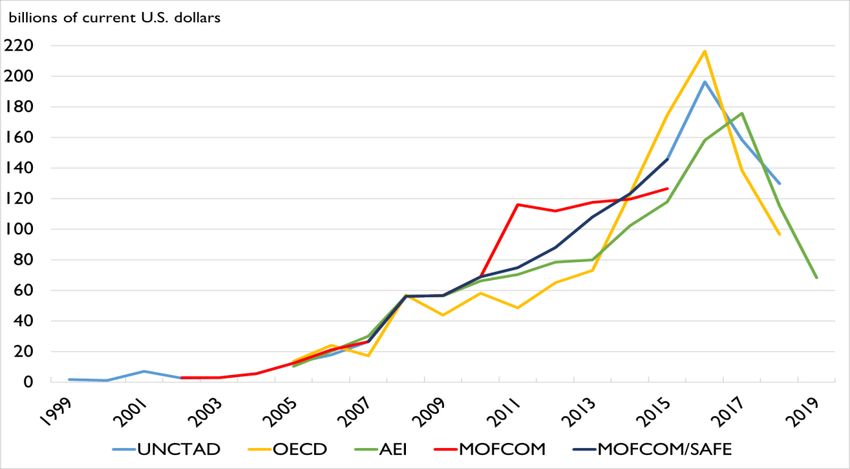
The People’s Republic of China (PRC or China) has significantly increased its overseas
investments since launching its “Go Global Strategy” in 1999 in an effort to make Chinese firms
more globally competitive and advance domestic economic development (Figure 1). Since then,
Chinese firms have acquired foreign assets and pledged billions of dollars to finance
infrastructure abroad. China’s push overseas has been particularly visible in the Indo-Pacific
region, a major focus of China’s effort to increase global trade connectivity through the “Belt and
Road Initiative” (BRI, initially known as “One Belt, One Road”), which launched in 2013.1
However, China’s overseas, global economic activities include the purchase, financing,
development, and operation of assets and infrastructure across Africa, Asia, Europe, Latin
America and the Caribbean, North America, and Oceania.

                       Figure 1. China’s Total Outward Direct Investment Flows

       Source: Congressional Research Service with data from the American Enterprise Institute (AEI)/Heritage Foundation China
       Global Investment Tracker; Ministry of Commerce of the People's Republic of China (MOFCOM) Foreign Direct Investment
       Statistics; MOFCOM/State Administration of Foreign Exchange of the People’s Republic of China (MOFCOM/SAFE)’s 2015
       Statistical Bulletin of China’s Outward Foreign Direct Investment; Organisation for Economic Co-operation and Development
       (OECD) International Direct Investment Statistics; and United Nations Conference on Trade and Development (UNCTAD)
       UNCTADstat.
       Notes: AEI includes only reported transactions of $100 million or more; MOFCOM includes only nonfinancial FDI; OECD,
       UNCTAD, and MOFCOM and China’s State Administration of Foreign Exchange (SAFE) compile data based on International
       Monetary Fund BPM6 and OECD BD4 guidelines.

1   Mercator Institute for China Studies, “Mapping the Belt and Road Initiative: This is Where We Stand,” July 6, 2018.

Congressional Research Service                                                                                                     1
Tracking China’s Global Economic Activities: Challenges and Issues for Congress
Links to Select Databases on China’s Foreign Direct Investment (FDI)
AEI American Enterprise Institute and the Heritage Foundation
China Global Investment Tracker
BEA U.S. Department of Commerce’s Bureau of Economic Analysis
Direct Investment by Country and Industry
MOFCOM Ministry of Commerce People’s Republic of China
Foreign Investment Statistics
NBS National Bureau of Statistics of China
Statistical Database
OECD Organisation for Economic Co-operation and Development
International Direct Investment Statistics
RG Rhodium Group
U.S.-China Investment Hub
SAFE State Administration of Foreign Exchange of the People’s Republic of China
Data and Statistics
UNCTAD United Nations Conference on Trade and Development
UNCTADstat
Many in Congress and the Trump Administration are focusing attention on possible critical
implications of China’s growing global economic reach for U.S. economic and geopolitical
strategic interests. Some analysts view China’s activities as largely commercial in nature,
following the path that some Western multinational firms forged in the 1980s and 1990s in
expanding and integrating into global markets.2 Others contend that China’s activities are
ultimately in support of alleged efforts by Beijing to challenge and undermine U.S. global
influence.3
This report does not provide figures or estimates of China’s global economic activities. Nor is it
an in-depth analysis of recent trends and developments. Rather, it provides an overview of select
issues and challenges encountered when compiling, interpreting, and analyzing statistics on
Chinese investment, construction, financing, and development assistance around the world.
Framing the Debate on China’s Global Reach
Economic- and resource-related imperatives play an important role in China’s expanding global
economic footprint. Analysts see strong domestic economic development as a primary objective
for China’s leaders for a number of reasons, including those leaders’ desire to raise the living
standards of the population, dampen social disaffection about economic and other inequities, and
sustain regime legitimacy. In addition, China’s rapid economic growth has created a domestic
appetite for greater resources and technology, as well as for creating markets for Chinese goods—
all of which have served as powerful drivers of China’s integration into the global economy and
2 See, for example, The Economist Intelligence Unit, “China’s Expanding Investment in Global Ports,” October 11,
2017. In certain aspects, some of China’s economic activities may resemble development assistance.
3 There are three broad areas of concern: (1) rapid increase/expansion, (2) types of activities (e.g., sensitive areas like
infrastructure and technology), and (3) the terms of engagement (e.g., state firms, the promotion of Chinese industrial
policies, indebtedness of host governments). For more detail, see, for example, Thomas P. Cavanna, “Unlocking the
Gates of Eurasia: China’s Belt and Road Initiative and Its Implications for U.S. Grand Strategy,” Texas National
Security Review, Vol. 2, No. 3, May 2019; Melanie Hart and Kelly Magsamen, “Limit, Leverage, and Compete: A New
Strategy on China,” Center for American Progress, April 3, 2019; and Catherine Trautwein, “All Roads Lead to China:
The Belt and Road Initiative, Explained,” PBS Frontline, June 26, 2019.
Congressional Research Service 2Tracking China’s Global Economic Activities: Challenges and Issues for Congress enthusiasm for international trade and investment agreements.4 For example, as China’s energy demands have continued to rise, the Chinese government has sought bilateral agreements, oil and gas contracts, scientific and technological cooperation, and de-facto multilateral security arrangements with energy-rich countries, both in its periphery and around the world. Moreover, China’s recent relative economic slowdown (in the aftermath of the government-financed boom of the post-global recession years) has created excess capacity and the need to find overseas markets and employment opportunities for its infrastructure and construction sectors.5 In pursuing commercial opportunities abroad, Chinese firms—many of them state owned—have become global leaders in these sectors (e.g., transport infrastructure, such as ports and high-speed rail). Some observers contend that these investment and construction trends may reflect an attempt by China to bolster its position as a global power, gain control of vital sea-lanes and energy-supply routes, secure key supply chains, aggregate control over communications infrastructure and standards, and build up geo-economic leverage to ensure support for its foreign policy objectives.6 In particular, some U.S. officials have expressed concerns that China’s growing international economic engagement goes hand-in-hand with expanding political influence.7 The seemingly—though debatable—“no strings attached” nature and looser terms of Beijing’s overseas loans and investments may be attractive to foreign governments wanting swifter, more “efficient,” and relatively less intrusive solutions to their development problems than those offered by bilateral and international financial institutions, such as the International Monetary Fund (IMF), World Bank, and Asian Development Bank (ADB).8 Unlike these institutions, many of the Chinese financial institutions and enterprises involved in China’s overseas investment, lending and construction are owned or subsidized by the government. As such, they are not accountable to shareholders, do not generally impose safeguards or international standards related to transparency, human rights, and environmental protection, and can afford short-term losses in pursuit of longer-term, strategic goals.9 4 See, for example, Sam Ellis, “China’s Trillion-Dollar Plan to Dominate Global Trade,” Vox, April 6, 2018. Other motivations for China’s foreign investments include securing strategic resources, learning how to operate in a global marketplace, and currying favor with senior officials by advancing PRC initiatives, such as BRI. In terms of construction contracts, an important motivation is to provide employment for Chinese construction workers who now have insufficient projects on which to work within China’s borders. 5 In some cases, China’s activities have heightened cultural backlash and resentment by the style that Chinese overseas investments and construction projects have been pursued, particularly in regard to the use of Chinese—rather than local—companies and workers. 6 William Pacatte, “Be Afraid? Be Very Afraid?—Why the United States Needs a Counterstrategy to China’s Belt and Road Initiative,” International Security Program, Center for Strategic & International Studies, October 2018. 7 See, for example: James Swan, “Africa-China Relations: The View from Washington,” U.S. Department of State Archive, February 9, 2007; White House, Claudia E. Anyaso, “Implications of Chinese Economic Expansion in Africa,” U.S. Department of State Archive, October 31, 2008; “Remarks by Vice President Pence at the 2018 APEC CEO Summit, Port Moresby, Papua New Guinea,” November 16, 2018; Eva Vergara, “Pompeo: China financing of Maduro prolongs Venezuela crisis,” AP News, April 12, 2019. 8 The Trump Administration and some Members of Congress have questioned the motives behind China’s actions in the case of several individual projects with strategic implications, notably the Hambantota port in Sri Lanka and a port in Djibouti. After Sri Lanka found itself unable to repay Chinese loans, a PRC company, China Merchants Port Holdings Company, Ltd., acquired a majority stake in the company that operates the Hambantota port, and signed a concession agreement to operate the port for 99 years from 2017. 9 Chinese projects typically involve a consortium of Chinese state firms who provide the full range of goods, labor and services for the projects that China finances. These projects are neither assistance—Chinese loans are typically not offered interest-free and tend to be issued at, or near, market terms—nor truly commercial, because repayments are often backed by collateral (e.g., energy, minerals, or commodities) commitments made to the Chinese government, including state firms designated by the Chinese government that might not even be party to the original transaction. Congressional Research Service 3
Tracking China’s Global Economic Activities: Challenges and Issues for Congress

Although some analysts and policymakers suggest that Chinese officials and state-owned
enterprises (SOEs) appear more comfortable working with undemocratic or authoritarian
governments, China’s outreach also has extended to the United States, key U.S. allies and
partners, and regions where U.S. economic linkages and diplomatic sway have been, until
recently, predominant. These developments have led some observers to conclude that Beijing
intends to challenge—or is already challenging—U.S. global leadership directly.10 As a result,
some Members of Congress and Administration officials are focusing attention on the critical
implications that China’s increasing international economic engagements could have for U.S.
economic and strategic interests.
Some observers have sought to compare China’s activities to those of the United States. In
contrast to China’s, however, U.S. global economic engagements have tended to be more diverse
and not government-directed or -funded.11 They have been driven primarily by the U.S. private
sector, whose global presence is long-standing and comprehensive.

Data Limitations
A major challenge when researching global investment and construction projects and related
loans is the accuracy of the data.12 While this challenge is not unique to projects involving
Chinese players, it is exacerbated by the nature of many Chinese projects and loans, whose terms
are not always publicly available or transparent. No comprehensive, standardized, or authoritative
data are available on all Chinese overseas economic activities—from either the Chinese
government or international organizations. A number of think tanks and private research firms
have developed datasets to track investment, loans, and grants by Chinese-owned firms and
institutions using commercial databases, news reports, and official government sources, when
available (Appendix A). These datasets often record the value of projects, loans, and grants when
they are publicly announced (e.g., at press conferences). However, many publicly announced
projects are never formalized, and if they are, project and loan details may change, and projects
may not always come to fruition for various reasons (e.g., changing economic and political
conditions, or concerns about sovereignty, debt structure, or environmental impact).

The Chinese government generally offers preferential terms and absorbs much of the commercial risk for Chinese firms
participating in these projects.
10 This could occur, for example, in international fora, where the United States has had a leading role in setting the rules

for international economic relations, or with respect to global markets and resources that China anticipates it will need
to sustain its economic progress.
11 The nature of the Chinese political system and major role of the state in its economy make it easier for China, in

comparison to the United States, to deploy economic resources abroad in pursuit of economic and foreign policy aims.
12 This report differentiates between investment and construction activities. “Investment” entails ownership and

includes greenfield investments and mergers and acquisitions (M&A), but it does not include portfolio investment (e.g.,
securities). “Construction,” on the other hand, refers to Chinese construction services performed in the host country.

Congressional Research Service                                                                                            4
Tracking China’s Global Economic Activities: Challenges and Issues for Congress
Select Issues with Data on China’s Overseas Economic Activities
Ministry of Commerce of the People’s Republic of China (MOFCOM) official statistics record only projects
approved by the Chinese national government.
China’s government definitions of what constitutes an investment or construction project have changed over
time, which makes it difficult to analyze trends.
Many datasets leave out projects and loans below a certain threshold (e.g., under $25 million or $100
million).
It is difficult—if not impossible—to track Chinese investment that goes through offshore financial centers
(e.g., Hong Kong, British Virgin Islands, and Cayman Islands)—which in some years has accounted for as much
as three-quarters of China’s total outward investment flows.
Datasets by think tanks and private research firms often record the value of projects, loans, and grants when
they are announced, and may not update that information to reflect if and when the projects come to
fruition.
Despite these limitations, figures derived from such “data trackers” often drive the policy debate.
Because U.S. policymakers may rely on them to assess the overall scope and magnitude of
Chinese activities, it is important to recognize the problems with the data and the limitations of
existing databases. While they might be valuable and informative, they may also provide vastly
different figures that are not necessarily comparable. For example, for 2015—the most recent
year for which complete annual data are available from all major sources—figures on China’s
investment flows into the United States vary from $2.6 billion (which only includes nonfinancial
gross foreign direct investment (FDI) flows and is reported by MOFCOM)13 to $16.4 billion
(which includes gross announced transaction flows of $100 million or more and is tracked by
AEI/Heritage)14 (Figure 2). Similarly, China’s total outward investment flows for the same year
range from $117.9 billion (AEI/Heritage) to $174.4 billion (OECD)15 (Figure 3 and Table 1).
Comparability issues also arise when trying to differentiate loan, investment, and construction
projects that overlap, since datasets only capture a certain type of activity. Various datasets’
categorizations may not cover the full range of activity that is taking place.
13 Ministry of Commerce of the People’s Republic of China (MOFCOM).
14 American Enterprise Institute/Heritage Foundation (AEI).
15 Organisation for Economic Co-operation and Development (OECD).
Congressional Research Service 5Tracking China’s Global Economic Activities: Challenges and Issues for Congress
Figure 2. China’s FDI Outflows to the United States in 2015
Estimates vary by as much as $13.8 billion
Source: Congressional Research Service with data from AEI/Heritage Foundation’s China Global Investment Tracker;
MOFCOM’s Foreign Direct Investment Statistics; MOFCOM/SAFE’s 2015 Statistical Bulletin of China’s Outward Foreign Direct
Investment; RG’s U.S.-China Investment Hub; and BEA’s Direct Investment by Country and Industry.
Notes: Not adjusted for inflation. 2015 is the most recent year for which data are available from all major sources. AEI only
includes reported transactions of $100 million or more; MOFCOM only includes nonfinancial FDI; RG includes gross FDI (total
inflows); and BEA includes net FDI (total inflows minus total outflows).
Figure 3. China’s FDI Outflows to the World in 2015
Estimates vary by as much as $56.5 billion
Source: Congressional Research Service with data from AEI/Heritage Foundation’s China Global Investment Tracker;
MOFCOM’s Foreign Direct Investment Statistics; MOFCOM/ SAFE’s 2015 Statistical Bulletin of China’s Outward Foreign Direct
Investment; OECD’s International Direct Investment Statistics; and UNCTAD’s UNCTADstat.
Notes: Not adjusted for inflation. 2015 is the most recent year for which data are available from all major sources. AEI only
includes reported transactions of $100 million or more; MOFCOM only includes nonfinancial FDI; OECD, UNCTAD, and
MOFCOM/SAFE compile data based on the IMF’s BPM6 and OECD’s BD4 guidelines.
Congressional Research Service 6Tracking China’s Global Economic Activities: Challenges and Issues for Congress
Table 1. China’s FDI Outflows to the World
(in billions of current U.S. dollars)
Year MOFCOM MOFCOM/SAFE UNCTAD OECD AEI/HERITAGE
2000 0.9
2001 6.9
2002 2.7 2.5
2003 2.9 2.9
2004 5.5 5.5
2005 12.3 12.3 13.7 10.2
2006 21.2 17.6 23.9 20.3
2007 26.5 26.5 26.5 17.2 30.1
2008 55.9 55.9 55.9 56.7 56.3
2009 56.5 56.5 56.5 43.9 56.1
2010 68.8 68.8 68.8 58.0 66.0
2011 116.0 74.7 74.7 48.4 70.3
2012 111.7 87.8 87.8 65.0 78.5
2013 117.6 107.8 107.8 73.0 79.8
2014 119.6 123.1 123.1 123.1 102.3
2015 126.3 145.7 145.7 174.4 117.9
2016 196.1 216.4 158.2
2017 158.3 138.3 175.6
2018 129.8 96.5 115.2
2019 68.2
Source: Congressional Research Service with data from the AEI/Heritage Foundation’s China Global Investment Tracker;
MOFCOM’s Foreign Direct Investment Statistics; MOFCOM/SAFE’s 2015 Statistical Bulletin of China’s Outward Foreign Direct
Investment; OECD’s International Direct Investment Statistics; and UNCTAD’s UNCTADstat.
Notes: Not adjusted for inflation. AEI only includes reported transactions of $100 million or more; MOFCOM only includes
nonfinancial FDI; OECD, UNCTAD, and MOFCOM/SAFE compile data based on the IMF’s BPM6 and OECD’s BD4 guidelines.
China’s official foreign direct investment (FDI) statistics are compiled by two government
agencies according to different criteria. The Ministry of Commerce of the People’s Republic of
China (MOFCOM)’s data are based on officially approved investments by nonfinancial
institutions—that is, information recorded during the approval process rather than through
surveys or questionnaires as in the United States (see textbox below). They are generally
separated out by country and industry. The State Administration of Foreign Exchange of the
People’s Republic of China (SAFE), on the other hand, reports Balance of Payments (BoP) data
at the aggregate level. SAFE, in theory, follows IMF guidelines. While both agencies are
supposed to reconcile their figures in their annual revisions, discrepancies in the total amounts
reported are common and significant.
Congressional Research Service 7Tracking China’s Global Economic Activities: Challenges and Issues for Congress
U.S. Inward and Outward Direct Investment Statistics
U.S. Department of Commerce’s Bureau of Economic Analysis (BEA)
BEA publishes two broad sets of statistics on outward direct investment and on inward direct investment: (1)
statistics on international transactions and direct investment positions and (2) statistics on the activities of
multinational enterprises. Both sets are derived from information collected in surveys of U.S. multinational
enterprises and surveys of U.S. affiliates of foreign multinational enterprises that are conducted by BEA.
BEA conducts seven mandatory surveys to collect information on direct investment. These surveys consist of
quarterly, annual, and benchmark surveys of outward and inward direct investment and a survey of new inward
direct investment. The quarterly surveys provide information on direct investment transactions and income for
the position accounts. Annual and benchmark surveys provide information on the activities of multinational
enterprises international transactions accounts and on direct investment positions for the international investment
and the more detailed information that is needed for annual and benchmark revisions of direct investment
transactions and positions. Benchmark surveys are conducted every 5 years. They provide the most
comprehensive coverage of business entities, transactions, and data items. Quarterly and annual surveys are largely
cutoff sample surveys of U.S. parents and their foreign affiliates and of U.S. affiliates of foreign parents above size-
exemption levels.
Reporting on BEA’s direct investment surveys is mandatory under the International Investment and Trade in
Services Survey Act (P.L. 94-472, 22 U.S.C. §§3101–3108, as amended). The Act protects the confidentiality of the
data that companies report.
Source: Excerpts from A Guide to BEA’s Direct Investment Surveys, U.S. Department of Commerce, Economics
and Statistics Administration.
Much of China’s official outbound FDI also has traditionally been registered in Hong Kong, the
former British colony that has been a Special Administrative Region of the PRC since 1997, or in
tax havens such as the Cayman Islands or British Virgin Islands. Chinese firms, in particular, are
known to use holding companies and offshore vehicles to structure their investments. “Round-
tripping” (the practice of firms routing themselves funds through localities that offer beneficial
tax policies or special incentives), “trans-shipping” (the practice of firms routing funds through
countries that offer favorable tax policies to later reinvest these funds in third countries), and
indirect holdings all make it difficult to track and disaggregate investments accurately. Chinese
domestic investors have also been known to rely on these schemes to take advantage of favorable
conditions granted only to foreign investors. As the Economist Intelligence Unit notes, “Chinese
statistics record approved projects rather than actual money transfers,” and “[c]ompanies often
list the initial port of call of their capital, rather than its final destination, thus falsely inflating the
importance of stop-over locations.”16
In addition to data reliability and comparability issues, it is not always possible to determine if an
asset or project is wholly or partially owned, financed, built, or operated by a Chinese entity.
Thus, the lack of consistent, disaggregated, and detailed information limits the proper assessment
of the size, scope, and implications of these activities. Moreover, because major projects
generally involve several phases and a sometimes-evolving cast of stakeholders, it is not always
possible to distinguish between the phases of acquisition or construction and those of
operations—as they are often blended in terms of time and firms involved.
Many of the overseas infrastructure projects in which Chinese entities are involved—particularly
ports—also present distinct challenges not always encountered in the analysis of traditional
foreign direct investments (e.g., multinational corporations building a new factory or acquiring an
existing domestic firm). In the case of infrastructure, to attract foreign investment and transfer
risks to the private sector, it is common for host countries to offer long-term concessions or
16The Economist Intelligence Unit, “Chinese Investment in Developed Markets: An Opportunity for Both Sides?”
2015.
Congressional Research Service 8Tracking China’s Global Economic Activities: Challenges and Issues for Congress leases—for both construction and operation. These typically allow the grantee firm the right to use land and facilities (e.g., ports and highways) for a defined period in exchange for providing services. Because these lands and facilities tend to be owned by the host government, the investments can come in the form of use-rights through leases or joint ventures. These challenges, together with the opacity of China’s terms and conditions, can limit the ability to assess accurately the extent of Chinese involvement. Data availability limitations also may arise since China often finances infrastructure development through its export credit agencies and development banks.17 China is not a member of the Organization for Economic Cooperation and Development (OECD) or part of its Arrangement on Officially Supported Export Credits, which includes rules on transparency procedures for government-backed export credit financing.18 The United States, China, and other countries have been working to develop a new set of international rules, but progress reportedly has been limited.19 Finally, some of China’s global economic activities are portrayed inaccurately as “foreign aid” or “development assistance.” While certain aspects may resemble assistance in the conventional sense, they generally do not meet the OECD standards of “official development assistance” (ODA).20 The terms of China’s “ODA-like” loans are less concessional than those of other major actors such as the United States and Japan, have large commercial elements with economic benefits accruing to Chinese actors, and are rarely government-to-government.21 Details on specific Chinese deals and overall flows are opaque because the PRC government rarely releases data on any of its lending activities abroad or those of its state firms and entities. China also is not part of the OECD’s Development Assistance Committee, which “monitors development finance 17 Some of China’s development and infrastructure assistance programs have been termed “tied aid” or “mixed credits.” Tied aid credits and mixed credits are two of the primary methods whereby governments provide their exporters with official assistance to promote exports. Tied aid credits include loans and grants which reduce the financing costs for exporters below market rates and which are tied to the procurement of goods and services from the donor country. Mixed credits combine concessional government financing (funds at below-market rates or terms) with commercial or near-commercial funds to produce lower than market-based interest rates and more lenient loan terms. These types of credits typically are tied to the procurement of goods and services from the donor country, and through them, foreign governments use their overseas assistance programs to influence procurement decisions in favor of their own exporters. The OECD’s Arrangement on Officially Supported Export Credits—of which China is not a part—provides disciplines on tied aid. 18 These are financial terms and conditions, such as down payments, maximum repayment terms, minimum interest rates, and country risk classifications; provisions on tied aid; notification procedures; and sector-specific terms and conditions, covering the export credits for ships, nuclear power plants, civil aircraft, renewable energies, and water projects. Military equipment, agricultural goods, and untied development aid are not covered by the Arrangement. 19 In 2012, the United States and China established an International Working Group on Export Credits (IWG) to develop a new set of international guidelines for official export credit support. The White House, “White House Fact Sheet on U.S.-China Economic Relations,” Press Release, November 12, 2014. More broadly, there are no international rules governing development finance comparable to those in the OECD that govern export credit financing among its members and other countries willing to join the OECD arrangement. 20 According to the Organization for Economic Cooperation and Development (OECD), official development assistance (ODA) consists of disbursements of loans made on concessional terms and of grants by official agencies (including state and local governments) to promote economic development and welfare in recipient countries and territories. ODA includes loans with a grant element of at least 25%. It does not include military aid and transactions that have primarily commercial objectives (e.g., export credits). 21 China offers little aid, and when it does, it is often tied—that is, aid combined with other investments and projects supported by Chinese firms, goods and services. According to the International Monetary Fund (IMF), concessional loans are “loans that are extended on terms substantially more generous than market loans. The concessionality is achieved either through interest rates below those available on the market or by grace periods, or a combination of these.” Congressional Research Service 9
Tracking China’s Global Economic Activities: Challenges and Issues for Congress
flows, reviews and provides guidance on development co-operation policies, promotes sharing of
good practices,” and helps set ODA standards.22
Issues and Options for Congress
Data limitations and lack of transparency, combined with the number of unknown variables that
drive China’s foreign economic policy decision-making processes, can affect how Members of
Congress perceive and address the challenges that China’s overseas economic activities pose to
U.S. and global interests.23 These limitations also complicate efforts to compare accurately the
extent to which China’s global economic reach differs from that of the United States.24 Little
consensus exists within the United States and the international community on China’s ultimate
foreign economic policy goals or what motivates and informs its economic activities abroad—
either in general or with regard to specific regions or countries. Debate is ongoing over whether
China’s global economic engagements have a pragmatic, overarching strategy, or are a series of
marginally-related tactical moves to achieve specific economic and political goals. Similarly,
some analysts argue that Beijing, through its global economic activities, is trying to supplant the
United States as a global power, while others maintain that it is focused mainly on fostering its
own national economic development.
In the absence of sufficient transparency in China’s international economic activities, Members of
Congress may seek to support current25 and new U.S. efforts to better track, analyze, and
publicize actual Chinese investment, construction, assistance, and lending activities. Better data
and information on China’s activities may help U.S. policymakers assess the scope and address
key questions over China’s international engagements and growing economic role, including:
How could the United States more accurately assess and respond to increasing
competition by China for leverage and influence, both in countries where the
United States is seeking to expand its economic and political ties, as well as in
those with strong existing U.S. relationships?
To what extent are the terms of China’s global investments and economic
assistance less restrictive than U.S. activities and how does this affect U.S. efforts
to promote good governance around the world?
What commercial advantages does China’s arguably unique approach to global
economic engagement provide its companies, how does this affect the ability of
U.S. companies to compete for international business, and what policies and
agreements should the United States put in place to mitigate these effects?
How can the United States expose where China is in violation of the rules and
norms of global institutions—particularly where it has or is seeking leadership
positions—and use this knowledge to require China to adhere to international
norms and condition its investments and assistance on widely accepted best
practices?
22 Organisation for Economic Cooperation and Development (OECD), “Development Assistance Committee,” 2019.
23 See James Scott, Seeing Like a State (New Haven, CT: Yale University Press, 1998), Chapter 1.
24 Some recent studies have concluded that the data may not be fully capturing the extent of activity, suggesting that at
times U.S. observers may be either underestimating and/or overestimating China’s global economic reach. See, for
example, Sebastian Horn, Carmen M. Reinhart, and Christoph Trebesch, “China Overseas Lending,” NBER Working
Paper Series 26050 (July 2019).
25 See, for example, the United States Agency for International Development (USAID)’s partnership with the College
of William & Mary AidData Center for Development Policy.
Congressional Research Service 10Tracking China’s Global Economic Activities: Challenges and Issues for Congress
What are the implications for the United States and international financial
institutions (IFIs) that often promote good governance when China competes
directly as an international lender and may offer less encumbered “assistance” in
ways that directly undermine U.S. and IFI values and principles? How should the
IFIs and the United States respond to this challenge, particularly when China is
seeking influence and leadership in both current IFIs and these alternative paths?
Should China’s leadership role be challenged if it is found to be undermining the
goals and principles of the organizations it leads or seeks to lead, including with
respect to transparency commitments?
How do differences in approach and scale of U.S. and Chinese global economic
activities affect global perceptions of U.S. engagement around the world?
U.S. policymakers could seek to improve their own knowledge base in ways that may enable
them to advance U.S. foreign economic interests more effectively, while at the same time
encouraging more transparency by China. This could include:
Collecting, maintaining, and publicizing—to the extent that is possible—a more
accurate calculus of actual Chinese economic activities, particularly by tracking
investment and assistance that is delivered, as opposed to that which is merely
announced (e.g., either unilaterally or by encouraging or requiring greater
disclosure through the international financial institutions and WTO).
Directing agencies within the executive branch to develop a whole-of-
government approach and guidance to better assess the global investment,
construction, and lending activities of U.S., Chinese, and other major actors. As
part of this effort, the U.S. government could harmonize U.S. programs for
gathering information and streamline data centralization. In addition, it could
study the adequacy of data and information recording, collection, disclosure,
reporting, and analysis at the U.S. and international levels and recommend
necessary improvements.
Establishing a U.S. statistical office or program tasked with collecting current
information on international capital flows and other information related to
international investment, public procurement, and export and investment
promotion, financing, and insurance by U.S., Chinese, and other major economic
actors.
Conducting oversight and examining more closely data collection and
transparency commitments in various institutions, including the Organization for
Economic Co-operation and Development (OECD), International Monetary Fund
(IMF), the World Bank, and United Nations Conference on Trade and
Development (UNCTAD) on investment, loans, and government procurement to
determine if these mechanisms are sufficient and/or are being adhered to.
Determining whether the World Trade Organization (WTO) should play a greater
role to enhance transparency and set standards for dissemination of investment
data through future reforms to key agreements or new agreements on investment.
Examining the activities of international and regional organizations to determine
if they are sufficient to address emerging data requirements or whether a major
U.S. and/or internationally-coordinated effort is required.
Supporting U.S. and international efforts to provide training courses, workshops,
and technical assistance programs for countries to implement international
Congressional Research Service 11Tracking China’s Global Economic Activities: Challenges and Issues for Congress
statistical guidelines and improve comparable data compilation and
dissemination practices.
Holding hearings on Chinese overseas lending and investment practices.
The United States could consider a combination of pressure and collaboration to strengthen its
economic engagement efforts and encourage China to adopt international best practices. While
the success of past efforts has arguably been limited, the United States could continue to:
Work with other countries and international economic institutions to improve the
collection and accuracy of data, address data deficiencies, and harmonize data
reporting requirements by China and other major economies.
Encourage China to participate more vigorously in adopting or developing rules
on export credit financing and related areas, while urging China to sign on to
public-private sector good governance initiatives and agreements.
Coordinate efforts with other countries to set terms for data transparency and best
practices for China to participate in multilateral and country-level donor foreign
assistance dialogues and related efforts to prioritize key development goals and
coordinate aid efforts in order to create synergies, avoid duplication and tied aid,
and maximize each donor’s strengths.
Offer to work collaboratively with China—either bilaterally or through
multilateral fora—to more clearly differentiate its official grant-based aid from
its subsidization of trade and commerce credit; monitor the effectiveness of its
aid strategies; harmonize aid reporting with other donor governments; and
develop best practices in support of transparency and accountability.
Congressional Research Service 12Tracking China’s Global Economic Activities: Challenges and Issues for Congress
Appendix A. Databases and Resources
Table A-1. Select Databases on China’s Global Investment, Construction, and
Lending Activities
Listed Alphabetically by Database Name
Geographic Time
Database Institution Scope
Coverage Coverage
Aid Data's Global Chinese William & Mary's Global Global Loans and 2000-2014
Official Finance Dataset Research Institute Grants
CFR Belt and Road Tracker Council on Foreign Belt and Road Imports, 2000-2017
Relations (CFR) (67 countries) Loans, and
Investment
China-Canada Investment University of Alberta’s Canada Investment 2014-2018
Tracker China Institute
(Edmonton, Canada)
China Global Investment American Enterprise Global Investment and 2005-present
Tracker Institute (AEI) and the Construction
Heritage Foundation Contracts
(Scissors 2020) ($100 million
and over)
China-Africa Research Johns Hopkins Africa Loans, Trade, 2003-2018
Initiative University’s School of Investment, (investment),
Advanced International and Contracts 2000-2017
Studies (loans), 1992-
2018 (trade),
1987-2016
(agricultural
investment),
1998-2018
(contracts)
China-Latin America Finance Inter-American Dialogue Latin America Loans and 2005-2018
Database and the Global and the Grants
Development Policy Caribbean
Center of Boston
University (Gallagher and
Myers 2019)
China's Global Energy Finance Global Development Global Financing for 2000-2019
Policy Center of Boston Fossil Fuel,
University (Gallagher Nuclear
2018) Power, and
Renewable
Energy
Projects
Congressional Research Service 13Tracking China’s Global Economic Activities: Challenges and Issues for Congress
Geographic Time
Database Institution Scope
Coverage Coverage
China’s Transport Inter-American Dialogue Latin America Infrastructure 2002-2018
Infrastructure Investment in and the Projects
LAC Caribbean (Planned and
Completed)
Chinese Investment in The Australian National Australia Investment 2014-2018
Australia (CHIIA) Database University’s Crawford
School of Public Policy,
East Asian Bureau of
Economic Research
(Canberra, Australia)
China's Overseas Lending Horn, Reinhart, Trebesch Global Loans and 1949-2017
2019 Grants
Chinese Aid in the Pacific/ Lowy Institute for Pacific Loans and 2002-2016
Pacific Aid Map International Policy Grants
(Sydney, Australia)
Chinese Export Credit Export-Import Bank of Global Export Loans 2013-2017
Agency Project Database the United States by China's
(Competitiveness Reports) Export-Import
Bank
IMF Coordinated Direct International Monetary Global Inward and 2009-2018
Investment Survey (CDIS) Fund (IMF) Outward
Direct
Investment
Positions
(Derived)
IMF Coordinated Portfolio International Monetary Global Portfolio 2015-2018
Investment Survey (CPIS) Fund (IMF) Assets and
Liabilities
(Derived)
Mapping China’s Tech Giants Australian Strategic Policy Global Tracks the 2000-present
Institute, International international
Cyber Policy Centre projects of 12
(Barton, Australia) companies
from across
China’s
ICT and
biotech
sectors
MERICS Belt and Road Mercator Institute for Belt and Road Investment, 2013-present
Tracker China Studies (MERICS) Initiative Construction,
(Berlin, Germany) Lending, and
Grants ($25
million and
over)
Congressional Research Service 14Tracking China’s Global Economic Activities: Challenges and Issues for Congress
Geographic Time
Database Institution Scope
Coverage Coverage
Monitor of Chinese OFDI in Red Académica de Latin America Investment 2000-2018
Latin America and the América Latina y el and the
Caribbean Caribe Sobre China (Red Caribbean
ALC-China) (Mexico City,
Mexico)
Reconnecting Asia Center for Strategic and Asia, Middle Infrastructure 2006-present
International Studies East, and (Loans, Grants,
(CSIS) Europe Investment,
and
Construction)
Statistical Bulletin of China's Ministry of Commerce of Global Inward and 2007-2015
Outward Foreign Direct the People’s Republic of Outward
Investment China, National Bureau of Direct
Statistics of the People’s Investment
Republic of China, and the Flows and
State Administration of Positions
Foreign Exchange of the
People’s Republic
U.S.-China Investment Hub Rhodium Group United States Investment Varies (1990-
and China present)
UNCTAD Bilateral FDI United Nations Global Inward and 2001-2012
Statistics Conference on Trade and Outward
Development (UNCTAD) Direct
Investment
Flows and
Positions
Source: Congressional Research Service (2020).
Congressional Research Service 15Tracking China’s Global Economic Activities: Challenges and Issues for Congress
Appendix B. China’s FDI in the United States
Table B-1. China’s FDI Stock the United States
(in billions of current U.S. dollars)
Year BEA BEA (UBO) MOFCOM/SAFE AEI/HERITAGE RG
2000 0.3 0.1
2001 0.5 0.1
2002 0.4 0.2
2003 0.3 0.3
2004 0.4 0.5
2005 0.6 1.7 2.5
2006 0.8 1.7 2.7
2007 0.6 1.9 10.1 3.0
2008 1.1 1.2 2.4 15.1 3.8
2009 1.6 2.0 3.3 23.3 4.5
2010 3.3 5.4 4.9 32.1 9.1
2011 3.6 9.2 9.0 34.3 13.9
2012 7.1 14.0 17.1 43.3 21.4
2013 7.9 13.3 21.9 59.4 35.6
2014 10.1 29.0 38.0 76.5 48.3
2015 14.7 33.1 40.8 92.9 63.6
2016 40.4 59.0 145.9 110.1
2017 39.5 58.0 170.9 139.8
2018 39.5 60.2 179.1 145.2
2019 182.3 148.3
Source: Congressional Research Service with data from the American Enterprise Institute/Heritage Foundation
(AEI/Heritage)’s China Global Investment Tracker; Ministry of Commerce of the People's Republic of China (MOFCOM)’s
Foreign Direct Investment Statistics; Rhodium Group (RG)’s U.S.-China Investment Hub; and U.S. Department of Commerce,
Bureau of Economic Research (BEA)’s Direct Investment by Country and Industry.
Notes: Not adjusted for inflation. BEA reports China’s “direct investment position” in the United States (the value of direct
investors’ equity in, and net outstanding loans to, their affiliates). BEA defines ultimate beneficial owner (UBO) as that person
or entity proceeding up a foreign parent’s ownership chain that is not owned more than 50% by another person or entity.
MOFCOM/SAFE’s data are based on the IMF’s BPM6 and OECD’s BD4 guidelines. AEI only includes cumulative gross
transactions of $100 million or more since 2005; RG includes cumulative gross FDI since 2000.
Author Information
Andres B. Schwarzenberg
Analyst in International Trade and Finance
Congressional Research Service 16Tracking China’s Global Economic Activities: Challenges and Issues for Congress Disclaimer This document was prepared by the Congressional Research Service (CRS). CRS serves as nonpartisan shared staff to congressional committees and Members of Congress. It operates solely at the behest of and under the direction of Congress. Information in a CRS Report should not be relied upon for purposes other than public understanding of information that has been provided by CRS to Members of Congress in connection with CRS’s institutional role. CRS Reports, as a work of the United States Government, are not subject to copyright protection in the United States. Any CRS Report may be reproduced and distributed in its entirety without permission from CRS. However, as a CRS Report may include copyrighted images or material from a third party, you may need to obtain the permission of the copyright holder if you wish to copy or otherwise use copyrighted material. Congressional Research Service R46302 · VERSION 5 · UPDATED 17
You can also read


