Transanal Open Hemorrhoidopexy - ORIGINAL CONTRIBUTION
←
→
Page content transcription
If your browser does not render page correctly, please read the page content below
ORIGINAL CONTRIBUTION

Transanal Open Hemorrhoidopexy
                         F. Pakravan, M.D.1 & C. Helmes, M.D.1 & C. Baeten, M.D., Ph.D.2

                         1 Coloproktologisches Zentrum D[sseldorf, D[sseldorf, Germany
                         2 Department of Surgery, University Hospital Maastricht (azM), Maastricht, The Netherlands

INTRODUCTION: Despite all developments in the recent                         is very cost effective compared to the other hemorrhoidal
years, the choice of an adequate treatment for                               tissue-sparing procedures.
hemorrhoids remains a problem. The hemorrhoidopexy
as described by Longo and the Doppler-guided
hemorrhoidal artery ligation follow a concept different                      KEY WORDS: Hemorrhoidopexy; Hemorrhoids; Suture
from the excision and destruction techniques from earlier                    technique.
years. In both techniques, the hemorrhoidal tissue is
                                                                                     ontinuing complaints of hemorrhoidal prolapse
preserved, as it may be important for anal sensation and
continence. The high costs of the circular stapler gun and
the Doppler methods can probably be overcome by the
proposed technique, a transanal open hemorrhoidopexy,
                                                                            C        following earlier elastic band ligations or other
                                                                                     first-line treatments of third-degree and fourth-
                                                                             degree hemorrhoids leave surgeons with difficult choices
while simultaneously preserving hemorrhoidal tissues.                        for pursuing treatment. The most common operation has
                                                                             been the hemorrhoidectomy in which the prolapsing
METHODS: Between November 2006 and May 2007, 38                              hemorrhoidal tissue is excised, with or without closure of
patients with third-degree hemorrhoids were treated with                     the wounds. These operations are very painful in the first
open transanal hemorrhoidopexy. All patients were                            weeks. Recent pathophysiologic insight proposes that
positioned in the lithotomy position and operated under                      elastic and muscular fibers in the anal canal are disrupted
general anesthesia; the anal mucosa was stitched to the                      allowing hemorrhoidal tissue to slide downward, forming
rectal wall with four Z-stitches after removal of a small                    a prolapse.1Y3 The Longo technique leaves the hemorrhoi-
rectal mucosa flap about 4 cm from the dentate line. The                     dal tissue intact but elevates the tissue back to its original
four stitches were circumferentially positioned at equal                     location. The results of this operation are good and reduce
distances. Postoperatively, the patients followed a                          patients’ postoperative pain scores considerably. The
fiber-rich diet for one week.                                                technique is well established but has a few problems: the
RESULTS: Most patients (n = 32, 84 percent) were without                     operation has to be performed blindly since the circular
any complaint upon follow-up at one week. Six patients                       stapler precludes visualization of the tissue that will be
(16 percent) experienced pain and were treated with oral                     resected, bleeding from the stapled anastomosis is very
analgesics. One patient (3 percent) experienced minor                        common, and the costs of the equipment are high at 400
bleeding that stopped spontaneously. After one month                         Euro in Germany which is approximately 600 US dollars.
follow-up, 34 patients (89 percent) had no symptom                                Another recently described technique is the Doppler-
complaints. Two patients (5 percent) experienced                             guided hemorrhoidal artery ligation. The hemorrhoidal
segmental prolapse and two patients (5 percent) had                          tissue is preserved and the arterial inflow is stopped by
remaining pruritus. No patient needed another                                ligation of the artery branches guided by Doppler
intervention.                                                                ultrasound. A flaw in the technique is that the prolapse
                                                                             is not directly addressed and the equipment often gives
CONCLUSION: The proposed operation, transanal open                           problems. The costs are less than Longo’s stapler
hemorrhoidopexy, appears to be an effective technique.                       hemorrhoidopexy but still considerable.
The procedure can be performed under direct vision and                            Transanal open hemorrhoidopexy described in this
                                                                             paper is a new technique which is much less costly and
                                                                             spares hemorrhoid tissue.
Address of correspondence: C. Baeten, M.D., Ph.D., Department of
Surgery AZM Maastricht, Postbox 5800, 6202AZ Maastricht, The
Netherlands. E-mail: c.baeten@mumc.nl
                                                                             METHODS
Dis Colon Rectum 2009; 52: 503Y506
DOI: 10.1007/DCR.0b013e318197d703                                            Between November 2006 and May 2007, transanal open
BThe ASCRS 2009                                                              hemorrhoidopexy was performed as a pilot study in
DISEASES   OF THE   COLON & RECTUM VOLUME 52: 3 (2009)                                                                                503

                         Copyright @ The ASCRS 2009. Unauthorized reproduction of this article is prohibited.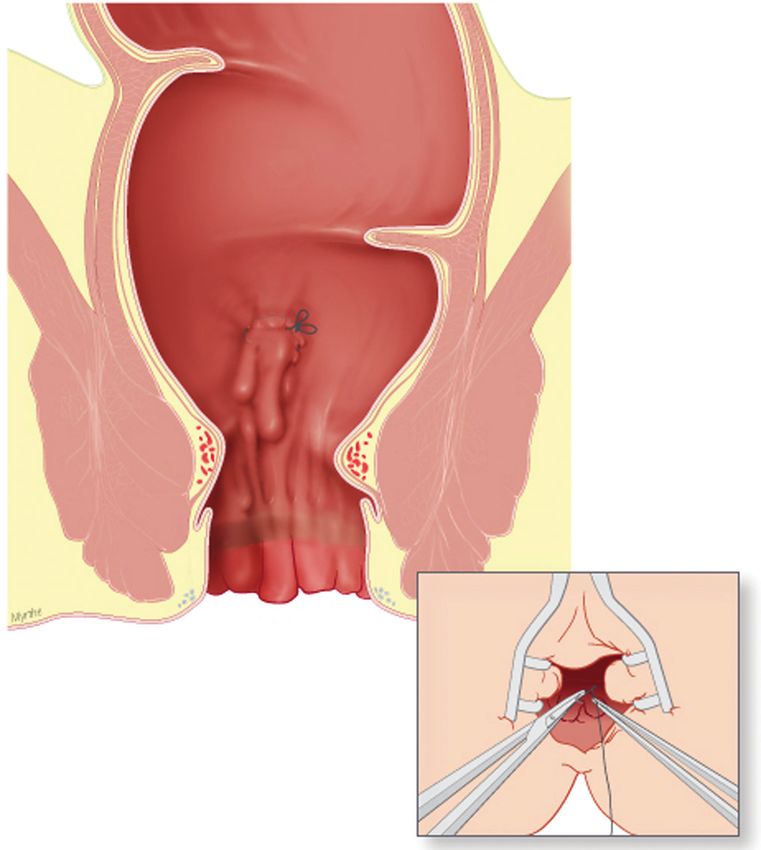
504                                                                              PAKRAVAN   ET AL:   TRANSANAL OPEN HEMORRHOIDOPEXY

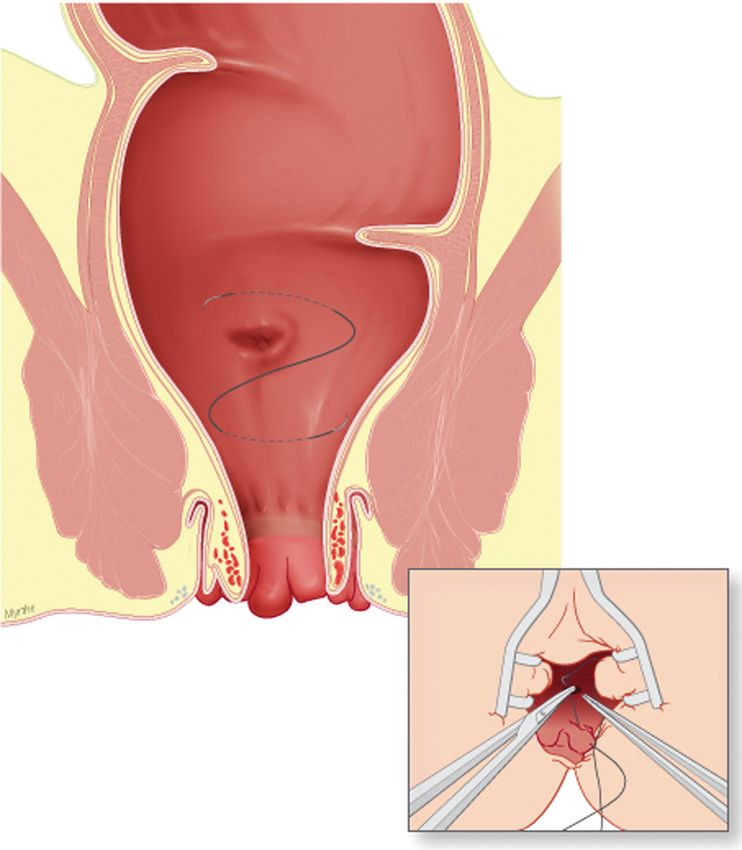
FIGURE 1. Z-shaped suture approximately 4 cm above the dentate
line. Submucosal injection of adrenaline solution (1:100,000).

38 consecutive patients with third and fourth-degree
                                                                 FIGURE 3. Lifting of the hemorrhoidal tissue by tightening of the
hemorrhoids. All patients were preoperatively questioned         Z-shaped suture.
about bleeding, anal pain, prolapse, and itching. After
anoscopic examination, all patients underwent anal                    All patients received a preoperative enema. No
manometry and a colonoscopy.                                     antibiotics were given. Patients were operated on under
                                                                 general anesthesia in the lithotomy position. A Parks’
                                                                 retractor was used to give access to the anorectum. At
                                                                 4 cm from the dentate line, a stitch through the rectal
                                                                 wall was placed and then at the upper level of the
                                                                 hemorrhoidal tissue using 2-0 Vicryl sutures. Before
                                                                 knotting this Z-suture, a 1-cm strip of mucosa between
                                                                 both stitches was excised after infiltration with adrenaline
                                                                 solution (1:100,000 dilutions). Then the Z-suture was
                                                                 tightened, pulling up the prolapsing hemorrhoid high
                                                                 into the anal canal. This procedure was repeated in three
                                                                 to four quadrants of the anus as needed at the point of
                                                                 maximal prolapse. The four sutures were mainly located
                                                                 at 2, 5, 7, and 11 o’clock (Figs. 1Y3).
                                                                      Postoperatively the patients received a fiber-rich diet.
                                                                 No postoperative antibiotics were given, and in cases of pain
                                                                 the patients received diclofenac and metamizole. Follow-up
                                                                 visits were scheduled at one, two, four, and seven days
                                                                 postoperatively and later after one and six months.

                                                                 RESULTS
                                                                 Thirty-eight patients were included (17 males, 45 percent
                                                                 and 21 females, 55 percent) with a mean (standard
                                                                 deviation, SD) age of 52 years (SD, 15). The mean (SD)
                                                                 follow-up was 157 days (SD, 68). All patients had circular
FIGURE 2. Excision of 1 cm [square] mucosa.                      or segmental prolapsing hemorrhoids. Seventeen patients

                      Copyright @ The ASCRS 2009. Unauthorized reproduction of this article is prohibited.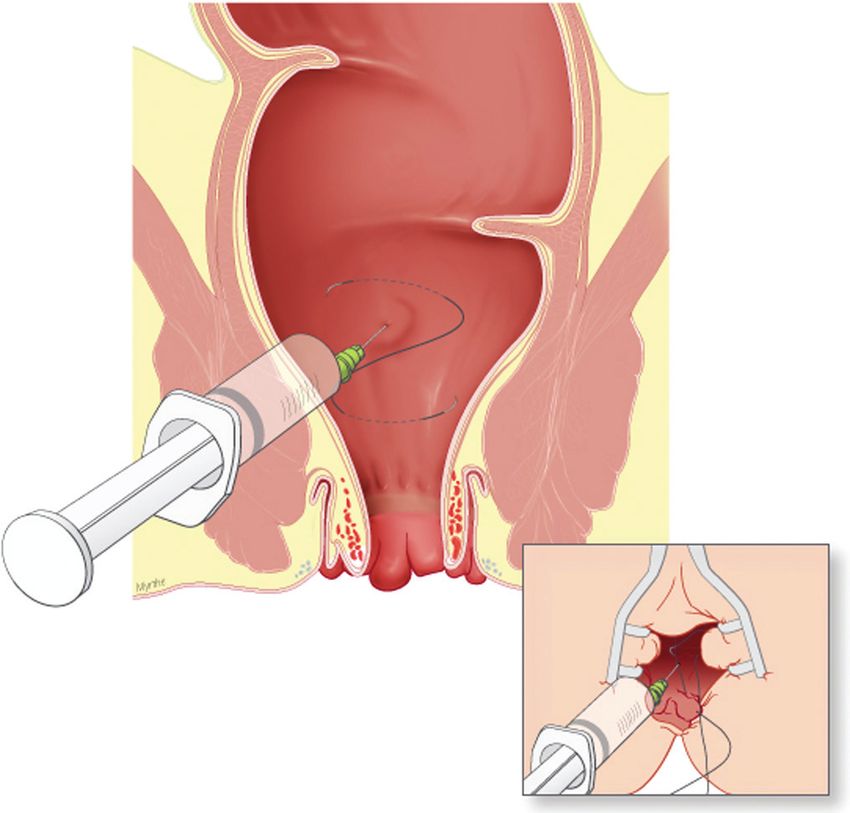
Diseases of the Colon & Rectum Volume 52:   3   (2009)                                                                505

experienced blood loss, 13 patients complained of              open or sutured wounds usually result in a painful
thrombosis, 10 patients experienced pain, 9 patients           postoperative period. The resection of the prolapse means
reported soiling, 7 patients were constipated, 7 patients      that the complaints from this prolapse will disappear.11
reported diarrhea, and 14 patients complained of itching.      Almost all newer surgical techniques rely on destruction
All patients underwent a transanal open hemorrhoido-           of superfluous hemorrhoidal tissue by heat (electro-
pexy and 1 to 4 quadrants were treated. The mean (SD)          cautery, laser), freezing (cryo probe), ligation (Barron
operating time was 15 minutes (16). No perioperative           banding), or sclerosing (injections). A recent technique is
complications occurred.                                        the Doppler-guided ligation of the hemorrhoidal arteries
     Immediately after surgery, 32 patients (84 percent)       as described by Morinaga et al.12 In this technique, the
were pain free. In six patients, severe pain was treated       hemorrhoidal tissue remains untouched and postopera-
with diclofenac and metamizole. In one patient, minor          tive pain is prevented.
bleeding occurred that was caused by a dehiscence of one            The stapled hemorrhoidectomy as described by
suture but the bleeding required no further treatment.         Longo13Y16 also leaves hemorrhoidal tissues untouched
     After one month, most patients (n = 34, 89 percent)       and prevents postoperative pain. This procedure should
were free of pain. Two patients (5 percent) still had          correctly be named stapled hemorrhoidopexy since hem-
perianal pruritus and two patients (5 percent) showed a        orrhoidal tissue is not resected, but elevated and fixed
small residual segmental prolapse. These patients were         inside the anorectum. This procedure became popular
treated conservatively with diet and pelvic floor physio-      since it results in little or no postoperative pain compared
therapy. After 6 months of follow-up, no patients              to classic hemorrhoidectomy. Many trials have been pub-
required additional surgery.                                   lished16Y25 confirming the pain-sparing effects. The first
                                                               postoperative defecation occurs earlier than in hemorrhoi-
                                                               dectomy26,27 and the patient acceptance is higher.28,29
DISCUSSION
                                                               Recurrence rates and reappearance of symptoms were
Complaints attributable to hemorrhoids are very com-           equal to excision techniques.30,31 A drawback is that the
mon in the Western world. Estimates suggest 50 percent         most important part of the operation has to be performed
of all people older than 50 years have hemorrhoid symp-        blindly. The high costs of the PPH stapler (400 Euro in
toms at least for some time. The causes of hemorrhoidal        Germany = 600 USD) makes this operation less attractive
disease are multiple, but most are attributable to difficult   for the insurance companies. The technique described in
passage of stool or constipation.4 Based on anatomic and       this paper has the same advantages as the Longo
radiologic investigations by Stelzner et al.5,6 and Thom-      procedure. The transanal open hemorrhoidopexy preserves
son,2,3 hemorrhoids are seen as an arteriovenous network       the well-innervated hemorrhoidal tissue but no costly
sliding downward in the anal canal. The most often             instruments are necessary. The anus did not need to be
prolapsing regions are typically located at 3, 7, and 11       dilated as wide as in the Longo operation. The Parks
o’clock in the lithotomy position. In these locations,         retractor needed only a small opening to create a good field
muscle and elastic fibers next to hemorrhoidal vessels are     of vision. The Parks retractor was only opened to allow
visible. These fibers are responsible for the connection       access for the instruments and was not used to stretch the
between mucosa and submucosa to the muscular rectal            anal sphincters and does not give a hidden ‘‘Lord effect.’’
wall.7,8 The hemorrhoidal tissue is a normal anatomic          No postoperative fecal incontinence was observed. The
entity, very important for fecal continence. When the          resection of a small strip of mucosa was performed to
connecting fibers are disrupted, the hemorrhoidal tissue       prevent the hemorrhoidal tissue from slipping down when
slides downward the anal canal and causes patients’            Vicryl sutures were dissolved at one month postoperation.
symptomatic complaints. The term hemorrhoid implicates              The postoperative pain generally observed in the PPH
that there are always symptoms. A hemorrhoid is the            procedure made it necessary to keep the patients in the
presence of normal tissue at the wrong location. The pain      hospital for a few days in some reports.32,33 The necessity
can be explained by the traction of the nonsensitive sliding   of general anesthesia is questionable in this patient group.
hemorrhoidal tissue at the highly sensitive anal skin. The     The results of this study indicate that it will be possible
blood loss is caused by irritation of the mucosal layer.       to perform the transanal open hemorrhoidopexy in the
Severe bleeding is only seen when the stowed hemorrhoid-       future as a day care procedure under local or regional
al vessels are disrupted.2,4,9 About 10 percent of patients    anesthesia. The short operation time of 15 minutes is
with hemorrhoids eventually need surgical therapy.10           comparable with the 17 minutes in the Longo procedure.34
     The traditional operation is the open (Milligan-               The postoperative residual prolapse was observed in
Morgan) or the closed (Ferguson-Parks) hemorrhoidec-           two patients (5 percent) but could be managed conser-
tomy in which the prolapsing hemorrhoidal tissue is            vatively and reoperation was not indicated.
resected with the adjacent anoderm. The normal tissue               As only an observational study, prospective, random-
that contributes to continence is partly removed and the       ized studies are necessary to confirm the outcome of this

                 Copyright @ The ASCRS 2009. Unauthorized reproduction of this article is prohibited.
506 PAKRAVAN ET AL: TRANSANAL OPEN HEMORRHOIDOPEXY
operation on the long-term basis and to confirm its value 18. Fazio VW. Early promise of stapling technique for haemor-
relative to other hemorrhoid treatments. rhoidectomy. Lancet 2000;355:768Y9.
19. Ganio E, Altomare DF, Gabrielli F, et al. Prospective
randomized multicentre trial comparing stapled with open
haemorrhoidectomy. Br J Surg 2001;88:669Y74.
CONCLUSION 20. Ho Y-H, Cheong W-K, Tsang C, et al. Stapled hemorrhoidec-
tomy: cost and effectiveness. Randomized, controlled trial
The method of the transanal open hemorrhoidopexy including incontinence scoring, anorectal manometry, and
seems to be an attractive alternative relative to other endoanal ultrasound assessments at up to three months. Dis
hemorrhoid tissue-preserving surgical techniques. Colon Rectum 2000;43:1666Y75.
21. Khalil KH, O’Bichere A, Sellu D. Randomized clinical trial of
sutured versus stapled haemorrhoidectomy. Br J Surg 2000;
REFERENCES
87:1352Y5.
1. Burkitt DP, Graham-Stewart CW. Hemorrhoids: postulated 22. Mehigan BJ, Monson JR, Hartley JE. Stapling procedures for
pathogenesis and proposed prevention. Postgrad Med J 1975; hemorrhoids versus Milligan-Morgan hemorrhoidectomy: a
51:631Y6. randomized controlled trial. Lancet 2000;355:782Y5.
2. Thomson H. A new look at hemorrhoids. Med Times 1976; 23. Pernice LM, Bartulucci B, Bencini L, et al. Early and late (ten
4:116Y23. years) experience with circular stapler hemorrhoidectomy. Dis
3. Thomson WH. The nature of hemorrhoids. Br J Surg 1975; Colon Rectum 2001;44:836Y41.
62:542Y52. 24. Ganio E, Altomare DF, Gabrielli F, Milito G, Canuti S.
4. Corman ML. Colon and rectal surgery. 5th ed. Los Angeles: Prospective randomized multicentre trial comparing stapled
Lippincott Wiliams & Wilkins, 2005:177Y8. with open haemorrhoidectomy. Br J Surg 2001;88:669Y74.
5. Stelzner F, Staubesand J, Machleidt H. The corpus cavernosum 25. Shalaby R, Desoky A. A randomized clinical trial of stapled
recti-basis of internal hemorrhoids. Langenbecks Arch Klin versus Milligan-Morgan haemorrhoidectomy. Br J Surg 201;
Chir Ver Dtsch Z Chir 1962;299:302Y12. 88:1049Y53.
6. Stelzner F. The corpus cavernosum recti. Dis Colon Rectum 26. Corea-Rovelo JM, Telez O, Obregon L, Miranda-Gomez,
1964;7:398Y9. Moran S. Stapled rectal mucosectomy vs. closed hemorrhoi-
7. Davy A, Duval C. Modifications macroscopiques et micro- dectomy: a randomized, controlled trial. Dis Colon Rectum
scopiques du reseau vasculaire hemorrhoidal dans la maladie 2002;45:1367Y74.
hemorrhoidaire. Arch Fr Appar Dig 1976;65:515Y21. 27. Ortiz H, Mazo J, Armendariz P. Randomized clinical trial of
8. Parnaud E, Guntz M, Bernard A, et al. Anatomie normale stapled (circular) vs. conventional diathermy hemorrhoidec-
macroscopique et microscopique du reseau vasculaire hemor- tomy. Br J Surg 2002;89:1376Y81.
rhoidal. Arch Fr Mal Appar Dig 1976;65:501Y14. 28. Bikhchandani J, Agarwal PN, Kant R, Malik VK. Randomized
9. Haas PA, Fox TA, Haas GP. The pathogenesis of hemorrhoids. controlled trial to compare the early and mid-term results of
Dis Colon Rectum 1984;27:442Y50. stapled versus open hemorrhoidectomy. Am J Surg 2005;189:
10. Bleday R, Pena JP, Rothenberger DA, Goldberg SM, Buls JG. 56Y60.
Symptomatic hemorrhoids: current incidence and complica- 29. Gravie JF, Lehur PA, Huten N, et al. Stapled hemorrhoidopexy
tions of operative surgery. Dis Colon Rectum 1992;35:477Y81. versus Milligan-Morgan hemorrhoidectomy: a prospective, ran-
11. Ho YH, Buettner PG. Open compared with closed haemor- domized, multicenter trial with 2-year postoperative follow-up.
rhoidectomy: meta-analysis of randomized controlled trials. Ann Surg 2005;242:29Y35.
Tech Coloproctol 2007;11:135Y43. 30. Cheetham MJ, Cohen CR, Kamm MA, Philipps RK. A
12. Morinaga K, Hasuda K, Ikeda T. A novel therapy for internal randomized, controlled trial of diathermy hemorrhoidectomy
hemorrhoids: ligation of the hemorrhoidal artery with a newly vs. stapled hemorrhoidectomy in an intended day-care set-
devised instrument (Moricorn) in conjunction with a Doppler ting with longer-term follow-up. Dis Colon Rectum 2003;46:
flow meter. Am J Gastroenterol 1995;90:610Y13. 491Y7.
13. MacRae HM, McLeod RS. Comparison of hemorrhoidal 31. Racalbuto A, Aliotta I, Corsaro G, Lanteri R, Di Cataldo A,
treatments: a meta-analysis. Can J Surg 1997;40:14Y7. Licata A. Hemorrhoidal stapler prolapsectomy vs Milligan-
14. Ooi BS, Ho YH, Tang CL, Eu KW, Seow-Choen F. Results of Morgan hemorrhoidectomy: a long term randomized trial. Int
stapling and conventional hemorrhoidectomy [letter]. Tech J Colorectal Dis 2004;19:239Y44.
Coloproctol 2002;6:61Y2. 32. Tjandra JJ, Han WR. Anal anesthetic block significantly
15. Longo A. Treatment of haemorrhoid disease by reduction of reduces immediate postoperative pain after stapled hemor-
mucosa and haemorrhoid prolapse with a circular-suturing rhoidectomy [meeting abstract]. Dis Colon Rectum 2004;47:
device: a new procedure. In: Proceedings of the Sixth World 607.
Congress of Endoscopic Surgery. Rome:1998;777Y84. 33. Kairaluom M, Nuorva K, Kellokumpo I. Day-case stapled
16. Beattie GC, Loudon MA. Follow-up confirms sustained benefit (circular) vs. diathermy hemorrhoidectomy: a randomized
of circumferential stapled anoplasty in the management of controlled trial evaluating surgical and functional outcome.
prolapsing hemorrhoids. Br J Surg 2001;88:850Y2. Dis Colon Rectum 2003;46:93Y9.
17. Correa-Rovelo JM, Tellez O, Obregon L, et al. Stapled rectal 34. Tjandra JJ, Chan MK. Systematic review on the procedure for
mucosectmy vs. closed hemorrhoidectomy. Dis Colon Rectum prolapse and hemorrhoids (stapled hemorrhoidopexy). Dis
2002;45:1367Y74. Colon Rectum 2007;50:878Y92.
Copyright @ The ASCRS 2009. Unauthorized reproduction of this article is prohibited.You can also read


