TRAVEL PLAN 2015 -2020 ROYAL STOKE UNIVERSITY HOSPITAL - UNIVERSITY HOSPITALS OF NORTH MIDLANDS NHS TRUST - UHNM
←
→
Page content transcription
If your browser does not render page correctly, please read the page content below
UNIVERSITY HOSPITALS OF NORTH MIDLANDS NHS TRUST

TRAVEL PLAN 2015 –2020
ROYAL STOKE UNIVERSITY HOSPITAL
UNIVERSITY HOSPITALS NORTH MIDLANDS
ROYAL STOKE UNIVERSITY HOSPITAL TRAVEL PLAN 2015 – 2020

CONTENTS

1        Background                                       3    3      Staff Travel Survey                           12

1.1      Introduction                                     4    3.1    Background                                    13

1.2      Layout of the Document                           4    3.2    Methodology                                   13

1.3      Target Group for the Travel Plan                 4    3.3    Survey Results and Analysis                   13

1.4      Aims of the Travel Plan                          4    3.4    Further Comments                              14

1.5      Objectives                                       5

1.6      Targets                                          5    4      Travel Plan Measures                          15

1.7      Travel Patterns of Trust Staff                   6    4.1    Introduction                                  16

1.8      Sustainable Transport Working Group              6    4.2    Walking Initiatives                           16

                                                               4.3    Cycling Initiatives                           17

2        The Existing Transport Network                   7    4.4    Public Transport Initiatives                  18

2.1      The Site                                         8    4.5    Car Sharing Scheme                            19

2.2      Cycling and Walking                              8    4.6    Car Parking Management Initiatives            20

2.3      Cycle Facilities                                 9    4.7    Promotion, Publicity and Support Mechanisms   20

2.4      Bus Travel                                       10   4.8    Implementation                                21

2.5      Rail                                             11   4.9    Monitoring                                    22

2.6      Inter-site (Link Bus) Service                    11   4.10   More Details                                  22

                                                                                                                         02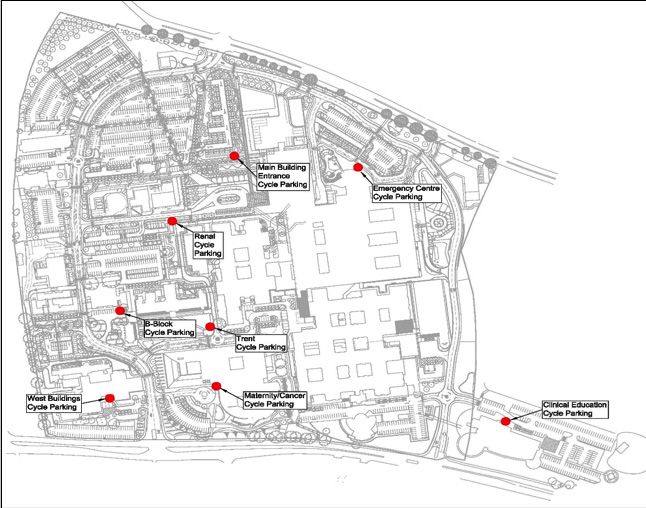
UNIVERSITY HOSPITALS NORTH MIDLANDS                       BACK TO
ROYAL STOKE UNIVERSITY HOSPITAL TRAVEL PLAN 2015 – 2020   CONTENTS

1. BACKGROUND

                                                                     03
UNIVERSITY HOSPITALS NORTH MIDLANDS BACK TO
ROYAL STOKE UNIVERSITY HOSPITAL TRAVEL PLAN 2015 – 2020 CONTENTS
1. BACKGROUND
1.1 Introduction • Chapter 3 briefly summarises the findings of the staff travel survey;
and
The University Hospitals of North Midlands NHS Trust (UHNM) was
• Chapter 4 sets out the Travel Plan measures, implementation and
established on 1 November 2014 following the integration of the former
monitoring.
Mid Staffordshire NHS Foundation Trust and the University Hospital of
North Staffordshire NHS Trust. The new Trust has two hospital sites –
Royal Stoke University Hospital in Stoke-on-Trent and County Hospital in 1.3 Target Group for the Travel Plan
Stafford.
The Travel Plan is predominantly aimed at influencing staff travel
Following the formation of the new Trust, some changes are underway behaviour as this user group is generally more able to alter their travel
at both hospital sites. In recent years, the Royal Stoke University Hospital mode than patients and visitors who may be making infrequent or one
site has undergone considerable redevelopment with the amalgamation off trips. Nonetheless, travel information, timetables, and advice will still
of services from the former Royal Infirmary, Central Outpatients and be distributed to these groups wherever possible and many Travel Plan
City General sites. As a result of the integration with County Hospital, measures will be of benefit to all users of the hospital. In future years
acute and major inpatient surgery, consultant-led maternity services and when the Travel Plan is established and operating patient and visitor
inpatient paediatric services are moving to Royal Stoke from County travel issues will be incorporated in more detail.
Hospital in 2015.
With the improvements taking place at both hospitals, the Trust has
commissioned Ove Arup & Partners Ltd (Arup) to develop a Travel Plan 1.4 Aims of the Travel Plan
and Parking Strategy for each hospital to support the Trust in managing This Travel Plan is a long term travel management strategy and details
transport and travel issues at both sites. specific measures designed to minimise the impact of travel to the site. It
This document is the Travel Plan for the Royal Stoke University Hospital provides a framework to deliver sustainable transport objectives.
and covers the period 2015 to 2020. It is difficult for institutions to predict and influence the behaviour of
staff; different people respond to different measures and therefore no
single measure will result in the travel plan meeting its objectives. It is
1.2 Layout of the Document important to offer realistic alternative travel options as people’s ability to
• Chapter 1 provides background information plus sets out the aims, change their travel will vary. This travel plan therefore sets out a number
objectives and targets of the Travel Plan; of measures and initiatives that will help to encourage sustainable travel
• Chapter 2 describes the existing sustainable transport facilities for behaviour and support the wider aspirations of the local highway and
travel to Royal Stoke; planning authorities.
04UNIVERSITY HOSPITALS NORTH MIDLANDS BACK TO
ROYAL STOKE UNIVERSITY HOSPITAL TRAVEL PLAN 2015 – 2020 CONTENTS
The Travel Plan seeks to: 1.6 Targets
• Reduce traffic generation and its impact (congestion, pollution, The SDMP contains three transport related targets:
accidents etc) and to develop and promote the widest possible travel
• To reduce car journeys (commuter and business) by 25% by 2020,
choices;
against the 2014/15 baseline;
• Manage the number of single occupancy vehicles which visit the site; • To increase commuting by active travel (walking and cycling) by 25%
• Promote increased use of public transport, cycling and walking; by 2020, against the 2014/15 baseline; and
• Promote integration between different transport modes; • To increase employee car sharing by 100% by 2020, against the
• Improve the accessibility of the site to non-car users and the disabled; 2014/15 baseline.
and
Table 1 shows the baseline (taken from the 2015 staff travel survey) and
• Provide clear information to staff and visitors on alternative modes of
targets for 2020.
transport to and from the site.
Table 1: Mode Share Targets 2020
1.5 Objectives
2014 / 15 2020
The key objective of the Travel Plan is to:
Mode for Journey to Work Target Target
Baseline
• Achieve a reduction in car-borne traffic associated with the operation (percentage of staff) Description Percentage
of the Royal Stoke by encouraging use of sustainable modes. Car Single Occupancy 60% 25% reduction 45%
The Travel Plan also encompasses the following wider objectives: Walking & Cycling 12% 25% increase 15%
• Encourage more walking, cycling and public transport travel to and
Car Sharing 14% 100% increase 28%
from the site;
• Improve road safety;
Nationally, 54% of journeys to work are by single occupancy car; in
• Create wider environmental benefits; and
Stoke on Trent the figure is 63%1. Therefore a reduction from 60% to
• Reduce traffic congestion and pollution.
45% in five years is an ambitious targets. However, the University of
The objectives of the Travel Plan reflect those of the Trust Sustainable Warwick has achieved a similar reduction in single occupancy car trips
Development Management Plan (SDMP): Our 2020 Vision: Our amongst staff from 72% in 2005 to 55% in 2015. This was mainly through
Sustainable Future which are: operation of a strong Travel Plan, seen as an exemplar within the travel
planning sector, and thus the targets set out above can be considered
• Assist patients, visitors and employees to travel by active and low
challenging but realistic if supported by vigorous execution of the
carbon modes;
Sustainable Development Management Plan (SDMP): Our 2020 Vision:
• To reduce employee single-occupancy car commuting;
Our Sustainable Future and Travel Plan.
• To reduce the demand for car parking spaces;
• To increase public transport (bus and rail) patronage; and
• Make a positive contribution to the local community and the
environment through the reduction in car usage to access the site 1. Office for National Statistics, 2011 census 05UNIVERSITY HOSPITALS NORTH MIDLANDS BACK TO
ROYAL STOKE UNIVERSITY HOSPITAL TRAVEL PLAN 2015 – 2020 CONTENTS
1.7 Travel Patterns of Trust Staff
!° Figure 1: Royal Stoke Staff Home Postcode Locations
Travel patterns are dependent on a variety of external "u
!(
influences such as the availability of public transport
services, cost of travel by different modes, parking
space availability, and particularly, how these relate
to home location. Figure 1 shows home post code
locations2 of all Trust staff based at Royal Stoke
and the Infirmary sites. The measures set out in this
travel plan are designed to encourage and support
individuals to adopt, or continue to use, sustainable
travel modes.
1.8 Sustainable Transport Working
Group
The Travel Plan aligns closely with the SDMP and
its annual Sustainable Development Action Plan
(SDAP) which provides details including schemes
and actions, target completion dates, key staff and
progress towards implementation. These two Trust
documents will support delivery of sustainable
transport initiatives.
The sustainability agenda is overseen by the
Sustainable Development Steering Group, which is
supported by seven Sustainability Working Groups.
The Sustainable Transport Working Group, one of the
seven monthly Working Groups, will be responsible
for managing the Travel Plan and reporting to the
quarterly Steering Group meetings. Implementation
and monitoring of the travel plan and terms of
reference for this group are available on request.
This Travel Plan has been aligned with the SDMP and
sets the direction for managing transport efficiently,
cost effectively and innovatively.
2. Post code data identifies cluster of premises – individual members of staff are
not identified.
06UNIVERSITY HOSPITALS NORTH MIDLANDS BACK TO
ROYAL STOKE UNIVERSITY HOSPITAL TRAVEL PLAN 2015 – 2020 CONTENTS
2. THE EXISTING TRANSPORT
NETWORK
07UNIVERSITY HOSPITALS NORTH MIDLANDS BACK TO
ROYAL STOKE UNIVERSITY HOSPITAL TRAVEL PLAN 2015 – 2020 CONTENTS
2. THE EXISTING TRANSPORT
NETWORK
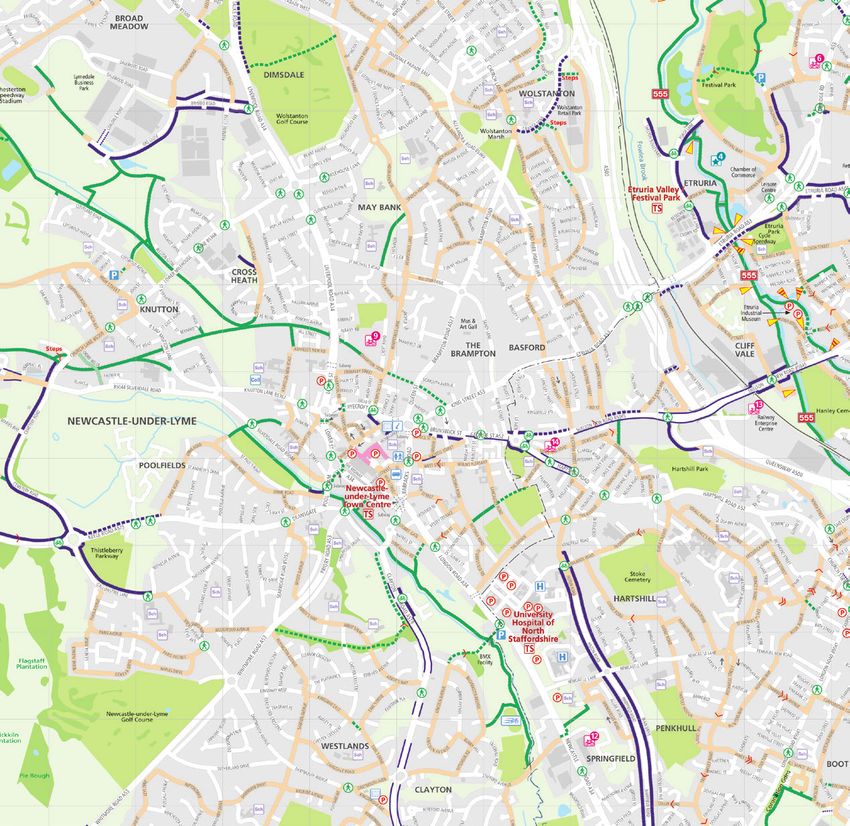
2.1 The Site Figure 2: Site Location Plan
Royal Stoke University Hospital is located in Hartshill
in the city of Stoke-on-Trent around 2.5 miles south
west of Stoke-on-Trent City Centre (located in
Hanley). It is situated on the boundary of the City of
Stoke-on-Trent with the areas to the north and west
of the site being part of Newcastle under Lyme in
Staffordshire. See Figure 2.
The Hospital site is bounded to the north and east by
residential areas located off The Avenue and Hilton
Road. To the south of the site is Harplands Hospital,
which is part of the North Staffordshire Combined
Healthcare NHS Trust and provides mental health,
learning disability and older people’s service, and
housing at Grindley Hill Court. The site is bounded to
the west by the A34 Newcastle Road / London Road.
2.2 Cycling and Walking
A shared use pedestrian and cycle path is provided
on both sides of Hilton Road, with segregation
between the pedestrian and cycle routes provided by
a narrow grass verge. A traffic free cycle path runs
through Lyme Valley Park, to the west of the A34.
There are also cycle lanes within the Royal Stoke site
which, when the works are completed, will run along
the road across the north of the site between the
A34 and Hilton Road accesses.
There are footways alongside all roads around Royal
08UNIVERSITY HOSPITALS NORTH MIDLANDS BACK TO
ROYAL STOKE UNIVERSITY HOSPITAL TRAVEL PLAN 2015 – 2020 CONTENTS
Stoke, and puffin crossings are provided at the main A34 and Hilton Road A number of cycle shelters are provided around the Royal Stoke site:
entrances, with pelican crossings at the A34 entrance by the Clinical
• Adjacent to the main building entrance (secure shelters for staff
Education Centre.
and visitors);
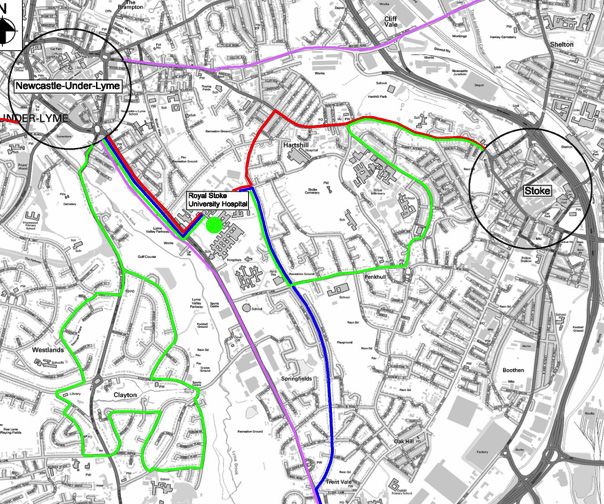
Cycle routes in the vicinity of the site are shown in Figure 3. • Renal;
• the Emergency Centre;
Figure 3: Cycle Routes (Extract from Stoke South Cycle Map, Stoke City Council) • B-Block;
• West Buildings;
CYCLE • Maternity/Cancer;
ROUTES
• Trent; and
• Clinical Education Centre (CEC).
Access to the secure shelters is via the staff ID badge.
Staff changing facilities, which include lockers and showers, are provided
on Floor 1 of the Main Building. Secure access is available through door
codes which are available on request through Corporate Services. Some
clinical departments also have their own staff facilities available.
The total number of stands at each location is shown in Table 2 and
illustrated in Figure 4
Table 2: Royal Stoke Cycle Parking
Location Number of Sheffield stands Number of spaces
Main building entrance 15 (10 in secure structure) 30
Renal 6 12
Emergency Centre 15 30
B-Block 5 10
West Buildings 5 10
Maternity/Cancer 8 16
Trent 4 8
Clinical Education 9 18
2.3 Cycle Facilities
Total 67 134
The Trust operates a Cycle to Work scheme currently provided by
Cyclescheme. The scheme enables employees to purchase a bike through
salary sacrifice which provides a tax benefit and offers savings on high
street prices. 09UNIVERSITY HOSPITALS NORTH MIDLANDS BACK TO
ROYAL STOKE UNIVERSITY HOSPITAL TRAVEL PLAN 2015 – 2020 CONTENTS
Figure 4: Cycle Parking Locations Table 3: Bus Services serving Royal Stoke
Nearest
Operator Service Route Frequency
stop
Keele to Crewe Leighton Hospital
First Potteries 3 (Cherry Route) via Newcastle – 10 minutes Hospital
UHNM – Stoke – Hanley – Kidsgrove
Hanley – Stafford via Newcastle – London
First Potteries 10 20 minutes
Trentham – Stone Road
Newcastle - UHNM – Trentham -
First Potteries 22 30 minutes Hospital
Blurton – Longton
Birches Head – Hanley – Newcastle
D&G Bus 41 30 minutes Hospital
– Clayton
Figure 5: Bus Services serving Royal Stoke
2.4 Bus Travel
There are public bus stops within the Royal Stoke site, located close to
the West Building and directly in front of the main entrance. Further bus
stops are located close to the site on the A34 and on Hilton Road.
The site is served by a number of bus services, as summarised in Table 3
and illustrated in Figure 5.
10UNIVERSITY HOSPITALS NORTH MIDLANDS BACK TO
ROYAL STOKE UNIVERSITY HOSPITAL TRAVEL PLAN 2015 – 2020 CONTENTS
2.5 Rail
Stoke-on-Trent railway station is about 1.5 miles north east of the Royal
Stoke site. The station is served by Cross Country, East Midlands Trains,
London Midland, Virgin Trains and Northern Rail services. Nearby stations
with services to Stoke-on-Trent include Stafford, Congleton, Longton,
Longport, Kidsgrove, Alsager, Crewe, Stone, Uttoxeter and Blythe Bridge.
Direct services are available to London, Manchester and Birmingham.
The station can be reached on foot in about 35 minutes’ walk from Royal
Stoke. It is also served by the 3, 41 and 42 bus services, with a bus journey
of 16 minutes.
2.6 Inter-site (Link Bus) Service
An inter-site shuttle bus is operated between Royal Stoke and County
Hospitals. This service departs from each hospital on the hour from
06:00am until 22:00pm and operates seven days per week. The journey
time is about 45 minutes and there is a pick-up and drop-off in Stone.
The service is free for staff but is also available for members of the
public with a fare of £5 return. The inter-site service currently attracts
around 3,500 passengers per month . Patronage is considerably higher
on weekdays than weekends with the most popular services being those
departing each site in the peak hours.
11UNIVERSITY HOSPITALS NORTH MIDLANDS BACK TO
ROYAL STOKE UNIVERSITY HOSPITAL TRAVEL PLAN 2015 – 2020 CONTENTS
3. STAFF TRAVEL SURVEY
12UNIVERSITY HOSPITALS NORTH MIDLANDS BACK TO
ROYAL STOKE UNIVERSITY HOSPITAL TRAVEL PLAN 2015 – 2020 CONTENTS
3. STAFF TRAVEL SURVEY
3.1 Background The mode shares indicated by the survey have been used as the baseline
for determining the mode share targets set out in section 1.6 above.
A staff travel survey was undertaken in early 2015 in order to provide
a baseline against which progress towards Travel Plan targets can be
measured, and provide data to help focus Travel Plan measures. 3.3.2 Journey Origin
Participants were asked to provide their home postcode or the postcode
from where they travel to the Hospital on a regular basis. These responses
3.2 Methodology provide the Trust with some basic data about likely mode shares from
geographic locations that can be used in helping to identify and develop
The Survey Monkey online survey website was utilised as the basic
measures to encourage the switch to more sustainable trips to work.
data collection tool although a paper version of the questionnaire was
distributed to staff that do not have access to the internet.
3.3.3 Occupation
The survey was distributed to all staff and was available for responses
Respondees were asked to select a category closest to their usual
from Friday 13th March until Tuesday 31st March. This was subsequently
occupation:
extended to Friday 22nd May.
• 42% - Admin/Clerical/Management
A total of 422 responses were received. Whilst in any survey of this type
• 17% - nursing staff
the respondees are self-selecting, there is no reason to suppose that the
• 12% - allied health professionals; and
sample is not broadly representative of the full staff population.
• 10% - facilities, catering and cleaning staff.
3.3 Survey Results and Analysis 3.3.4 Working Hours
Just over three quarters of respondents (77%) have fixed working hours
The key survey findings are summarised below.
whilst 23% work shifts.
The majority of staff working fixed hours start work between 07.00am
3.3.1 Mode of Travel
and 10.00am, with the peak being between 08.00am and 09.00am.
Staff were asked about their mode of travel to the Hospital:
Departure times were spread over a longer period, with most occurring
• 60% of respondents travel by car with no passengers; between 3.00pm and 8.00pm, peaking between 4.00pm and 6.00pm.
• 9% walk to the hospital
• 8% use the bus;
3.3.5 Journey Times
• 8% are the driver of a car share; and
Staff were asked how long it usually takes them to get to work using their
• 6% are the passenger in a car share or are dropped off. 13UNIVERSITY HOSPITALS NORTH MIDLANDS BACK TO
ROYAL STOKE UNIVERSITY HOSPITAL TRAVEL PLAN 2015 – 2020 CONTENTS
normal mode of travel: or pool cycles for use by staff for work journeys could justifiably lead to
reductions in car travel to work.
• 23% - up to 15 minutes;
• 41% - 16 to 30 minutes;
• 29% - 31 to 60 minutes;
3.4 Further Comments
• 6% - 61 to 90 minutes; and
At the end of the survey, respondents were given the opportunity to
• 1% - longer than 90 minutes.
make any comments or suggestions about their journey to or from work
Time to travel to the hospital was cross tabulated with journey time which or about sustainable transport to the Trust’s sites. These comments
showed that over half of those travelling for less than 15 minutes were provide useful pointers of the reasons for particular travel behaviour and
single occupancy car drivers. the type of initiative that may be effective in encouraging a change of
mode.
3.3.6 Staff Parking Permits
Staff were asked whether they currently hold a hospital parking permit,
and which type they hold:
• 43% - no permit;
• 23% - Royal Infirmary permit;
• 18% - Central Outpatients permit; and
• 13% - City General Standard permit.
3.3.7 Parking Locations
Those staff who said they travelled by car as a driver were asked where
they normally park their vehicle:
• 28% - on site in a staff car park;
• 28% - Royal Infirmary;
• 24% - Central Outpatients;
• 8% - in a nearby street;
• 4% - London Road Bowling Club.
3.3.8 Car Use for Work Purposes
Drivers only were asked if they regularly need to use their car during
working hours for work purposes. Almost a quarter of respondents
(23%) said that they did. This suggests that the need for a car for work
purposes may be a significant factor influencing mode choice for drivers
and therefore initiatives set out in the SDAP to investigate pool vehicles 14UNIVERSITY HOSPITALS NORTH MIDLANDS BACK TO
ROYAL STOKE UNIVERSITY HOSPITAL TRAVEL PLAN 2015 – 2020 CONTENTS
4. TRAVEL PLAN MEASURES
15UNIVERSITY HOSPITALS NORTH MIDLANDS BACK TO
ROYAL STOKE UNIVERSITY HOSPITAL TRAVEL PLAN 2015 – 2020 CONTENTS
4. TRAVEL PLAN MEASURES
4.1 Introduction work, in the case of Royal Stoke, this would include 16% staff as shown in
Figure 6.
The overall aim and direction of the Trust’s ongoing aspirations to become
more sustainable are set out in the SDMP. The measures and initiatives in For those within a reasonable distance of Royal Stoke, walking offers
the Travel Plan complement or mirror those in the SDAP. Key elements many benefits including positive health impact; very low cost; and
are: predictable journey time. Benefits to the wider community include
reduced traffic and pollution levels. The Trust is actively involved with
• Sustainable Transport Working Group - governance arrangements
Living Streets4 (and Sustrans5) to raise awareness of the health benefits
including senior officer commitment and support of the Travel Plan;
of active travel.
• Walking Initiatives – analysis of staff post codes shows that 16%
Walking initiatives to be taken forward include:
(or 831) live with 30 minutes’ walk (2.5km) and thus actions to help
this group make the journey by foot will beneficial to a large number • Undertake a pedestrian audit of the area around the hospital to
of people; assess pedestrian routes into the site;
• Cycling Initiatives – the usual distance regarded as reasonable for • Set up a Walking User Group to provide a forum for sharing
cycling to work is 6km, which encompasses 40% of staff (or 2068); concerns and ideas regarding walking;
• Public Transport initiatives – focussing on information, ticketing • Produce walking information packs for staff;
initiatives and route/service improvements; • Make personal alarms available for people who are concerned about
• Car sharing scheme – a UHNM branded scheme with dedicated personal security;
parking spaces and guaranteed lift home; and • Provide promotional material to raise awareness of the health
• Promotion and Publicity – measures are crucial to embed sustainable benefits of walking;
travel within the Trust and staff culture e.g. bespoke Sustainable • Improve website information regarding walking to the site from local
Travel section of the website and staff-travel leaflets (one for the destinations including a link to the walking mapping site, walkit.com;
Royal Stoke and one for County Hospital) will be produced and
promoting all of the sustainable transport offerings and how to
access them. • Produce a map showing walking routes indicating distances and
times to the most common destinations.
4.2 Walking Initiatives 4. Living Streets is a national charity which advocates for the rights and interests of pedestrians and aims to
create safe, attractive and enjoyable streets where people want to walk.
5. Sustrans is a charity to promote sustainable transport. It works on projects to encourage people to walk,
If 30 minutes (2.5km) is assumed as the usual maximum for walking to cycle and use public transport, to give people the choice of travelling in ways that benefit their health and
the environment.
16UNIVERSITY HOSPITALS NORTH MIDLANDS BACK TO
ROYAL STOKE UNIVERSITY HOSPITAL TRAVEL PLAN 2015 – 2020 CONTENTS
!° Figure 6: Staff within 30 minutes’ walking time !° !° Figure 7: Staff within 30 minutes’ cycling time
"u "u "u
!( !( !(
4.3 Cycling Initiatives for their place of work is important for encouraging staff to cycle. Site
visits and feedback from staff cyclists has suggested that the existing
Nationally, cycling is increasing and growing in popularity. There is
cycle parking is well used and as cycling increases further secure cycle
no generally accepted ‘norm’ for how far people might cycle to work
parking for staff will be provided as opportunities arise, for example, at
although 30 minutes (6km) is often accepted as a reasonable maximum
the Springfield Building there are changing facilities on each floor, and
for cycling to work (and is also in line with the 30 minutes’ walk time
therefore is well equipped for cyclists, but does not currently have any
discussed above). In the case of Royal Stoke, this would include 40% staff
cycle parking. Similarly, the Royal Infirmary site does not have any cycle
as shown in Figure 7.
parking and it is understood that staff based there currently take their
Figure 4 shows cycling parking locations on the Royal Stoke site. The bikes into the building.
availability of sufficient, secure cycle parking in convenient locations 17UNIVERSITY HOSPITALS NORTH MIDLANDS BACK TO
ROYAL STOKE UNIVERSITY HOSPITAL TRAVEL PLAN 2015 – 2020 CONTENTS
Cycling initiatives to be taken forward include: service and encourage more staff, patients and visitors to use it as a
sustainable and cost effective alternative to car travel.
• Monitor usage of secure cycle parking facilities near the main
buildings and increase provision if required and as opportunities arise; The travel survey has highlighted that the shuttle bus is valued by staff
and there is demand for a more frequent service. The Trust is currently
• Monitor availability of cloakroom/changing facilities with secure
considering increasing the frequency of the service and reviewing the
storage lockers and increase provision as opportunities arise;
requirement for users to pre-book.
• Set up a Bicycle User Group to provide a forum for sharing concerns
and ideas regarding cycling;
4.4.2 Bus Initiatives
• Provide cycling information packs to staff; Bus routes serving the Royal Stoke site are shown in Figure 5. The Service
• Make personal alarms available for people who are concerned about 3 bus route operated by First provides a good connection from the
personal security; railway station, with a 10 minute frequency.
• Provide promotional material to raise awareness of the health benefits Staff are able to purchase SMART bus passes which are heavily
of cycling; discounted and cover any service within the SMART area boundary with
any operator. The Trust have secured discounts with bus operators, First
• Improve website information regarding cycling to the site from local
and Arriva. First bus are offering UHNM staff a discounted rate on all
destinations;
Potteries services in line with their Student discount offering (over 50%
• Produce a map showing cycling routes indicating distances and times discount) and Arriva are offering a 10% discount on their ‘Saver’ tickets.
to the most common destinations;
The SMART bus pass is very beneficial in reducing the cost of bus travel
• Continue to promote the Cyclescheme bike purchase opportunity; for staff and the Trust is also investigating other ticketing options such as
• Promote National Bike Week and Cycle to work days; taster tickets, multi-trip tickets, discounted annual passes and interest-
free loans for annual pass purchase.
• Offer cycle proficiency training; and
Information is provided on the UHNM website about the bus services
• Investigate opportunities to establish a pool bike scheme and
to use to access Royal Stoke from a number of locations in Stoke and
availability of cycles for the journey from the station (see below).
Staffordshire. A link is provided to the national Traveline website which
contains up-to-date timetable and associated bus information.
4.4 Public Transport Initiatives Bus initiatives to be taken forward include:
• Continuation of Sustainable Transport Working Group;
4.4.1 Inter–site (Link Bus) Service
The inter-site bus service operating between Royal Stoke and County is • Promote the UHNM staff bus discounts (SMART bus pass, First and
a key element of the Trust’s strategy for managing the requirement for Arriva bus operator discounts);
people to travel between sites in a sustainable manner. The service will • Provide Real-time bus service information at screens within the main
become increasingly important as the Trust expands and integration atrium with links to the real-time feed added to the Trust’s travel
between Royal Stoke and County grows. This will be reflected through intranet pages; 18
promotions and other initiatives designed to raise awareness of theUNIVERSITY HOSPITALS NORTH MIDLANDS BACK TO
ROYAL STOKE UNIVERSITY HOSPITAL TRAVEL PLAN 2015 – 2020 CONTENTS
• Introduce a programme of public transport focused events to the opportunity for travel to the site as part of a multi-modal journey.
promote tickets options, promotions, discounts and so on; In addition to many of the more generic public transport initiatives
described above, financial and practical measures specifically to
• Initiate personalised travel surgeries and journey planning support;
encourage travel by train will be considered by the STWG. These include:
• Investigate options to pre-purchase tickets for travel to common
• interest free loans for purchase of season tickets and annual passes;
destinations;
• staff discounts for bus travel on the Route 3 bus services to and from
• Engage with bus operators to improve current routes or introduce
the station;
new ones;
• A bike loan or pool bike scheme whereby cycles could be made
• Change focus of patient appointment letters to promote public
available for travel between the station and Royal Stoke; and
transport for accessing the hospital;
• new cycle routes and facilities linking the hospital to the station.
• Introduce an information sheet of key public transport messages and
answers to common questions, for use by PALS and reception staff;
• Review and identify potential improvements to walking routes to all 4.5 Car Sharing Scheme
bus stops that serve the hospital;
Under current arrangements, staff who are interested in car sharing are
• Work with operators to improve bus information and shelters at bus
directed to the Liftshare.com website. However, this is open to all not just
stops;
staff from the Trust and therefore to increase car sharing, the Trust will
• Arrange a session led by First buses to identify key questions raised upgrade to utilise Liftshare Pro. This is a more sophisticated system which
by public and use with PALS; allows the Trust to operate a branded site linking to a car share scheme
which will only be available for Trust employees.
• Promote Catch the Bus Week each year; and
This will increase staff confidence in the scheme, as it will be specific to
• Work with bus operators to improve the attractiveness of buses on
hospital employees and clearly underwritten by the Trust. Developing a
routes through site, for example, by providing Wi-Fi access.
branding for the car share scheme with a name specific to the Trust (such
as ‘UHNM Trust Share’) will also provide the opportunity for a launch to
4.4.3 Park and Ride take place to promote car sharing to staff.
It is understood that Keele University has in the past engaged with the
To encourage staff to car share, spaces will be allocated in key Royal
Trust and local authorities to consider the possibility of a Park and Ride
Stoke staff car parks which are conveniently located. It is proposed in
scheme. In the long term there may be potential to deliver a scheme that
the Parking Strategy that the Springfield car park be designated as car
would serve the Royal Stoke site. However, the costs and complexity of
share parking only (27 spaces), plus the first block of 18 spaces on entry
Park and Ride are such that any scheme would require active support
to the Clinical Education car park, to accommodate demand across the
of the local authorities and probably further partners. The STWG will
site. Should demand for car sharing grow in the future or be greater than
continue to liaise as appropriate.
expected initially, the A34 car park would offer a further separate car
4.4.4 Rail Initiatives park which could be re-designated for car share only, and the car share
Stoke railway station, although 1.5 miles from the Royal Stoke, provides 19UNIVERSITY HOSPITALS NORTH MIDLANDS BACK TO
ROYAL STOKE UNIVERSITY HOSPITAL TRAVEL PLAN 2015 – 2020 CONTENTS
parking area in the Clinical Education car park could be extended further. The following measures will help to work towards achieving the Travel
Plan objectives:
To operate the scheme, each staff member (who had registered and
confirmed to the Trust that they were actively car sharing) will be issued • Continue promotion of the SWITCH awareness raising campaign
with a car share card with a unique ID number. To use a car share space, and the SWITCH Champions network as a conduit for information
two car share cards will need to be displayed, allowing car parking staff to and feedback, real time bus info, cycle route info, walking routes,
check the ID numbers against the car share database. journey planning, availability of walkit.com and Traveline;
The car share scheme will include a guaranteed ride home for car sharers • Provide recruitment brochure to all new (and prospective) staff as
in the event of unforeseen problems (such as an emergency at home). part of their induction process to make clear that single-occupant
car use is the least desirable commuting option and that sustainable
alternatives are available;
4.6 Car Parking Management Initiatives
• Liaise with Stoke City Council to promote any local deals such as
cycle purchase discounts and discounted public transport season
The Trust is committed to prioritising facilities for sustainable travel
tickets, that may have been negotiated by the Council as part of their
modes. Options for providing disincentives to travel by car may be
wider promotion of sustainable travel;
considered along with possible changes to the designation of car parks
in order to give priority to patient, visitor and sustainable vehicle parking • Display public transport maps, timetables, cycle route maps and
over staff. posters for events within communal areas to help publicise the Travel
Plan;
• Work with staff that already walk, cycle or travel by public transport,
4.7 Promotion, Publicity and Support Mechanisms
to consider and take forward their ideas for improvements.
Mode Groups might include a Bicycle Users Group, Bus Users Group,
The Travel Plan is a continuing process of implementation and review,
Pedestrians Group and Car Sharers Group. Within regular meetings
rather than a one-off event and therefore promotion, publicity and the
group members may be encouraged to discuss the Travel Plan from
use of support mechanisms will be on-going throughout the lifetime
their modal viewpoint, suggest measures that may help increase use
of the plan. This will be linked closely with ‘SWITCH’; the Trust’s new
of the mode, share ideas and help encourage others to use the mode;
awareness raising and behavioural change campaign.
• Provide information for visitors on printed and web-based materials
focussing on active travel and sustainable modes rather than
directions for car travel; and
• Provide staff with regular updates on the results of the travel surveys
and progress towards Travel Plan targets.
20UNIVERSITY HOSPITALS NORTH MIDLANDS BACK TO
ROYAL STOKE UNIVERSITY HOSPITAL TRAVEL PLAN 2015 – 2020 CONTENTS
4.8 Implementation • Liaise with public transport operators, taxi firms, and cycle dealers to
negotiate discounts for travel and purchase of cycles;
The Travel Plan (and SDAP) contains a range of measures designed to
encourage sustainable travel; some simple and easy to implement, others • Consult with local external interest groups such as residents of
more complex and requiring significant staff input and budget. Hence, the surrounding areas, Pedestrians and Cyclists Groups, Public Transport
Travel Plan measures have been broadly categorised by implementation User Groups, etc;
timescale as follows: • Undertake data collection via regular travel surveys to monitoring the
effectiveness of the travel plan and sustainable transport measures;
Short-term • Increase the frequency of the Inter-site Hospital Bus service and raise
• Initiate publicity and promotional measures; and distribute awareness encourage more staff, patients and visitors to use it
sustainable travel information; production of posters, leaflets, through promotions etc;
newsletters, timetables and similar; • Investigate other ticketing options for staff such as taster tickets,
• Organise events such as personalised travel surgeries, journey multi-trip tickets, discounted annual passes, pre-purchase tickets and
planning support, public transport focused events to promote tickets interest-free loans for annual pass purchase.
options, promotions, discounts and so on; • Liaise with operators and local authorities to improve bus information
• Undertake a pedestrian audit of the area around the hospital to and shelters at bus stops;
assess pedestrian and cycling routes into the site and from bus stops; • Introduce Real-time bus service information screens in the main
• Improve website information with the emphasis on walking, cycling, atrium and add real-time feed to the Trust’s website travel pages;
and public transport to the site rather than car travel; • Develop and implement a new Car Sharing Scheme;
• provide further secure cycle parking facilities for staff with swipe • Restrict staff Parking Permit allocation and increase staff parking
card access and sufficient lockers, changing and shower facilities in costs as disincentives to car travel; and
the buildings closest to the cycle parking;
• Investigate bike loan or pool bike scheme.
• Set up a Bicycle User Group to provide a forum for sharing concerns
and ideas regarding cycling;
Long term
• Offer cycle proficiency training; and
• Engage with bus operators to increase service frequencies, improve
• Change focus of patient appointment letters to promote public current routes, introduce new ones and improve the attractiveness of
transport for accessing the hospital. buses, for example, by providing Wi-Fi access; and
• Liaise with the local authorities and Keele University to investigate
Medium term potential Park & Ride options.
• Liaise with Stoke City, Newcastle Borough and Staffordshire County
Councils, neighbours and other large travel to take advantage of any
local opportunities to promote sustainable travel; 21UNIVERSITY HOSPITALS NORTH MIDLANDS BACK TO
ROYAL STOKE UNIVERSITY HOSPITAL TRAVEL PLAN 2015 – 2020 CONTENTS
4.9 Monitoring
In addition to the monitoring and measurement arrangements undertaken
for the SDMP, the impact of the Travel Plan will also be monitored. The
staff travel survey, undertaken as part of the development of this Travel
Plan, will be repeated every two years. This will enable the Travel Plan
initiatives to be evaluated and measure progress towards the modal share
targets.
4.10 More Details
Further details on any of the information or Travel Plan measures set out
in this Travel Plan are available from the Trust’s SWITCH campaign.
Please contact: switch@uhns.nhs.uk
22You can also read


