TRENDS IN RAILWAYS SECTOR - Key Sector Overview in India - BDB INDIA
←
→
Page content transcription
If your browser does not render page correctly, please read the page content below
TRENDS IN RAILWAYS SECTOR
     Key Sector Overview in India

Railways

Prepared by,
BDB India Private Limited

                            1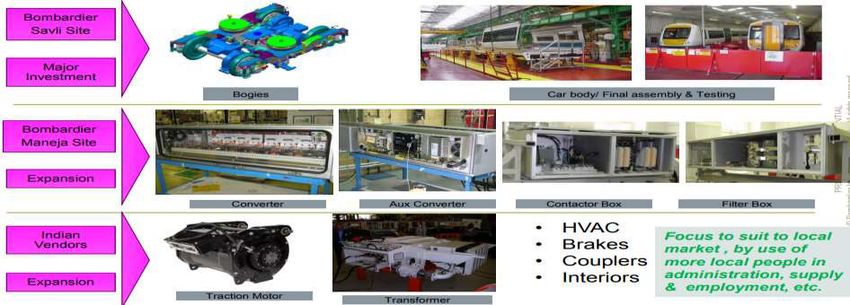
Table of Content

                 CONTENT                   PAGE NO

Overview                                      3

Metro Projects in India                       8

Key Players in the Indian Metro Railways
Manufacturing Sector                         11

About BDB                                    18

BDB's Business Divisions                     19

                             2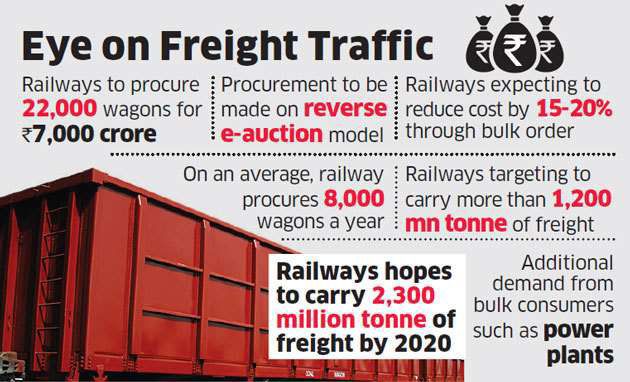
Overview

Organisational Structure of Indian Railways

                                        3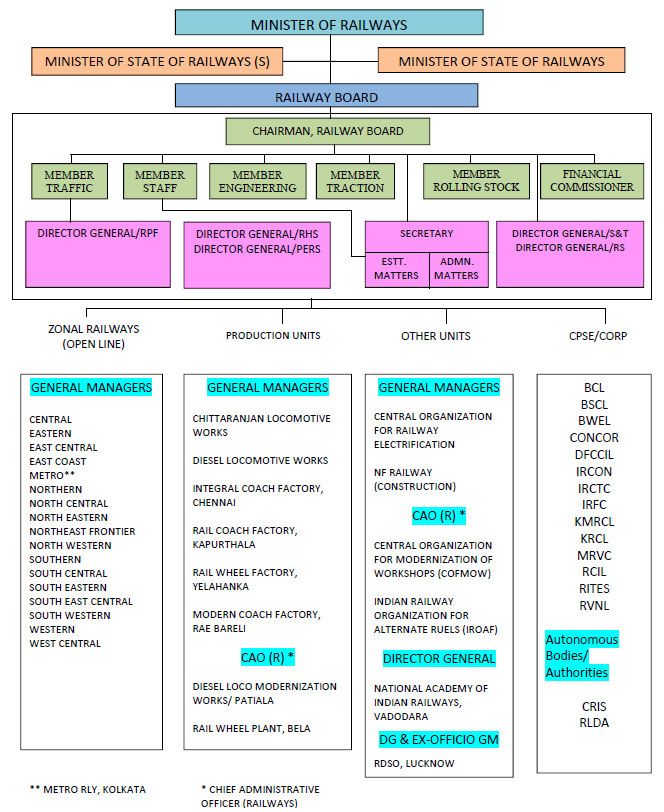
Indian Railways has grown manifold since its inception in 1853. Today, it is a departmental
commercial undertaking of the GoI under the overall control of the Railway Board.
During 2018-19, railways capital expenditure of 1,48,528 crore is earmarked for 18,000 km of
doubling, third and fourth line works, 5,000 km of gauge conversion, 3,600 km of track renewals
and rolling stock programme for 12,000 wagons, 5,160 coaches, and 700 locomotives.
The work on the eastern and western Domestic Freight Corridor (DFC) is going on along with the
redevelopment of 600 major railway stations. In addition, 16,800 crore has been allotted for
MRTS and Metro projects.
The Indian Railways manufactures a lot of its rolling stock and heavy engineering components. As
with most developing economies, the main reason is import substitution of expensive technology
related products. The six manufacturing plants of the Indian Railways, called Production Units,
are managed directly by the ministry. These six production units (PUs) are each headed by a
General Manager (GM), who also reports directly to the Railway Board.
List of Public Sector Railway Production Units in India
Railway Production Unit Product
Chittaranjan Locomotive Works (CLW, Chittaranjan) Steam Locomotives and Electric Locomotives
Diesel Locomotive Works (DLW), Varanasi Diesel Locomotives
Wheel Axle Plant (WAP), Bengaluru Wheel Axle Plant
Diesel Component Works (DCW), Patiala Diesel Components & Parts
Rail Coach Factory (RCF), Kapurthala, Punjab Rail Coaches
Integral Coach Factory (ICF), Chennai Coaching Stock
Bharat Earth Movers Limited, Bengaluru Rail Coaches for Delhi Metro Rail Corporation
Durgapur & Bengaluru Wheel Axle Plant
Rail Wheel Plant, Bela (Bihar) Wheels
Modern Coach Factory, Raebareli (UP) Coaching Stock
Tatanagar Metre Gauge Steam Locomotives
Bhilai Rail and Sleeper Cars
Perambur Rail Coaches
Other independent units of Indian Railways are:
Central Organisation for Railway Electrification (CORE), Allahabad
Central Organisation for Modernisation of Workshops (COFMOW), New Delhi
Research Design and Standards Organization (RDSO), Lucknow is the R&D division of Indian
Railways and functions as the technical advisor to Railway Board, Zonal Railways, and Production
Units.
4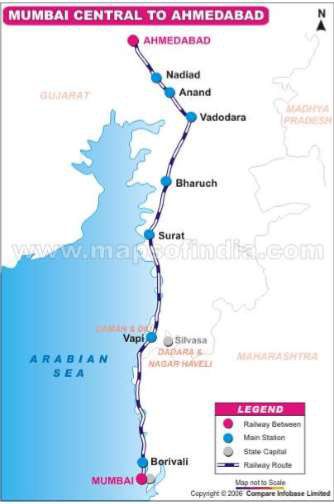
Central Organisation for Modernisation of Workshops (COFMOW)

COFMOW was established under the Ministry of Railways by the Govt. of India for modernizing
the Indian Railway workshops. The modernization project was funded through the World Bank
credits. Since its establishment in 1979, COFMOW has assisted in modernizing Indian Railways’
production units and maintenance workshops. This has involved purchasing over 9900 machines
valued at ₹8,970 million. It has thus emerged as a leading specialized organization in the fields of
manufacturing and maintenance technologies.

COFMOW is now the designated organisation of Indian Railways for selection, procurement and
induction of modern workshop technologies and machinery and plants.

Machinery and Plants (M&P) Budgeting at Indian Railways:

Railways and production units (PUs) must submit their consolidated Preliminary M&P
Programme for items costing more than ₹10 lakhs each and above each for Zonal Railways and
₹30 lakhs and above each for production units and all Road vehicles irrespective of their cost
through the M&P Portal maintained by the Railway Board.

For items costing up to ₹10 lakhs each and Electronic in-motion weigh bridges costing up to ₹20
lakhs each (excluding Road vehicles irrespective of their cost) can be sanctioned by Zonal Railway
under GM’s Powers. In case of production units, items costing up to ₹30 lakhs each (excluding
road vehicles irrespective of their cost) can be sanctioned under the GM’s Powers. The monetary
limits for submission of proposals to RB are revised from time to time as per the latest delegation
of powers.

There are four categories of machines procured under the M&P Program:

Category A: These are sophisticated and unique machines requiring an extensive market survey
and specialized knowledge of machine tools. They are procured by COFMOW.

Category B: Machines such as EOT cranes, welding machines, compressors, road mobile cranes
and diesel gensets that figure frequently in the M&P Programs of the railways should be carefully
procured, duly eliminating unreliable vendors from a highly competitive market. In this case,
when a procurement is bulked, the volumes involved afford a scale economy.
As the nodal procurement agency, COFMOW should consider the following options, apart from
the normal procurement option :

--     Entering into running / rate contracts for two to three years with the necessary price
       variation clause and place orders against the requirements of Zonal Railways / PUs.

--     In case of machines where it is becoming difficult to establish reliable suppliers, COFMOW
       may also examine the ILM option (install, maintain and lease), which can be availed by the
       consignee - Railways or PUs - in the same manner construction companies hire cranes,
       front end loaders and other machines on a long-term basis.

--     Category C: Special machines of unique and sophisticated nature for which the domain
       knowledge may not exist with COFMOW and where the requirements cannot be bulked,
       come under this category. These can be bought by the user railways, after seeking
       dispensation from COFMOW. Such dispensation should be sought from COFMOW well in
       time, so that the procurement is not delayed.

--     Category D: Other machines of smaller value below a certain limit barring certain excluded
       items, as stipulated by RB, as well as medical equipment whose procurement is best left to
       the user Railway, unless it is felt that such decentralization will compromise on quality or
       decelerate procurement.

                                                  5
When a machine is proposed in the M&P Program, the user should indicate the category against
each machine proposed along with his preference regarding the mode of procurement. In all the
categories of M&Ps, except category D, dispensation from COFMOW is essential for Zonal
Railways to arrange procurement by themselves.

Railway proposed investment over FY17-20: Electrification and construction of a
broad gauge line to remain a focus area for railways

                                                                        Amount
                           Particulars                                                    (%)
                                                                         (₹ Bn)
 Network decongestion (DFC + electrification, doubling +
                                                                          1,993           23.3
 electrification & traffic facilities)
 Network expansion (including electrification)                            1,930           22.5
 National projects (North Eastern & Kashmir connectivity
                                                                           390            4.6
 projects)
 Safety (track renewal, bridge works, RoB, RuB and S&T)                   1,270           14.8
 Information technology/research                                           50             0.6
 Rolling stock (locomotives, coaches, wagons production
                                                                          1,020           11.9
 maintenance)
 High speed rail and elevated corridor                                     650            7.6
 Total                                                                    8,560          100.0

Indian Railways is targeting 38,000 km electrification over the next five years versus the current
annual run rate of 2,000 km. These indicate significant growth potential in the railways sector.

During FY19, Indian Railways’ capital expenditure has been estimated at ₹1.48 lakh crore, large
part of which would be allocated to capacity creation

         --    Capacity constraints would be tackled through 18,000km of doubling, third and
               fourth line works
         --    Almost the entire railway network would be converted into broad gauge with
               5,000km of gauge conversion.

The Railways would also undertake the following initiatives to enhance passenger comfort and
safety:

         --    Electrification of rail network spanning 4,000km by the end of FY18
         --    Rolling stock for Dedicated Freight Corridors comprising 12,000 wagons, 5,160
               coaches and 700 locomotives to be procured during FY19

                                                 6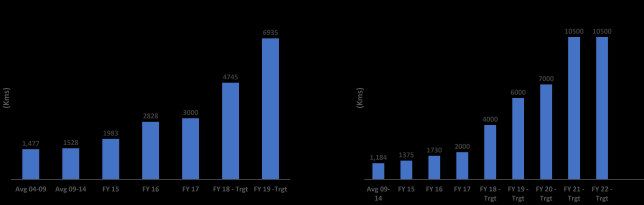
New Projects and Capacity Expansions Expected (Coach and Locomotives)

                                   Existing                  Investment   Product              Planned
   Project         Location                       Plan                              Capacity
                                  Capacities                   Model      Planned                Year

 Integral
                  Chennai,                                                LHB &                     Next 5
 Coach                              3,000      Expansion     Public                  6,000
                  Tamil Nadu                                              EMU                       years
 Factory (ICF)
 Modern
 Coach            Raebareli,                                              LHB                       Next 5
                                    1,000      Expansion     Public                  5,000
 Factory          Uttar Pradesh                                           coaches                   years
 (MCF)

 Rail Coach       Kapurthala,                                             LHB
                                    1,500      Expansion     Public                   1,700         2019
 Factory          Punjab                                                  coaches

 Rail Coach       Latur,                                                  EMU &
                                      -        New Project   PPP                      400           2020
 Factory          Maharashtra                                             Metro

 Rail Coach       Sonepat,                                                LHB                       Next 5
                                      -        New Project   PPP                      600
 Factory          Haryana                                                 coaches                   years

                  Kanchrapara,
 Rail Coach                                                                                         Next 5
                  West Bengal,        -        New Project   PPP          EMU         500
 Factory                                                                                            years
                  Bombardier

                  Madhepura,
 Alstom                               -        New Project   PPP          EL          800           2019
                  Bihar

                  Marhowra,
 GE                                   -        New Project   PPP          EL         1,000          2018
                  Bihar

 Dankuni
 Electric         Dankuni,
                                      -        New project   PPP          EL          200           2020
 Locomotive       West Bengal
 factory

 Coach            Kolar,                                                  LHB
                                      -        New project   PPP                      400           2020
 factory, Kolar   Karnataka                                               coaches

Electric Locomotives: It has been decided to produce only new generation state-of-art three-phase
electric locomotives in the future. These new generation locos save up to 20% electricity
consumption owing to their regenerative braking features.

Diesel Locomotives: Horse power of diesel locomotives has been increased from 2600 to 4500 HP.
These locos have state-of-art three phase AC-AC Insulated Gate Bipolar Transistor (IGBT) based
traction system. Moreover, other improvements such as dual cab, air conditioner in loco cabs,
auxiliary power unit (APU), hotel load and distributed power control system (DPCS) are provided
in locomotives.

                                                  7
Metro Projects in India: Growing Opportunity for Coach Building
The government data says that at present, around 324 km of metro rail is operational in Delhi and
NCR, Gurgaon, Kolkata, Chennai, Bengaluru, Jaipur and Mumbai.
Around 550 km is under construction in various cities, including Delhi and NCR, Kolkata,
Chennai, Jaipur, Mumbai, Kochi, Ahmedabad, Nagpur and Lucknow.
Around 3,500 metro cars have been ordered by domestic metro operators across 13 cities. Nearly
3,000 metro cars are likely to be procured over the next five years across cities with Mumbai and
Delhi ordering major quantities, said sources.
The union government is encouraging cities with population above two million to develop mass
transit systems; it is expected that around 50 cities will have population over two million by 2050.
These cities will evaluate to adopt metro, monorail or light rail vehicle-based transit system in the
coming years. For metros alone, a strong demand will be created with Indian metro rail operators
procuring more than 3000 metro cars in the next five years.
The demand for metro coach is seeing very good growth in the Indian market. In fact, new players
such as ICF want to grab a decent share in the growing metro coach market, which is currently
dominated by multinational companies such as Alstom and Bombardier, a couple of Chinese
companies and the state-owned BEML.
ICF entry into the metro railway system is taking time as most of them in the country operate in
standard gauge (SG). ICF had never built an SG coach as it operates predominantly in the broad
gauge space (it, however, supplies coaches to Kolkata Metro which operates in broad gauge).
There is a big difference in design for SG (1,435 mm) and BG coaches (1,676 mm). They believe
that they can bring down price by ₹3–4 crore per coach (each is priced at around ₹10 crore
currently) without affecting the quality.
While policy measures such as a streamlined tender/bids process, one window investment portals
from the state governments and the Ministry of Urban Development's (MoUD) push for metro
suppliers to “Make in India” have phenomenally improved the ease of operating businesses. The
new taxation regime has done much to clean up outdated taxation policies.
India is emerging as a key region for manufacturing coaches. As a market, rapid modernisation,
adoption of newer, safer and more sustainable technology, rapid urbanisation places India high on
the market potential index. Location-wise, having a base in India also helps companies assuredly
deliver projects across Asia, the Middle East and even beyond. Companies have been able to tap
into the large, skilled talent pool available in the country- young talent pool can help in developing
solutions for projects worldwide.
FDI is permitted in the following activities of the Railway Transport sector :
Suburban corridor projects through PPP
High speed train projects
Dedicated freight lines
Rolling stock including train sets, and locomotives or coaches manufacturing and
maintenance facilities
Railway Electrification
Signaling systems freight terminals
Passenger terminals
Infrastructure in industrial park pertaining to railway lines or sidings including electrified
railway lines and connectivity's to main railway line
Mass Rapid Transport Systems
8Metro Projects Planned in the Future
Operational Network
Metro Location Rolling Stock Supplier
Year (km)
Kolkata, CNR Dalian (A subsidiary of
Kolkata Metro 2021 113.42
West Bengal CRRC)
Consortium of Hyundai,
Delhi,
Delhi Metro 2021 140 Mitsubishi & MELCO /
Delhi
Bombardier / BEML
Bengaluru, BEML-led consortium with
Namma Metro 2021 34.37
Karnataka Mitsubishi & Hyundai
Gurgaon, CSR Zhuzhou (A subsidiary
Rapid Metro 2021
Haryana of CRRC)
Mumbai,
Mumbai Metro 2021 68.6 CSR Nanjing (China)
Maharashtra
Jaipur,
Jaipur Metro 2021 2.4 BEML
Rajasthan
Chennai,
Chennai Metro 2021 19.17 Alstom
Tamil Nadu
Kochi,
Kochi Metro 2021 25.6 Alstom
Kerala
Lucknow,
Lucknow Metro 2021 33 Alstom
Uttar Pradesh
Hyderabad,
Hyderabad Metro 2021 41.6 Hyundai - Rotem
Telangana
Nagpur,
Nagpur Metro 2018 41.7 CRRC
Maharashtra
Noida,
Noida Metro 2018 29.7 CRRC
Uttar Pradesh
Ahmedabad &
Metro Link express Gandhinagar, 2018 39.3 Hyundai - Rotem
Gujarat
Navi Mumbai, CSR Zhuzhou (A subsidiary
Navi Mumbai Metro 2019 11.1
Maharashtra of CRRC)
Pune,
Pune Metro 2021 31.3 CRRC
Maharashtra
9Operational Network
Metro Location Rolling Stock Supplier
Year (km)
Alstom (Sricity),
Vishakhapatnam Visakhapatnam,
2021 42.54 Bombardier (Salvi) and
Metro Andhra Pradesh
Japanese's Hitachi Rail
Surat, Bombardier, Alstom &
Surat Metro 2021 40.35
Gujarat BEML
Coimbatore,
Coimbatore Metro 2022 136 ICF
Tamil Nadu
Kanpur,
Kanpur Metro 2021 35 -
Uttar Pradesh
Guwahati,
Guwahati Metro 2022 61 -
Assam
Bhopal,
Bhopal Metro 2024 123.62 -
Madhya Pradesh
Agra,
Agra Metro 2024 30 -
Uttar Pradesh
Meerut,
Meerut Metro 2024 35 -
Uttar Pradesh
Varanasi,
Varanasi Metro 2024 29.23 -
Uttar Pradesh
Kozhikode Light Kozhikode,
2025 13.33 -
Metro Kerala
Indore,
Indore Metro 2020 107 -
Madhya Pradesh
Thiruvananthapuram Thiruvananthapuram,
2025 21.82 -
Metro Kerala
Dehradun -
Dehradun Metro Rishikesh- Haridwar, 2025 73 -
Uttarakhand
Srinagar,
Srinagar Metro 2025 58 -
Jammu and Kashmir
Greater Gwalior Gwalior,
2025 105 -
Metro Madhya Pradesh
10Key Players in the Indian Metro Railways Manufacturing Sector:
1. Alstom Transport India limited
Alstom has a strong presence in India. Currently, the company is executing metro projects in
several Indian cities including Chennai, Kochi and Lucknow where it is supplying Rolling Stock
manufactured out its state of the art facility at Sri City in Andhra Pradesh. In the Mainline space,
Alstom is executing signalling & power supply systems for the 343 km section on the World Bank
funded Eastern Dedicated Freight Corridor. Phase 1 in the construction of the new electric
locomotive factory for manufacturing and supply of 800 units of high horse power locomotives at
Madhepura in Bihar is complete while the depot at Saharanpur is also ready to commence
production. Alstom has set up the Engineering Centre of Excellence at Bengaluru, and this
coupled with a strong manufacturing base as well as localized supply chains, is uniquely positioned
to serve customers across the globe.
Alstom Transport India Limited (ATIL) was set up in 2011 to manufacture rolling stock for the
Indian metro market. The company is a wholly-owned subsidiary of Alstom Transport Holding
BV, Netherlands and has its manufacturing facility located in SriCity, Andhra Pradesh and
Coimbatore, Tamil Nadu. ATIL has an established presence in the transport segment with the
support of Alstom Group.
Alstom has also set up an electric locomotive plant at Madhepura (Bihar) and is setting up
maintenance depots at Saharanpur (Uttar Pradesh) and Nagpur (Maharashtra) to supply Indian
Railways with 800 double-section freight electric locomotives with associated long-term
maintenance.
This project is one of the strongest endorsements of the Make in India policy of the government
because of the highly localised supplier base that has been put in place to execute it. Almost 90%
of the components used to manufacture these locomotives are being sourced from Indian
companies.
The engine is made of about 2,500 components, of which 85–90% are sourced locally. Component
suppliers includes transformers from ABB, couplers from Faiveley and brakes from Knorr Bremse.
Alstom continues to look at opportunities to further increase the localisation aspect of the project.
The Madhepura locomotive project also includes large-scale development of local infrastructure
and facilities that will empower the local economy of Bihar as well. Alstom is adding to this
transformation by undertaking community-building projects in Madhepura to make sure the
benefits of industry seep through to the grassroots of this remote region.
Additionally, Sri City plant is not just a manufacturing unit for our Indian projects, it is also a base
for exports. With an annual production capacity of 240 cars and over 500 employees, this plant is
Alstom's base for manufacturing rolling stock for national and international projects - another
strong marker of Alstom’s commitment towards the Make in India initiative.
ATIL has a sizeable pending order book of around ₹5,622 crore as on November 2017, which
provides revenue visibility over the medium term. This also includes rolling stock (for Chennai,
Lucknow and Kochi projects) and associated infrastructure systems/equipment/services (for
Chennai, Lucknow, Delhi NCR, Jaipur and Kochi projects) for key metro rail projects being
developed in India.
112. Bombardier
Bombardier is one of the few rail companies in India which truly supports Indian government’s
Make in India campaign. Bombardier Transportation is not only making rail products and
solutions for the Indian market which are manufactured in India but they are also exported from
India. Bombardier signifies ‘Make in India for India’ and ‘Make in India for the World’.
Bombardier’s Savli site currently makes metro cars for Delhi Metro, and exports commuter cars
and bogie components to Australia, Brazil and Saudi Arabia. Its propulsion and controls
production / engineering site at Maneja in Vadodara delivers propulsion solutions for Mumbai
suburban rail network along with supplying electricals to Indian Railways for more than a decade.
Bombardier Transportation has delivered 614 metro cars to Delhi Metro Rail Corp. (DMRC) with
an additional order of 162 metro cars from Delhi Metro. Bombardier is the largest supplier of
signalling solutions to Delhi Metro. Bombardier is closely pursuing various metro projects in
Delhi, Ahmedabad, Mumbai, Nagpur, Pune, Vijayawada, Vizag and Bengaluru.
In 2015, Bombardier opened an information services global hub and new rail control solutions
centre in Gurgaon. In April 2017, Bombardier Transportation opened a new engineering centre in
Hyderabad, India. This new facility also focuses on the development of metro and electrical
multiple unit (EMU) product platforms and engineering design for transportation projects locally
and globally.
Bombardier Transportation Propulsion and Controls in India started its operations in 1997 with
the establishment of Maneja site in Vadodara, Gujarat and has since become one of the leading
companies in the rail equipment business offering a wide variety of propulsion and control
equipment to the Indian Railways and to its rolling stock division.
Their journey in India started with a mere two products and within a decade and a half it now
supplies twelve products to the Indian railways, which are all manufactured locally. In
addition to this, support is also provided to Indian Railway customers with aftersales services and
spare parts. Winning the Delhi Metro contract paved its way into the Indian Metro Market and
adding substantial expertise to the site. Mumbai Railway Vikas Corporation (MRVC) and
Queensland Rail (Australia) projects are currently under execution at the site.
123. BEML
BEML Limited’s Rail Coach Factory situated in Bengaluru, India is the first all steel integrated rail
coach factories established by the Government of India during 1948. It was set up with the
assistance and technical know-how imparted by M/s MAN, Federal Republic of Germany. This
factory was established to indigenously manufacture the passenger rail coaches (of broad gauge)
for the use of Indian Railways.
During the implementation of the first urban transit project by DMRC for its Phase-1, BEML and
Rotem signed a Technical Collaboration Agreement during 2002 and BEML became the first to
indigenously manufacture Metro Cars for DMRC RS1 contract and manufactured 220 Metro Cars.
Later, to indigenize the manufacture and integration of the Metro train sets, BEML obtained a
developmental order from DMRC to develop 8Nos. intermediate cars. The successful completion
of this developmental order strengthened BEML as an indigenous source for Metro Cars.
As on date, BEML has supplied over 1,100 Metro Cars for various projects in India. BEML’s efforts
in successful completion of indigenization of Rolling Stock and the augmentation of its production
facilities have been lauded by the customers.
With the experience gained in manufacture, integration and testing of Metro Cars, BEML
expanded its role in the Metro segment and holds a good market share in India. Since inception,
this Rail Coach Factory has manufactured & supplied over 17,000 mainline passenger coaches of
various types for long distance mainline routes of Indian Railways.
In addition, BEML has been manufactured and supplied over 800 of EMUs to Indian Railways for
use in its sub-urban and mainline routes. BEML has also manufactured and supplied self-
propelled equipment 20 Rail Bus (for public transport), over 40 other maintenance vehicles to
Indian Railways and over 120 8W-DHTCs (for OHE inspection & maintenance) to Indian
Railways and various Metro Corporations in India.
13Dedicated Freight Corridors: Growing Opportunity for Wagon Manufacturers
Railways is ramping up its freight carrying capacity by 1100 million tonne in the next two years as
it is hoping to complete the construction of 3,300km-long dedicated freight corridors by 2020.
Indian Railways is set to put out its largest tender for 22,000 wagons at a cost of at least ₹7,000
crore in the current financial year that could see big orders for Texmaco Rail and Engineering,
Titagarh Wagons, Jindal Rail and Jupiter Wagons among other wagon makers.
The orders would be through the reverse e-auction model, and if the lowest bidder isn’t able to
serve the entire order, the second-lowest bidder would get a chance without a fresh tendering
process.
The railways ministry hopes the bulk tender would help it reduce the cost of wagons by at least
15%-20%. On an average, the ministry procures 8,000 wagons a year.
Key players in the railway wagon manufacturing in India are:
Titagarh Wagons : Titagarh Wagons Limited is primarily engaged in the business of
manufacturing Railway Wagons & EMUs (Coaches). It makes a wide variety of wagons including
hopper, covered, open top, container flat, tank, flat and special purpose wagons and coaches
constituting ~90% of company revenues. The company would be a key beneficiary of railway
capex on rolling stock wagons.
Texmaco : Texmaco is primarily engaged in the business of manufacturing freight cars including
stainless steel cars and custom built special purpose freight cars. It has diversified into
manufacturing “Loco Shell” for electric locomotives. It has made a strategic acquisition of 49%
equity stake in Kalindee and is in the process of merger of the two companies. Rolling stock
division constituted ~60% revenue. The company would be a key beneficiary of railway capex on
Rolling stock wagons.
14High Speed Rail: Mumbai-Ahmedabad
The Mumbai-Ahmedabad high-speed rail corridor is an under-construction high-speed rail line
connecting the cities of Ahmedabad, Gujarat, and India's economic hub Mumbai, Maharashtra. It
will be India's first high-speed rail line.
The construction of the corridor began in August 2018 by acquiring land for Sabarmati terminus,
and the first high-speed train is scheduled to leave for its first run on 15 August 2022. The
corridor will use Japan Railways Shinkansen E5 Series Electric multiple unit for its rolling stock.
Most of the corridor will be elevated, except for a 21-km underground tunnel between Thane and
Virar, of which 7 km will be under the sea. The undersea tunnel was chosen to avoid damaging the
thick vegetation present in the area. The corridor will begin at the underground station in the
Bandra-Kurla Complex in Mumbai, and then traverse 21 km underground before emerging above
the ground at Thane.
Item (₹ bn)
Civil 230
Track 52
Station Construction 56
Depot/Workshop & Maintenance Depot 47
Electric Power Facilities 32
Signalling & Communication Facility 25
Rolling Stock 53
Total Construction/Procurement cost 495
Consulting Service Cost 22
Land Acquisition Cost 102
Management Cost 47
Contingency 33
Total Cost 700
The Mumbai-Ahmedabad corridor, along with five other high-speed rail corridors, was introduced
for a feasibility study in the 2009–2010 rail budget. A 650-km long high-speed rail corridor was
proposed to run from the Pune railway station to Ahmedabad railway station via Mumbai. The
point at which this route would touch Mumbai was to be decided when the feasibility report was
prepared.
The pre-feasibility study for the Ahmedabad–Mumbai–Pune corridor was completed by a
consortium of RITES, Italferr and Systra. The top speed expected for the corridor was up to 350
km/h. The proposed stations included Lonavala on Mumbai–Pune section and Surat, Bharuch
and Vadodara on Mumbai–Ahmedabad section. It was proposed to have 32 services between
Mumbai and Ahmedabad.
15Other Private Participants in the Railway manufacturing Sector
Below are some of the key component manufacturing companies catering to the Railways sector:
Company Location
FAIVELEY Transport Limited Bengaluru / Hosur, Karnataka
Jindal Rail Infrastructure Vadodara, Gujarat
Cimmco Bharatpur, Rajasthan
Besco Kolkata & Parganas, West Bengal
Modern Industries Ghaziabad, Uttar Pradesh
Frontier Alloy Steel Kanpur, Uttar Pradesh
Sanrok Enterprises Delhi
Escorts Faridabad, Haryana
Dellner India Sriperumbudur, Tamil Nadu
Raneka Industries Pithampur, Madhya Pradesh
Frontier Springs Kanpur & Sirmaur, Himachal Pradesh
Abok Spring Jaipur, Rajasthan
Omax Delhi
Pennar Hyderabad , Telangana
Siemens Kalwa, Maharashtra
ABB Bengaluru, Karnataka
KPCL Pune, Maharashtra
Stone Industries Kolkata, West Bengal
Key Clusters for Railway Components Manufacturing:
-- Bengaluru, Karnataka
-- Baroda, Gujarat
-- Kolkata, West Bengal
-- Hyderabad, Telangana
-- Chennai, Tamil Nadu
-- National Capital Region
-- Bihar
-- Varanasi, UP
-- Patiala, Punjab
-- Palakkad, Kerala
16Disclaimer :
This document has been prepared for general purpose only, in good faith, on the basis of
information available at this date, on secondary research of publicly available data. BDB India
Private Limited does not guarantee or warranty the accuracy, reliability, completeness or
currency of the information in this document nor its usefulness in achieving any purpose.
Readers are responsible for assessing the relevance and accuracy of the content of this
publication. BDB India Private Limited will not be liable for any loss, damage, cost or expense incurred or arising
by reason of any person using or relying on information in this document.
17BDB India Private Limited About BDB BDB India Private Limited is a business consulting and market research company headquartered in Pune, India. We have been working with customer driven and market oriented organizations over the last 29 years. Our consulting and research experience includes every major vertical in the B2B Industrial sector; Healthcare and the Agricultural sector. BDB has time and again displayed exceptional ability to map patterns and trends through our customized studies and developed winning strategies for entering and succeeding in markets such as South Asia, Africa, South East Asia and the Middle East & Far East (Japan, South Korea, Taiwan) Regions. BDB recommends specific products (and systems) to promote, geographical regions to start within, point of sale models, pricing, recommends specifications if customization is necessary and aftermarket support. The marketplace is the interface between product and consumer. All market and customer driven business enterprises therefore tailor their strategy, based on the marketplace. As commercial enterprises have to be market and customer driven, BDB's cutting edge inputs to our clients have always resulted in their meeting or exceeding their growth targets and market-leadership aims. Business research and Strategy is an intricate, involved and specialised subject and specialization cannot be mass produced. Every specialization needs expertise, dedication, commitment and enthusiasm. And at BDB, we pursue our specialization with a passion. We have constituted a fine team, whose talent and honesty of purpose is beyond compare. Researching the market thoroughly, profiling existing customers and potential customers, analysis of product differentiation, technology evaluation, re-evaluating customer needs and creating new markets are important steps towards success. Conversion of these needs into demand and creating an appropriate market interface can lead to sales growth and larger market share. The best result oriented strategy specifically tailored for our clients and for specific product range, requires intricate market research and intimate knowledge about the working of the market place. Our methodology of studying the markets in-depth involves primary research of the stakeholders – buyers, end users, OEMs, consultants, channel partners, competitors, and EPC contractors – the entire value chain. The findings are then analysed leveraging our years of experience. Thanks to the faith entrusted in us by many globally leading multinational companies as well as Indian business groups over quarter of a century; today BDB can carry out in-depth market analysis to map potential opportunities. BDB, an ISO certified company is uniquely qualified, experienced and equipped to design a failsafe growth plan that will achieve business growth. BDB's unique strategy developing expertise, based on in house market research, includes sectors such as electrical industry, process industry, automotive industry, machine tool industry, metallurgical industry, plastics and composites industry, HVAC industry, construction machinery industry, farm equipment industry, industrial chemical sector, agrochemical industry, pharmaceutical & healthcare sector, domestic appliances market, international markets as well as qualitative studies involving customer satisfaction measurement and monitoring in the industrial eco-system.
BDB India Private Limited

BDB's Business Divisions

                                                          Industrial
                               Automotive                                       Building Management Services
              Food processing equipment                                         Construction Equipment
                  Industrial Consumables                                        Electrical power
                  Industrial Automation &                                       Electronics and Telecommunication
                          Instrumentation                                       General Engineering
              Machinery & Machine Tools                                         Industrial Chemicals
                                Metallurgy                                      Marine
                                    HVAC                                        Process Equipment
                                Oil & Gas                                       Renewable Energy
                   Plastics & Composites

                            Healthcare                                   Agriculture and allied
                                                                                Farm machinery
                                                                                      Fertilizers
                            Medical consumables
                            Medical devices                                         Insecticides
                            Medical equipment                                    Micro irrigation
                            Hospital equipment                                   Micro nutrients
                            Hospitals                                                 Pesticides
                                                                                       Food and
                                                                                      beverages

BDB's Services

          MARKET                                        STAKEHOLDER                                 MARKETING
          CENTRIC                                       CENTRIC                                     CENTRIC
  • Market Sizing & Potential                • Customer Satisfaction &                     • Direct Marketing
   Assessment                                     Monitoring                                 - Creating Awareness
  • Market Entry Strategy
                                             • Vendor Satisfaction                           - Credibility Establishment
  • Price Sensitivity
  • Techno Economic Feasibility              • Brand Image                                    - Lead Generation
  • Bench Marking Analysis                                                                    - Sales Connect
   (Product, Price, Technology)
  • Raw Material & Location
   Evaluation
  • Partner Identification &
   Evaluation
  • Export Potential
BDB India Private Limited
You can also read


