Updates on NYISO's Comprehensive System Planning Process - PJM.com
←
→
Page content transcription
If your browser does not render page correctly, please read the page content below
Updates on NYISO’s Comprehensive
                System Planning Process
                Philip Chorazy
                Senior Engineer, Public Policy and Interregional Planning, NYISO

                Interregional Planning Stakeholder Advisory Committee (IPSAC) Meeting
                December 14, 2020

©COPYRIGHT   NYISO 2020. ALL RIGHTS RESERVED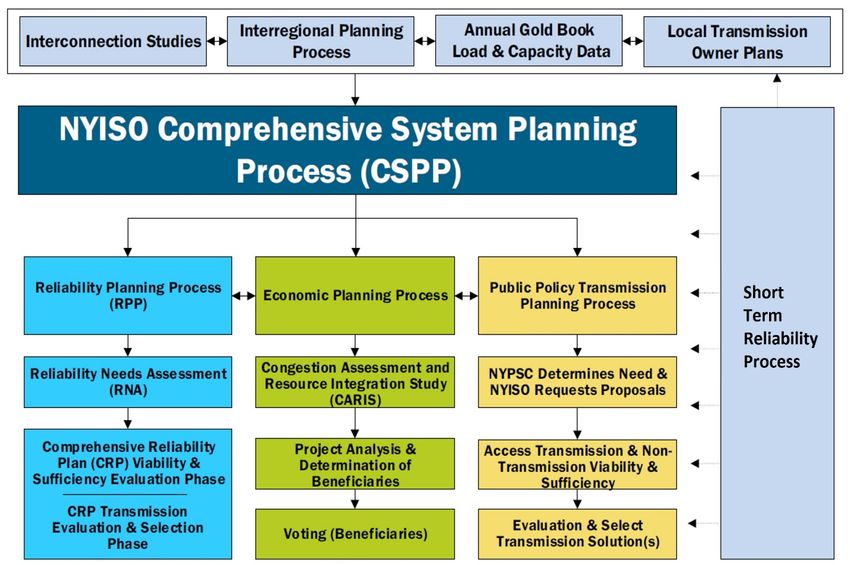
©COPYRIGHT NYISO 2020. ALL RIGHTS RESERVED 2
Reliability Planning Process
Two-year process starting in even years
Reliability Needs Assessment (RNA)
• Evaluates the adequacy and security of the Bulk Power
Transmission Facilities over a seven-year Study Period (years four
through ten of the next ten years), and identifies Reliability Needs
• Reliability Needs are defined as violations of Reliability Criteria (i.e.,
NERC, NPCC and NYSRC)
Comprehensive Reliability Plan (CRP)
• Develops a plan to satisfy the Reliability Needs identified in RNA, if
any
©COPYRIGHT NYISO 2020. ALL RIGHTS RESERVED 3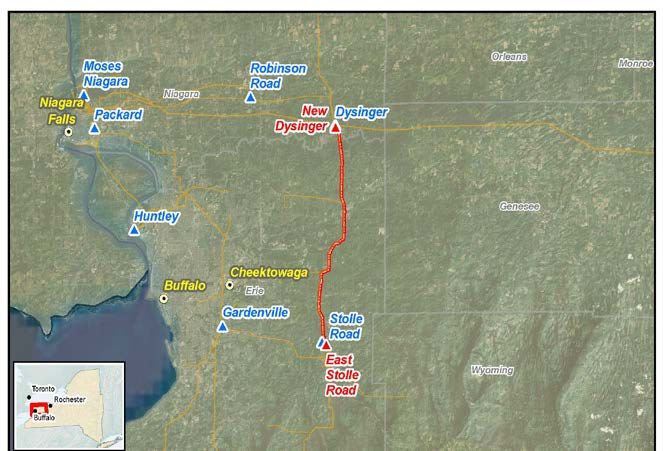
2020 Reliability Needs Assessment
Incorporates impacts of Peaker Rule into base case reliability analysis.
• New York State Department of Environmental Conservation (DEC) adopted a regulation to limit
nitrogen oxides (NOx) emissions from simple-cycle combustion turbines (“Peaking Units”)
(referred to as the “Peaker Rule”)
• The Peaker Rule required all impacted plant owners to file compliance plans by March 2, 2020
Includes a scenario evaluating the impacts of 70 percent of energy produced from
renewable resources by 2030 (“70 by 30”) for both Transmission Security and
Resource Adequacy.
Final 2020 RNA report is available.
• The 2020 RNA has identified violations or potential violations of reliability criteria (“Reliability
Needs”) in the base case throughout the entire study period (2024-2030) due to dynamic
instability, transmission overloads, and resource deficiencies. The issues identified are primarily
driven by a combination of forecasted peak demand and the assumed unavailability of certain
generation in New York City affected by the “Peaker Rule”
https://www.nyiso.com/documents/20142/2248793/2020-RNAReport-Nov2020.pdf
©COPYRIGHT NYISO 2020. ALL RIGHTS RESERVED 4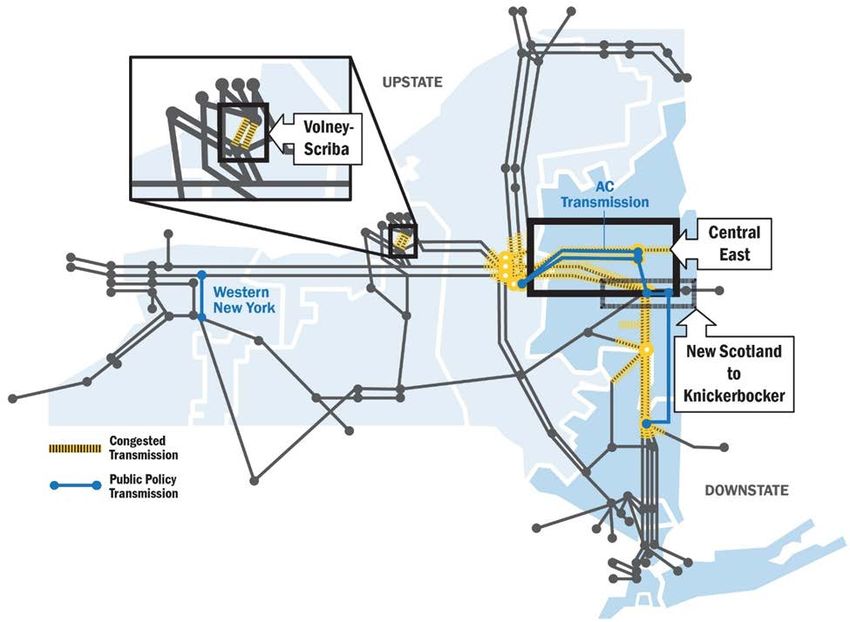
Queue #              Project Name             Zone        Point of          Summer       2020 RNA
                                                                                                         Interconnection      Peak (MW)    Commercial

 Proposed Projects                             Proposed Transmission Additions, other than Local Transmission Owner Plans
                                                                                                                                          Operation Date

 Included in the                                   Q545A*             Empire State Line           A      Dysinger - Stolle
                                                                                                             345kV
                                                                                                                                 n/a         6/2022

 2020 RNA Base                                      556           Segment A Double Circuit       E,F    Edic - New Scotland
                                                                                                               345kV
                                                                                                                                 n/a        12/2023

 Case
                                                    543          Segment B Knickerbocker-        F,G        Greenbush -          n/a        12/2023
                                                                  Pleasant Valley 345 kV                  Pleasant Valley
                                                                                                               345kV
                                                    430          Cedar Rapids Transmission        D      Dennison - Alcoa        80         10/2021
                                                                         Upgrade                               115kV
                                                 System              Leeds-Hurley SDU            F,G    Leeds- Hurley SDU        n/a      summer 2021
                                               Deliverability                                                  345kV
                                                 Upgrades*
                                               Proposed Generations Additions
                                                    387*              Cassadaga Wind              A       Dunkirk - Moon        126.5       12/2021
                                                                                                          Station 115 kV
                                                    396                 Baron Winds               C       Hillside - Meyer      238.4       12/2021
                                                                                                               230kV
                                                    422         Eight Point Wind Energy Center    B       Bennett 115kV         101.8       12/2021

                                                    505                 Ball Hill Wind            A       Dunkirk -             100.0       12/2022
                                                                                                      Gardenville 230kV
                                                    546              Roaring Brook Wind          E      Chases Lake             79.7        12/2021
                                                                                                      Substation 230kV
                                                    678         Calverton Solar Energy Center    K   Edwards Substation         22.9        12/2021
                                                                                                           138kV
                                                                                      MW Additions from 2019-2028 CRP           543
                                                                                           Total MW generation additions        669
                                               *
                                               also included in the 2019-2028 CRP Base Cases

©COPYRIGHT   NYISO 2020. ALL RIGHTS RESERVED                                                                                                               5
Generator Status Update
                                                                                             Generator Status Updates from March 15, 2020 through November 1, 2020
         Generating Unit     Zone       Current       Date of Generator Initial Testing Generator Deactivation Generator Deactivation            PSC        Proposed Retirement/ Rescinded                                Notes
                                       Generator      Status Change, if     Date, if    Assessment/Short-Term Assessment/Short-Term Retirement/Mothball       Mothball Date, if  Notice Date,
                                        Status            applicable      applicable    Assessment of Reliability Assessment of Reliability Notice Date, if      applicable      if applicable
                                                                                        Start Date, if applicable   Completion Date, if       applicable
                                                                                                                         applicable
      Cayuga 1                C     Retired              06/04/2020                           03/02/2020                04/08/2020           2/17/2020          *5/17/2020                     *Pending PSC approval
                                                                                                                                                                                               Per the NYISO’s Generator Deactivation Process, the
                                                                                                                                                                                               earliest date on which the Generator might retire is
                                                                                                                                                                                               06/01/20.
      INDIAN POINT__2         H     Retired              04/30/2020                           11/13/2017                12/13/2017           10/30/2019         04/30/2020
      INDIAN POINT__3         H     In Service                                                11/13/2017              12/13/2017              10/30/2019             04/30/2021
      KINTIGH____             A     Retired              03/31/2020                           12/12/2019              03/04/2020              11/15/2019             02/15/2020*                   *Per the NYISO’s Generator Deactivation Process, the
                                                                                                                                                                                                   earliest date on which the Generator might retire is
                                                                                                                                                                                                   03/12/2020.
      Cayuga 2                C     Retired              06/04/2020                           03/02/2020              04/08/2020              02/17/2020             *5/17/2020                    *Pending PSC Approval
                                                                                                                                                                                                   Per the NYISO’s Generator Deactivation Process, the
                                                                                                                                                                                                   earliest date on which the Generator might retire is
                                                                                                                                                                                                   06/01/2020.
      West Babylon 4          K     In Service                                                04/23/2020              06/19/2020              01/23/2020             12/12/2020
      Glenwood GT 01          K     In Service                                                07/15/2020              10/13/2020              03/16/2020             02/28/2021
      Dahowa Hydroelectric    F     In Service           04/30/2020
      Albany LFGE             F     ICAP Ineligible      07/01/2020                           07/15/2020              10/13/2020                                                                   On July 12, 2019, the NYISO deemed complete a
                                    Forced Outage                                                                                                                                                  Generator Deactivation Notice for the Retirement of
                                                                                                                                                                                                   Albany LFGE. The Generator Deactivation Assessment for
                                                                                                                                                                                                   the Retirement of this unit was completed on September
                                                                                                                                                                                                   20, 2019 and concluded that a Generator Deactivation
                                                                                                                                                                                                   Reliability Need was not identified. On July 1, 2020 this
                                                                                                                                                                                                   unit was placed on IIFO.
      HUDSON AVE_GT_3         J     In Service           07/10/2020

        Status of generators is reviewed and updated on a monthly basis:
        https://www.nyiso.com/ny-power-system-information-outlook?folderPath=public/planning/NY-Power-System-Information-and-Outlook/Generator-Status-Updates

©COPYRIGHT   NYISO 2020. ALL RIGHTS RESERVED                                                                                                                                                                                                                   6
Local Transmission Owner Plans (LTP)
The NYISO's Comprehensive System Planning Process (CSPP) begins with
the Local Transmission Owner Planning Process (LTPP). The LTPP allows
interested parties to examine the transmission system plans of each of the
New York Transmission Owners individually.
Local Transmission Owner Planning Process (LTPP) link:
• https://www.nyiso.com/documents/20142/3632262/Local-Transmission-Owner-Planning-Process-
LTPP.pdf
2020 Load and Capacity Data Report (Gold Book) containing BPTF LTPs
and firm non-BPTF LTPs (Section VII)
• https://www.nyiso.com/documents/20142/2226333/2020-Gold-Book-Final-Public.pdf
©COPYRIGHT NYISO 2020. ALL RIGHTS RESERVED 7Existing transmission facilities
modeled out-of-service
Con Edison’s B3402 and C3403 345 kV cables with no
return date
Moses-St. Lawrence L33P through fall 2022
©COPYRIGHT NYISO 2020. ALL RIGHTS RESERVED 8Short-Term Reliability Process (STRP)
The STRP uses quarterly Short-Term Assessments of Reliability (STAR)
studies to assess the reliability impacts of generator deactivations on both
BPTF and non-BPTF transmission facilities, in coordination with the
responsible transmission owner(s)
The STAR is also used by the NYISO, in coordination with the responsible
transmission owner(s) to assess the reliability impacts of other system
changes on the BPTF
Each STAR assesses a five-year period with a particular focus on needs that
are expected to arise in the first three years of the study period
• Needs that arise in years four or five may be addressed in the STRP or RPP
©COPYRIGHT NYISO 2020. ALL RIGHTS RESERVED 9Short-Term Reliability Process (STRP)
Short-Term Reliability Process webpage is now online
https://www.nyiso.com/short-term-reliability-process
Final Short-Term Assessment of Reliability (STAR): 2020 Quarter 3 report is available.
• The assessment identifies short-term needs starting in 2023 and increasing in scope and scale through
2025. The short-term needs include both thermal overloads on the bulk system as well as dynamic
instability. The issues identified are primarily driven by a combination of forecasted peak demand and
the assumed unavailability of certain generation in New York City affected by the New York State
Department of Environmental Conservation’s “Peaker Rule”
https://www.nyiso.com/documents/20142/16004172/2020-Q3-STAR-Report-vFinal.pdf
• The NYISO plans to solicit a regulated non-generation solution solely from Con Edison for the Near-Term
Reliability Needs in 2023. The NYISO will also solicit market-based and other permitted solutions to the
2023 needs
• The needs observed in years 2024 and 2025 are identical to those identified in the 2020 RNA, and will
be addressed in the long-term Reliability Planning Process
https://www.nyiso.com/documents/20142/17044621/2020Q3STAR_NearTermReliabilityNeedExplanatoryS
tatement_vFinal.pdf
©COPYRIGHT NYISO 2020. ALL RIGHTS RESERVED 10Economic Planning Process
Two-year process: Congestion Assessment and Resource
Integration Study (CARIS)
• Phase I: Study Phase
• Performed in alternate years to the RNA
• Determine three top congested locations in NYCA
• Develop generic solutions – transmission, generation, demand response, and energy efficiency
• Provide information to developers and marketplace
• Phase II: Specific Project & Additional Studies
• Specific Projects
– Transmission projects seeking regulated cost recovery under NYISO Tariff
– Eligibility threshold: Cost over $25M, benefit/cost ratio over 1.0, load payment saving over cost,
80% beneficiary vote
• Additional CARIS Studies
– Assumptions and scenarios customizable
– Confidential except for basic information
©COPYRIGHT NYISO 2020. ALL RIGHTS RESERVED 112019 CARIS Phase 1: Congestion Groupings ©COPYRIGHT NYISO 2020. ALL RIGHTS RESERVED 12
Status of CARIS
The 2019 CARIS Phase 1 Final Report
• Presented to the Management Committee (MC) on July 1, 2020
• Approved by the NYISO Board on July 24, 2020
Top three congested groupings:
• Central East Interface Report Link
• Central East – New Scotland – Knickerbocker 345kV
• Volney – Scriba 345kV
A scenario studying 70% of NY energy consumption from renewables by
2030 (70x30) is included
The NYISO is currently finalizing the 2020 CARIS Phase 2 database
©COPYRIGHT NYISO 2020. ALL RIGHTS RESERVED 13Economic Planning Process Changes
Tariff and process revisions under discussion with stakeholders for implementation in 2021
The NYISO staff recognizes the limitations of the existing process, and proposes to streamline the
approach and expand the scope to provide a more comprehensive analysis of the rapidly changing
New York energy landscape. The revisions include changes to:
• provide useful information to market participants, developers, and policymakers regarding
the transmission system’s ability to efficiently deliver energy from the future generation
resource mix to the forecasted load across the state;
• expand the assessments to cover a more meaningful study period of 20 years consistent
with the study period for any proposed transmission projects in the Economic or Public
Policy Planning Processes; and
• remove overly restrictive language that requires much labor by NYISO staff for fairly little
value, such as the evaluation of generic solutions to the same “top three” congested paths
each cycle.
©COPYRIGHT NYISO 2020. ALL RIGHTS RESERVED 14Public Policy Transmission Planning Process (PPTPP)
Two-year process performed in parallel with RNA/CRP
Phase I: Identify Needs and Assess Solutions
• NYISO solicits transmission needs driven by Public Policy Requirements
• PSC identifies transmission needs and defines additional evaluation criteria
• NYISO holds Technical Conference and solicits solutions (transmission, generation, or EE/DR)
• NYISO performs Viability and Sufficiency Assessment (VSA)
Phase II: Transmission Evaluation and Selection
• NYISO staff evaluates viable and sufficient transmission solutions and recommends the more
efficient or cost-effective solution
• Stakeholder review and advisory votes at BIC and MC
• NYISO Board may select a transmission solution for purposes of cost allocation and recovery
under the NYISO Tariff
©COPYRIGHT NYISO 2020. ALL RIGHTS RESERVED 15Western NY Project Selection
NYISO staff recommended Empire State Line
Proposal 1 (T014), proposed by NextEra
Energy Transmission New York, as the more
efficient and cost effective solution.
In October 2017, the NYISO Board of Directors
selected the NextEra project.
Final Western NY report is posted at:
https://www.nyiso.com/documents/20142/
1396391/Western%20New%20York%20Publ
ic%20Policy%20Transmission%20Planning%
20Report.pdf
©COPYRIGHT NYISO 2020. ALL RIGHTS RESERVED 16AC Transmission Project Selection
In April 2019, the NYISO Board of Directors selected the Segment A Double-
Circuit project, proposed jointly by North American Transmission (“NAT”) and
the New York Power Authority (“NYPA”), as the more efficient or cost effective
solution for Segment A. The Board also concluded that for Segment B, the
more efficient or cost effective solution is the New York Energy Solution
(NYES) Segment B project, which was jointly proposed by the Niagara Mohawk
Power Corporation d/b/a National Grid (“National Grid”) and the New York
Transco, LLC (“Transco”)
Final AC Transmission report is posted at:
https://www.nyiso.com/documents/20142/5990681/AC-Transmission-
Public-Policy-Transmission-Plan-2019-04-08.pdf
©COPYRIGHT NYISO 2020. ALL RIGHTS RESERVED 17AC TRANSMISSION
PROJECT SELECTION
• Segment A: T027 (Central East)
– New double-circuit Edic to New
Scotland 345 kV line
– Decommission Porter to
Rotterdam 230 kV lines
– 115/230/345 kV connection to
Rotterdam
• Segment B: T019 (UPNY/SENY)
– New Knickerbocker to Pleasant
Valley 345 kV line
– Rock Tavern substation terminal
upgrades
– Shoemaker – Sugarloaf 138 kV
line
©COPYRIGHT NYISO 2020. ALL RIGHTS RESERVED 18Interregional Coordination
Through the NYISO’s Transmission Interconnection Procedures,
the NYISO also coordinates with neighboring regions to identify
the impact, if any, of the Public Policy Transmission Projects on
the neighboring regions
• System Impact Studies have been completed for the selected Western NY
and AC Transmission projects
• Facilities Study has been completed for the selected Western NY project
• Facilities Studies are being performed for the selected AC Transmission
projects to finalize the Network Upgrade Facilities including the upgrades
to address New York-New England transfer degradation
©COPYRIGHT NYISO 2020. ALL RIGHTS RESERVED 19Future Public Policy Transmission Needs
The NYISO initiated the 2020-2021 PPTPP cycle in August 2020
by issuing a solicitation for proposed transmission needs driven
by Public Policy Requirements
15 entities proposed transmission needs (posted at link below).
The NYISO filed the proposals with the NYPSC and forwarded to
LIPA for its consideration those proposals that would involve
construction of transmission on Long Island
https://www.nyiso.com/cspp
If the NYPSC determines that there is a need for transmission, the
NYISO will solicit projects from developers to satisfy that need
©COPYRIGHT NYISO 2020. ALL RIGHTS RESERVED 20Stakeholder Material
The NYISO Comprehensive System Planning Process is regularly discussed at
the Electric System Planning Working Group (ESPWG) and Transmission
Planning Advisory Subcommittee (TPAS).
• https://www.nyiso.com/espwg
• https://www.nyiso.com/tpas
Study documentation is available at:
• https://www.nyiso.com/cspp
©COPYRIGHT NYISO 2020. ALL RIGHTS RESERVED 21Questions? © COPYRIGHT NYISO 2020. ALL RIGHTS RESERVED. 22
Our mission, in collaboration with our stakeholders, is to
      serve the public interest and provide benefit to consumers by:
             •    Maintaining and enhancing regional reliability
             •    Operating open, fair and competitive
                  wholesale electricity markets
             •    Planning the power system for the future
             •    Providing factual information to
                  policymakers, stakeholders and investors
                  in the power system

©COPYRIGHT   NYISO 2020. ALL RIGHTS RESERVED                           23
You can also read


