US GENERICS MARKET-EVOLUTION OF INDIAN PLAYERS - FEBRUARY 2019 - IQVIA.com
←
→
Page content transcription
If your browser does not render page correctly, please read the page content below

US GENERICS MARKET- EVOLUTION OF INDIAN
PLAYERS

FEBRUARY 2019
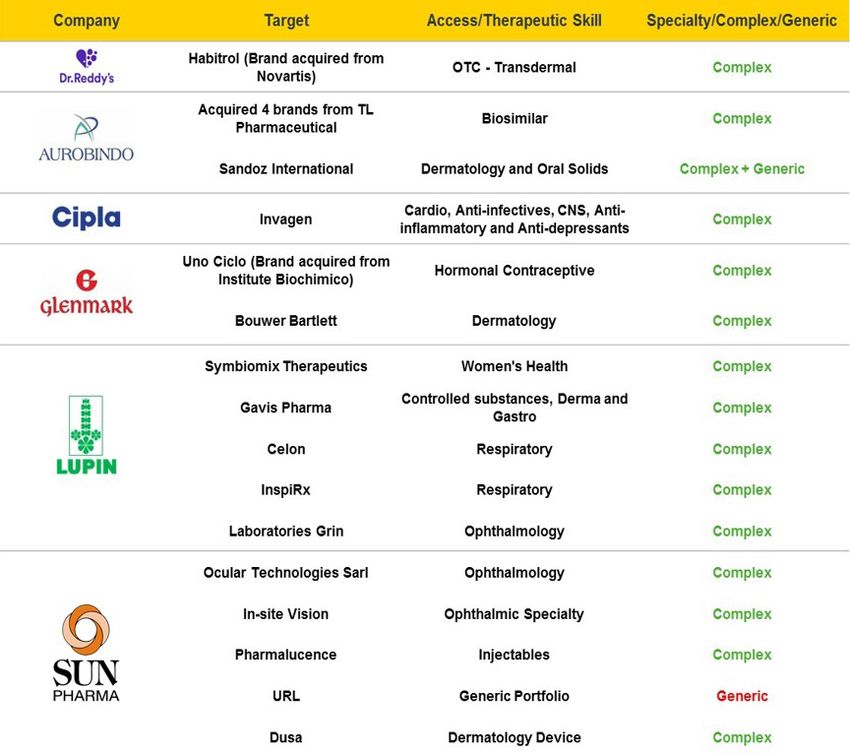
TABLE OF CONTENTS

Introduction                                                     3

ANDA Filing and Approval Trend                                   4

Evolution of Indian Players                                      7

   Launch of Complex Generics                                    8

   Order of Market Entry                                         9

Key Imperatives for Success of Indian Players in the US Market   11

   Right Portfolio Selection                                     11

   Time-To-Market                                                12

   Regulatory Compliance                                         14

Reference                                                        16

IQIVA Team                                                       17
INTRODUCTION

Generic drugs play an important role in the United States (US)
system of health care, accounting for greater than 90% of total
prescriptions1 dispensed in the US. The US generics market has
witnessed a transformation since 1984, post implementation of
the Hatch Waxman Act.

The Hatch-Waxman Act includes a number of                    The use of generics has increased substantially in
provisions to facilitate approval of generic drugs sold      the years following passage of the Hatch-Waxman
in the US by the Food and Drug Administration (FDA)          Act for a number of reasons namely; a) strengthened
and encourage generic drug entry, as described below:        mechanisms promoting generic use, such as tiered

1.   Abbreviated New Drug Applications (ANDAs)-              formularies with lower patient co-payments for

     By filing ANDAs, one seeks authorization to             generic than for brand-name drugs, and commercial

     generate generic copies of previously approved          insurance and public coverage plan restrictions

     drugs (also referred to as reference drugs).            limiting formulary coverage to generics in certain

     Although an ANDA must contain nearly the same           therapeutic categories; and b) state laws allowing

     information as an NDA, one major advantage              generic forms to be substituted automatically by

     over an NDA is that approval does not require           pharmacists for brand-name drugs prescribed by

     preclinical and clinical safety and efficacy testing.   physicians, so long as physicians have not specified

     ANDA approval is given based on therapeutic             that the prescription must be ‘‘dispensed as written.’’ 2

     equivalence of the generic drug with the reference      Attractiveness of the US generics market has resulted
     drug, primarily similar labeling, the same active       in a rise in the number of ANDA applications received
     ingredient(s), bioequivalence, and the same route       by the FDA, which has further undertaken initiatives
     of administration, dosage form, and strength.           to ease out the overall approval process. The FDA
                                                             introduced Generic Drug User Fee Amendments
2. 180-day generic exclusivity- This clause of               (GDUFA) to quicken delivery of safe and effective
     the Hatch-Waxman Act is intended towards                generic drugs to the public, and reduce costs to the
     stimulating the generic drug market by providing        industry. GDUFA was instrumental in improving ANDA
     an incentive to the first generic applicant who         approval rates, that have catapulted to ~65 ANDA
     challenges a branded manufacturer’s listed              approvals/month from ~40 in 2012. 3
     patents. In particular, the first ANDA-applicant to     The purpose of this paper is to understand the
     make a paragraph IV certification is rewarded with      changing pace of ANDA applications and how
     a 180-day period of exclusivity over other generic      companies worldwide, especially Indian players, are
     versions of the reference product if a court holds      tapping into this opportunity to successfully capture a
     the patent invalid or not infringed.                    larger chunk of the market.

                                                                                                          iqvia.com | 3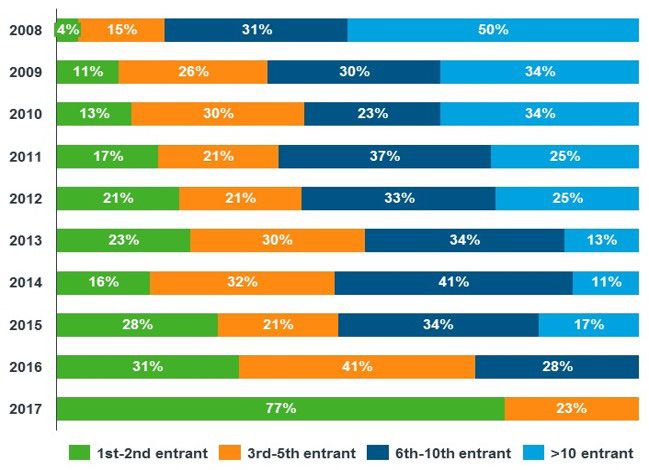
ANDA FILING AND APPROVAL TREND

ANDA applications have grown marginally since 2012                         applications. GDUFA implementation has helped
and have been range bound (1,000-1,100 applications/                       increase ANDA approval rates, that have catapulted
year) (Figure 1). During this period, the highest
        4
                                                                           to ~65 ANDA approvals/month from ~40 in 2012. With
number of ANDA applications were received in 2014.                         respect to ANDA review times, the average time for
However, that was majorly due to change in FDA                             FDA to complete the first review cycle decreased from
requirement of single exhibit batch stability data                         26 months for ANDAs submitted in fiscal year 2013 to
compared to three exhibit batch stability data for                         about 14 months5. With the incoming GDUFA II, the
ANDAs filed after July 2014.                                               review time for ANDA standard application is expected

Further, with the implementation of GDUFA, FDA                             to cut down further to 8-10 months.

committed to review and act on the backlog of ANDA

Figure 1: Year Wise (Jan-Dec) ANDA Applications

                            ANDAs Filed                                                     ANDAs Approved
                    1269
                                                      1128
        998                               1019

                                                                                                                         836

                                 676
                                                                                                                 614
                                                                                                       566
                                                                                     415        414

        2013         2014        2015      2016       2017                           2013       2014   2015      2016    2017

Source: FDA ANDA Approval Data

Figure 2: Generic Market Share (% of Total Rx)                             The increasing ANDA approvals have resulted in

                                                                    90%
                                                                           increase in market share of generic drugs among
                                                             89%
                                               87%
                                                      88%                  prescriptions from 72% in 2008 to 90% in 20176
                                        86%
                                 84%                                       (Figure 2). This has primarily been driven by the
                          80%                                              entry of generic players across therapies and loss of
                   78%
                                                                           exclusivity of patented products in the past decade.
            75%
                                                                           Within the past 5 years, drugs worth USD 83Bn have
     72%
                                                                           gone off-patent with another USD 72Bn worth of small
                                                                           molecule drugs slated to go off-patent in the next 5
                                                                           years7 (Figure 3).
 2008       2009   2010   2011   2012   2013   2014   2015   2016   2017

Source: IQVIA Institute

4 | US GENERICS MARKET- EVOLUTION OF INDIAN PLAYERS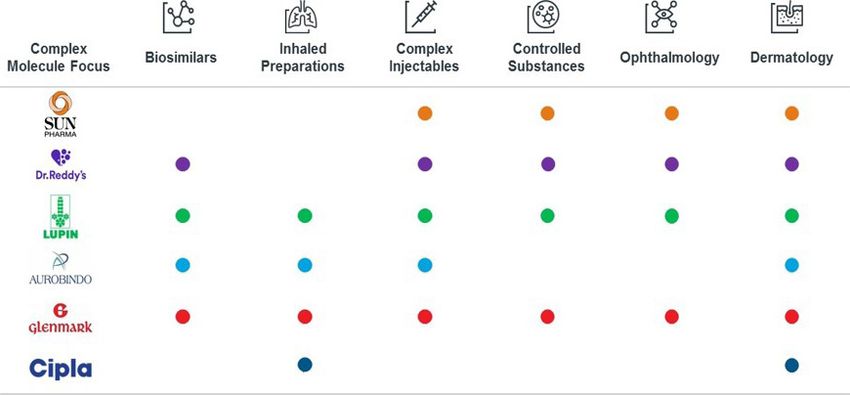
Figure 3: US Small Molecule Patent Expiry Exposure (USD Bn)
                                                                                               29

                                     24
                                                                                       23
                                                                   21
    18                    18
                 16
                                                                                15
                                                     14                                                                               14
                                                                                                            13
                                                           11                                                    12

                                                                                                                         5

   2009       2010        2011      2012           2013   2014    2015        2016    2017    2018        2019   2020   2021         2022
Source: IQVIA Institute

The increasing number of players filing ANDA                                  launch. As additional generic manufacturers market
applications for similar therapies has resulted in                            the product, the prices continue to fall with average
a highly competitive market with significant price                            generic prices dipping to less than 5% of the innovator
erosion. The price impact of having more number of                            in products with >10 generic players.8 Increasing
generic drugs for the same indication is dramatic.                            competitive environment and associated price
IQVIA analysis shows, on average, the first generic                           reductions resulted in a decline in generics market size
competitor prices its product at ~70%-80% of the                              from USD 77Bn to USD 71Bn between 2016 and 17.6
brand-name manufacturer. However, the entry of a                              The prescription price index which measures inflation
second generic manufacturer reduces the average                               in prescription drug prices by monitoring changes in
generic price to ~40%-50% of the branded drug price.                          consumer prices for a fixed basket of commonly used
In recent times, multiple generic players (5 or more)                         drugs has fallen to 26.27 as opposed 93.67 in 2008 for
have been entering at once, thereby resulting in price                        generics9. Interestingly, for branded drugs it increased
dips of ~50% of the innovator within the 1st year of                          from 107 to 308 during the same period (Figure 4).

Figure 4: Express Scripts’ Prescription Price Index

                                                                                                                                308
           Brand Prescription Price Index

           Generic Prescription Price Index
                                                                                                                  256
                                                                                                     220
                                                                                        192
                                                                         170
                                                           145
                           117                128
          107

                                                                                                     37           30
           94              92                                                                                                   26
                                              79           79
                                                                         57             49

          2008             2009               2010         2011          2012          2013          2014        2015          2016

Source: Health System Tracker

                                                                                                                             iqvia.com | 5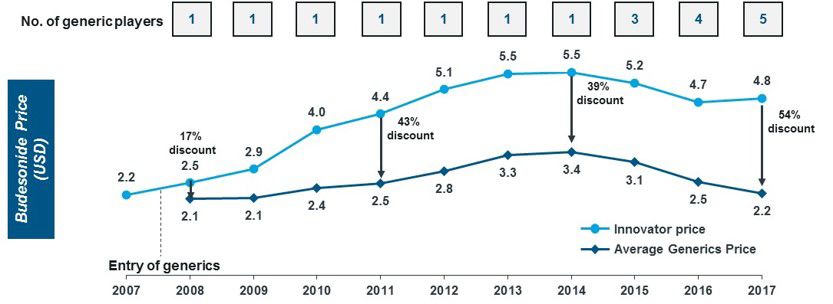
Figure 5: Consolidation of Distributor Organizations
                                                Medco

       Amerisource                           Express         Alliance          Walgreens Boots Alliance               Express Scripts
                          Walgreens                          Boots
       Bergen                                Scripts                           AmerisourceBergen                           Medco

       CardinalHealth           CVS                                            CardinalHealth                      CVS
                                             Caremark
                                                                                                                         Caremark

         McKesson              Rite Aid       Medco            Celesio         McKesson                   Rite
                                                                                    Celesio               Aid

Source: Generic Pharmaceutical Industry Yearbook

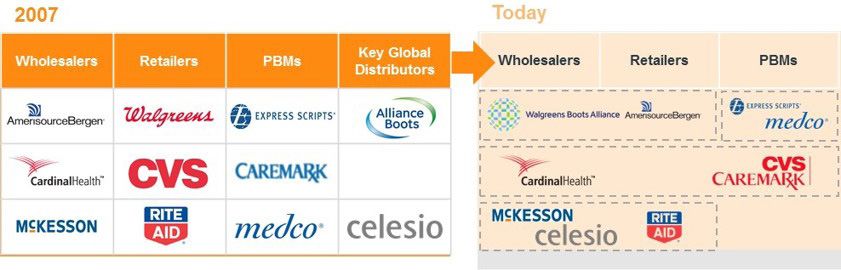
The decline in generic prices has further been augmented                  Figure 6: Market Share for Generics Buying Groups
by the rising trend in distributor consolidation. About                   in 2016
a decade ago, US had more than 10 pharmaceutical
                                                                          Walgreens                                                  31%
distributors contributing to ~80% of the US generic                       Boots
                                                                          Alliance
market. However, the last decade has been witness to
consolidation10 (Figure 5) so much that the top 3 players —               Red Oak                                              27%
WBAD, Red Oak and McKesson OneStop, have contributed
to >80%11 of the US generics market (Figure 6).
                                                                          McKesson                                         24%
With increasing consolidation in the pharma
supply chain, among wholesalers, PBMs, and retail
                                                                          OthersOthers                             19%
pharmacies, the bargaining power of these vertically
integrated players has improved drastically, leading to                   Source: Longer Term Investments, UBS (2017)

pricing pressure on small and medium sized generic
players. Increased bargaining power has resulted in a                     has grown in the past from USD 47Bn in 2012 to USD
4% – 5% discount in average generic sourcing cost.8                       71Bn in 2017, the annual growth rate has been constantly
Declining prices in the generics market due to rising                     declining from 22.8% in 2013 to 0.8% in 2016.12 The trend
competition from the surge in ANDA approvals and                          is likely to continue for the next few years with even
consolidation of distributors, has taken a toll on the                    negative growth rates before the market stabilizes and
generics market value. Although generics market size                      comes back on track by around 2020 (Figure 7).

Figure 7: US Generics Market Size (USD Bn)                                                                                   86
                                                                                                                 83
                                               76       77                                           79
                                                                    71                    73
                                      68                                       69

                         58

             47

            2012        2013          2014     2015     2016       2017       2018       2019       2020         2021       2022
Source: IQVIA Market Prognosis

6 | US GENERICS MARKET- EVOLUTION OF INDIAN PLAYERS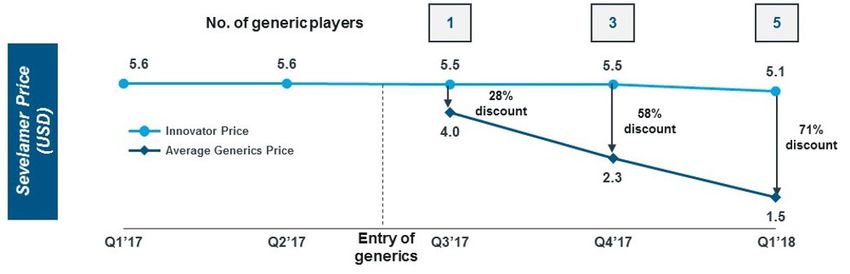
EVOLUTION OF INDIAN PLAYERS

Indian firms are rapidly expanding their presence in                      The clearances came despite regulatory pressure
the list of new generic approvals by the US Food and                      from the US Food and Drug Administration (FDA), and
Drug Administration (FDA). Indian pharma companies                        unprecedented warning letters issued to the pharma
received more than 300 approvals in 2017 to launch                        companies’ facilities. All drug majors — including
generic drugs in the US, which is an all-time high. Out                   Zydus, Sun Pharma, Dr Reddy’s and Cipla have faced
of the total ANDA approvals in the year 2016-17, Indian                   regulatory warning over the last 2-3 years.14
players have the highest share of ~40%13 (Figure 8).

Figure 8: Share of ANDA Approvals for Indian Companies

                         459             510             415           414             566          614           836

                         26%
                                         33%                           32%             32%          36%          38%
                                                        39%

                         74%
                                         67%                           68%             68%          64%
                                                        61%                                                      62%

                         2011            2012           2013           2014            2015         2016         2017

                                                           Indian Companies           Others
Source: FDA ANDA Approval Data

Figure 9: Aggregated Spend on R&D by Key Indian                              At a company level, Zydus leads with 66 approvals in
Players* (INR Cr)                                                            2017, followed by Aurobindo (52), Glenmark (18), Lupin
                                                                             (17), Gland Pharma (16) and Cipla (10). Zydus cornered

                                                               9,545
                                                                             majority of US filings as its Moraiya facility came out
                                                8,481                        of the USFDA scanner in June last year. Sun Pharma
                                +29%
                                 6,664                                       remained static at 10 approvals as its Halol plant was
                 4,842
                                                                             under the regulatory lens until recently.14
   3,456
                                                                             We believe that the share of Indian players will further
                                                                             increase to ~43%-45% over the next few years. The
   FY13           FY14           FY15           FY16           FY17
                                                                             reason for this increase is expected to be two-fold:

*Companies considered: Lupin, Zydus, DRL, Sun, Aurobindo, Jubilant,          1.   High R&D spend: Large Indian players continue
Glenmark, Cipla and Torrent                                                       to invest significantly in R&D. As seen in Figure
Source: Company Annual Reports
                                                                                  9, leading Indian players have increased their
                                                                                  R&D budgets by ~30% over the last few years,
                                                                                  indicating a good launch pipeline of these players.

                                                                                                                           iqvia.com | 7
2. Entry of new Indian players- The US market Figure 10: New Indian Companies Receiving ANDA
continues to see entry of two to three new Approvals
Indian players year after year, and these 45
2
companies are expected to further drive 3
the share of Indian players in overall ANDA 4
33 3
approvals. Large Indian companies like Mankind
and few Indian CDMOs are also planning to
enter the US market.
2013 2014 2015 2016 2017 Total
The increasing number of product approvals and New entrants
filings means that competitive intensity in the US,
Source: FDA ANDA Approval Data
a major market for many Indian companies, will *Name of new entrants in footnote
remain high and continue to put pressure on pricing.
Indian companies are reshaping their vision to reap 1. LAUNCH OF COMPLEX GENERICS
maximum value from the US market by extending While the number of ANDA filings continue to remain
the focus to complex formulations and launching strong for large Indian players, they have now
products early. begun transitioning the US business to specialty /
complex generics where competition is relatively
lower (Figure 11).
Figure 11: Complex Molecule Focus for Key Indian Players
Complex Inhaled Complex Controlled
Biosimilars Opthalmology Dermatology
Molecule Focus Preparations Substances Substances
Sun Pharma
Dr. Reddy’s
Lupin
Aurobindo
Glenmark
Cipla
Note- Analysis based on ANDAs filed and products under development
Source: Company Annual Reports
*List of New Indian Companies Receiving ANDA Approval
2014: Rubicon, Unimark Remedies, USV
2015: Granules India, Indchemie Health, Sidmak Labs India, Windlas Healthcare
2016: Biocon, Flamingo Pharma, Shilpa Medicare
2017: MSN Labs, Pharmtak
8 | US GENERICS MARKET- EVOLUTION OF INDIAN PLAYERSIndian players are also taking the acquisition route a significant presence in the US market have invested
to gain access to manufacturing units or proprietary in acquiring companies with focus on niche therapies
therapies. Most of the large Indian players that have (complex generics) (Figure 12).
Figure 12: Key Acquisitions by Indian Players
Company Target Access/Therapeutic Skill Specialty/Complex/Generic
Habitrol (Brand acquired from OTC - Transdermal
Dr. Reddy’s Novartis)
Complex
Acquired 4 brands from TL Biosimilar Complex
Pharmaceutical
Aurobindo
Sandoz International Dermatology and Oral Solids Complex + Generic
Cardio, Anti-infectives, CNS,
Cipla Invagen Anti-inflammatory and Anti- Complex
depressants
Uno Ciclo (Brand acquired from
Hormonal Contraceptive Complex
Glenmark Institute Biochimico)
Bouwer Bartlett Dermatology Complex
Symbiomix Therapeutics Women’s Health Complex
Controlled substances, Derma and
Gavis Pharma Complex
Gasto
Lupin
Celon Respiratory Complex
InspiRX Respiratory Complex
Laboratories Grin Ophthalmology Complex
Ocular Technologies Sarl Ophthalmology Complex
In-site Vision Ophthalmic Specialty Complex
Sun Pharma
Pharmalucence Injectables Complex
URL Generic Portfolio Generic
Dusa Dermatology Device Complex
Source: Crunchbase, VCCEdge
2. ORDER OF MARKET ENTRY companies to enter a molecule, which reduced to 50%
Indian players have been focusing on entering the in 2013-15. However, there has been a dramatic shift
market early to gain higher share in the market. in trend in the last couple of years, with >75% of Indian
IQVIA analysis shows that until 2012, ~60% of Indian players among the top 3 players to enter a generic
pharma players were typically among the top 6 or later molecule (Figure 13).
iqvia.com | 9Figure 13: Order of Market Entry for Indian Players
Note- Companies entering in the same month have been ranked equally
Source: IQVIA MIDAS Data
Early entry of Indian players has also been enabled by reduced from 1.5-2 years (2006-07) to ~7-9 months
increased focus on reducing the lead time between (2015-16) (Figure 14).
ANDA approval and market launch. The lead time has
Figure 14: Average Lead Time (in months) Between ANDA Approval and Launch for Indian Players
28
22
18
15
14 14
13 13
10 9
8
7
2005 2006 2007 2008 2009 2010 2011 2012 2013 2014 2015 2016
Source: IQVIA MIDAS Data, FDA ANDA Approval Data
10 | US GENERICS MARKET- EVOLUTION OF INDIAN PLAYERSKEY IMPERATIVES FOR SUCCESS OF
INDIAN PLAYERS IN THE US MARKET
The rising number of players targeting the US generics In the past, it has been observed that large Indian
market, a ramp-up in approval rates, consolidation players have only launched 75-80%13,15 of approved
among distributors (top 3 controlling 90% of the ANDAs. Wasted costs and time associated with
market) in the US and the falling number of products product failures result in huge financial loss – typical
going off-patent over the past few years, have driven cost of ANDA development for Indian players vary
significant crowding and pricing pressure in the US from INR 3-5 cr depending on the type of formulation
generics market. (simple generic vs. complex generic) (Figure 15). This
With affordable healthcare being a key focus area for demonstrates how product identification is one of
the US government, the outlook for generics prices the most crucial strategic consideration for generic
is expected to remain competitive in the near future. finished-dose companies (Figure 16).
While all generic companies are vulnerable to pricing
pressure, we believe that the smaller sized players Figure 15: Split of ANDA Development Cost
and new entrants will be most affected due to their
vanilla portfolios. Few well established pharmaceutical GDUFA 35-40%
companies have already started pursuing strong
BA/BE 22-25%
growth trajectories, through diversification to specialty
portfolio. Companies like Lupin, Sun Pharma and Manpower 15-17%
Aurobindo have made aggressive acquisitions in
Materials 13-15%
the complex molecule space and launched multiple
complex generics in the recent past. Many other Others 10%
companies are tending towards selection of products Cost of ANDA
3-5Cr
Development
with more complex chemistries where they foresee
high market opportunity with less competition, or Source: Expert interactions, IQVIA Analysis
the possibility of differentiating themselves beyond
price competitiveness. While complex generics is an
Large Indian players like Cipla are now focusing on right
emerging opportunity, Indian companies need to focus
portfolio selection as indicated by their MD “I do not
on the following to succeed in the US market:
think we are going to file more than 20 products in a
1. RIGHT PORTFOLIO SELECTION: year, but we will choose them well. Nowadays, in the US,
When aiming for a revenue-rich portfolio, generic you think you have a very good product but there are
finished-dose companies must critically evaluate multiple eight companies filing the product on day one and then
criteria like loss of exclusivity, market data, availability there are another five after that. We are running our R&D
of generics, manufacturing requirements and costs, machinery really hard and the outcome may not be what
forecasted competition etc. in order to increase the we want. So we will try and do less filings but focus on the
likelihood of success, and limit the risk of failure. ones that are lot more complex.”16
iqvia.com | 11Figure 16: Rating of Indian Players Based on Number of ANDAs Launched to ANDAs Approved
Alembic Aurobindo Torrent
Cipla Dr. Reddy’s Glenmark Jubilant Lupin Sun Pharma
Pharma
Note- Only molecules directly launched by the parent company between 2005 to 2016 considered
Source: IQVIA MIDAS Data, FDA ANDA Approval Data
2. TIME-TO-MARKET: lower competition - Budesonide (inhalation suspension)
To limit competition and prolong high profitability had just 1 generic player in the market until 6 years of
business, Indian pharma companies focusing on US LoE. However, of late, multiple players are entering the
market are building complex generics pipeline. However, complex generics market, as can be seen in the case of
with increasing number of players focusing on this Sevelamer, where generic prices dropped from 72% of
space, price erosion is expected to happen faster than innovator’s price to 29% within three quarters of launch
before. Historically, price erosion was limited due to due to entry of 5 generic players (Figure 17) .
Figure 17: Complex-Generics Price Comparison
Source: IQVIA MIDAS Data
12 | US GENERICS MARKET- EVOLUTION OF INDIAN PLAYERSAs a result, lead time to approval becomes very critical, (Figure 18), where Zydus was behind peers in terms
which in turn is a function of timing of filing, quality of of filing ANDA with USFDA (on the basis of application
work done to prove bioequivalence and establishing number). However, due to exhaustive and satisfactory
robust manufacturing processes that would enable up- data submitted by Zydus, it was the first to get its ANDA
scaling from lab to commercial level. approved by USFDA (Figure 18). In the current 55%
Submission of complete and satisfactory data can volume market share for Eletriptan generics, Zydus
substantially reduce time of correspondence between contributes 25%15. Thus, better the ANDA application,
ANDA filing company and FDA, thereby reducing faster is the time to market and higher is the scope for
approval time. We highlight the case of Eletriptan enjoying benefits post approval.
Figure 18: Approval Timeline for Eletriptan
Sequencing as per Sequencing as per
ANDA Number Approval Date
1 Teva 1 Zydus Although Zydus was the
fourth to file for
Eletriptan, it was the first
to recieve approval
2 Mylan 2 Teva
Ajanta
3 3 Mylan
Pharma
Ajanta
4 Zydus 4
Pharma
Source: FDA ANDA Approval Data
Timely approval needs to be backed by timely launch varies across Indian players from 1 month to >10 months
of the product in the market, as delay in launching of (Figure 19). Companies like Dr. Reddy’s and Glenmark
generics post approval has the potential of hampering have leveraged strong supply chain setups to ensure
the benefits that a company can enjoy in the market. launches within 2 months of approvals.13,15
The lag between ANDA approval to actual market launch
iqvia.com | 13Figure 19: Average Time from ANDA Approval to Market Launch
1 2 3 4 5 6 7 8 9 10 >10
month months months months months months months months months months months
Alembic
Aurobindo
Cipla
Dr. Reddy's
Glenmark
Jubilant
Lupin
Sun Pharma
Torrent Pharma
Note- Timeline based on products approved and launched between 2013 to 2016. Considered products directly launched by the parent company
Source: FDA ANDA Approval Data, IQVIA MIDAS Data
3. REGULATORY COMPLIANCE: intimation time for plant inspection has also been slashed
Adherence to the cGMP (current good manufacturing from 25-30 days to as little as 24 hours18.
practices) as per FDA guidelines, is sacrosanct to prevent Further, the FDA has intensified scrutiny on drug
regulatory clampdown on company facilities. India has the manufacturing facilities as companies are now being
highest number of FDA approved finished dosage facilities penalized for lapses such as inappropriate clothing of
(~200)17 . Hence, the relevance of Indian facilities is high in employees, improper washing conditions and inadequate
the global context (Figure 20). US FDA has increased the lighting, apart from issues relating to data integrity, batch
frequency of its inspections to once or even twice a year, failure investigations or improper quality control systems.
compared to once in two to three years earlier. The prior
Figure 20: Number of Inspections Conducted by USFDA in India
205
176
143
125 120*
114
102 102
93
46
2009 2010 2011 2012 2013 2014 2015 2016 2017 2018
*Data till Aug | Note- Only considered inspections and audits for drug quality assurance purposes
Source: US FDA Inspections and Audits report
14 | US GENERICS MARKET- EVOLUTION OF INDIAN PLAYERSCompanies failing to adhere to FDA guidelines have faced remained static at 10 as its Halol plant remained under
the brunt of not getting timely approvals in the past. the regulatory scanner of FDA.
For instance, Sun Pharma’s approval count for last year
We believe that although the US generic market will be challenging over the medium term, given
the pricing and competition risks, Indian companies with clear visibility in terms of US pipeline,
in advanced stage of making investments in complex molecule, robust supply chain setups in
the US and strong internal quality processes in compliance with FDA guidelines, are bound to
succeed.
iqvia.com | 15REFERENCES
1. IQVIA Medical Audit Data (MAT March 2018)
2. Updated trends in US brand-name and generic drug competition, JME (March 2016)
3. Activities Report of the Generic Drug Program, US FDA (2017)
4. State of OGD: Pivoting to GFUFA II, US FDA (2017)
5. Generic Drug Backlog at FDA: A Dive Into the Confusing Numbers, Regulatory Affairs Professionals Society
(November 1, 2016)
6. Medicine Use and Spending in the US, IQVIA Report (2017)
7. Global Generic and Biosimilar Trends and Insights, IQVIA Report (2018)
8. IQVIA Analysis basis a sample of 20 small molecules
9. What are the recent and forecasted trends in prescription drug spending?, Health System Tracker (December
20, 2017)
10. Generic Pharmaceutical Industry Yearbook, Torreya Partners (2016)
11. Longer Term Investments, UBS (2017)
12. IQVIA Market Prognosis Report
13. FDA ANDA approval data
14. Company Annual Reports
15. IQVIA MIDAS Data
16. Pricing woes force Cipla, Glenmark, Lupin to go slow on US drug pipeline, Business Standard (2018)
17. Indian drug makers under FDA radar as the US regulator approves more ANDAs, The Pharma Letter
(September 12, 2018)
18. Indian drug makers wary as US FDA sharpens focus on quality control, Livemint (May, 2017)
16 | US GENERICS MARKET- EVOLUTION OF INDIAN PLAYERSIQVIA TEAM
Jasdeep leads the management consulting practice and services business
in South Asia. He also drives the private equity program and cross-border
DR. JASDEEP SINGH collaboration work. He has been a trusted advisor to leading domestic
Senior Principal and and MNC companies, and private equity clients in India. He has on-ground
Consulting Head, experience with Pharma companies across functions of R&D and strategy
South Asia, IQVIA in both emerging and regulated markets. Jasdeep has authored various
research articles and whitepapers. He received a Bachelors and Masters
degree in Biochemical Engineering and Biotechnology from Indian
Institute of Technology, Delhi, and a Doctorate in Chemical Engineering
from University of Cambridge.
Mohit is part of the management consulting team based out of Gurgaon.
Mohit has worked on engagements across commercial due diligence,
MOHIT JAIN
business process improvement, market research, business strategy &
Sr. Consultant,
planning and sales & marketing effectiveness for both pharmaceutical
IQVIA India
and med tech players. Mohit received a Masters degree in Business
Administration from NMIMS University, Mumbai and has completed
his B. Pharma from School of Pharmacy and Technology Management,
Mumbai.
Pratyush is part of the management consulting team based out of
PRATYUSH GOEL Gurgaon. Pratyush has worked on various client engagements focusing
Analyst, on market assessment, growth strategies, pricing and due diligence
IQVIA India studies across the pharmaceutical industry. He has worked on various
point-of-view reports for private sector companies. Pratyush holds a
Bachelor’s degree in Chemical Engineering from Indian Institute of
Technology, Delhi.
iqvia.com | 17ABOUT IQVIA
IQVIA (NYSE:IQV) is a leading global provider of information, innovative
technology solutions and contract research services focused on using
data and science to help healthcare clients find better solutions for
their patients. Formed through the merger of IMS Health and Quintiles,
IQVIA offers a broad range of solutions that harness advances in
healthcare information, technology, analytics and human ingenuity
to drive healthcare forward. IQVIA enables companies to rethink
approaches to clinical development and commercialization, innovate
with confidence as well as accelerate meaningful healthcare outcomes.
IQVIA has approximately 55,000 employees in more than 100 countries,
all committed to making the potential of human data science a reality.
IQVIA’s approach to human data science is powered by the IQVIA
CORE™, driving unique actionable insights at the intersection of big
data, transformative technology and analytics with extensive domain
expertise.
IQVIA is a global leader in protecting individual patient privacy. The
company uses a wide variety of privacy-enhancing technologies
and safeguards to protect individual privacy while generating and CONTACT US
analyzing the information that helps their customers drive human
+91 22 7109 7200 / 7299
health outcomes forward. IQVIA’s insights and execution capabilities
help biotech, medical device and pharmaceutical companies, medical
LOCATION
researchers, government agencies, payers and other healthcare
stakeholders tap into a deeper understanding of diseases, human Unit No. 902, 9th Floor, ‘B’ Wing,
behaviors and scientific advances, in an effort to advance their path Supreme Business Park,
toward cures. To learn more, visit www.IQVIA.com Supreme City,
Hiranandani Gardens, Powai,
Mumbai - 400 076
DISCLAIMER
IQVIA has relied on information available through its proprietary databases and that which is available in the
public domain, towards preparing the document. The primary sources of data in preparing this report have
been documented throughout this report. While we have made an attempt to source data from reputable
sources, we do not accept responsibility for such information. Details of our primary information sources
are stated throughout the report and we have satisfied ourselves, so far as possible, that the information
presented in our report is consistent with other information available with us. We have not, however, sought
to establish the reliability of the sources by reference to other evidence.
As with any attempt to estimate future events, conclusions, and other information included herein are subject to
certain risks and uncertainties, and are not to be considered guarantees of any particular outcome.
All reproduction rights, quotations, broadcasting, publications reserved. No part of this document may be
reproduced or transmitted in any form or by any means, electronic or mechanical, including photocopy,
recording, or any information storage and retrieval system, without express written consent of IQVIA. •
©2018 IQVIA Incorporated and its affiliates. All rights reserved. Trademarks are registered in the United
States and in various other countries.
Copyright © 2019 IQVIA. All rights reserved. 02.2019.SouthAsiaYou can also read


