User Experience and Equity in Online and Hybrid Education: Build for all students - By Peralta Community College District - Online Teaching Conference
←
→
Page content transcription
If your browser does not render page correctly, please read the page content below
User Experience and Equity in
Online and Hybrid Education:
Build for all students
By Peralta Community College District
Alex Hernandez – Helpdesk Supervisor, Peralta Community College District – primary role is to develop
excellent user support for students and employees of the district, and to lead the team that responds to
help requests.
Alex has been working in IT, providing support to students in educational institutions for over 12
years. His educational background is in system administration and his expertise is well placed in
designing technical support systems. He provides leadership to a diverse team of support providers,
and specializes in building support resources for a very diverse student population. Alex is bilingual in
Spanish and English.
Srujana Tumu – Educational Technologies Analyst, Peralta Community College District - primary role is
administrator of the Learning Management System(s) and peripheral technologies
Srujana Tumu serves at the Educational Web Tech Analyst at Peralta Community College District. In
addition to serving as the LMS asministrator, she works to build bridges between technology,
faculty, and students. Srujana has an MS in Computer Science and has used her tech skills in
educational institutions since 2011. Srujana is multilingual, including fluency in Telugu, Hindi, and
English.
Co-Presenters Chelsea Cohen – Distance Education Coordinator, Laney Community College – primary role is training
and support to DE faculty and students
Chelsea is a trilingual tenure-track instructor in English to Speakers of Other Languages (ESOL) and
serves as Laney College’s Distance Education Coordinator. In addition, she is a trained peer reviewer
of online courses for the Online Education Initiative. She is passionate about instructional design and
equipping her students with technology skills that will open doors in both their educational and
professional lives.
Inger Stark – Distance Education Coordinator, Peralta Community College District – primary role is to
provide leadership and support to the four colleges as they develop and improve their online and hybrid
programs.
Inger is a tenured sociology instructor at Laney College, currently serving as the district Distance
Education Coordinator. Inger’s background includes 5 years as an administrator (4 years as a dean
and 1 as a Vice President of Instruction) and 12 years of teaching. Her favorite job responsibility is
teaching teachers how to create online learning activities that create a sense of student belonging
and classroom inclusiveness.
Distance Education
Retention and success
Terminology Achievement gap
Disproportionately impacted students
Diversity and inclusion
Equity
Growth of, and increasing dependence on,
technology - in education
Flat/decreasing enrollment in CCC system
Increased demand for online and hybrid
learning opportunities
Context
Achievement gaps between F2F and distance
education students
Long standing achievement gaps among
student populations, which are exacerbated
in distance education environments
Our Message: Build for all Students

          • Institutionalize processes and practices
            that support equity.
Peralta   • Use research based interventions.
          • Peralta Equity Rubric overview
            •F1 - Alex
            •F2, F3, F5 & F6 - Chelsea
            •F8 - Srujana
F1:
Technology   Alex Hernandez
Access
How are students going to access online?
Login Portal PC/MAC
Single Sign-On Mobile devices
F1:
Software Browsers
Technology
AccessEnglish Speakers of Other Languages
(ESOL)
Disproportionately impacted students
New students
F1:
Technology Returning students
Access Prospective studentsF2, F3, F5, F6 Chelsea Cohen
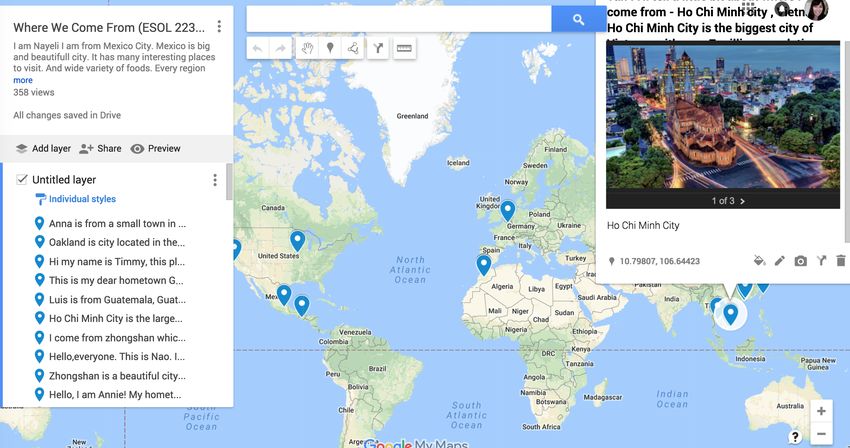
Example Activity:
Google Maps Introduction Activity by Anna Cortesio
F2: Diversity
and Inclusion
How does this support equity?
1. Creates connections
2. Honors students stories and unique life
experiences
3. Can be done in ANY disciplineExample Activity:
Instructor chose a textbook with valuable
information but images were not diverse or
inclusive.
Steps to addressing this inequity:
F3: Images Raised awareness by acknowledging the
and represent limited and biased representations
ation Expressed her discomfort
Facilitated dialogue around representation
and stereotypes
Encouraged students to write letters to the
publishers about why inclusive materials
matterHow does this support equity?
She wanted them to know in her class,
she understood invisibility
F3. Images The students who were not
and represent represented were acknowledged and
ation valued
For students who WERE represented,
she wanted them to notice the
exclusion of others in the bookThe Activity:
"I'm having my students create presentations on the film and then lead
community presentations and film screenings before they submit their
film analysis essays. They take pictures, videos or recordings of their
F5. Content presentation and then write about it. I literally have 35 videos, pictures
and/or recordings of families, friends and roommates coming together
Meaning debating concepts in the film. -Alicia Caballero-Christenson
F6.
How does this support equity?
Personal
Connections 1. Creates connection in the community and within the
class
2. All learners becomes an expert in the subject
3. In the discussion, students could connect their own
socio-cultural backgrounds with the socio-cultural
backgrounds of othersUser experience activity
• You're an online student at the college on the index
card you received
• You urgently need tutoring and other online student
resources.
F8. Student • Try to find those resources.
Support • When you're done, report your experience at:
https://tinyurl.com/pccd-otc
http://backchannelchat.com/Backchannel/bkjjxF8 – Student
Srujana Tumu
SupportUse the rubric to structure student support
similar to the way it is used to structure
F8. Student classes
Support • Images and representation (F3)Use the rubric to structure student support
• Images and representation (F3)
F8. Student • Diversity and Inclusion (F2)
Support • Personal connections (F6)Suggestions
• Preferred name / gender
• Include students in building resources and have
students test the resources
F8. Student • Having multilingual support staff
Support • Make resources available in multiple places and
formats, and accessible from multiple places
• Faculty know the resources available
• Subtitles in multiple languages in informational
videosReminder: @ONE new course: "Equity & Culturally Responsive Teaching in the Online Environment" Questions, suggestions, ideas, and discussion
You can also read


