Video Entertainment Market Outlook - COVID-19 has provided a massive boost to SVOD at the expense of other video formats - Venture Insights
←
→
Page content transcription
If your browser does not render page correctly, please read the page content below

Video Entertainment Market Outlook
COVID-19 has provided a massive boost to SVOD at the expense of other video formats

January 2021
January 2021

Executive Summary
                                                            Premium Pay-TV
•       We forecast the Australian video market to          •   We expect Pay-TV revenues to decline to A$1.6b in 2024.
        decline at a 2% CAGR to about A$5.5bn in            •   Foxtel is attempting to reinvent itself in a structurally challenged market
        2024, driven primarily by the revenue deflation         environment as multiple SVOD platforms emerge to grab audience share. SVOD
                                                                services like Foxtel Now and Kayo are becoming increasingly important as Foxtel
        as viewing shifts from traditional to digital
                                                                battles to retain subscribers as ARPUs decline.
        platforms.                                          •   But with growth shifting to SVOD, Foxtel faces the risk of cannibalising its existing
                                                                high ARPU customer base. Coupled with high fixed sports programming costs,
•       COVID-19 has provided a massive boost to                this means that Foxtel revenues will remain under pressure.
        SVOD revenues, which will continue to grow at
                                                            SVOD
        a 9.3% CAGR through to 2024. However, we            •   SVOD received a major boost due to COVID-19 lockdown. Its FY20 revenues
        forecast a significant decline in Pay-TV and            jumped by 34% YoY.
        Physical media formats.                             •   The market is set for a renewed bout of competitive intensity driven by the entry
                                                                of multiple new players. We expect SVOD revenues to increase at a 9.3% CAGR
•       Pay-TV will remain under pressure driven by             through to 2024.
        the structural changes in the way video content     •   Among the new entrants, we expect Disney+ to become a major player driven by
                                                                its massive content catalogue and global brand leadership.
        is consumed. While Foxtel will offset some of
                                                            •   While we expect Disney+ to be a formidable competitor, we expect Netflix to
        this pressure by participating in the SVOD              maintain its dominant position in Australia as its local content catalogue remains
        market, it will not be able to recover the losses       significantly larger than that of Disney+ at launch.
        in its traditional Pay-TV business.                 TVOD and EST (see Glossary for definitions)
                                                            •  We expect TVOD/EST revenue to grow at a 3.8% CAGR through to 2024. While
•       Technology has rendered much of the physical
                                                               we expect some existing users to migrate to SVOD, we also expect new users
        media industry obsolete as consumers move              (i.e. those currently buying Physical Media) to start to buy TVOD/EST services.
        away from renting and storing movie content         Physical Media
        on DVD and Blu-ray discs, to digital formats.       •   Physical media continues to decline. We expect a revenue CAGR of -10.6%
                                                                through to 2024.
•       Cinema revenues are projected to decline
                                                            Cinema
        gradually primarily due to cheaper substitutes
                                                            •   We expect Cinema revenues to decline at a relatively modest pace of -0.3%
        on offer for consumers.                                 CAGR through to 2024 driven by a declining per capita admissions rate. The
                                                                decline in admissions is expected to be partially offset by a focus on targeting
                                                                newer audience segments.

210129 Video Entertainment Market Outlook                          2
January 2021
Summary
Average household spend on Video Entertainment to decline driven by the shift to streaming
platforms
Fig 1: Household spending on video entertainment
• The rise of streaming has driven a significant change in how
video content is consumed. While viewers today have 2010 2020 2024F Example of Supplier
significantly more choice when it comes to content, we don’t
expect any increase in household spending on video.
• In fact, Venture Insights forecasts average household spending
TOTAL A$673 A$599 A$516
on video to decline in line with historical trends driven primarily
by the price deflation due to the shift from from traditional to
digital platforms.
Pay-TV A$282 A$264 A$155
• Average Australian household spend on video is expected to
continue declining at an expected -3.6% CAGR; falling from
A$599 in FY20 to A$516 in FY24.
• The shift from traditional to digital formats is evident across the
entire video spectrum: SVOD A$0 A$147 A$196
− Premium Pay-TV, traditionally the dominant video source, has
seen its price dominance erode as prices have declined due
to competition with SVOD
TVOD/EST A$0 A$26 A$28
− Physical media (the retail and rental of DVDs and Blu-ray) are
also experiencing strong revenue pressures, as households
transition their dollars to SVOD services and as major
electronics manufacturers discontinue the production of DVD
and Blu Ray players Physical A$257 A$37 A$22
− Cinemas are also expected to continue being impacted by
decreasing attendance as consumers delay viewing of non-
essentials, opting for a more convenient digital experience
Cinema A$135 A$125 A$118
− Viewing minutes are being funnelled into SVOD services,
which have lower price points.
Source: VENTURE INSIGHTS
210129 Video Entertainment Market Outlook 3January 2021
Summary
Digital continues to grow with overall market declining through to 2024
• We expect the total video entertainment market to decline to 2024 (-2% Fig. 2: Video revenues by platform (A$m)
CAGR). We detail the individual video platform forecasts below, but in
short, the declining outlook reflects declines in Physical Media and Pay 5500
TV despite a growth principally in SVOD services.
5000
• The launch of multiple new SVOD platforms in 2019 and 2020 will
4500
increase the competitive pressures on traditional platforms and
accelerate the shift away from linear viewing. 4000
• The Video Entertainment Market is expected to decline at -2% CAGR 3500
through to 2024. Within this, we forecast:
3000
• SVOD/IPTV: revenue to grow at a 9.3% CAGR to reach
A$2.1bn by 2024 driven by increasing penetration (both new 2500
customers and an increase in SVOD subs per household) and growth 2000
due to COVID-19.
1500
• Premium Pay-TV: subscriber revenue to decrease at a -11.1% CAGR
1000
dropping to A$1.6bn in 2024 from A$2.6bn in 2020.
• TVOD/EST : revenue to grow at a 3.8% CAGR through to 2024. 500
• Physical Media (DVD / Blu-ray): revenue to contract at a -10.6% CAGR 0
to reach A$236mn by 2024.
F
F
F
F
A
A
A
A
A
A
A
A
21
22
23
24
13
14
15
16
17
18
19
20
• Cinema: revenue to decline at a -0.3% CAGR, to A$1.2bn by 2024
20
20
20
20
20
20
20
20
20
20
20
20
driven by the structural shift to digital alternatives.
Premium Pay-TV SVOD TVOD/ EST Physical Media Cinema
Fig. 3: Video industry revenue forecasts by platform (A$m)
Video market forecasts (A$m) FY18A FY19A FY20A FY21F FY22F FY23F FY24F CAGR (FY20–24)
Premium Pay-TV (excl. advertising) 2,627 2,646 2,629 2,047 1,942 1,885 1,642 -11.1%
SVOD/IPTV 783 1,090 1,460 1,584 1,741 1,936 2,081 9.3%
TVOD/EST 237 245 256 266 275 284 297 3.8%
Physical Media 518 437 370 325 292 262 236 -10.6%
Cinema 1,245 1,229 1,238 1,235 1,232 1,229 1,225 -0.3%
Total video market revenue 5,410 5,647 5,953 5,457 5,483 5,597 5,481 -2.0%
Video market revenue growth (%) 4.4% 5.4% -8.3% 0.5% 2.1% -2%
Source: VENTURE INSIGHTS, COMPANY
210129 Video Entertainment Market Outlook 4January 2021
Premium Pay-TV
Foxtel continues to face structural hurdles even as new SVOD players with deeper pockets
emerge
• Up until about six years ago, Foxtel had enjoyed uninterrupted growth as Fig. 4: SVOD pricing by platform (A$ per month)
Australia’s monopoly premium Pay-TV provider. But the arrival of both
international SVOD players and local SVOD challengers is now having a 25
significant effect on Foxtel.
• The SVOD growth surge under COVID and the associated lockdowns has
accelerated migration from traditional Pay TV to SVOD. We believe Foxtel will 20
aim to stabilise Pay-TV subscriptions at the cost of ARPU, but Foxtel’s
challenges are structural and it will not be able to recover all of its lost revenue.
• To make matters worse, the Australian SVOD market is set for a renewed bout 15
of competitive intensity with Disney+ and Apple TV+ making inroads. Foxtel,
which has been quietly chipping away at its new strategy of developing 25
standalone OTT platforms, will see a pick-up in pricing pressure in 2021 as the
10 20
new entrants prioritise reach over revenues. Both platforms are priced at a 50- 19
70% discount to comparable plans from Netflix, Stan and Foxtel Now. If Foxtel
Now cuts prices in response, it will need to significantly increase penetration to
grow revenue. 5
8.99
7.99
• Given the structural challenges it faces and the rise of competitor SVOD
services due to COVID-19 in Australia, we forecast Premium Pay-TV revenues to
fall from A$2.9bn in FY20 to A$1.9bn by FY24. We also note the risk of the 0
Foxtel business reaching a tipping point if its foray into SVOD fails to make an Foxtel Now Netflix 4K Stan 4K Disney+ Apple TV+
impact.
Fig 5: Premium Pay-TV forecasts
Pay-TV Forecast FY17A FY18A FY19A FY20A FY21F FY22F FY23F 2024F
Households (000's) 9,423 9,594 9,766 9,939 10,110 10,281 10,443 10,615
Premium Pay-TV penetration (%) 27.1% 25.3% 27.7% 20.7% 19.8% 19.0% 18.2% 17.5%
Subscribers - Premium (000's) 2,550 2,432 2,703 2,054 2,002 1,952 1,904 1,856
ARPU - Premium (A$) 77 78 74 74 71 69 67 65
Revenue - Premium (A$m) 3,149 3,078 3,046 2,947 2,368 2,263 2,206 1,962
Revenue pcp growth (%) -2.3% -1.1% -3.2% -19.6% -4.4% -2.5% -11.1%
Source: VENTURE INSIGHTS, COMPANY
210129 Video Entertainment Market Outlook 5January 2021
Premium Pay-TV – Kayo and the risks of cannibalisation
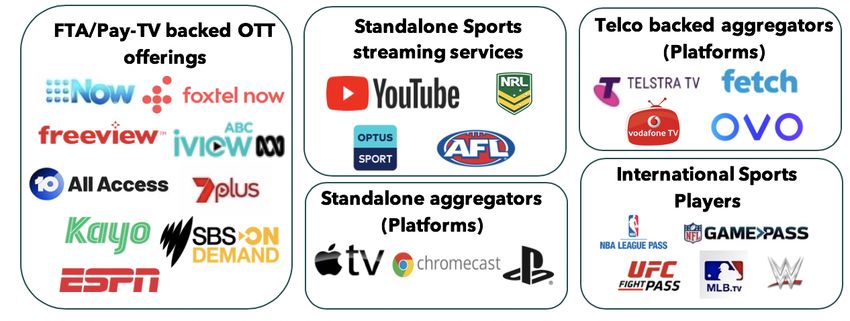
Rise of sports streaming apps and 5G could threaten Foxtel in Live Sports
Fig 6: Will Kayo cannibalise Foxtel?
• In the last few years, new platforms are threatening to disrupt
the most important pillar of Foxtel’s product offering – Live
Sports. In response, Foxtel has launched its standalone sports
streaming service – Kayo Sports.
• But while Foxtel hopes that Kayo will help expand its subscriber
base and appeal to younger audiences, Kayo also risks 82%
cannibalising Foxtel’s existing subscribers that are on higher 66% 34%
priced premium packages.
• According to Venture Insights’ 2020 consumer survey, 18% of 18%
Foxtel subscribers said that they would change their Foxtel
subscription after the Kayo launch.
I am not a Fox tel subscriber
• Foxtel also risks losing some of its sports focused customer
I am a Foxtel subscrib er and d o not plan to change m y sub sc ription due to Kayo
base to telcos that are looking to expand their content offerings
I am a Foxtel subscrib er and d o plan to (have) alter m y subscription due to Kayo
using sports. Optus in particular has established itself as the
premier Football streaming provider in Australia with its focus Fig 7: Rising competition in sports streaming
on European Football. We expect sports streaming to emerge
as a key use case for 5G and expect telcos to combine 5G and
sports streaming to extract a revenue premium from customers
willing to pay for a better sports streaming experience.
• We believe Foxtel will need to go beyond lower pricing, promo
offers and SVOD. Foxtel should be looking to position itself as
the aggregator of choice by offering multiple streaming
services under one bill and one interface. The move to integrate
and bundle Netflix with Foxtel was a step in the right direction,
but it may be a case of too little too late as Netflix is already
available on multiple other devices and platforms.
Source: VENTURE INSIGHTS
210129 Video Entertainment Market Outlook 6January 2021
SVOD
The SVOD market is set for a renewed bout of competitive intensity driven by the entry of
multiple new players
• Netflix has maintained its dominance of the Australian SVOD market. We Fig 8: SVOD revenue and pcp growth (A$mn, %)
estimate that Netflix has 5mn+ paying subscribers in Australia.
2500 160%
• However, the SVOD market is entering a new era of streaming wars with
new international players with deeper pockets emerging. We expect new 140%
players like Disney+ and Apple TV+ to focus on grabbing market share 2000
over revenues. Both Disney+ and Apple TV+ are priced about 50% 120%
cheaper than the comparable Netflix / Stan plans.
100%
1500
• We think this competition will keep SVOD prices down until market shares
stabilize. 80%
• We forecast subscriber growth of 6.4% CAGR through to 2024 along with 1000
60%
corresponding SVOD revenue growth of 9.3% CAGR. Our forecasts are
based on the following assumptions: 40%
500
– Subscribers to grow to 13.7m by 2024, driven strongly by ongoing
20%
growth of Netflix as well as uptake of Disney+. Individual subscribers
will increasingly have more than one subscription in order to access
0 0%
unique content across different platforms. 2015A 2016A 2017A 2018A 2019A 2020A 2021F 2022F 2023F 2024F
– ARPU to remain steady around A$11-A$12 through to 2024.
SVOD revenues (A$m, LHS) pc p grow th % (RHS)
Fig 9: SVOD forecasts
SVOD Forecast FY18A FY19A FY20A FY21F FY22F FY23F FY24F CAGR (FY20–24)
Households (000's) 1.7%
9,594 9,766 9,939 10,110 10,281 10,443 10,615
Household penetration (%)
48% 62% 74% 78% 83% 84% 86%
SVOD subs per HH (approx.) (ratio)
1.4 1.4 1.5 1.5 1.6 1.6 1.5
SVOD subscribers (000's) 6.4%
6,202 8,505 10,681 11,803 13,259 13,489 13,700
ARPU (A$) (2.9)%
12 12 13 12 12 11 11
Total SVOD Revenue (A$m) 9.3%
783 1,090 1,460 1,584 1,741 1,936 2,081
Source: VENTURE INSIGHTS, COMPANY
Note: Includes IPTV subscribers (i.e. Fetch, Foxtel on T-Box).
210129 Video Entertainment Market Outlook 7January 2021
SVOD
Netflix to remain the largest SVOD player but will face increasing competition from new
players such as Disney+
• New streaming services are expected to give incumbents Netflix and Stan a challenge right out of the gate with the new players focusing on
grabbing audience share over profitability.
• Among the new entrants, we expect Disney+ to become a major player driven by its massive content catalogue and global brand leadership.
We also anticipate Disney to pull off a ‘Verizon’ type deal in Australia and partner with a major telco. Verizon in the US, offers 12 months free
Disney+ service to new subscribers.
• We estimate Disney+ had about 1.2mn subscribers in FY20 and further expect its subscriber base to increase to 4mn subscribers by the end of
FY24.
• While we expect Disney+ to be a formidable competitor, we expect Netflix to maintain its leading position in Australia as its local content
catalogue remains significantly larger than that of Disney+ at launch. Disney+ launched with 600+ TV shows and movies while Netflix has more
than 4,000 TV shows and movies in its Australian catalogue.
• Furthermore, globally, Netflix outspent Disney by nearly 4x on original content in 2020 with Netflix estimated to have spent US$4.4bn while
Disney is estimated to have spent US$1.3bn. In January 2021, Netflix announced it will no longer needs external financing to fund its operations.
Fig 10: SVOD subscriber market share (%) Fig 11: Estimated original content spending in 2020 – Netflix vs Disney (US$b)
100% 5.0
11% 15%
90% 20% 4.5
27% 26%
80% 4.0
70% 18% 20% 3.5
60% 21% 3.0
20%
18%
50% 16% 17% 2.5
40% 2.0
30% 62% 59% 1.5
51% 48%
20% 45% 42% 42% 1.0
10% 0.5
0% 0.0
2018A 2019A 2020A 2021F 2022F 2023F 2024F Netfli x Disney
Netfli x Stan Fetch Foxtel Now Kayo Sports Disney+ Amazo n Other
Source: VENTURE INSIGHTS, COMPANY
210129 Video Entertainment Market Outlook 8January 2021
TVOD/EST
Growth to continue
• We expect TVOD/EST revenue to grow at a 3.8% CAGR to reach A$297m by 2024. While we expect some existing users to migrate spend
to SVOD, we also expect new users (i.e. those currently buying Physical Media) to start to buy TVOD/EST services.
• Although the majority of streamed video watching will be undertaken through SVOD, for content not available on SVOD (specifically new
film releases), TVOD/EST will be the dominant method of consumption.
• TVOD generates 60% of the revenue within the sector; only movie content is being purchased through this service as users opt to rent or
subscribe to SVOD in order to watch TV series.
• EST has a near 60:40 split of revenue from movie and TV content.
• The rise of SVOD has had a knock-on effect on the amount of video piracy occurring within Australia, with numbers significantly reducing –
the number of Australians consuming only pirated content has reduced from 12% in 2015 to 1% in 2019 while the number of Australians
consuming a mix of both legal and pirated content has reduced from 31% in 2015 to 15% in 2019.
• The Australian Government is striving to reduce piracy within the nation, introducing a number of Anti-piracy laws since 2015. As the
government continues to make the piracy of video content more difficult, TVOD/EST is the clear option for viewing content not on SVOD.
Further anti-piracy regulations will in turn drive growth in TVOD/EST.
Fig 12: TVOD/EST forecast (A$m) Fig 13: TVOD/EST revenue mix (%)
300 100%
297
284 90%
250 275
266
256 80% 43% 41% 40% 40% 40% 40% 40% 39%
245
237
221 70%
200
60%
150 50%
40%
100
30% 57% 59% 60% 60% 60% 60% 60% 61%
50 20%
10%
0 0%
2017A 2018A 2019A 2020A 2021F 2022F 2023F 2024F 2017A 2018A 2019A 2020A 2021F 2022F 2023F 2024F
TVOD EST
Source: VENTURE INSIGHTS, Consumer Survey on Online Copyright Infringement 2019
210129 Video Entertainment Market Outlook 9January 2021
Physical Media
The ubiquity of streaming platforms will accelerate the decline of physical media
• Technology has rendered much of the physical media industry obsolete as consumers move away from renting and storing movie content on
DVD and Blu-ray discs, to digital formats.
• Digital video streaming quality has dramatically improved in the past few years from SD quality to 4K streams. The decline in consumption of
physical media has also forced major electronics manufacturer Samsung to announce that it will stop manufacturing Blu Ray players.
• We expect Physical Media (DVD / Blu-ray) revenue to contract at a -10.6% CAGR to reach A$236mn by 2024, at which point rental revenue will
be largely insignificant (A$1mn) and retail revenue will have dropped to A$235mn. COVID-19 has added to the decline of this industry.
• Rental
− Over the last decade, rental businesses for DVDs have largely disappeared – the number of DVD rental stores have declined from more
than 2,000 to fewer than 500 stores. We expect this decline to accelerate as faster internet speeds (5G and NBN) and changing video
consumption habits (from TV to smartphones) reduces the propensity to rent DVDs i.e. video viewing is moving to devices that are not
addressable by physical media.
• Retail
− We expect retail sales to decline at a -10.5% CAGR to 2024 as consumers migrate to more convenient and relatively lower priced SVOD
and TVOD/EST platforms. However, we anticipate that there will still be a market for physical retail through to 2024, as a small percentage
of consumers will still want to physically own their video content, despite the majority transitioning to SVOD.
Fig 14: Physical Media forecasts Fig 15: Number of Video Releases on DVD, VHS and Blu-Ray
650
7,000
575
6,000
500
5,000
425
4,000
350
275 3,000
200 2,000
2017A 2018A 2019A 2020A 2021F 2022F 2023F 2024F 2009 2010 2011 2012 2013 2014 2015 2016 2017 2018
Source: VENTURE INSIGHTS, Screen Australia
210129 Video Entertainment Market Outlook 10January 2021
Cinema
Revenues are projected to decline gradually over the next 4 years primarily due to cheaper
substitutes on offer for consumers
• Over the past two decades there has been a massive change to the cinema landscape with consumers turning to cheaper alternatives as technology
improves such as the introduction of the DVD and more recently SVOD platforms.
• Cinema distributors and exhibitors have been conservative in their response to the changing market. They have tried to maintain revenues by
increasing pricing and have consequently barely scratched the surface of innovation.
• Cinema attendance per capita in Australia has been in steady decline since ‘A Beautiful Mind’ swept the Academy Awards in 2002. The primary reason
behind the steady drop in attendance has been the new availability of close substitutes. The first drop in attendance rates (2002-2006) was likely due
to the release of the DVD in 2000, which became a staple in most households by 2002. The second major drop in cinema attendance rates started in
2010 and this not surprisingly coincided with the popularity of illegal piracy and was further accentuated by the transformation of Netflix from a DVD
rental company to an SVOD platform.
• Coinciding with these changes has been the improvement of home entertainment technology. Most family homes now have large television screens
and high-quality sound systems which reduce the need to go to a ‘big screen’.
• Total Cinema revenue is forecast to gradually decline to A$1.2bn by 2024, a -0.3% CAGR driven by a declining per capita admissions rate and limited
flexibility in increasing ticket prices.
• In order to counter the declining admissions rate, Australian Exhibitors have been releasing more Asian films to target the increasingly multicultural
population. In 2019, around 40% of movies released in Australia were from Asia, compared to 4 in 2002%.
Fig 16: Cinema revenues, FY17 – FY23 (A$m) Fig 17: Admissions per Capita (2006-2018)
1300 5 2000 - DVD launches
1250 4
1200 3
2010 – Over 50% of
Australians pirated a
1150 2 movie 1
1100 1
1050 0
1976
1978
1980
1982
1984
1986
1988
1990
1992
1994
1996
1998
2000
2002
2004
2006
2008
2010
2012
2014
2016
2018
1000
2017A 2018A 2019A 2020A 2021F 2022F 2023F 2024F
Source: VENTURE INSIGHTS, Screen Australia
210129 Video Entertainment Market Outlook 11January 2021
Glossary
Glossary of Sector Definitions
Type of Video Description Companies Revenue from
Subscription and
Pay TV Broadcast television that requires a subscription to watch Foxtel, Optus TV
Advertising
Seven, Nine, Ten, ABC, WIN,
Free to Air Broadcast television that is free to watch Advertising
SBS
On demand video that requires a subscription and is Netflix, Stan, Foxtel Now,
SVOD Subscription
delivered OTT Amazon Prime, Other
On demand video that is purchased (EST) or rented (DTR)
iTunes, Google Play, BigPond
TVOD through a single transaction (i.e. not subscription based) One off purchase
Movies,
and is delivered OTT
Digital video (delivered OTT) that is free to watch and is iView, SBS on Demand, Plus7,
BVOD Advertising
funded by advertisements 9Now, Tenplay
Warner Home Video, Walt
Physical Video Purchase / rental of physical DVD's and Blu-Rays Disney Studios, Universal, One off purchase
Roadshow
Event Cinemas, Village
Cinemas, Hoyts Cinemas, Ticket purchases
Cinema Video content that is shown in a cinema
Reading Cinemas, Palace and Advertising
Cinemas
Source: VENTURE INSIGHTS, COMPANY
210129 Video Entertainment Market Outlook 12January 2021
Methodology and Definitions
Methodology and definitions
• Our forecast methodology assesses consumer viewing behaviour and focuses on ‘end-state’ behaviours (and spending patterns) at
the end of our five-year horizon. To achieve this, we have drawn on industry interviews, global comparative data and analysis
(including via our partners at Enders Analysis)
• The methodology section also contains important definitions (i.e. Premium versus Pay-lite) which should be understood before
reading on
• The next page provides an illustrative overview of the methodology and our forecast data. We highlight the following definitions to
be aware of:
– Pay-TV: Our Pay-TV forecasts reflect Premium Pay-TV services only, which we define as services provided via Foxtel’s HFC or
satellite service where the service is delivered to a set-top-box
– Pay-lite Pay-TV: Although this definition is not referred to within this report, historically Pay-lite was defined as services provided
via the internet and can be bundled in the sale of broadband. Pay-lite includes SVOD services. These are excluded from our
Pay-TV forecasts and are included in our SVOD forecasts.
– Cinema: While not specifically a home entertainment video service, we include in our model to reflect that customers have a
choice between video services consumed in the home and the cinema. Equally, and while not contained in our model here,
when we assess share of time across video/TV, we include free-to-air TV in our assessment
Source: VENTURE INSIGHTS, COMPANY
210129 Video Entertainment Market Outlook 13January 2021
Methodology and Definitions
Bottom Up forecast methodology
Pay-TV SVOD TVOD/EST Physical Media Cinema
Premium Pay-TV - services provided Includes SVOD services (Netflix, Includes all TVOD/EST services Includes DVD and Blu-ray Includes all movie theatrical
DEFINITION
via Foxtel's HFC or satellite service Stan, Amazon Video) plus Pay-lite (including iTunes, BigPond, Google, Includes all Rental (incl. rental kiosks) and services
Pay-lite - is backed out of the Pay-TV type services (Foxtel Now, Fetch) Fetch etc) Retail (i.e. JB Hifi, Dick Smith, Target, K-
forecast (included SVOD) Mart, ABC Stores etc)
• Household penetration • Household penetration • Transaction volumes - across rental, • Transaction volumes - rental vs sell- • Box office admissions
• Subscribers by operator • Subscribers by operator sell-through split by movie vs TV through (retail) • Average Ticket Price (ASP)
content • Average Selling Price (ASP) - rental
• ARPU by operator • ARPU by operator • Revenue
METRICS
• Average Selling Price (ASP) - across vs sell-through (retail)
• Revenue by operator • Revenue by operator
rental, sell-through split by movie vs • Revenue - rental vs sell-through
TV content (retail)
• Revenue — across rental, sell-through
split by movie vs TV content
• ABS • ABS • Company disclosures, industry • Company disclosures, industry • Company disclosures, industry
Company disclosures, industry Company disclosures, industry interviews, VI insights including interviews, VI insights including interviews, VI insights including
METHODOLOGY
• •
interviews, VI insights including interviews, VI insights including survey survey survey
survey survey • Company disclosure, industry • Company disclosure, industry • Company disclosure, industry
• Company disclosure, retail • Company disclosure, retail interview, retail pricing, VI insights interview, retail pricing, VI insights interview, retail pricing, VI
pricing, VI insights including pricing, VI insights including including survey including survey insights including survey
survey survey • Revenue a calculation of above • Revenue a calculation of above • Revenue a calculation of above
• Revenue a calculation of above • Revenue a calculation of above
Top Down validation
• Video spending per household - assessed against historical trend, global comps (UK, USA), insights from VI survey to determine future spending
and mix by platform
• Digital disruption impact scenarios as spending moves to digital — assessed against global comps (UK, USA), insights from VI survey and global
recorded music case-study
• Revenue share by platform — assessed against historical trend, global comps (UK, USA), insights from VI survey
• Share of time across all video platforms (including FTA) versus share of dollars — assessed against historical trends, global comps (UK, USA),
insights from VI survey, global TV viewing behaviour case-study
Source: VENTURE INSIGHTS, COMPANY
210129 Video Entertainment Market Outlook 14About Venture Insights
About Venture Insights
Venture Insights provides a subscription research service covering the media, digital and telecommunications industries in Australia, NZ and
Europe, with a special focus on new disruptive technologies.
For more information go to www.ventureinsights.com.au or contact us at info@ventureinsights.com.au
NITISH KUMAR, PHD
333 George Street
nitish.kumar@ventureinsights.com.au Sydney, NSW, 2000
Australia
DAVID KENNEDY
www.ventureinsights.com.au
david.kennedy@ventureinsights.com.au
Important notice: By accepting this research note, the recipient agrees to be bound by the following terms of use. This research note has been prepared by Venture Insights Pty Ltd and published solely for guidance and
general informational purposes to authorised users under the terms of a licence agreement between Venture Insights Pty Ltd and its subscriber. You need to be expressly authorised to use it, and it may only be used for your
internal business purposes and no part of this note may be reproduced or distributed in any manner including, but not limited to, via the internet, without the prior permission of Venture Insights Pty Ltd. If you have not
received this note directly from Venture Insights Pty Ltd, your receipt is unauthorised. If so, or you have any doubt as to your authority to use it, please return this note to Venture Insights immediately.
This research note may contain the personal opinions of research analysts based on research undertaken. This note has no regard to any specific recipient, including but not limited to any specific investment objectives, and
should not be relied on by any recipient for investment or any other purposes. Venture Insights Pty Ltd gives no undertaking to provide the recipient with access to any additional information or to update or keep current any
information or opinions contained herein. The information and any opinions contained herein are based on sources believed to be reliable but the information relied on has not been independently verified. Neither Venture
Insights Pty Ltd nor its officers, employees and agents make any warranties or representations, express or implied, as to the accuracy or completeness of information and opinions contained herein and exclude all liability to
the fullest extent permitted by law for any direct or indirect loss or damage or any other costs or expenses of any kind which may arise directly or indirectly out of the use of this note, including but not limited to anything
caused by any viruses or any failures in computer transmission.
Any trade marks, copyright works, logos or devices used in this report are the property of their respective owners and are used for illustrative purposes only. Unless otherwise disclosed, Venture Insights has no affiliation or
connection with any organisations mentioned in this report. However, the information contained in this report has been obtained from a variety of sources, including in some cases the organisations themselves. In addition,
organisations mentioned in this report may be clients of Venture Insights.
The recipient hereby indemnifies Venture Insights Pty Ltd and its officers, employees and agents and their related entities against any direct or indirect loss or damage or any other costs or expenses of any kind which they may
incur directly or indirectly as a result of the recipient’s use of this note.
© 2021 Venture Insights Pty Ltd. All rights reserved
15You can also read


