Wā Ora Montessori School Charter 2016 2018 - Wa Ora Montessori ...
←
→
Page content transcription
If your browser does not render page correctly, please read the page content below
Wā Ora Montessori School Charter
         2016 - 2018
Mission - Purpose
Wā Ora Montessori exists to:
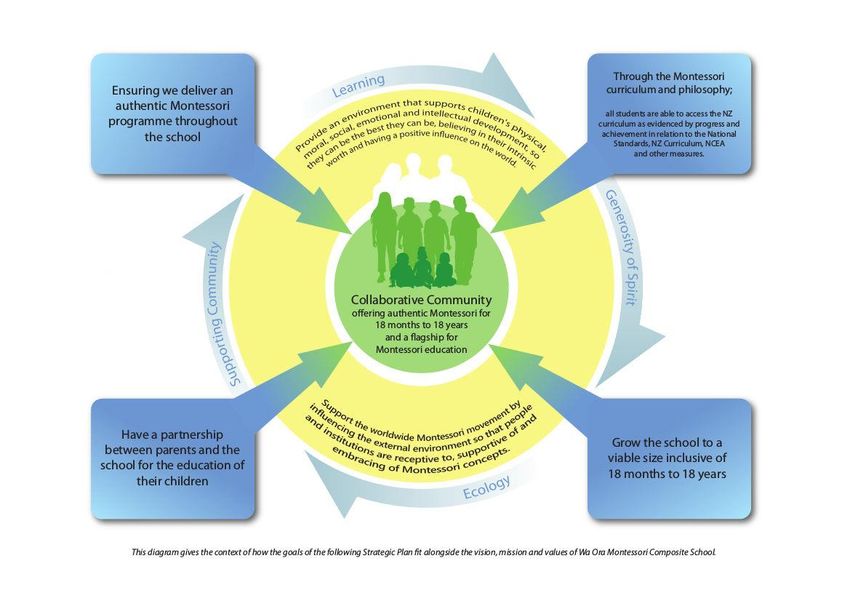
1. Provide an environment that supports children's physical, moral, social, emotional and intellectual development, so
they can be the best they can be, believing in their intrinsic worth and having a positive influence on the world.
2. Support the worldwide Montessori movement by influencing the external environment so that people and
institutions are receptive to, supportive of and embracing of Montessori concepts.
Vision – Our future ideal
Wā Ora Montessori will be a collaborative community offering an authentic Montessori
education experience for 18 months to 18 year olds and being regarded as a flagship for
Montessori Education
Values – What guides us morally
Learning – to learn is to live fully. We pursue excellence in learning and living by encouraging and equipping people
to be independent thinkers, eager to explore and experiment, and conscious of the possibilities and experiences
that come from having a balanced, creative and well mixed life.
Ecology – everything natural is interconnected. We are impressed and awed by nature. We must conduct our lives
responsibly and sustain ably, for we always affect other natural things.
Generosity of spirit – good people create good people. Human communities make possible the greatest
expressions of human goodness and achievement. Through our own school community we live the values that
create people who appreciate that sharing, working together, altruism and respect improves the experiences and
potential of everyone in that community. We produce people who can bind together communities greater in size
than ours – their neighbourhoods, towns and cities, to whole nations and the global community .
A mutually supporting community – we are a thriving, energetic community of families, children and staff. School
staff are ‘Renaissance’ people – capable across a wide range of areas, who challenge themselves to extend their
learning and thrive on sharing their passion and mastery with our children. Our families invest their time, energy
and trust in the school, bringing their strengths and skills to contribute; forming a support base for the school and
for each other. Our children build a community where all are respected and each person’s contribution is valued.
They take pride in their environment, offer help to each other and experience joy in realising their full potential. Guiding Principles
To strive for students to achieve independence and self-confidence through the development of core competencies
and knowledge by implementing the Montessori curriculum through Te Whāriki and The New Zealand Curriculum.
To strive for the Montessori ideals within the framework of the Desirable Objectives and Practices and the National
Education Guidelines
To affirm and value the variety of cultures present within the Wa Ora community with particular emphasis on the
unique place of Māori as tangata whenua and the principle of partnership inherent in Te Tiriti o Waitangi.
The Special Character of Wā Ora Montessori School
(a) The Wa Ora Montessori School is part of an international network of Montessori schools and was established by parents
in the Wellington community to serve the educational needs of its tamariki and adolescents by applying the philosophy of Dr
Maria Montessori within kura.
(b) The Special Character of this school is determined by the Montessori philosophy which is aimed at fostering the
unfolding of each individual’s unique natural tendencies.
(c) Central to the Montessori pedagogy is the concept of the four Planes (or phases) of Development as humans move from
infancy to adulthood. It provides a holistic view of the developing human being and implicitly reinforces the idea of the
importance of education as a “help to life”. The four Planes are:
0 – 6 years Individual Creation of the Person
6 – 12 years Construction of the Intelligence
12 – 18 years Construction of Social Self
18 – 24 years Construction of Self Understanding
An individual will pass through each plane. At each stage there are different emotional, intellectual and physical needs. We
respond to tamariki at each stage and set up a prepared environment appropriate for each Plane of Development.
(d) Human tendencies of exploration, repetition, orientation, self-perfection, order, imagination, manipulation, work,
observation, abstraction and communication are catered for appropriate to the age and developmental readiness of the
tamaiti, in all of the classrooms.
(e) The early childhood curriculum lays the foundation for development by recognising the needs and the sensitive periods
of the child between the ages of three and six. It covers the areas of practical life, sensorial education, mathematics, language
and culture which includes: biology, zoology, science, history and extends children up to and beyond the age of 6.
(f) Cosmic Education provides the philosophical reference for primary education in Montessori schools. In its broadest
sense, this philosophy encompasses the concept of interdependence within the universe and individual responsibility for
global harmony. Cosmic Education also includes the concept of education for life through which the child learns that caring
is expressed through the basic attitudes of respect and responsibility.
(g) Children of the Land provides the philosophical reference for high school education. The curriculum is taught in four to
six week cycles under of humanities (English, history, economics etc) and Occupations (sciences, technology and maths) as
well as creative and physical expression and small business skills. Adolescents need a supportive environment in which to
integrate their new physical and metal selves into the adult they are becoming.(h) In general, Wa Ora provides ākonga with a prepared Montessori environment that: Has a full set of age appropriate Montessori materials in every room incorporating control of error appropriately. Is peaceful, uncluttered, beautiful, clean and ordered. Has supplementary materials that can be used to meet targeted objectives. Has the outdoors as an extension of the classroom. Has ākonga in the full 3-4 year mixed age range. Gives ākonga as close to the full 3 hour work cycle as possible and allows them to freely choose work. Allows for freedom of movement. Makes use of natural materials wherever possible. (i) The Montessori philosophy practised at Wa Ora includes: An acceptance of a philosophy that formal Montessori education occurs in three year cycles, An acceptance of a specific structured school environment which encourages individual choice through true discovery.
Strategic Plan
The following section describes the strategic goals for the next 5 years.
FOCUS AREA - CURRICULUM & STUDENT ACHIEVEMENT
Strategic Goal This is strategic to the school as we are legally obliged to deliver the NZ curriculum via a
Montessori curriculum (our integration agreement) and set objectives around National
Standards.
Through the Montessori Objectives
curriculum and philosophy, all
a. All students are achieving the desired Montessori benchmark at the end of their appropriate
students are able to access the
3 year cycle
NZ curriculum as evidenced by
b. Effective measurements are developed for the High school – both in the adolescent
progress and achievement in
programme and the college.
relation to the National
c. Minimise assessment to ensure special character is maintained.
Standards, NZ Curriculum,
d. Targets for national standard will be set each year.
NCEA and other measures.FOCUS AREA – MONTESSORI AUTHENTICITY
Strategic Goal This is strategic to the school since our belief is that the Montessori pedagogy is the best
pedagogy to deliver the child outcomes defined in our mission.
Ensuring we have and deliver Objectives
an authentic Montessori
a. Retention and development of high quality Montessori Teachers
programme throughout the
b. Lead teachers are 100% Montessori qualified with the qualifications being of a high quality
school.
c. Development of high school Montessori programme – both as Adolescent programme and
College programme that can be assessed as excellent Montessori practice for these age
groups.
d. Continual development of authentic Montessori practice throughout the school
FOCUS AREA - GROWTH
Strategic Goal This is strategic to the school since our change of class application had target roll figures in it and
not achieving these is likely to bring into question the schools viability. As the playgroup and
preschool feeds the primary school then it must form part of this goal.
Grow the school to a viable size Objectives
inclusive of 18 months to 18
a. Increase student numbers to 280 in the area school and 100 in the preschool.
years.
b. Develop the required capital infrastructure in a financially viable and environmentally
sustainable way.
c. Ensure staffing levels are appropriate and sustainable.FOCUS AREA – PARENT SATISFACTION
Strategic Goal This is strategic because the school believes, backed by research, that outcomes for children are
improved if parents are fully involved in the child's education.
Have a partnership between Objectives
parents and the school for the
a. Improve communication mechanisms throughout the school
education of their children.
b. All parents have a base knowledge of Montessori sufficient to support their child's learning
(both at home and at Wa Ora).
c. High participation of parents in the school events and roles. Overall Strategies
Through the Montessori curriculum and philosophy, all students are able to access the NZ curriculum as evidenced by progress
and achievement in relation to the National Standards, NZ Curriculum, NCEA and other measures.
Objectives Strategies
a. Students are achieving the desired Ensure staff are high quality, trained and experienced Montessori teachers
Montessori benchmark at the end of their who love what they do.
appropriate 3 year cycle Engage experts to appraise our ‘Montessoriness’ at all levels
Measure outcomes at the end of each 3 year cycle and share results so that
each level of the school can celebrate its success and identify areas to improve
on.
b. Effective measurements are developed for Have clear outcomes for all programmes
the High school – both in the adolescent Look to outside Montessori, for ways to measure these outcomes, e.g. NCEA,
programme and the college. OTJ, well-being surveys.
c. Minimise assessment to ensure special Ensure teacher's performance is measured on desire to learn and engagement
character is maintained. as well as more traditional outcomes.
Ensure any formal assessment is well thought out and utilised.
d. Targets for national standard will be set Analysis of EOY results drive the following year’s targets
each yearEnsuring we have and deliver an authentic Montessori programme throughout the school.
Objectives Strategies
a. Retention and development of high quality Continue to build team cohesion through sharing and a building on the sense
Montessori Teachers. of community within the staff
Continued investment in PD – both Montessori and non-Montessori
Encourage and grow leadership that allows people to grow in their career
b. Lead teachers are 100% Montessori Investigate alternative avenues for funding teacher training, e.g. Personal loan
qualified with the qualifications being of a Develop strategies for fast tracking international teachers
high quality Attract and retain NZ teachers who can train before they start teaching at Wā
Ora.
c. Development of high school Montessori Focus on Montessori outcomes rather than just NCEA delivery
programme – both as Adolescent Incorporate information obtained from overseas experience
programme and College programme that Develop assessment practices outside simply external qualification results
can be assessed as excellent Montessori
practice for these age groups.
d. Continual development of authentic Ensure Montessori philosophy underpins all pedagogical decisions made
Montessori practice throughout the school Continue to invest in Montessori PD
Review by external Montessori expertsGrow the school to a viable size inclusive of 18 months to 18 years.
Objectives Strategies
a. Increase student numbers to 280 in the Ensure staff is high quality, trained and experienced Montessori teachers who
area school and 100 in the preschool. love what they do.
Engage experts to appraise our ‘Montessoriness’ at all levels
Measure outcomes at the end of each 3 year cycle and share results so that
each level of the school can celebrate its success and identify areas to improve
on.
b. Develop the required capital infrastructure Have clear outcomes for all programmes
in a financially viable and environmentally Look to outside Montessori, for ways to measure these outcomes, e.g. NCEA,
sustainable way. OTJ, well-being surveys.
c. Ensure staffing levels are appropriate and Ensure teacher's performance is measured on desire to learn and engagement
sustainable. as well as more traditional outcomes.
Ensure any formal assessment is well thought out and utilised.Have a partnership between parents and the school for the education of their children.
Objectives Strategies
a. Improve communication mechanisms Have a communications position within the school to focus on providing best
throughout the school practice and to review systems for maximum effectiveness.
b. All parents have a base knowledge of Develop methodologies for educating parents in the Montessori principles; the
Montessori sufficient to support their key to the effectiveness of this is making it quick and easy to access.
child's learning (both at home and at Wā
Ora).
c. High participation of parents in the school Encourage strong parental support and involvement in the school community
events and roles through matching the school’s needs with parent’s resources and/or skills.
e.g. Matariki, working bees, production, PTA events etcWĀ ORA MONTESSORI AREA AND PRESCHOOL 2016 ANNUAL PLAN
Strategic NAGS Objectives Strategies People Due Resources Indicators
Goal 1 responsible required
Through the Curriculum Ākonga are Posted curriculum is Richard and End of Time for all o Ākonga can see the learning that needs to
Montessori (a) Develop and achieving the developed for the science Adolescent Term 2 take place at each stage of the school in
curriculum implement desired curriculum for adolescent teachers order to be ready for the next stage
and teaching and Montessori programme All year o Kawakawa planning is up to date and
philosophy, learning benchmark at Tracking programme for the As above means both kaiako and ākonga know what
all ākonga programmes the end of adolescent programme is to expect
are able to their developed As above All year o Benchmarks for six year olds entering
assess the (i) To provide appropriate 3 Ensure the planning is Primary school are used to evaluate the
New all ākonga in year cycle consistent across the High effectiveness of the Preschool programme
Zealand Yr1-13 with School Primary and Term 3 in preparing ākonga for Primary
curriculum opportunities Develop a system to track Preschool
as to achieve for ākonga against this and kaiako
evidenced success in all report to the BoT/Council
by progress areas of the Revise benchmarks for Tania and Term
and New Zealand Primary school to make sure Primary ākonga 3/4
achievement Curriculum they are up to date
in relation
to the ii) Giving Targets are set Writing: PD with expert Ongoing o The number of ākonga achieving at a
National priority to against In house PD on writing, in boys literacy satisfactory level in writing increases
Standards, ākonga National including PLGs and sector skills o Targets for National Standards and NCEA
New achievement in Standards staff meetings literacy are met
Zealand literacy and Identified 6 & 7 year old $2,000 o Regular monitoring of ākonga needing
curriculum, numeracy, All ākonga are ākonga will work on letter additional support occurs and is analysed
NCEA and especially in achieving recognition and formation for progress
other Yr1-8 highly in the with Mzia o SLT oversees the writing progress each
measures core areas Work with expert to develop $10,000 term and helps kaiako analyse data
targeted writers, particularly o Classroom programmes include strategies
boys identified as successful through PD with as
Mzia continues to support $6,000 yet to be named expert on literacy for boys
Davis programme students
Arrange transition meetings
to pass on relevant
1information as children move
from one class to the next
and so progress isn’t’ halted
Reading: SLT Mid and o Six year olds who have worked with the
Continue reading support All staff end year Reading Recovery teacher improve their
programme with parents, Reading reading skills and are able to continue with
reading recovery and Recovery tutor the regular classroom programme
targeted assistance from
additional allocated time to o The support through the ‘reading with
Reading Recovery teacher parents’ programme will have allowed
Reading recovery 0.2 FTTE targeted ākonga to improve their writing
programme operates for four funded by over the year
children/week BoT
Ensure ākonga transitioning o Targets for reading are included in ‘literacy
from one area of the school targets’ for selected ākonga. An inquiry
to the next have sufficient that supports literacy development for the
skills to allow them to be 29 identified ākonga still at Wā Ora in 2016
independent in the will be developed, rather than one that
curriculum supports writing as will be developed by
Have a range of programmes the 21 other identified ākonga
and avenues to recommend
to parents looking for
external support for their As in writing
tamariki
Develop literacy aids for
ākonga who need support in
reading and writing
Math: o Ākonga have the confidence and skills to
Focus for Preschool is SLT Mid and be successful in the math areas
children learning as many All staff end year
basic facts as possible before
transitioning o Small group work in both the adolescent
Develop a way to track programme and the High School allows
ākonga moving through the ākonga to be supported or challenged as
math map in the High School DP High School Term 1 appropriate
Develop a way of delivering Math teachers
2structured lessons that o Targeted 12-15 year olds make accelerated
provide choice in Kawakawa As above Term 1 progress
Work on strategies to assist
targeted ākonga in the 12-
15yr programmes accelerate
their learning
b) Through a Effective Areas identified by the NZCER Tumuaki Term 3 $300 o The survey shows the identified areas have
range of assessment survey are worked on SLT improved
assessment measurements The ‘Wellness at School’ DP High School Term 3 $300 o The review shows any areas that need to
practices, are developed review and survey is High School be attended to
gather for the High undertaken with the 15-18yr kaiako o Reports are easy to prepare and
information School – both olds understand
that is in the Relook at the reporting Term 1 o Reports to the Board give information on
sufficiently Adolescent structure for Primary School Primary kaiako student progress in an easily understood
comprehensive Programme Reports to the Board will be Term 1 manner. These are shared with the
to enable the and the developed and given on the SLT community
progress and College results of assessment in Social June o The posted curriculum is used effectively at
achievement of Studies and technology October the planning and tracking level and is
ākonga to be New teachers are brought up analysed to show what we are doing well
evaluated to speed with MRX and use by o Reading Recovery teacher, teacher aide,
all is monitored Primary and librarian, specialist teachers are all utilised
(ii) Breadth and Feedback from child voice is specialist to best effect
depth of shared and used to improve kaiako o Children are moving to Primary from
learning related specialist programme for Preschool with the necessary skills and
to the needs, ākonga attitudes to quickly and successfully access
abilities and Specialist teachers join High the Primary curriculum
interests of School inquiry and meetings
students, the Keep parents informed of Preschool
nature of the progress in NCEA through the kaiako
school and the year to ensure whānau,
National ākonga and kaiako are
Curriculum working together
Assess the benchmarks being
reached in Preschool
according to the sensitive
periods, absorbent mind and
3Human tendencies
(c) On the basis Minimise Ensure external agencies are SENCO T1 Time o Results from PAT, e-AsTTle and other
of good quality assessment brought in for those ākonga Tumuaki T2 Budget as formats are used to inform future teaching
assessment practices to who need it in all levels of the DP High School necessary needs
information, ensure the school o Regular monitoring of ākonga with IEP’s is
identify breadth of the Ensure ākonga who qualify T1 RTLB done by SENCO to ensure they are making
students and Montessori are enrolled for SACS for progress against the goals set
groups of curriculum is NCEA Assessments o A report is written by the SENCO on the
students maintained Have SENCO monitor T1 progress of ākonga receiving additional
and still meets children’s progress according Ongoing Time support
(i) Who are not the needs of to IEPs on regular basis o Ākonga with IEPs meet the learning goals
achieving parents, PAT is used twice per year for NZCER outlined for them
(ii) Who are at kaiako, ākonga reading and math, and e-
risk of not and the AsTTle is used for writing, to June,
achieving Ministry of gain ‘line in the sand’ Nov
Education assessments to use when
(iii) Who have making OTJs. Assistive
special needs technology is used were
appropriate
PAT listening test is done in
March – to allow teachers to March
have baseline data to initial
reasonable expectations of
ākonga
e) In There is no Targets for Māori ākonga are SLT Time o Targets for Māori ākonga are met
consultation disparity set Kaiako o Literacy skills of Māori tamariki are
with the between Revitalise whanau hui Whānau rōpū effective
school’s Māori Māori and Work with whanau to o Kapa Haka is a successful and appreciated
community, non- Māori increase literacy skills of part of the school
develop and ākonga in tamariki, particularly of tama $200 o Tikanga and Te Reo are embedded in
make known to excellent Continue to develop Kapa policies, procedures and everyday
the school’s academic Haka rōpū practices
community, achievement Gain a better understanding o As many Māori as non- Māori achieve at
policies, plans of specific values and or above the standard for reading, writing
4and targets for practices that have been and maths
improving the identified by whānau as being o At least 85% of Māori ākonga will achieve
achievement of important for them and NCEA Level 1, 2 and 3
Māori ākonga putting that into practice, i.e.
tuakana/tēina, Ako,
manaakitanga etc.
Tikanga and Kapa Haka group has a more Tumuaki Ongoing o Kapa Haka performances are looked
Te Reo Māori even mix of pupils across the Whanau rōpū forward to and appreciated
are seen and school Māori kaiako o Phrases and words will be heard in the
heard as part Matariki celebration is SLT playground
of our normal strengthened in its new o Matariki celebration increases to include
school life format and is integrated more more whanau
into the school o Each SLT will incorporate Maori into their
Te Reo Māori is used more in verbal and written communication
all areas o Karakia at the beginning of all meetings
Numbers of ākonga taking o New staff employed are up to speed
Māori into NCEA increases quickly and are supportive of the
Te Reo appears in an importance of our Māori ākonga achieving
increasing number of our success as Māori
publications o More whānau are involved in the WAG
Enhance understanding of and in the school
specific values and practices
researchers have identified by
Māori as being effective for
Māori and putting that into
practice incorporating into
the appraisal system
Develop a way to look at how
our Māori Pre-schoolers are
doing and discuss twice per
year (trends and ideas)
(f) Provide The Yr7 ākonga have Tumuaki Term 3 o Ākonga have adequate support in deciding
appropriate appropriate careers exposure DP High School future pathways for careers and make
career Extend implementation of Ongoing appropriate decisions for subject choices
education and academic goal setting to the o Our Yr13 students participate in University
guidance for all adolescent programme open days
5ākonga in Yr7 Careers advisor has more o It is understood by ākonga and whānau
and above time to devote to this and is that the expected leaving qualification is
excused from an advisory Term 2 Level 2 at minimum, Level 3 by preference
group to do so o STAR money is used effectively to support
Advisory groups target Yr11-13 career education
Kawakawa ākonga to ensure
they are on track for success Ongoing
in their desired field
Expand opportunities for
careers exploration through STAR budget
STAR expenditure Ongoing
Preschool Ensure language enrichment Tumuaki Allocated o Most children enter primary able to write
ākonga enter and games are a daily part of DP Preschool time using correct letter formation, fluid writing
Primary with the Preschool programme and automatic retention of each letter,
writing skills Develop strategies to meaning they can write easily and legibly
that enable support targeted tamariki
them to work make progress in their
independently writing
6Strategic Goal NAGS Objectives Strategies People Due Resources Indicators
2 responsible required
Have a School Review Whānau show Look at how attendance and Tumuaki Ongoing Time o Parent information events are
partnership their participation in parent events SLT Reliable well attended and meet the
approach To maintain a commitment to can be enhanced by ensuring PLG in charge of communication needs of parents
between Charter and develop the content is of interest parent evenings system
parents and Strategic Plan knowledge of Class parents are supported to Communications o Whanau feel they have the
the school for relevant to our authentic be an effective part of the officer opportunity to be part of the
the education community Montessori as communication network community
of their identified by Wa More areas are included in
tamariki Ora working bees rather than the o The process of parents
usual Saturday morning slot. In contributing to the school has
addition, Sunday mornings will adapted more to allow many
be trialled avenues for parents to contribute
Participation by Survey attendees to Tumuaki Each Reliable o Attendance at parent evenings of
whānau in school determine what is successful Communications term Communication all kinds continues to grow
events exceeds and what needs to change officer systems o The PTA membership is growing
previous levels Continue to look for ways to BoT and feels it is contributing
and BoT / ensure parents know what is PTA Time positively to the school
Council / PTA coming up with regards to o The PTA feels appreciated for the
membership is parent evenings work they do
above minimum Encourage whanau to stand
levels for BoT in this year’s elections
Grow the size of the PTA
Maintain an School is running Follow review cycle that Tumuaki According o Policies, procedures, curriculum
ongoing smoothly, is includes all areas of to and compliance are up to date
programme of compliant with compliance schedule and meeting current needs
self-review all regulations Review staff induction to PA, SLT o Staff are working well, with new
including and is meeting ensure new staff are quickly staff knowing what they need to
evaluation of the needs of brought up to speed know
information on ākonga Delegate roles to appropriate o Reports to the BoT are on time
ākonga effectively people SLT and contain enough information
achievement Have a clear schedule with to allow the BoT/Council to know
7deadlines that people can see Tumuaki what is happening in all areas
and meet
SLT to direct review of Social
Studies and Technology in SLT
preparation for reports to the o Procedures are available to
BoT community on the school website
Ensure community is aware of Communications for parents and on Google Drive
all policies and procedures Officer for all staff
Report to High School report format is Tumuaki End of Access to o Reports across the school are
ākonga and tweaked to make it easier for DP High School Term 1 survey gizmo or meaningful, give enough
whānau on the teachers to complete similar survey information so parents are aware
achievement of Primary School reports are website of how their child is doing and
individual reviewed DP Primary End of T1 are easy to understand
ākonga. Report The annual report is submitted School Searchable o The audited annual report is
to the school’s to the auditor in a timely March website presented at the Council AGM
community on fashion and includes outcomes Tumuaki and posted on the website. It is
achievement of in relation to targets set in sent to MoE by the March 1st
students as a 2015 cut-off date
whole and as Reports are written on Social
groups in Studies, Technology, as well as Tumuaki As review o Results from curriculum reports
relation to reading, writing, math for Yr2- SLT timetable to the BoT are shared with the
National 10 and NCEA for Yr11-13+ community
Standards
Improve Develop ways of meeting with o The parent survey indicates that
satisfaction of community to find out and whānau are satisfied with:
school respond to issues that might - The communication with
community with be there whānau
communication Meet with new parents shortly - Satisfaction with education
and education after they start to build offered
relationships - Decisions made in running
Present reports to the the school
BoT/Council regularly o 85% of whānau rate their
satisfaction with the school’s
communications as good or
better
8Strategic Goal NAGS Objectives Strategies People Due Resources Targets/Indicators
3 responsible required
Ensuring we Employment The Preschool Montessori trained staff lead Krista Term 2-4 o Staff have a greater understanding
have and and Personnel and Primary philosophy discussions at regular Tumuaki of what we do and why
deliver an School continue staff meetings to ensure it is SLT
authentic Develop and to offer always front and centre of
Montessori implement authentic everything we do. o School is running effectively as a
Programme personnel and Montessori Evaluation of Montessori aspect of Montessori School.
throughout the industrial programmes that school by Carla Foster in Term 2,
school policies, which are internally with recommendations
promote high and externally considered and implemented as
levels of staff assessed possible/appropriate.
performance, according to the
use educational Montessori
resources Journey to
effectively and Excellence
recognise the (MJ2Ex)
needs of indicators and
ākonga implemented as
necessary
The High School Assistance is sought from an Tumuaki Term 3 $2,000 o We are confident that our
programme is external experienced programme DP High School programme is staying Montessori
externally director for ongoing development June while delivering a sound NCEA
assessed to be Support new lead teacher for Aug programme
providing adolescent programme, sending Jul/Aug $2,000 - o Staff develop a network of peers
excellent him to Australia for the ‘Meeting $3000 across Australia that they can
Montessori in the Middle’ gathering of exchange ideas with
practices for the adolescent teachers, along with 1- o Trained staff are helping the
Adolescent 2 other adolescent teachers. programme to stay true to
Programme and Montessori principles and ideas
the College
Programme
9A sustainable Continue sending staff on training Tumuaki Ongoing $40,000 o Joel finishes his primary training;
staffing - 1 to finish Primary Jenny finishes Preschool training
programme is - 1 to start Preschool training o Another Preschool teacher is hired
maintained with Have DP of Primary school o DP does not have a classroom of
annual retention released to take care of needs of her own and can oversee
of full time staff Primary teachers Tumuaki Term 3 $ development of Primary area of
of 85% Continue to look at work place school
satisfaction, particularly in staff o Staff input has guided
feeling empowered SLT development of workplace in 2015
Work with SLT to help ensure their o SLT have the tools needed to grow
staff feel fully supported to and support their staff
develop and extend their skil ls
Continue to develop appraisal o Appraisal system continues to be
system to meet many needs, integrated and meaningful, and
through development of inquiry successfully demonstrated
and job description evaluations teachers can be re-registered
Strategic Goal NAGS Objectives Strategies People Due Resources Targets/Indicators
4 responsible required
Grow the Financial and Develop the More room for teaching is Property Term 1 Donation o Specialist areas are complete and
School to 380 Property required developed Committee from trust equipped, and meet needs of
students Management infrastructure – Playgroup and Preschool rolls teachers and ākonga
between the Allocate funds building and continue to be target of o Roll and waiting list is at a level
ages of 3 years to reflect the people to meet advertising that means keeping classes full is
to 18 years school’s the growing Re-brand continues to be rolled no longer a concern
priorities as needs of the out – sports uniforms, brochures Monthly $30,000 o Branding is increasingly recognised
stated in the school etc. as representing and belonging to
Charter us
Monitor and A budget with identified revenue Tumuaki Feb Allocation o Spending is close to budgeted
Comply with control school streams is monitored closely SLT of time projections
asset expenditure and Monthly reports are presented to BoT/ Monthly o All spending is according to budget
management ensure annual the BoT/Council Proprietors projections
plans and accounts are Expenditure is monitored by o Any variations are approved in
implement prepared and budget holders to ensure Monthly advance
maintenance audited as spending stays within allocation o The budget allows the school to
10programme to necessary grow as planned
ensure
buildings and
facilities
provide a safe,
healthy
learning
environment
There are 270 Marketing initiatives target gaps Tumuaki Monthly o Classes have the right number of
ākonga in the in roll to ensure even growth Proprietor students in a well-balanced way
Area School by through school Communications o The waiting list has enough
the end of this Enrolments are managed carefully Officer children on it to fill any gaps as
plan and 100 so as to ensure the roll cap is not they occur and so we are assured
tamariki in exceeded Sept of filling each cohort with the
Preschool Limited entrance to places in the numbers desired
Primary and High School are
managed carefully
There is New DP for Preschool is found Term 2 o Management structure is effective
appropriate staff PD plan for teachers to ensure for different parts of school,
in each area of succession is in place for ensuring school is well run
the school Montessori trained teachers and o School is staffed with the right
management staff teacher in the right area from
The BoT subsidises subject Preschool to High School
specialists in High School to o NCEA is offered in the identified
ensure there are enough staff to subjects to Level 3
teach NCEA subjects
11Targets
Writing
By the end of 2016:
National Standards
1. 73% of ākonga are at or above National Standards
2. 80% of children below and well below National Standards in 2015 will make accelerated progress of at least two sub-levels
Paying particular attention to:
1. Tama in the 9-12 class where 18 below and 5 well below
2. Tamāhine in Yr7
3. Ākonga in Yr8
4. 80% of ākonga below and well below in both reading and writing (54% (or 27 of the 50 ākonga below or well-below) will make accelerated progress)
Māori ākonga
1. 73% of Māori ākonga will meet National Standards
2. The 7 (out of a total of 22) Māori tamariki who are below or well below will make accelerated progress
Yr9 and 10 ākonga
3. 78% of Yr9/10 ākonga will be at expected curriculum levels for their class
4. The 12 students (9 Yr9 and 3 Yr10) who were below or well-below curriculum expectations in 2015 will make accelerated progress
NCEA
1. 100% of ākonga will gain numeracy credits
2. 100% of ākonga will gain literacy credits
3. At least 85% of Yr11 ākonga will gain NCEA Level 1
4. At least 85% of Yr12 ākonga will gain NCEA Level 2
5. At least 85% of Yr13 ākonga will gain NCEA Level 3
6. At least 20% of students will get an excellent endorsement up from 14% in 2015
7. The number of merit endorsements will remain high (>50%)
12You can also read


