Week 3 Independent Study Packet - Sympl Benefits
←
→
Page content transcription
If your browser does not render page correctly, please read the page content below
Week 3               3 rd

                             Grade

  Independent
  Study Packet
             Education.com

        5 MORE Days of
   Independent Activities in
       Reading, Writing,
Math, Science, and Social Studies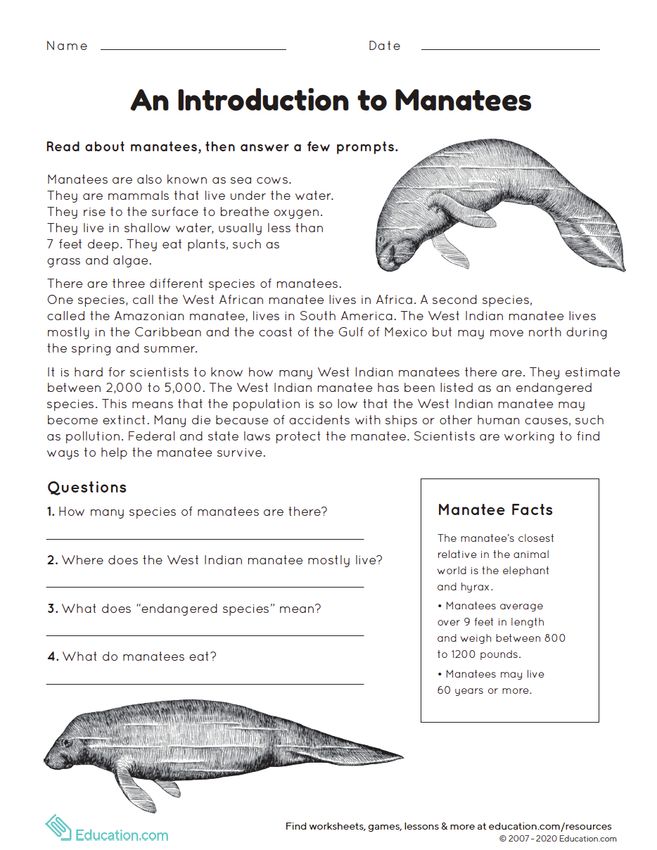
Helpful Hints for
                 Students and Families
Materials You Will Need:
 Pencils
 Extra paper or a notebook/journal. (You may
 put everything into one notebook if you like.)
 Colored pencils, markers, or crayons
 for some of the activities

 Internet access to conduct research
 for some activities
 You will need different materials for
 the optional Design Challenge

              Directions & Tips
                                  There is a schedule for each day.
                                  You may complete the activities in any
                                  order. Social studies and science
                                  activities may take you more than
                                  one day to complete.
                                  Make sure to plan your time so that you
                                  don’t let things pile up at the end.

                                  Read the directions carefully before
                                  completing each activity.
                                  Check off each of the activities when you
                                  finish them on the activity menu.
                                  Make sure an adult signs the activity menu
                                  before you bring it back to school.

                                  Find worksheets, games, lessons & more at education.com/resources
                                                                            © 2007 - 2020 Education.com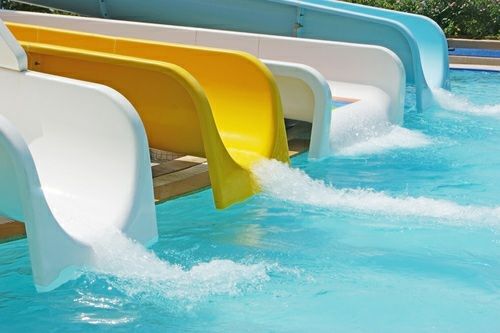
Activity Menu
                       Day 1            Day 2            Day 3             Day 4                 Day 5

                  Read for 20 minutes and answer three of the questions from the reading log
   Reading        on another piece of paper or in a journal. Challenge: Try not to repeat a question!

                  The Ocean         A Series of      How the           Manatee Facts       Learning
                                    Events: The      Whale Got                             About the
                                                     His Throat:                           Ocean
                                    Water Cycle
                                                     Reading
                                                     Comprehension

   Writing        Sentence          Work on          Informational     My Research         Two Truths
                  Stretching        Writing:         Writing: Strong   Notes               and One Lie:
                                    Run-On           Support
                                                                                           Research
                                    Sentences                                              Edition

   Grammar        Similes: Clear    Similes:         Simile or         Metaphor and        The
   Practice       as Crystal        Easy as Pie      Metaphor          Simile Search       Twisted
                                                                                           Ankle

   ?; !
    Math          Jump-a-Round      Function         Number            Monster Glyph       More
                                    Tables           Sequences                             Multiplication
                                                                       Candy Multi-
                                                                                           Comparisons
                                    Input and        Fun Fun Math      plication Game
                                    Output Tables    Puzzles                               Multiplication
                                                                                           and Compari-
                                                                                           son

 Social Studies   Learn more about Dr. Martin Luther King, Jr.            Optional
                  Nonfiction Text Features: Martin Luther King, Jr.       Design Challenge:
                  Two Truths and One Lie: Martin Luther King, Jr.         Making a Water Slide
                  Martin Luther King Jr. Cut-and-Paste Timeline

    Science       Discover more about the oceans and ocean life.
                  How to Separate Salt from Water
                  Animal Habitats: Oceans
                  Why is the Ocean Blue?
                  Ocean Resources

Parent/Guardian Signature:
Reading Log
1. Read a fiction or nonfiction book on your
own or with a grown-up.

2. Put your name and the title of the book at
the top of a new page.

3. Choose one of the prompts from the chart
and write the letter at the top of the page in the
title of the book.

4. Write 3–5 sentences about your book.
Remember, not all of the questions make sense
for every book!

a.                              b.                         c.
     What details in the text    Which words in the book      What lesson is the author
       describe one of the      were tricky? What strategy      trying to teach the
       characters? Draw a          did you use to help you     reader? How do you
     sketch of the character.        understand them?                 know?
d.                              e.                                 f.
                                       What is the most                   What did the author
 What is your favorite part
                                     important part of the               want you to learn? How
   of the text? Why?
                                        story? Why?                          do you know?

g.                              h.                                 i.
      How does the main                 What is the most                What are three facts you
       character feel in             interesting part of the            learned from reading this
      this book? How do                   text? Why?                              book?
         they change?

j.                              k.                                 l.
 How do the pictures in the       Where does the story                   What information was
   text help you understand      take place (the setting)?               surprising in the text?
     what you are reading?         How does the author                           Why?
       Give an example.                describe it?

m.                              n.                                 o.
  What is the character’s          How is this book like                What was a major event
  main problem, and how           another you have read?                in the story? Why was it
  did they solve it? How            How is it different?                 important to the story?
 would you have solved it?

                                          Find worksheets, games, lessons & more at education.com/resources
                                                                                     © 2007 - 2020 Education.com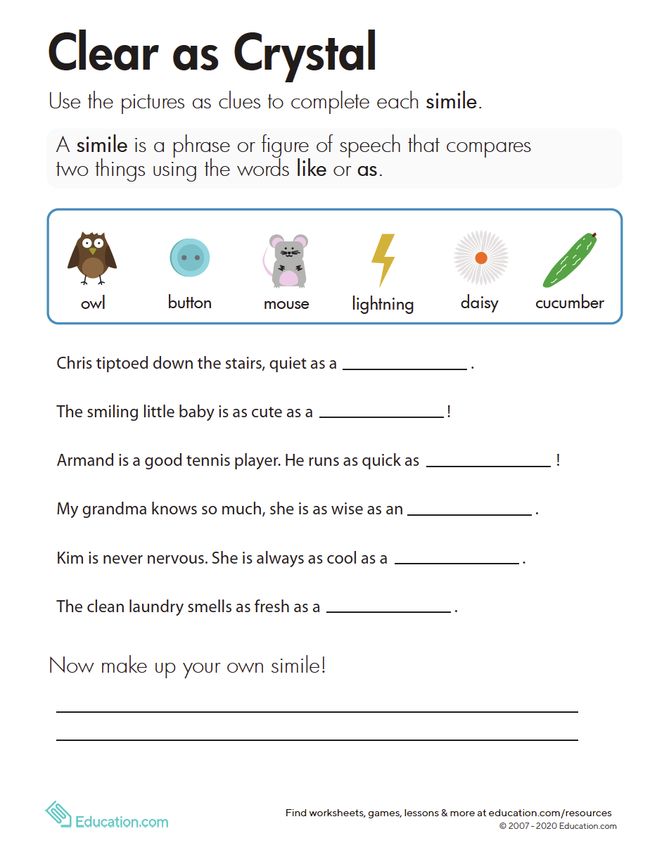
Day 1

                                 Read this short text about the
   Reading                      ocean and answer the questions.

    Writing                       Learn how to make your short
                                      sentences stretchier.

Grammar Practice                        Learn what a simile is.

                                   Practice rounding numbers
     Math                         to the nearest ten or hundred
                                       using a number line.

                   Find worksheets, games, lessons & more at education.com/resources
                                                             © 2007 - 2020 Education.com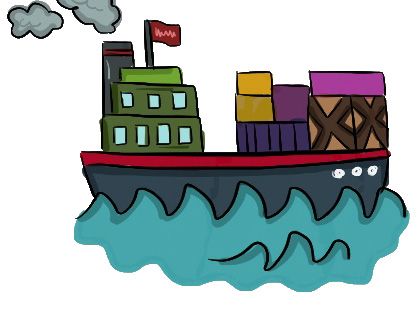
Name: _______________________________                              Date: ______________________

                                            The Ocean
Read the informational text. Next, use a dictionary to figure out the meaning
of the underlined words. Write what the words mean and why the author used
them in the spaces below. Finally, explain why the author wrote this text.

 The ocean is important to all living things. More than 70 percent of Earth’s
 surface is covered by the ocean. If you saw Earth from outer space, it
 would look similar to a blue marble. That’s a lot of water! The ocean is the
 Earth’s largest habitat.

 There is only one World Ocean and five ocean basins. The water in the
 World Ocean flows between the ocean basins, just like air moves around
 on land.

 About one million types of animals live in the ocean. Different animals live
 in different parts of the ocean depending on what they need to stay alive.

 It’s important that humans take care of the ocean so it stays healthy for
 years to come. One way to help the ocean is to pick up trash on the
 beach.

 The ocean is important to all living things. Over half of the Earth’s surface is
 covered by the ocean. Scientists have only explored part of the ocean.
 There is still so much left to explore!

               Atlantic Ocean
                                 Indian Ocean
       Arctic Ocean

                         Southern Ocean                                World Ocean

                  Pacific Ocean

                                            Find worksheets, games, lessons & more at education.com/resources
                                                                                      © 2007 - 2020 Education.com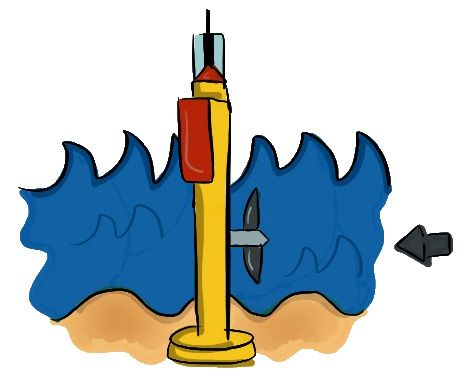
Name: _______________________________                    Date: ____________________

1. The word ______________________ means ___________________________________
  __________________________________________________________________________.
  This word is important to the main idea of the text because _________________
  __________________________________________________________________________.

2. The word ______________________ means ___________________________________
  __________________________________________________________________________.
  This word is important to the main idea of the text because _________________
  __________________________________________________________________________.

3. The word ______________________ means ___________________________________
  __________________________________________________________________________.
  This word is important to the main idea of the text because _________________
  __________________________________________________________________________.

4. The word ______________________ means ___________________________________
  __________________________________________________________________________.
  This word is important to the main idea of the text because _________________
  __________________________________________________________________________.

5. The word ______________________ means ___________________________________
  __________________________________________________________________________.
  This word is important to the main idea of the text because _________________
  __________________________________________________________________________.

  In your own words, explain what the topic of the text is. Can you figure out the
  main idea of the text? What did the author want you to learn? How do you
  know?
  __________________________________________________________________________
  __________________________________________________________________________
  __________________________________________________________________________
  __________________________________________________________________________

                                  Find worksheets, games, lessons & more at education.com/resources
                                                                            © 2007 - 2020 Education.com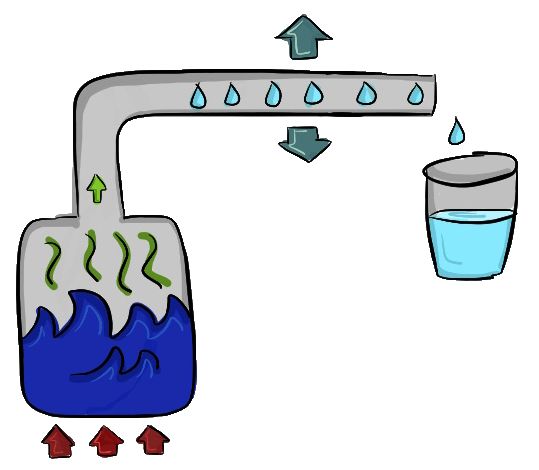
Name:                                                                     Date:

                                   Sentence Stretching
   Prepositions and prepositional phrases can be used to give more information about our topic.
   Our sentences can be longer and more specific!

   Use prepositions from the word bank to extend the sentences below and provide more details.
   Write each new sentence on the matching line. Look at the example below to get started.
                          Word Bank
                before        above          toward
                onto          during        between               1   2    3   4    5   6   7   8   9   10   11   12

            Example:
            Starting Sentence: Scott sat in the car.
            New Sentence: Scott sat between his two sisters throughout the long car ride.

   1. Starting Sentence: Lacey’s dog jumped.
        New Sentence:

   2. Starting Sentence: Look in the cabinet.
        New Sentence:

   3. Starting Sentence: On the screen I saw an announcement that you shouldn’t talk.
        New Sentence:

   4. Starting Sentence: It is important to buy the airplane tickets.
        New Sentence:

   5. Starting Sentence: Jessie ran.
        New Sentence:

                                                                        Copyright
                                            Find worksheets, games, lessons & more© 2017
                                                                                      atEducation.com LLC All Rights Reserved
                                                                                         education.com/resources
                                                                                   More worksheets at www.education.com/worksheets
                                                                                                   © 2007 - 2020 Education.com
Clear as Crystal
      Use the pictures as clues to complete each simile.

       A simile is a phrase or figure of speech that compares
       two things using the words like or as.

            owl               button   mouse          lightning                  daisy       cucumber

       Chris tiptoed down the stairs, quiet as a                                  .

       The smiling little baby is as cute as a                           !

       Armand is a good tennis player. He runs as quick as                                       !

       My grandma knows so much, she is as wise as an                                        .

       Kim is never nervous. She is always as cool as a                                  .

       The clean laundry smells as fresh as a                                .

      Now make up your own simile!

                                         Find worksheets, games, lessons & more at education.com/resources
                                                                                     Created by :
Copyright 2008-2009 Education.com                                                    © 2007 - 2020 Education.com
                                                                                   www.education.com/worksheets
Name:________________________ Date:_______________
Jump-A-Round
Rounding numbers is like jumping to the nearest ten or nearest hundred.
When the number has a 1, 2, 3, or 4 in the ones place, it is rounded DOWN to
the nearest ten. When the number has a 5, 6, 7, 8 or 9 in the ones place, it is
rounded UP to the nearest ten. For example, 6 can be rounded up to 10.
0 1 2 3 4 5 6 7 8 9 10 11 12 13 14 15 16 17 18 19 20
Round each number to the nearest ten.
1. 15 is about _________ 2. 12 is about _________ 3. 3 is about _________
4. 11 is about _________ 5. 16 is about _________ 6. 5 is about _________
7. 19 is about _________ 8. 13 is about _________ 9. 28 is about _________
When the number has a 1, 2, 3, or 4 in the tens place, it is rounded DOWN to the nearest hundred. When
the number has a 5, 6, 7, 8 or 9 in the tens place, it is rounded UP to the nearest hundred. For example,
128 can be rounded down to 100.
100 110 120 130 140 150 160 170 180 190 200 210 220 230 240 250 260 270 280 290 300
Round each number to the nearest hundred.
10. 174 is about _________ 11. 218 is about _________ 12. 152 is about _________
13. 256 is about _________ 14. 239 is about _________ 15. 134 is about _________
16. 421 is about _________ 17. 503 is about _________ 8. 972 is about _________
Copyright © 2017 Education.com LLC All Rights Reserved
Find worksheets, games, lessons & more at education.com/resources
More worksheets at www.education.com/worksheets
© 2007 - 2020 Education.comDay 2
Practice connecting
Reading key events in nature.
Learn what run-on sentences are, and
Writing
practice fixing them.
Grammar Practice Similes can be easy as pie!
Math Can you find the math pattern
that makes what goes in come out
a certain way?
Find worksheets, games, lessons & more at education.com/resources
© 2007 - 2020 Education.comName: _______________________________ Date: _______________________
A Series of Events: The Water Cycle
Sequence is the order in which something is done. Use time order words
to help you understand the order of events. Some examples include:
• first, second, third • before, after, next
•then, later, soon after • last, finally, eventually
Directions: Read the passage below.
The Water Cycle
Have you ever wondered what happens to puddles after a big rainstorm? Each bit of precipitation in our
world goes through the water cycle. The water cycle is the movement of all the water on Earth. The water in,
on, and above the Earth is always moving and changing states. It changes from liquid to vapor. It changes
from vapor to ice, and back again. The cycle continually repeats itself.
First, the sun heats up the Earth’s surface and draws water into the atmosphere. This process is called evapo-
ration. This is what makes puddles disappear! The water evaporates, changing from a liquid into a gas.
Then, as the water vapor rises into the sky, it cools down. It turns back into a liquid when it is in the clouds.
This part of the water cycle is called condensation.
After the clouds become heavy, precipitation falls. It falls as rain, snow, hail, or sleet. Sometimes precipita-
tion can fall in heavy amounts. This can cause flooding and problems for people and animals on Earth.
Mountainous areas, places that typically have snow, experience melting when the temperatures rise. The
snowmelt runs down toward sea level.
As the runoff reaches lower elevations, it can end up in lakes and rivers, eventually leading to the ocean.
This part of the process is called collection. Water is collected in different places on the Earth. It can be
absorbed back into trees and plants. It can return to lakes, rivers, and the ocean. The water can freeze into
snow, ice, or glaciers, depending on the climate.
The water cycle is a system in nature that is constantly moving. The steps always occur in the same order,
and the cycle always repeats itself.
Directions: Complete the chart with details from the text that show the correct sequence of events.
First,
Next,
After that,
Then,
Finally,
Copyright © 2018 Education.com LLC All Rights Reserved
Find worksheets, games, lessons & more at education.com/resources
More worksheets at www.education.com/worksheets
© 2007 - 2020 Education.comRun-On Sentences
A run-on sentence is two complete sentences that have been joined together
in the wrong way, using incorrect punctuation or no punctuation.
Incorrect run-on sentence : I gave Tom my jacket, it was too small for me.
Correct : I gave Tom my jacket. It was too small for me.
Read each sentence. If it is a complete sentence, put a check ( ) beside it. If it is a
run-on sentence, rewrite it as two complete sentences on the lines provided.
1. The cat followed me home, it looked hungry. ________________________________
_________________________________________________________________
2. I gave the cat some tuna and a bowl of water. _____________________________
_________________________________________________________________
3. I wanted to keep the cat, Mom shook her head. ___________________________
_________________________________________________________________
4. The cat had a collar and tags, it already had a home. ___________________________
_________________________________________________________________
5. Mom called the number on the tag, a nice lady answered. ____________________
_________________________________________________________________
6. The lady came to our house, she thanked me for finding her cat. _________________
_________________________________________________________________
7. I’m glad we helped the lady get her cat back. ________________________________
_________________________________________________________________
Find worksheets, games, lessons & more at education.com/resources
Copyright © 2010-2011
2012-2013 by Education.com © 2007 - 2020 Education.com
More worksheets at www.education.com/worksheetsEasy as Pie
Use the pictures as clues to complete each simile.
A simile is a phrase or figure of speech that compares
two things using the words like or as.
elephant bee bat feather desert tree
I’m so thirsty, my mouth is as dry as a .
Without her glasses on, Judy felt as blind as a .
The baby kitten is as light as a .
I was as busy as a as I worked to finish my homework.
My older brother is as tall as a .
If my dog keeps eating so much, he’ll become as big as an .
Now make up your own simile!
Find worksheets, games, lessons & more at education.com/resources
Created by :
Copyright 2008-2009 Education.com © 2007 - 2020 Education.com
www.education.com/worksheetsInput Output Math Tables
Determine the pattern to calculate the missing numbers.
IN OUT IN OUT IN OUT IN OUT
3 5 3 3 2 12 9
4 6 5 3 6 10 7
5 6 9 5 10 7
7 9 9 15 7 6
9 11 11 8 16 4 1
10 15 27 10 3
IN OUT IN OUT IN OUT IN OUT
4 1 3 1 3 0 3
5 6 3 2 11
8 6 3 9 5 15 3
11 9 5 15 18 4 19
14 12 7 8 6 27
15 8 24 9 27 7
Created by :
Copyright 2012-2013 Education.com Find worksheets, games, lessons & more at education.com/resources
www.education.com/w orksheets
© 2007 - 2020 Education.comInput Output Math Tables
Determine the pattern to calculate the missing numbers.
IN OUT IN OUT IN OUT IN OUT
1 2 2 6 0 3 20 18
2 4 4 8 3 18 16
3 4 6 4 7 15
4 6 8 12 8 14 12
5 10 9 12 11
6 12 16 16 10
IN OUT IN OUT IN OUT IN OUT
3 6 4 7 1 20 25
4 12 5 9 9 4 27
5 8 14 10 13 28
6 17 14 11 10
7 42 12 16 14 8
8 56 15 27 20 4 34
Created by :
Copyright 2012-2013 Education.com Find worksheets, games, lessons & more at education.com/resources
www.education.com/w orksheets
© 2007 - 2020 Education.comDay 3
Reading Read this whale of a tale!
Identify important facts
Writing to support an argument.
Learn to pick out clue words to help
Grammar Practice tell the difference between a simile
and a metaphor.
Fill in the missing numbers on
Math these two math challenges.
Find worksheets, games, lessons & more at education.com/resources
© 2007 - 2020 Education.comHow the Whale got his Throat by Rudyard Kipling
O nce upon a time there was a giant Whale who lived deep in the sea. He was always hungry, and more than anything he
loved to eat fish of all different kinds: mackerel, salmon, tuna, crab, octopus, squid, eel and more. He ate and ate, until there was only
one fish left in the whole sea!
Luckily, the Last Fish in the sea was a clever one. Before the hungry Whale could chase him, the Last Fish took a bow and asked,
“Oh, mighty Whale, have you ever tasted man?”
“No,” said the Whale, who was a bit confused, “What is it like?”
“Oh, it’s delicious,” said the clever Last Fish, “And it will really fill you up. I saw one just the other day sitting on a raft in the
middle of the sea. He is a shipwrecked sailor. Go and find him!”
So the Whale swam and swam, until he came upon a raggedy sailor, alone on a wooden raft. The hungry Whale crept up, opened
his mouth wide and swallowed the sailor, raft and all. But it was not as the clever Last Fish had said—this man was not delicious at
all! He kicked and danced, pranced and punched at the inside of the Whale’s belly.
Annoyed, the Whale swam around trying to find that clever Last Fish, but he’d already made his escape. “This man is making me
hiccup,” the Whale said to himself, “What should I do?” Suddenly, from inside his belly the Whale heard a man’s yell: “Take me
home, to Albion, or I’ll kick as hard as ever!”
The poor, hiccupping Whale had no choice but to swim the man home. After he escaped, the man lived happily ever after. And so
did the Whale, but he had forgotten about the raft that was lodged in his throat. It was like a permanent sift! From then on, it
prevented the Whale from eating anything except tiny fish.
And that was how the Whale got his throat.
Activities WORD SEARCH
Put the events in the order in which they happened.
# Order D T Y Z J U Z Q U V N M E D I
E F V D B B B N O A A J E U E
A. The Whale met the Last Fish. Y G Y O E J E R J O G P W O X WORD LIST
B. The Whale spit out the man. O U O T T G Z Z S I A F V A C Albion
N X Q D G S G G C C S D P L E Annoyed
C. The man's raft was stuck in the Whale's throat. N C L E V E R A S D J R W B D Clever
D. The Whale ate almost all the fish in the sea. A O H L K U I E R D E H U I Z Confused
A O R I E I D P Q V A Q U O K Delicious
E. The Whale swallowed the sailor.
E G E C R I X D E L I U M N R Escaped
E J R I H Q Z N E D H H O U H Hiccup
Who asked the Whale if he had tasted a man?_____________ S K I O S I T D E S U F N O C Prevented
M F Y U D E C U X D B T W B B Raggedy
Who danced and kicked in the Whale's stomach?___________ T I I S D L K C E R Y K U H D Whale
Who swam the sailor home?_____________________ Y G D G A X N H U N Y D J W M
B G O Q F F O A Z P D D N E U
At the end of the story, who could eat only small fish?__________
Copyright © 2011-2012 by Education.com More worksheets
Find worksheets, games, at www.education.com/worksheets
lessons & more at education.com/resources
© 2007 - 2020 Education.comName: _______________________________ Date: _______________________
Informational Writing: Strong Support
What is Informational Writing?
The purpose of this genre of writing is to inform the reader about a topic.
It uses information (facts and details) to teach about the topic.
*Informational writing does not include opinions or statements to convince others to
do or believe something.
Directions: Circle the facts that would best support a topic in an informational essay.
1. Which of the following facts would support an informational essay about tornadoes? Circle three.
a. A tornado is a violent weather event.
b. I think tornadoes are really scary storms.
c. Tornadoes are sometimes called twisters.
d. It is exciting to see a strong and powerful tornado in the sky.
e. The region of the United States that has the most tornadoes is called Tornado Alley.
2. Which of the following facts would support an informational essay about rain? Circle three.
a. Rain is necessary for plants and grass to grow.
b. Rain usually happens as either a drizzle or a shower.
c. Rain makes me want to stay in bed all day and sleep.
d. Rain can contain dirt, dust, grass, and even chemicals.
e. It is fun to jump in the puddles and run in the mud after rain falls.
3. Which of the following facts would support an informational essay about flowers? Circle three.
a. Without sunlight and water, flowers will die.
b. All houses should have gardens full of flowers in the front.
c. The most beautiful flowers are those that bloom in the spring.
d. Flowers get their food from sunlight, water, and minerals in the soil.
e. Flowers take in carbon dioxide, which is what humans release when we breathe.
4. Which of the following facts would support an informational essay about the sun? Circle three.
a. Light from the sun reaches the Earth in about eight minutes.
b. I enjoy the warmth of the sun in the spring and summer months.
c. The sun is a star that is found at the center of the Solar System.
d. You should wear sunscreen and light colored clothing when outside.
e. The sun’s diameter is about 110 times wider than the Earth’s diameter.
Your Turn! Write 3 strong supporting facts on the lines below about a topic of your choice.
Topic: _____________________________
Fact 1: ___________________________________________________________________________________
Fact 2: ___________________________________________________________________________________
Fact 3: ___________________________________________________________________________________
Find worksheets, games, lessons
Copyright © 2017&Education.com
more at education.com/resources
LLC All Rights Reserved
More worksheets at www.education.com/worksheets
© 2007 - 2020 Education.comName: Date:
Simile or Metaphor?
A metaphor compares two different things, usually with the word “is.” A
simile also compares two different things but uses words such as “like”
or “as.” Look at each of the following sentences and answer the
questions below.
Example: Our class is a buzzing beehive today.
This is a: metaphor This means:
(simile/metaphor) A) Our class is especially busy today.
B) A bee got into our classroom.
1. The assembly was like watching grass grow.
This is a: This means:
(simile/metaphor) A) Not very much happened at the
assembly.
B) The assembly was green.
2. His hands were as cold as ice.
This is a: This means:
(simile/metaphor) A) His hands were wet.
B) His hands were extremely cold.
3. The kitten is a fluffy cloud.
This is a: This means:
(simile/metaphor) A) The kitten is furry and white.
B) The kitten sleeps all day.
4. I’m as hungry as a bear.
This is a: This means:
(simile/metaphor) A) I’m not very hungry.
B) I’m really hungry.
Copyright
Find worksheets, games, lessons & more © 2017 Education.com LLC All Rights Reserved
at education.com/resources
More worksheets at www.education.com/worksheets
© 2007 - 2020 Education.comNumber Sequences
Fill in the missing number that completes the sequence.
Ex. 1 , 2 , ___ , 4 : the missing number is 3
1.) 2 , 4 , ___ , 8 2.) 1 , 5 , ___ , 13 3.) 3 , 6 , ___ , 12
4.) 5 , ___ , 15 , 20 5.) 1 , ___ , 9 , 27 6.) 4 , ___ , 16 , 32
7.) 6 , 8 , ___ , 20 8.) 4 , 5 , ___ , 10 9.) 4 , 9 , 16 , ___
10.) 8 , 27 , 64 , 125 , ___ 11.) 0 , 1 , 1 , 2 , 3 , 5 , ___
12.) 30 , 28 , 26 , 24 , ___ 13.) 16 , 12 , 8 , ___
14.) 27 , 26 , 24 , 21 , ___ 15.) 32 , 30 , 26 , 18 , ___
16.) 500 , 100 , 20 , ___ 17.) 48 , 24 , 12 , ___
18.) 81 , 27 , 9 , ___ 19.) 256 , 64 , 16 , ___
Find worksheets, games, lessons & more at education.com/resources
© 2007 - 2020 Education.comMissing Number Puzzles
These puzzles are tricky!
Use 1 through 4 to finish each equation. Use each number only once.
Each column is a math equation. Each row is a math equation.
HINT: Multiply BEFORE you add and subtract!
1. 2.
3. 4.
Answers
1. 2. 3. 4.
Find worksheets, games, lessons & more at education.com/resources
Copyright © 2010-2011 by Education.com More worksheets at www.education.com/worksheets
© 2007 - 2020 Education.comDay 4
Reading Learn all about the manatee.
Take some research notes about
Writing the ocean. Use the items in this packet
or do your own research.
Pick a book you are reading
to find six examples of similes and
Grammar Practice metaphors. Write them in your notebook,
using this sheet as a guide.
Make your own monster glyph
Math and play a game with candy or any
other small objects.
Find worksheets, games, lessons & more at education.com/resources
© 2007 - 2020 Education.comName Date
An Introduction to Manatees
Read about manatees, then answer a few prompts.
Manatees are also known as sea cows.
They are mammals that live under the water.
They rise to the surface to breathe oxygen.
They live in shallow water, usually less than
7 feet deep. They eat plants, such as
grass and algae.
There are three different species of manatees. One species called the West African
manatee lives in Africa. A second species, called the Amazonian manatee, lives in South
America. The West Indian manatee lives mostly in the Caribbean and the coast of the
Gulf of Mexico but may move north during the spring and summer.
It is hard for scientists to know how many West Indian manatees there are. They
estimate between 2,000 to 5,000. The West Indian manatee has been listed as an
endangered species. This means that the population is so low that the West Indian
manatee may become extinct. Many die because of accidents with ships or other human
causes, such as pollution. Federal and state laws protect the manatee. Scientists are
working to find ways to help the manatee survive.
Questions
1. How many species of manatees are there?
Manatee Facts
_________________________________________
The manatee’s closest
2. Where does the West Indian manatee mostly live? relative in the animal
_________________________________________ world is the elephant
and hyrax.
3. What does “endangered species” mean?
• Manatees average
_________________________________________ over 9 feet in length
and weigh between 800
4. What do manatees eat?
to 1200 pounds.
_________________________________________ • Manatees may live
60 years or more.
Find worksheets, games, lessons & more at education.com/resources
© 2007 - 2020 Education.comName: Date:
My Research Notes
Before you write an informational essay, you will need to do research. Research is a process
in which you look for information or facts about a specific topic. You can use books, articles,
or the internet to do research. Make sure to use reliable, trustworthy sources!
Research Steps:
1. Choose your topic. What are you interested in learning about?
2. Make a plan. Where will you look for information?
3. Take notes. In your own words, write down important facts and big ideas.
4. Cite your sources. Write down the places you found your information.
Topic:
Main Idea: In your own words, write about the topic.
Details: These are interesting facts that support the Source: Where did you find this
main idea. Paraphrase each fact in your information? Write the title and
own words. page number of the book or the
name and URL of the website.
Example: Crab Facts
Japanese spider crabs have legs that are 13 feet long. https://www.education.com/worksheet/
article/crab-facts/
Copyright
Find worksheets, games, lessons & more© 2018
atEducation.com LLC All Rights Reserved
education.com/resources
More worksheets at www.education.com/worksheets
© 2007 - 2020 Education.comName: Date:
My Research Notes
Details: These are interesting facts that support the Source: Where did you find this
main idea. Paraphrase each fact in your information? Write the title and
own words. page number of the book or the
name and URL of the website.
Copyright
Find worksheets, games, lessons © 2018
& more atEducation.com LLC All Rights Reserved
education.com/resources
More worksheets at www.education.com/worksheets
© 2007 - 2020 Education.comName: Date:
Metaphor and Simile Search
Directions: Find examples of metaphors or similes in the book
you are reading, write down the quote, then fill in the context
(what is happening) and what you think it means.
Title: Author:
Page: Circle one: metaphor simile
Quote:
Context:
Meaning:
Copyright
Find worksheets, games, lessons & more © 2017 Education.com LLC All Rights Reserved
at education.com/resources
More worksheets at www.education.com/worksheets
© 2007 - 2020 Education.comName Date
Monster Glyph
Directions: On a separate sheet of paper, create your unique monster by following these directions.
Draw an oval head if you ride the bus to school.
Shape of head Draw an octagonal head if you ride in a car to school.
Draw a rectangular head if you walk or ride a bike or scooter to school.
Draw your monster’s body in the shape of an animal if you have 1 syllable in your last name.
Shape of body Draw your monster’s body in the shape of a robot if you have 2 syllables in your last name.
Draw your monster’s body in the shape of food if you have 3 or more syllables in your last name.
Give your monster curly hair if you prefer scary movies.
Amount of hair Give your monster spiky hair if you prefer funny movies.
Give your monster no hair if you prefer action movies.
Draw your monster’s mouth in the shape of a triangle if your age is 2 x 4.
Draw your monster’s mouth in the shape of a pentagon if your age is 3 x 3.
Shape of mouth
Draw your monster’s mouth in the shape of a rhombus if your age is 3 + 4.
Draw your monster’s mouth in the shape of an arrow if your age is 4 + 6.
# of eyes Your age + 2.
# of legs Number of letters in your first name x 3.
# of arms Number of letters in your last name x 2.
# of teeth Number of teachers you have x 6.
Find your monster’s name. Use the first letter of your name to find your monster’s first name.
Then use the first letter of the month you were born to find your monster’s last name.
A - Alien F - Shadowy K - Howling P - Scary U - Phantom
B - Costume G - Pumpkin L - Vampire Q - Hair-raising V - Magic
C - Bone H - Spooky M - Potion R - Nightmare W - Goblin
D - Fright I - Foggy N - Wicked S - Haunt X - Ghost
E - Terrifying J - Mysterious O - Gravestone T - Witch Y - Superhero
Z - Horrible
My monster’s name: The __________________ __________________
Find worksheets, games, lessons & more at education.com/resources
© 2007 - 2020 Education.comName: _______________________________ Date: ______________________
Candy Multiplication Game
In this game, you will use candy to practice multiplication! Place the number of candies onto the
circles, and then record the addition and multiplication expressions in the chart. See the example below.
Example: Make 3 groups of 5.
Your board should have 5 candies in 3 circles
Addition Fact Multiplication Fact Answer
Example: 5 + 5 + 5 5x3 15
Find worksheets, games, lessons & more at education.com/resources
© 2007 - 2020 Education.comName: _______________________________ Date: ______________________
Candy Multiplication Game
Use these circles to make equal groups of candies.
Find worksheets, games, lessons & more at education.com/resources
© 2007 - 2020 Education.comDay 5
Identify some key details
Reading
about the ocean.
Now that you’re an ocean expert,
Writing make up two truths and
a lie about it!
Grammar Practice Find the two hidden similes
in this text.
Compare these
Math multiplication problems.
Find worksheets, games, lessons & more at education.com/resources
© 2007 - 2020 Education.comName: _______________________________ Date: ______________________
Learning About the Ocean
Directions:
Underline or highlight the main idea in the text. Look back at the text to complete the
sentences at the bottom of the page.
The ocean is important to all living things.
More than 70 percent of Earth’s surface is
covered by oceans. If you saw Earth from
outer space, it would look similar to a blue
marble. That’s a lot of water! The ocean is
the Earth’s largest habitat.
There is only one world ocean and five ocean basins. The water in the
world ocean flows between the ocean basins, just like air moves around on
land.
About one million types of animals live in the ocean. Different animals live in
different parts of the ocean depending on what they need to stay alive.
It’s important that humans take care of the ocean so it stays healthy for
years to come. One way to help the ocean is to pick up trash on the
beach.
The ocean is important to all living things. Over half of the Earth’s surface is
covered by the ocean. Scientists have only explored part of the ocean.
There is still so much left to explore!
The topic of the text is ___________________________________.
The main idea of the text is __________________________________________________.
Key Detail #1 Key Detail #2 Key Detail #3
Find worksheets, games, lessons & more at education.com/resources
© 2007 - 2020 Education.comName Date
Two Truths and One Lie: Research Edition
Conduct research about ______________________ . Then write three statements about the topic in
which two statements are true and the third is false.
Write a paragraph about the same topic. Make sure your paragraph contains the correct answer to
the lie.
_____________________________________________________________________________________
_____________________________________________________________________________________
_____________________________________________________________________________________
_____________________________________________________________________________________
_____________________________________________________________________________________
_____________________________________________________________________________________
_____________________________________________________________________________________
Give your worksheet to another learner so they can determine which statements are true and which is
the lie, using your paragraph as help! You get to be the teacher when they are done. Did they get the
right answer?
Find worksheets, games, lessons & more at education.com/resources
© 2007 - 2020 Education.comName: Date:
The Twisted Ankle
Directions: As you read the passage, underline the
two similes, then answer the questions below.
Ivan and I jogged slowly; Mala zoomed past us like a race car
speeding around a curve. As she sped by, I tripped over a rock
and fell. “Ouch!” I yelled. “I think my ankle is broken!” Mr. Lee
came over to help me up. “I don’t think it’s broken,” he said.
“Look, you can walk on it.” I still wanted an ice pack, so I leaned
on my friends to hop like a one-legged rabbit to the school nurse.
1. Which is the first simile? 2. What is the meaning of the
first simile?
A) As she sped by, I tripped
over a rock and fell. A) Mala ran very fast.
B) “Ouch!” I yelled. “I think my B) The narrator compares his/
ankle is broken!” her ankle to something
C) Mala zoomed past us like a broken.
race car speeding around a C) The narrator fell down like a
curve. rock.
3. Which is the second simile?
Opinion: Why do you think the
A) Mr. Lee came over to help author included the second
me up. simile?
B) to hop like a one-legged
rabbit
C) I still wanted an ice pack.
Copyright © 2017 Education.com LLC All Rights Reserved
Find worksheets, games, lessons & more at education.com/resources
More worksheets at www.education.com/worksheets
© 2007 - 2020 Education.comMore Multiplication Comparisons
Name:_________________________________________ Date:__________________
Directions: Test your multiplication skills by writing in the correct symbol: >, < or =.
1. 2. 3.
13 x 0 2 x 1 12 x 5 10 x 6 5 x 5 6 x 4
4. 5. 6.
12 x 3 6 x 6 4 x 3 5 x 2 6 x 5 7 x 3
7. 8. 9.
6 x 9 7 x 8 12 x 4 9 x 5 8 x 3 6 x 4
10. 11. 12.
8 x 4 6 x 6 5 x 4 9 x 2 13 x 0 2 x 1
13. 14. 15.
9 x 5 7 x 8 3 x 3 4 x 2 11 x 6 7 x 9
16. 17. 18.
6 x 3 4 x 4 5 x 2 7 x 1 7 x 7 6 x 8
19. 20. 21.
10 x 5 7 x 6 7 x 4 14 x 2 9 x 4 5 x 8
Copyright © 2017 Education.com LLC All Rights Reserved
Find worksheets, games, lessons & more at education.com/resources
More worksheets at www.education.com/worksheets
© 2007 - 2020 Education.comX Multiplication Practice
Greater Than, Less Than or Equal To
Test your multiplication skills by writing in the correct symbol: >, < or =
1. 2. 3.
6x3 4x4 5x2 7x1 5x5 6x4
4. 5. 6.
9x5 7x8 3x3 4x2 6x5 7x3
7. 8. 9.
8x4 6x6 5x4 9x2 9x7 8x8
10. 11. 12.
10 x 5 7x6 7x4 14 x 2 8x3 6x4
13. 14. 15.
6x9 7x8 12 x 4 9x5 11 x 6 7x9
16. 17. 18.
12 x 3 6x6 4x3 5x2 7x 7 6x8
19. 20. 21.
13 x 0 2x1 12 x 5 10 x 6 9x4 5x8
Find worksheets, games, lessons & more at education.com/resources
More worksheets at www.education.com/worksheets Copyright © 2012-2013
2011-2012 by Education.com
© 2007 - 2020 Education.comSocial Studies
Learn more about Dr. Martin Luther King, Jr.
Nonfiction Text Features: Martin Luther King, Jr.
Two Truths and One Lie: Martin Luther King, Jr.
Martin Luther King Jr. Cut-and-Paste Timeline
Find worksheets, games, lessons & more at education.com/resources
© 2007 - 2020 Education.comName Date
NONFICTION TEXT FEATURES
MARTIN LUTHER KING, JR.
Text Features help a reader navigate a text by offering
more information about it. MARTIN LUTHER KING, JR.
E xamples : il l u strations , photog raphs , ca pt io n s , m a ps , QUICK FACTS:
ch arts, grap h s, he ading s , table s of con t e n t s . • MLK is the nickname
given to Martin Luther
King, Jr.
directions: Read the passage below, then answer the • King graduated from high
questions on the following page. school at the age of 15.
• King led the Montgomery
Martin Luther King, Jr. is famous for his role in the civil rights Bus Boycott in 1955.
movement. He believed that everyone should be equal. He worked hard for
that. He fought against discrimination. Discrimination is when a person or • His house was bombed
group of people are treated differently.
in 1956 by people who
Martin Luther King, Jr. was born in Atlanta, Georgia, in 1929. He grew up disagreed with his civil
in a time when things were not fair for everyone. The laws said that African
rights work.
Americans did not have the same rights as white people. There were separate
schools for African American kids and white kids. They could not go to the • In 1963, King was arrested
same schools. Restaurants also had rules that separated African American for protesting in Alabama.
people and white people.
• King was assassinated in
Beliefs and Actions Memphis in 1968.
King believed that African Americans should have the same rights as white
people. He believed that people should be treated equally, no matter what
color skin they have.
He believed in protests and resistance. He did not believe that violence was
March on Washington
the answer. He knew that it was important to stay peaceful so people would
listen. Martin Luther King, Jr. boycotted. He refused to buy products or washington, d.c.
services from places that did not treat him fairly. He marched. His marches
made people think about discrimination.
March on Washington
In 1963, there was a civil rights march on Washington, D.C., called the March
on Washington for Jobs and Freedom. King became very well known after
this event. King made a famous speech at this march. It is called the “I Have
A Dream” speech. Around 250,000 people marched and heard his speech.
The March on Washington
In the speech, he spoke about racism. He wanted it to end. Racism is the poor
treatment and violence against people because of their race. Martin Luther was in the nation’s capital,
King, Jr. talked about things being better for African American people. Washington, D.C.
Martin Luther King won the Nobel Peace Prize in 1964. That same year, the
Civil Rights Act was passed. It banned many types of discrimination. Martin
Luther King, Jr. worked hard to bring about change in the United States.
Today, people still work for the equality he spoke about.
Find worksheets, games, lessons & more at education.com/resources
© 2007 - 2020 Education.comName Date
NONFICTION TEXT FEATURES
MARTIN LUTHER KING, JR.
Text Features help a reader navigate a text by offering more information about it.
E xamples : illustrations, photographs, captions, maps, charts, graphs, headings, tables of contents.
directions: Answer the questions by writing complete sentences.
Part 1:
1. What information does the sidebar show?
2. Write a caption to accompany this image of Martin Luther King, Jr.
3. What do the headings tell the reader?
Part 2:
directions: Use the passage and sidebar to fill in the missing information on the timeline below.
1929 ____ 1964
Martin Luther Led Montomery Won Nobel
King, Jr. was born. bus boycott. Peace Prize.
1944 ____ 1968
_________ Gave his “I Have _________
_________ a Dream” speech. _________
Find worksheets, games, lessons & more at education.com/resources
© 2007 - 2020 Education.comName Date
Two Truths and One Lie: MLK, Jr.
Read the three statements about Martin Luther King, Jr. Can you figure out which two
statements are true and which one is false? Research using books, articles, or websites
to confirm your answer. Circle the lie.
1 Martin Luther King, Jr. was inspired by Gandhi's peaceful protest and Christian
values, so he decided to preach about nonviolent protests for social change.
2
In the speech, “Strength to Love”, Martin Luther King, Jr. said, “Darkness cannot drive
out darkness, only light can do that. Hate cannot drive out hate, only love can do
that.”
3 Martin Luther King, Jr. Day, celebrated on the last Monday of January, is about
celebrating the life and successes of Martin Luther King, Jr.
Answer these questions after doing some research.
1. Fix the false statement so that it is now true.
2. Choose a fact about Martin Luther King, Jr. you think is important.
3. Explain why you chose that fact to share.
4. On a separate sheet of paper, write a paragraph about Martin Luther King, Jr. using more than two
sources for information (like a website and an article).
Find worksheets, games, lessons & more at education.com/resources
© 2007 - 2020 Education.comName Date
Martin Luther King Jr. Cut-and-Paste Timeline
Directions: Read the passage below. Then cut the events and place them in the correct order on the timeline.
Martin Luther King Jr. was born on January 15th, 1929. He was born in Atlanta, Georgia. At that time, the country
was segregated. Segregation is when people are separated according to groups, like racial groups. Martin was
not allowed to go to the same school as white kids. He was not allowed to sit near them at restaurants. He did not
like segregation, and he wanted to see a change. He became a leader.
One way that he was a leader was during the Montgomery Bus Boycott. In December of 1955, the boycott began.
A boycott is when people refuse to buy or use something, or go somewhere. The purpose of a boycott is to
protest, or ask for something to change. This boycott began when Rosa Parks refused to give up her seat to a
white person on a bus. Dr. Martin Luther King Jr. helped organize the boycott.
Martin Luther King Jr. is known for his “I Have a Dream” speech. It was made in 1963. He was at the “March on
Washington for Jobs and Freedom” where people wanted to show support for equal rights. They wanted jobs and
freedom. His speech gave people hope. The march was successful. In 1964, the Civil Rights Act was passed. The
law said that there would be no more racial segregation.
In 1968, Martin Luther King Jr. went to Memphis, Tennessee, to help workers who
wanted changes in their jobs. While he was there, he was shot and killed. The person
who killed him did not like Martin Luther King Jr.’s message.
Martin Luther King Jr. was an important leader in the United States. People all over
the country were sad when he died. Now, we celebrate Dr. King in January each year.
This holiday gives us the chance to honor his hard work for civil rights.
1963 1968 1929 1955
Martin Luther King Jr. Martin Luther King Jr. Martin Luther King Jr. Martin Luther King Jr.
gave his “I Have a was shot and killed was born in Atlanta, led the Montgomery
Dream” speech. in Memphis, Tennessee. Georgia. Bus Boycott.
Find worksheets, games, lessons & more at education.com/resources
© 2007 - 2020 Education.comScience
Discover more about the oceans and ocean life.
How to Separate Salt from Water
Animal Habitats: Oceans
Why is the Ocean Blue?
Ocean Resources
Find worksheets, games, lessons & more at education.com/resources
© 2007 - 2020 Education.comHow to Separate Salt from Water
Salt, a mineral with the main component beingsodium chloride, or NaCl, has been
used for millennia to help preserve food (and make it tasty!). In ancient times, salt
was used as a form of currency in some cultures. During the period when the
ancient Phoenicians controlled the salt trade in the Mediterranean, salt was as
expensive as gold! In this lab, we will learn how to separate salt from water through
a solar process—you can use the sun to evaporate water, leaving behind the salt.
Objective: Evaporate water to form salt crystals.
Materials
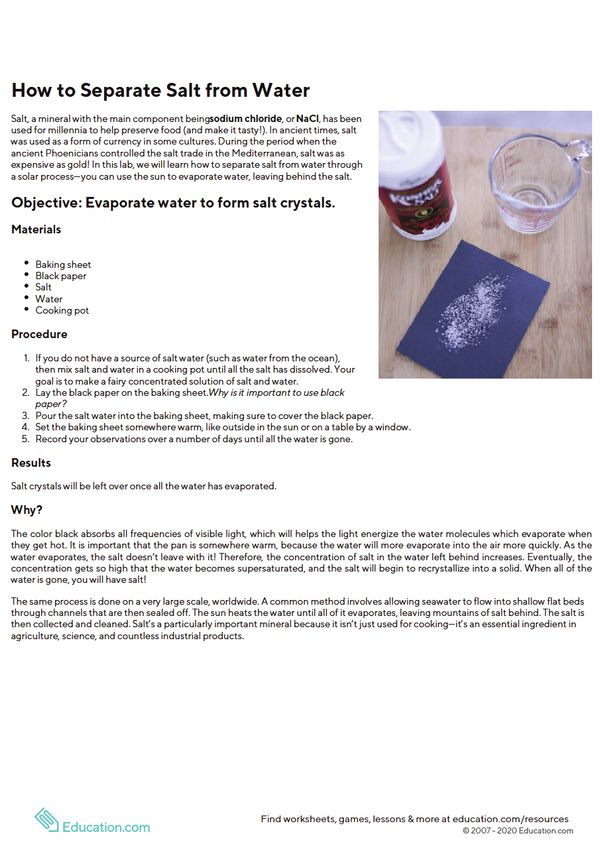
Baking sheet
Black paper
Salt
Water
Cooking pot
Procedure
1. If you do not have a source of salt water (such as water from the ocean),
then mix salt and water in a cooking pot until all the salt has dissolved. Your
goal is to make a fairy concentrated solution of salt and water.
2. Lay the black paper on the baking sheet.Why is it important to use black
paper?
3. Pour the salt water into the baking sheet, making sure to cover the black paper.
4. Set the baking sheet somewhere warm, like outside in the sun or on a table by a window.
5. Record your observations over a number of days until all the water is gone.
Results
Salt crystals will be left over once all the water has evaporated.
Why?
The color black absorbs all frequencies of visible light, which will helps the light energize the water molecules which evaporate
when they get hot. It is important that the pan is somewhere warm, because the water will evaporate into the air more quickly. As
the water evaporates, the salt doesn’t leave with it! Therefore, the concentration of salt in the water left behind increases. Eventually,
the concentration gets so high that the water becomes supersaturated, and the salt will begin to recrystallize into a solid. When all of
the water is gone, you will have salt!
The same process is done on a very large scale, worldwide. A common method involves allowing seawater to flow into shallow flat beds
through channels that are then sealed off. The sun heats the water until all of it evaporates, leaving mountains of salt behind. The salt is
then collected and cleaned. Salt’s a particularly important mineral because it isn’t just used for cooking—it’s an essential ingredient in
agriculture, science, and countless industrial products.
Find worksheets, games, lessons & more at education.com/resources
© 2007 - 2020 Education.comANIMAL HABITATS - FUN PAGE!
Animals of the Sea
Water covers over seventy percent of our planet, and billions of
fascinating animals thrive in the oceans and seas. There is a
whole world beneath the water‛s surface filled with weird and
wonderful wildlife that many of us may never see.
WORD SEARCH
Words may be horizontal, vertical, backwards,
Name:________________________________ or diagonal
Date:_____________
FUN FACTS
Blowfish
S O C T O P U S D E Crab The male seahorse carries the eggs,
and “gives birth” to the live babies.
S W D I U Q S E O L Shark
•••
E S O E T H C L L T Seahorse You are twice as likely to be struck by
A T S R Q S R A P R Coral lightning than to be bitten by a shark.
•••
H A H L D I A H H U Starfish
An octopus has no bones.
Squid
O R A A E F B W I T
Octopus
R F R R A W I I N A Word Search Answer
SWORDFISH SEATURTLE
Whale
DOLPHIN WHALE OCTOPUS SQUID STARFISH
CORAL SEAHORSE SHARK CRAB BLOWFISH
Word List:
T O E L B R O H H I
S I K O A O R S I E
Dolphin
S H H H L I C O S E
E I S R O A O K I S
E S O C I L H H H S
Sea Turtle
A N I I W A R R F R
T I W B F E A A R O
I H H O R B L E O T U H H A I D L H A H
Swordfish R P A R S Q R S T A
Word List: T L L C H T E O S E
BLOWFISH CRAB SHARK SEAHORSE CORAL L O E S Q U I D W S
STARFISH SQUID OCTOPUS WHALE DOLPHIN
SEA ANIMAL MATCH UP
E D S U P O T C O S
SEATURTLE SWORDFISH
Draw a line from the sea animal to its name.
Date:_____________ Name:_________________________________
Color the
Sea Turtle
Orca
Blowfish
Eel
Great White Shark
Seahorse
Find worksheets, games, lessons & more at education.com/resources
Copyright
Copyright©©2012-2013
2010-2011by
byEducation.com
Education.com More worksheets at www.education.com/worksheets
© 2007 - 2020 Education.comWHY AND
WHYHOW
AND SERIES
HOW
Why
Whyisisthe
theocean
sky blue?
blue?
The ocean appears blue
to us because of the light
from the sun.
d
We often think that the sun’s light just
ge
re
an
gr low
or
allows us to see, but without light, colors
n
l
ye
ee
wouldn’t even exist!
ol o
g
di
et
in
vi
What we see as white light from the sun is
all the other
actually a combination of all the colors of colors are absorbed
the rainbow. Try and imagine red, orange,
yellow, green, blue, indigo and violet rays
of light streaming from the sun. Objects
either absorb or reflect these rays.
QUESTION & ANSWER:
When the sun’s light hits the ocean,
the red, orange, yellow, green, indigo
What colors make up the light from the sun? and violet rays are absorbed so that
we can’t see them! Only the blue light
is reflected. The ocean itself isn’t really
blue; we’re just seeing the reflected
blue light.
What color/s does the ocean reflect?
What color/s does the ocean absorb?
Find worksheets, games, lessons & more at education.com/resources
© 2007 - 2020 Education.comOCEAN RESOURCES
The ocean is one of our greatest resources. The world’s oceans provide many useful
items and functions for not only people who live on the coast, but all people. The first
thing that comes to mind when we think about sea resources is food, but the sea
provides many other kinds of resources as well.
TIDAL
TURBINE The world’s oceans provide energy in the
SEA form of electricity from wave action. As
LEVEL waves crash on the beach they drive a
turbine, a kind of engine, which produces
CURRENT
electricity that we can use in our homes
and buildings.
SEA BED
COOLING
The world’s oceans are providing
water for people who live in dry places.
This is mostly true in other countries VAPOR
where there isn’t a lot of fresh water
available. Salty sea water must have
the salt removed before people can FRESH WATER
drink it. Huge machines in factories
are necessary to make this happen. SEA WATER
It’s called desalination.
HEATING
One of the most important ways we use the
world’s oceans and seas is transportation.
It’s not something we think about a lot, but
it’s true. Many of the products you use in your
home—TVs, clothes, and even some kinds of
food—were made elsewhere and shipped to
the United States on large cargo vessels.
Find worksheets, games, lessons & more at education.com/resources
© 2007 - 2020 Education.comMORE IMPORTANT EVEN THAN TRANSPORTATION,
HOWEVER, IS THE FOOD RESOURCE THAT THE
SEAS PROVIDE. BELOW, LIST AT LEAST 10
KINDS OF FOOD THAT COME FROM THE SEA:
1.
2.
3.
4.
5.
6.
7.
8.
9.
10.
WHAT’S YOUR FAVORITE SEAFOOD? DRAW IT BELOW.
Find worksheets, games, lessons & more at education.com/resources
© 2007 - 2020 Education.comOptional
Design Challenge
Making a Water Slide
Find worksheets, games, lessons & more at education.com/resources
© 2007 - 2020 Education.comDesign Challenge: Making a Water Slide
Have your child kick off their summer vacation by making a
miniature water slide! Using a few household supplies (plus
any upcycled materials you wish), children combine their
creativity and design thinking to imagine and then construct a
model of a water slide. These instructions help guide children
through the process, from conceptualization to construction,
testing, and revision.
What You Need:
Paper cups
Paper tubes (such as paper towel rolls)
Paper straws
Plastic wrap
Tupperware or container to make a “pool” at the bottom
of the slide
Glue
Tape
Small toy(s)
Pen and paper for notetaking
Any other supplies you find that can be upcycled!
What You Do:
Since this activity is fairly open-ended, there are numerous possibilities for how your child may decide to complete it. The purpose of
this challenge is to allow your child to creatively decide how to use materials for a specific purpose: making a water slide. Although this is
a creative challenge, it will likely be useful for you to guide your child through the process and provide suggestions for how they can
best use their materials. We have given some ideas for how you can build your water slide, but feel free to make any adjustments
according to the materials you have and what your child would like to do!
Part 1: Constructing the Water Slide
1. First, ask your child to define a slide by drawing some examples on a piece of paper. This will get your child to start thinking about
the structure of a slide, prior to planning how they want to build their own.
a. Some questions you may ask your child to get them to start thinking about the design process: What do you notice about
the structure of a slide? Do you notice how one end of the slide is always higher than the other? What is the difference
between a normal slide and a water slide?
2. After your child has identified some of the key aspects of slides, allow them to brainstorm different ways they can use the
materials you have provided them to create their own water slide. Ask them to write or draw their ideas on a piece of paper.
a. We suggest allowing your child to think creatively prior to making any suggestions, but feel free to guide them if you notice
that they are stuck.
3. Once your child has made a plan for their water slide, allow them to begin building. Be sure to supervise and assist them at any
time they need help.
Below, we have written a procedure for building a water slide. Feel free to use it if you’d like, or feel free to go solely off of your child’s
ideas:
1. Cut your paper tubes down on one side and stretch out the sides to create a slide structure. Depending on how long you want
your slide to be, you may want to glue or tape two to three tubes together.
2. Add glue down the center of the tubes and cover them with plastic wrap.
a. Ask your child why they think it’s necessary to use plastic wrap. (Answer: Plastic wrap makes the slide water-resistant.)
Find worksheets, games, lessons & more at education.com/resources
© 2007 - 2020 Education.comDesign Challenge: Making a Water Slide (Continued)
Part 2: Making a Structure to Support the Slide
1. After your child has built their water slide, explain that they will now need to create a structure that will hold up their slide.
2. First, ask your child to identify some of the necessary components of the water slide’s supporting structure. Some questions you
may ask to guide your child:
a. What does the structure need to support? (Answer: The structure needs to hold the weight of the slide and the toys that go
on it.)
b. Where must the structure go to? (Answer: The structure must bring the slide down to the pool.)
c. What must the elevation of the structure be like? (Answer: The structure must start taller at the top of the slide, and
gradually decrease in height to come down to the pool.)
3. After your child has thought critically about the key components of the slide’s structure, they can beingrainstorming
b how they will
make one. Again, ask them to write or draw their ideas on a piece of paper.
a. Allow your child sufficient time to think independently and creatively about how they want to use the materials, but feel
free to guide them with open-ended questions or suggestions whenever they are stuck.
4. An idea for creating the structure that you may suggest to your child:
a. Poke two holes in the bottom of each of your paper cups. (The number of paper cups you will need depends on how long
your slide is. Make sure to have enough to support the slide’s weight.)
b. Then, tape one straw in each hole. This will create a Y shape in each cup, which will support the sides of the slide.
c. For the top of the slide, which is the tallest point, stack two cups together by gluing or taping their mouths together. This will
add height to the structure. Only tape two straws in the holes of the top cup, which will then support the top of the slide.
b
5. Once your child has made a plan for how they want to build their supporting structure, allow them to startuilding. Be sure to
supervise and help out wherever needed.
Part 3: Putting it All Together and Testing
1. Once your child has built both the water slide and its supporting structure, it’s time for the fun part: putting it all together and
testing it out! Make sure to test out your child’s slide outside or in an area that you don’t mind getting wet.
2. Have your child tape the water slide to the supporting structure, and place a container at the bottom of the slide to serve as a
“pool.”
3. In order to test their prototype, ask your child to bring a small toy and place it at the top of the slide. Then, have them pour water
at the top of the slide and see whether their toy will successfully slide down to the pool.
a. Allow your child to experiment with different amounts of water and different speeds of pouring until they find what works
best.
b. If your child finds any flaws in their design, help them figure out what went wrong and encourage them to make revisions. It
is important that they keep brainstorming and prototyping until they make a successful structure.
Find worksheets, games, lessons & more at education.com/resources
© 2007 - 2020 Education.comYou can also read


