What does it take to assess the state of knowledge related to the physical science basis of climate change in 2021? Perspectives related to the ...
←
→
Page content transcription
If your browser does not render page correctly, please read the page content below
What does it take to assess the state of knowledge
 related to the physical science basis of climate change in 2021?

            Perspectives related to the IPCC WG1 AR6 report

                             Valérie Masson-Delmotte

valmasdel                                                     www.ipcc.ch
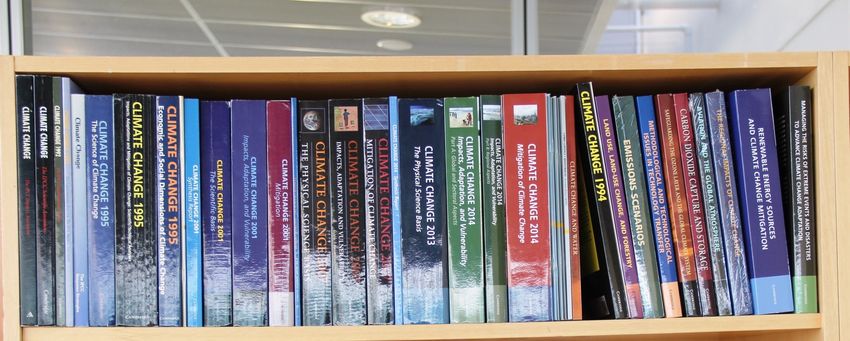
Mandate of the IPCC

v The IPCC assesses the scientific, technical and socio-economic information
  relevant to understanding the scientific basis of risk of human-induced
  climate change, its potential impacts and options for adaptation and
  mitigation.

v The IPCC is organized in Working Groups and one Task Force :
   - WGI : the physical science basis
   - WGII : impacts, adaptation and vulnerability
   - WGIII : mitigation of climate change
   - Task Force on national greenhouse gas inventories

v IPCC reports must be policy-relevant but not policy-prescriptive

       COMPREHENSIVE, OBJECTIVE, OPEN AND TRANSPARENT BASIS
New knowledge
                       45000

                       40000       Number of peer-reviewed publications
                                   with the keyword « climate change »
                       35000

                       30000

                       25000
                                                 Robust?
                                                 Emergent?
                       20000
                                                 Scientific controversies?
                                                 Knowledge gaps?
                       15000
                                                                                                    MATURATION OF
                       10000                                                                        KNOWLEDGE

                        5000

                           0
                            1970   1975   1980     1985      1990      1995   2000   2005   2010   2015   2020

Web of Science, 2020
Report preparation steps

    Plenary
   decision to
                          Scoping                  Outline approval         Nominations of authors
   prepare a
     report                                                           Ad@

     Publications                         Cut
cut-off submission date       Second                        First
                            Order Draft                     Order
                                                Expert      Draft
                            + draft SPM
                                                review                        Selection of authors
                                                                        Cut
           Expert and
          government
             review                        Cut
                                Final
                              chapters            Goverment           Final       Cut Plenary
                              & SPM for            review of          SPM
                                                                                     approval
                                 gov.                SPM              draft
      Publications             review
cut-off acceptance date
                                                                                            Report
SPM = Summary for Policy Makers                                                           Publication!
The communication challenge

                      Clarity of key findings

                      Traceability of key findings to the lines of evidence from assessed publications

                      Calibrated confidence language

https://link.springer.com/article/10.1007/s10584-011-0178-6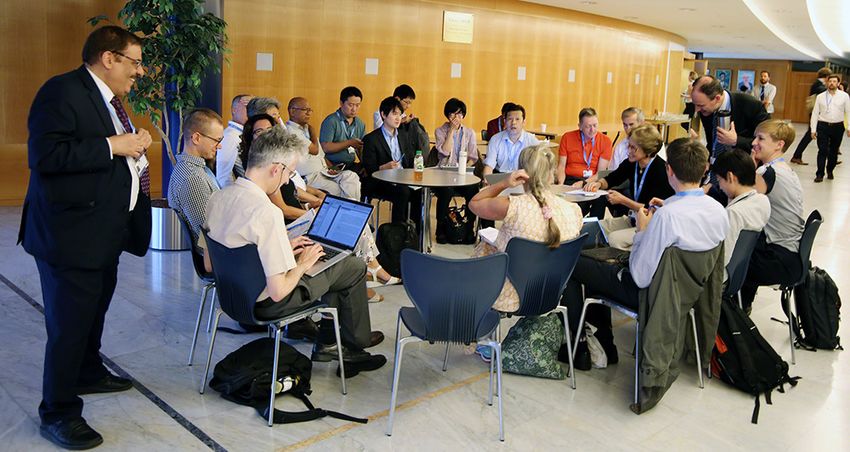
The communication challenge

                                                                                                     https://climateoutreach.org/case-studies-from-ipcc-authors/
https://www.ipcc.ch/site/assets/uploads/2019/04/IPCC-visual-style-
guide.pdf

                                                               https://climateoutreach.org/reports
                                                               /ipcc-communications-handbook/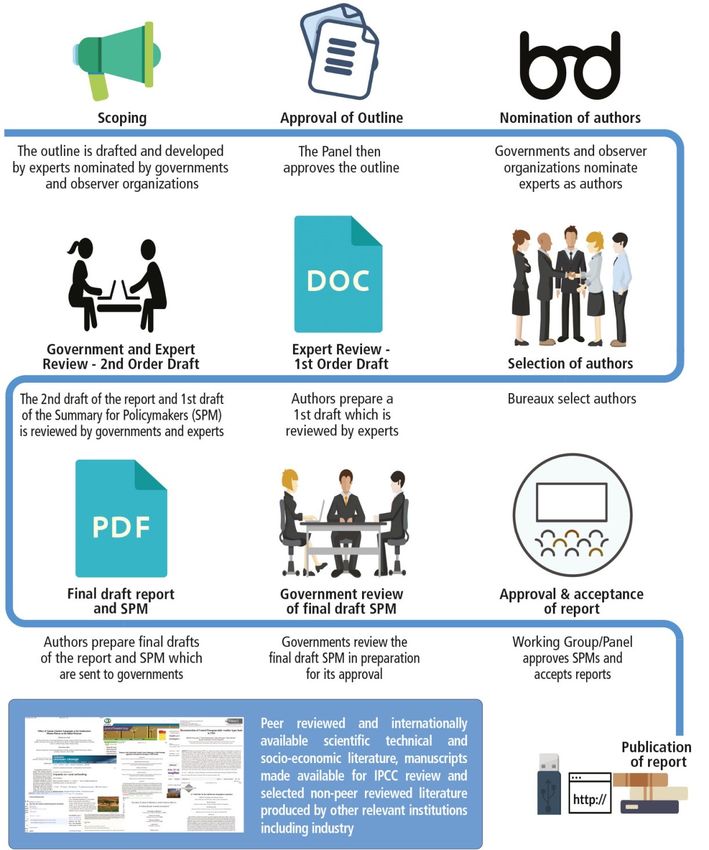
The 6th Assessment cycle
                       May 2019                 of the Intergovernmental
                       Emission                Panel on Climate Change
                      inventories

        Oct. 2018      Sept. 2019        August 2021             Feb 2022         Sept 2022
                          Océans                                 Impact,
         1.5 C
             o
                      et cryosphère     Physical science      adaptation and    Synthesis report
         1.5°C       Ocean &                 basis            vulnerabilities
                     cryosphere

          Talanoa       Usage des                                                  Paris Agreement
          Dialogue      Land
                          terres                           Mitigation                2023 Global
           COP24                                                                      Stocktake

                      August 2019                          March 2022

                     AR7 : Special Report on Cities and Climate Change
www.ipcc.ch
@IPCC_CH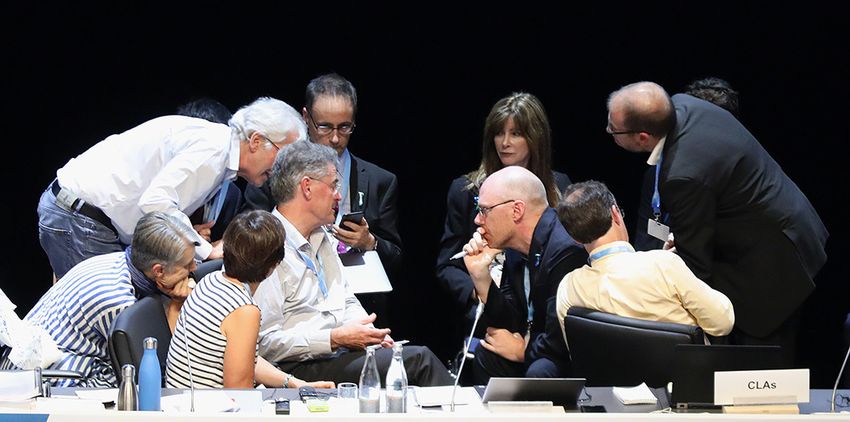
The report in numbers

                            91 Authors from 40 Countries

 133 Contributing authors

      6000 Studies                 1 113 Reviewers

                                       42 001 Comments

ipcc.ch/report/sr15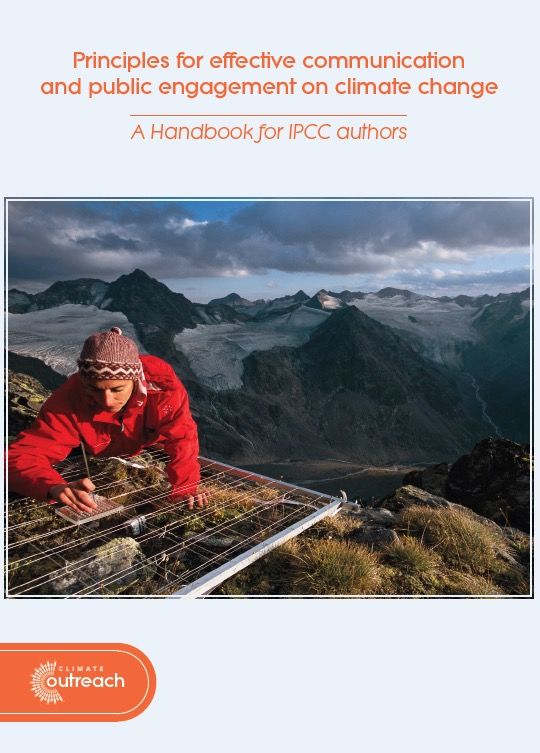
“Many IPCC members remarked on the unusually difficult review of the
                 Summary for Policymakers (SPM) at IPCC-48.

                 Much of the underlying tension was fed by spillover from unresolved
                 issues in the UNFCCC process.

https://enb.iisd.org
SR1.5 Highlights
• Integration across disciplines & IPCC Working Groups
• Emissions / levels of global warming / regional consequences
• Storylines of warmer worlds (https://www.ipcc.ch/infographic/worlds-apart)
• Formalisation of remaining carbon budgets
• Multiple dimensions of feasibility
• Climate change, climate action and sustainability
Complexities of the relationship between science and policy, and the role of the IPCC in these processes.
The writing of SR15 may herald the ways that the IPCC evolves its function and work for the post-Paris era.
Livingston and Rummukainen, Environmental Science & Policy, 2020104 authors (36 countries) 6981 publications 31 176 comments from 824 expert reviewers Human-induced climate change is affecting life-sustaining systems, from the top of the mountains to the depth of the ocean. Some of these changes will continue for generations to come www.ipcc.ch/report/SROCC
SROCC Highlights
www.ipcc.ch/report/SROCC

                           • Socio-ecosystem approach
                           • Committed changes, irreversibility, abrupt change, deep uncertainty
                           • Storylines for low probability but high impact events
                           • Risk levels depend on global climate change and effectiveness of local responses
                           • Education, climate literacy
“After this intensive exercise, many
participants agreed that the report
was more readable, accurate, and
relevant. The science was scrutinized
but not questioned”
“In many ways the SPM approval process boils down to a process of
translation for which few scientists have been trained: translating
technical details (…) into language that can be readily understood by
policymakers while still staying true to the underlying science “
https://enb.iisd.orgwww.ipcc.ch/report/SRCCL 107 authors
>7 000 publications
28 275 comments from 596 reviewers
Land : critical
resources under
growing pressure
Sustainable land
management is
part of the solution
“Climate Change and Land:
But it can’t
An IPCC Special Report on climate change, do it all
desertification, land degradation, sustainable
land management, food security, and
greenhouse gas fluxes in terrestrial ecosystems”“It is the first IPCC Special Report to encompass the missions
of all three Rio Conventions—climate change (UNFCCC),
biodiversity (CBD), and desertification (UNCCD).
Multiple challenges :
Mitigation, adaptation, land degradation & desertification, It is also the first report of its kind to be undertaken jointly
food security, biodiversity, ground water stress, water quality
by all the IPCC bodies: the three Working Groups (WGs) as
well as the Task Force on National GHG Inventories.
It has also been called the first Special Report to take a more
systemic approach to a sector or area—in this case, the food
system.”
“Everyone had something to say on each section of the report
regarding their own country, its land, and its interests (…)
The approval process was remarkably constructive”
“a wide diversity of solutions exists at every scale and for every actor”
https://enb.iisd.orgThe 6th Assessment cycle
May 2019 of the Intergovernmental
Emission Panel on Climate Change
inventories
Oct. 2018 Sept. 2019 August 2021 February 2022 September 2022
Océans Impact,
1.5 C
o
et cryosphère Physical science adaptation and Synthesis report
1.5°C Ocean & basis vulnerabilities
cryosphere
Talanoa Usage des Paris Agreement
Dialogue Land
terres Mitigation 2023 Global
COP24 Stocktake
August 2019 March 2022
www.ipcc.ch
@IPCC_CHScoping the AR6 WGI report https://apps.ipcc.ch/eventmanager/documents/47/040820171122-Doc.%206%20-%20SYR_Scoping.pdf
209 lead authors, 50 review editors and 600 contributing authors (40 countries)
 1089 expert reviewers (54,677 comments)
 > 9,200 peer-reviewed publications
 1250 scientific graphs and figures
 2000 pages

 “the AR5 doesn’t pack the same punch as the AR4”

    “Several key messages in the report stand out
    due to stronger scientific evidence, increased
    certainty and/or new findings“

                                                                   “Importantly, the report provides
                                             “hiatus”              information on temperature implications
                                                                   of cumulative total CO2 emissions”
https://enb.iisd.org
Scoping the AR6 WGI report
• Reflecting science advances and progress in understanding
• Global and regional scales
• Facilitating the integration of multiple lines of evidence
• Building on AR6 special reports, enhaning handshakes with WGII - III
Cross-cutting issues
• Scenarios and pathways
• Risk assessment
• SRM, CDR
• Air quality, SLCF
• Water & carbon New outline
• Regional climate change, atlas
« holistic » approach
https://apps.ipcc.ch/eventmanager/documents/47/040820171122-Doc.%206%20-%20SYR_Scoping.pdfWorking Group I
1. Framing, context, methods
Large scale climate change Process understanding Regional climate
information
2. Changing state of the 5. Global carbon and other
climate system biogeochemical cycles 10. Linking global to
3. Human influence on the 6. Short-lived climate regional climate
climate system forcers 11. Weather and climate
4. Future global climate 7. The Earth’s energy extreme climate events
budget 12. Climate information for
8. Water cycle changes risk assessment
9. Oceans, cryosphere and 13. Regional climate change
sea level change AtlasWGI bureau meeting @ WMO
• Selection of authors
• 996 nomination, 232 selections based on expertise
https://www.nature.com/articles/d41586-020-01047-8• Implementation of inclusive and participatory approaches
• 3 physical Lead Author Meetings
• Coordination x WG (invitations to attend meetings, specific webinars, « bridge » authors, x WG teams on specific topics)
Ex : guidance note on the concept of risk in the AR6
https://www.ipcc.ch/event/guidance-note-concept-of-risk-in-the-6ar-cross-wg-discussions/
https://www.nature.com/articles/d41586-020-01047-8• Due to the pandemic, the 2020-2021 schedule was adjusted, and all the final
report preparation steps have taken place online
• The approval session will take place online over 2 weeks starting on July 26
- concise summary for policy makers
- series of informal webinars (Q&A)
https://www.nature.com/articles/d41586-020-01047-8230 authors (60 countries)
Working Group I >74 800 review comments from 750 and 1279 reviewers
14 000 peer-review publications
Summary for Policymakers
Infographic on
climate futures Technical Summary
Interactive Atlas
Large scale climate change Process understanding Regional climate
information
2. Changing state of the 5. Global carbon and other
34 FAQs climate system biogeochemical cycles 10. Linking global to
Regional fact sheets 3. Human influence on the 6. Short-lived climate regional climate
climate system forcers 11. Weather and climate
FAIR data principles 4. Future global climate 7. The Earth’s energy extreme climate events
budget 12. Climate information for
8. Water cycle changes risk assessment
Emulators
9. Oceans, cryosphere and 13. Regional climate change
sea level change Atlas
Climate impact-drivers
Low-likelihood outcomes
1. Framing, context, methods
Annex VII: GlossaryDraft Summary for Policy Makers The current state of climate Our possible climate futures Climate information for risk assessment and regional adaptation Limiting climate change
Structure of the Synthesis Report

Introduction

Current Status and Trends

Long term Climate and Development Futures

Near Term Responses in a Changing Climate
The preparation of the AR6 WGI report has been made possible thanks to :

•   Constant team work within the WGI bureau and with other WGs

•   The amazing WGI Technical Support Unit supervised by Anna Pirani and
    the coordinator of the science team, Sarah Connors

•   The impressive dedication of Coordinating Lead Authors, Lead Authors,
    Contributing Authors, Review Editors, Chapter Scientists, and Expert
    Reviewers (including collective reviews from early career scientists)

•   Support to IPCC Authors from their host institutions

•   Support from the IPCC Secretariat and member states
You can also read


