Written evidence submitted by Mark Thomas on behalf of the 99% Organisation (HCB94)
←
→
Page content transcription
If your browser does not render page correctly, please read the page content below
Written evidence submitted by Mark Thomas on
        behalf of the 99% Organisation (HCB94)

                                       Mark Thomas
                            Founder of the 99% Organisation
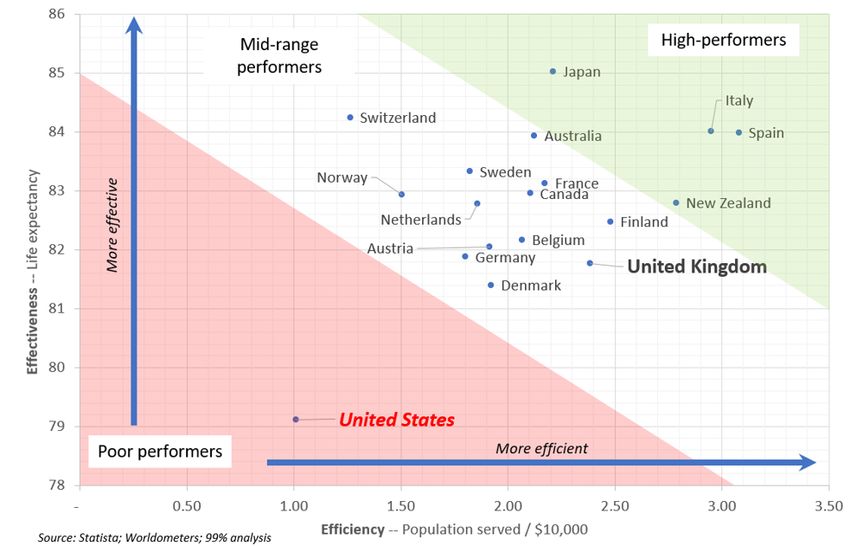
                         Visiting Professor at IE business School

Executive Summary
Without significant amendment, the Health and Care Bill poses significant risks to the
efficiency, effectiveness and accessibility of the NHS as a universal health service free at the
point of use:

   •   the Bill creates enormous powers for ministers and Integrated Care Boards without
       corresponding duties and adequate safeguards;

   •   from the perspective of patients and taxpayers, The US healthcare system is a very
       poor performer. Nevertheless, although it is the least efficient, effective and
       accessible in the developed world, the US system appears to be the model towards
       which this Bill is moving the NHS. To our concern, we note that there is an enormous
       commercial incentive to do so;

   •   several members of the current Cabinet have made it clear that they do not wish to
       see the NHS continue in anything like its current form and have made proposals that
       would move the NHS towards the US system. Commercial interests are legally bound
       favour such a move. There are thus powerful motivations to erode two of the
       fundamental principles of the NHS: that it is free at the point of use and that it is
       governed on behalf of UK patients and taxpayers;

   •   the Bill should be amended to protect the efficiency, effectiveness and accessibility
       of the NHS for the UK population.

Introduction
Most of my career has been spent in business: I was Group Development Director for
UniChem plc (now Walgreens Boots Alliance) and for many years I led the Strategy practice
at PA Consulting Group. I am the author of The Complete CEO, The Zombie Economy and
99% (one of the FT’s best books of 2019). I founded the 99% Organisation and am a Visiting
Professor at IE business School in Spain.
This submission is a distillation of the paper produced by the 99% Organisation NHS Project
team, which included former NHS consultants, management consultants, social workers and
others. The full paper is available here: https://99-percent.org/wp-
content/uploads/2021/09/NHS-Fact-pack-v1.6.pdf.
I am happy to provide further detail in oral evidence to the Committee should you wish.
The main submission
1. This submission amplifies and provides evidence for the points mentioned in the
executive summary.
Power without responsibility or scrutiny
2. The Bill concentrates power over the NHS into two sets of hands: those of ministers
and the Integrated Care Boards (ICBs).
3. To ministers, the Bill gives enhanced powers to circumvent normal procurement
rules (e.g. advertising and competitive tendering) and to award contracts at will1.
During COVID we have seen use of emergency procurement procedures in ways
which are, at best, a sub-optimal use of public money – for example with personal
protective equipment (PPE) and with test and trace. In the case of PPE, well over £1
Billion of public money2 was spent with inexperienced suppliers and a significant
proportion of what was delivered was not usable in practice. In the case of test and
trace, which is costing £37 Billion of public money3, the National Audit Office (NAO)
has published two highly critical reports about its lack of effectiveness. Both of these
are currently the subject of judicial review. Without amendment, the Bill would
enable ministers to procure in this way routinely and without scrutiny.
4. The Bill also gives ministers the power to amend or abolish existing bodies, create
new NHS trusts and to intervene in reconfigurations of NHS. Without amendment,
the Bill would enable them to restructure the NHS at will without consulting
Parliament.
5. Finally, unless the Bill is amended, there will no longer be a statutory duty on any
body to arrange provision of secondary (i.e., hospital) medical services – only a
power for ICBs to do so.
6. Such a concentration of power without responsibility or scrutiny would be
inappropriate for any government whether well disposed towards the NHS or
otherwise.
Risks of moving towards the US system
7. The US healthcare system appears to be the model towards which the NHS is being
steered4. And this is curious because the US system is not a high performer either in
comparison with the NHS or with other systems around the world.
1
(Pollock & Roderick, 2021)
2
(Thomas, Money for Nothing?, 2020)
3
(Thomas, What's in a Name?, 2021)
4
(Harrington, Beetham , & Matthews, 2021)8. As patients and as taxpayers, there are three dimensions on which we would like to
see the NHS perform well:
• efficiency – as taxpayers, we would like the NHS to provide a high-quality healthcare
service to the UK population as cheaply as possible;
• effectiveness – as patients, we would like the NHS to provide good healthcare
outcomes; and
• accessibility – as patients, we would like the NHS to be accessible geographically,
temporally (i.e. without long waiting lists) and, of course, financially.
9. For efficiency, we can measure the number of people served per $10,000 spent. For
effectiveness, there is no perfect measure, but life expectancy is a reasonable, if
crude, proxy.
10. As the chart below shows, in terms of efficiency and effectiveness, the UK system is a
good mid-range performer; the US system is the stand-out poor performer.
Figure 1: Comparison of Healthcare Systems
11. In addition to these considerations there is also accessibility. The US system is
prohibitively expensive for those without insurance, and, even for those with
insurance, it can often be ruinous. Two thirds of American personal bankruptcies are
as a result of medical Bills5.
5
(Himmelstein, Lawless, Thorne, Foohey, & Woolhandler, 2018)12. Given this, it is initially surprising that the US system might be a favoured
destination. But there is a fourth dimension, which is not a concern to UK taxpayers
or patients but is vitally important to other stakeholders: profit. The US system is
particularly good as a profit generator. Our estimates suggest that the profit
opportunity available to healthcare corporations if the UK adopted the US system is
of the order of $28 Billion6 per annum.
13. The risk to the UK, therefore, is that because of the size of the prize, the interests of
healthcare corporations will trump those of UK taxpayers and patients at enormous
cost to their lives and livelihoods.
Inclination to change the nature of the NHS
14. Given the concentration of power in the hands of ministers and ICBs, we are
concerned about their motivations when it comes to steering and governing the
NHS.
15. John Major commented in 20167:
“The concept that [the Cabinet] would care for the National Health Service
is a rather odd one: Michael Gove wanted to privatise it; Boris wanted to
charge people for using it; and Iain Duncan Smith wanted a social
insurance system. The NHS is about as safe with them as a pet hamster
would be with a hungry python.”
16. The Health Secretary, Sajid Javid, has celebrated8 his adherence to the ideas of Ayn
Rand who vehemently opposed the very idea of publicly funded healthcare. And
there is a long history of papers by Cabinet members and others promoting the
privatisation of the NHS9 and the shift to an insurance-based scheme10 – dating far
back as 198211.
17. On the corporate side, as drafted, the Bill will allow corporate members to sit on the
ICBs (and indeed this has already started to happen12) and therefore to play an
important role in the governance of the NHS. Directors of corporations have a
fiduciary duty to the members of their company – i.e. to their shareholders. Where
there is a conflict of interest between taxpayers, patients and company
shareholders, the corporate members are legally bound to favour their shareholders.
And as noted above there is an enormous commercial incentive to steer the NHS
towards the US system.
6
(The 99% Organisation, 2021)
7
(Mason, 2016)
8
(Hoskin, 2015)
9
(Gove, et al., 2015)
10
(Redwood, 1988)
11
(Armstrong, 1982)
12
(BSW Partnership Board , 2021)18. This evidence that this Bill, as it stands, will introduce conflicting motivations within
NHS governance highlights the need for amendment to add checks and balances to
the Bill.Amendments needed to the Bill
19. For the reasons stated above, without amendment, the Bill poses a grave risk to the
NHS itself and to UK taxpayers and patients.
20. Others13 have proposed more comprehensive lists of amendments; the table below
summarises what we believe to be the most important amendments needed.
What the Bill does What it should do: Amendments Needed
The Bill removes the obligation for public The Government should protect the NHS
tendering for NHS services and allows from unnecessary and costly private sector
ministers to circumvent normal involvement and ensure scrutiny and
procurement rules. transparency over the awarding of
contracts. The most effective way of doing
that is to make the NHS the default option
for NHS contracts and to tender
competitively where this is not possible.
The legislation leaves open the possibility Keep governance under the control of
for corporate healthcare providers to gain those whose fiduciary duty is to patients
seats on ICS boards which represents a and to the NHS rather than to
clear conflict of interest and gives them shareholders.
undue influence in decision-making.
There will no longer be a statutory duty on Reintroduce a duty on the Health
any body to arrange provision of secondary Secretary to provide a high-quality health
(i.e., hospital) medical services – only a and care service, free at the point of use
power for ICBs to do so. for all UK citizens.
Gives new and considerable powers to Introduce a statutory duty on the ICBs to
amend or abolish existing arm’s length ensure provision of secondary medical
bodies, create new NHS trusts and to services
intervene in reconfigurations of the health
Ensure adequate funding to meet the
service.
needs of the population.
Gives ministers greater control over Impose strict protection on patient data
patient data. unless totally anonymised (not merely de-
personalised) especially when given or sold
to commercial organisations.
September 2021
13
E.g. (Pollock & Roderick, 2021) and (Tonkin, 2021)References
Armstrong, R. (1982, 9 6). Longer Term Options. Retrieved from https://99-percent.org/:
https://99-percent.org/wp-content/uploads/2021/07/Longer-Term-Options-Cabinet-
Paper.pdf
BSW Partnership Board . (2021, 5 28). BSW Partnership Board . Retrieved from
https://bswpartnership.nhs.uk/: https://bswpartnership.nhs.uk/wp-
content/uploads/BSW-Partnership-Board-meeting-28-May-2021-combined-
papers.pdf
Gove, M., Kwarteng, K., Norman, J., Hunt , J., Penrose, J., Carswell, D., & Hannan , D. (2015).
Direct Democracy: An Agenda for a New Model Party. Retrieved from
https://whatwouldvirchowdo.files.wordpress.com/:
https://whatwouldvirchowdo.files.wordpress.com/2015/09/direct_democracy___an
_agenda_for_a_new_model_party.pdf
Harrington, D., Beetham , H., & Matthews, S. (2021, 5). NHS BILL 2021. Retrieved from
https://publicmatters.org.uk/: https://publicmatters.org.uk/wp-
content/uploads/2021/05/Public-Matters-BRIEFING-NHS-BILL-FINAL.pdf
Himmelstein, D. U., Lawless, R. M., Thorne, D., Foohey, P., & Woolhandler, S. (2018, 11 17).
Medical Bankruptcy: Still Common Despite the Affordable Care Act. Retrieved from
https://ajph.aphapublications.org/:
https://ajph.aphapublications.org/doi/abs/10.2105/AJPH.2018.304901?journalCode
=ajph&
Hoskin, P. (2015, 1 15). Javid: “I read the courtroom scene from ‘The Fountainhead’ to my
future wife!”. Retrieved from https://www.conservativehome.com/parliament/:
https://www.conservativehome.com/parliament/2015/01/javid-i-read-the-
courtroom-scene-from-the-fountainhead-to-my-future-wife.html
Mason, R. (2016, 6 5). John Major: NHS at risk from Brexit 'pythons' Johnson and Gove.
Retrieved from https://www.theguardian.com/:
https://www.theguardian.com/politics/2016/jun/05/john-major-nhs-risk-brexit-
pythons-johnson-and-gove
Pollock, M. A., & Roderick, P. (2021, 9 25). Health and Care Bill 2021-22. Retrieved from
https://allysonpollock.com/: https://allysonpollock.com/?p=3690
Redwood, O. L. (1988). Britain's Biggest Enterprise. Retrieved from
https://www.scribd.com/: https://www.scribd.com/doc/56986348/Britain-s-Biggest-
Enterprise
The 99% Organisation. (2021, 09 01). Protecting the NHS from Destructive Reform. Retrieved
from https://99-percent.org/: https://99-percent.org/wp-
content/uploads/2021/09/NHS-Fact-pack-v1.6.pdf
Thomas, M. E. (2020, 9 1). Money for Nothing? Retrieved from https://99-percent.org/:
https://99-percent.org/money-for-nothing/Thomas, M. E. (2021, 4 13). What's in a Name? Retrieved from https://99-percent.org/:
https://99-percent.org/whats-in-a-name/
Tonkin, T. (2021, 7 7). Health and Care Bill: BMA demands greater protection for patients
and NHS. Retrieved from https://www.bma.org.uk/: https://www.bma.org.uk/news-
and-opinion/health-and-care-bill-bma-demands-greater-protection-for-patients-and-
nhsYou can also read


