2017 2018 Doing Business With OCS
←
→
Page content transcription
If your browser does not render page correctly, please read the page content below

ANNUAL REPORT

2017
2018
Letter to the Minister
—
The Honourable Victor Fedeli, Minister of Finance

Dear Minister,
I am pleased to present the Ontario Cannabis Retail Corporation (OCRC) Annual Report.
The report covers the fiscal period from April 1, 2017, to March 31, 2018.

Susan Robinson
Acting Chair, Ontario Cannabis Retail Corporation
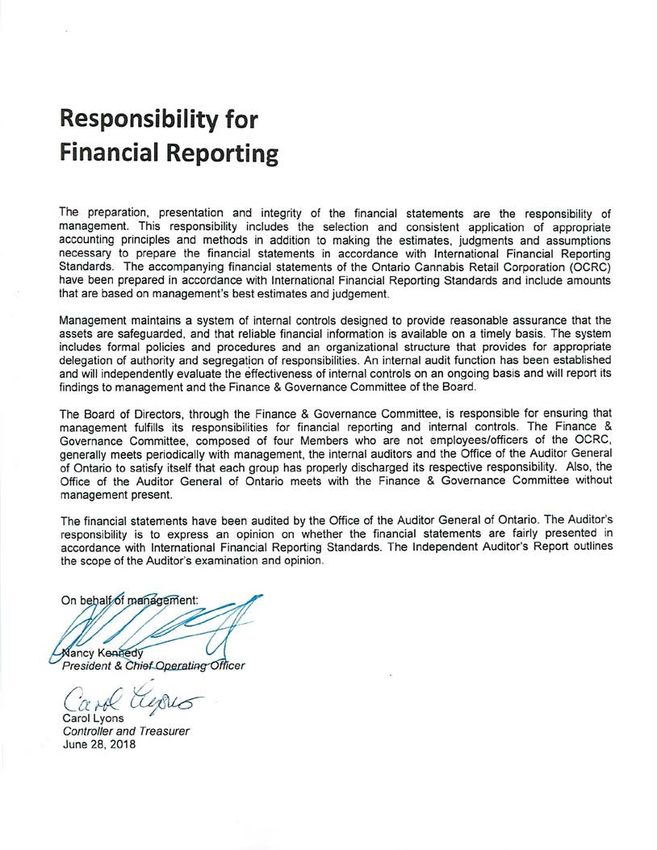
Table of Contents
—
Message from the Acting Chair              4
Message from the President                 5
Overview                                   6
Operating Environment                      7
Strategic Direction                        8
Key Activities                             9
Operational Performance                    11
OCRC Board of Directors                    12
Corporate Structure                        13
Financial Performance                      14
Financial Position                         15
Appendix – Financial Statement and Notes   17

Message from the Acting Chair
—
I am pleased to present the first Annual Report of the Ontario Cannabis Retail Corporation
(OCRC), doing business as the Ontario Cannabis Store (OCS). Meeting the challenges
of cannabis legalization is no small feat, and this report outlines the critical activities and
accomplishments the OCS has achieved to meet this important milestone.
Established in January 2018, the Board of the Ontario Cannabis Retail Corporation was tasked
with the overall governance of the OCS. Since then, our board has met numerous times, struck
two subcommittees and welcomed two new members. I would like to thank my fellow board
members for their dedicated service. We will continue to operate using best practices in public
sector governance and hold ourselves to the highest standards of accountability and transparency.
The OCS was established as a subsidiary of the Liquor Control Board of Ontario (LCBO) in
order to quickly set up our operations to meet the timeline for cannabis legalization. Initially, the
OCRC Board reported to the LCBO Board. Several LCBO Board members, including myself, were
appointed to the OCRC Board to lend our experience and help establish it. The experience
was a testament to the high degree of collaboration between both organizations to achieve our
shared objective of retailing in the public interest.
In September 2018, the provincial government announced changes to our relationship with the
LCBO. The OCRC Board will report directly to the Minister of Finance. I am thankful to the LCBO
Board and executive team for their support and guidance as we established the OCRC as an
independent organization. I am committed to working with the LCBO Board to ensure a smooth
transition in the coming year.
The Government of Ontario also announced changes to the cannabis retail model in Ontario,
where the OCS would no longer operate retail stores; instead, it will deliver an online retail channel
and supply a network of private stores. The board is committed to supporting and providing
guidance to the OCS as we shift our approach to deliver on our revised mandate. I am confident
we will succeed with this ambitious goal while advancing the government’s objectives to protect
public safety and help eliminate the illegal cannabis market.
In closing, I want to express how grateful I am to be working with such a leading class of executives
and staff at the OCS, who take their responsibility as the province’s online cannabis retailer very
seriously. They are incredibly competent and motivated, and act with honesty and integrity in
everything they do. The people make the place, and on behalf of the OCRC Board, thank you to
the members of the OCS for their outstanding progress toward legalization.

Susan Robinson
Acting Chair,
Ontario Cannabis Retail Corporation

                                                                         OCRC ANNUAL REPORT 2017-2018 | 4
Message from the President
—
I welcome the opportunity to present the first ever Annual Report of the Ontario Cannabis
Retail Corporation. Since the OCS was formed in December 2017, our team has been focused
on providing safe and responsible access to recreational cannabis in time for federal
legalization. I am truly grateful for the efforts of our staff, who have worked tirelessly to meet
this important milestone.
Throughout everything we do is a focus on safety and meeting the needs of our future customers.
From day one, the OCS has followed Privacy by Design principles to develop a safe, secure online
shopping experience for adults 19 years of age and older. The OCS has implemented 24/7 security
monitoring and ongoing security testing of its site, as well as a privacy program to sustain
the OCS’s mandate to protect personal information. Age verification at delivery is another
fundamental component of the safe and secure OCS online retail experience.
Making the OCS work is about delivering the very large pieces, such as our IT solution and
the distribution channel, while making sure we keep our eyes on every detail. To deliver on our
commitments, we have built business partnerships with Shopify, supply chain and logistics
providers, and many other technology providers. We have worked with our ministry partners,
federally licensed producers and Health Canada to ensure a tested, diverse and high-quality
supply of cannabis for Ontario consumers. Through ongoing competitive product calls, the OCS
will continue to work closely with licensed producers and accessory suppliers to ensure that
Ontario’s legal cannabis marketplace has sufficient supply and a broad selection of cannabis
products that meet the needs of Ontario consumers.
Over the coming year, we will be working with the Ministry of Finance, the Attorney General and
the Alcohol and Gaming Commission of Ontario to establish a wholesale distribution network
to supply cannabis to licensed private stores in Ontario once legislative requirements are put in
place. We will work to ensure the OCS meets forecasted wholesale demand while continuing to
offer a secure online retail experience. We will continue to build on our early work to articulate
and implement our strategic direction, key corporate priorities and performance measures. This
work will ensure we are continually striving to meet government objectives along with public
and stakeholder expectations of the OCS as an online retailer and wholesaler.
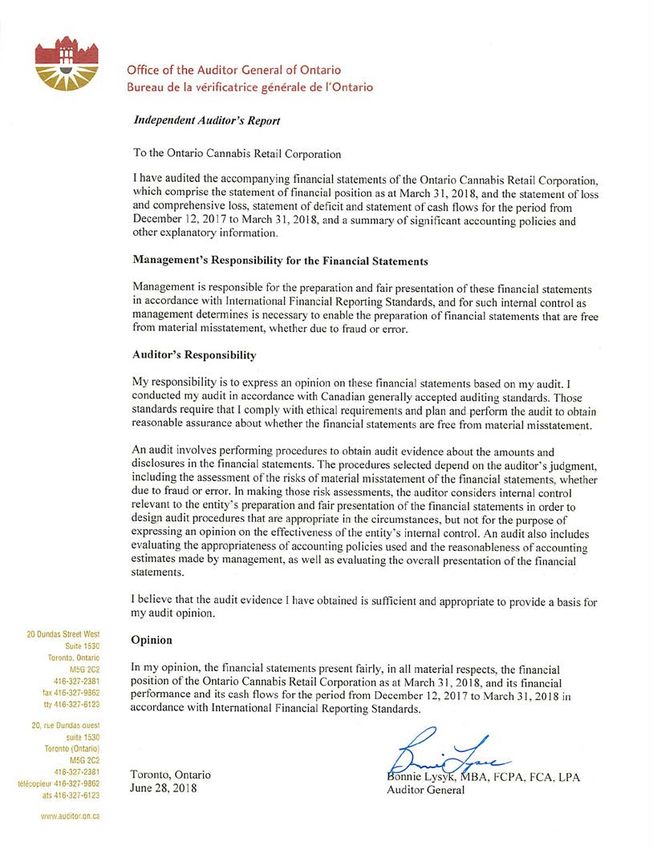
This Annual Report details our formative actions, financial performance and significant
accomplishments since the OCS was established in December 2017 until fiscal year-end on
March 31, 2018.
As always, we will act in the public interest while ensuring a safe and secure retail experience.

Patrick Ford
President and Chief Operating Officer,
Ontario Cannabis Retail Corporation

                                                                       OCRC ANNUAL REPORT 2017-2018 | 5
Overview
—
The Ontario Cannabis Retail Corporation, operating as the Ontario Cannabis Store, is the province’s
exclusive online retailer of recreational cannabis in Ontario. The OCS was established as a
Crown agency through the Ontario Cannabis Retail Corporation Act, 2017. The Act authorizes
the OCS to buy, possess and sell recreational cannabis and related products through its online
retail channel once cannabis is legalized in Canada.
The OCS’s main objectives in the sale of recreational cannabis are to:
  • ensure recreational cannabis is sold safely and securely through its online retail site;
  • protect the privacy of its customers;
  • educate the public and consumers to promote informed and responsible use; and,
  • facilitate a convenient online retail experience with a wide product offering to divert
		 users to the legal channel.
The principles that guide the activities of the OCS are prescribed in provincial and federal legislation.
The OCS’s operations are also guided by regulations set out by Health Canada. In fulfilling its
mandate, the OCS reports to the Minister of Finance, and endeavours to operate efficiently and
with transparency. The OCS is also committed to supporting the Government of Ontario’s objec-
tives of building a cannabis retail system that will help eliminate the illegal market and is safe and
reliable, with rules that keep cannabis out of the hands of youth, and keep our roads safe.

                                                                          OCRC ANNUAL REPORT 2017-2018 | 6
Operating Environment
—
In April 2017, the federal government introduced legislation to legalize and regulate non-medical
cannabis in Canada. The federal Cannabis Act included rules for producing, possessing and
selling non-medical cannabis across Canada. In June 2018, legislation to enact the federal
Cannabis Act received royal assent. Shortly after, the federal government announced that the
Cannabis Act would come into force on October 17, 2018.
Under the legislation, the federal government has the authority to set requirements for licensed
producers along with industry-wide rules and standards, including those governing packaging,
advertising and promotion. At the time of cannabis legalization, only cannabis flowers, seeds and
oils are available for legal purchase. The federal government has indicated that cannabis edible
products and concentrates will be legal for sale around October 2019.
The federal government’s cannabis legislation delegates the responsibility for cannabis sales
and distribution to the provinces and territories. The delay between the passage of the federal
bill and the legalization date was to give provinces and territories sufficient time to establish
their retail models. A variety of public, private and hybrid approaches arose across Canada.
While each jurisdiction in Canada has made distinct choices regarding the structure of its retail
model, the common core elements that have emerged are to build social licence, divert users
from the illegal market and promote responsible consumption.

                                                                       OCRC ANNUAL REPORT 2017-2018 | 7
Strategic Direction
                        —
                        As an agency of the provincial government, the OCS supports the Ontario government’s key
                        policy and fiscal objectives. Since its inception, the OCS has aimed to reinforce provincial
                        government commitments around cannabis legalization, namely to protect public health and
                        safety. Moving forward, the OCS will review its strategic direction and operations to ensure
                        consistency with the provincial government’s direction and service delivery standards.
                        Over the past year, the OCS has been guided by a series of core strategic objectives (see below)
                        aimed at ensuring the agency takes a customer-focused, cautious and prudent approach to the
                        opening of Ontario’s recreational cannabis marketplace.

1   OPERATE A
    SECURE AND
    CONVENIENT
    ONLINE RETAIL
    CHANNEL
                    2   DIVERT
                        CONSUMERS
                        FROM THE
                        ILLICIT MARKET      3       OPERATE
                                                    FROM AN
                                                    EDUCATION-
                                                    FIRST
                                                    PLATFORM
                                                                        4       DELIVER
                                                                                VALUE FOR
                                                                                ONTARIO
                                                                                TAXPAYERS            5       OFFER A BROAD
                                                                                                             SELECTION OF
                                                                                                             HIGH-QUALITY
                                                                                                             CANNABIS
                                                                                                             PRODUCTS

                        In order to effectively deliver on its mandate and establish itself as a steady state organization,
                        the OCS is embarking on a longer-term strategic planning process over the coming year.
                        Establishing a long-term strategic direction will enable the OCS to become a leading online
                        retailer while its operating environment becomes increasingly complex. The OCS will develop
                        a strategic plan to help the agency navigate future challenges and opportunities in the sector,
                        and it will create a corporate planning process to ensure it is delivering on its commitments
                        and hitting its targets.

                               PERFORMANCE TARGETS
                               The OCS will integrate performance measurement into its overall
                               strategic planning approach. Developing key metrics and targets will
                               enable the OCS to improve its operating effectiveness by promoting
                               a focus on accountability through continued targeting, monitoring and
                               evaluation of results. Over the coming years, the OCS will engage in
                               multi-year target setting and link performance measurement to resource
                               planning in order to become a results-oriented organization.

                                                                                                OCRC ANNUAL REPORT 2017-2018 | 8
Key Activities
—
In order to meet the federally imposed obligation for provinces and territories to be ready for
retail sales by the date of cannabis legalization, the Government of Ontario tasked the OCS to
launch an online retail channel that includes a verification system that would ensure safe
at-home delivery for cannabis products.
To prepare for the legalization of recreational cannabis on October 17, 2018, the OCS has
accomplished the following core activities over the past year.

BUILDING A SECURE E-COMMERCE SITE
The OCS selected Ontario-based Shopify to design and build an online platform for its
e-commerce sales.
From the beginning, the OCS adopted a Privacy by Design approach, with high standards
of privacy and security built into system requirements. OCS.ca is designed to adhere to the
advertising and promotion restrictions put in place by Health Canada.
Protecting youth has also been top of mind for the OCS during the development of its e-commerce
platform. OCS.ca features several age-gating measures to restrict access for youth.

                                                                      OCRC ANNUAL REPORT 2017-2018 | 9
ESTABLISHING RELATIONSHIPS WITH
LICENSED PRODUCERS AND OTHER SUPPLIERS
Through supply agreements with cannabis producers licensed by Health Canada, the OCS
ensured a diverse and high-quality supply was ready and available for legalization. Supply
agreements for both cannabis and accessories were achieved through a competitive process.
The OCS will continue to hold competitive cannabis product calls to expand its selection to
be responsive to the preferences of Ontario consumers.

PROMOTING SOCIAL RESPONSIBILITY
The OCS is committed to protecting youth and to being a positive community partner. Preventing
sales to anyone under the designated legal purchasing age of 19 will remain a priority.
The OCS online retail store is an education-first platform and includes strict age-verification
measures. In accordance with federal and provincial laws, the OCS developed an age-verification
process to restrict youth access to OCS.ca and prevent youth from viewing or receiving cannabis
products or cannabis accessories.
Each and every time a customer visits OCS.ca, they will be required to provide their date of
birth and confirm that they are 19 years of age or older before entering the site. When finalizing
purchases at checkout, customers will have to click to confirm once again that they are 19 years
of age or older. Finally, upon delivery, delivery agents will verify identification for anyone that
appears to be under the age of 25 to ensure that packages are not delivered to anyone under
19 years of age.
Promoting safe and responsible use of recreational cannabis has been a key priority for the OCS.
The OCS has developed comprehensive learning content that provides trusted information
regarding products and safe consumption habits. The OCS will continue to educate its customers
on the facts surrounding cannabis consumption.

                                                                      OCRC ANNUAL REPORT 2017-2018 | 10
Operational Performance
—
The Ontario Cannabis Retail Corporation was established under the Ontario Cannabis Retail
Corporation Act, 2017, Chapter 26, Schedule 2. It is a corporation without share capital and is an
agent of the Crown.
The OCS’s current operations are supported by the resources of the Liquor Control Board of
Ontario. Given the need to quickly deliver on legalization, the OCS was established using a
shared services model that leverages people, contracts and processes in place at the LCBO.
During the period ending March 31, 2018, the OCS was fully engaged in set-up activities that
were largely performed by a project team composed of LCBO employees, using LCBO resources.
Services and resources provided by the LCBO were charged to the OCS on a shared service
basis. In addition, the OCS hired certain employees directly, mainly to support the set-up of retail
store operations.
OCRC ANNUAL REPORT 2017-2018 | 11OCRC Board of Directors
—
The OCS is governed by a board of directors, consisting of up to seven members, each appointed
by the LCBO Board of Directors. The OCRC Board has struck two committees: the Finance and
Governance Committee, and the Human Resources and Compensation Committee. The list below
reflects the members of the OCRC Board who served during the fiscal year ending March 31, 2018,
including their original appointment dates.
Virginia Cirocco (Member)
March 29, 2018 – March 28, 2021
David Graham (Member)
January 25, 2018 – August 16, 2020
Ira Kagan (Member)
January 25, 2018 – January 24, 2021
Susan Pigott (Chair)
January 25, 2018 – August 10, 2018
Susan Robinson (Vice-Chair)
January 25, 2018 – August 3, 2019
Lori Spadorcia (Member)
January 25, 2018 – February 14, 2020
Rajesh Uttamchandani (Member)
March 29, 2018 – March 28, 2021
REMUNERATION
Total Board Expenses to March 31, 2018 = $275.51
Total Board Per Diems to March 31, 2018 = $11,560.00
OCRC ANNUAL REPORT 2017-2018 | 12Corporate Structure
—
The organizational structure of the OCS is composed of seven functional divisions, each led by
an executive, reporting to the president and chief operating officer. The OCS has established
itself as a nimble organization to allow for organizational change as its role and the sector evolve
over the coming years.
OCRC BOARD
PRESIDENT &
CHIEF OPERATING OFFICER
STRATEGY + INFORMATION LEGAL OPERATIONS FINANCE HUMAN
PARTNERSHIPS TECHNOLOGY RESOURCES
— — —
— — —
LEGAL + MARKETING FINANCE +
INTERNAL + INTERNAL ADVISORY ADMINISTRATION HUMAN
EXTERNAL IT SERVICES SERVICES — RESOURCES
COMMUNICATIONS — SERVICES
— — E-COMMERCE
— PROCUREMENT —
VENDOR BOARD + —
CORPORATE RELATIONS CORPORATE TALENT
AFFAIRS + GOVERNANCE SUPPLY CHAIN ACQUISITION
STRATEGY
— —
MERCHANDISING DIVERSITY +
INCLUSION
—
—
RETAIL +
CUSTOMER CARE LEARNING +
DEVELOPMENT
OCRC ANNUAL REPORT 2017-2018 | 13Financial Performance
—
The audited financial statements of the Ontario Cannabis Retail Corporation are prepared in
accordance with International Financial Reporting Standards as issued by the International
Accounting Standards Board. See appendix for audited financial statements.
The initial set-up of the OCS was substantially complete on October 17, 2018, when revenues
commenced, but the OCS anticipates additional one-time costs to be incurred as a result of further
channel development, systems enhancements, and other corporate projects. To support the
set-up activities and initial operations, the OCS may draw funds from the Ontario Financing
Authority to a maximum principal amount of $150 million until December 31, 2019.
Over the fiscal year ending March 31, 2018, the OCS was engaged in set-up activities to enable
the sale of recreational cannabis. At that time, the OCS was also involved in the establishment of
retail stores. The set-up activities were largely performed by a project team composed of LCBO
employees, using LCBO resources. The services provided by LCBO employees and resources
were charged back to the OCS on a shared service basis. In addition, the OCS hired certain
employees directly, mainly to support the set-up of retail operations. Other expenses include
insurance, depreciation and net interest expense. No revenues will be recognized until the next
fiscal year, when the sale of recreational cannabis in Canada is legalized on October 17, 2018.
See below for the breakdown of set-up expenses for the period ending March 31, 2018.
LCBO shared services $6,666,054
Employee salaries and benefits $86,379
Other expenses, net $54,471
Total $6,806,904
The OCRC will continue to engage in set-up activities during the first half of fiscal 2018–2019 to
ensure personnel, systems and infrastructure are in place to support retail operations, with sales
across the province commencing on October 17, 2018. Further set-up activities will continue after
October 17, 2018, for development of sales channels and systems enhancements.
OCRC ANNUAL REPORT 2017-2018 | 14Financial Position
—
NOTES
• Trade and other receivables
ASSETS
includes recoverable Harmonized
Sales Tax and interest receivable.
Cash $24,953,119
• Prepaid expenses represents Trade and other receivables $1,170,002
amounts paid by the LCBO on
the OCRC’s behalf for services to Prepaid services $200,000
be provided in future, including
software licences and software Prepaid expenses $1,275,645
support, rent, and insurance.
Property, plant and equipment $2,338,522
• Property, plant and equipment
includes vehicles, computer Total assets $29,937,288
hardware and store fixtures under
development.
• Trade and other payables and
provisions includes mainly
amounts invoiced and accrued
for LCBO shared services but LIABILITIES AND DEFICIT
also includes amounts accrued
for services received from other Trade and other payables and provisions $11,728,298
vendors, as well as accrued
employee salaries and benefits. Borrowings $25,015,894
• Borrowings includes an advance
on March 19, 2018, from a loan
Deficit – Accumulated loss ($6,806,904)
facility provided by the Ontario
Financing Authority and accrued
Total liabilities and deficit $29,937,288
interest.
• Financial position is unaudited.
NOTES
• Net cash provided by operating
activities was mainly provided by
working capital. LIQUIDITY AND CAPITAL RESOURCES
• Net cash used in investing The OCRC’s sources and uses of cash for the period ending
activities was for the purchase of
vehicles and computer equipment, March 31, 2018, were as follows:
and the development of stores and
store fixtures. Net cash provided by operating activities $2,294,360
• Net cash provided by financing Net cash used in investing activities ($2,341,241)
activities was provided by a
loan advance from the Ontario Net cash provided by financing activities $25,000,000
Financing Authority.
Net increase in cash $24,953,119
OCRC ANNUAL REPORT 2017-2018 | 15COMMITMENTS
The OCRC’s contractual commitments at March 31, 2018, are
limited to leases and shared services arrangements as follows:
Short-term leases – premises
$364,177 Shared services – warehouse lease
$589,275 $569,051 $588,730
FISCAL 2019 FISCAL 2020 FISCAL 2021
The OCRC’s short-term lease is related to short-term office accommodation.
The warehouse lease commitment is related to third-party warehousing services obtained by the
LCBO on behalf of the OCRC.
RELATED PARTY TRANSACTIONS – SHARED SERVICES
Amounts invoiced by the LCBO for shared services and payments made on behalf
of the OCRC for the period ended March 31, 2018, were as follows.
INVOICED
Shared administrative services $5,945,588
Property, plant and equipment $1,536,156
Prepaid items $1,469,796
Insurance $43,165
$8,994,705
HST $1,155,763
Total $10,150,468
OCRC ANNUAL REPORT 2017-2018 | 16Ontario Cannabis Retail Corporation Financial Statements and Notes — MARCH 31, 2018 Financial Statements APPENDIX PAGE 1 Index to Notes APPENDIX PAGE 5 Notes APPENDIX PAGE 6
ONTARIO CANNABIS RETAIL CORPORATION
Statement of Financial Position

(Canadian dollars)

                                                    Note     March 31, 2018
Assets
Current assets
Cash                                                    6           24,953,119
Trade and other receivables                             7            1,170,002
Prepaid expenses                                        8            1,275,645
                                                                    27,398,766
Non-current assets
Prepaid services                                        8               200,000
Property, plant and equipment                           9            2,338,522
                                                                     2,538,522
Total assets                                                        29,937,288

Liabilities and deficit
Current liabilities
Trade and other payables and provisions                10           11,728,298
Non-current liabilities
Borrowings                                             12           25,015,894
Total liabilities                                                   36,744,192

Deficit
Accumulated loss                                                     6,806,904
Total deficit                                                        6,806,904
Total liabilities and deficit                                       29,937,288

                                          For the period December 12, 2017
                                              to March 31, 2018 (Note 1)

                                                                                   2

                                                   OCRC Annual Report 2017-2018 | APPENDIX 1
ONTARIO CANNABIS RETAIL CORPORATION
Statement of Loss and Comprehensive Loss
(Canadian dollars)
For the period
December 12, 2017 to
Note March 31, 2018 (Note 1)
Revenue 3 -
Administrative expenses 4 6,805,248
Finance income 5 (14,238)
Finance costs 5 15,894
Net loss and comprehensive loss 6,806,904
See accompanying notes to the financial statements.
1
OCRC Annual Report 2017-2018 | APPENDIX 2ONTARIO CANNABIS RETAIL CORPORATION
Statement of Changes in Deficit
(Canadian dollars)
Accumulated
loss Total Deficit
Balance at beginning of period - -
Net loss 6,806,904 6,806,904
Balance at March 31, 2018 6,806,904 6,806,904
See accompanying notes to the financial statements.
3
OCRC Annual Report 2017-2018 | APPENDIX 3ONTARIO CANNABIS RETAIL CORPORATION
Statement of Cash Flows
(Canadian dollars)
For the period
December 12, 2017 to
March 31, 2018 (Note 1)
Operating activities:
Net loss (6,806,904)
Adjustments for:
Depreciation 2,719
Interest on borrowings 15,894
Change in non-cash balances related to operations:
Trade and other receivables (1,170,002)
Prepaid expenses (1,475,645)
Trade and other payables and provisions 11,728,298
Net cash provided by operating activities 2,294,360
Investing activities:
Purchase of property, plant and equipment (2,341,241)
Net cash used in investing activities (2,341,241)
Financing activities:
Proceeds from borrowings 25,000,000
Net cash provided by financing activities 25,000,000
Net increase in cash 24,953,119
Cash, end of year 24,953,119
See accompanying notes to the financial statements.
4
OCRC Annual Report 2017-2018 | APPENDIX 4ONTARIO CANNABIS RETAIL CORPORATION
Notes to Financial Statements
(Canadian dollars)
Index to Notes to Financial Statements
1. Corporate and General Information ..................................................................................................... 6
2. Basis of Presentation and Significant Accounting Judgments and Policies ......................................... 6
3. Revenue and Cost of Sales ............................................................................................................... 11
4. Administrative Expenses .................................................................................................................... 12
5. Finance Income and Finance Costs................................................................................................... 12
6. Cash ................................................................................................................................................... 12
7. Trade and Other Receivables ............................................................................................................ 12
8. Prepaid Expenses .............................................................................................................................. 13
9. Property, Plant and Equipment .......................................................................................................... 13
10. Trade and Other Payables and Provisions ........................................................................................ 13
11. Lease Liabilities.................................................................................................................................. 14
12. Borrowings ......................................................................................................................................... 14
13. Post-Employment and Other Long-term Employee Benefits ............................................................. 15
14. Financial Risk Management ............................................................................................................... 15
15. Capital Management .......................................................................................................................... 16
16. Related Parties................................................................................................................................... 16
17. Commitments for Expenditure............................................................................................................ 18
18. Contingent Liabilities .......................................................................................................................... 18
19. Subsequent Events ............................................................................................................................ 18
5
OCRC Annual Report 2017-2018 | APPENDIX 5ONTARIO CANNABIS RETAIL CORPORATION
Notes to Financial Statements
(Canadian dollars)
1. Corporate and General Information
1.1 The Corporation and its operations
The Ontario Cannabis Retail Corporation (“OCRC”, “the Corporation”) is a corporation without
share capital incorporated under the Ontario Cannabis Retail Corporation Act, S.O. 2017, Chapter
26, Schedule 2 (“the Act”).
OCRC is a government business enterprise with the exclusive right to sell non-medical cannabis in
the Province of Ontario (“Province”) when it is legalized in Canada. As an Ontario Crown
corporation, OCRC is exempt from income taxes. Per the legislation under the Act, OCRC will
transfer most of its earnings to the Province in the form of a dividend.
OCRC’s head office is located at 1 Yonge Street, 18th Floor, Toronto, Ontario, Canada, M5E 1E5.
1.2 Legalization of cannabis
In April 2017, the federal government introduced legislation to legalize and regulate non-medical
cannabis in Canada. The proposed federal Cannabis Act will create rules for producing,
possessing and selling non-medical cannabis across Canada. On June 21, 2018, legislation to
enact the Cannabis Act received Royal Assent. The provisions of the Cannabis Act come into
force on a day or days to be fixed by order of the Governor in Council. On June 20, 2018, the
Federal Government announced that the Cannabis Act would come into force on October 17, 2018.
OCRC was established on December 12, 2017 as an agent of the Crown. In Ontario, the Act
authorizes OCRC to buy, possess and sell non-medical cannabis and related products. The
Corporation’s fiscal year begins on April 1 in each year and ends on March 31 in the following year;
consequently, these financial statements are for the period commencing December 12, 2017 and
ending March 31, 2018.
During the period ending March 31, 2018, OCRC was engaged in set-up activities. Retail
operations are expected to commence in the fall of 2018 with the opening of retail stores and
commencement of online sales across the Province. OCRC will open additional retail stores by
2020.
2. Basis of Presentation and Significant Accounting Judgments and Policies
2.1 Statement of compliance
These financial statements have been prepared in accordance with International Financial
Reporting Standards (“IFRS”) as issued by the International Accounting Standards Board (“IASB”).
The audited financial statements were approved by the Board of Directors and authorized for issue
on June 28, 2018.
2.2 Basis of presentation
These financial statements have been prepared on the historical cost basis.
6
OCRC Annual Report 2017-2018 | APPENDIX 6ONTARIO CANNABIS RETAIL CORPORATION
Notes to Financial Statements
(Canadian dollars)
2.3 Functional and presentation currency
The financial statements are presented in Canadian dollars (“C$”), OCRC’s functional currency.
2.4 Accounting standards and amendments not yet effective
The IASB has issued the following standards and amendments that are not applicable to OCRC
and that become effective for OCRC subsequent to March 31, 2018:
• IFRS 1 First-time Adoption of International Financial Reporting Standards: amendments delete
short-term exemptions.
• IFRS 10 Consolidated Financial Statements and IAS 28 Investments in Associates and Joint
Ventures: amendments clarify that the election to measure at fair value through profit or loss an
investment in an associate or a joint venture that is held by an entity that is a venture capital
organization, or other qualifying entity, is available for each investment in an associate or joint
venture on an investment-by-investment basis, upon initial recognition. In addition, amendments
clarify that long-term interests in an associate or joint venture, to which the equity method is not
applied, are accounted for using IFRS 9.
• IFRS 2 Classification and Measurement of Share-based Payment Transactions: amendments
clarify how to account for certain types of share-based payment transactions.
• IFRS 4 Insurance Contracts: amendments, regarding the interaction of IFRS 4 Insurance
Contracts and IFRS 9 Financial Instruments, provide two options for entities that issue
insurance contracts within the scope of IFRS 4.
• IAS 40 Transfers of Investment Property: amendments clarify that transfers of investment
property require a reassessment of whether the property continues to meet the definition of
investment property.
• IFRIC 22 Foreign Currency Transactions and Advance Consideration: amendments clarify the
exchange rate to be used in transactions that involve consideration paid or received in advance
in foreign currency.
• IFRS 17 Insurance Contracts: requires entities to account for all insurance contracts in a
consistent manner. Insurance obligations will be accounted for using current values, instead of
historical cost. The information will be updated regularly, providing more useful information to
users of financial statements.
• IFRIC 23 Uncertainty over Income Tax Treatments: amendments specify how to reflect
uncertainty in accounting for income taxes.
2.5 Revenue and cost of sales
OCRC has early applied IFRS 15 Revenue from Contracts with Customers in these financial
statements.
Revenue is recognized when the Corporation satisfies a performance obligation by transferring
control of a promised good or service to a customer. Revenue is measured as the amount of
consideration that the Corporation expects to be entitled to in exchange for transferring the good or
service to the customer, excluding taxes.
Cost of sales includes the cost of inventories expensed during the period and other costs incurred
to fulfill performance obligations to customers.
7
OCRC Annual Report 2017-2018 | APPENDIX 7ONTARIO CANNABIS RETAIL CORPORATION
Notes to Financial Statements
(Canadian dollars)
2.6 Finance income and finance costs
Finance income comprises interest income on cash balances. Finance costs consist of interest
expense on borrowings and lease liabilities.
Interest income and expense are calculated using the effective interest method.
2.7 Cash and cash equivalents
Cash and cash equivalents are recognized initially at fair value plus transaction costs and
subsequently measured at amortized cost.
Cash equivalents are highly liquid investments with original maturity dates of 90 days or less from
the date of acquisition.
2.8 Trade and other receivables
Trade and other receivables are recognized initially at fair value and subsequently measured at
amortized cost less an allowance for impairment, if any.
At the end of each reporting period, OCRC estimates the amount of lifetime expected credit losses
on its trade and other receivables and reduces the carrying amount of account receivables.
Lifetime expected credit losses are the losses that may result from all possible default events.
OCRC estimates the amount of expected credit losses based on individual accounts, taking into
consideration customer credit worthiness, current economic trends, past experience and forecasts
of future economic conditions. The recognized impairment loss (or gain) is the amount of the
expected credit losses (or reversals) that is required to adjust the loss allowance to the amount of
lifetime expected credit losses at the reporting date.
2.9 Prepaid expenses
Cash outlays for goods and services that are to be received in future periods are recognized as
prepaid expenses. Expenses are recognized in net income or loss when the goods and services
are received.
2.10 Property, plant and equipment
Major capital expenditures with a future useful life beyond the current year are measured at
historical cost less accumulated depreciation and accumulated impairment losses. Historical cost
includes expenditures that are directly attributable to the acquisition, construction or development
of the asset.
Depreciation is recognized in the income statement over the expected useful lives of each major
component of property, plant and equipment, using the straight-line method. The estimated useful
lives and depreciation method are reviewed at the end of each reporting period, with the effect of
any changes in estimate accounted for on a prospective basis.
Property, plant and equipment under construction and not available for use are carried at cost, less
any recognized impairment loss. Such assets are classified to the appropriate categories of
property, plant and equipment when completed and ready for intended use. Depreciation of these
assets commences when the assets are ready for their intended use.
8
OCRC Annual Report 2017-2018 | APPENDIX 8ONTARIO CANNABIS RETAIL CORPORATION
Notes to Financial Statements
(Canadian dollars)
The cost of subsequently replacing part of an item of property, plant and equipment is recognized
in the carrying amount of the item if it is probable that the future economic benefits related to the
part will flow to OCRC, and its cost can be measured reliably. The carrying amount of the replaced
item of property, plant and equipment is derecognized, if any. The costs of the day-to-day servicing
of property, plant and equipment are recognized as expense as incurred.
Annually OCRC reviews the carrying amounts of its property, plant and equipment to determine
whether there is any indication of an impairment loss. If any such indication exists, the recoverable
amount of the asset is estimated in order to determine any impairment loss. Where the asset does
not generate cash flows that are independent from other assets, OCRC estimates the recoverable
amount of the cash-generating unit (“CGU”) to which the asset belongs. The CGU is deemed to be
each retail store. If the recoverable amount of an asset or CGU is estimated to be less than its
carrying amount, the carrying amount of the asset or CGU is reduced to its recoverable amount.
Any impairment loss is recognized as expense in the period in which it occurs.
The estimated useful lives of property, plant and equipment are as follows:
Leasehold improvements 5 to 10 years, or lease term, if shorter
Machinery and equipment 4 to 10 years
Computer hardware 4 years
2.11 Trade and other payables and provisions
Trade and other payables are initially measured at fair value less transaction costs and are
subsequently measured at amortized cost.
Short-term employee benefits are benefits that are expected to be wholly settled within twelve
months of the annual reporting period in which they are earned by employees. Short-term
employee benefits are expensed and a provision is recognized when employees render service.
2.12 Lease liabilities
OCRC has early applied IFRS 16 Leases in these financial statements.
Except for short-term leases and leases of low-value assets, OCRC recognizes a lease liability on
the lease commencement date, unless the lease term is twelve months or less or the underlying
asset has a low value. The initial amount of the lease liability comprises the present value of the
lease payments during the lease term. The lease term is the non-cancellable period for which
OCRC has the right to use the asset, including extension or termination option periods that OCRC
is reasonably certain to exercise.
The lease payments are discounted using the interest rate implicit in the lease, if that rate can be
readily determined. If that rate cannot be readily determined, the lease payments are discounted
using the Corporation’s incremental borrowing rate. Subsequently, the lease liability is measured
by increasing the liability to reflect interest and decreasing the liability to reflect payments. The
lease liability is remeasured to reflect reassessment or modification or to reflect in-substance fixed
lease payments.
Short-term leases and leases of low-value assets are accounted for by recognizing the lease
payments on a straight-line basis over the lease term.
9
OCRC Annual Report 2017-2018 | APPENDIX 9ONTARIO CANNABIS RETAIL CORPORATION
Notes to Financial Statements
(Canadian dollars)
2.13 Borrowings
Borrowings are financial liabilities with original maturity dates greater than one year. They are
initially measured at fair value less transaction costs and subsequently measured at amortized
cost, using the effective interest method.
Borrowing costs directly attributable to the acquisition or construction of a qualifying asset are
recognized in the cost of the qualifying asset. Qualifying assets are those that require a substantial
period of time to prepare for their intended use.
2.14 Post-employment and other long-term employee benefits
Employee pension benefits
OCRC’s contributions to defined benefit pension plans are accounted for on a defined contribution
basis with OCRC’s contribution recognized as expense in the period the contributions become
payable.
Other long-term employee benefits
Other long-term employee benefits are employee benefits that are not expected to be wholly
settled within twelve months of the annual reporting period in which they are earned by employees.
Other long-term employee benefit liabilities are actuarially determined using the Projected Unit
Credit Method and management’s best estimate. The annual benefit cost is the sum of the service
cost and one year’s interest cost plus remeasurements of the defined benefit obligation. Actuarial
gains and losses due to remeasurements of the defined benefit liabilities are recognized in
administrative expenses in the period in which they occur.
2.15 Financial instruments
OCRC has early applied IFRS 9 Financial Instruments in these financial statements.
Financial assets and financial liabilities are recognized when OCRC becomes a party to the
contractual provisions of the instrument.
Financial assets and financial liabilities are initially measured at fair value, plus or minus
transaction costs that are directly attributable to their acquisition. The measurement of financial
instruments in subsequent periods and the recognition of changes in fair value depend on the
category in which they are classified.
(i) Financial assets
Classification of financial assets depends on the business model for managing the financial asset
and the contractual cash flow characteristics of the financial asset. A financial asset is
subsequently measured at amortized cost if both of the following conditions are met:
(a) The financial asset is held within a business model whose objective is to hold financial
assets in order to collect contractual cash flows:
(b) The contractual terms of the financial asset give rise on specified dates to cash flows that are
solely payments of principal and interest on the principal amount outstanding.
All of the financial assets held by OCRC meet the conditions for subsequent measurement at
amortized cost.
10
OCRC Annual Report 2017-2018 | APPENDIX 10ONTARIO CANNABIS RETAIL CORPORATION
Notes to Financial Statements
(Canadian dollars)
(ii) Financial liabilities
All financial liabilities are classified as subsequently measured at amortized cost except for
financial liabilities classified as subsequently measured at fair value through profit or loss. Such
liabilities include derivatives (other than derivatives that are financial guarantee contracts or are
designated and effective hedging instruments), other liabilities held for trading, and liabilities that
are designated to be measured at fair value through profit or loss. For financial liabilities
subsequently measured at fair value through profit or loss, changes in fair value related to changes
in own credit risk are presented separately in other comprehensive income.
All of the financial liabilities held by OCRC are measured subsequently at amortized cost.
(iii) Effective interest method
The amortized cost of a financial asset or liability and interest income or interest expense is
calculated using the effective interest method.
2.16 Fair value
Fair value is the price that would be received to sell an asset or paid to transfer a liability in an
orderly transaction between market participants at the measurement date. Assets and liabilities
that are measured at fair value on a recurring or non-recurring basis are classified according to a
three-level hierarchy based on the type of inputs used to make the measurements. This hierarchy
is as follows:
Level 1: inputs are quoted prices (unadjusted) in active markets for identical assets or liabilities;
Level 2: inputs other than the Level 1 quoted prices that are observable for the asset or liability
either directly (i.e. prices) or indirectly (i.e. derived from prices); and
Level 3: inputs for the asset or liability that are not based on observable market inputs
(unobservable inputs).
2.17 Use of estimates and judgments
The preparation of financial statements in accordance with IFRS requires management to make
judgments, estimates and assumptions that affect the application of accounting policies and the
carrying amount of assets and liabilities, disclosures of contingent assets and liabilities as at the
date of the financial statements, and the carrying amount of revenues and expenses for the
reporting period. These estimates are changed periodically and, as adjustments become
necessary, they are recognized in the financial statements in the period in which they become
known.
The judgments and key sources of estimation uncertainty that have a significant effect on the
amounts recognized in these financial statements are disclosed in the relevant notes to which the
estimates and judgments relate.
3. Revenue and Cost of Sales
OCRC’s revenue will comprise sales of cannabis products and accessories.
No revenues or costs of sales may occur until the sale of non-medical cannabis is legalized and
OCRC’s retail operations commence.
11
OCRC Annual Report 2017-2018 | APPENDIX 11ONTARIO CANNABIS RETAIL CORPORATION
Notes to Financial Statements
(Canadian dollars)
4. Administrative Expenses
Administration expenses include the following costs incurred during the period ended March 31,
2018 to set up OCRC:
LCBO shared services (Note 16b) 6,666,054
Employee expenses 86,379
Depreciation 2,719
Other expenses 50,096
6,805,248
5. Finance Income and Finance Costs
Finance income and costs for the period ended March 31, 2018 include the following:
Interest income on cash (14,238)
Interest on borrowings (Note 12) 15,894
1,656
6. Cash
Cash as at March 31, 2018 includes interest-bearing bank accounts. OCRC did not hold any cash
equivalents as at March 31, 2018.
7. Trade and Other Receivables
At March 31, 2018, trade and other receivables include the following:
Recoverable input tax credits 1,155,764
Interest receivable 14,238
1,170,002
Expected credit losses on trade and other receivables are nil.
The fair value of trade and other receivables approximates its carrying amounts due to its short-term
nature.
12
OCRC Annual Report 2017-2018 | APPENDIX 12ONTARIO CANNABIS RETAIL CORPORATION
Notes to Financial Statements
(Canadian dollars)
8. Prepaid Expenses
Prepaid expenses for the period ended March 31, 2018 include the following:
Short-term prepaid expenses
Prepaid services 1,053,724
Prepaid warehouse lease (Note 11) 160,868
Prepaid insurance 61,053
1,275,645
Long-term prepaid services 200,000
1,475,645
9. Property, Plant and Equipment
The following table presents the net book value and changes in the cost and accumulated
depreciation of property, plant and equipment for the period ended March 31, 2018:
Machinery and Computer Work-in-
equipment hardware progress Total
Cost - additions 44,986 105,399 2,190,856 2,341,241
Accumulated depreciation 692 2,027 - 2,719
Net book value 44,294 103,372 2,190,856 2,338,522
10. Trade and Other Payables and Provisions
Trade and other payables and provisions consist of amounts payable to LCBO for shared service
costs and amounts payable to other suppliers, as well as payroll accruals and withholdings.
At March 31, 2018, trade and other payables and provisions include the following:
Payable to LCBO 10,150,468
Accrued expenses 1,573,779
Provisions 4,051
11,728,298
The fair value of trade and other payables and provisions approximates their carrying amounts due to
their short-term nature.
13
OCRC Annual Report 2017-2018 | APPENDIX 13ONTARIO CANNABIS RETAIL CORPORATION
Notes to Financial Statements
(Canadian dollars)
11. Lease Liabilities
Expenses relating to leases of low-value assets (printers) accounted for on a straight-line basis over
the lease term were $3,657 for period ending March 31, 2018.
Expenses relating to short-term leases (short-term office accommodation) accounted for on a
straight-line basis over the lease term were $196,329 for the period ending March 31, 2018.
Commitments for short-term leases in fiscal 2019 are $589,275.
LCBO has entered into an arrangement with a warehousing services provider on behalf of OCRC.
The warehousing services provider leases a warehouse facility from a third party. LCBO and OCRC
are not parties to this lease. The warehousing services provider, the third party and LCBO have
agreed to assignment of the lease to LCBO in the event that a written request is made by the
warehousing services provider and LCBO. As at March 31, 2018, the lease has not been assigned to
LCBO.
OCRC is committed to reimburse LCBO for lease expenses related to OCRC’s use of the warehouse.
The commitment for these lease expenses is included in the shared services commitments disclosed
in Note 16b.
12. Borrowings
On February 14, 2018, OCRC entered into a loan agreement with the Ontario Financing Authority
and the Minister of Finance. Refer to Note 16. Under the agreement, for the purpose of financing
OCRC’s set-up and initial operations, OCRC may draw funds from the Ontario Financing Authority to
a maximum principal amount of $150 million until December 31, 2019. No payments of interest or
principal are required until July 1, 2020. The loan may be secured by a general security agreement,
if required by the Ontario Financing Authority. The loan is at market terms.
Until December 31, 2019, the loan bears interest at a floating rate that is equal to the Province’s all-
in cost of funds for a one-month treasury bill, including fees and commissions, plus 52.5 basis points.
This rate represents a market rate as it is available to OCRC from other market participants. Interest
is accrued, compounded and reset monthly on the first business day of the month. The interest rate
at March 31, 2018 is 1.785%.
At March 31, 2018, OCRC has drawn $25 million and accrued interest of $15,894. Changes in
borrowings for the period ended March 31, 2018 are as follows:
Cash inflows - Draws 25,000,000
Non-cash changes - Interest expense 15,894
Total changes in borrowings 25,015,894
The loan is repayable in equal semi-annual payments over a ten-year term commencing July 1,
2020. The interest rate will be the Province’s all-in cost of funds as at January 1, 2020 for a ten-year
amortizing loan, including fees and commissions, plus 52.5 basis points. Interest will compound
semi-annually.
The fair value of borrowings at March 31, 2018 approximates their carrying amount due to their
recent issuance.
14
OCRC Annual Report 2017-2018 | APPENDIX 14ONTARIO CANNABIS RETAIL CORPORATION
Notes to Financial Statements
(Canadian dollars)
13. Post-Employment and Other Long-term Employee Benefits
(i) Employee pension benefits
OCRC provides defined pension benefits to all permanent employees and to non-permanent
employees who elect to participate through the Public Service Pension Fund (“PSPF”). The
Province, which is the sole sponsor of the PSPF, determines OCRC’s annual contributions to the
fund. As the sponsor is responsible for ensuring that the funds are financially viable, any surpluses
or unfunded liabilities arising from statutory actuarial funding valuations are not assets or obligations
of OCRC.
For the period ended March 31, 2018, OCRC’s pension contributions of $4,607 are included in
administrative expenses.
(ii) Other long-term employee benefit plans
Other long-term employee benefits provided by OCRC include self-insured workers’ compensation
benefits. No amount has been recognized for this liability as OCRC has not incurred any workers’
compensation claims.
14. Financial Risk Management
OCRC’s Treasury Risk Management Policies regarding financial risk management and internal
controls are being developed to set out a prudential framework for the identification, measurement,
management and control of financial risks. These policies will be a fundamental part of OCRC’s
long-term strategy covering areas such as liquidity risk and interest risk. OCRC’s financial risk
management approach is to minimize the potential adverse effects from these risks on its financial
performance. OCRC is exposed to the following financial risks:
(a) Credit risk
Credit risk is the risk of financial loss due to a financial counterparty or another third party failing
to meet its financial or contractual obligations to the OCRC.
OCRC’s credit risk is limited to its cash accounts. OCRC minimizes credit risk by restricting its
banking and cash management to arrangements with Schedule A banks.
(b) Liquidity Risk
Liquidity risk is the risk that OCRC may not have cash available to satisfy financial liabilities as
they fall due.
OCRC seeks to limit its liquidity risk by actively monitoring and managing its available cash
reserves to ensure that it has sufficient access to liquidity at all times to meet financial obligations
when due as well as those relating to unforeseen events. In addition, OCRC has mitigated
liquidity risk until 2020 through financing arrangements with the Ontario Financing Authority.
During this period up to $150 million is available to OCRC for its set-up costs and initial
operations. Refer to Note 12.
(c) Interest Rate Risk
Interest rate risk refers to the risk that the value of a financial instrument or cash flows associated
with the instruments will fluctuate due to changes in market interest rates. OCRC is exposed to
interest rate risk on its cash deposited in bank accounts and on its loan liability balance owed to
15
OCRC Annual Report 2017-2018 | APPENDIX 15ONTARIO CANNABIS RETAIL CORPORATION
Notes to Financial Statements
(Canadian dollars)
the Ontario Financial Authority (OFA). The OFA Loan interest rate is variable, based on the one-
month Province of Ontario treasury bill rate plus OFA services charges.
A sensitivity analysis for OCRC’s exposure to interest rate risk for the period ending March 31,
2018 is as follows:
Increase/(Decrease) in net income
Interest rate risk exposure 0.5% increase in 0.5% decrease in
interest rates interest rates
Cash 445 (445)
Borrowings (4,452) 4,452
15. Capital Management
OCRC is a corporation without share capital. Its capital structure consists of cash and cash
equivalents, borrowings and accumulated deficit.
OCRC’s objectives in managing its capital are to preserve capital and to maintain sufficient liquidity to
meet future financial commitments, including the repayment of borrowings from the Ontario Financing
Authority. By achieving these objectives, OCRC is able to fund its future growth.
The Board of Directors is responsible for oversight of management including policies related to
financial risk management. OCRC management is responsible for overseeing its capital structure
and mitigating financial risk in response to changing economic conditions.
16. Related Parties
OCRC is related to the Province of Ontario and its agencies, ministries and crown corporations.
Related party transactions are measured at the amount of consideration agreed to by the related
parties and include, during the period ended March 31, 2018:
• Ontario Financing Authority loan to OCRC (Refer to Note 12), and
• LCBO management and shared services to OCRC.
(a) Ontario Financing Authority
On February 14, 2018, OCRC entered into a loan agreement with the Ontario Financing Authority and
the Minister of Finance to finance OCRC’s set-up costs, including shared services provided by LCBO.
The loan is at market terms. Refer to Note 12.
(b) LCBO
LCBO provided services, goods and other property to OCRC to support its establishment and
oversee its initial operations. These services and goods are provided to OCRC on a cost basis.
Transfers of property, plant and equipment are provided at LCBO’s carrying amount.
16
OCRC Annual Report 2017-2018 | APPENDIX 16You can also read


