2021 CALIFORNIA FORESTS: TARGETED HEADWATER RESILIENCE
←
→
Page content transcription
If your browser does not render page correctly, please read the page content below
2021 CALIFORNIA FORESTS: TARGETED HEADWATER RESILIENCE
            IMPLEMENTATION AND MONITORING

2021 REQUEST FOR PROPOSALS

Full Proposal Due Date: Thursday, August 5, 2021 by 11:59 PM Eastern Time

OVERVIEW
The National Fish and Wildlife Foundation (NFWF) is soliciting proposals to address a variety of forest health
and resilience needs in California. This Request For Proposals (RFP) seeks to support efforts across 5 key
areas:
    1. Large-Scale Reforestation for Wildfire Recovery
    2. Headwaters Protection and Improvements on the Inyo National Forest
    3. Transportation Infrastructure and Aquatic Organism Passage Improvements On, or
       Adjacent To USFS lands
    4. Sierra Nevada Meadow Restoration to Benefit Desert Terminal Lakes
    5. Fuels Management Monitoring and Species Response

Details for each of the eligible activities presented in this opportunity are provided in the sections below.
Collectively, this funding opportunity continues NFWF’s efforts toward improving Forest Health and
Watershed Resilience across California and complements the goals of many of our public and private
partners who are working to protect, restore, and conserve California’s critical forested environments. This
funding opportunity seeks to award approximately $3,750,000 in grants. Major funding for this RFP comes
from the Los Angeles Department of Water and Power, the Arbor Day Foundation, US Forest Service, US
Bureau of Land Reclamation, and US Fish and Wildlife Service.

GEOGRAPHIC FOCUS
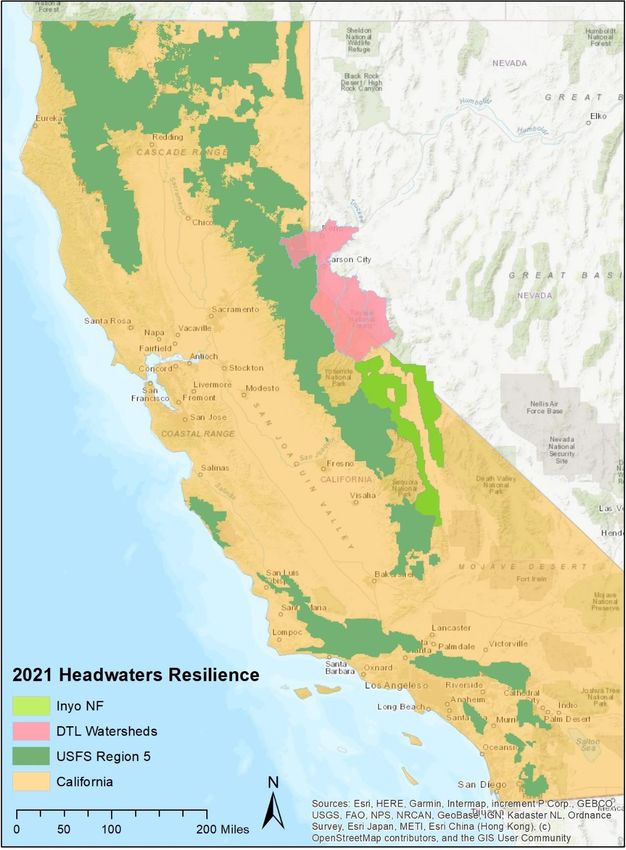
Eligible projects for this funding opportunity are in part defined by the type of activity and associated
funding partner for the 5 targeted project areas described in the overview. To be eligible for funding,
projects must occur within the areas defined here and illustrated in the map below.
    •    Reforestation of Areas Impacted by High Intensity Wildfire
             o State-wide; priority on large-scale reforestation and tree planting related-activity
    •    Headwaters Protection and Improvements on the Inyo National Forest
             o Any projects benefiting watershed health and resilience on the Inyo National Forest, with
                  emphasis on headwater protection for LADWP drinking water sources
    •    Transportation Infrastructure and Aquatic Organism Passage Improvements on USFS lands
             o All USFS-system lands are eligible; priority project locations described in the RFP Appendix
    •    Sierra Nevada Meadow Restoration for the benefit of Desert Terminal Lakes
             o Headwater meadows in California for the Truckee, Carson, and Walker River basins
•    Fuels Management Project Monitoring and Species Response
            o State-wide (Northern CA priority); should occur at an appropriate regional scale to link
               recent and/or planned fuels management with sensitive, threatened and endangered
               species data (e.g. California spotted owl, pacific fisher)

Page 2 of 12
PROGRAM PRIORITIES
Proposals submitted to this RFP must respond to the program priorities associated with one of the 5
targeted headwater resilience needs described below. Each project area has its own expectations, guidance
and conditions. Proposals must describe how projects for which funds are requested will directly and
measurably contribute to those particular program area goals. In addition to the guiding principles and
background information contained in each of the sections below, the 2021 RFP Appendix provides specific
project descriptions and recommendations that emphasize particular priorities of the participating funding
partners. Interested applicants are encouraged to review and consider the Appendix project descriptions
and apply as appropriate, however eligible relevant non-appendix projects are encouraged as well.
Large-scale Post-Fire Reforestation and Recovery
The Arbor Day Foundation and NFWF have partnered to provide approximately $1.2 million in funding to
assist with post-fire reforestation needs and recovery. Primary focus of these funds is intended to support
activities that will directly contribute to large-scale reforestation efforts in areas impacted by high intensity
wildfire. On-the-ground planting/reforestation, including plant propagation and/or seedling purchase are
desired, however complementary activities that can demonstrate improvements in the pace and scale of
reforestation efforts (e.g. nursery capacity building; seed collection/storage; post-fire site
clearing/preparation, etc) may also be considered. The Arbor Day Foundation funding is NOT LIMITED to
any particular jurisdictional boundaries or specific wildfire events. Preference will be given to projects that
address reforestation at significant scales and clear and quantifiable outcomes (e.g. hundreds of acres, tens
of thousands of trees planted) that provide and array of benefits (source-water protection, sensitive species
habitat recovery, etc).
Headwaters Protection and Improvements on the Inyo National Forest
The Los Angeles Department of Power and Water (LADWP), Inyo National Forest (INF), and NFWF are
collaborating to provide opportunities to help protect and enhance headwater conditions for the Owens
River watershed, a significant source of water for the City of Los Angeles. Through this RFP, $1,000,000 will
be available to support a suite of activities on the Inyo National Forest that will provide forest and water
resource protection, resilience to high intensity wildfire, carbon capture benefits, and other related shared
goals and priorities of the partners.
Priority projects of interest are detailed in the RFP Appendix, and include fuels reduction, prescribed fire
activity, invasive vegetation removal to reduce the risk of wildfire and restore a more heterogenous age-
class and structure to these headwater forests, to the benefit of fish and wildlife species, and source-water
quality and quantity. In addition, project priorities include opportunities to address planning and
management of recreational opportunities and associated watershed management concerns. They include:
• Prescribed Fire in Casa Diablo Area
• Bishop and Pine Creek watersheds Fuels Reduction
• June Mountain Ski Area Vegetation Management and June Loop Hazard Fuels Removal
• Buttermilk Area Recreational Use Planning and Improvements
• Forest-wide Invasive Management of Tamarisk
Proposals for Inyo National Forest focused projects should be developed in coordination with INF staff to
ensure alignment with INF policies and priorities. Application materials should include letters of support
from an INF Line Officer, and reference existing or planned NEPA-compliance and schedule of activity.
Page 3 of 12Transportation Infrastructure and Aquatic Organism Passage Improvements on
USFS Lands
In partnership with the USFS, NFWF has $813,000 in funding to support partner-driven assistance for
improvements to USFS-system transportation infrastructure (e.g., roads, bridges, culverts, and drainage
features) and aquatic organism passage. Grant funding will be awarded to transportation infrastructure
improvements that can demonstrate aquatic ecosystem recovery and watershed improvement, with
particular emphasis to anadromous and native fish, or other aquatic species of concern on USFS lands.
Projects may include:
• Maintenance, replacement, and/or improvement to roads, bridges, culverts, and drainage features;
• Installation of drainage features such as culverts, drainage dips, and other associated BMPs;
• Decommissioning transportation infrastructure that has a deleterious impact on watershed health
and/or human health and safety;
• Implementing strategic restoration projects in response to, and in anticipation of, extreme weather
and storm events, and;
• Maintenance and improvements of existing transportation infrastructure to increase accessibility to
fuels reduction and native vegetation projects.
All proposals must describe the ecosystem benefits that are anticipated through implementation of the
project. Competitive proposals should address one or more of the following:
• Improve hydrologic connectivity and aquatic organism passage;
• Reduce sediment and other runoff-borne pollutants to streams;
• Restore and/or maintain natural flow and geomorphology, and;
• Protect existing watersheds, meadows, fens, riparian corridors, and instream habitats
• Remove or reduce invasive species threatening aquatic habitat and/or listed species.
Program preference is for shovel-ready implementation projects that have, or are reasonably expected to
complete all necessary regulatory compliance (NEPA, etc.) by the time of award, however planning and
design projects may be considered. Specific priority transportation infrastructure projects desired for
selected National Forests are included in the RFP Appendix.
All bridge and other road structure designs and construction implementation must be communicated to
and reviewed and approved by the Forest Service (FS) Regional Office and National Forest before
construction can begin. Road structure projects may include bridges, open bottom arches, retaining walls
over 6’ in height, and any structure requiring structural engineering on National Forest roads and lands.
Application materials should include letters of support from a relevant USFS Line Officers, and reference
existing or planned NEPA-compliance and schedule of activity.
Sierra Nevada Meadow Restoration for the benefit of Desert Terminal Lakes
NFWF, in partnership with the U.S. Bureau of Reclamation (BOR), has close to $464,000 in available grant
funding in 2021 for implementation of meadow restoration projects within California Sierra Nevada
meadows that drain to Desert Terminal Lakes basins.
The Sierra Nevada headwater meadows program seeks to restore and protect mountain meadow
ecosystems that serve as key habitat for fish and wildlife, as well as provide hydrological benefits for
people, such as increased groundwater storage, flow reliability, and reduced sedimentation.
Page 4 of 12To be eligible for funding, projects must occur within California’s Sierra Nevada meadows region and benefit the Desert Terminal Lakes basins (Truckee River/Carson River/Walker River watersheds). Projects on either public or private land are eligible. Preference will be given to projects that contribute to the recovery of regional species of concern, specifically, native trout, including Lahontan cutthroat trout, Yosemite toad, willow flycatcher, and California spotted owl to name a few. Projects that are contiguous with, adjacent to, and/or expand on benefits from other recently restored meadows are desirable. Successful applicants will include components to measure effectiveness and evaluate project outcomes, such as monitoring changes in streamflow volume or groundwater storage, or changes in species composition and abundance. Fuels Management Project Monitoring and Species Response For the 2021 round of funding, U.S. Fish and Wildlife Service (USFWS) and their regional partners have aligned with NFWF to dedicate $270,000 to support monitoring and analysis of fuels treatments in northern California/Sierra Nevada forested environments. While a variety of potential monitoring and analysis project designs are eligible for consideration, preference for this round of funding is for the compilation, synthesis and/or meta-analysis of existing data at regional-scale geographies, rather than individual site- specific or project-level monitoring. The purpose of this round of funding is to understand how to design fuel treatments to maximize benefits to species across the landscape. Project proposals will need to clearly articulate the key management or conservation questions to be addressed, expected data types and sources to be used, and analysis methods employed. Successful applicants will address questions and develop timelines for outcomes that provide near-term utility that can be applied to developing best management practices for fuel treatments to maintain and protect species from high intensity fires. Ideally, selected research projects would assist land managers in assessing fuels management projects effects on multiple species at the project and landscape-scale. In addition to the priority described above, NFWF will also consider projects that examine developing consistent and regionally applied monitoring approaches to evaluate pre and post fuels treatment and assess how they benefit fish and wildlife. Project may incorporate actual monitoring of an existing fuels treatment site/s to demonstrate proof-of-concept, however, proposals will need to clearly articulate the rationale and broader regional application for the proposed design, and how the information generated will ultimately be used at-scale to appropriately measure how fuels management projects interact with wildlife to inform land-management decision making. Examples of potential fuels monitoring concepts are included in the RFP Appendix. PROJECT METRICS To better gauge progress on individual grants and to ensure greater consistency of project data provided by multiple grants, the 2021 Targeted Headwaters Resilience RFP has a list of metrics in Easygrants for proposal applicants to choose from for future reporting. We ask that applicants select all relevant metrics from this list for their project. Note - the metrics under the headings below are not exclusive to a particular type of project – for example, a Forestry and Fuels Management focused project may utilize metrics from General, Transportation Infrastructure, and Meadows Restoration as well if those metrics are relevant to your project. If you think an applicable metric has not been provided, please contact Jim Bond to discuss acceptable alternatives to include in this list. Page 5 of 12
Table 1. Program Metrics
Project Activity                   Recommended Metric                        Additional Guidance
GENERAL
Volunteer Participation          Capacity, Outreach, Incentives – Building Enter the number of volunteers participating
                                 institutional capacity – # volunteers      in projects
                                 participating
Outreach/Education               Capacity, Outreach, Incentives –           Enter the number of people reached by
                                 Outreach/Education/Technical Assistance - outreach, training, or technical assistance
                                 # people reached                           activities
Research                         Planning, Research, Monitoring –           Enter the number of acres assessed
                                 Research – Acres assessed for improved
                                 management
Research                         Planning, Research Monitoring – Research Enter the number of studies and reports with
                                 - # studies completed to inform            findings that will be produced to adapt and
                                 management                                 inform management decisions
Restoration                      Planning, Research, Monitoring –           Enter the number of Engineering and Design
planning/design/permitting       Research - # E&D plans developed           plans, and/or compliance documents (NEPA,
                                                                            CEQA, etc) developed/approved
Invasive Vegetation Removal      Habitat Restoration – Removal of           Enter the number of acres restored through
                                 Invasives – acres restored                 invasive flora management
Invasive Species Removal         Species-specific strategies – Invasive     Enter the number of individual invasive
                                 animal or predator removal – # of          animals or predators removed
                                 individuals removed
Riparian restoration             Habitat Restoration – Riparian Restoration Enter the number of acres restored through
                                 – Acres restored                           riparian corridor restoration
Trail Improvements               Habitat Management – Green                 Enter the number of miles of trails developed
                                 Infrastructure – miles of trails improved or improved
FORESTRY AND FUELS MANAGEMENT
Trees Planted                    Habitat Management – Green                 Enter the number of trees planted
                                 Infrastructure - # trees planted
Plant Cultivation                Habitat Restoration – Plant Cultivation – Enter the number of seedlings propagated
                                 Seedlings propagated
Seed Harvesting                  Habitat Restoration – Seed Harvesting – Enter the number of pounds of seeds
                                 lbs harvested                              collected, may be estimated from bushels of
                                                                            cones collected
Reforestation and Restoration of Habitat Restoration – Land restoration – Enter acres restored through the re-
Forest Vegetation                acres restored                             establishment (planting) of native vegetation.
                                                                            If the project to be undertaken includes
                                                                            Invasive Vegetation Management actions
                                                                            also use “Removal of Invasives – Acres
                                                                            Restored“. If project to be undertaken
                                                                            includes Fuels Reduction actions prior to
                                                                            planting (thinning, limbing, tree removal,
                                                                            etc.) also use “Improved Management
                                                                            Practices – Acres under Improved
                                                                            Management”. If the project is a combination
                                                                            of these actions, use those metrics which
                                                                            apply to each of the activities and then enter
                                                                            the representative acres. For example, a 10
                                                                            acres project site may include 10 acres of
                                                                            “Removal of Invasives” and 5 acres of
                                                                            planting under “Land Restoration”
Application of fuels management Habitat Management: Fuels management Enter the number of acres treated with
treatment prescription           treatment (mechanical/hand) - # of acres limbing / thinning / removal of vegetation.
(Mechanical/Hand)                treated                                    Treatment of areas that are impacted by

Page 6 of 12
disease or insect infestation should be
captured under "Removal of infected
individuals - Acres restored" instead.
Application of fuels management Habitat Management: California Spotted Enter the number of acres treated for the
treatment prescription Owl - Fuels management treatment primary benefit of California Spotted Owl.
(Mechanical/Hand) – California (mechanical/hand) - # of acres treated Indicate the type of treatment(s), why the
Spotted Owl area was chosen for fuels management
pertaining to California Spotted Owl habitat.
Application of fuels management Habitat Management: Northern Spotted Enter the number of acres treated for the
treatment prescription Owl - Fuels management treatment primary benefit of Northern Spotted Owl.
(Mechanical/Hand) – Northern (mechanical/hand) - # of acres treated Indicate the type of treatment(s), why the
Spotted Owl area was chosen for fuels management
pertaining to Northern Spotted Owl habitat.
Application of fuels management Habitat Management: Fisher - Fuels Enter the number of acres treated for the
treatment prescription management treatment (mechanical/hand) primary benefit of Pacific fisher. Indicate the
(Mechanical/Hand) – Pacific Fisher - # of acres treated type of treatment(s), why the area was
chosen for fuels management pertaining to
Pacific fisher habitat.
Application of fuels management Habitat Management: BMP Enter the number of acres where prescribed
treatment prescription (Prescribed implementation for prescribed burns - # of burning is implemented.
Burning) acres
Application of fuels management Habitat Management: California Spotted Enter the number of acres where prescribed
treatment prescription (Prescribed Owl - BMP implementation for prescribed burning is implemented for the primary
Burning) – California Spotted Owl burns - # of acres benefit of California Spotted Owl.
Application of fuels management Habitat Management: Northern Spotted Enter the number of acres where prescribed
treatment prescription (Prescribed Owl - BMP implementation for prescribed burning is implemented for the primary
Burning) – Northern Spotted Owl burns - # of acres benefit of Northern Spotted Owl.
Application of fuels management Habitat Management: Fisher - BMP Enter the number of acres where prescribed
treatment prescription (Prescribed implementation for prescribed burns - # of burning is implemented for the primary
Burning) – Pacific Fisher acres benefit of Pacific Fisher.
Treatment or removal of insect or Habitat Restoration: Removal of infected Enter the number of insect- or disease-
disease-affected trees individuals - # of acres restored affected acres treated with any treatment type
(mechanical / hand / prescribed burning).
TRANSPORTATION INFRASTRUCTURE
BMP implementation for road Habitat Management - BMP Enter the number of miles of roads improved,
improvements implementation for road improvements - maintained, or decommissioned. In the notes,
Miles of road improved, maintained or state the BMP type(s) and expected
decommissioned environmental benefits.
Fish passage improvements Habitat Management - Fish passage Enter the number of bridges and or culverts
improvements - # passage barriers rectified replaced, improved or decommissioned. In
the notes, state the number and types of
barriers rectified (i.e. bridge, culvert, etc).
Fish passage improvements Habitat Management - Fish passage Enter the number of miles of stream made
improvements - Miles of stream opened accessible to aquatic organism passage.
MEADOW RESTORATION
Meadow/wetland restoration Habitat Restoration - wetland restoration - Enter the number of wetland/meadows acres
Acres restored restored.
Instream restoration Habitat Restoration - instream restoration - Enter the number of habitat structures
# structures installed installed, replaced, upgraded or repaired for
ecosystem improvement.
Instream restoration Habitat Restoration - Instream restoration - Enter the number of stream miles restored
Miles restored (habitat/flow) that will see quantifiable
instream improvements from the meadow
restoration.
Page 7 of 12ELIGIBILITY
Eligible and Ineligible Entities
Large-scale Inyo NF USFS Sierra Fuels
Reforestation Headwaters Transportation Meadows - DTL Management
Protection Infrastructure Monitoring
Applicant
Non-Profit OK OK OK OK OK
Organizations
Federal OK OK X OK OK
Agencies
State OK OK OK OK OK
Agencies
Local/Muni. OK OK OK OK OK
Agencies
Tribal Gov. & OK OK OK OK OK
Organizations
Educational OK OK OK OK OK
Institutions
International X X X X X
Organizations
For-profit X X X X X
Business
Unincorporated X X X X X
Individuals
Ineligible Uses of Grant Funds
• Equipment: Applicants are encouraged to rent
equipment where possible and cost-effective or
use matching funds to make those
purchases. NFWF acknowledges, however, that
some projects may only be completed using
NFWF funds to procure equipment. If this
applies to your project, please contact the
program staff listed in this RFP to discuss
options.
• Federal funds and matching contributions may
not be used to procure or obtain equipment,
services, or systems (including entering into or renewing a contract) that uses telecommunications
equipment or services produced by Huawei Technologies Company or ZTE Corporation (or any
subsidiary or affiliate of such entities) as a substantial or essential component, or as critical
technology of any system. Refer to Public Law 115-232, section 889 for additional information.
NFWF funds and matching contributions may not be used to support political advocacy, fundraising,
lobbying, litigation, terrorist activities or Foreign Corrupt Practices Act violations.
• NFWF funds may not be used to support ongoing efforts to comply with legal requirements,
including permit conditions, mitigation and settlement agreements. However, grant funds may be
used to support projects that enhance or improve upon existing baseline compliance efforts.
Page 8 of 12FUNDING AVAILABILITY AND MATCH SUMMARY Project Area Available Funding Award Range Match Requirements Large-Scale Forest Restoration $1,200,000 $200,000 - $1,200,000 No Restriction; 1:1 match Inyo National Forest $1,000,000 $100,000 - $250,000 No Restriction; 1:1 match Transportation Infrastructure $813,000 $50,000 - $800,000 Non-federal; 50% match Meadow Restoration $463,893 $50,000 - $460,000 Non-federal; 50% match Fuels Monitoring $270,000 $50,000 - $270,000 Non-federal; 50% match *Project length, typically, will be within 24 months from time of grant agreement execution EVALUATION CRITERIA All proposals will be screened for relevance, accuracy, completeness and compliance with NFWF and funding source policies. Proposals will then be evaluated based on the extent to which they meet the following criteria. Program Goals and Priorities – Project contributes to the resource needs and goals associated with the relevant funding source for your desired activity, and has specific, quantifiable performance metrics to evaluate project success. Project addresses one or more of the priorities defined in this RFP. Technical Merit – Project is technically sound and feasible, and the proposal sets forth a clear, logical and achievable work plan and timeline. Project engages appropriate technical experts throughout project planning, design and implementation to ensure activities are technically-sound and feasible. Cost-Effectiveness – Project includes a cost-effective budget that balances performance risk and efficient use of funds. Cost-effectiveness evaluation may include, but is not limited to, an assessment of either or both direct and indirect costs in the proposed budget. The federal government has determined that a de minimis 10% indirect rate is an acceptable minimum for organizations without a NICRA, as such NFWF reserves the right to scrutinize ALL proposals with indirect rates above 10% for cost-effectiveness. Transferability – Project has potential and plan to transfer lessons learned to other communities and/or to be integrated into government programs and policies. Communication – Project includes a detailed plan to communicate information about the project to appropriate audiences. Funding Need – Project establishes a clear need for the funds being requested and demonstrates that activities would not move forward absent funding. Conservation Plan and Context – The project advances an existing conservation plan or strategy. Monitoring – Project includes a plan for monitoring progress during and after the proposed project period to track project success and adaptively address new challenges and opportunities as they arise. Long-term Sustainability – Project will be maintained to ensure benefits are achieved and sustained over time. This should include how future funding will be secured to implement necessary long-term monitoring and maintenance activities. Page 9 of 12
Past Success – Applicant has a proven track record of success in implementing conservation practices with
specific, measurable results.

Partnership – An appropriate partnership exists to implement the project and the project is supported by a
strong local partnership that leverages additional funds and will sustain it after the life of the grant. Identify
proposed partners, if known (including potential or contemplated subawards to third party subrecipients of
the applicant), the roles they will play in implementing the project, and how this project will build new or
enhance existing partnerships. (Note: a project partner is any local community, non-profit organization,
tribe, and/or local, state, and federal government agency that contributes to the project in a substantial
way and is closely involved in the completion of the project.)

OTHER
Budget – Costs are allowable, reasonable and budgeted in accordance with NFWF’s Budget Instructions
cost categories. Federally-funded projects must be in compliance with OMB Uniform Guidance as
applicable.

Matching Contributions – Matching Contributions consist of cash, contributed goods and services,
volunteer hours, and/or property raised and spent for the Project during the Period of Performance. Larger
match ratios and matching fund contributions from a diversity of partners are encouraged and will be more
competitive during application review.

Procurement – If the applicant chooses to specifically identify proposed Contractor(s) for Services, an
award by NFWF to the applicant does not constitute NFWF’s express written authorization for the applicant
to procure such specific services noncompetitively. When procuring goods and services, NFWF recipients
must follow documented procurement procedures which reflect applicable laws and regulations.

Publicity and Acknowledgement of Support – Award recipients will be required to grant NFWF the right
and authority to publicize the project and NFWF’s financial support for the grant in press releases,
publications and other public communications. Recipients may also be asked by NFWF to provide high-
resolution (minimum 300 dpi) photographs depicting the project.

Receiving Award Funds – Award payments are primarily reimbursable. Projects may request funds for
reimbursement at any time after completing a signed agreement with NFWF. A request of an advance of
funds must be due to an imminent need of expenditure and must detail how the funds will be used and
provide justification and a timeline for expected disbursement of these funds.

Compliance Requirements – Projects selected may be subject to requirements under the National
Environmental Policy Act, Endangered Species Act (state and federal), and National Historic Preservation
Act. Documentation of compliance with these regulations must be approved prior to initiating activities
that disturb or alter habitat or other features of the project site(s). Applicants should budget time and
resources to obtain the needed approvals. As may be applicable, successful applicants may be required to
comply with additional Federal, state or local requirements and obtain all necessary permits and
clearances.

Quality Assurance – If a project involves significant monitoring, data collection or data use, grantees may
be asked to prepare and submit quality assurance documentation (www.epa.gov/quality). Applicants
should budget time and resources to complete this task.

Page 10 of 12
Permits – Successful applicants will be required to provide sufficient documentation that the project
expects to receive or has received all necessary permits and clearances to comply with any Federal, state or
local requirements. Where projects involve work in the waters of the United States, NFWF strongly
encourages applicants to conduct a permit pre-application meeting with the Army Corps of Engineers prior
to submitting their proposal. In some cases, if a permit pre-application meeting has not been completed,
NFWF may require successful applicants to complete such a meeting prior to grant award.

Federal Funding – The availability of federal funds estimated in this solicitation is contingent upon the
federal appropriations process. Funding decisions will be made based on level of funding and timing of
when it is received by NFWF.

TIMELINE

Dates of activities are subject to change. Please check the program page of the NFWF website for the most
current dates and information – Northern California Forests and Watersheds

        Applicant Webinar                                         Thursday, July 8, 2021 at 2:00pm PST
        Full Proposal Due Date                                    Thursday, August 5, 2021 by 8:59pm PST
        Review Period                                             Late August - October
        Awards Announced                                          Mid-November

HOW TO APPLY

All application materials must be submitted online through National Fish and Wildlife
Foundation’s Easygrants system.

1. Go to easygrants.nfwf.org to register in our Easygrants online system. New users to the system will be
prompted to register before starting the application (if you already are a registered user, use your existing
login). Enter your applicant information. Please disable the pop-up blocker on your internet browser prior
to beginning the application process.

2. Once on your homepage, click the “Apply for Funding” button and select this RFP’s “Funding
Opportunity” from the list of options.

3. Follow the instructions in Easygrants to complete your application. Once an application has been
started, it may be saved and returned to at a later time for completion and submission.

Page 11 of 12
APPLICATION ASSISTANCE A Tip Sheet is available for quick reference while you are working through your application. This document can be downloaded here. Additional information to support the application process can be accessed on the NFWF website’s Applicant Information page. For more information or questions about this RFP, please contact: Jim Bond, Senior Manager, California Forest Programs Email: James.Bond@NFWF.org; Phone: 415-243-3107 Jessica Perla, Program Coordinator, Western Regional Office Email: Jessica.Perla@NFWF.org; Phone: 202-595-2422 For issues or assistance with our online Easygrants system, please contact: Easygrants Helpdesk Email: Easygrants@nfwf.org Voicemail: 202-595-2497 Hours: 9:00 am to 5:00 pm ET, Monday-Friday. Include: your name, proposal ID #, e-mail address, phone number, program you are applying to, and a description of the issue. Page 12 of 12
You can also read


