A First Look at Privacy Analysis of COVID-19 Contact Tracing Mobile Applications - arXiv
←
→
Page content transcription
If your browser does not render page correctly, please read the page content below
1

                                               A First Look at Privacy Analysis of COVID-19
                                                    Contact Tracing Mobile Applications
                                         Muhammad Ajmal Azad, Junaid Arshad, Syed Muhammad Ali Akmal, Farhan Riaz,Sidrah Abdullah, Muhammad
                                                                               Imran and Farhan Ahmad

                                            Abstract—Todays smartphones are equipped with a large                    developed for tracing, tracking, and informing citizens about
                                         number of powerful value-added sensors and features such                    whether they have recently come in close contact with the
                                         as a low power Bluetooth sensor, powerful embedded sensors                  person showing confirmed attributes of COVID-19. These apps
                                         such as the digital compass, accelerometer, GPS sensors, Wi-
arXiv:2006.13354v3 [cs.CR] 16 Aug 2020

                                         Fi capabilities, microphone, humidity sensors, health tracking              can be either private or government-owned.
                                         sensors, and a camera, etc. These value-added sensors have                     The Contact tracing operates by identifying positive cases of
                                         revolutionized the lives of the human being in many ways such,              COVID-19 and asking them for their close contacts manually
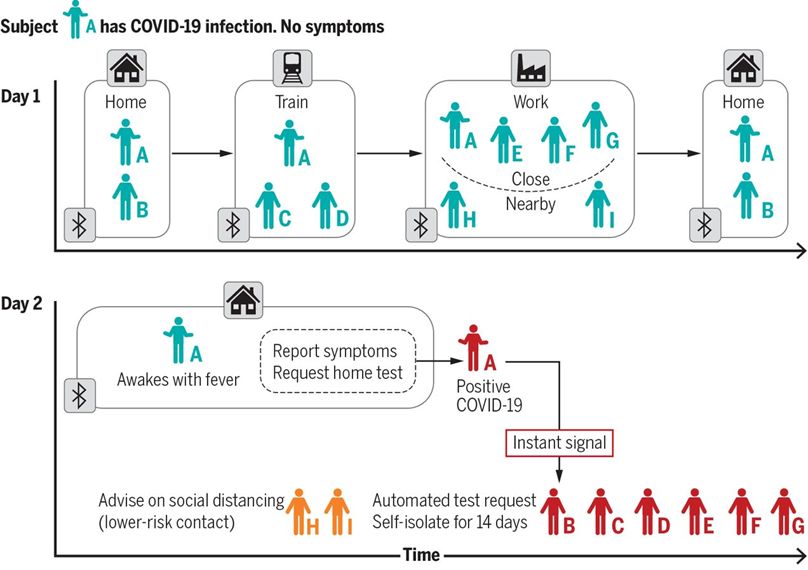
                                         as tracking the health of the patients and movement of doctors,             or identifying their close contacts in an automated way. Figure
                                         tracking employees movement in large manufacturing units, and               1 presents the building block and working mechanism of the
                                         monitoring the environment, etc. These embedded sensors could
                                         also be used for large-scale personal, group, and community sens-           contact tracing apps [1]. The contact-tracing apps exchange
                                         ing applications especially tracing the spread of certain diseases.         information when the phones of two persons are close enough
                                         Governments and regulators are turning to use these features to             to each other. These people who came socially close to one
                                         trace the people thought to have symptoms of certain diseases or            another will be informed if their counterparts during the
                                         virus e.g. COVID-19. The outbreak of COVID-19 in December                   social interaction were officially infected with the COVID-
                                         2019, has seen a surge of the mobile applications for tracing,
                                         tracking and isolating the persons showing COVID-19 symptoms                19. These apps can only serve as the anchor point to inform
                                         to limit the spread of disease to the larger community. The use of          citizens and provide suggestions on whether they should go to
                                         embedded sensors could disclose private information of the users            isolation or not. These apps have already shown efficiency
                                         thus potentially bring threat to the privacy and security of users.         in controlling the spread of the virus in South Korea and
                                         In this paper, we analyzed a large set of smartphone applications           Singapore and flatten the spread curve through ”Test” and then
                                         that have been designed to contain the spread of the COVID-19
                                         virus and bring the people back to normal life. Specifically, we            Trace mechanism [2], [3].
                                         have analyzed what type of permission these smartphone apps                    The contact-tracing apps are broadly developed by the
                                         require, whether these permissions are necessary for the track              national or country lead health regulators. To provide a reliable
                                         and trace, how data from the user devices is transported to the             and efficient decision, the developed apps utilize the informa-
                                         analytic center, and analyzing the security measures these apps
                                                                                                                     tion from various smartphone sensors (GPS, Bluetooth) along
                                         have deployed to ensure the privacy and security of users.
                                                                                                                     with names, addresses, gender, age, contact details, calling
                                           Keywords—Contact-tracing applications,privacy-preservation,               log history, and contact history, etc. to make the decision.
                                         COVID-19,Security, Pandemic Response
                                                                                                                     These apps either interact automatically with the national
                                                                                                                     health data system for the test results of the citizens or citizens
                                                                  I. I NTRODUCTION                                   could manually provide test results to the health organization.
                                                                                                                     For instance, upon downloading, Pakistan’s track & trace
                                            It is believed that a virus that causes the novel COVID-                 app 1 requests permission to use the device’s location and
                                         19 disease spreads mainly from having a close interaction                   user personal details such as name, phone number, and email
                                         or contact with the person already being affected with the                  address, and that stored data will be shared with a third party.
                                         virus, and still carrying the attributes of the virus. Since                The current version of this app (as of June-2020) then uses
                                         December 2019, work has already begun on the development                    the device’s location and the location of users with positive
                                         of a potential vaccine for the cure, however, until the de-                 COVID-19 test results to render a map showing high-level
                                         velopment of vaccines for masses, the only possible way of                  hotspots for COVID-19 infections. Similarly, Google and Ap-
                                         protection is to limit the interaction with the people, isolate             ple jointly developed an API that enables app developers to use
                                         the people through imposing full or smart lock-down. The                    the Bluetooth beacon messages for exchanging information
                                         efficient smart lockdown could be imposed by employing the                  between two persons who are in close contact with each
                                         track and trace method that only isolates the infected people               other and showing virus symptoms. Some countries use the
                                         and their contacts. For this purpose, several smartphone apps               call detailed records to trace the close contact of the infected
                                         for android, iOS, and Windows operating systems have been                   person and isolate them as well.
                                            Muhammad Ajmal Azad and Farhan Ahmed are with Derby University,
                                                                                                                        The use of these apps is normally voluntary and is con-
                                         Derby, United Kingdom, Junaid Arshad is with Birmingham City University,    sidered as the support to control the spread of the virus.
                                         Birmingham, United Kingdom, Syed Muhammad Ali Akmal, and Sidrah             The developed app requests users for specific permission e.g.
                                         are with NED University of Engineering and Technology, Karachi, Pakistan,
                                         Muhammad Imran is with King Saud University, Saudi Arabia and Farhan
                                                                                                                     contact details, call history, web searches, camera permissions,
                                         Riaz is with National University of Science and Technology, Islamabad,
                                         Pakistan                                                                      1 https://tinyurl.com/y4lt634d
2
Fig. 1: Tracing and Isolating through Smartphone based Contact-tracing [1]
access to call records, messages, and mobile media (videos provides a discussion on privacy and permission analysis of
and photos). This information could pose serious privacy mobile apps and work performed towards the development of
and security risks to the users and limit users to use these track and trace apps. Section III defines the background on the
apps. The privacy of users may be protected through the use trace and track smart applications. The section also provides
of different mechanism e.g. data anonymization, differential the working mechanism and important features of developed
privacy, and decentralized app development [4]. However, it apps. Section IV critically analyses the security and privacy
is already identified that anonymization systems are not pro- of different apps. Section V provides recommendations for
viding effective privacy-preservation [5]–[7] and decentralized design chose secure development and concludes the paper.
app development is still at the early stage and progressing very
slowly. II. R ELATED W ORK
In this paper, we provide a first look at the permission, A large number of works have been presented that analyse
security, and privacy analysis of the contact tracing apps the functionality of smartphone apps and the leakage of the
available at the Android and iOS app stores. We have studied sensitive information of their users [9]–[11]. Many contact
app stores to define the nature of the privacy risks these apps tracing applications involve tracing users using GPS, Blue-
have, what types of permissions these apps are requesting tooth, and wireless technologies [12]–[17]. These approaches
for their functioning, which permissions are unnecessarily usually provide users with two options. Either the user has
required, and how they store and process the user data. to self-report themselves, or the application takes the help
Currently, only a small number of certified apps (developed of a wireless technology [18]. A large number of people
by the country regulator) are available at the play stores, so are currently downloading and using contact-tracing apps,
we performed an exhaustive manual analysis on the available and hence the privacy aspects of these apps have become
apps. Our analysis shows that the majority of the track and paramount for the research and development of unanimous
trace apps collect personal information such as name, device privacy regulation. The regulators such as the Federal Trade
ID, and location, however, some apps require access to further Commission, the US National Telecommunication and infor-
resources such as SMS, microphone, camera, and storage mation administrations, the European Union Commission [19],
memory of the device. Access to such resources is not required [20], Information Commissioners Office [21] are analyzing
for the accurate function of such apps, and, therefore should and providing these guidelines to the app developers, content
not be requested by the developers. Furthermore, a number of creators, website operators to improve the development of their
apps disclose sharing data with third parties, however, a small products in terms of security and privacy. In this section,
number of these acquire the permission of the user before we summarize works related to the security and privacy of
sharing this data with the third parties. As track and trace smartphone apps.
apps are voluntary and rely on the public’s trust to achieve Smartphone apps normally get access to user data and other
their function effectively [8], addressing concerns with regards information through the use of permission [22] that the users
to data collection and sharing are paramount to their success provide to the smartphone app at the time of app installation.
to combat COVID-19. For example, an app might ask to grant the to see the location
The rest of the paper is organized as follows: Section II of the user, the messages stored on the mobile phone, the3 search history, etc. The user can still control the permission alyzed the privacy preservation mechanism for various contact after the installation but it might affect the functionality tracing applications and discussed the attributes which contact- of apps operations. Providing permission to various private tracing apps should have to ensure the privacy of users.Michael information would expose the private information of users to et al [41] discussed the ethical consideration of contact-tracing the advertisers, insurance companies [23], [24], and publicly apps for fighting against the COVID-19. Several contact- expose personal data of the users without the users consent tracing application has been compared in [42] in terms of data [25], [26]. A large number of smartphones app also ask un- collection, retention of data, purpose, and sharing of collected necessary permission that is not required for the functionality data, what mechanisms the apps have deployed to ensure the of the app, these apps might pose a serious threat to privacy privacy of users. Most recently, Carmela et al. [4] describe and security of the users [27], [28]. Muhammad et al. [29], [30] and analyse a decentralized system for secure and privacy- analyzed the security and privacy of smartphone apps designed preserving proximity tracing to combat the spread of COVID- for blocking the advertisement and providing mobile VPN 19. The system is solely based on the anonymous identifiers clients. Ilaria et al. [31] analyzed the permissions requested of positive users of the COVID-19 without providing the by the smartphone apps and assigned a sensitivity score to exact location information to the health authorities. Serge the app if the app asked to read the personal information of [43] analyse the security and privacy properties of the pan- the users. They concluded that around 56% of the app asks European Decentralized Privacy-Preserving Proximity Tracing users to provide permission to sensitive parts of the users data. (DP3T) system. Health authorities or any other users would Barrera et al. [32] investigated the relationship between free not be able to learn the private information of the users except android apps and the most popular 1100 Android apps by a notification message when a person is exposed to COVID- deploying machine learning methods. It is also concluded that 19 affected person.Ruoxi et al. [44] analyze the security people are willing to use the paid version of smartphone apps and privacy of contact tracing apps in three dimensions: a) if apps are not asking for unnecessary permissions. Enck et al. evaluate the design choice (centralized or decentralized) used [33] proposed a lightweight certification mechanism to identify for privacy preservation, b) static analysis for the identifi- Android apps that are asking for suspicious permissions. Pern cation of potential vulnerabilities and c) (iii) evaluate the et al. [34] studied the user-consent permission systems by robustness of approaches used for privacy-preservation. The using the user-centric data from the Facebook apps, chrome paper has not analyzed the permission analysis. Yaron et al. browser extensions, and Android smartphone apps. It is very [45] analysed the security and privacy properties of Bluetooth important to develop tools or applications that inform users based specification by Apple and Google, concluding that about the privacy indicator of the apps they are using for spe- the specifications may have some significant security and cific purposes. To address this issue, Max et al. [35] developed privacy risks. The Centers for Disease Control and Prevention a prototype that provides users with privacy indicators of the (CDS) have issued guidelines that define a set of features a app. The prototype also identifies previously exposed hidden contact tracing app should have to help health departments to information flows out of the apps. overcome the COVID-19 pandemic [46]. Contact tracing with smartphones can be employed to restrict the transmission of a pandemic disease. Utilizing com- III. CHARACTERIZING C ONTACT T RACING A PPS puting technologies to avert and control the pandemic seems Contact tracing is an important tool for the community to be an obvious choice. However, these contact tracing apps to prevent the outspread of novel pandemic diseases, such might invade privacy, collect personal data, and justify mass as COVID-19 [47]. In past contact-tracing tools have shown surveillance against users’ wishes. There must be a protocol effectiveness against the spread of transmissible diseases such for contact tracing that observes commitment to privacy, as as STD, HIV, Ebola, and tuberculosis [48], [49]. Contact well as provides the consent mechanism where there is a need tracing is the process of identifying persons who are in to share individual data. Contact tracing may collect personal close contact with the infected person so that exposed targets data such as location which is not an effective privacy control can be informed to have self-isolation and quarantine, thus when it comes to user’s data [36]. The process of contact breaking the chain of transmission [36]. The current outbreak tracing usually involves collecting users’ privacy information of COVID-19 and its highly contagious feature motivates without informing them. Privacy-literate individuals might be technology developers to develop smartphone apps for the reluctant to share their information which in turn hampers effective tracing of the footprint of the disease. In this section, the process of contact tracing. Privacy-preserving approaches we provide the architectural setup of contact-tracing apps and might encourage individuals to participate more in this process their significance towards controlling the spread of disease. and increase their confidence in those applications [18]. Prominent privacy researchers from across the world are A. Centralized and Decentralized Architecture arguing with the government agencies and vendors involved The design of contact-tracing apps is mainly using data from in developing the contact-tracing application about the privacy, the users thus has some privacy concerns which motivate the and also highlighted the catastrophic consequences these apps developer to come up with privacy-preserving solutions. The would have on the citizens private lives [37], [38]. To ensure privacy of users can be addressed using the centralized and privacy, Berke et al. [39] utilized the semantics of private set decentralized system setup. The centralized and decentralized interaction for assessing the risk exposure of users using en- apps entirely have different architecture and properties shown crypted and anonymous GPS locations. Manish et al. [40] an- in Figure 2 and explained below.
4

                                      Fig. 2: Architectural Setup of Contact Tracing Apps
   1) Centralised models: In the centralized setup, the smart-     only slow and has a late response, but would also require
phones of the users having specific contact-tracing apps send      resources for identifying infected persons and then asking for
the random identifier to the centralized trusted system. The       his contacts and then contacts of his contacts to track the flow
centralized system in this setup holds the information from all    of the disease. The technologies soon realized the importance
users of the app. If a person has tested positive for the COVID-   of smartphones and used the inbuilt smartphone sensors for
19 virus, the identifier of other users who have exchanged         tracking in an automated and efficient way. The use of digital
identifiers in the past can be sent to the centralized server      technologies help the citizen at the early stage of the virus
along with other information e.g. time data is sent, a time when   spread and inform people for isolation at the early stage.
identifiers are exchanged, etc. The centralized system decrypts    The use of smartphone apps for contact tracing has shown
the identifiers and automatically notifies the interacted phones   promising results in several countries to combat the spread of
suggesting or informing users to self-isolate or take other        the virus [50], however, the performance efficiency depends
preventive measures. The centralized system can also utilize       on the number of people using the application [51]. One thing
the available information for further analysis and policies for    that limits the usage of the app is the privacy because a large
placing lockdown in hard-hit proximities.                          number of existing apps store data at the central trusted system,
   2) Decentralised models: In the decentralized setup there       and in some circumstance, this data is made available to the
is not a trusted centralized system that exists for the handling   third party systems for performing artificial Intelligence and
of the user’s data and matching of smartphones identifier. If a    data analysis.
person is diagnosed positive with the COVID-19, the identifier
of his phone and test result is uploaded to the centralized
                                                                   C. Vendor Support
system. Other smartphones having the app can access these
reports and locally establish the truth whether he was close to       As the healthcare officers and medical entities are working
an infected individual or not. If a smartphone comes across        together worldwide to fight the spread of this pandemic,
the identity that has COVID-19 then alert is the sent to the       Google and Apple have joined an effort and developed a
user of the smartphone for precaution and self-isolation. The      privacy-preserving contact tracing API that uses Bluetooth
location and proximity of the person are not known to the          signals [52] for exchanging information between people who
centralized system thus ensuring the privacy of the users using    are in close contact with each other. The apps using this
the app. The health organizations or the government still used     API operate in a decentralized fashion, however, a centralized
the shared data to understand the spread of the virus in the       database is maintained. This framework allows healthcare
community but would not have detailed information about the        agencies to propose or develop smartphone apps that help in
users.                                                             limiting the spread of the disease with the help of Bluetooth
                                                                   technology. This API will bring interoperability between iOS
                                                                   and Android devices while maintaining privacy, consent, and
B. Significance of Contact Tracing for COVID-19                    transparency [53]. A test project, PACT (Private Automated
   Since the outbreak of the COVID-19 pandemic in December         Contact Tracing), was built at MIT to harness the strength of
2019, as of June 2020, there exists no medicine or vaccine         Bluetooth-based, privacy-preserving, automated contact trac-
to fight against the rapidly spreading pandemic. Governments       ing API. This project detects proximity between contacts
across the world are currently focusing on the ways that would     with the help of Bluetooth signals within a 6-foot radius.
have the least load on their health systems. This has been         Instead of relying on the GPS, this system sends out random
achieved through imposing travel restrictions or lockdown          Bluetooth numbers, which can later be updated to a database
however, it is not only affecting the economy but there are        with the user’s consent [54]. The first large-scale pilot for
also fears of the second wave of infection once the restrictions   this joint venture has been launched in Switzerland, known as
are relaxed. The governments are finding ways to identify the      SwissCovid. This application determines the close contact that
methods for contact tracing in order to quickly identify and       lasted for more than 15 minutes and notifies the user with the
isolate the infected persons. The manual contact tracing is not    procedure to follow [55].
5
Apple also released a new application for COVID-19 based • Health Canada is developed by the government of
on CDC guidelines that provide COVID-19 information across Canada to provide a personalized recommendation to the
the USA. In this application, the users have to answer some users based on their risk factors. Personal data collected
questions related to recent exposure and risk factors. In is only used by Health Canada and is not shared with any
return, they get a CDC recommendation on what their next other application or agency [61].
step should be. However, this application does not replace a • The government of Vietnam has developed an application
healthcare worker in any way [56], [57]. Another application, named COVID-19 which includes features such as chat-
”HEALTHLYNKED COVID-19 Tracker”, which became the bot, consultation, and live updates on COVID-19. The
most downloaded coronavirus tracker application for March. application requires access to media, location, storage,
The application enables users to track local cases and chat device ID, and call logs. The application’s privacy poli-
with other users around the world. The most unique feature cies are updated in its native language [62].
of this application is that it enables real-time chat with other • COVID19 - DXB Smart App is developed by the gov-
users and share updates [58], [59]. ernment of Dubai and provides general information on
COVID-19 and also provides correct statistics. The appli-
IV. ANALYSIS OF C ONTACT T RACING APPS cation collects personal information voluntarily but does
not share with the third-party applications unless required
In this section, we present our approach to studying current by the law [63].
contact tracing apps for COVID-19. We have focused on • COVI is a third-party COVID-19 informative app devel-
smartphone apps for any platform (iOS, Android, Microsoft) oped by Droobi, a Qatar based digital company. This
and available anywhere in the world. Although there appears application collects personal data such as contact infor-
a concerted effort by governments across the globe to contain mation, age, health information, and unique identifiers,
the pandemic, we identified through our analysis that many etc. [64].
such apps have been developed by third-party individuals or • Corona360 is an app developed in South Korea which
organizations. Therefore, we have also included these in our enables users to update their COVID-19 status as well as
analysis. Furthermore, as the contact tracing technology is still view the status of other people. For privacy reasons, the
in its early stages (especially within the context of COVID-19), app does not collect any personal information such as ID,
although many apps claim to perform track and trace function, name, or phone number [65].
their effectiveness in this respect is subjective. • CoronaCheck is a third-party application that has been
developed to enable its users to conduct self-assessment
A. Data collection and provide accurate expert COVID-19 information to
the users. This application does not collect any personal
In order to achieve an in-depth analysis of current track information and does not share data with third-party
& trace apps, we performed exhaustive search techniques vendors [66].
to collect relevant apps across two major platforms (iOS • The Beat COVID Gibraltar app is developed for the
and Android), irrespective of the country or the developing region of Gibralter and it utilizes Bluetooth technology
organization (government and private). We have chosen iOS in a decentralized way to track other phones who come
and Android because these systems currently hold the most in close contact with the person declared himself as the
market share in the smartphone industry. Specifically, we used virus affected.
keywords such as COVID-19, COVID track & trace, and Coro- • BC COVID-19 Support is developed for the resident of
navirus track & trace. We analyzed the results of our search British Columbia, Canada, to inform the people about
queries to filter apps that did not relate to contact tracing to the status of COVID-19 in British Columbia and guide
mitigate the spread of COVID-19. We used a manual analysis them on what next action people should take. All the
of the app description to conduct this filtering. Furthermore, recommendations are personalized so it involves some
as several countries have encountered difficulties to achieve level of contact tracing.
effective contact tracing, we did not exclude apps performing • COVID Symptom Study has been designed for everyone to
the partial or limited function in this regard. Overall, we report their health status to the people who are developing
identified 26 smartphone apps that claim to perform contact policies to fight against the Virus.
tracing in their description belonging to 17 different countries. • BeAware Bahrain is a mobile application developed for
Details of these apps are presented in table V with a brief the region of Bahrain that helps citizens to contain the
description of some apps presented below. Furthermore, Fig 3 spread of the virus by using the contact tracing efforts.
presents a graphical representation of the timeline with respect • Tawakkalna (Covid-19 KSA) is the official app of king-
to launching dates of prominent apps. dom of Saudi Arabia. It helps in controlling the spread of
• COVID-19 Gov PK is an app developed by the gov- COVID-19 and suggest authorities where to impose the
ernment of Pakistan. Initially, the application provided curfew and lockdown.
awareness to citizens about COVID-19, however, with
the development of the new radius alert feature, this Our study of these apps consisted of analyzing publicly
application provides information which are hot-spot areas available information shared by the app developers and plat-
that help country to impose smart lock-down [60]. form i.e. privacy policy, permissions requested, and user6
COVI COVID-19 Gov PK TraceTogether
CoronaCheck COVID19 Care for Media Aarogya Setu HaMagen
COVID-19 Corona-Datenspende Health Assessment PDMA Corona-Warn-App DXB Smart App
11th March 25th March 4th April 14th April 17th April 18th April 8th May 3rd June 10th June 15th June 16th June 25th June 8th July 10th July 15th July 20th July 23rd July 24th July 27th July 29th July 29th July 30th July 30th July 5th August 6th August
Pakistan's NAP for COVID-19 NHS 24 : Covid-19 Home Quarantine WHO Info NHS App OpenWHO COVID Alert
Health Monitoring PDMA COVID Symptom Tracker Canada COVID-19 BC COVID-19 Support
Corona 360 Coronavirus Australia
Fig. 3: Timeline for release of COVID-19 track & trace apps
reviews. Furthermore, as some of the apps did not use SSL, we Furthermore, 04 apps studied require access to the micro-
performed black-box testing of the apps using the Burp suite phone of the device whereas 05 apps require access to media
to analyze the network traffic during the app usage. The traffic and storage of the device which are of course not critical
analysis did indeed help us identify the information collected to the app’s function. Such apps are indeed causing concern
by these apps and shared with back-end servers which are regarding the privacy of their users and exemplify a lack
liable to interception using network sniffing software. of attention to the security and privacy of the users by app
developers.
Distribution of apps and permissions requested
30 C. Analysing privacy
25 To understand the privacy considerations applied for the
Number of apps
20 apps within our study, our analysis took into account the
15
privacy policy published by the application developer as well
10
as the use of basic privacy protection mechanisms such as
SSL/TLS to achieve encrypted data transmissions.
5
Through the study of privacy policies of the apps as well
0
as traffic analysis, we identified that most of the apps collect
o
s
g
ia
ID
a
n
p
e
es
in
nf
er
tio
on
rtu
ed
personal data such as location information, name, and phone
e
ep
c
ll i
m
vic
h
ca
ac
M
ta
Ca
ca
op
s le
Lo
ts
De
k
icr
or
S&
na
m
number, etc. Although collecting such information is vital for
w
M
ro
SM
Ru
et
tf
ll n
en
effective track & trace, appropriate mechanisms should be
Fu
ev
Pr
Permissions requested applied to ensure secure sharing, processing, and storage of
such data. Such details were not available for most of the apps
Fig. 4: Distribution of apps and requested permissions analyzed in this study. Furthermore, an interesting observation
we made was the type of information gathered by the apps.
B. Permission analysis Specifically, our analysis identified that the track & trace app
Permissions required by a smartphone app are significant as developed by Dubai collects personal information such as date
they communicate with the user the resources required by the of birth, name, email address, and caller ID. Such information
app to perform its function. Therefore, presenting the user with is not required for effective track and trace and risks privacy of
a list of permissions not only achieves transparency (providing users as any malicious actor with access to such information
the user an insight into the app operation) but it also serves to can easily perform ID theft attacks. We believe data collection
seek user consent. Within the context of our study, we have policies for such apps require immediate attention to minimize
gathered information about the permissions required by the risk to individual user privacy.
track and trace apps under study. Figure 4 presents a graphical A significant challenge with respect to security and privacy
representation of the distribution of the apps with respect to within smartphone apps is sharing data with third parties
permissions required by them. to aid targeted advertisements. Smartphone apps using such
As presented in Figure 4, we expected the majority of the strategies leverage advanced analytics techniques to identify
apps to require access to location data of a device however our user-behavior and profiles to achieve personalized advertise-
study also identified permissions requested by the apps which ments. Within this context, the information collected by track
are not necessary to perform their function. For instance, & trace apps is highly personalised and if made accessible to
we identified 06 apps that require access to SMS and call third-parties can lead to sophisticated advertisement techniques
information of the device. In some scenarios access to phone breaching public trust and confidence in such apps. Our
numbers can be envisioned however access to SMS within a analysis of the apps concluded that all apps are free to use
device is not essential to the function of a track and trace and do not include any in-app advertisements. However, some
app. Similarly, we identified 04 apps that require access to the apps (as highlighted in table V) do share data with third parties
camera of the device which is of course an unexpected request without precise information about who these third parties,
by a track and trace app. what data is shared, and how this data will be used by the7
third parties. Therefore, focused efforts from the research COVID-19 Gov PK app, user review includes comments
community are required to enhance data sharing, processing, highlighting a lack of encryption and concerns about data
and storage practices within such scenarios. traveling in plain-text. However, for apps such as Corona-
Another aspect concerning the privacy of information col- Datenspende which requires a user to connect to a fitness app
lected is how it is stored and shared by the apps. In this respect, as a pre-requisite, there are no user comments with regards to
our analysis revealed that 10 of the apps shared data with how data is captured, analyzed, stored and processed between
third parties however the nature and identity of such parties the third-party fitness app and the government app for CVOID-
are not identified in the privacy policies. This is a cause of 19. These observations reflect a lack of awareness among users
concern regarding individual privacy as the aims of sharing with regards to measures to preserve the privacy of personal
this data are not clear and therefore users are not aware of how data collected, stored, and analyzed by computing systems,
their data may be used. For instance, a common apprehension therefore, requiring efforts to raise awareness among users.
among users is the sharing of data with advertisement agencies
V. C ONCLUSIONS AND R ECOMMENDATIONS
who may wish to use such data for targeted advertisement and
adware. As Coronavirus is a contagious disease that spreads through
Having said this, we also identified examples of good close social interaction between humans, contact tracing is
practice within our analysis. Specifically, some of the apps vital for containing its spread. Mobile devices present an ideal
clearly state requirements for user consent before sharing platform to introduce contact tracing software due to their
data with third parties thereby assuring users with respect ease of use, widespread ownership, and personalized usage.
to how their data is shared. For instance, Corona360 (the Therefore, several smartphone apps have been developed by
app developed by the government of South Korea) collects governments, international agencies, and other parties to miti-
personal and sensitive data of users but whenever the data is gate the virus spread. However, there is an increasing concern
used, the user is notified for the reason of data usage. regarding the collection and use of data, and out-sourcing data
In addition to the above, our analysis also uncovered to third-party systems. In this paper, we analyzed a large set
security vulnerabilities within some apps. In particular, we of contact-tracing apps with respect to different security and
identified five apps that were not using SSL/TLS to ensure privacy metrics. Specifically, we analyzed contact-tracing apps
secure communication made through the app. Pursuing this for permission analysis, privacy analysis, the security of the
direction of analysis, we conducted traffic monitoring of such apps, and reviews of the users. Our major findings are as
apps and identified serious flaws in the app developed by follows:
the government of Pakistan. Details of these vulnerabilities 1) Although there have been significant technological ad-
have been reported to the relevant authorities however such vancements to aid COVID-19 response, contact tracing
vulnerabilities do put user privacy at risk especially where the apps require further enhancements to achieve desired
app is collecting and utilizing personal user data. objectives in a privacy-aware manner.
2) A number of track & trace apps request permissions
which may not be required for the successful operation
D. App review analysis of the app’s function. These include access to storage
In addition to the permissions requested, privacy policy, media, camera, and microphone which might result in
and traffic analysis of the worldwide COVID-19 track and in a breach of user’s privacy.
trace apps, we have also studied user comments available in 3) Several apps mention outsourcing data to third parties,
Google Play and App Store reviewing these apps. Although however, it is unclear who are these third parties, what
the majority of these comments are related to the usability data is shared, and how it is processed by these parties.
and general function of the app, we found some comments to 4) Some apps (used in developing countries) have not
be insightful with respect to how the app collects and utilizes adopted appropriate security measures for the exchange
data. For instance, the app developed by the government of of the data to and from the user to the data centers.
Israel was commented by a user to ask for users’ permission 5) Our analysis of the user reviews and the ratings for
when sharing data with third parties as well as to guarantee contact-tracing apps suggested that a large number of
not to send the data anywhere but compare it locally on users are aware of privacy concerns of these apps.
user’s device against downloaded ”Corona paths”. Another Though digital technologies could play a prominent role in
interesting observation was made for the Corona-Datenspende addressing the current pandemic challenges and the contain-
app, where user comments suggest that one cannot use the app ment of the spread of the virus. However, the effectiveness
without connecting to a fitness account and hence completely and accuracy of these systems depend upon the working
breaking the point of anonymity. As suggested by the user, architecture of applications and user participation. The user
connecting to the app via a fitness app such as Fitbit indeed participation could be improved if systems employed mecha-
does indicate sharing personal user data across different apps nism that ensures the security and privacy of users. To ensure
which is a risk to user privacy. the privacy, security, and secure development of contact tracing
Through analysis of the user reviews of apps, we observed apps, we recommend following design choices that should be
that although some of the users have included concerns about followed for the development of contact tracing apps:
the privacy of information through their feedback, these are 1) In order to ensure the privacy and security of the
relatively minor proportions of users. For instance, for the user data, the contact tracing systems have to consider8
the well established and state of the art encryption
systems for storing data, enable personalized access
control mechanisms and utilize secure communication
mechanisms for the exchange of data between the users
and the data center. Furthermore, developers should also
consider the semantics of secure software development,
strong authentication mechanism possibly two-factor au-
thentication to minimize the risk of misuse.
2) The contact-tracing apps should perform their operations
in a completely decentralized way. i.e. the system per-
forms the bulk of its operation at the user side.
3) The app’s privacy policy should be mentioned in a
way that a user could easily understand. The developer
should also adopt the mechanisms that they could easily
destroy user data once this pandemic is over.
4) The design system should not unnecessarily seek per-
missions for example access to videos, browsing history,
or the images.
5) The developers should consider the measures that assign
a unique pseudonymized identifier for the users which
must not be linked to the user’s real identity and could
not be used to learn the private information of users
through background knowledge.
6) To improve usability, the design should be simple and
should have a user interface for interaction and personal
tracking.
7) We also recommend developers and regulators to use the
identity verification (telephone number authentication)
or authentication system within their trace and track
system so the information could be exchanged through
the reliable voice call.
It is very important to incorporate the techniques that ensure
the privacy of citizens so that they can confidently participate
in limiting the spread of the disease. The apps should not serve
as the tool for mass surveillance tools so that people trust the
system without having any concerns about their privacy and
tracking of their private lives. As a part of our future work, we
are looking to conduct a user study using qualitative measures
focused on directly considering the feedback from users to
further understand the usability and security concerns of users.9
TABLE I: Analysis of Smartphone apps designed to limit spread of COVID-19.
App Platform Permissions Requested Privacy Policy Country No of TLS/ App Reviews App API
Down- SSL ver- version
loads sion
COVID- Android Location (approximate and Data to be shared with third party Pakistan 500,000+ No lack of encryption. Data might 3.0.7 5.0 and
19 Gov precise), full network access, be traveling in plaintext. Radius up
PK prevent device from sleeping alert is not accurate. Doesnt
show patients infected with
COVID-19
COVID Android & Wifi connection information, Collects sensitive personal infor- United 500,000+ N/A basic information related to 0.14 5.0 and
Symptom iOS full network access, audio set- mation such as DOB, name, gen- King- COVID-19 symptoms, helps up
Tracker tings, run at startup, prevent der, COVID-19 tests status, lo- dom people take precautionary
the device from sleeping cation, details of any treatment, measures to self-isolate
email, phone number, IP ad-
dress. Shared with universities,
research centers, amazon web
service, google analytic, etc.
BC Android & Location (approximate and Personal information collected Canada 10,000+ Yes Doesnt update on a regular basis 1.20.0 5.0 and
COVID- iOS precise), full network access, for COVID-19 alerts and man- with current stats. No graph of up
19 Support prevent the device from agement, only used by Ministry active cases. Inaccurate and out-
sleeping of Health dated information
OpenWHO: Android & Wifi connection, full network Requires name and email to cre- United 500,000+ No Language issue to some people. 3.4 5.0 and
Knowl- iOS access, media/files, and stor- ate an account used for com- States Gives out a certificate for com- up
edge for age, run at startup, prevent the munications and the announce- pleting the course, increases pub-
Health device from sleeping ment of changes to the open- lic health knowledge
Emergen- WHO platform
cies
Pakistan’s Android This application requires no No information being shared Pakistan 50,000+ Yes Shares information related to 1.1 5.0 and
National special permissions to run COVID-19 and SOPs that gov- up
Action ernment has launched for the
Plan for safety of people
COVID-
19
Health Android Location (approximate and Information will be accessed Pakistan 1000+ No Data information being sent in 1.4 4.0.3
Moni- precise), receives data from by Smart Asset Sindh Health, plaintext. No encryption or algo- and up
toring internet and full network shared with third party rithm is used for data protection.
PDMA access Too many bugs. Doesnt work ef-
ficiently.
Canada Android Location (approximate and Personal data is collected by Canada 50,000+ Yes App doesnt take into account 4.0.0 5.0 and
COVID- precise), full network access, Health Canada only to support pre-existing conditions. Will be up
19 prevent device from sleeping COVID-19. much more effective if user can
see map with active cases.
COVID- Android Location, phone, media, stor- May use personal information Vietnam 100,000+ N/A App is only available for Veit- 1 4.4 and
19 age, camera, microphone, wifi, with third party namese and not available in up
device ID, call information, English. Very narrow coverage
download files without notifi- overall. Provides basic informa-
cation, run at startup, prevent tion. Only accessible in Veitnam
the device from sleeping
COVI Android Location, phone, wifi, device Information such as DOB, name, Qatar 10,000+ N/A Only restricted for the people liv- 2.0.2.2 5.1 and
ID, call information, pair with the account number is collected ing in Qatar. Doesnt get updates. up
Bluetooth devices, receive data and shared with trusted third par- Provides basic information
from Internet, run at startup, ties
prevent device from sleeping
COVID19 Android Microphone, camera, location, Sends personal information such Dubai 1000+ N/A Only restricted for the people 3.8 5.0 and
- DXB storage, calendar, Wifi connec- as ID, name, DOB, email, geo- living in Dubai. Some users re- up
Smart App tion, media, receive data from graphical location to a third party ported experiencing network er-
Internet, pair with Bluetooth ror whenever they open this app
devices, full network access,
prevent device from sleeping,
change audio settings
Corona Android Location (approximate and Collects personal and sensitive South 10+ Yes Useful and multilingual solution 2.2.2 4.3 and
360 precise), receives data from data of user but whenever the Korea for find Corona free locations up
the internet, full network data is being used, the user is
access, prevent the device notified for the reason
from sleeping
CoronaCheck Android Full network access Will not share any information Pakistan 10,000+ Yes Gives detailed information re- 1.1 4.1 and
&iOS lated to COVID-19 protection, up
symptoms. Translate English to
Vocal language.
Coronavirus Android Location (approximate and Collects information but does not Australia 500,000+ N/A App opens in the web browser 1.4.5 6.0 and
Australia &iOS precise), receives data from use it without asking from the which is clunky, the infection up
internet and full network user status is updated less often than
access the press releases, and is out of
date later in the day.
NHS App Android & Location, phone, media, No specific information about United 500,000+ N/A Requires personal details 1.36.3 5.0 and
iOS storage, camera, microphone, sharing data with third parties King- such as photo, name, DOB, up
Wifi, device ID, call dom NHS number. Requires
information, download files 12 hours for the initial
without notification, run at setup. Misleading/inaccurate
startup, prevent device from information about compatible
sleeping operating systems
Aarogya Android Location (approximate and Cannot access its privacy policy India 50,000,000+ N/A Location, network and Bluetooth 1.4.1 5.0 and
Setu precise), receives data from visibility required. No proper up
internet and full network tracking, no radius alert, bugs,
access doesnt update cases. Takes a new
location every time when ac-
cessed
TraceTogether Android & Media, storage, receive data Mobile number and anonymous Singapore 500,000+ N/A Doesn’t alert you to infected 2.2.0 5.1 and
iOS from Internet, pair wth Blue- ID are shared in a secure server cases in your area. Drains battery up
tooth devices, full internet and not available to be shared pretty fast due to Bluetooth con-
access, prevent device from with Public nection.
sleeping10
HaMagen Android Device and app history, loca- Cross-referencing location data Israel 1,000,000+ No Correlates overlaps only since 2.2.6 5.0 and
&iOS tion, Wifi connection, full net- with the corona patients installation. Should extract up
work access, prevent device and use historical information.
from sleeping, change network Data processed locally when a
connectivity user opts against downloaded
”Corona paths”
Home Android & Location, phone, media, stor- Collected data may be shared Poland 100,000+ N/A GPS location is invalid. Cannot 1.39.5 6.0 and
Quar- iOS age, camera, microphone, wifi, with third party add a phone number as it gives up
antine device ID, call information, away error.
(Kwaran- download files without notifi-
tanna cation, run at startup, prevent
domowa) device from sleeping
NHS 24 : Android & Full network access, receives Collect personal data and share UK 1000+ N/A Not Compatible Basic informa- 1.0.3 4.1 and
COVID- iOS data from internet prevent de- with third party tion only up
19 vice from sleeping
Beat Android view Wi-Fi connection,pair No personal data will be stored Gibraltar 10000+ N/A Developed only for Gibraltar, 1.18 6 and up
Covid with Bluetooth devices, full or used easy to use
Gibraltar network access
EHTERAZ Android location data, phone access for personal data will be stored or Qatar 1,000,000+ n/A additional authentication 9.02 6 and up
calls, Photos / Media / Files, used performed, some privacy
full network access flaws are identified
BeAware Android require access to apps running, personal data will be stored or Bahrain 100,000+ N/A some privacy flaws are identified 0.2.1 4.4 and
Bahrain read calendar information, re- used up
quire access to location, media
files, and storage, pair Blue-
tooth devices
Shlonik Android record audio, access to running Collects data and location infor- Kuwait 100,000+ N/A some privacy flaws are identified varies 4.4 and
apps, require access to loca- mation up
tion, media files, and storage,
pair Bluetooth devices, precise
location information, full net-
work access
COVID Android/iOS phone access, access to media Data is provided by users manu- Netherlands 50,000+ N/A N/A 1.1.2 6 and up
Radar files and storage, pair Blue- ally
tooth devices
Tawakkalna Android GPS Location, read the storage Data is provided by users manu- Saudi 1,000,000+ N/A helps in imposing curfew 1.7 6 and up
(Covid-19 data, take pictures and make ally Arabia
KSA) video, pair via Bluetooth de-
vice, full network access
MySejahtera Android precise location (GPS and Data is provided by users manu- Malaysia 1000K+ N/A user also need to register through 1.0.24 4 and up
network-based), call access, ally their website
media & storage access, cam-
era access, full network access11
R EFERENCES [21] (2017) Mobile privacy disclosures: Building trust through transparency:
A federal trade commission staff report. [Online]. Available: https:
[1] L. Ferretti, C. Wymant, M. Kendall, L. Zhao, A. Nurtay, L. Abeler- //tinyurl.com/y765bgxj
Dörner, M. Parker, D. Bonsall, and C. Fraser, “Quantifying sars- [22] A. P. Felt, K. Greenwood, and D. Wagner, “The effectiveness of
cov-2 transmission suggests epidemic control with digital contact application permissions,” in Proceedings of the 2nd USENIX Conference
tracing,” Science, vol. 368, no. 6491, 2020. [Online]. Available: on Web Application Development, ser. WebApps11. USA: USENIX
https://science.sciencemag.org/content/368/6491/eabb6936 Association, 2011, p. 7.
[2] (2017) Test, trace, contain: how south korea flattened its coronavirus [23] (2017) Many popular android apps leak sensitive data, leaving millions
curve. [Online]. Available: https://tinyurl.com/yabnmckr of consumers at risk. [Online]. Available: https://tinyurl.com/yb7hfjxr
[3] (2017) How digital contact tracing slowed covid-19 in east asia. [24] (2017) Researchers spot thousands of android apps leaking user
[Online]. Available: https://tinyurl.com/tc8z8wj data through misconfigured firebase databases. [Online]. Available:
[4] C. Troncoso, M. Payer, J.-P. Hubaux, M. Salathé, J. R. Larus, https://tinyurl.com/ybjdrcth
E. Bugnion, W. Lueks, T. Stadler, A. Pyrgelis, D. Antonioli, L. Barman, [25] B. Krishnamurthy and C. E. Wills, “On the leakage of personally
S. Chatel, K. G. Paterson, S. vCapkun, D. Basin, J. Beutel, D. Jackson, identifiable information via online social networks,” in Proceedings of
M. Roeschlin, P. Leu, B. Preneel, N. P. Smart, A. Abidin, S. Gurses, the 2nd ACM Workshop on Online Social Networks, ser. WOSN 09.
M. Veale, C. J. F. Cremers, M. Backes, N. O. Tippenhauer, R. Binns, New York, NY, USA: Association for Computing Machinery, 2009, p.
C. Cattuto, A. Barrat, D. Fiore, M. Barbosa, R. Oliveira, and J. C. 712. [Online]. Available: https://doi.org/10.1145/1592665.1592668
Pereira, “Decentralized privacy-preserving proximity tracing,” ArXiv, [26] C. Zuo, Z. Lin, and Y. Zhang, “Why does your data leak? uncovering
vol. abs/2005.12273, 2020. the data leakage in cloud from mobile apps,” in 2019 IEEE Symposium
[5] A. Narayanan and V. Shmatikov, “De-anonymizing social networks,” in on Security and Privacy (SP), 2019, pp. 1296–1310.
2009 30th IEEE Symposium on Security and Privacy, 2009, pp. 173–
[27] J. Kang, D. Kim, H. Kim, and J. H. Huh, “Analyzing unnecessary
187.
permissions requested by android apps based on users’ opinions,” in
[6] ——, “Robust de-anonymization of large sparse datasets,” in 2008 IEEE Information Security Applications, K.-H. Rhee and J. H. Yi, Eds. Cham:
Symposium on Security and Privacy (sp 2008), 2008, pp. 111–125. Springer International Publishing, 2015, pp. 68–79.
[7] K. Sharad and G. Danezis, “An automated social graph de-
[28] S. T. Peddinti, I. Bilogrevic, N. Taft, M. Pelikan, U. Erlingsson,
anonymization technique,” in Proceedings of the 13th Workshop on
P. Anthonysamy, and G. Hogben, “Reducing permission requests
Privacy in the Electronic Society, ser. WPES 14. New York, NY,
in mobile apps,” in Proceedings of the Internet Measurement
USA: Association for Computing Machinery, 2014, p. 4758. [Online].
Conference, ser. IMC 19. New York, NY, USA: Association
Available: https://doi.org/10.1145/2665943.2665960
for Computing Machinery, 2019, p. 259266. [Online]. Available:
[8] (2020) Coronavirus: Nhs contact tracing app needs 60% take- https://doi.org/10.1145/3355369.3355584
up to be successful, expert warns. [Online]. Available: https:
[29] M. Ikram and M. A. Kaafar, “A first look at mobile ad-blocking apps,”
//tinyurl.com/y7u3mh7a
in 2017 IEEE 16th International Symposium on Network Computing and
[9] K. W. Y. Au, Y. F. Zhou, Z. Huang, and D. Lie, “Pscout: Analyzing
Applications (NCA), 2017, pp. 1–8.
the android permission specification,” in Proceedings of the 2012 ACM
Conference on Computer and Communications Security, ser. CCS 12. [30] M. Ikram, N. Vallina-Rodriguez, S. Seneviratne, M. A. Kaafar, and
New York, NY, USA: Association for Computing Machinery, 2012, p. V. Paxson, “An analysis of the privacy and security risks of android
217228. [Online]. Available: https://doi.org/10.1145/2382196.2382222 vpn permission-enabled apps,” in Proceedings of the 2016 Internet
Measurement Conference, ser. IMC 16. New York, NY, USA:
[10] W. Enck, P. Gilbert, B.-G. Chun, L. P. Cox, J. Jung, P. McDaniel,
Association for Computing Machinery, 2016, p. 349364. [Online].
and A. N. Sheth, “Taintdroid: An information-flow tracking system for
Available: https://doi.org/10.1145/2987443.2987471
realtime privacy monitoring on smartphones,” in Proceedings of the 9th
USENIX Conference on Operating Systems Design and Implementation, [31] I. Liccardi, J. Pato, and D. J. Weitzner, “Improving user choice through
ser. OSDI10. USA: USENIX Association, 2010, p. 393407. better mobile apps transparency and permissions analysis,” Journal of
[11] L. Shi, J. Fu, Z. Guo, and J. Ming, “jekyll and hyde is risky: Shared- Privacy and Confidentiality, vol. 5, no. 2, Feb. 2014. [Online]. Available:
everything threat mitigation in dual-instance apps,” in Proceedings https://journalprivacyconfidentiality.org/index.php/jpc/article/view/630
of the 17th Annual International Conference on Mobile Systems, [32] D. Barrera, H. G. Kayacik, P. C. van Oorschot, and A. Somayaji,
Applications, and Services, ser. MobiSys 19. New York, NY, USA: “A methodology for empirical analysis of permission-based security
Association for Computing Machinery, 2019, p. 222235. [Online]. models and its application to android,” in Proceedings of the 17th ACM
Available: https://doi.org/10.1145/3307334.3326072 Conference on Computer and Communications Security, ser. CCS 10.
[12] T. Altuwaiyan, M. Hadian, and X. Liang, “Epic: Efficient privacy- New York, NY, USA: Association for Computing Machinery, 2010, p.
preserving contact tracing for infection detection,” 2018 IEEE Inter- 7384. [Online]. Available: https://doi.org/10.1145/1866307.1866317
national Conference on Communications (ICC), pp. 1–6, 2018. [33] W. Enck, M. Ongtang, and P. McDaniel, “On lightweight mobile phone
[13] L. O. Danquah, N. Hasham, M. MacFarlane, F. E. Conteh, F. Momoh, application certification,” in Proceedings of the 16th ACM Conference
A. A. Tedesco, A. Jambai, D. A. Ross, and H. A. Weiss, “Use of a mobile on Computer and Communications Security, ser. CCS 09. New York,
application for ebola contact tracing and monitoring in northern sierra NY, USA: Association for Computing Machinery, 2009, p. 235245.
leone: a proof-of-concept study,” BMC Infectious Diseases, vol. 19, [Online]. Available: https://doi.org/10.1145/1653662.1653691
2019. [34] P. H. Chia, Y. Yamamoto, and N. Asokan, “Is this app safe? a large scale
[14] A. Prasad and D. Kotz, “Enact: Encounter-based architecture for contact study on application permissions and risk signals,” in Proceedings of
tracing,” 06 2017, pp. 37–42. the 21st International Conference on World Wide Web, ser. WWW 12.
[15] E. Reddy, S. Kumar, N. Rollings, and R. Chandra, “Mobile application New York, NY, USA: Association for Computing Machinery, 2012, p.
for dengue fever monitoring and tracking via gps: Case study for fiji,” 311320. [Online]. Available: https://doi.org/10.1145/2187836.2187879
03 2015. [35] M. Van Kleek, I. Liccardi, R. Binns, J. Zhao, D. J. Weitzner,
[16] C. Shahabi, L. Fan, L. Nocera, L. Xiong, and M. Li, “Privacy-preserving and N. Shadbolt, “Better the devil you know: Exposing the
inference of social relationships from location data: A vision paper,” data sharing practices of smartphone apps,” in Proceedings of
in Proceedings of the 23rd SIGSPATIAL International Conference on the 2017 CHI Conference on Human Factors in Computing
Advances in Geographic Information Systems, ser. SIGSPATIAL 15. Systems, ser. CHI 17. New York, NY, USA: Association for
New York, NY, USA: Association for Computing Machinery, 2015. Computing Machinery, 2017, p. 52085220. [Online]. Available:
[Online]. Available: https://doi.org/10.1145/2820783.2820880 https://doi.org/10.1145/3025453.3025556
[17] E. Yoneki and J. Crowcroft, “Epimap: Towards quantifying contact [36] T. Yasaka, B. Lehrich, and R. Sahyouni, “Peer-to-peer contact tracing:
networks for understanding epidemiology in developing countries,” Ad Development of a privacy-preserving smartphone app,” 04 2020.
Hoc Networks, vol. 13, p. 8393, 02 2014. [37] (2017) Joint statement on contact tracing: Date 19th april 2020.
[18] A. Hekmati, G. Ramachandran, and B. Krishnamachari, “Contain: [Online]. Available: https://tinyurl.com/ybm27jxx
Privacy-oriented contact tracing protocols for epidemics,” 2020. [38] (2017) Contact tracing in the real world. [Online]. Available:
[19] (2017) General data protection regulation gdpr. [Online]. Available: https://tinyurl.com/ty7sxo5
https://gdpr-info.eu/ [39] H. Cho, D. Ippolito, and Y. W. Yu, “Contact tracing mobile apps for
[20] (2017) Mobile privacy principles promoting consumer privacy in the covid-19: Privacy considerations and related trade-offs,” ArXiv, vol.
mobile ecosystem. [Online]. Available: https://tinyurl.com/yaxy74wa abs/2003.11511, 2020.You can also read


