Airbnb
General guidance on the taxation
of rental income, including
Frequently Asked Questions
←
→
Page content transcription
If your browser does not render page correctly, please read the page content below
Airbnb General guidance on the taxation of rental income, including Frequently Asked Questions
Airbnb | General guidance on the taxation of rental income, including Frequently Asked Questions
July 2017

    Disclaimer

    These guidance notes are provided by EY solely for the use of Airbnb and may not be
    relied upon or used by any other party. As such, the guidance is solely for information
    purposes and EY and Airbnb assume no responsibility whatsoever to third parties as a
    result of the use of information contained herein. This document and notes are to
    provide guidance only. We recommend that you seek advice from your own tax
    advisor, should you have any questions or concerns about your own tax situation
    including your ability to avail of any relief from income tax.

    Please refer to the Responsible Hosting Page available on the Airbnb website for
    additional general information about hosting in Ireland.

                                                                                 1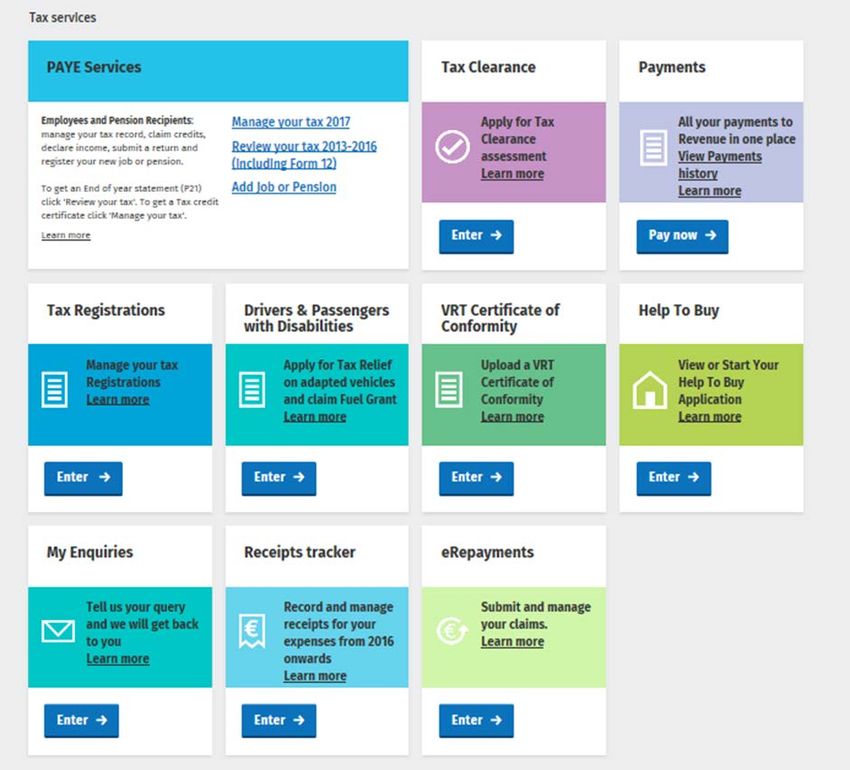
Airbnb | General guidance on the taxation of rental income, including Frequently Asked Questions
July 2017

Table of contents
Table of contents ..................................................................................................................... 2
1.     Taxation of rental income in Ireland ................................................................................. 3
   1.1     Rental income.......................................................................................................... 3
   1.2     Where to obtain information from Airbnb ................................................................... 3
   1.3     Expenses that can be deducted ................................................................................. 3
   1.4     Capital allowances/wear and tear............................................................................... 5
   1.5     Pro-rata expenses .................................................................................................... 5
   1.6     Expenses that cannot be deducted............................................................................. 5
   1.7     Documentation to be retained ................................................................................... 6
   1.8     Receipts not retained ............................................................................................... 6
   1.9     Reporting rental income on a tax return ..................................................................... 6
   1.10    Jointly owned property ............................................................................................ 6
   1.11    Applicable tax rates .................................................................................................. 7
   1.12    Rental losses ........................................................................................................... 7
   1.13    Sample rental computation ....................................................................................... 7
   1.14    Capital Gains Tax.................................................................................................... 10
   1.15    Trading Income ...................................................................................................... 10
2.     Rent-a-room relief........................................................................................................ 11
   2.1     What is rent-a-room relief ....................................................................................... 11
   2.2     Revenue’s interpretation ......................................................................................... 11
   2.3     The conditions required for rent-a-room relief to apply .............................................. 11
   2.4     Who can avail of the relief? ..................................................................................... 11
   2.5     Examples of circumstances where the relief is not due ............................................... 12
   2.6     The exemption limits .............................................................................................. 12
   2.7     Sample rental computation where rent-a-room relief not applicable ............................ 12
   2.8     How is the relief granted? ....................................................................................... 14
   2.9     Claiming rent-a-room relief on a tax return ............................................................... 14
   2.10    Capital Gains Tax.................................................................................................... 14
   2.11    Rent-a-room relief – Frequently Asked Questions ....................................................... 15
3.     Guide to preparing an annual tax return ......................................................................... 17
   3.1     The requirement to file a tax return in relation to rental income ................................. 17
   3.2     Registering for income tax ...................................................................................... 17
   3.3     Electronic filing ...................................................................................................... 18
   3.4     Preliminary tax ...................................................................................................... 18
   3.5     Deadlines to meet .................................................................................................. 19
   3.6     Expression of Doubt ............................................................................................... 20
   3.7     Submitting a tax return........................................................................................... 23
   3.8     Payment of income tax liability ................................................................................ 24
   3.9     Records to be kept ................................................................................................. 24
   3.10    Revenue right to inspect records ............................................................................. 24
   3.11    Application of interest and penalties ........................................................................ 25
4.     Airbnb’s reporting obligations ....................................................................................... 26
Appendix A Resident and Ordinarily Resident ....................................................................... 27
Appendix B     Personal tax rates 2016 and 2017 ..................................................................... 28
Appendix C     Common sections in the tax return .................................................................... 29

Disclaimer
These guidance notes are provided by EY solely for the use of Airbnb and may not be relied upon or used by any other party. As such, the guidance is solely for
information purposes and EY and Airbnb assume no responsibility whatsoever to third parties as a result of the use of information contained herein. This document and
notes are to provide guidance only. We recommend that you seek advice from your own tax advisor, should you have any questions or concerns about your own tax
situation including your ability to avail of any relief from income tax.
Please refer to the Responsible Hosting Page available on the Airbnb website for additional general information about hosting in Ireland.

                                                                                   2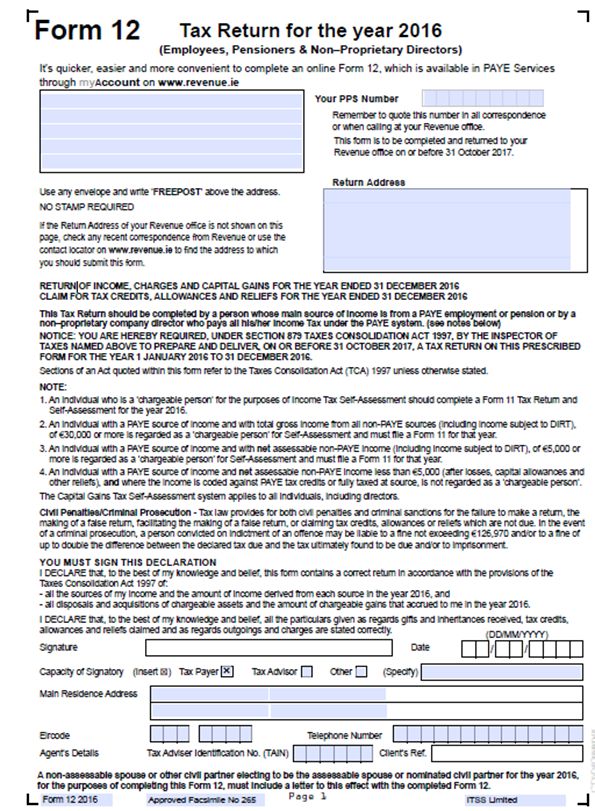
Airbnb | General guidance on the taxation of rental income, including Frequently Asked Questions
      July 2017

1.    Taxation of rental income in Ireland

1.1   Rental income
      Irish rental income (i.e. rental income from a property located in the Republic of Ireland) is subject
      to Irish tax regardless of where the person in receipt of that income resides. For example, where an
      individual is in receipt of rental income from the letting of an Irish property and they are living
      outside Ireland, the Irish rental income is still subject to tax in Ireland.

      Rental income may be exempt from tax in Ireland where rent-a-room relief applies. However, a
      number of conditions must be met in order to claim rent-a-room relief. Please refer to Section 2 for
      further information in relation to this relief. Where rent-a-room relief can be claimed in respect of
      rents received, the below information regarding the taxation of rental income will not be relevant, as
      the rents received are relieved from tax under rent-a-room relief.

      Irish rental income is subject to tax under what is known as Schedule D, Case V which is part of the
      Taxes Consolidation Act 1997.

      ‘Rent’ is the gross amount of monies received (before any expenses are deducted) from the letting
      of any property. It can also include monies received for any goods or services that are provided
      under a rental agreement, e.g. meals, laundry etc.

      Taxable rental income is the gross amount of rent received less any allowable expenses. This can
      also be referred to as ‘net’ rental income. Where the allowable expenses are greater than the gross
      amount of rent received, a rental loss will arise.

      The calculation of net taxable rental income (or loss) is referred to as a ‘rental computation’. A
      separate rental computation is required for each letting.

      Rental income is subject to tax in the year in which it is ‘receivable’. For example, if rental income
      that was receivable during December 2016 is not actually received until January 2017, it is still
      subject to tax in 2016.

      Foreign rental income (i.e. rental income from a property located outside the Republic of Ireland)
      may also be taxable in Ireland where the host is resident or ordinarily resident in Ireland (see
      Appendix A for an explanation of these terms). An individual in receipt of foreign rental income
      should engage a tax advisor to confirm whether the income is subject to tax in Ireland and also to
      ensure that the rental income is correctly reported in Ireland and any tax that may be due is paid in
      the country where the property is located. For Irish tax purposes, an individual is entitled to claim
      the same deductions in respect of expenses incurred in letting a foreign rental property, as would be
      due if the property were located in Ireland (please refer to section 1.3 below for further information
      in relation to expenses).

1.2   Where to obtain information from Airbnb
      An Airbnb host can refer to this Airbnb Help Centre article as a guide to accessing their reservation
      and transaction history in order to calculate their gross rental income for any particular period.

1.3   Expenses that can be deducted
      As outlined above, taxable rental income is the gross amount of rent received less any allowable
      expenses. In general, a deductible or allowable expense is one that has actually been incurred and is
      not regarded as capital in nature.

      Disclaimer
      These guidance notes are provided by EY solely for the use of Airbnb and may not be relied upon or used by any other party. As such, the guidance is solely for
      information purposes and EY and Airbnb assume no responsibility whatsoever to third parties as a result of the use of information contained herein. This document and
      notes are to provide guidance only. We recommend that you seek advice from your own tax advisor, should you have any questions or concerns about your own tax
      situation including your ability to avail of any relief from income tax.
      Please refer to the Responsible Hosting Page available on the Airbnb website for additional general information about hosting in Ireland.

                                                                                         3
Airbnb | General guidance on the taxation of rental income, including Frequently Asked Questions
July 2017

Examples of expenses that can be deducted in calculating taxable rental income (or loss), are as
follows:

•    Rates payable by the host in respect of the property, e.g. rates paid to a local authority,

•    The cost of any goods or services provided by the host as part of the rental agreement, e.g. gas,
     electricity, TV, internet, bin collection etc. (where separate payment is not received by the host
     from the guest for the good/service),

•    The cost of maintaining the property, e.g. cleaning, laundry etc.

•    The cost of insuring the property. In addition to building and content cover, a deduction can also
     be claimed for certain premiums paid in respect of mortgage protection policies linked to the
     rental property,

•    The cost of managing the property, e.g. legal fees and accountancy fees incurred by the host in
     connection with the letting of the property. The Airbnb service fee will also qualify as a
     deductible expense,

•    The cost of repairs, e.g. fixing broken windows, doors, furniture and machines etc.,

•    Mortgage interest incurred on the purchase, repair or improvement of the premises being rented
     (subject to the paragraphs below).

     From April 2009, the amount of mortgage interest allowed as a deduction in calculating taxable
     rental income is restricted to 75% of the interest accruing during the year. Interest is treated as
     accruing on a daily basis. From 1 January 2017, the amount of mortgage interest allowed as a
     deduction in calculating taxable rental income is restricted to 80% of the interest accruing during
     the year. The restriction on the deductibility of the mortgage interest will gradually be reduced
     between 2017 and 2021, with full deductibility being available for mortgage interest accruing
     from 1 January 2021.

     In addition, in order to claim a deduction for mortgage interest, the host must ensure they are
     compliant with the requirements of the Residential Tenancies Act 2004 in relation to the
     registration of a tenancy with the Private Residential Tenancies Board (‘PRTB’). The PRTB
     registration fee itself is also a deductible expense. Further information in relation to the
     requirement to register tenancies with the PRTB is available at www.prtb.ie or by contacting the
     PRTB on 0818 30 30 37 or registrations@prtb.ie.

     Only mortgage interest accruing during the period the property is actually rented can be
     deducted.

The above list of expenses is not exhaustive.

Where rent-a-room relief is applicable, the deduction of expenses does not need to be considered.
Further information in relation to this relief is available in Section 2.

Where an individual is in receipt of rental income and that rental income is not exempt from tax
under the provisions of rent-a-room relief (e.g. because the conditions necessary to claim rent-a-
room relief are not met), then the individual must prepare a tax calculation and include a net taxable
figure on an annual income tax return.

Note: An annual income tax return must be filed regardless of whether rent-a-room relief is
applicable or not.

Disclaimer
These guidance notes are provided by EY solely for the use of Airbnb and may not be relied upon or used by any other party. As such, the guidance is solely for
information purposes and EY and Airbnb assume no responsibility whatsoever to third parties as a result of the use of information contained herein. This document and
notes are to provide guidance only. We recommend that you seek advice from your own tax advisor, should you have any questions or concerns about your own tax
situation including your ability to avail of any relief from income tax.
Please refer to the Responsible Hosting Page available on the Airbnb website for additional general information about hosting in Ireland.

                                                                                   4
Airbnb | General guidance on the taxation of rental income, including Frequently Asked Questions
      July 2017

1.4   Capital allowances/wear and tear
      A wear and tear allowance or capital allowance is available in respect of capital expenditure incurred
      on fixtures and fittings (e.g. furniture, kitchen appliances, etc.) provided by a host for the purposes
      of furnishing rented residential accommodation. The allowance can be taken as a deduction against
      taxable rental income.

      The allowances are available only where the expenditure is incurred wholly and exclusively in
      respect of a house used solely as a dwelling which is, or is to be, let as a furnished house on bona
      fide commercial terms on the open market.

      The availability of a wear and tear allowance must be considered carefully in light of Airbnb hosts’
      specific circumstances. An individual who is in receipt of taxable rental income and has incurred
      expenditure on fixtures and fittings to furnish rented residential accommodation, should engage a
      tax advisor to confirm whether a wear and tear allowance is available.

      The wear and tear allowance that can be claimed each year is equal to 12.5% of the expenditure
      incurred on the fixture or fitting. This can be claimed for a maximum of eight years from the
      purchase of the fixture or fitting.

      Capital allowances can only be deducted for income tax and PRSI purposes and cannot be deducted
      for the Universal Social Charge (USC), i.e. the USC is applicable to the taxable rental income before
      the deduction of capital allowances whereas income tax and PRSI are applicable to the taxable rental
      income after the deduction of capital allowances.

1.5   Pro-rata expenses
      Only allowable expenses incurred in respect of the period the property is let can be deducted in
      calculating taxable rental income. Pre-letting expenses (with certain exceptions) and post-letting
      expenses are not allowed as deductions. Allowable expenses incurred between lettings are allowed
      as deductions but only to the extent that they are directly related to the period in which the
      accommodation is let.

      Therefore, where on-going expenses such as electricity, gas etc. are incurred only the portion
      relating to the period the property is let can be deducted. It will be necessary to pro-rate the
      expense on a reasonable basis to calculate the portion relating to the period the property was
      rented. It will also be necessary to keep records of this calculation.

      If only part of a premises is let, then only the expenses incurred on that part of the premises that is
      let are allowed as a deduction in calculating taxable rental income. For example, if a room or rooms
      are let in a private house and the rental income received is greater than the limit allowed under rent-
      a-room relief, the rental income will be taxable. In order to calculate the taxable rental income, it will
      be necessary to apportion any ‘household’ or ‘shared’ expenses between the part of the premises
      that is let and the part that is not let.

1.6   Expenses that cannot be deducted
      The following are examples of expenses that cannot be deducted in calculating taxable rental income
      (or loss):

      •    Pre-letting expenses with certain exceptions. Pre-letting expenses are those that are incurred
           prior to the date on which the premises is first let,

           Certain pre-letting expenses are allowed as a deduction. These are auctioneer’s letting fees,
           advertising fees and legal expenses incurred on first lettings.

      Disclaimer
      These guidance notes are provided by EY solely for the use of Airbnb and may not be relied upon or used by any other party. As such, the guidance is solely for
      information purposes and EY and Airbnb assume no responsibility whatsoever to third parties as a result of the use of information contained herein. This document and
      notes are to provide guidance only. We recommend that you seek advice from your own tax advisor, should you have any questions or concerns about your own tax
      situation including your ability to avail of any relief from income tax.
      Please refer to the Responsible Hosting Page available on the Airbnb website for additional general information about hosting in Ireland.

                                                                                         5
Airbnb | General guidance on the taxation of rental income, including Frequently Asked Questions
      July 2017

      •    Post-letting expenses. Post-letting expenses are those that are incurred after the final letting,

      •    Expenses incurred between lettings where the host occupies the premises during that period
           between lettings,

      •    Interest accruing in the period 1) following the purchase of a premises up to the time a tenant
           enters into a lease and occupies the premises, and 2) after the final letting,

      •    Capital expenditure incurred on additions, alterations or improvements to the premises unless
           incurred on fixtures and fittings and a wear and tear allowance is available,

      •    Expenses incurred on lettings that are exempt under the provisions of rent-a-room relief,

      •    The Local Property Tax (‘LPT’),

      •    An individual cannot claim a deduction for their own labour.

      The above list is not exhaustive.

1.7   Documentation to be retained
      Full and accurate records of all lettings must be kept for tax purposes. All supporting documentation
      in respect of those records must also be kept, e.g. details from Airbnb, mortgage interest details,
      invoices, bank statements, cheque stubs, receipts for all expenses incurred etc. In general, records
      must be retained for six years.

      Receipts etc. do not need to be submitted with the annual income tax return. However, the Revenue
      may request copies of receipts etc. to support the taxable rental income an individual declares on
      their annual income tax return.

1.8   Receipts not retained
      If expense receipts have been mislaid individuals are advised to contact their service providers, e.g.
      gas or electricity companies, to obtain backdated receipts. The Revenue will generally not accept
      credit card/bank statements only as evidence of the expense.

1.9   Reporting rental income on a tax return
      Individuals with taxable rental income will need to file an annual income tax return to report this
      taxable income to the Revenue.

      In addition, individuals who wish to claim rent-a-room relief will need to file an annual income tax
      return in order to claim this relief and to report the level of gross rents generated in the tax year.

      The requirement to file an Irish tax return will exist for any tax year during which an individual is in
      receipt of Irish rental income (whether it is regarded as taxable or whether rent-a-room relief is
      applicable).

      Please refer to section 3.2 as a guide for reporting taxable rental income on an annual income tax
      return.

1.10 Jointly owned property
      Where an individual owns a property jointly with someone else, it is necessary to apportion the
      rental income (and allowable expenses) between them based on each individual’s percentage

      Disclaimer
      These guidance notes are provided by EY solely for the use of Airbnb and may not be relied upon or used by any other party. As such, the guidance is solely for
      information purposes and EY and Airbnb assume no responsibility whatsoever to third parties as a result of the use of information contained herein. This document and
      notes are to provide guidance only. We recommend that you seek advice from your own tax advisor, should you have any questions or concerns about your own tax
      situation including your ability to avail of any relief from income tax.
      Please refer to the Responsible Hosting Page available on the Airbnb website for additional general information about hosting in Ireland.

                                                                                         6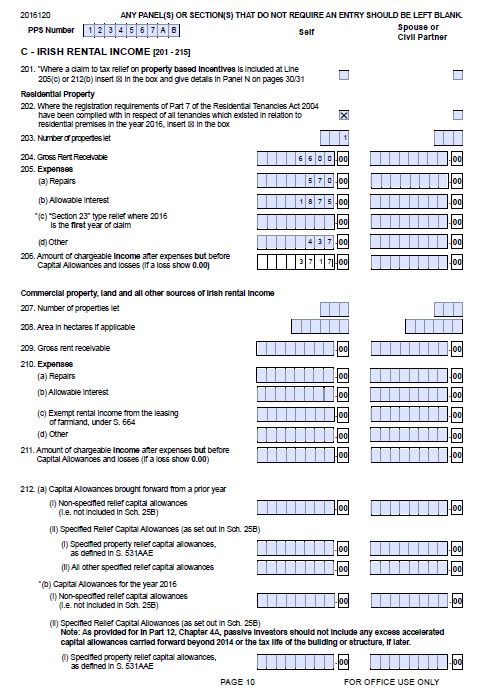
Airbnb | General guidance on the taxation of rental income, including Frequently Asked Questions
      July 2017

      ownership of the property. For example, where a brother and sister own a rental property (50:50),
      the gross rents received must be split evenly between each individual. Each individual will be
      required to report their portion of the taxable net rental income on their own individual tax return.

      Where a married couple own a property jointly and they are jointly assessed to tax, then they will
      report all of the net taxable rental income on the same tax return.

1.11 Applicable tax rates
      The tax rates applicable to rental income are the same as those applicable to other sources of
      income.

      The tax rates applicable to taxable or net rental income will depend on the level of other income (i.e.
      non-rental income) an individual receives during the tax year. For example, where an individual’s
      other income in 2016 exceeds their standard rate bands for income tax and Universal Social Charge
      (‘USC’) and they have used their annual tax credits, their taxable or net rental income is subject to
      income tax at 40%, the USC at 8% and PRSI at 4% (a combined rate of 52%). Please refer to Appendix
      B for confirmation of the income tax rates for the 2016 and 2017 tax years.

1.12 Rental losses
      A rental loss will arise where allowable expenses are greater than the gross rents received. An
      individual will still need to file an annual income tax return even where a rental loss arises.

      That rental loss can be carried forward to future tax years indefinitely to reduce rental profits in
      those years. The rental loss can only be used to reduce rental profits, i.e. taxable rental income. For
      example, it cannot be used to reduce taxable employment income. The rental loss must be used in
      the earliest year possible.

1.13 Sample rental computation

          Example

          Sinéad owns a home in Ireland. She occasionally spends time with her parents abroad and rents out her
          home for temporary periods, e.g. 1 week, 1 month and various weekends. In 2016 this accounted for a
          period of 3 months in total. The total gross rents received were €6,600 for the 3 months during which the
          property was rented.

          Sinéad incurred the following annual expenses in 2016 in respect of the property:

          1.       Insurance of €550,

          2.       Mortgage interest of €10,000,

          3.       Local Property Tax of €585,

          4.       Cleaning during the period the property was rented of €300, and

          5.       Repairs at the end of the period the property was rented due to damage caused by guest of €570.

          Sinéad has kept a record of the total gross rents received and has all supporting documentation, e.g.
          confirmation of mortgage interest incurred in 2016 from her Bank, receipts for expenditure incurred etc.
          Sinéad is single and her only other source of income is from her employment. This income is subject to PAYE
          etc. at source.

      Disclaimer
      These guidance notes are provided by EY solely for the use of Airbnb and may not be relied upon or used by any other party. As such, the guidance is solely for
      information purposes and EY and Airbnb assume no responsibility whatsoever to third parties as a result of the use of information contained herein. This document and
      notes are to provide guidance only. We recommend that you seek advice from your own tax advisor, should you have any questions or concerns about your own tax
      situation including your ability to avail of any relief from income tax.
      Please refer to the Responsible Hosting Page available on the Airbnb website for additional general information about hosting in Ireland.

                                                                                         7
Airbnb | General guidance on the taxation of rental income, including Frequently Asked Questions
July 2017

 Sinéad’s rental computation:                                                     €

 Gross rental income                                                              6,600

 Less allowable expenses:

 Annual Insurance*                                            137.50
 Annual Mortgage interest**                                   1,875
 Cleaning***                                                  300
 Repairs***                                                   570                 (2,882.50)

 Net taxable rental income                                                        €3,717.50

 Sinéad’s PAYE income exceeds her standard rate band for income tax and USC and she has used her tax
 credits in full against her PAYE income. Therefore, her net taxable rental income will be subject to income
 tax, USC and PRSI at marginal rates. Therefore, her tax liability is as follows:

 •     Income tax = €1,487 (i.e. €3,717.50 @ 40%)

 •     USC = €297.40 (€3,717.50 @ 8%)

 •     PRSI = €148.70 (€3,717.50 @ 4%)

 •     Total tax liability = €1,933.10

 *Only the part of the expense relating to the period the property was rented can be claimed as a deduction.
 As the property was only rented for 3 out of 12 months, the insurance should be apportioned on this basis.
 Therefore, €550 * 3/12 = €137.50

 **The deduction for interest accruing on loans used to purchase, improve or repair rented residential
 property is restricted to 75% of the interest accruing during the year (i.e. in Sinéad’s case it is restricted to
 €7,500, i.e. €10,000 * 75%)). Again only the part of the expense relating to the period the property was
 rented can be claimed as a deduction. As the property was rented for 3 out of 12 months, the restricted
 mortgage interest should be apportioned on this basis. Therefore, €7,500 * 3/12 = €1,875

 ***The cleaning and repairs expenses relate directly to the rental of the property. As such, the full amount
 of these expenses can be claimed as a deduction.

 ****The Local Property Tax (‘LPT’) is not allowed as a deduction.

 The above example is prepared on the basis that rent-a-room relief is not applicable. Please refer to Section
 2 for guidance on the conditions required to claim rent-a-room relief.

Disclaimer
These guidance notes are provided by EY solely for the use of Airbnb and may not be relied upon or used by any other party. As such, the guidance is solely for
information purposes and EY and Airbnb assume no responsibility whatsoever to third parties as a result of the use of information contained herein. This document and
notes are to provide guidance only. We recommend that you seek advice from your own tax advisor, should you have any questions or concerns about your own tax
situation including your ability to avail of any relief from income tax.
Please refer to the Responsible Hosting Page available on the Airbnb website for additional general information about hosting in Ireland.

                                                                                   8
Airbnb | General guidance on the taxation of rental income, including Frequently Asked Questions
July 2017

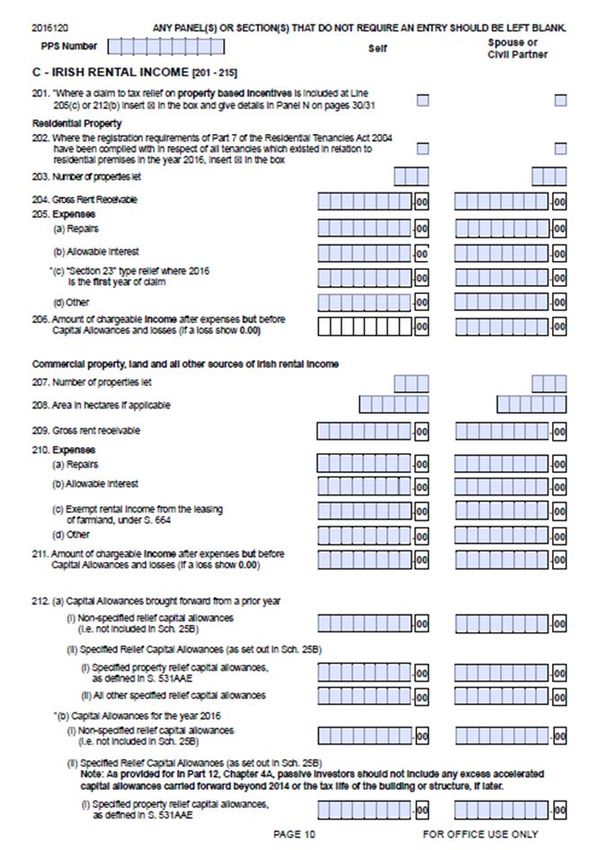
The illustration below indicates where Sinéad’s gross rental income, expenses and net taxable rental
income are reported in Section C of her annual income tax return (Form 11). Please refer to Section
3 for further information in relation to the completion of the annual income tax return.

        Page 10 of 2016 ‘Form 11’

  Sinéad’s PPS
  number is
  inserted here                                                                                                                                            Gross rents are
                                                                                                                                                           inserted here

                                                                                                                                                           Repairs are
                                                                                                                                                           inserted here

                                                                                                                                                           Mortgage
                                                                                                                                                           interest
                                                                                                                                                           (restricted to
                                                                                                                                                           75%) is inserted
                                                                                                                                                           here

                                                                                                                                                      Insurance and
                                                                                                                                                      cleaning
                                                                                                                                                      expenses are
                                                                                                                                                      inserted here

                                                                                                                                            Net taxable
                                                                                                                                            rental income is
                                                                                                                                            inserted here

Disclaimer
These guidance notes are provided by EY solely for the use of Airbnb and may not be relied upon or used by any other party. As such, the guidance is solely for
information purposes and EY and Airbnb assume no responsibility whatsoever to third parties as a result of the use of information contained herein. This document and
notes are to provide guidance only. We recommend that you seek advice from your own tax advisor, should you have any questions or concerns about your own tax
situation including your ability to avail of any relief from income tax.
Please refer to the Responsible Hosting Page available on the Airbnb website for additional general information about hosting in Ireland.

                                                                                   9
Airbnb | General guidance on the taxation of rental income, including Frequently Asked Questions
July 2017
1.14 Capital Gains Tax
In general, Principal Private Residence relief (PPR relief) provides for relief from capital gains tax
(‘CGT’) on the gain arising on the disposal of a dwelling house or part of a dwelling house which has
been occupied by an individual as his or her sole or main residence.
PPR relief is subject to the following condition being met:
• The dwelling house must have been occupied by the individual as his or her sole or main
residence throughout the period of ownership. Note that the last 12 months of ownership is
automatically deemed to be a period of occupancy in any event.
Where the dwelling house was not occupied by the individual as his or her sole or main residence
throughout the period of ownership, only partial relief may be due. The gain is deemed to accrue
evenly throughout the entire period of ownership and only the portion of the gain that relates to the
period of owner-occupation can be relieved from CGT. There are certain exceptions to this rule, for
example where the individual is required to move abroad for work purposes.
If a portion of the dwelling house was used exclusively for the purpose of a trade, business or
profession, again only partial relief may be due and only the portion of the gain that relates to the
qualifying part of the dwelling house (i.e. the part that was occupied as a principal private residence)
can be relieved from CGT.
The CGT exemption is not restricted in respect of any period for which the vendor has availed of
rent-a-room relief, i.e. where the conditions for rent-a-room relief are satisfied and the vendor has
occupied the property as their sole or main residence throughout the period of ownership, the
above capital gains tax exemption will still apply.
Further information on PPR relief is available on the Revenue website.
1.15 Trading Income
Income from the provision of accommodation can be considered as trading income rather than
rental income in certain circumstances, e.g. where an individual is operating a guesthouse / bed &
breakfast type service. In order to confirm whether the income is to be regarded as trading income
first the individual must consider whether or not they are carrying on a trade. A trade is not clearly
defined in Irish tax legislation. Instead, in determining whether a trade exists reference must be
made to case law and to the ‘badges of trade’ which are commonly used to determine whether a
trade is being carried on. The specific facts and circumstances of each case need to be reviewed to
make the determination. If in doubt, an individual should seek tax advice to assist them in
determining whether the income they receive from the provision of accommodation is to be treated
as trading income.
Where the income received is regarded as trading income, rent-a-room relief is not available as this
relief is only available in respect of rental income which is subject to tax under Case V or Case IV of
the TCA 1997.
Disclaimer
These guidance notes are provided by EY solely for the use of Airbnb and may not be relied upon or used by any other party. As such, the guidance is solely for
information purposes and EY and Airbnb assume no responsibility whatsoever to third parties as a result of the use of information contained herein. This document and
notes are to provide guidance only. We recommend that you seek advice from your own tax advisor, should you have any questions or concerns about your own tax
situation including your ability to avail of any relief from income tax.
Please refer to the Responsible Hosting Page available on the Airbnb website for additional general information about hosting in Ireland.
10Airbnb | General guidance on the taxation of rental income, including Frequently Asked Questions
July 2017
2. Rent-a-room relief
2.1 What is rent-a-room relief
Rent-a-room relief provides an income tax exemption (including USC and PRSI) for rents received in
a tax year, where certain conditions are met (see below). The relief is only available to individuals
who rent a room (or rooms) for residential purposes in their sole or main residence.
Revenue has recently updated their guidance in relation to rent-a-room relief and this can be found
on the Revenue’s website. This section should be read in conjunction with the updated guidance
from Revenue.
http://www.revenue.ie/en/tax-professionals/ebrief/2015/no-212015.aspx
2.2 Revenue’s interpretation
In February 2015, Revenue issued a guidance note confirming their view that Rent a Room Relief
should not apply to income from the provision of accommodation to occasional visitors for short
term stays. The guidance note states that ‘income from the provision of accommodation to
occasional visitors for short periods does not qualify for the relief as, in this scenario, the visitors
use the accommodation as guest accommodation rather than for residential purposes’.
However, Rent a Room Relief may still be available in certain circumstances. Individuals who are
uncertain as to their entitlement to claim Rent a Room Relief should seek professional tax advice
before filing a claim. An Expression of Doubt may be lodged with the tax return where the position is
uncertain. Please refer to Section 3.6 for further information on the Expression of Doubt.
2.3 The conditions required for rent-a-room relief to apply
Rent-a-room relief is only available where certain conditions are met, as follows:
• The room(s) being let must form part of a ‘Qualifying Residence’ as defined, i.e. a residential
premises (i.e. a building or part of a building used as a dwelling) located in Ireland which is
occupied by an individual as their sole or main residence during the tax year; and
• Gross rents receivable in a tax year must not exceed €14,000 per annum for 2017 or €12,000
per annum for 2016. Gross rents include income received in respect of the letting and other
sums received in connection with the letting (e.g. meals, laundry and other similar goods or
services incidentally supplied) before deduction of any allowable expenses.
Where the above conditions are not met, the rents received may be liable to income tax (including
USC and PRSI) as rental income or trading income. An individual is obliged to file an annual income
tax return to report the rental income or trading income.
An exemption from income tax may be claimed if the above conditions are met however a tax return
must be filed in order to claim rent-a-room relief.
2.4 Who can avail of the relief?
Individuals who meet the conditions as set out above. The relief does not apply to companies or
partnerships. However, it can apply where rents are received by more than one individual, for
example, a husband and wife, where there is no partnership. In such cases, the €12,000 exemption
limit is divided equally between them.
Disclaimer
These guidance notes are provided by EY solely for the use of Airbnb and may not be relied upon or used by any other party. As such, the guidance is solely for
information purposes and EY and Airbnb assume no responsibility whatsoever to third parties as a result of the use of information contained herein. This document and
notes are to provide guidance only. We recommend that you seek advice from your own tax advisor, should you have any questions or concerns about your own tax
situation including your ability to avail of any relief from income tax.
Please refer to the Responsible Hosting Page available on the Airbnb website for additional general information about hosting in Ireland.
11Airbnb | General guidance on the taxation of rental income, including Frequently Asked Questions
July 2017
2.5 Examples of circumstances where the relief is not due
Some common examples include:
• Where gross rents received in a tax year exceed €14,000 for 2017 or €12,000 for 2016,
• Where the property is not an individual’s sole or main residence (e.g. an investment property),
• The relief is not due where a child pays rent to a parent,
• The relief is not due where the person in receipt of the income is an employee of the person
making the payment.
The above list is not exhaustive.
2.6 The exemption limits
€14,000 for 2017 and €12,000 for 2016 are the exemption limits applicable, as set out above. If
the gross rents exceed these limits then the full amount is taxable, i.e. not just the amount that
exceeds the applicable limit.
2.7 Sample rental computation where rent-a-room relief not applicable
Example
Disclaimer
These guidance notes are provided by EY solely for the use of Airbnb and may not be relied upon or used by any other party. As such, the guidance is solely for
information purposes and EY and Airbnb assume no responsibility whatsoever to third parties as a result of the use of information contained herein. This document and
notes are to provide guidance only. We recommend that you seek advice from your own tax advisor, should you have any questions or concerns about your own tax
situation including your ability to avail of any relief from income tax.
Please refer to the Responsible Hosting Page available on the Airbnb website for additional general information about hosting in Ireland.
12Airbnb | General guidance on the taxation of rental income, including Frequently Asked Questions
July 2017
Séan owns a three bed house in Dublin. He sub-let two rooms in the house throughout 2016. Each room
was sub-let for €700 per month. The total gross rents Séan received for 2016 was therefore, €16,800.
As this amount exceeds the limit for 2016 (€12,000), Séan is not entitled to rent-a-room relief.
The house measures 2,200 ft². The rooms Séan sub-lets measure 300 ft² and 350 ft² respectively.
Séan incurred the following expenses in 2016 in respect the property:
1) Insurance of €700,
2) Mortgage interest of €14,000,
3) Local Property Tax of €1,215,
4) Light and Heat of €3,600, and
5) Repairs of €200 in respect of damage to one of the sub-let rooms.
Séan has kept a record of gross rents received and has all supporting documentation, e.g. confirmation of
mortgage interest incurred in 2016 from his Bank, receipts for expenditure incurred etc.
Séan is single and his only other source of income is from his employment. This income is subject to PAYE
etc. at source.
In calculating net taxable rental income, Séan may deduct allowable expenses which relate to the rooms
that are sub-let. Where an expense is incurred and it relates to the entire house (i.e. not just the sub-let
rooms) it is necessary to calculate the portion of the expense that relates to the sub-let rooms on a just
and reasonable basis. A just and reasonable basis might be for example to apportion the expense based
on the square footage of the sub-let rooms and the house. This is the basis on which Séan’s rental
computation has been prepared below.
Séan’s rental computation: € €
Gross rental income 16,800
Less allowable expenses:
Insurance* 239
Mortgage interest** 3,580
Light and heat*** 1,227
Repairs**** 200 (5,246)
Net taxable rental income €11,554
*Only the part of the insurance expense as relates to the rooms that are sub-let can be taken as a deduction.
The portion relating to the rooms that are sub-let must be calculated on a just and reasonable basis, e.g. based
on square footage as follows, €700 * 750 ft²/2,200 ft² = €239.
**The deduction for interest accruing on loans used to purchase, improve or repair rented residential property
is restricted to 75% of the interest accruing during the year. Again only the part of this expense as relates to the
rooms that are sub-let can be taken as a deduction, e.g. €14,000 * 75% = €10,500, €10,500 * 750 ft²/2,200
ft² = €3,580.
Disclaimer
These guidance notes are provided by EY solely for the use of Airbnb and may not be relied upon or used by any other party. As such, the guidance is solely for
information purposes and EY and Airbnb assume no responsibility whatsoever to third parties as a result of the use of information contained herein. This document and
notes are to provide guidance only. We recommend that you seek advice from your own tax advisor, should you have any questions or concerns about your own tax
situation including your ability to avail of any relief from income tax.
Please refer to the Responsible Hosting Page available on the Airbnb website for additional general information about hosting in Ireland.
13Airbnb | General guidance on the taxation of rental income, including Frequently Asked Questions
July 2017
***Only the part of the light and heat expense as relates to the rooms that are sub-let can be taken as a
deduction. The portion relating to the rooms that are sub-let must be calculated on a just and reasonable basis,
e.g. based on square footage as follows, €3,600 * 750 ft²/2,200 ft² = €1,227.
****The repairs relate directly to one of the rooms that are sub-let and as such the entire expense can be taken
as a deduction.
*****The Local Property Tax (‘LPT’) is not allowed as a deduction.
2.8 How is the relief granted?
A tax return must be filed in order to claim rent-a-room relief and to report the level of gross rents
generated in the tax year. Please refer to Appendix C which illustrates the relevant section of the
return that must be completed.
2.9 Claiming rent-a-room relief on a tax return
Please refer to section 3.2 as a guide for claiming rent-a-room relief on an annual income tax return.
2.10 Capital Gains Tax
In general, Principal Private Residence relief (PPR relief) provides for relief from capital gains tax
(‘CGT’) on the gain arising on the disposal of a dwelling house or part of a dwelling house which has
been occupied by an individual as his or her sole or main residence.
PPR relief is subject to the following conditions being met:
• The dwelling house must have been occupied by the individual as his or her sole or main
residence throughout the period of ownership. Note that the last 12 months of ownership is
automatically deemed to be a period of occupancy in any event.
The CGT exemption is not restricted in respect of any period for which the vendor has availed of
rent-a-room relief, i.e. where the conditions for rent-a-room relief are satisfied and the vendor has
occupied the property as their sole or main residence throughout the period of ownership, the
above capital gains tax exemption will still apply.
If a portion of the dwelling house was used exclusively for the purpose of a trade, business or
profession, only partial relief may be due and only the portion of the gain that relates to the
qualifying part of the dwelling house (i.e. the part that was occupied as a principal private residence)
can be relieved from CGT.
Further information on PPR relief is available on the Revenue website.
Disclaimer
These guidance notes are provided by EY solely for the use of Airbnb and may not be relied upon or used by any other party. As such, the guidance is solely for
information purposes and EY and Airbnb assume no responsibility whatsoever to third parties as a result of the use of information contained herein. This document and
notes are to provide guidance only. We recommend that you seek advice from your own tax advisor, should you have any questions or concerns about your own tax
situation including your ability to avail of any relief from income tax.
Please refer to the Responsible Hosting Page available on the Airbnb website for additional general information about hosting in Ireland.
14Airbnb | General guidance on the taxation of rental income, including Frequently Asked Questions
July 2017
2.11 Rent-a-room relief – Frequently Asked Questions
Please note that Revenue has recently updated their guidance in relation to rent-a-room relief and
this can be found on the Revenue’s website. This section should be read in conjunction with the
updated guidance from Revenue.
http://www.revenue.ie/en/tax-professionals/ebrief/2015/no-212015.aspx
1. I understand rent-a-room relief only applies to a ‘qualifying residence’ –
please explain
A qualifying residence is a property, situated in Ireland, and which is occupied by an individual as
their sole or main residence during a tax year. You must therefore live in the property in order for
rent-a-room relief to apply.
2. Is rent-a-room relief available if I let my entire apartment/house?
Rent-a-room relief is available in respect of sums arising from the letting of a room or rooms in a
property that is occupied by the individual as their sole or main residence. If the entire property is
let, and you are not living there, this condition would not be met; therefore the relief would not
apply in these circumstances.
3. I share a house with some friends. I will be away for a number of months
this year due to work. Can I claim rent-a-room relief if I let my room
during the time that I won’t be living in the property?
It is a condition of the relief that the individual in receipt of the income occupies the property as
their ‘sole or main residence’ during the year. This does not however require that you must live in
the property throughout the year. Therefore, provided the property is your sole or main residence at
some time during the year, and the other conditions are met, the relief should apply.
4. I receive rental income from an apartment which I own as an investment
property, can I claim rent-a-room relief?
No, the relief only applies to income from the letting of a room or rooms in a property which is
occupied by you as your sole or main residence.
5. I am a tenant in a rented house, can I claim rent-a-room relief if I sublet
a room in the house?
Yes, you can. It is not a requirement of the legislation that the person receiving the rent is the owner
of the property. You may however need to consult your landlord to establish whether subletting is
permitted under the terms of your lease.
6. I own a house jointly with my spouse, we both live in the property; if we
let out our spare rooms, can we both claim the maximum relief of
€12,000/€14,000 per year?
Disclaimer
These guidance notes are provided by EY solely for the use of Airbnb and may not be relied upon or used by any other party. As such, the guidance is solely for
information purposes and EY and Airbnb assume no responsibility whatsoever to third parties as a result of the use of information contained herein. This document and
notes are to provide guidance only. We recommend that you seek advice from your own tax advisor, should you have any questions or concerns about your own tax
situation including your ability to avail of any relief from income tax.
Please refer to the Responsible Hosting Page available on the Airbnb website for additional general information about hosting in Ireland.
15Airbnb | General guidance on the taxation of rental income, including Frequently Asked Questions
July 2017
Where income arises to more than one individual from the letting of rooms in a qualifying residence,
the exemption is divided between them. Assuming that you and your spouse were each entitled to
half the rent, then you would each be entitled to claim exemption on up to €6,000/€7,000 each,
per year.
7. We have a basement in our house which has been turned into a self-
contained unit with its own entrance; does rent-a-room relief apply to
letting the basement unit?
Yes. Provided the self-contained unit forms part of the residential premises the relief should apply,
subject to meeting the usual conditions. The relief would not however apply to a unit which is
physically separate from the residence, for example a mews building standing in the garden of the
residence.
8. My employer is hosting a conference and due to a shortage of nearby
hotel accommodation has offered to pay employees for the use of spare
rooms in their home if they are willing to host delegates, can I claim
rent-a-room relief for these payments?
No, rent-a-room relief does not apply to payments received either directly or indirectly by an
individual, or a person connected with the individual, in respect of accommodation provided in a
home where the individual is an employee of the person making the payment or of a person
connected with the payer.
9. I have a holiday home and I sometimes let rooms during peak season,
can I claim rent-a-room relief?
No, you must occupy the property as your sole or main residence. Since the property is a holiday
home, this condition would not be met.
10. What can I do if I disagree with Revenue’s assessment of the income I
receive from the rental of a room in my home?
Tax legislation provides for a right of appeal against a variety of matters including assessments or
determinations arising from Revenue’s interpretation of legislation.
A taxpayer who is aggrieved by any assessment made by the Revenue Commissioners can lodge an
appeal against the assessment by providing written notice to Revenue within 30 days of the notice
of assessment. On receipt of the appeal, the Revenue may amend the assessment or alternatively,
the Inspector of Taxes will list the case for hearing before the Appeal Commissioners.
The Appeal Commissioners are independent officials who will review the position and issue a
determination as to which position is correct based on the facts presented (i.e. the Revenue’s or the
taxpayer’s). If the taxpayer or Revenue is dissatisfied with the Appeal Commissioners decision a
further appeal can be lodged in the Circuit Court. If either party is dissatisfied with the Appeal
Commissioner’s or the Circuit Court’s decision, the appeal can be carried to the High Court, but only
on a point of law. There is also an appeal from the High Court to the Supreme Court, but again only
on a point of law.
You should consult a tax advisor and obtain legal advice in relation to the making of an appeal.
Disclaimer
These guidance notes are provided by EY solely for the use of Airbnb and may not be relied upon or used by any other party. As such, the guidance is solely for
information purposes and EY and Airbnb assume no responsibility whatsoever to third parties as a result of the use of information contained herein. This document and
notes are to provide guidance only. We recommend that you seek advice from your own tax advisor, should you have any questions or concerns about your own tax
situation including your ability to avail of any relief from income tax.
Please refer to the Responsible Hosting Page available on the Airbnb website for additional general information about hosting in Ireland.
16Airbnb | General guidance on the taxation of rental income, including Frequently Asked Questions
July 2017
3. Guide to preparing an annual tax return
3.1 The requirement to file a tax return in relation to rental income
Individuals with taxable rental income will need to file an annual income tax return to report this
taxable income to the Revenue.
In addition, individuals who wish to claim rent-a-room relief will need to file an annual income tax
return in order to claim this relief and to report the level of gross rents generated in the tax year.
The requirement to file an Irish tax return will exist for any tax year during which an individual is in
receipt of Irish rental income (whether it is regarded as taxable or whether rent-a-room relief is
applicable). There is no requirement to file a tax return for any tax year during which an individual is
not in receipt of rental income and only has employment income that has been subject to PAYE in
full.
Ireland has a calendar year tax system, with the tax year running from 1 January to 31 December
each year.
Individuals who file an annual income tax return will either need to file a Form 12 tax return or
alternatively they will need to register for income tax in Ireland and file a Form 11 tax return. The
Form 12 is a shorter version of the tax return and is intended for use by those whose income is
mainly subject to PAYE.
Form 12
An individual with PAYE income (i.e. employment income that is subject to PAYE, USC and PRSI at
source) and a low level of non-PAYE income (e.g. rental income) can make an arrangement with
Revenue to have the tax due on their non-PAYE income collected by reducing their annual tax
credits. In order to enter into such an arrangement with Revenue, the individual must have:
• Gross non-PAYE income of less than €30,000 per annum, and
• Net taxable non-PAYE income (i.e. gross income less deductible expenses) of less than €5,000
per annum.
An electronic version of the Form 12 called the ‘eForm 12’ is available via Revenue’s myAccount
service. Please refer to section 3.3 below for further information in relation to the eForm 12.
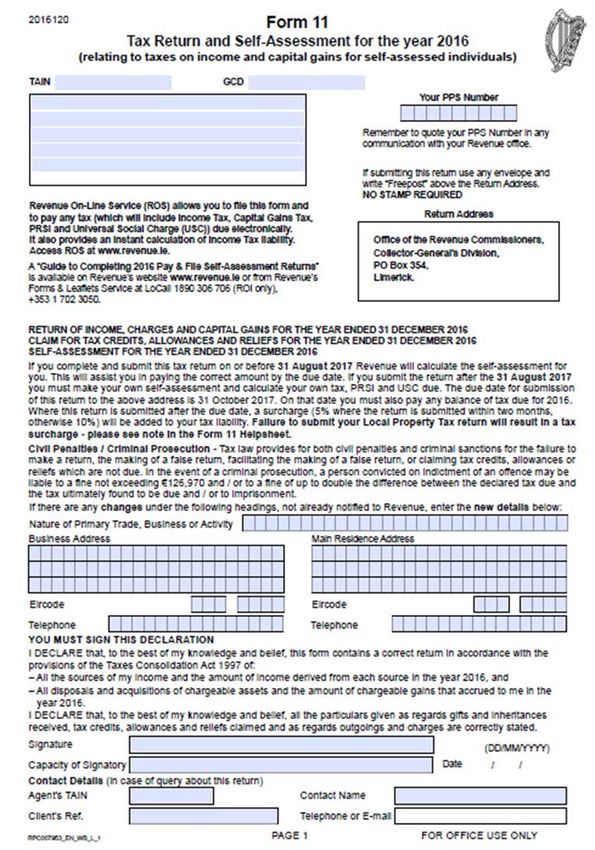
Form 11
Individuals who have non-PAYE income and who do not meet both of the conditions outlined above
are regarded as ‘chargeable persons’ and must register for income tax and file a Form 11 tax return
via the self-assessment system.
3.2 Registering for income tax
An individual can register for income tax by completing a Form TR1 and submitting this to their local
Revenue district. Alternatively, this can be done using Revenue’s On-line Service (‘ROS’). However, in
order to use ROS, an individual must first register for the service.
An individual can register for ROS by clicking the link ‘Register for ROS’ on Revenue’s homepage
(www.revenue.ie)
Disclaimer
These guidance notes are provided by EY solely for the use of Airbnb and may not be relied upon or used by any other party. As such, the guidance is solely for
information purposes and EY and Airbnb assume no responsibility whatsoever to third parties as a result of the use of information contained herein. This document and
notes are to provide guidance only. We recommend that you seek advice from your own tax advisor, should you have any questions or concerns about your own tax
situation including your ability to avail of any relief from income tax.
Please refer to the Responsible Hosting Page available on the Airbnb website for additional general information about hosting in Ireland.
17Airbnb | General guidance on the taxation of rental income, including Frequently Asked Questions
July 2017
Once registered an individual can register for income tax via ROS. In order to do this log into your
ROS account using the ROS access number provided by Revenue. Click on the ‘My Services’ tab at
the top of your account homepage and then click on ‘Manage Your Tax Registrations and Agent
Links’. You will then see a list of taxes you can register for.
Revenue offer support via the ROS helpdesk (roshelp@revenue.ie or LoCall 1890 201 106 (ROI
only) or +353 1 702 3050 (outside ROI)) for any ROS related queries.
Where an individual ceases to be regarded as a chargeable person and no longer has an obligation
to file an annual income tax return, they can de-register for income tax via ROS or by contacting
their local Revenue district.
3.3 Electronic filing
Form 12
A paper form of the Form 12 is available. This can be completed and submitted by post to the
taxpayer’s local Revenue district (please refer to section 3.8 for further detail on the submission of
the return).
An electronic Form 12 – the ‘eForm 12’ is also available via Revenue’s ‘myAccount’ service. The
eForm 12 is a shorter version of the paper Form 12 and certain information from the taxpayer’s
Revenue record is pre-populated on the eForm 12. myAccount is a single access point for secure
Revenue online services (excluding ROS) such as PAYE Anytime, Local Property Tax etc. Where a
taxpayer is not registered for myAccount they can do so by logging on to www.revenue.ie and
selecting ‘Register for myAccount’.
If a PAYE taxpayer is already registered for ‘PAYE Anytime’ they will be able to log in to myAccount
using their existing PAYE Anytime PIN.
Form 11
Any taxpayers that register for income tax/re-register for income tax from 1 January 2015 will be
required to file tax returns and pay tax liabilities electronically via ROS.
3.4 Preliminary tax
Preliminary tax must be paid by individuals who are regarded as ‘chargeable persons’ and who are
required to file a Form 11 tax return.
Preliminary tax is an estimate of tax payable for a tax year on non-PAYE income and is payable in
advance. Preliminary tax must be paid by 31 October in the year in question (or the ROS extended
deadline – please refer to section 3.5 below for further information in relation to the tax deadlines).
For example, preliminary tax for the 2017 tax year is due by 31 October 2017 (or the ROS extended
deadline). Preliminary tax for the 2017 tax year is an estimate of the tax payable by an individual in
respect of 2017.
When calculating the preliminary tax payment an individual must ensure to include their liability to
PRSI and the Universal Social Charge, as well as income tax.
In order to avoid interest charges, the amount of preliminary tax paid for a tax year must equal or
exceed the lower of the following three amounts:
• 90% of an individual’s final liability for the tax year, or
Disclaimer
These guidance notes are provided by EY solely for the use of Airbnb and may not be relied upon or used by any other party. As such, the guidance is solely for
information purposes and EY and Airbnb assume no responsibility whatsoever to third parties as a result of the use of information contained herein. This document and
notes are to provide guidance only. We recommend that you seek advice from your own tax advisor, should you have any questions or concerns about your own tax
situation including your ability to avail of any relief from income tax.
Please refer to the Responsible Hosting Page available on the Airbnb website for additional general information about hosting in Ireland.
18You can also read


