An Economic Development Strategy to Grow the Economy of Fayetteville, Georgia - Fayetteville, GA
←
→
Page content transcription
If your browser does not render page correctly, please read the page content below
An Economic Development
                                                                       Strategy to Grow the Economy
                                                                       of Fayetteville, Georgia
                                                                       March 1, 2016
                                                                       Edited: April 18, 2016

                                                                       Prepared for:
                                                                       The City of Fayetteville, Georgia

715 Birkdale Drive | At lanta, GA 30215 | p 770.716.9544 | f 770.719.8911 | www.g arnereconomics .com
TABLE OF CONTENTS

Executive Summary ............................................................................................................................................................................................................... 3

Chapter 1: Where Fayetteville Stands as a place for Business .......................................................................................................................................... 7

Chapter 2: Optimal Business Targets For Fayetteville ..................................................................................................................................................... 20

   Small Business, Retail, and Film Production Support Services .................................................................................................................................. 22

   Professional and Corporate Office Users ....................................................................................................................................................................... 25

   Computers and Technology ............................................................................................................................................................................................. 28

   Health Services ................................................................................................................................................................................................................... 31

Chapter 3: Observations & Recommendations—Where Do We Go from Here? ........................................................................................................... 40

   Execute Effectively (Effective Service Delivery)............................................................................................................................................................... 41

   Enhance the Product (Product Improvement) ............................................................................................................................................................... 47

   Tell The Story (Marketing) ................................................................................................................................................................................................ 52

Chapter 4: Conclusion........................................................................................................................................................................................................... 55

Recommendations Summary ............................................................................................................................................................................................. 56

Appendix A: Fayetteville Tax Allocation District FAQ........................................................................................................................................................ 57
EXECUTIVE SUMMARY

In August 2015, the City of Fayetteville, Georgia,                                 In assessing Fayetteville as a competitive place to locate and grow a business,
retained Fayetteville-based Garner Economics, LLC to                               the consulting team found that the City falls behind its peers, the State of
create an economic development strategy specific to                                Georgia, and national averages in many criteria considered important to a
the City that will take into account the current state                             community’s competitive economic position. While Fayetteville has enjoyed
of the City and provide a roadmap for Fayetteville to                              several positive gains in the recent year—for example, the creation of
create economic opportunities for its citizens.                                    Pinewood Atlanta Studios and the building of the City’s film industry—there
                                                                                   are many areas the City needs to improve if it is to be successful in attracting
The focus of the engagement was to help                                            and retaining the types of companies that will provide better opportunities
Fayetteville’s leadership understand the product                                   for its residents.
improvement, marketing, and potential organizational changes it must make
to ensure that the City strengthens its competitive position and is able to        To begin mitigating these challenges and strengthening the City’s overall
attract and retain the types of businesses that will create jobs and               position, this strategy creates a customized, comprehensive plan for
opportunities for its citizens.                                                    Fayetteville’s economic development for the next several years. Its end goal is
                                                                                   to give the City the tools it needs to grow along a positive trajectory and
Specifically, the scope of services for the overall project included:              provide the community and the people that live and work there with a
                                                                                   steadily growing economic future.
(1) A comprehensive and holistic assessment of key forces driving the
    economy and its shifting dynamics;                                             Analysis and Assessments
(2) An Assets and Challenges Assessment (A&C) of Fayetteville from the
                                                                                   As summarized in the Competitive Realities Report shared with the City in
    perspective of a site-location consultant that facilitates investment
                                                                                   December 2015, our approach to creating this strategy began with Garner
    decisions;
                                                                                   Economics conducting an A&C of the City and gathering input and
(3) Recommendations for business targets suitable for the City based on our        perceptions of Fayetteville’s business climate from the community. The
    research and analysis; and finally,                                            former was done through a windshield tour of the City and against a pre-
                                                                                   determined list of 51 criteria used to evaluate Fayetteville from a site-
(4) A set of implementable recommendations that the leadership in the City         selection perspective. Garner Economics assessed the City based on the
    can utilize to enhance the economic well-being of the area and make            qualities, elements, and infrastructure that a business will look for when
    Fayetteville a desirable business location and enhance its quality of place.   considering Fayetteville as a place for its operations.

An Economic Development Strategy for Fayetteville, Georgia                                                                                        Page 3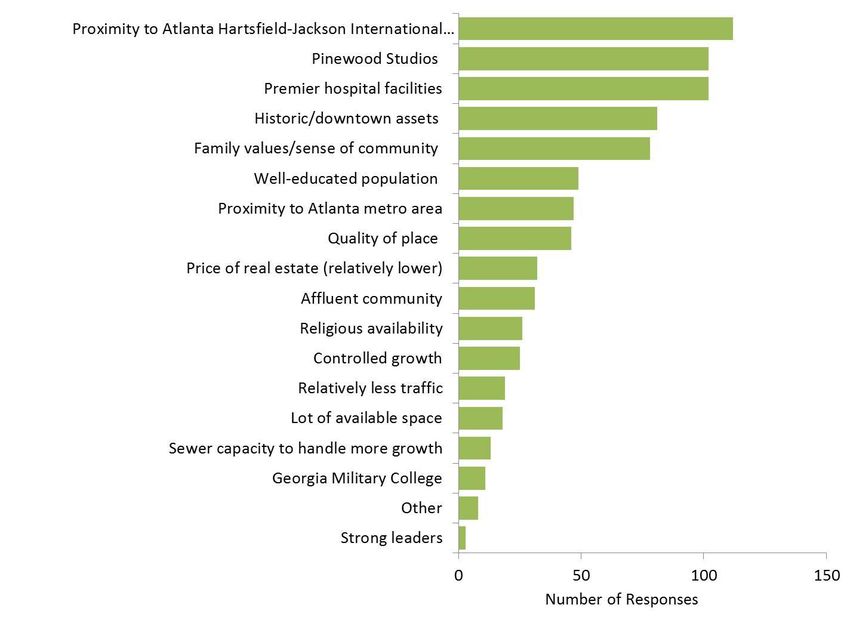
The community engagement phase took the form of three focus groups with Target Industries
key community stakeholders and an online survey to solicit a variety of
perceptions of the area’s business climate and areas for improvement. This The above analysis revealed that there are areas that need attention if
input was used to validate and augment conclusions reached in the A&C. Fayetteville is to reach its potential as a competitive place for business. To
confront these challenges, the City must find a balance between proactively
Finally, because Fayetteville must compete with other geographies—both working to recruit investment to the community, while protecting the
nationally and within the Atlanta metropolitan area, it is important to friendly, small-town fabric that makes Fayetteville what it is today. To do so,
understand where the City stands compared to key competitors. Garner the City must find consensus around the type of community it wants to be
Economics evaluated key demographic and economic indicators for the City and work to recruit and retain the types of companies and talent that will
and compared them to statewide and national-level data, as well against the enable this vision to come to fruition.
two benchmark cities: Woodstock, Georgia, and Opelika, Alabama. These
benchmark geographies were selected by the strategy steering committee Chapter 2 provides insights in to what types of targets are “best fits” for
with the City of Fayetteville. Fayetteville, given the City’s existing assets and goals for the future. The
description of, and rationale for, the targets will help the City and other
In addition to these assessments, the team also looked at Fayetteville’s retail economic development groups in the area prioritize marketing resources and
sector and identified areas of leakage and conducted a Local Specialization, will identify areas where policymakers can act to increase Fayetteville’s
Competitiveness & Growth Assessment for the City. competitive position in attracting and retaining these business sectors.
These “building blocks” and the key findings of the Competitive Realities The identified target industry sectors for Fayetteville are:
Report are summarized in Chapter 1. This dataset and body of knowledge are
the basis upon which the recommendations have been built. Small Business, Retail, and Film Professional and Corporate
Production Support Services Office Users
Computers and Technology Health Services
Assets &
Labor & Challenges
Economic Assessment
Analysis
Community
Engagement
Economic Development Strategy
for Fayetteville
An Economic Development Strategy for Fayetteville, Georgia Page 4
Recommendations                                                                     FIGURE 1: STRATEGIC RECOMMENDATIONS

Based on the assets and challenges identified within Fayetteville and the           Organizational Change
needs of the target business sectors, the recommendations provided within           1. Reorganize the City’s Community Development Department
this strategy, and presented in detail in Chapter 3, reflect items the team            a. Rename the community development department
believes the City should undertake to mitigate negative perceptions by site-           b. Hire an Economic Development Director
location advisors or companies looking to invest in Fayetteville. Additionally,
                                                                                       c. Separate the Planning and Zoning functions from economic
the recommendations highlight areas where the City should work with others                development
in the region to better leverage Fayetteville’s location in the Atlanta
                                                                                    2. Expand the existing Fayetteville Downtown Development Authority to
metropolitan area. The recommendations also provide tactics the City can use
                                                                                       encompass radius business district boundaries
to effectively market Fayetteville to the recommended business sector
                                                                                    3. Promote the existing Tax Allocation District
targets.
                                                                                    4. Make the case for a sustainable funding source for economic
The recommendations go beyond traditional recruitment, expansion, and                  development projects
retention activities and look at Fayetteville and its economic future               Product Improvement
holistically. The recommendations are meant to be a comprehensive
economic development strategy and are built to support one another. To be           1. Recruit a vocational tech two-year college
successful in attaining its goals, City leaders will need to take on a more         2. Develop a city-sponsored or city-owned Center for Visual and
structured approach to economic development that is proactive in guiding               Performing Arts
the area’s growth and assertive in building a funding stream to catalyze the        3. Implement the key recommendations of the 2010 LCI Urban Study
change. This will mean executing economic development efforts differently           4. Create a plan to improve gateways into the City
and being a champion for long-term investments that will add to the City’s          5. Provide the public free, high-speed Internet access in the Core Business
“product” and quality of place.                                                        District and in disadvantaged neighborhoods
                                                                                    6. Conduct a downtown parking study
The recommendations are broken into three categories: policy changes and
investments that should be made to strengthen the City’s product, tactics to        Product Marketing
market the City and better tell its economic development story, and                 1. Create a separate economic development portal to enhance the City’s
organizational changes that will allow Fayetteville to significantly increase and      website
improve its economic development service delivery. The recommendations              2. Partner with local and regional economic development allies to market
further provide the optimal sequencing for taking on the tasks.                        the City
                                                                                    3. Engage Atlanta area commercial developers to promote the City’s value
                                                                                       proposition
                                                                                    4. Re-brand (or create) a unified Fayetteville brand

An Economic Development Strategy for Fayetteville, Georgia                                                                                       Page 5
As described in the following chapters, Fayetteville has great potential but        The following chapters provide the rationale and create a plan for
must confront current challenges to improve its ability to be a home for the        undertaking the strategy. Achieving these goals will require bold and strategic
types of businesses and talent it desires. Given the competition of its peer        steps to transform Fayetteville into a place that attracts quality talent and
communities and the changing demands and needs of the City’s talented               companies, while maintaining the City’s unique character and commitment to
workforce, Fayetteville must be strategic in leveraging its assets and building     quality and fully leveraging its position in the Atlanta metropolitan region.
its value proposition. Fortunately, the City has the leadership, aspirations, and
resources to catalyze change in the community. By taking steps to change its
trajectory, Fayetteville can shape its economic future and optimize economic
opportunities for its residents.

An Economic Development Strategy for Fayetteville, Georgia                                                                                        Page 6
CHAPTER 1: WHERE FAYETTEVILLE STANDS AS A PLACE FOR BUSINESS
A Summary of the Competitive Realities Report
This chapter summarizes the Garner Economics team’s findings in Phase I, the Among the two groups, there were several areas of agreement. Survey
“discovery” phase of the assignment. The assessment was an objective and respondents tended to focus on broader quality of place assets and issues,
subjective evaluation, and it included data collection, on-site visits, and while focus group respondents had deeper comments and concerns over
soliciting opinions and perspectives of the City’s stakeholders. By knowing particular economic assets or challenges such as local regulations and
where Fayetteville stands, the City knows what challenges or gaps exist and procedures and workforce needs. Both groups rated the City as “average” in
can take steps to ameliorate negative situations, strengthen its overall terms of its business climate (i.e., policies and laws enacted by the local
“product,” and be a more attractive business location. Likewise, by knowing government that impact local businesses). The overarching key themes that
the area’s strengths, the City can better market them in its efforts to attract emerged include:
external businesses and retain those businesses already located in A desire for more streamlined interaction with the City
Fayetteville.
Continuing tensions between encouraging growth in Fayetteville and
What Stakeholders Think maintaining the status quo
The need to improve access to and through the City
To provide a context around the data accumulated in the A&C and economic A lack of amenities for younger professionals and visitors
and labor analysis, Garner Economics held three focus groups with
stakeholders in Fayetteville and Fayette County to solicit their perceptions The opportunity to leverage the energy of Pinewood Atlanta Studios
and opinions of the City’s business climate. Fifty-two people participated in A desire for regionalism—on the county level
the focus groups. Additionally, an electronic survey based on the focus group Recruiting companies to Fayetteville, so residents have opportunities
responses was distributed by the City. There were 182 survey respondents. closer to home and the City’s tax base is increased
The respondents represented a broad group of area residents, including both
corporate and economic development perspectives as well as feedback from The graphs on the following pages highlight the feedback in terms of the
the general citizenry. An additional opinion survey to a random selection of overall competitive position of the City. A detailed summary of the
high school students was also provided. community engagement input was provided in the Competitive Realities
Report.
An Economic Development Strategy for Fayetteville, Georgia Page 7
FIGURE 2: PRIORITIES TO STRENGTHEN FAYETTEVILLE’S COMPETITIVE POSITION AS A PLACE FOR BUSINESSES AND TALENT
When asked to indicate the top items they would like to see the City leadership take on to strengthen Fayetteville’s ability to attract and retain quality
companies and talent to the City—without worrying about money or politics—the two groups responded as follows:
Most frequently noted by focus groups: Most frequently noted by survey respondents:
Improve access to highways and Develop downtown and adjacent properties
strengthen the road system within Attract/retain millennials; serve needs of aging population
Fayetteville
Attract and grow jobs/lessen need to out-commute
Create a cultural arts district and
performing arts center Fix the internal road system
Develop an area within the City that is a Create a shopping district that is unique and draws visitors
destination for residents and attracts
Ensure that our school system is ready to address diversity
visitors
Improve K-12 schools within Fayetteville
Ensure that the school system is ready
to address the diversity that the County Better market Fayetteville to potential tourists/companies
is experiencing
Promote regionalism in Fayette County
Communicate the many assets
Fayetteville has to offer Open a new park or nature area within the City
Create a cultural arts district
Host more festivals/events to build community
Encourage developments that are lifestyle centers
Improve inter-city transit
Better leverage and use the Tax Allocation Districts
An Economic Development Strategy for Fayetteville, Georgia Page 8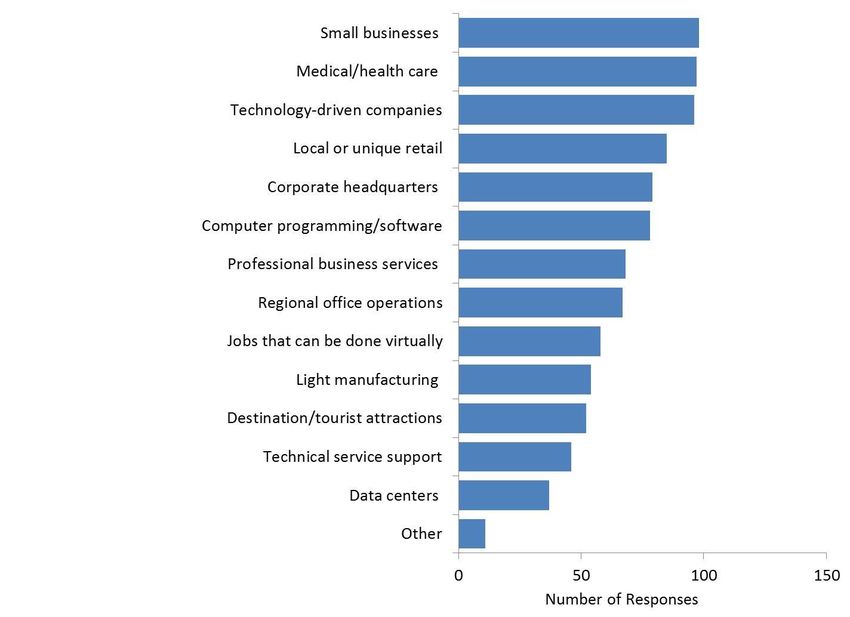
FIGURE 3: PERCEIVED STRENGTHS
 When asked to indicate Fayetteville’s strengths, the two groups responded as follows:*

*Survey respondents were asked to choose up to five of the possible options.
 An Economic Development Strategy for Fayetteville, Georgia                               Page 9

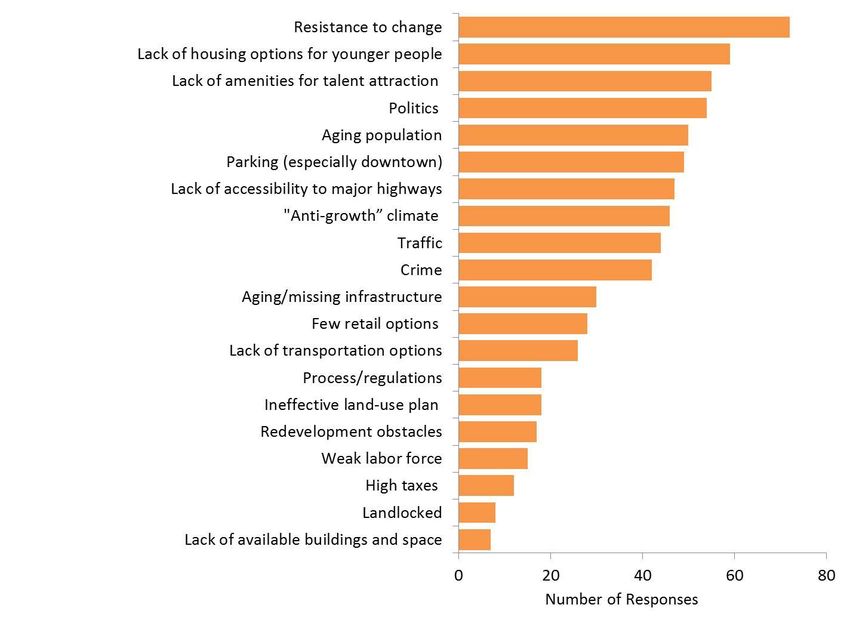
FIGURE 4: PERCEIVED INHIBITORS

 When asked to indicate issues that inhibit Fayetteville from recruiting businesses, the two groups responded as follows:*

*Survey respondents were asked to choose up to five of
the possible options.

 An Economic Development Strategy for Fayetteville, Georgia                                                                  Page 10
FIGURE 5: POTENTIAL INDUSTRIES
When asked what types of companies would be a good fit for the area, the two groups responded as follows:

An Economic Development Strategy for Fayetteville, Georgia                                                  Page 11
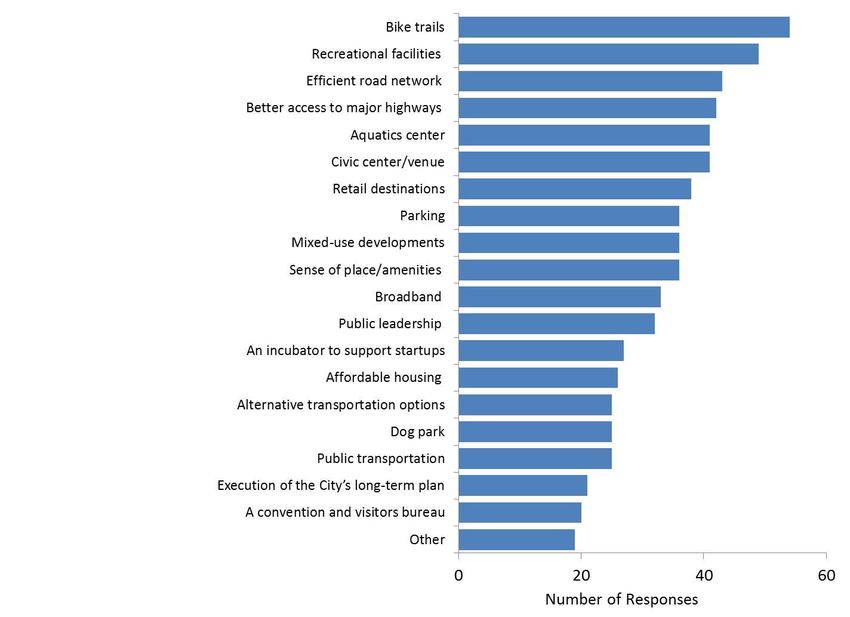
FIGURE 6: LACKING INFRASTRUCTURE
When asked what hard or soft infrastructure* is weak or missing in Fayetteville, the survey respondents ranked the items as follows. Focus group participants
most frequently noted the need for a more efficient road network and parking.

    *Hard infrastructure was defined as the
    physical networks such as roadways, sewer,
    broadband Internet, airports, and/or ports.
    Soft infrastructure was defined as
    institutions or places that support the
    economic, health, and cultural climate of a
    place, such as the education system, the
    health care system, system of government,
    and/or parks.

    Note: Survey respondents were asked to
    choose up to five of the possible options.

An Economic Development Strategy for Fayetteville, Georgia                                                                                   Page 12
Assets and Challenges Assessment
Grounded by decades of economic development, site-location analysis, Of the 51 variables analyzed, 17 are considered an Asset and 20 a
and industry cluster targeting experience, Garner Economics began the Challenge (14 rated as Neutral). With 20 challenge rankings, Fayetteville
project to assess Fayetteville by using a rigorous set of techniques based has too many in the negative column based on the ratio of an
on fully sourced and reliable datasets to completely understand the City’s economically healthy, dynamic city. The goal in the future will be for
current economic state. The main component of this phase was the those policymakers engaged in local economic development to move the
Assets and Challenges Assessment (A&C), which is a compilation of bar with the neutral rankings from neutral to an asset, and the challenge
local facts and data points with quantitative analysis and some subjective ranking to neutral (or better).
opinions. These are typically the same variables that are used when we
To enable a summary overview of the A&C’s main findings for readers, a
conduct a locational assessment on behalf of a corporate client. The team
set of dashboard icons was presented. Each finding has an accompanying
assessed Fayetteville against 51 criteria.
icon to assist with interpretation. The tables on the following pages
The A&C helps local leaders understand the area’s potential so they can summarize the assessment of Fayetteville.
best develop realistic goals, identifies key strengths to emphasize in
economic development marketing efforts, and identifies key weaknesses
that may limit investment in the area. By knowing what challenges or
gaps exist, Fayetteville can take the steps necessary to ameliorate the
situation and be a more attractive business location. Likewise, by knowing
its strengths, the City can better leverage them in its efforts to attract REPORT DASHBOARD
businesses.
Indicates the City is better (more positive) compared to a
majority of the benchmark geographies or points to a positive
trend or asset within the area.
Indicates the City is neutral or normal, neither positive nor
negative. Indicator may represent an observation or be in the
middle of the benchmark geographies.
Indicates the City is worse compared to a majority of the
benchmark geographies or points to a negative trend or
challenge within the area.
An Economic Development Strategy for Fayetteville, Georgia Page 13FIGURE 7: FAYETTEVILLE’S ASSETS AND CHALLENGES
Neutral ratings are not summarized in this report. Detailed data can be found in the COMPETITIVE REALITIES REPORT.
Assets Challenges
Centrally located for major regional market Lack of interstate highway(s)
Access to Centrally located for national market Lack of rail service
Markets Well positioned to serve international markets Lack of port facilities (inland and/or water)
Within 1 hour of commercial air passenger service
Broadband availability and speeds
Availability of managerial personnel Lack of skilled industrial workers
Within ½ hour of university/college Lack of skilled clerical workers
Labor
Lack of technicians and scientists
Lack of post-secondary vocational training
Lack of engineering program (local)
No relative assets Lack of adequate level of professional staff
Lack of local economic development strategic plan(s)
City Economic
Development Low level of leadership support of economic development
Program program
Low level of funding for the City’s economic development
program
Availability of fully served and attractive office sites Lack of availability of fully served and attractive industrial sites
Access to Space and space and space
Availability of fully served and attractive retail space
Access to Capital No relative assets Lack of availability of venture capital from local sources for
business startups or early stage funding
An Economic Development Strategy for Fayetteville, Georgia Page 14FAYETTEVILLE’S ASSETS AND CHALLENGES, CONTINUED
Assets Challenges
Government Availability/capacity of wastewater treatment Availability/capacity of water
Impact on
Availability of labor training incentives SAT scores of Fayette County High Scholl related to the
Business
Local property taxes (City of Fayetteville) benchmarked jurisdictions
Quality of Place Availability of executive-level housing Availability of apartments
Cost-of-Living Index Availability of recreational opportunities
Level of cultural activity Availability of first-class hotels, motels, and resorts
Availability of shopping facilities Quality and variety of local restaurants
Availability of adequate medical facilities
Labor and Economic Trends
In addition to assessing Fayetteville against criteria and measures preferred by most site-selection professionals. The most detailed
employed by site selectors, work during the assessments and analysis demographics data, industry statistics, and comparative rankings were
phase examined the area’s economic position against the State of used because businesses considering Fayetteville will do the same.
Georgia, the United States, and two benchmark cities: Woodstock,
Georgia, and Opelika, Alabama. These benchmark geographies were As the scorecards presented in the Competitive Realities Report (and
selected by the City. replicated on pages 16-19) indicate, Fayetteville has mixed results in
terms of demographics, labor, and economics.
Garner Economics used data that can be verified and, for which,
comparisons with other cities or areas can be made at the level of detail
An Economic Development Strategy for Fayetteville, Georgia Page 15Demographic & Labor Dynamics
Over the last decade, the total population of Fayetteville has increased 16.1% or 2,698 residents; the rate is above the nation, the state, Fayette
County, and Opelika, but below the benchmark city of Woodstock.
Over the last five years, the annual rate of population growth in Fayetteville has been 1.5%, while over 10 years, the rate averaged 2.2%.
Fayetteville’s 5- and 10-year annual pace of population growth is above Opelika, Fayette County, the state, and the nation.
Over the 2009 to 2013 period, Fayetteville attracted 36.5% of its new residents from a Different County in Same State, a higher proportion than was
experienced in both benchmark communities, the state, and the nation. Fayetteville attracted the lowest relative proportion of new residents from a
Different State. The City also attracted the second highest percentage from Abroad.
Among all of the study areas, Fayetteville has the second most racially diverse population.
At 41.2 years, the median age in Fayetteville is higher than both benchmark cities, the state, and the nation, but slightly lower than the County
median.
Fayetteville’s highest proportion of residents is in two age groups: 35–44 and 45–54. Fayetteville has a lower share of residents in age groups 25–34
than both benchmark cities.
Fayetteville’s violent and property crime rates were below Opelika, the state, and the nation, but above Woodstock and the County.
Educational attainment among the majority of Fayetteville’s population ages 25+ holds at least a high school diploma, with 42% holding a Bachelor’s
Degree or Graduate or Professional Degree. With the exception of Woodstock, Fayetteville has the lowest proportion of residents whose highest
level of educational attainment is Less than 9th Grade.
At 1379, Fayetteville’s 2015 composite SAT total score for Fayette County High School is below all of the study areas.
Fayette County High School and the entire district rank above all other benchmarks, except Opelika, in high school graduation rates.
An Economic Development Strategy for Fayetteville, Georgia Page 16Demographic & Labor Dynamics (continued)
Among Fayetteville’s new residents ages 25 and over, 42.3% hold a Bachelor’s Degree or higher. This is greater than Opelika, the state, and the nation—and
only slightly lower than Woodstock and the entire County.
Among Fayetteville residents ages 25 and over, median earnings are on par with the state and nation for all categories of educational attainment, however,
lower than Fayette County. Earnings were lower than Woodstock as well, with the exception of the Graduate or Professional Degree category.
58.8% of those working in Fayetteville live outside the area (in-commute).
6,519 workers that live in Fayetteville travel outside the area for employment (out-commute).
Over the last 10 years, the number of workers Living in Fayetteville but Employed Outside (out-commuters) has increased 40.8% or 1,890 more workers.
Economic Dynamics
The 2015 estimated average weekly wage in Fayetteville is $719. The average wage applies to employees that work in Fayetteville regardless of
residence. This average wage is the third lowest among the study areas, with the lowest in Opelika.
Over the five-year period of 2010 to 2015, the estimated average weekly wage in Fayetteville increased by $26 or 3.7%. This increase is well above
the benchmark city of Opelika, but behind Woodstock, the County, the state, and the nation.
For 2013, the per capita income in Fayetteville was $30,036, which was higher than Opelika, the state, and the nation—but lower than Woodstock
and Fayette County.
Over 11.2% of workers in Fayetteville classify themselves as Self-Employed—which is second only to Fayette County, which had 11.4% Self-
Employed.
An Economic Development Strategy for Fayetteville, Georgia Page 17Economic Dynamics (continued)
At $18,049, median earnings among those Fayetteville workers classified as Self-Employed in Own Not Incorporated Business were the lowest among
the study areas.
Among residents ages 16 and over in Fayetteville, 58.1% are employed, which falls between the two benchmark cities and is below the County, but
above both the state and nation.
Fayetteville’s proportion of families with two income earners (Married, Husband and Wife in Labor Force) is 43.3%, which is higher than Opelika, the
state, and the nation, but lower than Woodstock and the County.
Compared to the nation and the state, Fayetteville has the highest total share of households with incomes in the $15,000 to $24,999 category.
Fayetteville’s proportion of those above $100,000 is 26.4%, which is below the overall county average of 38.5% and Woodstock’s average of 28.5%.
Of 20 major industry categories, Fayetteville has the highest relative percentage in one industry: Health Care & Social Assistance.
The 2015 composite Cost-of-Living Index for Fayette County-Fayetteville is estimated to be 93.4. This is lower than Auburn-Opelika and the national
average.
Households in Fayetteville have the greatest access to DSL and cable broadband compared to the benchmark cities, the County, state, and nation.
Fayetteville’s average percentage of retail leakage is 59.4, indicating that shoppers from Fayetteville spend less than half of their disposable income
in the City.
The largest retail gap (indicating local consumers travel outside Fayetteville to satisfy their retail demands) is in Motor Vehicle & Parts Dealers at
$212.9 million, followed by General Merchandise Stores with an $86.2 million gap.
An Economic Development Strategy for Fayetteville, Georgia Page 18Local Specialization, Competitiveness & Growth
Below are general observations from an in-depth analysis of industry sectors and occupational groups in Fayetteville. This information is not benchmarked to
the nation, the state, or benchmark cities:
Since 2010, the largest absolute industry jobs gains in Fayetteville came from Health Care & Social Assistance, up 1,028 jobs or 27 percent, followed
closely by Accommodation & Food Services, up 1,019 jobs or 61 percent.
There were significant job losses in Government (-454 jobs or 9 percent); Professional, Scientific & Technical Services (-75 jobs or 7 percent); Real Estate
& Rental & Leasing (-57 jobs or 20 percent); and Crop & Animal Production (-33 jobs or 56 percent).
Industrial average earnings in Fayetteville are above the national same-industry average in two major sectors: Manufacturing (10.3 percent higher) and
Transportation & Warehousing (8.8 percent higher).
Over the last five years, the single largest absolute occupational gains in Fayetteville came from Food Preparation & Serving Related, up 909 jobs or 48
percent.
Fayetteville’s median hourly earnings are above the nation for Military and Farming, Fishing & Forestry, but below the nation for the other 22
occupational sectors.
Five industry sectors in Fayetteville have a level of local specialization above 1.0 (which indicates a larger percentage than the national average) and
have grown within the last five years: Health Care & Social Assistance, Accommodation & Food Services, Retail Trade, Construction, and Other Services.
The single industry At-Risk is Government, which has a strong local specialization at 1.2 but experienced a loss of 454 jobs over the past five years.
Motion Picture and Video Production, a subsector of the Information category, may be classified as an Emerging industry due to new studios in
Fayetteville. Using the Atlanta MSA and the State of Georgia as comparisons, both show this subsector as Emerging.
Four main industry sectors with strong local Competitive effects were Accommodation & Food Services, Health Care & Social Assistance, Construction,
and Transportation & Warehousing.
Over the last five years, the occupational groups of Food Preparation & Serving Related, Healthcare Practitioners & Technical, Sales & Related,
Healthcare Support, Construction & Extraction, Personal Care & Service, and Community & Social Service each experienced job growth while exhibiting
local specialization.
An Economic Development Strategy for Fayetteville, Georgia Page 19CHAPTER 2: OPTIMAL BUSINESS TARGETS FOR FAYETTEVILLE
The optimal business sectors target selection is level. In some cases, target sectors are actually losing jobs nationally, but
based on the site-specific characteristics of the local Fayetteville’s particular set of economic development assets still put it in
economy in Fayetteville. The recommended targets position to capture demand. For each target, a list of related occupations is
are for those engaged in recruiting new business to presented, along with a count of the current number of employed workers in
Fayetteville to prioritize resources with these Fayette County for each occupation.
industry sectors that offer the most promise for the City. These optimal
targets hold a competitive advantage to the community and, thus, help Because economies are dynamic and impossible to precisely predict, these
policymakers prioritize the City’s economic development strategy. four optimal targets offer opportunities across several non-competing
sectors, affording a means to diversify economic development strategies and
In selecting optimal targets, Garner Economics uses a desirability and avoid risky overconcentration.
feasibility screening matrix to determine the recommended targets.
Desirability includes the types of business sectors the community would like The target information is presented in a practical and workable format,
to see in Fayetteville (Figure 8). Feasibility includes what the area can actually avoiding complex analysis and extensive projections of future outcomes.
achieve in the short- to mid-term, based on current or planned locational Instead, the justifications for the targets should be clearly apparent and make
assets and in conducting an analytical review of the local and regional sense to the average practitioner. Under each major target sector, a list of
economy. individual subsectors is provided with accompanying NAICS classifications. A
full description for each subsector target can be found in Table 9. Detailed
Using results from the previously completed Competitive Realities Report, subsector targets help to bridge the gap from broad economic concepts to a
the Assets and Challenges Assessment, focus groups, and field visits, four workable means for identifying
business and industry groups were chosen that best match the unique specific prospective industries FIGURE 8: OPTIMAL TARGET SCREENING
competitive advantages in the area to the needs of particular industry and firms. PROCESS
sectors. Special attention is given to sectors in the midst of significant change
or innovative transformation, with the strong likelihood that there will be For each target, a bulleted list of
increased interest in adding, growing, or moving operational sites. Each rationales is presented and
sector selected has some sort of competitive advantage in the marketplace. identified as appealing to the
Some sectors are already well established in the area and are positioned for needs of prospects (P) or the
additional growth. For others that are not as well established, there are community (C). This material can
opportunities to leverage Fayetteville’s assets in order to either attract be used in marketing and
existing businesses or to encourage entrepreneurs to start new ventures. For community support efforts or to
all targeted businesses, Fayetteville’s competitive advantages are presented, help economic development
along with recent and projected performance of the targets at the national personnel prioritize targeting
efforts.
An Economic Development Strategy for Fayetteville, Georgia Page 20OPTIMAL BUSINESS TARGETS FOR FAYETTEVILLE
Small Business, Retail, and Film Professional and Corporate Office
Computers and Technology Health Services
Production Support Services Users
MAJOR SUBSECTORS
Local or Unique/Boutique Retail Regional and Corporate Management, Scientific, and Offices of Physicians, Dentists,
Destination/Tourist Attractions Headquarters for Private and Not- Technical Consulting Services and Other Health Practitioners
Virtual Jobs and Co-Working for-Profit Institutions Scientific Research and Health Services Educational
Facilities Legal Services Development Services Institutions
Restaurants and Other Dining Accounting, Tax Preparation, Software Publishers Outpatient Care Centers
Establishments Bookkeeping, and Payroll Services Computer Systems Design and Medical and Diagnostic
Film Production Support Services: Office Administrative Services Related Services Laboratories
► Pinewood Forrest Business Support Services Data Processing, Hosting, and Home Health Care Services
Development Related Services Nursing and Residential Care
► Catering Facilities Support Services Facilities
► Ground Transportation High-Tech Light Manufacturing
► Staffing Agencies
► Agents and Talent Scouts
An Economic Development Strategy for Fayetteville, Georgia Page 21SMALL BUSINESS, RETAIL, AND FILM PRODUCTION SUPPORT SERVICES
This target group seeks to leverage three of Fayetteville’s combination of proximity to Atlanta, affordability, and quality of
Fayetteville’s strongest assets: 1) its historic life has made it a popular place for many professionals to reside. However,
downtown, 2) its resident base of educated since most of the jobs in the local economy are in lower wage industries, just
professionals, and 3) the presence of Pinewood 10 percent of the resident workforce works within the City. For the 6,500
Atlanta Studios. Collectively, these assets provide commuters who leave the City every day to go to work, many may be
a platform for building a diverse base of small entrepreneurs-in-waiting and others may be able and interested in working
businesses that provide a range of goods and services related to retail, dining, out of shared office space or “co-working” facilities in Fayetteville.
entertainment, transportation, the arts, and professional businesses.
Pinewood Studios represents an enormous opportunity for promoting
Downtown Fayetteville is a compact, but significant, historic district that entrepreneurial business growth in Fayetteville. In addition to the studio
presently contains a limited number of retail, dining, and shopping services. itself, the planned Georgia Film Academy soundstage and future Pinewood
The downtown area boasts a large base of daytime employees, as well as a Forrest mixed-use development will greatly expand the presence of the film
hotel, but business development has been limited by issues related to industry in the area. This will create a variety of opportunities for support
accessibility and parking; investments in these items could have a significant services, including catering, transportation, talent scouts, placement
effect on increasing investment. agencies, and even local acting talent.
Rationales
Established Main Street development program (P) (C) Opportunity to provide local opportunities for current out-commuters (C)
Presence of Pinewood Studios and related activity (P) Opportunity to create entrepreneurship opportunities (C)
Availability of management personnel (P) Opportunity to improve quality of retail and dining offerings (C) (P)
Within ½ hour of college/university (P) Opportunity to capture retail spending that is currently leaking out (C)
High level of educational attainment among resident population (P) Excellent broadband access and speed (P)
Availability of fully served and attractive retail space (P) Recent rapid growth in Accommodation & Food Services sector (P)
Low local property taxes (P) Average target subsector 2015 national earnings of $25,511 (P)
Availability of executive and moderate-cost housing (P) Average target subsector 10-year past employment growth of 22.1% (C)
Low cost of living (P) Average target subsector projected 10-year job growth of 15.2% (C)
Availability of major shopping facilities (P) An existing local pool of high-demand occupations (Table 2) (P)
High rate of population growth (P) Quality of place assets: proximity to Atlanta (ATL) Airport, cultural activity,
Highly rated K-12 public schools in the County (P) historic buildings and areas, medical facilities, low crime rate (P)
An Economic Development Strategy for Fayetteville, Georgia Page 22Table 1: Small Business, Retail, and Film Production Support Services Target Subsectors
2015-2025
National
National 2005-2015 National
Job Count,
NAICS Description Earnings, National Job Job
2015
2015 Growth Growth
(Millions)
Forecast
RETAIL AND DINING DESTINATIONS
4452 Specialty Food Stores $27,790 2.8% 5.9% 0.32
4481 Clothing Stores $23,210 -0.6% 13.2% 1.18
453220 Gift, Novelty, and Souvenir Stores $21,924 -20.0% -9.9% 0.29
722410 Drinking Places (Alcoholic Beverages) $19,283 3.3% 5.4% 0.44
72251 Restaurants and Other Eating Places $19,553 22.0% 11.8% 10.20
CO-WORKING FACILITIES
531120 Lessors of Nonresidential Buildings (Except Mini warehouses) $66,248 43.0% 16.6% 0.89
FILM PRODUCTION SUPPORT SERVICES
485320 Limousine Service $22,341 66.1% 28.8% 0.21
485510 Charter Bus Industry $37,812 -4.6% 2.0% 0.03
561311 Employment Placement Agencies $45,769 -5.0% 11.1% 0.28
561320 Temporary Help Services $34,807 16.2% 30.0% 2.91
Agents and Managers for Artists, Athletes,
711410 $56,529 22.8% 11.9% 0.08
Entertainers & Public Figures
711510 Independent Artists, Writers, and Performers $22,331 21.6% 13.8% 1.23
722310 Food Service Contractors $23,372 29.8% 12.3% 0.69
722320 Caterers $18,287 15.7% 2.8% 0.28
722330 Mobile Food Services $29,420 90.9% 34.1% 0.70
WEIGHTED AVERAGES/TOTALS $25,511 22.1% 15.2% 19.72
Source: EMSI, Garner Economics
An Economic Development Strategy for Fayetteville, Georgia Page 23Table 2: Small Business, Retail, and Film Production Support Services: Fayette County Existing Labor Pool of High-Demand Occupations-2015
Employed in Employed in
Occupation Fayette Occupation Fayette
County County
Retail Salespersons 2541 Hosts and Hostesses, Restaurant, Lounge, and Coffee Shop 215
Combined Food Preparation and Serving Workers, 1398 Cooks, Institution and Cafeteria 213
Including Fast Food
Cashiers 1360 Bus Drivers, School or Special Client 212
Waiters and Waitresses 1202 Counter Attendants, Cafeteria, Food Concession, 169
and Coffee Shop
First-Line Supervisors of Retail Sales Workers 1185 Bartenders 169
Property, Real Estate, and Community Association 1148 Human Resources Specialists 157
Managers
Cooks, Restaurant 529 Dining Room and Cafeteria Attendants and 129
Bartender Helpers
First-Line Supervisors of Food Preparation and 408 Amusement and Recreation Attendants 106
Serving Workers
Light Truck or Delivery Services Drivers 350 Taxi Drivers and Chauffeurs 78
Food Preparation Workers 341 Human Resources Managers 62
Musicians and Singers 340 Food Servers, Non-restaurant 52
Food Service Managers 275 Actors 48
Dishwashers 233 Agents and Business Managers of Artists, Performers, 34
and Athletes
Source: EMSI, Garner Economics
An Economic Development Strategy for Fayetteville, Georgia Page 24PROFESSIONAL AND CORPORATE OFFICE USERS
Fayetteville’s unique assets make it a competitive Businesses in each of the sectors in this cluster will be largely oriented
location for a range of companies. The City has towards serving larger businesses located across the Southeast. There are
many assets for office-based businesses: several models for successful businesses, including firms that provide services
residential appeal, proximity to ATL Airport, to local residents, firms that support businesses in larger cities, branch offices
accessibility to the I-75 and I-85 corridors, of national or regional companies, or firms that move to the area to take
affordable and available office space and sites, advantage of its assets.
excellent broadband service, and many quality-of-life advantages.
Fayetteville’s appeal will differ somewhat for each specific sector. Law and
Fayetteville is already home to a large base of professional workers but, as accounting firms will be able to take advantage of population growth in the
mentioned under the preceding target, nearly all of these workers commute surrounding area. Administrative and business support services companies
to jobs in other locations. This resident workforce is important for two can perform outsourced functions for companies in Atlanta and other major
reasons: 1) it can be a springboard for entrepreneurs, and 2) it is attractive for regional markets. Regional or corporate headquarters can find affordable
prospective employers. space in proximity to qualified workers that is still convenient to larger
markets.
Rationales
Centrally located for regional, national, and international markets (P) High percentage of Self-Employed workers in local labor force (P)
Availability of management personnel (P) Competitive wages in Management of Companies & Enterprises and
Within ½ hour of college/university (P) Professional, Scientific, and Technical Services sectors (P)
Proximity to ATL Airport and surrounding business districts (P) Ability to attract/retain the sizeable number of high-wage earners who
presently out-commute (C)
High rate of educational attainment (P)
High rate of growth in Office & Administrative Support and Management
High median household income level (P)
occupational groups (P)
High relative share of residents with Bachelor’s Degrees (P)
Average target subsector 2015 national earnings of $85,501 (C)
Availability of executive and moderate-cost housing (P)
Average target subsector 10-year past job growth of 19.2% (C)
Excellent broadband access and speed (P)
Average major subsector projected 10-year job growth of 11.7% (C)
Availability of fully served and attractive office sites and space (P)
Strong existing local pool of high-demand occupations (Table 4) (P)
High rate of population and labor force growth (P)
Quality of place assets: cultural activity, historic buildings and areas, medical
facilities, low crime rate, shopping, medical, K-12 schools (P)
An Economic Development Strategy for Fayetteville, Georgia Page 25Table 3: Professional and Corporate Office Users Target Subsectors
2015-2025 National
National 2005-2015 National Job
NAICS Description Earnings, National Job Job Count,
2015 Growth Growth 2015
Forecast (Millions)
5411 Legal Services $92,693 0.4% 7.7% 1.50
541211 Offices of Certified Public Accountants $92,351 14.5% 9.9% 0.51
541214 Payroll Services $76,284 33.3% 20.3% 0.20
541219 Other Accounting Services $42,011 8.8% 3.5% 0.56
551114 Corporate, Subsidiary, and Regional Management Offices $123,355 32.80% 11.70% 2.30
561110 Office Administrative Services $62,992 26.40% 18.80% 0.81
5614 Business Support Services $39,324 16.2% 14.9% 1.24
WEIGHTED AVERAGES/TOTALS $85,501 19.2% 11.7% 7.10
Source: EMSI, Garner Economics
An Economic Development Strategy for Fayetteville, Georgia Page 26Table 4: Professional and Corporate Office Users: Fayette County Existing Labor Pool of High-Demand Occupations-2015
Employed in Employed in
Occupation Fayette Occupation Fayette
County County
General and Operations Managers 940 Lawyers 321
Office Clerks, General 855 Business Operations Specialists, All Other 276
Secretaries and Administrative Assistants, Except Legal, 828 Market Research Analysts and Marketing Specialists 244
Medical, and Executive
Customer Service Representatives 804 Financial Analysts 188
Management Analysts 715 Billing and Posting Clerks 160
Bookkeeping, Accounting, and Auditing Clerks 672 Tax Preparers 97
Accountants and Auditors 642 Office and Administrative Support Workers, All Other 95
Receptionists and Information Clerks 531 Paralegals and Legal Assistants 70
First-Line Supervisors of Office and Administrative 467 Court Reporters 48
Support Workers
Sales Representatives, Services, All Other 427 Title Examiners, Abstractors, and Searchers 41
Financial Managers 355 Legal Secretaries 34
Chief Executives 353
Source: EMSI, Garner Economics
An Economic Development Strategy for Fayetteville, Georgia Page 27COMPUTERS AND TECHNOLOGY
This target group includes a mix of technology-oriented information technology. With digital transactions, virtual workplaces, and
industry sectors that aim to capitalize on Fayetteville’s teleworking becoming the norm for many companies, lower cost areas close
skilled and educated workforce. This cluster places a to major cities are poised to attract smaller businesses and/or startups from
particular focus on those who live in the local area but this cluster.
commute outside the local area to computing, IT, or
tech jobs elsewhere in the Atlanta region. Fayetteville is also well positioned to attract niche manufacturing businesses,
particularly those that use high-technology processes. This advantage is partly
The industry groups found in this cluster are all poised to benefit from the due to the number of qualified technical workers living locally and partly due
convergence of global economic and technological forces. These subsector to Fayetteville’s proximity to a large base of skilled manufacturing workers
targets are responding to corporate clients’ adaptation to rapid changes in from existing businesses on Atlanta’s Southside. Given the limited amount of
customer expectations within an evolving technological landscape. land and sites for industrial uses, this would need to focus on smaller and/or
Fayetteville’s proximity to Atlanta is an asset for this group of industries, as less labor intensive users, though.
Atlanta is the leading location in the Southeast for businesses involved in
technical consulting, computer systems design, data processing, and
Rationales
Centrally located for regional and national markets (P) Competitive wages in Information and Professional, Scientific, and Technical
Availability of technicians and scientists (P) Services sectors (P)
Within ½ hour of major college/university (P) Emerging growth in local Manufacturing sector (P)
Availability of office and flex space (P) Ability to attract/retain the sizeable number of high-wage earners who
presently out-commute (C)
Proximity to ATL Airport and surrounding business districts (P)
Average target subsector 2015 national earnings of $103,214 (C)
High rate of educational attainment (P)
Average target subsector 10-year past job growth of 30.0% (C)
Availability of executive and moderate-cost housing (P)
Average major subsector projected 10-year job growth of 20.1% (C)
Excellent broadband access and speed (P)
Strong existing local pool of high-demand occupations (Table 6) (P)
High rate of population and labor force growth (P)
Quality of place assets: cultural activity, historic buildings and areas, medical
Strong wages in Manufacturing sector (C)
facilities, low crime rate, shopping, medical, K-12 schools (P)
An Economic Development Strategy for Fayetteville, Georgia Page 28Table 5: Computers and Technology Target Subsectors
2015-2025 National
National 2005-2015 National Job
NAICS Description Earnings, National Job Job Count,
2015 Growth Growth 2015
Forecast (Millions)
33441 Semiconductor and Other Electronic Component Manufacturing $116,334 -16.5% -0.5% 0.38
Navigational, Measuring, Electromedical, and Control Instruments
33451 $111,102 -9.6% 0.6% 0.40
Manufacturing
511210 Software Publishers $151,134 34.4% 25.4% 0.37
518210 Data Processing, Hosting, and Related Services $96,089 18.1% 9.7% 0.38
5415 Computer Systems Design and Related Services $104,709 43.2% 26.2% 2.30
5416 Management, Scientific, and Technical Consulting Services $74,145 40.5% 24.8% 1.59
5417 Scientific Research and Development Services $131,235 14.7% 14.8% 0.70
WEIGHTED AVERAGES/TOTALS $103,214 30.0% 20.1% 6.12
Source: EMSI, Garner Economics
An Economic Development Strategy for Fayetteville, Georgia Page 29Table 6: Computers and Technology: Fayette County Existing Labor Pool of High-Demand Occupations-2015
Employed in Employed in
Occupation Fayette Occupation Fayette
County County
General and Operations Managers 940 Computer Programmers 119
Management Analysts 715 Software Developers, Systems Software 103
Bookkeeping, Accounting, and Auditing Clerks 672 Computer and Information Systems Managers 99
First-Line Supervisors of Office and Administrative 467 Office and Administrative Support Workers, All Other 95
Support Workers
Team Assemblers 440 Network and Computer Systems Administrators 86
Financial Managers 355 Electrical and Electronic Equipment Assemblers 78
Chief Executives 353 First-Line Supervisors of Helpers, Laborers, and Material 61
Movers, Hand
First-Line Supervisors of Production and Operating Workers 198 Computer Network Support Specialists 52
Financial Analysts 188 Assemblers and Fabricators, All Other 37
Computer User Support Specialists 177 Database Administrators 35
Computer Systems Analysts 174 Computer Network Architects 32
Software Developers, Applications 155 Computer Operators 25
Web Developers 136
Source: EMSI, Garner Economics
An Economic Development Strategy for Fayetteville, Georgia Page 30HEALTH SERVICES
The industries in the health services target already In spite of the major presence and growth prospects of this cluster, the local
form the backbone of the Fayetteville economy. The health care industry is limited by its orientation to providing retail health care
Health Care & Social Assistance sector presently services to the local resident market, as opposed to regional destination
accounts for 20 percent of its jobs. Much of this services. As such, the growth prospects of Piedmont Fayette Hospital and of
industry centers around Piedmont Fayette Hospital, related health care industries will be dictated by demand growth from
which is the largest private employer in the City, with Fayette County and surrounding areas. With continued population growth
about 1,450 jobs, and is considered the premier health care facility on and an aging population in the area, this target should see sustained growth.
Atlanta’s Southside. The hospital’s status is being enhanced further by its
recent affiliation with the MD Anderson Cancer Network. Another component of this target is specific to the region’s aging population:
the care and housing of the elderly. This target includes nursing care facilities,
In addition to being Fayetteville’s largest industry group, health care has also continuing care retirement communities, and assisted living facilities. With
been one of its fastest growing. From 2010-2015, the sector added more than Fayette County’s median age 7.1 years above the state average, these
1,000 jobs in the City. More importantly, local wages in this sector are facilities will clearly be needed in the local area in the future.
comparable to national averages, while most other local sectors pay far
below national averages.
Rationales
Centrally located for local and regional markets (P) Strong wages in Health Care sector (C)
Availability of skilled medical workers (P) Strong local Competitive effect for Health Care sector (P)
Availability of post-secondary vocational training (P) Strong growth for Healthcare Practitioners and Technical and Healthcare
Within ½ hour of college/university (P) Support occupations (P)
Availability of executive and moderate-cost housing (P) Average target subsector 2015 national earnings of $58,753 (C)
Presence of Piedmont Fayette Hospital (C) (P) Average target subsector 10-year past job growth of 33.6% (C)
Availability of fully served and attractive office sites and space (P) Average major subsector projected 10-year job growth of 23.7% (C)
High rate of population and labor force growth (P) Strong existing local pool of high-demand occupations (Table 8) (P)
High median household income level (P) Quality of place assets: cultural activity, historic buildings and areas, medical
facilities, low crime rate, shopping, K-12 schools (P)
High median age in local and regional population (P)
High concentration of employment in Health Care sector (P)
An Economic Development Strategy for Fayetteville, Georgia Page 31You can also read


