An Experimental Study on Strength Characteristics and Hydration Mechanism of Cemented Ultra-Fine Tailings Backfill
←
→
Page content transcription
If your browser does not render page correctly, please read the page content below
ORIGINAL RESEARCH
                                                                                                                                             published: 06 August 2021
                                                                                                                                       doi: 10.3389/fmats.2021.723878

                                               An Experimental Study on Strength
                                               Characteristics and Hydration
                                               Mechanism of Cemented Ultra-Fine
                                               Tailings Backfill
                                               Gan Deqing, Li Hongbao, Chen Chao *, Lu Hongjian and Zhang Youzhi
                                               College of Mining Engineering, North China University of Science and Technology, Tangshan, China

                                               In order to study the strength characteristics and hydration mechanism of the cemented
                                               ultra-fine tailings backfill (CUTB), the uniaxial compressive strength (UCS) tests of CUTB
                                               and cemented classified tailings backfill (CCTB) with cement-tailing ratio (C/T ratio) of 1:4
                                               and 1:6 and curing ages of 3, 7, 14 and 28 days were carried out. The hydration products
                                               and morphology of the cemented paste backfill (CPB) were analyzed by X-ray diffraction
                                               (XRD) and scanning electron microscope (SEM). The results show that the UCS of the
                                               CUTB is significant compared to the CCTB under the same conditions; the greater the C/T
                                               ratio and curing age, the greater the UCS difference value. The UCS growth curve of the
                          Edited by:
                            Lijie Guo,         CUTB is approximately S-shaped, and there is a relationship between the UCS and curing
 Beijing General Research Institute of         age. The ultra-fine tailings particles in the CUTB have potential activity; in the alkaline
         Mining and Metallurgy, China
                                               environment–generated cement hydration, active SiO2 and Al2O3 particles undergo
                        Reviewed by:
                        Chen Qiusong,
                                               secondary hydration reaction, resulting in no or very little Ca (OH)2 crystals generated
      Central South University, China          in the CUTB, and the hydration products and morphology are also different.
                                Jiaqi Li,
     University of California, Berkeley,       Keywords: cemented ultra-fine tailings backfill, uniaxial compressive strength, regression equation, hydration
                          United States        mechanism, secondary hydration reaction

                 *Correspondence:
                        Chen Chao
             13931501518@163.com               INTRODUCTION

                    Specialty section:
                                               The ultra-fine particles of mineral monomer exist in iron ore; therefore, iron ore must be ground to
         This article was submitted to         ultra-fine size to separate minerals and gangue (Deng et al., 2017a). The tailings particles discharged
                   Structural Materials,       after mineral processing of the concentration plant are extremely fine, classified as ultra-fine tailings
               a section of the journal        (UT). The tailings are usually discharged into the tailing pond or transported to the backfill plant to
                  Frontiers in Materials       be used as cemented aggregates (Wang et al., 2014).
           Received: 11 June 2021                 Generally speaking, the uniaxial compressive strength (UCS) of cemented paste backfill (CPB) is
           Accepted: 05 July 2021              mainly determined by the cement-tailing ratio (C/T ratio), mass concentration, and curing age.
         Published: 06 August 2021             Taking the underground mining environment into consideration, the UCS is affected by many
                            Citation:          factors such as temperature and mixing water (Benzaazoua et al., 2004; Fall et al., 2010; Yilmaz et al.,
    Deqing G, Hongbao L, Chao C,               2012; Ercikdi et al., 2013; Jiang et al., 2019). The classified tailings have gotten promising results in
  Hongjian L and Youzhi Z (2021) An            CPB for several years, making the technological process more perfect. In recent years, the study is
     Experimental Study on Strength
                                               aimed at studying specific mines, focusing on the proportioning scheme optimization under the
       Characteristics and Hydration
  Mechanism of Cemented Ultra-Fine
                                               premise of satisfying UCS, ore recovery rate and settlement, and the rheological characteristics and
                     Tailings Backfill.         transport characteristics of the filling slurry (Wang et al., 2009; Liu et al., 2019). The design
             Front. Mater. 8:723878.           optimization of mine filling process parameters and reasonable adjustment of the proportioning
   doi: 10.3389/fmats.2021.723878              scheme in CPB can reduce the amount of cementing materials and improve the utilization of tailing

Frontiers in Materials | www.frontiersin.org                                         1                                         August 2021 | Volume 8 | Article 723878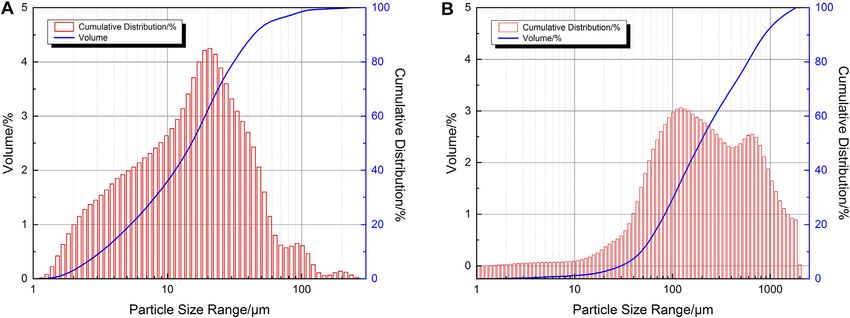
Deqing et al.                                                                                                           Cemented Ultra-Fine Tailings Backfill

(Lu et al., 2018). In addition, some experts measured and                         reaction of CUTB are different from CCTB, which is
analyzed the stress state and pore water pressure of                              essentially different. Therefore, it is very important to research
underground CPB, indicating that filling and settlement time                       the strength characteristics and hydration reaction mechanism of
schedules have a significant impact on the pore water pressure of                  CUTB. In this article, the ultra-fine tailings and classified tailings
the cemented backfill, which in turn affects the quality of CPB                    of iron were used as experimented materials. Based on the
(Doherty et al., 2015). The constitutive model and percolation                    analysis of the basic physical and chemical properties, the
model of CPB contributing to the efficient use of tailings are also                strength experiment of different schemes of CPB was
studied (Helinski et al., 2007). Some of the industrial waste                     designed, the strength variation law of CUTB analyzed, and a
byproducts, including fly ash, slag, water granulated slag, and                    prediction model based on the strength value of tailings gradation
limestone powder, have been applied as potential active materials                 characteristics and curing age constructed. X-ray diffraction
to CPB to reduce cement consumption and reduce filling costs                       (XRD) and scanning electron microscope (SEM) were used to
(Ouellet et al., 2007; Wang et al., 2009; Cihangir et al., 2012; Yin              compare and analyze the hydration products of different CPB,
et al., 2012; Zheng et al., 2016; Deng et al., 2017b). Many studies               research the hydration reaction mechanism of CUTB, and discuss
have shown that the choice of cement type also affects the UCS of                 the strength formation mechanism of CUTB.
CPB (Ercikdi et al., 2009; Xue et al., 2018).
    The traditional research of CPB is based on the theory of
building materials; the aggregates are not allowed to contain a                   MATERIALS AND METHODS
large amount of ultra-fine particles. With the extensive
application of classified tailings, a series of problems have                      Test Material
arisen: low utilization of tailing, polluted underground                          Tailings
environment, long cycle of filling mining, and high filling                         The test materials are the ultra-fine tailings and the classified
costs. Therefore, many studies have been carried out to                           tailings in an iron ore mine in northern North China. The
analyze the fineness of tailings on the quality of CPB (Kesimal                    composition of the tailings is shown in Figure 1 and Table 1.
et al., 2003; Fall et al., 2005; Fall et al., 2008; Yilmaz et al., 2014; Ke       The size of the median grain of the ultra-fine tailings is 14.97 μm,
et al., 2015; Ke et al., 2016). In recent years, with the increase of             and the restricted rain size is 20.7 μm, and it is classified into UT
UT output, there are some signs of progress in relevant research.                 according to the Design Reference Materials for Tailing Facilities.
Kawatra has analyzed the mineral composition and particles                        The median grain size of the classified tailings is 190.78 μm, and
morphology of UT in several regions (Kawatra, 2017). Wang                         the restricted grain size is 269.5 μm. The coefficients of
et al. have investigated and analyzed the current status of UT, also              uniformity for the two types of tailings are 5.88 and 5.12,
discussed the key technical problems of slow settlement rate and                  respectively. The coefficients of curvature for the two types of
the low water recovery rate in the recycling of UT, and proposed a                tailings are 1.1 and 0.86, respectively (Xu et al., 2013). The two
solution (Wang et al., 2014). The theoretical and applied research                types of tailings belong to the better gradation tailings.
on UT is currently concentrated on the rheological characteristics                    Figure 2 shows that the ultra-fine tailings are mainly
and conveying characteristics of slurry. Many experimental                        composed of cohesive particles and powder particles,
studies have been carried out on the influencing factors,                          containing a small number of sand particles, and the shape
parameter optimization, and transportation performance                            of the particles is mostly irregular (Wolff et al., 2011). The
optimization (Yang et al., 2017; Zhou et al., 2017a; Zhou et al.,                 surface of the particles is smooth with large surface energy.
2017b; Deng et al., 2018a; Deng et al., 2018b). There is less                     There is an agglomeration phenomenon found in the ultra-fine
literature on the UCS of cement ultra-fine tailings backfill                        tailings (Wolff et al., 2011). The classified tailings are composed
(CUTB). Qiu et al. have researched the effect of C/T ratio,                       of sand particles. The surface of the particles is relatively rough,
mass concentration, and curing age on the UCS of CUTB. The                        mostly the crystal grain boundary surface and a small amount
results show that UT has certain activity and the curing age is the               of staggered fracture surface. A small number of cohesive
most important factor affecting UCS, followed by the C/T ratio                    particles and powder particles attach to the surface of sand
and mass concentration (Qiu et al., 2017). Niroshan et al. have                   particles.
designed a uniaxial compressive strength test with different                          Figure 3 shows the XRD spectrum results. The tailings contain
cementitious materials and contents and found that CUTB of                        a large amount of SiO2 (Wolff et al., 2011), which belongs to high
slag + cement had a higher early strength. Compared with CPB,                     silicon tailings, and contain MgO, CaO, Al2O3, and total Fe.
CUTB of slag and cement had a higher stiffness, summing up the                    Figure 3 also shows that the intensity of the diffraction peak of
prediction model of UCS (Nircoshan et al., 2017). Based on the                    the classified tailings is greater than that of the ultra-fine tailings;
UCS test and the physicochemical properties of UT, Xu et al. have                 especially, the main diffraction peak of SiO2 is significant. The
discussed the diagenesis mechanism of CUTB (Xu et al., 2013).                     intensity of the main diffraction of SiO2 in the classified tailings is
    Most of the current research involved the application and                     about 15,000, while the main diffraction peak intensity of SiO2 in
optimization material of UT and the cemented backfill to UT;                       the ultra-fine tailings is less than 9,000. It can be seen that the
however, few studies discussed the strength characteristics and                   ultra-fine tailings particles have a low degree of crystallization,
the hydration reaction mechanism of CUTB. Because the                             and the amorphous particles have high surface energy, high
particles sizes of most UT are smaller than those of cement                       content, and large specific surface area, so the activity of the
particles, the strength formation mechanism and hydration                         ultra-fine is relatively higher than that of the classified tailings.

Frontiers in Materials | www.frontiersin.org                                  2                                     August 2021 | Volume 8 | Article 723878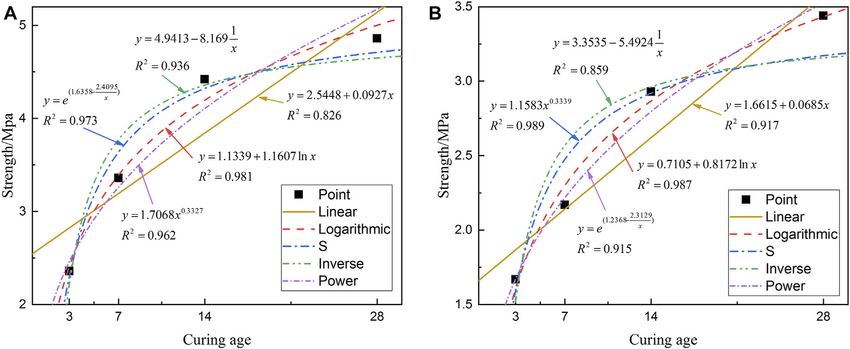
Deqing et al.                                                                                                                     Cemented Ultra-Fine Tailings Backfill

  FIGURE 1 | Grain size distribution curve of tailing: (A) the ultra-fine tailings; (B) the classified tailings.

TABLE 1 | Physical and chemical characterization of the tailings and binder.

Characteristics                                                                        The ultra-fine tailings            The classified tailings               Binder

Chemical composition                    SiO2                                                    67.58%                          74.24%                         20.8%
                                        MgO                                                      5.60%                           3.34%                         3.23%
                                        CaO                                                      4.04%                           2.96%                         56.2%
                                        Al2O3                                                    7.30%                           7.65%                         10.0%
                                        Fe2O3                                                      —                               —                            4.4%
                                        SO3                                                        —                               —                           2.49%
                                        Total Fe                                                 6.00%                           4.29%                           —
                                        Total                                                   90.52%                          92.48%                         97.12
                                        Alkalinity coefficient                                     0.13                            0.08                           —
                                        Quality coefficient                                        0.25                            0.19                           —
                                        Activity coefficient                                       0.06                            0.04                           —
Physical properties                     Effective grain size (d10/μm)                             3.52                           52.62                          1.55
                                        Median grain size (d50/μm)                               14.97                          190.78                          14.1
                                        Control grain size (d60/μm)                               20.7                           269.5                          17.3
                                        Coefficient of uniformity (Cu)                             5.88                            5.12                         11.16
                                        Coefficient of curvature (Cc)                              1.10                            0.86                          1.13

    Table 1 also shows the main chemical components of tailings,                             (Benzaazoua et al., 2004). Tap water from Lunan District of
the mass ratios of 90.52% (the ultra-fine tailings) and 92.48% (the                           Tangshan City was used as mixing water to mix binder and
classified tailings). The ultra-fine tailings have an alkalinity                               tailings and prepare ultra-fine tailings backfill slurry.
coefficient of 0.13, which belongs to the acidic tailings. The
quality coefficient of the ultra-fine tailings is 0.25; the quality                            Uniaxial Compressive Strength Tests
is a little poor. The activity coefficient of the ultra-fine tailings is                       Experiment Mixing Ratio
0.06; the ultra-fine tailings have a lower activity (Xu et al., 2013).                        According to the research experience and application (Qiu et al.,
                                                                                             2017), the C/T ratios were 1:4 and 1:6, and the curing age was 3, 7,
Binder                                                                                       14, and 28 days. Because of the obvious difference at the same
The cement used in the tests is the production batch of Jidong                               mass concentration of the ultra-fine tailings and the classified
brand ordinary Portland cement (325#), which was produced in                                 tailings, the mass concentration was determined to be 70%.
Tangshan city, Hebei Province, China.
                                                                                             Experiment Method
Mixing Water                                                                                 According to the experiment scheme, calculate and weigh the
The tailings discharged from the plant contain water. In the test                            quality of cement and tailings. Then, they will be mixed evenly and
preparation stage, the tailings were placed into a drying box to be                          poured into the mixing vessel. After that, add water and mix for
dried; then, they will be naturally cooled at room temperature to                            2 min to complete the backfill slurry. The backfill slurry is injected
avoid the influence of moisture in the tailings on the test                                   into the standard triple test strip of 7.07 cm × 7.07 cm × 7.07 cm

Frontiers in Materials | www.frontiersin.org                                             3                                    August 2021 | Volume 8 | Article 723878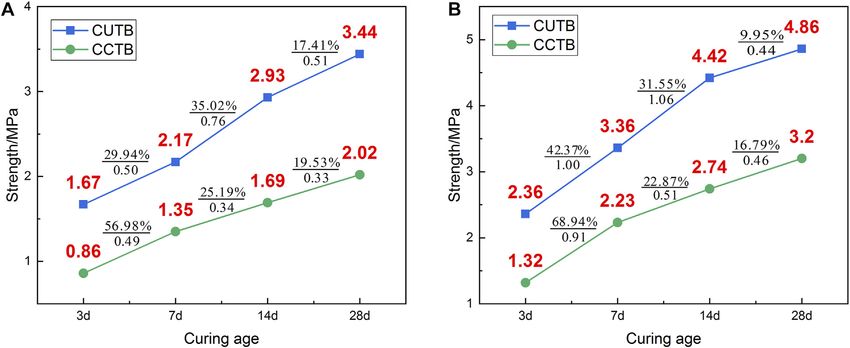
Deqing et al.                                                                                                                  Cemented Ultra-Fine Tailings Backfill

  FIGURE 2 | SEM images of the tailings: (A) the ultra-fine tailings; (B) the classified tailings.

  FIGURE 3 | XRD spectrum results of tailings: (A) the ultra-fine tailings; (B) the classified tailings.

(Xue et al., 2018). After being tamped and smoothed, it will be                           sealed bottle was taken out and naturally air-dried, than ground to
placed in the curing box for 24 h and then demolded. The CPB was                          about 200 mesh. The scanning angle was 5°–7° and the scanning
numbered and labeled and then placed in the curing box for                                speed was 0.02°/min by X-ray diffractometer (Bruker D8
maintenance. The curing environment temperature is 20 ± 1°C, the                          ADVANCE) (Fall et al., 2005). Another complete sample of
relative humidity is 90%, and the curing time is controlled                               CPB in the sealed bottle was taken and naturally air-dried. The
according to the experimental scheme. The cured CPB was                                   microscopic morphology of the original fracture surface of CPB
placed on the test platform of the uniaxial press, aligned with                           was taken by the scanning electron microscope (JSM-6390A), and
the axis. To determine the UCS of the backfill, each group of CPB is                       the acceleration voltage was 15 kV (Fall et al., 2005).
measured 3 times and averaged (Fall et al., 2005).

XRD and SEM                                                                               RESULTS AND DISCUSSION
After the uniaxial compressive strength test, the internal samples of
CPB were stored in a sealed bottle containing anhydrous ethanol.                          UCS Variation Law of CUTB
The purpose is to replace the moisture in the CPB sample and                              At present, domestic and foreign researchers generally believe
terminate the hydration reaction. A small amount of CPB in the                            that the higher the proportion of cement and the longer the

Frontiers in Materials | www.frontiersin.org                                          4                                    August 2021 | Volume 8 | Article 723878
Deqing et al.                                                                                                                 Cemented Ultra-Fine Tailings Backfill

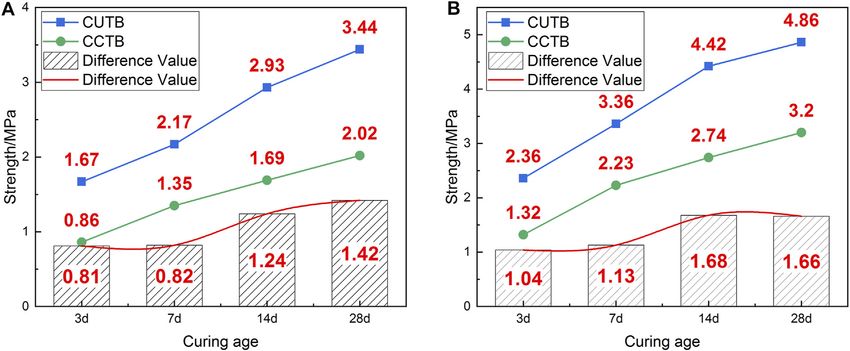
  FIGURE 4 | UCS and difference value (DV) of CPB with different mixing ratios: (A) C/T ratio 1:6; (B) C/T ratio 1:4.

TABLE 2 | UCS of CPB with different mixing ratio.

Number                     Mass concentration (%)                     C/T ratio                   Tailings              Curing age (d)                 UCS/MPa

1                                       70                                1:4                        UT                       3                           2.36
2                                       70                                1:4                        UT                       7                           3.36
3                                       70                                1:4                        UT                      14                           4.42
4                                       70                                1:4                        UT                      28                           4.86
5                                       70                                1:6                        UT                       3                           1.67
6                                       70                                1:6                        UT                       7                           2.17
7                                       70                                1:6                        UT                      14                           2.93
8                                       70                                1:6                        UT                      28                           3.44
9                                       70                                1:4                        CT                       3                           1.32
10                                      70                                1:4                        CT                       7                           2.23
11                                      70                                1:4                        CT                      14                           2.74
12                                      70                                1:4                        CT                      28                           3.20
13                                      70                                1:6                        CT                       3                           0.86
14                                      70                                1:6                        CT                       7                           1.35
15                                      70                                1:6                        CT                      14                           1.69
16                                      70                                1:6                        CT                      28                           2.02

curing age, the greater the UCS of the CPB (Kesimal et al., 2003).                     increases by 0.42 MPa (C/T ratio 1:6) and 0.55 MPa (C/T ratio 1:4),
Figure 4 and Table 2 show that the CUTB also follows the rule in                       respectively, and the UCS difference value of the CUTB increases
terms of C/T ratio and curing age.                                                     sharply, which is approximately an S-shaped curve. With the
   Figure 4 also shows that the UCS of the CUTB is significantly                        increase of the C/T ratio (cement content), the UCS difference
higher than the CCTB at the same conditions and the greater the                        value of the CUTB increases. When the C/T ratio is 1:6, the UCS
C/T ratio, the greater the UCS difference value. When the C/T                          difference value of CUTB is 1.07 MPa, and when the C/T ratio is 1:
ratio is 1:6, the UCS differences value of CPB are 0.81 MPa                            4, the UCS difference value is 1.38 MPa. It shows that the CUTB is
(3 days), 0.82 MPa (7 days), 1.24 MPa (14 days), and 1.42 MPa                          more sensitive to the change of cement content, increasing the
(28 days), and the average value is 1.07 MPa. Moreover, when the                       same quality of cement; the UCS of CUTB increases more.
C/T ratio is 1:4, the UCS differences value of CPB are 1.04 MPa                            Figure 5 shows that the UCS variation laws of the CUTB and
(3 days), 1.13 MPa (7 days), 1.68 MPa (14 days), and 1.66 MPa                          the CCTB are different under the same mixing ratio. The CUTB
(28 days), and the average value is 1.38 MPa. With the increase of                     has a relatively large early strength, which reaches 1.67 MPa at a
the curing age, when the UCS difference value increases, the ultra-                    C/T ratio of 1:6 and a curing age of 3 days. Under the same mixing
fine tailings are more conducive to the increase of UCS in the                          ratio, the UCS of the CCTB is only 0.86 MPa. The UCS growth
CUTB and increase faster than those of the CCTB. Especially                            curve of the CUTB is approximately S-shaped, and during the
during the curing age of 7–14 days, the UCS differences value                          curing age of 3∼7 days, the UCS growth rate of the CUTB is slow,

Frontiers in Materials | www.frontiersin.org                                       5                                      August 2021 | Volume 8 | Article 723878
Deqing et al.                                                                                                                           Cemented Ultra-Fine Tailings Backfill

  FIGURE 5 | UCS variation law of CPB with different mixing ratios: (A) C/T ratio 1:6; (B) C/T ratio 1:4.

  FIGURE 6 | Fitting curve and regression equation of UCS with curing age: (A) C/T ratio 1:6; (B) C/T ratio 1:4.

with an increase of 0.5 MPa (29.94%). The UCS growth rate of the                        equation. The function expression of regression equation is as
CUTB is accelerated during the curing age of 7–14 days, with an                         follows:
increase of 0.76 MPa (35.02%). In the later period of curing age
(14–28 days), the UCS growth rate of the CUTB decreases, with                                                   P k  f (Tk , b1 , b2 , · · ·, bm , ),
an increase of 0.51 MPa (17.41%). In contrast, the UCS growth                                   k is regression value of UCS, Tk is curing age, and b1 , b2 , · · ·,
                                                                                        where P
curve of the CCTB is of an approximately convex shape, and the
                                                                                        bm are regression parameters.
UCS growth rate decreases with curing age. When the C/T ratio is
                                                                                           The principle of the least-square method is to minimize the
1:6, the UCS growth rate of CCTB is 0.49 MPa (56.98%),
                                                                                        sum of squares deviations between all observed values and
0.34 MPa (25.19%), and 0.33 MPa (19.53%), respectively.
                                                                                        regression values:
UCS Regression Fitting of CUTB                                                                                             n
                                                                                                                                                                  2
Figure 6 shows that there is a nonlinear relationship between the                               Q(b1 , b2 , · · ·, bm )   Pk − f (Tk , b1 , b2 , · · ·, bm , ) ,
                                                                                                                          i1
UCS and curing age of CUTB. According to the variation law of
UCS and curing age of CUTB, the least-square method is used for                         where Q(b1 , b2 , · · ·, bm ) is the sum of squares deviations and Pk is
curve regression analysis and to obtain a significant regression                         the observation value.

Frontiers in Materials | www.frontiersin.org                                        6                                              August 2021 | Volume 8 | Article 723878
Deqing et al. Cemented Ultra-Fine Tailings Backfill
TABLE 3 | Regression equation and test results.
C/T ratio Equation type Expression R R2 ADJ R2 F p
1:4 Linear P 2.5448 + 0.0927T 0.909 0.826 0.739 9.5153 0.091
Logarithmic P 1.1339 + 1.1607 ln T 0.99 0.981 0.971 100.8506 0.0098
(1.6358−2.4095
T )
S Pe 0.986 0.973 0.960 72.1308 0.0136
Inverse P 4.9413 − 8.169 T1 0.968 0.936 0.904 29.3922 0.0324
Power P 1.7068T 0.3327 0.981 0.962 0.943 51.0318 0.019
1:6 Linear P 1.6615 + 0.0685T 0.957 0.917 0.874 21.9546 0.0427
Logarithmic P 0.7105 + 0.8172 ln T 0.993 0.987 0.980 147.1173 0.0067
(1.2368−2.3129
T )
S Pe 0.957 0.915 0.873 21.6065 0.0433
Inverse P 3.3535 − 5.4924 T1 0.927 0.859 0.788 12.1806 0.0732
Power P 1.1583T 0.3339 0.994 0.989 0.984 187.3661 0.0053
The parameters of different curve regression equations are XRD Analysis of CPB
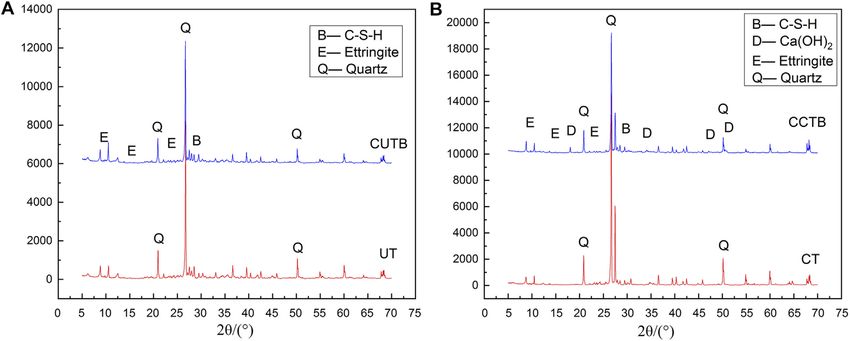
calculated, and the method of variance analysis is selected for Figure 8 shows the XRD spectrum of the ultra-fine tailings and
statistical analysis. Then, the correlation coefficients (R), the classified tailings under the same conditions (C/T ratio 1:4,
coefficient of determinations (R2), and adjusted coefficient mass concentration 70%, and curing age of 3 days). The SiO2
of determinations (ADJ R2) of different regression equations diffraction peak can be clearly seen from the figures because the
are obtained, as well as the F values and p values of the main component of CPB is SiO2, which accounts for about 40% of
significance test. The specific calculation results are shown the total mass. On the other hand, most SiO2 particles are inert
in Table 3. materials, which act as aggregate and do not participate in the
Table 3 shows that the linear regression equation between hydration reaction. The main hydration products in CUTB are
UCS and curing age of the CUTB at the C/T ratio of 1:4 and 1:6 is C-S-H and AFt. Among them, AFt belongs to the crystals and has
relatively low, and the adjusted coefficients of determinations are obvious diffraction peaks and C-S-H is a mostly amorphous
only 0.739 and 0.874, indicating that the UCS of CUTB is hydrate with poor crystallinity. Moreover, there is a broad,
nonlinear with the curing age. According to the scatter plot, convex hull background under the diffraction peaks of 2θ
select the regression equations as follows: logarithmic equation, between 20° and 45°. In contrast, the XRD spectrum of CCTB
S-shaped equation, inverse equation, and power equation. The can observe not only AFt crystals and C-S-H but also obvious
C/T ratio is 1:4, the logarithmic equation and the S-shaped diffraction peaks of Ca (OH)2 crystals.
equation have a high degree of regression, and the adjusted The analysis shows that the content of Ca (OH)2 crystals in the
coefficients of determinations are 0.971 and 0.960. The F value CUTB is very little or non-existent, and the area of the convex
of the logarithmic regression is 100.8506; the p values are 0.0098 < hull background of the spectrum is significantly larger than that
0.01, showing that the significance of the logarithmic is extremely of the CCTB. It shows that the hydration products and content of
great. The C/T ratio is 1:6, the logarithmic regression equation CUTB and CCTB are different, and the hydration reaction in the
and the power equation have a high degree of regression, and the two kinds of CPB is different.
adjusted coefficients of determinations are 0.980 and 0.984. The F
values are 147.1173 and 187.3661, and the p values are 0.0067 and SEM Analysis of CPB
0.0053. In summary, the UCS of CUTB has a logarithmic The CPB is mainly composed of three major types of materials,
relationship with curing age, and the regression equation is as including unhydrated cement clinker, inert including in tailings
follows: and hydration product (Xu et al., 2013), and hydration products
C/T 1: 4 P 1.1339 + 1.1607 ln T of Portland cement such as calcium silicate hydrate (C-S-H),
(1) ettringite (AFt), calcium aluminate sulfate hydrate (AFm),
C/T 1: 6 P 0.7105 + 0.8172 ln T.
portlandite (Ca (OH)2) and hydrogarnet (C3AH6). The
According to the regression equation, the regression values composition of C-S-H gel is complex, and it is usually
corresponding to different observation values are calculated, and assumed that the molecular formula is C3S2H3. C-S-H gel has
residual error analysis is performed. The specific calculation extremely poor crystallinity and its morphology is not fixed; most
results are shown in Figure 7 and Table 4: of them are fibrous, granular, and networked. The structural
Analyzing the residual error of the regression equation, it can formula of AFt is [Ca3 Al(OH)6 · 12H2 O](SO4 )16 · H2 O, with a
be seen that the observation value and the regression value are high degree of crystallinity. The crystal is generally hexagonal
very small, but the residual value has a unit and cannot be prismatic, which grows into needle-like or columnar shape
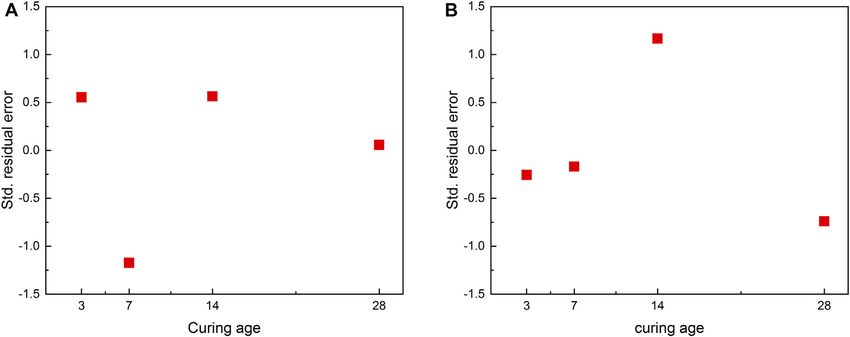
directly used for comparative analysis. Generally, the residual according to the growth space. The Ca (OH)2 has a good
values are standardized, and it follows the standard normal crystallinity with a hexagonal plate shape. It is unevenly
distribution N (0,1). The standardized residuals of the distributed and the crystal size is 10–100 μm (Fall et al., 2005).
regression equations of UCS and curing age are all within Figures 9A,B are SEM images of CUTB and CCTB under the
the interval of −2∼+2 and contain randomness, indicating same conditions (C/T ratio 1:4, mass concentration 70%, and
the equation is normal. curing age of 3 days). It can be seen from the figure that there are
Frontiers in Materials | www.frontiersin.org 7 August 2021 | Volume 8 | Article 723878Deqing et al. Cemented Ultra-Fine Tailings Backfill
FIGURE 7 | Standardized residual error of regression equation: (A) C/T ratio 1:6; (B) C/T ratio 1:4.
TABLE 4 | Regression value and residual error analysis.
C/T ratio Observation value Regression value Residual error Standardized residual error
1:4 2.36 2.4091 −0.0491 −0.2564
3.36 3.3925 −0.0325 −0.1697
4.42 4.197 0.223 1.1656
4.86 5.0015 −0.1415 −0.7395
1:6 1.67 1.6083 0.0617 0.553
2.17 2.3008 −0.1308 −1.1723
2.93 2.8672 0.0628 0.5628
3.44 3.4337 0.0063 0.0566
FIGURE 8 | XRD spectrum of CPB with S/W ratio 1:4 and curing age of 3 days: (A) CUTB; (B) CCTB.
Frontiers in Materials | www.frontiersin.org 8 August 2021 | Volume 8 | Article 723878Deqing et al. Cemented Ultra-Fine Tailings Backfill FIGURE 9 | SEM images of CPB with different C/T ratio and curing age: (A) CUTB, C/T ratio 1:4, curing age of 3 days; (B) CCTB, C/T ratio 1:4, curing age of 3 days; (C) CUTB, C/T ratio 1:4, curing age of 7 days; (D) CUTB, C/T ratio 1:4, curing age of 28 days; (E) CCTB, C/T ratio 1:4, curing age of 28 days. Frontiers in Materials | www.frontiersin.org 9 August 2021 | Volume 8 | Article 723878
Deqing et al.                                                                                                        Cemented Ultra-Fine Tailings Backfill

obvious hydration products in the CPB in the early curing age,                    Figures 9A,D,E are SEM images of CUTB at different curing
but the morphology of the hydration products is different                      ages under the same proportion (C/T ratio 1:4, mass concentration
between the CUTB and the CCTB. In the CUTB, the C-S-H                          70%, and curing age of 28 days). It can be seen from the figures that
gel mostly wraps fine particles and ultra-fine particles in a                    the morphology of C-S-H gel changes with the curing age and has
network shape or attaches to the surface of coarse particles in                regularity. At the curing age of 3 days, the C-S-H gel is centered on
a fibrous; the AFt crystals are randomly distributed on the surface             the fine particles and ultra-fine particles and grows on the surface
of the particles and in tiny pores, and length is about 1∼3 μm. In             of the surface in a network shape, and the surface of the coarse
the CCTB, the C-S-H gel basically exists on the surface of fine                 particles is exposed and no obvious C-S-H gel is observed. At the
particles and ultra-fine particles, the AFt crystals are mostly                 curing age of 7 days, with the continuous growth of the C-S-H gel
perpendicular to the surface of fine particles and ultra-fine                    outside the coating layer, the particles and the C-S-H gel form
particles, and the length is about 1∼3 μm. The Ca (OH)2                        agglomerates where the fine particles and ultra-fine particles are
crystals are randomly filled in the fine pores and micro-pores,                  dense, and there are obvious network-shaped C-S-H gel on the
with a size of about 5–10 μm. No obvious Ca (OH)2 crystals are                 surface of local coarse particles. The morphology of AFt crystals
observed in the CUTB, it can be seen that the hydration products               changed with the growth of the curing age, AFt crystals are mainly
in the CUTB and CCTB are different, and the hydration reactions                distributed on the particle surface and tiny pores, and the size does
that occur are also different. It shows that the particle size of              not change significantly, about 1∼3 μm.
tailings affects the hydration process of the CPB, and the
distribution and morphology of the hydration products change                   Hydration Reaction Mechanism of CUTB
due to the difference in particle size.                                        After the cement, ultra-fine tailings, and water were mixed, the
    Figures 9C,D are SEM images of CUTB and CCTB under the                     chemical reaction will be produced immediately. The first is the
same conditions (C/T ratio 1:4, mass concentration 70%, and curing             rapid dissolution of cement clinker minerals:
age of 28 days). According to the hydration mechanism of the
cement paste, the hydration reaction continues at 28 days of                                 C3 A → Ca2+ + Al(OH)−4 + OH −
curing age, the hydration rate decreases, the hydration product                          f − CaO → Ca2+ + OH −
                                                                                                                                                     (2)
grows slowly, and the internal structure of CPB is basically                               CaSO4 → Ca2+ + SO2−4
formed. However, the morphology of the hydration products and                                 C3 S → Ca2+ + OH − + C − S − H(m).
internal structure of CUTB and CCTB are still different. In the
                                                                                  At this moment, the liquid phase of cement ultra-fine tailings
CUTB, the C-S-H gel forms a coating layer around fine particles and
                                                                               backfill slurry contains various ions: Ca2+, OH−, Al (OH)4−, SO42−,
ultra-fine particles, and grows outwards. At the same time, it grows
                                                                               etc. The slurry is alkaline, and the hydration reaction of CUTB is
in a network on the surface of the coarse particles and connects the
                                                                               carried out under an alkaline environment. C3A is one of the main
fine particles and ultra-fine particles with the coarse particles to form
                                                                               components of cement, and immediate hydration reaction when it
a dense three-dimensional whole. The AFt crystals are distributed on
                                                                               is mixed with water rapidly produces C4AH13, immediately
the surface of coarse particles and tiny pores, and the length is about
                                                                               reacting with gypsum to form AFt (Myers et al., 2017):
1∼3 μm. In the CCTB, the C-S-H gel forms a coating layer around
fine particles and ultra-fine particles, grows outward with particles as                        C3 A + Ca(OH)2 + H2 O → C4 AH13
                                                                                                                                                     (3)
the center, and connects the particles into a whole. The AFt crystals                        C4 AH13 + 3CSH2 + H2 O → AFt + CH.
mostly exist perpendicular to the surface of fine particles and ultra-
fine particles, and the length is about 1∼3 μm. The Ca (OH)2 crystals              The hydration reaction rate of C3S is slightly slower than that
are distributed disorderly in the CCTB: some are wrapped by C-S-H              of C3A because the pore solution of C3S particles quickly reaches
gel and some are filled into pores.                                             saturation, inhibiting the dissolution of C3S particles. However,
    There are no obvious Ca (OH)2 crystals in the CUTB at the                  the formation and growth of hydration such as C-S-H take a
curing age of 28 days. It can be seen that the difference of                   certain time, thus hindering the hydration of C3S particles, but
hydration reaction between the two CPB always exists,                          this duration of this stage is very short (Scrivener et al., 2019).
indicating that the particle size of tailings has always affected              With the increase of curing age, the hydration reaction rate of C3S
the hydration process in the curing process, and there is the                  gradually increases and reaches the maximum. The hydration
difference in the structure of the CPB and the morphology of the               product of C3S is mainly C-S-H gel, and the concentration of Ca
hydration products. Although the C-S-H gel forms a coating layer               (OH)2 solution is increased continuously by the generated large
after curing 28 days, the C-S-H gel grows with independent                     amount of Ca2+ iron and OH− iron:
particles as the center in the CCTB, with the increasing                                     C3 S + H2 O → C − S − H + Ca(OH)2 .                     (4)
thickness of the coating layer. Particles contact with each
other and continue to grow at the contact point and finally                         Figures 8, 9A,B show that the hydration products of the
form a three-dimensional whole, and obvious particle profile                    CUTB and CCTB are different, indicating that not only does the
can be observed in the figure. In the CUTB, fine particles and                   cement itself undergoe a hydration reaction, but also other
ultra-fine particles are wrapped in C-S-H gel to form aggregates,               components of CPB participate in the hydration reaction.
and independent fine particles and ultra-fine particles are not                  According to the results of XRD energy spectrum analysis of
observed. The aggregates connect with adjacent coarse particles to             tailings, the ultra-fine particles in the ultra-fine tailings are
form a dense whole.                                                            amorphous, with high surface energy and certain potential

Frontiers in Materials | www.frontiersin.org                              10                                     August 2021 | Volume 8 | Article 723878
Deqing et al. Cemented Ultra-Fine Tailings Backfill
activity, which can react with Ca (OH)2 in ultra-fine tailings The adjusted coefficient of determinations (ADJ R2) is 0.971
filling slurry solution (Geng et al., 2017; Li et al., 2019): (C/T ratio 1:4) and 0.980 (C/T ratio 1:4), respectively, and passed
SiO2 + Ca(OH)2 + H2 O → C − S − H the significance test and residual test equations.
(5)
Al2 O3 + Ca(OH)2 + H2 O → C − A − H.
3) The XRD energy spectrum shows that the hydration products
Therefore, some of the mineral particles in the UT, such as and content of CUTB and CCTB are different. In the CUTB,
SiO2 and Al2O3, do not act as a backfill aggregate but participate the content of Ca (OH)2 crystals is very little or non-existent,
as active materials in the hydration reaction. It increased the but the content of the C-S-H gel is higher than the CCTB.
amount of C-S-H and C-A-H and consumed Ca (OH)2. 4) The particle size of tailings affects the hydration process of the
Due to the existence of secondary hydration reaction in the CPB and the distribution and morphology of the hydration
CUTB, this consumes Ca2+ ions, OH− ions, and gypsum in the products. In the CUTB, no obvious Ca (OH)2 crystals are
solution and increases the production of C-S-H gel and AFt observed during the curing. The C-S-H gel forms a coating
crystals. Because of the decrease in the concentration of Ca2+ ions layer around fine particles and ultra-fine particles and grows
and OH− ions, the concentration of Ca (OH)2 can not be to form aggregates. In the CCTB, the C-S-H gel grows with
supersaturated, resulting in very little or not Ca (OH)2 crystals independent particles as the center, and particles contact each
formation in the CUTB. other by C-S-H gel.
With the curing age increasing, gypsum is gradually 5) The ultra-fine tailings particles in the CUTB have potential
consumed, making the C3A in the CUTB not completely activity; in the alkaline environment-generated cement
hydrated, and is exhausted. The reaction of AFt generated in hydration, the active SiO2 and Al2O3 particles undergo
the early curing age of CUTB with C4AH13 formed by hydration secondary hydration reaction, C-S-H and C-A-H are
of C3A produces AFm: generated while consuming Ca (OH)2, resulting in different
hydration reactions of CUTB and CCTB, and the hydration
AFt + C3 A + H2 O → AFm. (6) products and morphology are also different.
The AFm generated by hydration reaction and the C-S-H gel 6) It is well-known that the groundwater protection challenges
coating layer on the surface of particles are mixed, where no AFm related to cemented paste backfill have become a worldwide
crystals could be observed on the SEM image. This reaction also issue in mining areas (Chen et al., 2021). Thus, the leaching
consumes AFt, causing the AFt crystals to be converted into AFm risk of CUTB to groundwater will be further studied in our
without further growth, so the size of AFt crystals observed in the future studies.
SEM image does not change significantly.
In summary, the hydration of CUTB is based on cement
hydration, which is affected by ultra-fine tailings particles with DATA AVAILABILITY STATEMENT
potential activity, and can result in secondary hydration reaction,
affect the hydration process, and change the hydration products The original contributions presented in the study are included in
and morphology. the article/Supplementary Materials; further inquiries can be
directed to the corresponding author.
CONCLUSION
AUTHOR CONTRIBUTIONS
In this study, UCS test of the CPB with different curing ages and
different C/T ratios was designed, and XRD energy spectrum and GD contributed to the experiments scheme and discuss the
SEM image were carried out. The following conclusions were results. CC contributed to the conception of the study. LiH
drawn in this study: contributed to the experiments and wrote the manuscript.
LuH and ZY discussed the results and contributed to the final
1) The UCS of the CUTB is significantly higher than the CCTB manuscript.
under the same conditions, and the greater the C/T ratio and
curing age, the greater the UCS difference value between the
CUTB and CCTB. The variation laws of the CUTB and CCTB FUNDING
are different under the same mixing ratio; the UCS growth
This work was supported by the National Natural Science
curve of the CUTB is approximately S-shaped and the UCS
Foundation of China (No. 51774137), the Department of
growth curve of the CCTB has an approximately
Education of Hebei Province (No. ZD2015020), the
convex shape.
Natural Science Foundation of Hebei Province (Nos.
2) There is a logarithmic relationship between the UCS of
E2021209006 and E2019209326), the “333” Talent Project
the CUTB and the curing age; the regression equation is as
of Hebei Province, China (No. 202001011), and State Key
follows:
Laboratory of Process Automation in Mining and Metallurgy
C/T 1: 4 P 1.1339 + 1.1607 ln T and Beijing Key Laboratory of Process Automation in Mining
C/T 1: 6 P 0.7105 + 0.8172 ln T and Metallurgy (No. BGRIMM-KZSKL-2018).
Frontiers in Materials | www.frontiersin.org 11 August 2021 | Volume 8 | Article 723878Deqing et al. Cemented Ultra-Fine Tailings Backfill
REFERENCES Kesimal, A., Ercikdi, B., and Yilmaz, E. (2003). The Effect of Desliming by
Sedimentation on Paste Backfill Performance. Minerals Eng. 16, 1009–1011.
doi:10.1016/S0892-6875(03)00267-X
Benzaazoua, M., Fall, M., and Belem, T. (2004). A Contribution to Understanding Li, J., Geng, G., Myers, R., Yu, Y.-S., Shapiro, D., Carraro, C., et al. (2019). The
the Hardening Process of Cemented Pastefill. Minerals Eng. 17, 141–152. Chemistry and Structure of Calcium (Alumino) Silicate Hydrate: A Study
doi:10.1016/j.mineng.2003.10.022 by XANES, Ptychographic Imaging, and Wide- and Small-Angle
Chen, Q., Sun, S., Liu, Y., Qi, C., Zhou, H., and Zhang, Q., (2021). Experimental Scattering. Cement Concrete Res. 115, 367–378. doi:10.1016/
and Numerical Study on Immobilization and Leaching Characteristics of j.cemconres.2018.09.008
Fluoride from Phosphogypsum Based Cemented Paste Backfill. Int. J. Min Liu, L., Fang, Z., Qi, C., Zhang, B., Guo, L., and Song, K. I.-I. L. (2019). Numerical
Met. Mater. doi:10.1007/s12613-021-2274-6 Study on the Pipe Flow Characteristics of the Cemented Paste Backfill Slurry
Cihangir, F., Ercikdi, B., Kesimal, A., Turan, A., and Deveci, H. (2012). Utilisation Considering Hydration Effects. Powder Tech. 343, 454–464. doi:10.1016/
of Alkali-Activated Blast Furnace Slag in Paste Backfill of High-Sulphide Mill j.powtec.2018.11.070
Tailings: Effect of Binder Type and Dosage. Minerals Eng. 30, 33–43. Lu, H., Qi, C., Chen, Q., Gan, D., Xue, Z., and Hu, Y. (2018). A New Procedure
doi:10.1016/j.mineng.2012.01.009 for Recycling Waste Tailings as Cemented Paste Backfill to Underground
Deng, D. Q., Liu, L., Yao, Z. L., Song, K. I.-I. L., and Lao, D. Z. (2017a). A Practice of Stopes and Open Pits. J. Clean. Prod. 188, 601–612. doi:10.1016/
Ultra-fine Tailings Disposal as Filling Material in a Gold Mine. J. Environ. j.jclepro.2018.04.041
Manage. 196, 100–109. doi:10.1016/j.jenvman.2017.02.056 Myers, R. J., Geng, G., Li, J., Rodríguez, E. D., Ha, J., Kidkhunthod, P., et al. (2017).
Deng, X. J., Klein, B., Hallbom, D. J., de Wit, B., and Zhang, J. X. (2018a). Influence Role of Adsorption Phenomena in Cubic Tricalcium Aluminate Dissolution.
of Particle Size on the Basic and Time-dependent Rheological Behaviors of Langmuir 33 (1), 45–55. doi:10.1021/acs.langmuir.6b03474
Cemented Paste Backfill. J. Materi Eng. Perform. 27, 3478–3487. doi:10.1007/ Nircoshan, N., Sivakugan, N., and Veenstra, R. L. (2017). Laboratory Study on
s11665-018-3467-7 Strength Development in Cemented Paste Backfills. J. Mater. Civil. Eng. 29.
Deng, X., Klein, B., Tong, L., and de Wit, B. (2018b). Experimental Study on the doi:10.1061/(asce)mt.1943-5533.0001848
Rheological Behavior of Ultra-fine Cemented Backfill. Construction Building Ouellet, S., Bussière, B., Aubertin, M., and Benzaazoua, M. (2007). Microstructural
Mater. 158, 985–994. doi:10.1016/j.conbuildmat.2017.05.085 Evolution of Cemented Paste Backfill: Mercury Intrusion Porosimetry Test
Deng, X., Zhang, J., Klein, B., Zhou, N., and deWit, B. (2017b). Experimental Results. Cement Concrete Res. 37, 1654–1665. doi:10.1016/
Characterization of the Influence of Solid Components on the Rheological and j.cemconres.2007.08.016
Mechanical Properties of Cemented Paste Backfill. Int. J. Mineral Process. 168, Qiu, J., Yang, L., Sun, X., Xing, J., and Li, S. (2017). Strength Characteristics and
116–125. doi:10.1016/j.minpro.2017.09.019 Failure Mechanism of Cemented Super-Fine Unclassified Tailings Backfill.
Doherty, J. P., Hasan, A., Suazo, G. H., and Fourie, A. (2015). Investigation of Some Minerals 7, 58. doi:10.3390/min7040058
Controllable Factors that Impact the Stress State in Cemented Paste Backfill. Scrivener, K., Ouzia, A., Juilland, P., and Kunhi Mohamed, A. (2019). Advances in
Can. Geotech. J. 52, 1901–1912. doi:10.1139/cgj-2014-0321 Understanding Cement Hydration Mechanisms. Cement Concrete Res. 124,
Ercikdi, B., Baki, H., and İzki, M. (2013). Effect of Desliming of Sulphide-Rich Mill 105823. doi:10.1016/j.cemconres.2019.105823
Tailings on the Long-Term Strength of Cemented Paste Backfill. J. Environ. Wang, C., Harbottle, D., Liu, Q., and Xu, Z. (2014). Current State of fine mineral
Manage. 115, 5–13. doi:10.1016/j.jenvman.2012.11.014 Tailings Treatment: A Critical Review on Theory and Practice. Minerals Eng.
Ercikdi, B., Kesimal, A., Cihangir, F., Deveci, H., and Alp, İ. (2009). Cemented Paste 58, 113–131. doi:10.1016/j.mineng.2014.01.018
Backfill of Sulphide-Rich Tailings: Importance of Binder Type and Dosage. Wang, X.-m., Zhao, B., and Zhang, Q.-l. (2009). Cemented Backfill Technology
Cement and Concrete Composites. 31, 268–274. doi:10.1016/ Based on Phosphorous gypsum. J. Cent. South. Univ. Technol. 16, 285–291.
j.cemconcomp.2009.01.008 doi:10.1007/s11771-009-0049-8
Fall, M., Benzaazoua, M., and Ouellet, S. (2005). Experimental Characterization of Wolff, A. P., da Costa, G. M., and de Castro Dutra, F. (2010). A Comparative Study
the Influence of Tailings Fineness and Density on the Quality of Cemented of Ultra-Fine Iron Ore Tailings from Brazil. Mineral. Process. Extractive Metall.
Paste Backfill. Minerals Eng. 18, 41–44. doi:10.1016/j.mineng.2004.05.012 Rev. 32, 47–59. doi:10.1080/08827508.2010.530718
Fall, M., Benzaazoua, M., and Saa, E. G. (2008). Mix Proportioning of Xu, W. B., Du, J. H., Song, W. D., and Cheng, H. Y. (2013). Experiment on the
Underground Cemented Tailings Backfill. Tunnelling Underground Space Mechanism of Consolidating Backfill Body of Extra-fine Grain Unclassified
Tech. 23, 80–90. doi:10.1016/j.tust.2006.08.005 Tailings and Cementitious Materials. Rock. Soil Mech. 8, 2295–2302.
Fall, M., Célestin, J. C., Pokharel, M., and Touré, M. (2010). A Contribution to doi:10.16285/j.rsm.2013.08.013
Understanding the Effects of Curing Temperature on the Mechanical Xue, G., Yilmaz, E., Song, W., and Cao, S. (2018). Compressive Strength
Properties of Mine Cemented Tailings Backfill. Eng. Geology. 114, 397–413. Characteristics of Cemented Tailings Backfill with Alkali-Activated Slag.
doi:10.1016/j.enggeo.2010.05.016 Appl. Sci. 8, 1537. doi:10.3390/app8091537
Geng, G., Myers, R. J., Li, J., Maboudian, R., Carraro, C., Shapiro, D. A., et al. Yang, L., Qiu, J., Jiang, H., Hu, S., Li, H., and Li, S. (2017). Use of Cemented Super-
(2017). Aluminum-induced Dreierketten Chain Cross-Links Increase the Fine Unclassified Tailings Backfill for Control of Subsidence. Minerals 7, 216.
Mechanical Properties of Nanocrystalline Calcium Aluminosilicate Hydrate. doi:10.3390/min7110216
Sci. Rep. 7 (1). doi:10.1038/srep44032 Yilmaz, E., Belem, T., and Benzaazoua, M. (2012). One-Dimensional Consolidation
Helinski, M., Fahey, M., and Fourie, A. (2007). Numerical Modeling of Cemented Parameters of Cemented Paste Backfills/Parametry Jednowymiarowej
Mine Backfill Deposition. J. Geotech. Geoenviron. Eng. 133, 1308–1319. Konsolidacji Podsadzki W Postaci Cementowej Pasty. Gospod. Surowcami.
doi:10.1061/(asce)1090-0241(2007)133:10(1308) Min. 28, 29–45. doi:10.2478/v10269-012-0030-2
Jiang, H., Fall, M., Li, Y., and Han, J. (2019). An Experimental Study on Yin, S., Wu, A., Hu, K., Wang, Y., and Zhang, Y. (2012). The Effect of Solid
Compressive Behaviour of Cemented Rockfill. Construction Building Mater. Components on the Rheological and Mechanical Properties of Cemented Paste
213, 10–19. doi:10.1016/j.conbuildmat.2019.04.061 Backfill. Minerals Eng. 35, 61–66. doi:10.1016/j.mineng.2012.04.008
Kawatra, S. K. (2017). Mineral Processing and Extractive Metallurgy Review. An Yılmaz, T., Ercikdi, B., Karaman, K., and Külekçi, G. (2014). Assessment of
Int. J. Min. Proc. Ext. Met. Rev. 38. doi:10.1080/08827508.2017.1390966 Strength Properties of Cemented Paste Backfill by Ultrasonic Pulse Velocity
Ke, X., Hou, H., Zhou, M., Wang, Y., and Zhou, X. (2015). Effect of Particle Test. Ultrasonics 54, 1386–1394. doi:10.1016/j.ultras.2014.02.012
Gradation on Properties of Fresh and Hardened Cemented Paste Backfill. Zhao, J.-w., Wang, X.-m., Peng, K., and Li, S. (2017a). Utilization of Foaming
Construction Building Mater. 96, 378–382. doi:10.1016/ Technology in Cemented Paste Backfill of High-Mud Superfine Unclassified
j.conbuildmat.2015.08.057 Tailings. Adv. Mater. Sci. Eng. 2017, 1–7. doi:10.1155/2017/6157869
Ke, X., Zhou, X., Wang, X., Wang, T., Hou, H., and Zhou, M. (2016). Effect of Zheng, J., Zhu, Y., and Zhao, Z. (2016). Utilization of limestone Powder and Water-
Tailings Fineness on the Pore Structure Development of Cemented Paste Reducing Admixture in Cemented Paste Backfill of Coarse Copper Mine
Backfill. Construction Building Mater. 126, 345–350. doi:10.1016/ Tailings. Construction Building Mater. 124, 31–36. doi:10.1016/
j.conbuildmat.2016.09.052 j.conbuildmat.2016.07.055
Frontiers in Materials | www.frontiersin.org 12 August 2021 | Volume 8 | Article 723878Deqing et al. Cemented Ultra-Fine Tailings Backfill
Zhou, K.-p., Gao, R., and Gao, F. (2017b). Particle Flow Characteristics and the publisher, the editors and the reviewers. Any product that may be evaluated in
Transportation Optimization of Superfine Unclassified Backfilling. Minerals this article, or claim that may be made by its manufacturer, is not guaranteed or
7, 6. doi:10.3390/min7010006 endorsed by the publisher.
Conflict of Interest: The authors declare that the research was conducted in the Copyright © 2021 Deqing, Hongbao, Chao, Hongjian and Youzhi. This is an open-
absence of any commercial or financial relationships that could be construed as a access article distributed under the terms of the Creative Commons Attribution License
potential conflict of interest. (CC BY). The use, distribution or reproduction in other forums is permitted, provided
the original author(s) and the copyright owner(s) are credited and that the original
Publisher’s Note: All claims expressed in this article are solely those of the authors publication in this journal is cited, in accordance with accepted academic practice. No
and do not necessarily represent those of their affiliated organizations, or those of use, distribution or reproduction is permitted which does not comply with these terms.
Frontiers in Materials | www.frontiersin.org 13 August 2021 | Volume 8 | Article 723878You can also read


