An introduction to matteo.luperto at unimi.it - Sistemi Intelligenti Avanzati, 2020/2021 - Home di homes.di.unimi.it
←
→
Page content transcription
If your browser does not render page correctly, please read the page content below
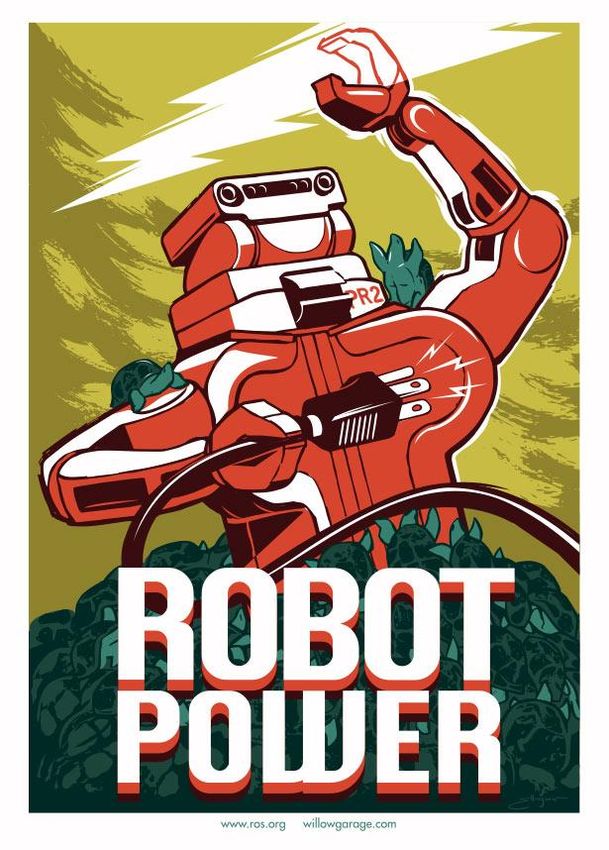
An introduction to

           matteo.luperto at unimi.it

              Sistemi Intelligenti Avanzati, 2020/2021   1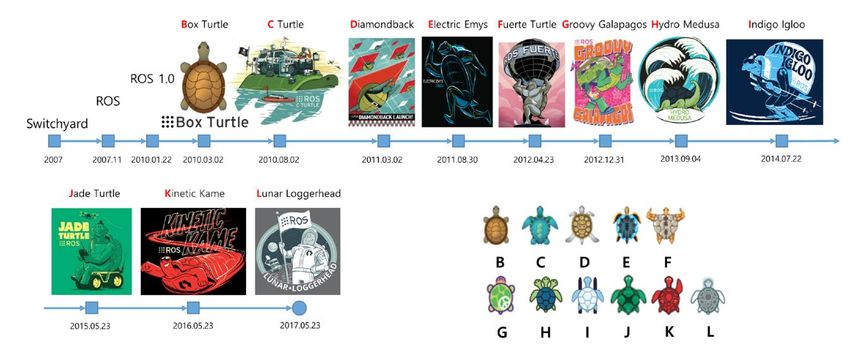
ROS: the Robot Operating System
    ROS is an open-source, meta-operating system
    for your robot. It provides the services you
    would expect from an operating system,
    including hardware abstraction, low-level
    device control, implementation of commonly-
    used functionality, message-passing between
    processes, and package management. It also
    provides tools and libraries for obtaining,
    building, writing, and running code across
    multiple computers. [wiki.ros.org]

Sistemi Intelligenti Avanzati, 2020/2021     2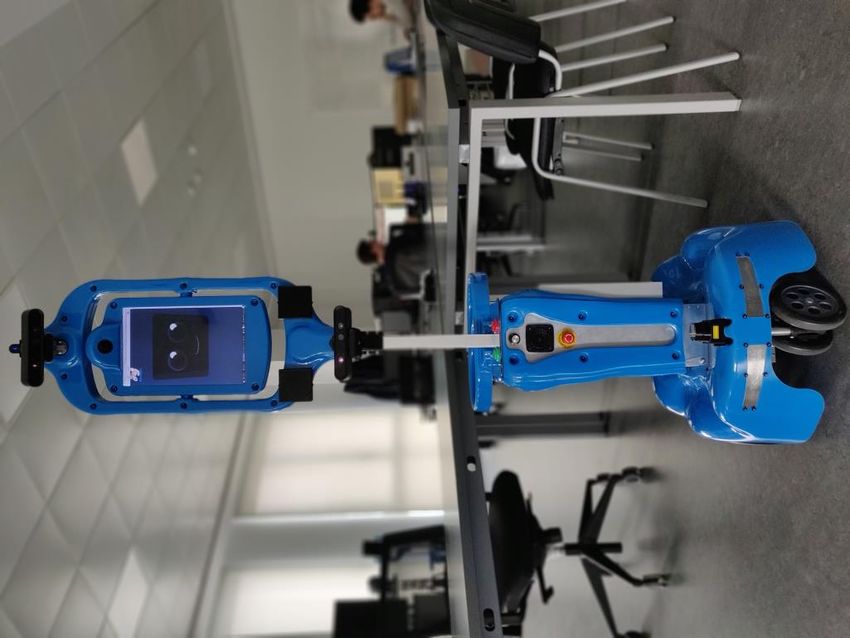
Robot software architecture
                                                    Low level functionalities as real-time
                                                     motor controllers, sensors drivers,
                                                           battery management

                                                                       +
                                                         Core functionalities as mapping,
                                                          localization, navigation, people
                                                                      detection
                                                                       +
                                                         Reasoning mechanism for path
                                                          planning, task allocation, self
                                                                 management

              Sistemi Intelligenti Avanzati, 2020/2021                                       3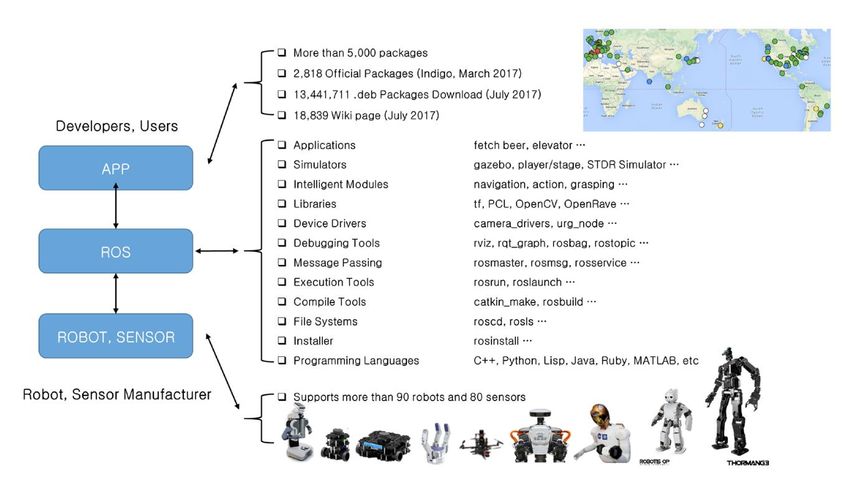
Robot software architecture
                                                 The development of (even a single)
                                              robots (functionality) requires both low-
                                              level hardware related and high-level AI-
                                                         based mechanism

                                                   Modularity and scalability are
                                                consequently core features in a robot
                                                       software architecture

                                                          ROS provide this

                                                 ROS has established itself as the de-
                                                facto standard for robot development

              Sistemi Intelligenti Avanzati, 2020/2021                                   4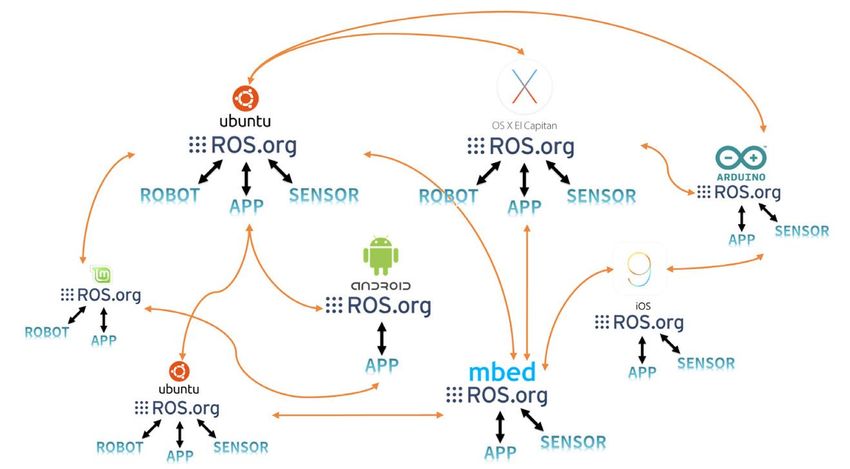
More at:
                                           robots.ros.org

Sistemi Intelligenti Avanzati, 2020/2021              5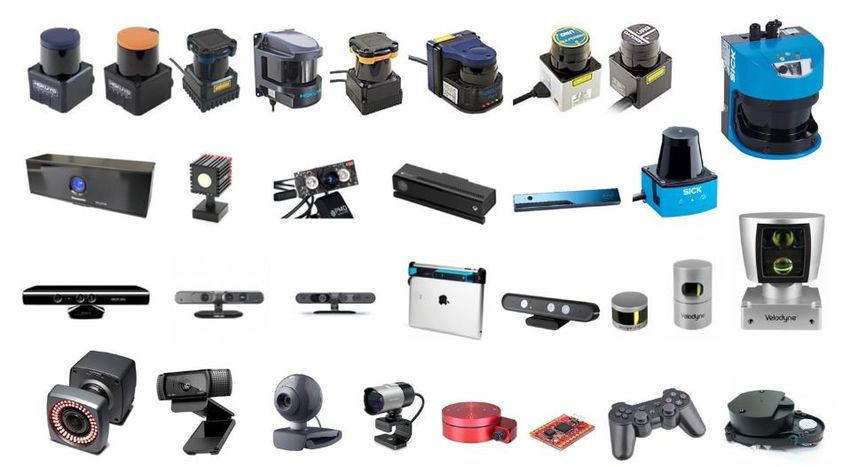
Our ROS robots

            Sistemi Intelligenti Avanzati, 2020/2021   6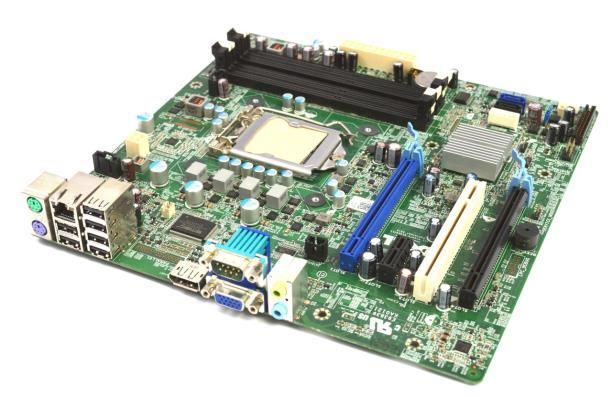
Sensors with ROS [wiki.ros.org]
       Sistemi Intelligenti Avanzati, 2020/2021   7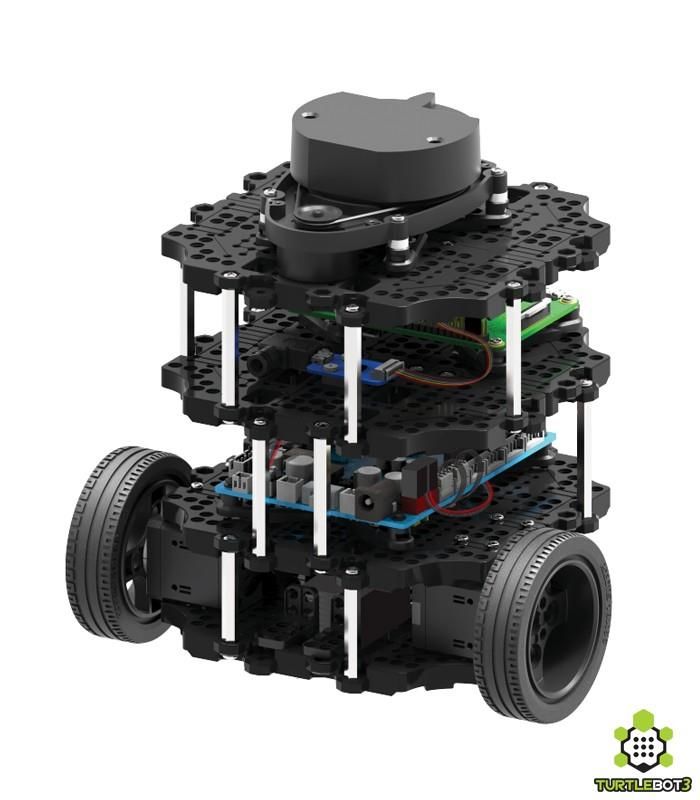
What is ROS?
Is a Meta-Operating System
  • Scheduling – loading – monitoring, and error handling
  • virtualization layer between applications and distributing computing resources
  • runs on top of (multiple) operating system(s)

• is a framework
• not a real-time framework but embed real-time code
• enforce supports a modular software architecture

                                    Sistemi Intelligenti Avanzati, 2020/2021         8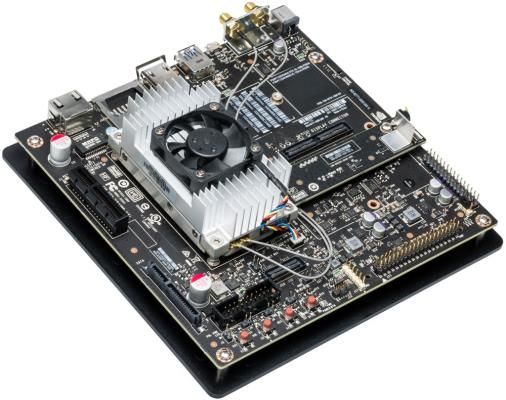
ROS SW architecture
• distributed framework of processes (Nodes)
• enables executables to be individually designed and loosely
  coupled at runtime.
• processes can be easily shared and distributed.
• supports a federated system of code Repositories that enable
  collaboration to be distributed as well.
This design, from the filesystem level to the community level,
enables independent decisions about development and
implementation, but all can be brought together with ROS
infrastructure tools.

                      Sistemi Intelligenti Avanzati, 2020/2021   9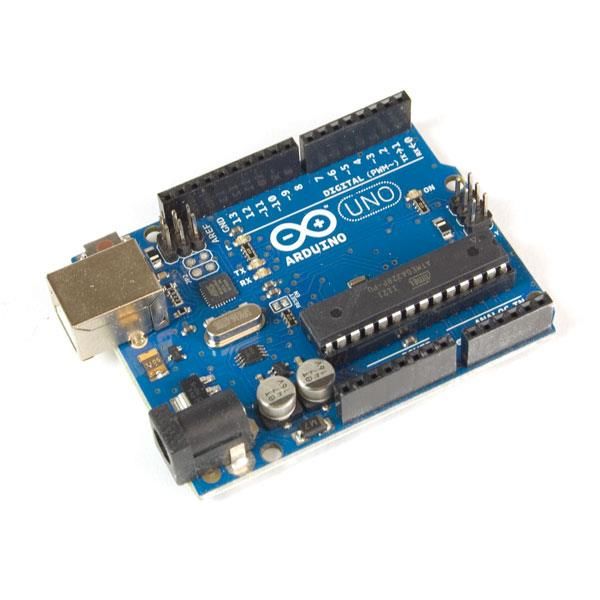
More ROS features
• thin: ROS is designed to be as thin as possible
• easy to integrate with other frameworks and libraries
• language independence
 core languages are Python and C++ but you can use what you want
• easy testing: built in unit/integration test framework and
  debug tool
• scaling: ROS tools can be distributed across different
  machines and is appropriate for large development process
The core idea behind all of this is: code reuse + modularity

                       Sistemi Intelligenti Avanzati, 2020/2021    10
What ROS provides
• core and advanced robot
functionalities
(mapping, localization,
navigation, obstacle
avoidance)
• drivers and integration with
sensors
• integration with multiple robot
architectures
UAV – manipulators –wheeled
robots
• integration with libraries
(OpenPose, OpenCV, deep
learning fw)
• simulation tools
All free and ready to use
Support from the community
Sistemi Intelligenti Avanzati, 2020/2021 11ROS-community
Sistemi Intelligenti Avanzati, 2020/2021 12• more than 10y of ROS now
• last version (ROS1): ROS Noetic (2020)
• EOL 2025
• next mayor release: ROS 2
• first version already released
• migration at the beginning
Sistemi Intelligenti Avanzati, 2020/2021 13Core aspects of
Sistemi Intelligenti Avanzati, 2020/2021 14ROS aspects
• nodes
• topics Building blocks of ROS
• messages
• services
• actions Communication / SW architecture
• transforms
• debugging Tools
• simulations
Developers tools
• bags
Sistemi Intelligenti Avanzati, 2020/2021 15ROS nodes
A node is a process that performs
computation:
• nodes are combined together into a
graph and communicate with one
another using streaming topics, services,
and parameters,
• are meant to operate at a fine-grained
scale,
• a robot control system will usually
comprise many nodes.
Sistemi Intelligenti Avanzati, 2020/2021 17ROS nodes
For example, one node controls a laser range-finder,
one Node controls the robot's wheels motors, one
node performs mapping, one localization, one node
performs path planning, one node gives velocity
commands to the wheels, one node provides a
graphical view of the system, and so on.
Sistemi Intelligenti Avanzati, 2020/2021 18ROS nodes
The use of nodes in ROS provides several benefits to the
overall system.
• fault tolerance as crashes are isolated to individual nodes.
• code complexity is reduced in comparison to monolithic
systems. Implementation details are also well hidden - nodes
expose a minimal API –
• alternate implementations, even in other programming
languages, can easily be substituted.
Sistemi Intelligenti Avanzati, 2020/2021 19Nodes and topics
Topics are named buses over
which nodes exchange messages.
• topics have anonymous publish/subscribe semantics,
which decouples the production of information from its
consumption.
• nodes are not aware of who they are communicating
with.
• nodes that are interested in data subscribe to the relevant
topic; nodes that generate data publish to the relevant
topic. nodes
• there can be multiple publishers and subscribers to a topics
topic.
Sistemi Intelligenti Avanzati, 2020/2021 20ROS topics
and messages
• each topic is strongly typed by the ROS message type used to publish to it
• nodes can only receive messages with a matching type.
• type consistency is not enforced among the publishers, but subscribers
will not establish message transport unless the types match.
• all ROS clients check to make sure that an MD5 computed from
the message format match.
Sistemi Intelligenti Avanzati, 2020/2021 21ROS master
• the ROS Master provides naming
and registration services to the
rest of the nodes in the ROS
system.
• it tracks publishers and
subscribers to topics.
• it enables individual ROS nodes
to locate one another. Once
these nodes have located each
other they communicate with
each other peer-to-peer.
Sistemi Intelligenti Avanzati, 2020/2021 22ROS master and nodes
• the ROS master is a process and it is
defined by its IP/port shared across all
nodes
• acts as coordinator and manages the
communication among nods
• this allows nodes to be distributed on
different machines
(in the same network)
• this mechanism allows to decouple the
execution of a process from the
machine where the process is
distributed
Sistemi Intelligenti Avanzati, 2020/2021 23ROS master and nodes
• robots may have to perform several
(computationally intensive)
tasks together
• hardware decoupling allows to
distribute such tasks on dedicated
hardware (e.g., Nvidia Jetson for GPUs)
• moreover, robots are hardware and
this architecture allows to easily
interface control boards for sensors,
motors, etc.. (e.g., Arduino)
Sistemi Intelligenti Avanzati, 2020/2021 24ROS on multiple platforms
• as ROS is a middleware, computation can be
distributed across different OS
• however, this in practice is far than ideal
• OS independence is de-facto provided for linux-
based and embedded systems.
• rule-of-thumb: use Ubuntu for non-embedded
Sistemi Intelligenti Avanzati, 2020/2021 25
systems not all versions either, but this will improve with ROS2Set up a ROS topic publisher/subscriber
• a subscriber node registers to the
ROS MASTER
• and announces its
• Name
• Topic name
• Message Type
• communication is performed using
XMLRPC
Sistemi Intelligenti Avanzati, 2020/2021 26Set up a ROS topic publisher/subscriber
A publisher node
now registers to
the
ROS MASTER
Sistemi Intelligenti Avanzati, 2020/2021 27Set up a ROS topic publisher/subscriber
The ROS MASTER
distributes info
as all subscribers
that want to
connect to the
topic and to the
publisher node
Sistemi Intelligenti Avanzati, 2020/2021 28Set up a ROS topic publisher/subscriber
The subscriber
node requests a
direct connection
to the published
node and transmits
its information to
the publisher node
Sistemi Intelligenti Avanzati, 2020/2021 29Set up a ROS topic publisher/subscriber
The publisher node
sends the URI
address and port
number of its TCP
server in response
to the connection
request.
Sistemi Intelligenti Avanzati, 2020/2021 30Set up a ROS topic publisher/subscriber
At this point a
direct connection
between publisher
and subscriber
node is established
using TCPROS
(TCP/IP based
protocol)
Sistemi Intelligenti Avanzati, 2020/2021 31Communication among nodes
After communication between
nodes is established, ROS
provides 3 types of
interactions
• Topics
• Services
• Actions
Sistemi Intelligenti Avanzati, 2020/2021 32Communication among nodes
• The standard communication mechanism is using ROS topics.
• Nodes can have multiple topics
• Nodes can even use topics for internal communication
• Continuos -loop()- or one-shot (e.g. when data are ready)
Sistemi Intelligenti Avanzati, 2020/2021 33ROS Services
• ROS services are
synchronous
request from
one node to
another.
• Request/Reply
mechanism.
A client can make a persistent connection to a service, which enables higher performance at the
cost of less robustness to service provider changes.
Sistemi Intelligenti Avanzati, 2020/2021 34ROS Actions
• ROS services are
asynchronous
request from
one node to
another.
• Request/Reply
mechanism, with
feedbacks and
If the service takes a long time to execute, the user might want the possibility to
the ability to cancel the request during execution or get periodic cancel the
feedback about how the request is progressing.
Action Services are for these tasks.
request.
Sistemi Intelligenti Avanzati, 2020/2021 35ROS parameter server
The parameter server is a shared,
multi-variate dictionary that is
accessible via network APIs.
• nodes use this server to store
and retrieve parameters at
runtime.
• used for static, non-binary data
such as configuration
parameters.
• globally viewable so that tools
can easily inspect the
configuration state of the system Example of params are map
and modify if necessary. size/resolution and sensor
configuration/settings.
Sistemi Intelligenti Avanzati, 2020/2021 36ROS Transforms
• in robotics programming, the robot’s joints, or wheels with
rotating axes, and the position of each robot through
coordinate transformation are very important
• in ROS, this is represented by TF (transforms)
• TF are published with a mechanism
similar to (and parallel) the one
used for ROS Topics
Sistemi Intelligenti Avanzati, 2020/2021 37ROS
Transforms
• all components of the
robots should be
connected through a chain
of TF to a global reference
frame (world or map)
• this is particularly
important, as TFs allow the
robot to project sensors
onto a global reference
frames
Sistemi Intelligenti Avanzati, 2020/2021 38ROS Transforms
• some TF are static (e.g., the
position of sensors w.r.t.
The robot reference frame)
• some TF are dynamic and
are computed real-time by
nodes
(e.g. the position of the
robot in the map, the
position of joints in a hand
gripper)
Sistemi Intelligenti Avanzati, 2020/2021 39ROS Transforms
• TF can become complex,
especially for robot with a
lot of Degrees Of Freedom
(DOF) as grippers
• ROS provides visualization
tools for controlling such
aspects
Sistemi Intelligenti Avanzati, 2020/2021 40Developing toos
Sistemi Intelligenti Avanzati, 2020/2021 41Developing a robot in ROS
• mobile robots easily became
very complex objects
• issues can emerge with single
components, hardware failures,
integration, …
• impossible to control all
possible sources of uncertainty
Sistemi Intelligenti Avanzati, 2020/2021 42Environmental inaccuracies
• All of the robot available
knowledge is based on sensors
but…
• …sensors itself are (very) noisy
• odometry is the estimation of
the robot motion from internal
sensors (e.g. IMU or velocity)
• odometry itself is very noisy
and unreliable
Sistemi Intelligenti Avanzati, 2020/2021 43Reducing environmental inaccuracies
Even if assuming that there
are no unexpected failures in
the robot modules, some of
the robot modules are
designed to cope and
reduces known sources of
uncertainty and to integrate
data together
Mapping integrates sensor readings (e.g., laser range scanner) together
reducing odometry error thus obtaining a valid map of the environment
Sistemi Intelligenti Avanzati, 2020/2021 44Developing a robot in ROS
• Modularity and scalability of
nodes and topics help in
developing complex integrated
system but…
• …still the resulting ROS
computational graph is
impossible to be analyzed at
glance
Sistemi Intelligenti Avanzati, 2020/2021 45The graph of ROS nodes and topics of a real robot
Sistemi Intelligenti Avanzati, 2020/2021 46How to program robots then?
• A lot of components and
modules integrated among them
• Sensors and robot hardware are Making even a simple run with a
noisy and can fail robot can be very time
consuming
• Impossible to control all possible
sources of uncertainty
Sistemi Intelligenti Avanzati, 2020/2021 47How to program robots then?
• A lot of components and
modules integrated among them
• Sensors and robot hardware are Developing and integrating
noisy and can fail a new functionality into a
pre-existing robot can be
difficult too
• Impossible to control all possible
sources of uncertainty
Sistemi Intelligenti Avanzati, 2020/2021 48Why ROS is useful
• A lot of components and • Use packages provided by the
modules integrated among them community
• Split computation into nodes
• Sensors and robot hardware are • Test in advance in simulations
noisy and can fail
• Use pre-recorded sensor inputs
• Impossible to control all possible • Visual inspection tool for
sources of uncertainty monitoring all of the robot
aspects
Sistemi Intelligenti Avanzati, 2020/2021 49Why ROS is useful
• A lot of components and • Use packages provided by the
modules integrated among them community
• Split computation into nodes
• Sensors and robot hardware are • Test in advance in simulations
noisy and can fail
• Use pre-recorded sensor inputs
• Impossible to control all possible • Visual inspection tool for
sources of uncertainty monitoring all of the robot
aspects
Sistemi Intelligenti Avanzati, 2020/2021 50Why ROS is useful
• A lot of components and • Use packages provided by the
module integrated among them community
• Split computation into nodes
• Sensors and robot hardware • Test in advance in simulations
are noisy and can fail
• Use pre-recorded sensor inputs
• Impossible to control all • Visual inspection tool for
possible sources of uncertainty monitoring all of the robot
aspects
Sistemi Intelligenti Avanzati, 2020/2021 51You can also read


