Analysis of the Influence of Biomass Addition in Coal Mixture for Metallurgical Coke Production
←
→
Page content transcription
If your browser does not render page correctly, please read the page content below

Global Journal of Researches in Engineering: E
                      Civil And Structural Engineering
                      Volume 21 Issue 2 Version 1.0 Year 2021
                      Type: Double Blind Peer Reviewed International Research Journal
                      Publisher: Global Journals
                      Online ISSN: 2249-4596 & Print ISSN: 0975-5861

Analysis of the Influence of Biomass Addition in Coal Mixture
for Metallurgical Coke Production
                                                                    By Alex M. A. Campos & Paulo S. Assis
Abstract- Metallurgical coke is a common material used for hot metal production in blast furnaces. In
addition to the fuel function, it has a physical assignment, supporting the load inside the reactor, and
chemical, supplying carbon to hot metal. However, due to growing discourse on environmental issues,
the production of hot metal via coke blast furnace has been in evidence. This process is responsible for
about 70% of CO2 emissions in steelmaking. On the other hand, biomasses are materials that are
available in different ways in nature and considered neutral in CO2 emissions since they absorb this gas
and release oxygen in the photosynthesis process. Thus, a viable alternative in the short term is the partial
replacement of the coal used in coke production with biomass, which would generate environmental
gains, and guarantee the sustainable production. Therefore, this work aims to show several published
researches using biomass in coke production. The effects that biomass has on the properties of coke will
be emphasized, and at the end, an environmental analysis will be shown with the possible use of
biomass. It will be possible to see that it is possible to substitute between 2 and 10% of the coal for
biomass, producing coke with the characteristics required in the blast furnace.
Keywords: biomass; coke; cokemaking; ironmaking; steelmaking.
GJRE-E Classification: FOR Code: 290899

 AnalysisoftheInfluenceofBiomassAdditioninCoalMixtureforMetallurgicalCokeProduction

                                                        Strictly as per the compliance and regulations of:

© 2021. Alex M. A. Campos & Paulo S. Assis. This is a research/review paper, distributed under the terms of the Creative
Commons Attribution-Noncommercial 3.0 Unported License http://creativecommons.org/licenses/by-nc/3.0/), permitting all non-
commercial use, distribution, and reproduction in any medium, provided the original work is properly cited.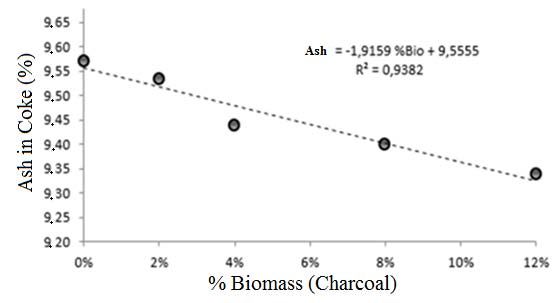
Analysis of the Influence of Biomass Addition in
 Coal Mixture for Metallurgical Coke Production
                                          Alex M. A. Campos α & Paulo S. Assis σ

Abstract- Metallurgical coke is a common material used for hot      huge demand for steel in China, which is the largest
metal production in blast furnaces. In addition to the fuel         coke exporter.
function, it has a physical assignment, supporting the load                  One of the alternatives that has been studied,
inside the reactor, and chemical, supplying carbon to hot
                                                                    mainly to mitigate environmental impacts, is the
metal. However, due to growing discourse on environmental
                                                                    replacement of part of coal used in coke making by
issues, the production of hot metal via coke blast furnace has
been in evidence. This process is responsible for about 70% of      biomass. Thus, there would be a reduction in CO2

                                                                                                                                        2021
CO2 emissions in steelmaking. On the other hand, biomasses          emissions, since biomass can be considered neutral in
are materials that are available in different ways in nature and    emissions as it captures this from the atmosphere

                                                                                                                                                  Year
considered neutral in CO2 emissions since they absorb this          during photosynthesis process. In addition, the
gas and release oxygen in the photosynthesis process. Thus,         photosynthesis can generate a drop in the cost of steel                              1
a viable alternative in the short term is the partial replacement   production, since the price difference between coal and
of the coal used in coke production with biomass, which would

                                                                                                                                        Global Journal of Researches in Engineering ( E ) Volume XxXI Issue II Version I
                                                                    biomass can be considerable.
generate environmental gains, and guarantee the sustainable
                                                                             Biomass is all vegetable or animal organic
production. Therefore, this work aims to show several
                                                                    matter that is used in the production of energy. Like
published researches using biomass in coke production. The
effects that biomass has on the properties of coke will be          other renewable sources, biomass can be considered
emphasized, and at the end, an environmental analysis will be       neutral in CO2 emissions. Compared to fossil fuels,
shown with the possible use of biomass. It will be possible to      biomass has a higher volatile content, less carbon and a
see that it is possible to substitute between 2 and 10% of the      lower calorific value, lower sulfur content, lower ash
coal for biomass, producing coke with the characteristics           content, higher hydrogen content, and may be
required in the blast furnace.                                      interesting for its use in the steel industry. For Quan
Keywords: biomass; coke; cokemaking; ironmaking;                    (2016), compared to plastic and other waste, biomass is
steelmaking.                                                        a source of perspective for the replacement of fossil
                                                                    fuels in the future, as it is abundant, renewable, clean,
                 I.    Introduction
                                                                    and carbon neutral.

S
       teelmaking processes have a high-energy                               The great gain in substituting part of coal for
       consumption and coal is the main source, and                 biomass in metallurgical coke production is in the
       steel production has been responsible for 7–9% of            environmental. What makes biomass neutral in CO2
CO2 emissions in recent years, largely due to the use of            emissions is the so-called carbon cycle. Burning
fossil fuels. To produce 1.85 t of steelis emitted around           biomass causes the release of CO2 into the atmosphere.
3.3 t of CO2, which puts the steel sector in the spotlight          However, plants, through photosynthesis, transform CO2
of the environmental discussion (Holappa, 2020).                    and water into carbohydrates, which make up their living
          In the steel industry, the process that emits             mass, releasing oxygen. Thus, the use of biomass, not
more CO2 is the blast furnace (about 70%) due to the                in a predatory way, does not change the average
high consumption of fossil fuels, including coke (Orth,             composition of the atmosphere over time (Silva, 2008).
2007). For this reason, efforts to reduce CO2 emissions             In this approach, the GGE balance is negative, which
must focus on the blast furnace, with solutions to                  means that the overall sequestration of CO2 from the
minimize the effects of burning coke and coal. In                   atmosphere for the cultivation of biomass is greater than
addition, coke, as well as coal, represents about 40% of            the CO2 emissions during the production process. In
the final cost of steel, which makes producers look for             addition, the low sulfur content in biomass results in very
sustainable alternatives to compose the coke mixture.               low emissions of SOx. This can result in the use of
          For Noldin (2005), the inevitable dependence              biomass to supply the energy and reducers necessary
on the use of metallurgical coke puts conventional blast            for the production of hot metal, guaranteeing an
furnaces in a difficult situation, due to environmental             ecologically correct operation.
restrictions and to the global scarcity and exorbitant                       Studies involving the use of biomass in
prices of this raw material. This new scenario of                   steelmaking processes have been gaining strength due
shortages and high coke prices was created by the                   to the factors mentioned. Particularly in the cokemaking,
                                                                    most studies involve charcoal fines or wood residues
Author α: Khambar Tursunbaeve.                                      such as sawdust and bark. All studies in this line show
e-mail: alexcampos88@yahoo.com.br

                                                                                                               © 2021 Global Journals
Analysis of the Influence of Biomass Addition in Coal Mixture for Metallurgical Coke Production
that when adding biomass to coal mixture for coke the industrial revolution, coke became an essential fuel
production, there is a drop in coke quality. However, for hot metal and steel production, increasing the
there are results that, in a certain limit, are viable and productivity of blast furnaces (Ricketts, 2000).
can bring economic and environmental gains without Metallurgical coke is produced through coal
considerable loss of coke quality. distillation at temperatures of approximately 1000oC.
In view of these facts, this work aims to discuss This process is called cokeification, and occurs in
the use of biomass, replacing fossil fuels, in coal batteries containing retorts (long, high and strict) in the
mixtures used in cokemaking for metallurgical coke case of By-product coke ovens or in chambers when the
production. The use of biomass in the coke oven will be Heat Recovery coke oven is used (Mourão, 2011).
shown, presenting some works that have been The coke produced must have high resistance
developed around the world and making a critical properties to avoid degradation insides blast furnace, as
analysis, pointing out the pros and cons of this use. well as containing high carbon content, low reactivity,
Some environmental aspects of the use of biomass will low ash, and sulfur content.
also be discussed. Finally, some suggestions will be Steelmakers have the coke oven integrated into
given for future work on the use of biomass in the steelmaking plant, but there are also independent
2021
steelmaking processes. producers whose main customers are steelmakers. In
Year
coke plants, 1000kg of coal produce around (AISE,
II. Development 1999):
2 In the development of this work, some important • 750kg of coke (690kg of blast furnace coke, and
concepts about coke, its production, about biomass, 60kg of coke breeze);
Global Journal of Researches in Engineering ( E ) Volume XxXI Issue II Version I
and its application in the production of metallurgical • 36kg of tar (which includes: 2.5kg of naphthalene,
coke will be shown. At the end, an environmental 15kg of light oils, and 18.5kg of tar);
analysis, an actualization of political discourses, and • 7.28kg of total benzol (comprising: 5.35kg of
simulation of possible scenarios that can be reached by benzene, 1.25kg of toluene, and 0.68kg of xylene);
steel companies will be made. • 12kg of ammonium sulfate.
a) Coke Production World steel production in 2019 was about 1.6
The coke production process was developed in billion tonnes, most of this production is via coke blast
England in the late 16th century, and at first, the coke furnace, that is, a large production is required to serve
produced was not used in hot metal production, that steel mills. As can be seen in figure 1, world coke
was basically produced in charcoal blast furnaces. After production in 2018 reached 629 million tons.
Figure 1: World Coke Production (Garside, 20019)
© 2021 Global JournalsAnalysis of the Influence of Biomass Addition in Coal Mixture for Metallurgical Coke Production
In the blast furnace, coke has some main materials that will compose the mixtures, so that it is
functions, including: possible to predict the coke quality.
• Acts as a generator of reducing gases: its
b) Biomasses
gasification generates reducing gases that are
Biomass can be defined as the total mass of
responsible for changing iron oxides to metallic iron.
organic substances that occur in a habitat. The forms of
• Acts as a combustible material: as coke burning
biomass on our planet are many, and varied. According
reactions are exothermic, they generate heat for
to their origin, biomasses are divided into four basic
reactions to reduce oxides and fuse metallic iron.
categories defined by Rocha (2011) as:
• Enriching hot metal carbon content, acting as hot
• Crops for energy production - grown mainly to
metal fuel.
generate energy;
• And finally, it supports the layers of metallic charge,
• Post-harvest waste - waste generated during
thus allowing permeable beds to be generated for
harvest such as straw, wood waste and natural
the passage of upward gases.
waste. They are interesting because they have low
To perform the functions listed in the blast cost.
2021
furnace, coke must present (Rizzo, 2009): • Organic by-products - are residues from the
− Maximum carbon content and minimum ash, sulfur, industrial processing of biomass, livestock manure,
Year
and moisture content. vegetable fibers, etc.;
− Adequate reactivity values for CO2 and H2O. • Organic waste - includes sewage effluents, 3
− Particle size range, when loaded in the blast domestic, commercial, and industrial waste.
Global Journal of Researches in Engineering ( E ) Volume XxXI Issue II Version I
furnace, suitable and controlled. To use biomass in the steelmaking process, the
− Good resistance to mechanical, thermal, and most interesting categories are harvest for energy, in the
chemical degradation. case of charcoal, and the post-harvest residues, which
Some quality parameters are necessary to are the types of biomass considered in this work. The
analyze the quality of coke in the blast furnace, including amount of waste after harvest can reach 50% of
the chemical, physical and metallurgical porperties. production by weight, and in some cases, such as
Table 1 shows expected values for coke according to coffee and soy. Table 2 shows the production of crops
each property. in 2019, according to the Food and Agricultural
Organization of the United Nations (FAO), and the
Table 1: Coke properties for blast furnace uses
calculation of possible quantities of post-harvest waste
(Rizzo, 2009) generated according to Carvalho (1992).
Properties Coke Quality Table 2: World biomass production (FAO, 2019)
Moisture < 6,0%
Production Residues*
Fixed Carbon 65-75% Biomasses
(103 t) (103 t)
Ash < 10,5%
Sugar cane 1.949.310,1 633.525,8
Volatiles < 1,2%
Soya 333.671,7 166.835,5
Sulfur < 07%
Phosphor < 0,045% Maize 1.148.487,3 492.701,1
Alkalis < 0,35% Coffee 10.035,6 5.017,8
Density 180-350 kg/m3
Rice 755.473,8 151.094,8
Drum Index (150/15) > 85%
CSR > 65,5% *Calculated according to CARVALHO, 1992.
CRI 21 a 25,5% The use of biomass is the oldest method for
Compression Strength 130-160 kgf/cm3 providing energy. However, the use of biomass as a
Particle Size 45-60 mm renewable energy source must undergo a development
of technology. In addition to the positive environmental
These variables presented will affect the effects of using biomass as a fuel, it can be said that
operational control of the blast furnace, the permeability greenhouse gases are emitted during their burning, but
of the load, iron ore reduction reactions, and the amount is the same produced by the natural
characteristics of hot metal produced. Many tests are decomposition process. In addition, in the case of plant
done with coke before being used in a blast furnace. biomass, during its growth, carbon dioxide is consumed
The most important ones are CRI (Coke Reactivity during photosynthesis, which can generate a positive
index), CSR (Coke Strength after Reaction), DI (Drum balance when analyzing the emission (Campos, 2018).
Index), average size, compression resistance, among In photosynthesis process CO2 capture from the
others. In addition, it is important to characterization the atmosphere is reduced to organic compounds, and the
© 2021 Global JournalsAnalysis of the Influence of Biomass Addition in Coal Mixture for Metallurgical Coke Production
more the phytosystem is growing, the more carbon it use biomass in its raw state, and therefore, it is
removes from the atmosphere, calling "carbon necessary to convert them through processes such as
sequestration". In growing ecosystems, such as torrefaction, pyrolysis, combustion, etc.
soybean, cotton, and castor plantations, among others, Biomass, according to Babich (2019), can be
the removal of carbon dioxide from the air via used in steel mills in three different ways, such as
photosynthesis is high, reaching up to 35t CO2 / hectare injection into blast furnaces or electric arc furnaces,
(EMBRAPA, 2007). incorporation into cargo materials or into the mixture of
In addition to chemical properties, biomasses coal for coke or generation of reducing gas.
differ in their physical properties like lower density, and Silva (2008) performed an analysis of biomass
greater porosity. To analyze economic aspects, is in coal mixture using a pilot furnace with concentrations
necessary evaluate two restrictions. First, it is necessary of 2%, 4%, and 6% with different types of biomass such
to know whether the biomass to be exploited as rice husk, soy, coconut, macadamia husk, coffee
energetically has no other uses (industrial or food). husk, and charcoal. The biomasses with concentrations
Second, if all the costs of the biomass harvested are of 6%, presented a good behavior due to their presence
compatible with the energy benefits and comparable does not alter the swelling index and to reduce the sulfur
2021
with other fuels. Finally, technological restrictions are content and its fluidity.
Year
due to the existence or not of reliable processes and The calcined rice husk with a 6% concentration
operations to convert biomass into fuels. was used in an industrial test. Its addition to the coal
4 mixture increased the average size of the coke, without
c) Influence of Biomass Addition in Coal mixtures for
changing its mechanical resistance. In figure 2, it is
Global Journal of Researches in Engineering ( E ) Volume XxXI Issue II Version I
Cokemaking
possible to observe a comparison of the data obtained
The use of biomass in the industrial sector has
on the industrial scale compared to the standard coke
been gaining ground for presenting unique properties
produced. It is possible to notice that there were no
such as renewability, carbon neutrality, low sulfur
changes in the DI, its reactivity was maintained and the
content, low ash content, high reactivity, among others,
ash content had an increase due to the presence of
which, when properly treated, are able to replace fossil
silicon oxides in the rice husk.
fuel in the production of coke, for example (Mousa,
2016). For the steel industry, it is not advantageous to
Figure 2: Industrial test of the use of 6% rice husk in the coke mixture (Silva, 2008)
A drop in the mechanical resistance of the coke that the coarse grinder aggravates the drop in DI in
was observed when adding biomass. The Main effects, relation to biomass with smaller particle size for the
and interaction analyzes between the addition of same level of addition. In figure 3 is possible to see a
biomass and granulometry factors allows to conclude research using charcoal with different particle sizes.
© 2021 Global JournalsAnalysis of the Influence of Biomass Addition in Coal Mixture for Metallurgical Coke Production
2021 Year
5
Figure 3: Evolution of DI with the addition of biomass (Silva, 2016a)
Global Journal of Researches in Engineering ( E ) Volume XxXI Issue II Version I
The drop in DI can be attributed to the increase CRI, respectively. In figure 4, it is possible to notice that
in the inert content of the mixture, decreasing its coking the addition of 2% of sawdust generated a drop of 3.9 %
power. According to Kubota (2008), the greater in the CSR and an increase of 0.63 % in CRI. In the
participation of aggregates above 1.5mm increases the addition of 5%, there was a significant drop of 12.29 %
concentration and propagation of cracks, depreciating in CSR and an increase of 2.54 % in CRI.
the mechanical resistance of the coke.
Carvalho (2021) found an inverse and direct
relationship between biomass participation in CSR and
Figure 4: CSR e CRI of coke produced with wood and sawdust (Carvalho, 2021)
When compared to sawdust 2%, wood 2%
showed a lower drop in CSR values (1.5%) and a
smaller increase in CRI values (0.12 %). Wood 5%
showed a higher CSR value (66.14 %) compared to the
sawdust level 5% (59.74 %), with an increase in CRI to
23.65 % against 22.65% of sawdust.
Another important point is the sulfur content,
which is not desired in hot metal production. Liziero
(2017) concludes in his work that whenever biomass is
added to the coal mixture, there will be a decrease in the
sulfur content of the mixture, as shown in figure 5.
© 2021 Global JournalsAnalysis of the Influence of Biomass Addition in Coal Mixture for Metallurgical Coke Production
2021 Year
6
Global Journal of Researches in Engineering ( E ) Volume XxXI Issue II Version I
Figure 5: Effect of sulfur content in coke with biomass addition (Liziero,2017)
Regarding the ash content of coke with the in biomass can be seen in the dispersion diagram
addition of biomass, a linear decrease with the increase shown in figure 6.
Figure 6: Ash behavior with biomass addition (Silva, 2016).
This behavior is expected since the ash Some additives can improve the coking
contents of biomasses tend to be much lower than capacity of a coal mixture and, therefore, can partially
coals used in coke mixtures. In this way, the insertion of reduce the negative effects of biomass additions. This
biomass improves the coke ash balance, with a direct can be seen in figure 7.
reflection on the drop in fuel consumption in the blast
furnace. For each 1% reduction in ash in coke, 7kg /t hot
metal is saved in coke rate practiced in the blast furnace
(Silva, 2016). In addition, the low ash content of biomass
is interesting for the coking process, since there is a
decrease in tar formation.
© 2021 Global JournalsAnalysis of the Influence of Biomass Addition in Coal Mixture for Metallurgical Coke Production
2021 Year
Figure 7: Biocoque optical micrographs: (a) coke with 10% charcoal; (b) coke with 10% charcoal and an additive.
1-Voids; 2-coke matrix; 3-particles of charcoal (Mathieson, 2015)
7
The left side micrograph (a) refers to biocoque Protocol, introduced in 1997, was the first international
Global Journal of Researches in Engineering ( E ) Volume XxXI Issue II Version I
obtained without the addition of an additive, showing agreement to reduce greenhouse gases. The Paris
that surfaces of residual biomass particles are poorly agreement, signed in 2015 and valid since November
assimilated in the coke matrix, evidenced by the well- 2016, determined an increase in the planet's
defined limits of inclusions. The encapsulation of temperature by 2oC by 2100. This agreement was
charcoal particles in the coke matrix was considerably ratified by 179 countries that were in different stages of
improved when 2% of an organic additive was added to implementation and development of their environmental
the mixture (b). CRI and CSR also tend to improve since policies. Countries that have ratified the agreement
the addition of an additive reduce the reactivity of coke recognize that the need to take action against climate
(Mathieson, 2015). change will imply accelerated policies and regulations
These presented studies show that biocoque, that inevitably affect the industrial competitiveness of all
coke produced with the addition of biomass, can be an nations and their respective economies. In parallel,
adequate substitute for conventional fossil fuels with the several countries have set their own targets for reducing
potential to reduce CO2 emissions and reduce costs in emissions. Table 3 shows some goals presented by
the steel industry. countries in COP 21 for reducing greenhouse gas
emissions.
d) Environmental Evaluation
Environmental changes has become one of the
most important issues in global politics. The Kyoto
Table 3: Goals are set by some countries to reduce greenhouse gas emissions (IRENA, 2020)
Countries Goals
Australia 5-25% lower than 2000, until 2020
Brazil 37% lower than 2005 until 2025 and 43% until 2030
Canada 17% lower than 2005, until 2020
China 20-25% reduction in emissions per unit of GDP from 2005, until 2020
Reduce 20% until 2020, 40% until 2030 and 80-95% until 2050
European Union
(compared with 1990)
India 20-25% reduction in emissions per unit of GDP from 2005, until 2020
Russia 15-20% lower than 1990, until 2020
USA 17% lower than 2005, until 2020
Even with all these goals set by the countries, it According to Sathler (2017), a Brazilian steel
will still be difficult to reach the global goal. The effort will company in 2016 had an average coke rate and
have to be greater, and each contribution can be useful. injection rate of, respectively, 295kg/t of hot metal and
Therefore, replacing fossil fuels with biomass in the steel 188 kg/t of hot metal. For Silva (2016), it is necessary
industry will be interesting to help in this process. Thus, around 1.2tons of coal to produce 1 ton of coke,
it will be presented how much it is possible to contribute therefore, for this situation, the consumption of l coal to
with the partial replacement of coal in the cokemaking. produce 1 ton of hot metal is 188kg in PCI and 354kg of
© 2021 Global JournalsAnalysis of the Influence of Biomass Addition in Coal Mixture for Metallurgical Coke Production
coal in coke. Consider equation 1 presented by The Di decrease with the increase of biomass in
Carvalho (2003): the mixture. This was associated with the quantity of
inert content, which influences in the mechanical
1C +0.5 O2 + 1.88N2 = 0.9CO2 + 0.1CO + 1.88N2 (1)
resistance. In addition, the coarse granulometry
Doing a simple stoichiometric calculation, it is decreases more than the fines one.
possible to say that burning 1 ton of carbon produces The addition of biomass to the coal mixture is
3.3 tons of CO2. It is possible to find in the literature still considerably low, despite significantly influencing
several characterizations of coal with an average carbon the cost and CO2 emission, since it acts with a lower
content of 85%. Concluding, 542kg of coal have 460kg CRS and a higher CRI in relation to the coke
of carbon, and its burning emits 1520kg of CO2, that is, conventionally used by steel companies.
the emission in a blast furnace process reaches In terms of the environment, the use of 6% of
1520kg/t of hot metal. Considering only the share of biomass in the blast furnace is capable of reducing CO2
emissions from coke, this value would be 1168.2kg/t of emissions by up to 6.21% per ton of hot metal,
hot metal. according to the calculations carried out, and despite
The main question is how much CO2 can be being a low value; it causes an immense effect when
2021
avoided with the use of biomass in coal mixtures for considering the annual 87 million tonnes of reduced CO2
Year
cokemaking. emissions.
Researches developed by Silva (2008), Is necessary to optimize the processes for
8 Campos (2018), Suopajärvi (2017), among others, obtaining, transporting and stocking biomass so that
analyzing the use of biomass in coke production, point they can compete with fossil fuels as a raw material for
Global Journal of Researches in Engineering ( E ) Volume XxXI Issue II Version I
out that it is possible to use an average of 6% of the the cokemaking. Cooperation between industrial sectors
biomass in coal mixture, producing coke with qualities and agribusiness is essential. The development of
and requirements to be used in a blast furnace. alternatives is extremely important in order to guarantee
Therefore, if we consider the data presented above an increase in the useful life of the coke plant.
(354kg of coking coal per ton of hot metal), replacing
6% of coal used in coke production by biomass, there Acknowledgement
would be a decrease of 22kg of coal per ton of hot The authors acknowledge CAPES, CNPq,
metal produced. Finally, the contribution of coke burning REDEMAT, UFOP, EcoEnviroX and, all that contributed
to CO2 emissions in a blast furnace would be 1095.6kg to this research.
of CO2 /t of hot metal, a decrease of 72.6kg of CO2/t of
hot metal. References Références Referencias
When considering world production, this value 1. AISE Steel Foundation. The making, shaping and
can be significant. According to the World Steel treating of steel, Ironmaking volume.11.ed.
Association (2021), hot metal production in 2019 Pittsburgh, PA: The AISE Steel Foundation, 1999.
reached 1.2 billion tons, that is, considering that all hot 780p. ISBN: 0–930767–03–9.
metal was produced via a coke blast furnace and that 2. BABICH, A., SENK, D., SOLAR, J., MARCO, I.
6% of the coking coal was replaced by biomass, around Efficiency of biomass use for blast furnace injection.
87 million tonnes of CO2 emissions would be avoided in ISIJ International, v. 59, n.12, p.2212-2219, 2019.
one year. 3. CAMPOS, A.M.A., ASSIS, P.S., NOVACK,
Obviously, these numbers are just to provoke
K.M. Aspectos Econômicos E Ambientais Do Uso
reflection and point some numbers of the use of
De Biomassas Na Siderurgia, p. 21-32. In: 48°
biomass in the coke production. Other factors must be
Seminário de Redução de Minérios e Matérias-
analyzed for use, but it is a fact that environmental
primas, São Paulo, 2018.
restrictions are increasingly demanding, and the steel
4. CARVALHO, F.C. Disponibilidade de Resíduos
industry must adapt to meet the environmental schedule
Agroindustriais e do Beneficiamento de Produtos
and show that it is a strong sector, which aims a
Agrícolas. Informações Econômicas, v.22, n.12,
sustainable production.
p.31-46. 1992.
III. Conclusions 5. CARVALHO, L.A.L., CAMPOS, A.M.A., ASSIS, P.S.
Quality evaluation of metallurgical coke produced
The addition of biomass in coal mixture can be with sawdust and different mixture of coal. REM, Int.
used in a certain limit. Researches shows that an Eng. J., Ouro Preto, v. 74, n. 2, p. 219-223,
average quantity is around 6%, without an expressive 2021.
change in coke quality. The quantity used can vary 6. EMBRAPA. Balanço Energético e “Sequestro” de
according to the granulometry and type of biomass, Carbono em Culturas Oleaginosas. Campina
which case presented show the differences. Grande, 2007. Available in:< https://ainfo.cnptia.
© 2021 Global JournalsAnalysis of the Influence of Biomass Addition in Coal Mixture for Metallurgical Coke Production
embrapa.br/digital/bitstream/CNPA/20778/1/DOC16 20. SATHLER, Felipe; JUNIOR, Ramiro C. N.;
7.PDF>. Access in: 25/03/2021. PERDIGÃO, L. P.; RIBEIRO, E.C.; WASEN, L.A.
7. GARSIDE, M. Coke production Worldwide. Statista. Projeto CR298: Altas taxas de injeção de carvão
2019. Available in: . Access in 09/04/2021. de Redução de Minérios e Matérias-primas, São
8. HOLAPPA, L. 2020. A General Vision for Reduction Paulo, 2017.
of Energy Consumption and CO2 Emissions from 21. SILVA, A. M. Estudo da utilização da biomassa em
the Steel Industry. Metals, v. 10, n. 9, p. 1117-1138, substituição parcial ao carvão mineral no processo
2020. de fabricação do ferro gusa em alto-forno. 2008.
9. IRENA. Reaching zero with renewables: Eliminating 147 f. These (PhD) – Programa de pós-graduação
CO2 emissions from industry and transport in line em engenharia Mecânica, Universidade Estaual
with the 1.5 oC climate goal, International Paulista. 2008.
Renewable Energy Agency, Abu Dhabi, 2020. 22. SILVA, A. M. et al. Estudo Da Utilização Da
Available in: . Access in: 8/04/2021. Csn. Tecnologia em Metalurgia e Materiais, v. 5, n.
10. KUBOTA, Y. et al.; Effects of coal inertinite size on 1, p. 40–45, 2008
coke strength. ISIJ International, v.48, n°5, p.563- 23. SILVA, G.L.R. Utilização de Moinha de Bioredutor e 9
571, 2008. Pneu Inservível na Produção de Coque Metalúrgico.
Global Journal of Researches in Engineering ( E ) Volume XxXI Issue II Version I
11. LIZIERO, G. CARLOS, A. MARLON, A. DORNELAS, 2016. 188 f. Tese (Doutorado) – Programa de pós-
P. DIAS, N. MOREIRA, V. 2017. Avaliação da adição graduação em engenharia de materiais,
de biorredutor na mistura de carvões minerais na Universidade Federal de Ouro Preto. 2016a.
qualidade do coque metalúrgico,V Congresso 24. SILVA, G.L.R., BRAGA, E.M.H., ASSIS, P.S.,
Brasileiro de Carvão Mineral. Criciúma, SC, Brasil. QUINTAS, A.C.B., DORNELAS, P.H.G., MOURA,
12. MATHIESON, J. SOMERVILLE, M.A. DEEV, A. L.C.A., SOUZA, R.D.S., 2016. Utilização de finos de
JAHANSHAHI, S. (2015). Utilization of biomass as carvão vegetal para produção de biocoque
an alternative fuel in ironmaking. 10.1016/B978-1- metalúrgico. ABM Week. Rio de Janeiro, RJ, Brasil.
78242-156-6.00019-8 25. SUOPAJÄRVI, H., KEMPPAINEN, A.,
13. MOURÃO, Marcelo B. Introdução a siderurgia. 2.ed. HAAPAKANGAS, J., Fabritius, T. Extensive review of
São Paulo: Associação Brasileira de Metalurgia the opportunities to use biomass-based fuels in iron
Materiais e Mineração, 2011. 428p. and steelmaking processes. Journal of Cleaner
14. MOUSA E, WANG C, RIESBECK J, LARSSON M. Production, v.148, p.709-734, 2017.
2016.Biomass applications in iron and steel 26. WORLD STEEL ASSOCIATION. Steel Statistical
industry: An overview of challenges and yearbook 2020 concise version. Available in:
opportunities. Renewable and Susteainable Energy . Accessed in: April 15th
Tecnored process-High potential in use differente 2021.
kinds of solid fuel. Materials Research, v. 8, n.4, p.
447-451, 2005.
16. ORTH, A., ANASTASIJEVIC, N., EICHBERGER, H.,
Low CO2 emission technologies for iron and
steelmaking as well as titania slag production.
Minerals Engineering, v. 20, n. 9, pp. 854-861, 2007.
17. QUAN, C.; GAO, N. Copyrolysis of Biomass and
Coal: A Review of Effects of Copyrolysis
Parameters, Product Properties, and Synergistic
Mechanisms. BioMed Research International, v.
2016, p. 1-11, 2016.
18. RICKETTS, John A. History of Ironmaking.
Warrendale: Iron & Steel Society, 2000. 194p.
19. RIZZO, Ernandes M. S. Processo de Fabricação de
Ferro-Gusa em Alto-Forno. São Paulo: Associação
Brasileira de Metalurgia Materiais e Mineração,
2009. 278p.
© 2021 Global JournalsYou can also read


