Augmented Reality Realizing - By Amit Kore, Rahul Lanje and Raghu Burra Atos Syntel
←
→
Page content transcription
If your browser does not render page correctly, please read the page content below
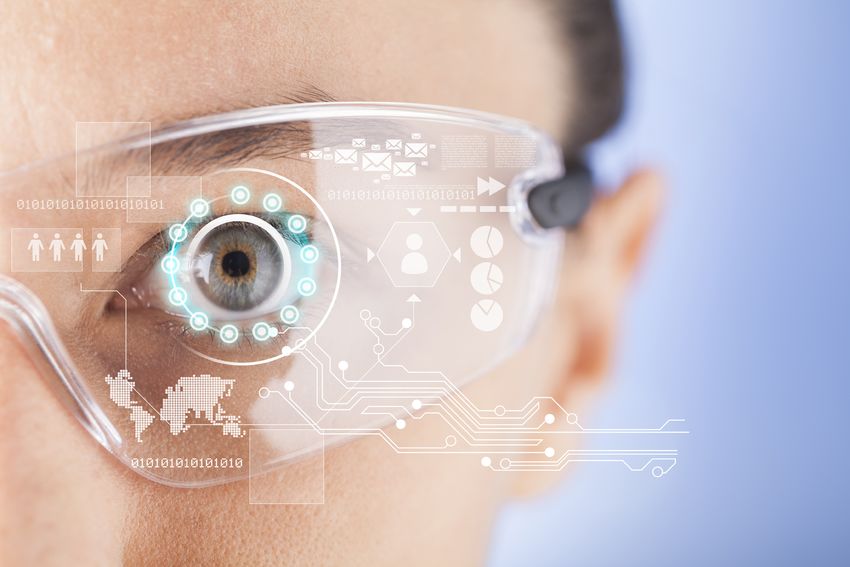
Realizing
    Augmented Reality
By Amit Kore, Rahul Lanje and Raghu Burra
Atos Syntel

                                            1
Introduction
Virtual Reality (VR) and Augmented Reality (AR) have been around for some time but there is renewed excitement,
with industry watchers like TechCrunch, Fortune and the BBC branding 2016 as “The Year of VR.”
Samsung’s Gear VR for their Simple DIY Google Cardboard
Galaxy devices was already has brought a basic VR
launched in late 2015 experience to the masses
Facebook’s Oculus Rift will HTC Vive VR in April
launch in early 2016
Sony’s PlayStation VR
Microsoft Hololens will launch in April
in early 2016
Samsung, Microsoft, Facebook, and Google all have launches of their $150 Billion in revenue by 2020
headsets due in 2016. According to the Consumer Technology
Association (CTA), virtual reality headsets are expected to take off in AR VR
2016 with projected sales up by 500 percent to 1.2 million units.[1]
$120 $30
AR/VR could have hundreds of millions of users, with hardware price
points similar to smartphones and tablets. Digi-Capital predicts that AR and VR
technologies could reach $150
Billion in revenue by 2020, with AR
Sales
accounting for around $120 billion
Users and VR at $30 billion.[2]
500% 2016
1.2 million units 2016
So what is this technology?
VR and AR technologies both leverage similar types of technologies, and they each exist to serve the user with
an enhanced or enriched experience using stereo 3D high definition video and audio, but there’s a big difference.
VR is closed and fully immersive usually involving wearing a headset, while AR is open and partly immersive –
you can see through and around it. VR puts users inside virtual worlds, immersing them; AR puts virtual things
into users’ real worlds, augmenting them.
References
[1] Consumer Technology Association (CTA) at CES 2016 http://goo.gl/qFQ3df
[2] Digi-Capital’s Report http://goo.gl/QJha4V
1AR can experienced through VR headsets as well as in apps viewed through mobile devices to blend digital
components. This distinction between them can be thought as splitting hairs, but this difference could give AR
the edge over not just VR, but the entire smartphone and tablet market.
A pure quantitative analysis of the AR/VR market today is challenging, because there’s not much of a track record
to analyze yet.
Chances are, you have already seen great examples of AR during your favorite televised sporting event, with
examples that include the virtual strike zone in baseball, hockey’s infamous glowing puck, and football’s familiar
“first down line” – which is virtually overlaid onto our television image in real time.
VR puts users inside virtual worlds,
immersing them AR puts virtual things
into users’ real worlds,
VR is closed and fully immersive augmenting them.
usually involving wearing a headset
Vs
AR is open and partly
immersive – you can AR can experienced through VR
see through and around it headsets as well as in apps viewed
through mobile devices to blend
digital components
2How can businesses leverage this?
Dramatic advances in big data analytics, artificial intelligence, enterprise APIfication and broadband internet
have combined with an exponential reduction in the size and cost of sensor technology to make it possible to
transform science fiction pipe dreams into a practical reality with vast possibilities.
Let’s look at how enterprises can put this technology to use in their businesses:
Logistics (warehouse management): Staff
productivity can be exponentially boosted by equipping
them with augmented reality headsets able to locate
items within a warehouse, navigate the wearer to them,
and direct them to the correct processing stations for
shipping or fulfillment.
Healthcare: Providers can minimize training and
orientation time by leveraging AR/VR solutions for
medical learning and training, or patient counseling.
Gamification can be employed to encourage and track
physical exercise and plan discounts can be offered to
individuals with healthy lifestyles.
Retail: AR solutions can boost sales and improve the
consumer experience by enabling customers to try out
products virtually before purchasing them.
Insurance: AR/VR solutions can be used to enhance
the customer experience, product demos and
employee engagement in the insurance industry. Key
applications include creating safety awareness content
or helping train on safety and risk handing practices,
but the sky is the limit as the technology matures.
3Travel: Virtual reality has the potential to profoundly
change the travel business. It can enable customers to
make better informed travel choices by “visiting” a
destination before they even search for an airline ticket.
The excitement created before the consumer’s plans
are finalized could dramatically increase travel
revenues.
Enterprises of all sizes are looking to tap into the true potential of AR systems, and the potential applications of
overlaying real-time digital assets onto the real world are limitless. The addressable market for AR is considered
to be similar to that of the smartphone/tablet market.
What AR/VR technologies are available?
There are quite a few software development kits (SDKs) and tools already available to develop platforms for
AR/VR. These include:
Google Cardboard SDK for Unity,
which enables developers to use Unity
to create virtual reality experiences for
Android and iOS.
Unity3D is a game development MozVR is a JavaScript-based VR
platform used to build high-quality framework by the Mozilla Foundation
3D and 2D games and deploy them that can build browser-based VR
cross mobile, desktop and AR/VR. applications.
OpenCV is a library of programming
functions mainly aimed at real-time
computer vision, originally developed by
PTC Vuforia is an advanced and widely
Intel research.
adopted augmented reality (AR)
technology platform which was recently
purchased from Qualcomm.
The right choice of technologies for enterprise AR projects depends on many factors, from planned use cases to
the business environment and conditions in the enterprise.
4How Atos Syntel can help
my enterprise employ AR/VR?
Atos Syntel’s Digital One™ solution group works to transform organizations into digital enterprises by
combining the power of Atos Syntel’s domain and enterprise systems expertise with next generation
technology capabilities in Mobility, Social, Big Data Analytics, Internet of Things, Cloud and Emerging
technologies.
Atos Syntel’s holistic approach enables clients to leverage digital technologies to increase speed to market,
enhance customer engagement and drive new growth avenues.
Digital One’s Innovation Center of Excellence has been developing Proofs of Concept for AR/VR in the areas
of logistics and travel. These solution platforms help demonstrate the power of AR/VR to enterprises and
how capable these technologies have become. Their implementations are now practical and within reach,
paving the way for our clients to execute future applications both within and outside their enterprises. To speak
with a Atos Syntel representative about how we can put AR and VR to work for your enterprise,
visit us online at www.atos-syntel.net.
Atos Syntel helps global enterprises thrive in the Digital Age by building agile, efficient
technology infrastructures that blend existing business models with disruptive digital innovations.
Atos Syntel's next-generation automation platform, SyntBots®, enables clients to manage, migrate, and
modernize their business and technology ecosystems.
Atos Syntel believes in a "Customer for Life" philosophy to build collaborative partnerships and creates
long-term business value for its clients by investing in IP, solutions and industry-focused delivery teams with
deep domain knowledge in the banking, healthcare, insurance, retail, logistics and manufacturing industries.
About Syntel
Syntel (NASDAQ: SYNT) is a leading global provider of integrated information technology and Knowledge
Process Outsourcing (KPO) solutions spanning the entire lifecycle of business and information systems and
processes. The Company is driven by its mission to create new opportunities for clients by harnessing the
passion, talent and innovation of Syntel employees worldwide.
Syntel leverages dedicated Centres of Excellence, a flexible Global Delivery Model, and a strong track record of
building collaborative client partnerships to create sustainable business advantagee for Global 2000
organizations. Recently named one of the “50 Best Managed Global Outsourcing Vendors” by The Black Book
of Outsourcing, Syntel is assessed at SEI CMMi Level5, and is ISO 27001 and ISO 9001:2000certified.
To learn more, visit us at: www.syntelinc.com
© 2016 Syntel. All rights reserved.
5About Us
Atos Syntel is a leading global provider of integrated information technology and knowledge process services.
Atos Syntel helps global enterprises evolve the core by leveraging automation, scaled agile and cloud
platforms to build efficient application development and management, testing and infrastructure solutions. Our
digital services enable companies to engage customers, discover new insights through analytics, and create a
more connected enterprise through the internet of things. Our "Customer for Life" philosophy builds
collaborative partnerships and creates long-term client value by investing in IP, solutions and industry-focused
delivery teams with deep domain knowledge.
To learn more, visit us at www.atos-syntel.net.
This document is provided “as is”. Information and views expressed in this document, including URL and other web site references, may
change without notice. All other trademarks and trade names are the property of their respective owners and used here for identification
purposes only.
© 2018, SYNTEL INC.
5You can also read


