Automatic Generation of String Signatures for Malware Detection
←
→
Page content transcription
If your browser does not render page correctly, please read the page content below
Automatic Generation of String Signatures for
                Malware Detection

           Kent Griffin, Scott Schneider, Xin Hu, and Tzi-cker Chiueh

                             Symantec Research Laboratories

       Abstract. Scanning files for signatures is a proven technology, but ex-
       ponential growth in unique malware programs has caused an explosion
       in signature database sizes. One solution to this problem is to use string
       signatures, each of which is a contiguous byte sequence that potentially
       can match many variants of a malware family. However, it is not clear
       how to automatically generate these string signatures with a sufficiently
       low false positive rate. Hancock is the first string signature generation
       system that takes on this challenge on a large scale.
           To minimize the false positive rate, Hancock features a scalable model
       that estimates the occurrence probability of arbitrary byte sequences in
       goodware programs, a set of library code identification techniques, and
       diversity-based heuristics that ensure the contexts in which a signature
       is embedded in containing malware files are similar to one another. With
       these techniques combined, Hancock is able to automatically generate
       string signatures with a false positive rate below 0.1%.

       Keywords: malware signatures, signature generation, Markov model,
       library function identification, diversity-based heuristics.

1    Introduction
Symantec’s anti-malware response group receives malware samples submitted
by its customers and competitors, analyzes them, and creates signatures that
could be used to identify instances of them in the field. The number of unique
malware samples that Symantec receives has grown exponentially in the recent
years, because malware programs are increasingly customized, targeted, and in-
tentionally restricted in distribution scope. The total number of distinct malware
samples that Symantec observed in 2008 exceeds 1 million, which is more than
the combined sum of all previous years.
   Although less proactive than desired, signature-based malware scanning is
still the dominant approach to identifying malware samples in the wild because
of its extremely low false positive (FP) rate, i.e., the probability of mistaking
a goodware program for a malware program is very low. For example, the FP
rate requirement for Symantec’s anti-malware signatures is below 0.1%. Most
signatures used in existing signature-based malware scanners are hash signatures,
each of which is the hash of a malware file. Although hash signatures have a
low false positive rate, the number of malware samples covered by each hash

E. Kirda, S. Jha, and D. Balzarotti (Eds.): RAID 2009, LNCS 5758, pp. 101–120, 2009.

c Springer-Verlag Berlin Heidelberg 2009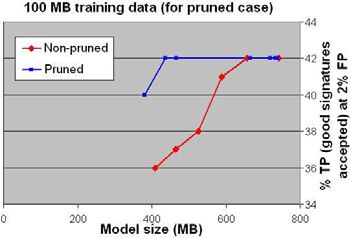
102    K. Griffin et al.

signature is also low – typically one. As a result, the total size of the hash
signature set grows with the exponential growth in the number of unique malware
samples. This creates a signature distribution problem for Symantec: How can
we distribute these hash-based malware signatures to hundreds of millions of
users across the world several dozen times per day in a scalable way?
   One possible solution is to replace hash signatures with string signatures, each
of which corresponds to a short, contiguous byte sequence from a malware bi-
nary. Thus, each string signature can cover many malware files. Traditionally,
string signatures are created manually because it is difficult to automatically de-
termine which byte sequence in a malware binary is less FP-prone, i.e., unlikely
to appear in any goodware program in the world. Even for manually created
string signatures, it is generally straightforward for malware authors to evade
them, because they typically correspond to easy-to-modify data strings in mal-
ware binaries, such as names of malware authors, special pop-up messages, etc.
   Hancock is an automatic string signature generation system developed in
Symantec Research Labs that automatically generates high-quality string sig-
natures with minimal FPs and maximal malware coverage. i.e. The probability
that a Hancock-generated string signature appears in any goodware program
should be very, very low. At the same time each Hancock-generated string sig-
nature should identify as many malware programs as possible. Thus, although
one string signature takes more space than one hash signature, it uses far less
space than all of the hash signatures it replaces.
   Given a set of malware samples, Hancock is designed to create a minimal
set of N -byte sequences, each of which has a sufficiently low false positive rate,
that collectively cover as large a portion of the malware set as possible. Based on
previous empirical studies, Hancock sets N to 48. It uses three types of heuristics
to test a candidate signature’s FP rate: probability-based, disassembly-based,
and diversity-based. The first two filter candidate signatures extracted from
malware files and the last selects good signatures from among these candidates.
   Hancock begins by recursively unpacking malware files using Symantec’s un-
packing engine. It rejects files that are packed and cannot be unpacked, according
to this engine, PEiD [1], and entropy analysis, and stores 48-byte sequences from
these files in a list of invalid signatures. Hancock does this because signatures
produced on packed files are likely to cover the unpacking code. Blacklisting
certain packers should only be done explicitly by a human, rather than through
automated signature generation.
   Hancock then examines every 48-byte code sequence in unpacked malware
files. It finds candidate signatures using probability-based and disassembly-based
heuristics: it filters out byte sequences whose estimated occurrence probability
in goodware programs, according to a pre-computed goodware model, is above
a certain threshold; that are considered a part of library functions; or whose as-
sembly instructions are not sufficiently interesting or unique, based on heuristics
that encode malware analysts’ selection criteria. It examines only code so that
disassembly-based heuristics can work and because malware authors can more
easily vary data.
Automatic Generation of String Signatures for Malware Detection      103

   Among those candidate signatures that pass the initial filtering step, Hancock
further applies a set of selection rules based on the diversity principle: If the
set of malware samples containing a candidate signature are similar, then they
are less FP-prone. A candidate signature in a diverse set of malware files is
more likely to be a part of a library used by several malware families. Though
identifying several malware families seems like a good idea, if a signature is part
of library code, goodware files might use the same library. On the other hand, if
the malware files are similar, they are more likely to belong to one family and
the candidate signature is more likely to be code that is unique to that family.
   Finally, Hancock is extended to generate string signatures that consist of mul-
tiple disjoint byte sequences rather than only one contiguous byte sequence.
Although multi-component string signatures are more effective than single-
component signatures, they also incur higher run-time performance overhead
because individual components are more likely to match goodware programs.
In the following sections, we will describe the signature filter algorithms, the
signature selection algorithms, and the multi-component generalization used in
Hancock.

2   Related Work

Modern anti-virus software typically employ a variety of methods to detect
malware programs, such as signature-based scanning [2], heuristic-based detec-
tion [3], and behavioral detection [4]. Although less proactive, signature-based
malware scanning is still the most prevalent approach to identify malware be-
cause of its efficiency and low false positive rate. Traditionally, the malware
signatures are created manually, which is both slow and error-prone. As a re-
sult, efficient generation of malware signatures has become a major challenge for
anti-virus companies to handle the exponential growth of unique malware files.
To solve this problem, several automatic signature generation approaches have
been proposed.
   Most previous work focused on creating signatures that are used by Network
Intrusion Detection Systems (NIDS) to detect network worms. Singh et al. pro-
posed EarlyBird [5], which used packet content prevalence and address dispersion
to automatically generate worm signatures from the invariant portions of worm
payloads. Autograph [6] exploited a similar idea to create worm signatures by
dividing each suspicious network flow into blocks terminated by some breakmark
and then analyzing the prevalence of each content block. The suspicious flows are
selected by a port-scanning flow classifier to reduce false positives. Kreibich and
Crowcroft developed Honeycomb [7], a system that uses honeypots to gather
inherently suspicious traffic and generates signatured by applying the longest
common substring (LCS) algorithm to search for similarities in the packet pay-
loads. One potential drawback of signatures generated from previous approaches
is that they are all continuous strings and may fail to match polymorphic worm
payloads. Polygraph [8] instead searched for invariant content in the network
flows and created signatures consisting of multiple disjoint content substrings.
104     K. Griffin et al.

Polygraph also utilized a naive Bayes classifier to allow the probabilistic match-
ing and classification, and thus provided better proactive detection capabilities.
Li et al. proposed Hasma [9], a system that used a model-based algorithm to
analyze the invariant contents of polymorphic worms and analytically prove
the attack-resilience of generated signatures. PDAS (Position-Aware Distribu-
tion Signatures) [10] took advantage of a statistical anomaly-based approach to
improve the resilience of signatures to polymorphic malware variants. Another
common method for detecting polymorphic malware is to incorporate semantics-
awareness into signatures. For example, Christodorescu et al. proposed static
semantics-aware malware detection in [11]. They applied a matching algorithm
on the disassembled binaries to find the instruction sequences that match the
manually generated templates of malicious behaviors, e.g., decryption loop. Yeg-
neswaran et al. developed Nemean [12], a framework for automatic generation
of intrusion signatures from honeynet packet traces. Nemean applied cluster-
ing techniques on connections and sessions to create protocol-semantic-aware
signatures, thereby reducing the possibility of false alarms.
   Hancock differs from previous work by focusing on automatically generating
high-coverage string signatures with extremely low false positives. Our research
was based loosely on the virus signature extraction work [13] by Kephart and
Arnold, which was commercially used by IBM. They used a 5-gram Markov chain
model of good software to estimate the probability that a given byte sequence
would show up in good software. They tested hand-generated signatures and
found that it was quite easy to set a model probability threshold with a zero false
positive rate and a modest false negative rate (the fraction of rejected signatures
that would not be found in goodware) of 48%. They also generated signatures
from assembly code (as Hancock does), rather than data, and identified candidate
signatures by running the malware in a test environment. Hancock does not do
this, as dynamic analysis is very slow in large-scale applications.
   Symantec acquired this technology from IBM in the mid-90s and found that
it led to many false positives. The Symantec engineers believed that it worked
well for IBM because IBM’s anti-virus technology was used mainly in corporate
environments, making it much easier for IBM to collect a representative set of
goodware. By contrast, signatures generated by Hancock are mainly for home
users, who have a much broader set of goodware. The model’s training set cannot
possibly contain, or even represent, all of this goodware. This poses a significant
challenge for Hancock in avoiding FP-prone signatures.

3     Signature Candidate Selection

3.1   Goodware Modeling

The first line of defense in Hancock is a Markov chain-based model that is trained
on a large goodware set and is designed to estimate the probability of a given
byte sequence appearing in goodware. If the probability of a candidate signature
appearing in some goodware program is higher than a threshold, Hancock rejects
Automatic Generation of String Signatures for Malware Detection      105

it. Compared with standard Markov models, Hancock’s goodware model has two
important features:
 – Scalable to very large goodware set. Symantec regularly tests its anti-
   virus signatures against several terabytes of goodware programs. A standard
   Markov model uses linear space [14] in the training set size, with a large con-
   stant factor. Hancock’s goodware model focuses only on high-information-
   density byte sequences so as to scale to very large goodware training sets.
 – Focusing on rare byte sequences. For a candidate signature to not cause
   a false positive, its probability of appearing in goodware must be very, very
   low. Therefore, the primary goal of Hancock’s model is to distinguish between
   low-probability byte sequences and very rare byte sequences.

Basic Algorithm. The model used in Hancock is a fixed-order 5-gram Markov
chain model, which estimates the probability of the fifth byte conditioned on the
occurrence of the preceding four bytes. Training consists of counting instances
of 5-grams – 5-byte sequences – as well as 4-grams, 3-grams, etc. The model
calculates the probability of a 48-byte sequence by multiplying estimated prob-
abilities of each of the 48 bytes. A single byte’s probability is the probability of
that byte following the four preceding bytes. For example, the probability that
“e” follows “abcd” is
               count(abcde)
 p(e|abcd) =                ∗ (1 − (count(abcd))) + p(e|bcd) ∗ (count(abcd))
               count(abcd)

In this equation, count(s) is the number of occurrences of the byte sequence s
in the training set. We limit overtraining with (count(s)), the escape mass of
s. Escape mass decreases with count.
                                √
                                       Empirically, we found that a good escape
mass for our model is (c) = 32+ c .
                              √   32√

Model Pruning. The memory required for a vanilla fixed-order 5-gram model
is significantly greater than the size of the original training set. Hancock re-
duces the memory requirement of the model by incorporating an algorithm that
prunes away less useful grams in the model. The algorithm looks at the relative
information gain of a gram and eliminates it if its information gain is too low.
This allows Hancock to keep the most valuable grams, given a fixed memory
constraint.
   Consider a model’s grams viewed as nodes in a tree. The algorithm considers
every node X, corresponding to byte sequence s, whose children (corresponding
to sσ for some byte σ) are all leaves. Let s be s with its first byte removed.
For example, if s is “abcd”, s is “bcd”. For each child of X, σ, the algorithm
compares p(σ|s) to p(σ|s ). In this example, the algorithm compares p(e|abcd) to
p(e|bcd), p(f|abcd) to p(f|bcd), etc. If the difference between p(σ|s) and p(σ|s )
is smaller than a threshold, that means that X is does not add that much value
to σ’s probability and the node σ can be pruned away without compromising
the model’s accuracy.
106 K. Griffin et al.
To focus on low-probability sequences, Hancock uses the difference between
the logs of these two probabilities, rather than that between their raw probability
values. Given a space budget, Hancock keeps adjusting the threshold until it hits
the space target.
Model Merging. Creating a pruned model requires a large amount of interme-
diate memory, before the pruning step. Thus, the amount of available memory
limits the size of the model that can be created. To get around this limit, Han-
cock creates several smaller models on subsets of the training data, prunes them,
and then merges them.
Merging a model M1 with an existing model M2 is mostly a matter of adding
up their gram counts. The challenge is in dealing with grams pruned from M1
that exist in M2 (and vice versa). The merging algorithm must recreate these
gram counts in M1 . Let sσ be such a gram and let s be s with its first byte
removed. The algorithm estimates the count for sσ as count(s) ∗ p(σ|s ). Once
these pruned grams are reconstituted, the algorithm simply adds the two models’
gram counts.
Experimental Results. We created an occurrence probability model from a
1-GByte training goodware set and computed the probability of a large number
of 24-byte test sequences, extracted from malware files. We checked each test
byte sequence against a goodware database, which is a large superset of the
training set, to determine if it is a true positive (a good signature) or a false
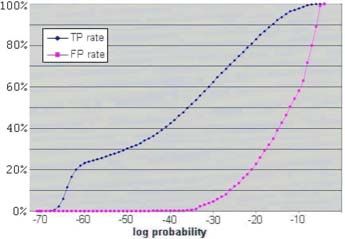
positive (which occurs in goodware). In Figure 1, each point in the FP and TP
curves represents the fraction (Y axis value) of test byte sequences whose model
probability is below the X axis value.
As expected, TP signatures have much lower probabilities, on average, than
FP signatures. A small number of FP signatures have very low probabilities –
below 10−60 . Around probability 10−40 , however, the model does provide excel-
lent discrimination power, rejecting 99% of FP signatures and accepting almost
half of TP signatures.
Fig. 1. Fractions of FP and TP sequences Fig. 2. TP rate comparison between
with probabilities below the X value models with varying pruning thresholds
and varying training set sizesAutomatic Generation of String Signatures for Malware Detection 107
To evaluate the effectiveness of Hancock’s information gain-based pruning
algorithm, we used two sets of models: non-pruned and pruned. The former were
trained on 50 to 100 Mbytes of goodware. The latter were trained on 100 Mbytes
of goodware and pruned to various sizes. For each model, we then computed its
TP rate at the probability threshold that yields a 2% FP rate. Figure 2 shows
these TP rates of goodware models versus the model’s size in memory. In this
case, pruning can roughly halve the goodware model size while offering the same
TP rate as the pruned model derived from the same training set.
3.2 Library Function Recognition
A library is a collection of standard functions that implement common operations,
such as file IO, string manipulation, and graphics. Modern malware authors use
library functions extensively to simplify development, just like goodware authors.
By construction, variants of a malware family are likely to share some library func-
tions. Because these library functions also have a high probability of appearing in
goodware, Hancock needs to remove them from consideration when generating
string signatures. Toward this goal, we developed a set of library function recog-
nition techniques to determine whether a function in a malware file is likely to be
a library function or not.
A popular library identification technique is IDA Pro’s Fast Library Iden-
tification and Recognition Technology (FLIRT) [15], which uses byte pattern
matching algorithms (similar to string signature scanning) to quickly determine
whether a disassembled function matches any of the signatures known to IDA
Pro.1 Although FLIRT is very accurate in pinpointing common library func-
tions, it still needs some improvement to suit Hancock’s needs. First, FLIRT is
designed to never falsely identify a library. To achieve this, FLIRT first tries to
identify the compiler type (e.g., Visual C++ 7.0, 8.0, Borland C++, Delphi, etc.)
of a disassembled program and applies only signatures for that compiler. For ex-
ample, vcseh signatures (Structured Exception Handling library signatures) will
only be applied to binary files that appear to have been compiled with Visual
C++ 7 or 8. This conservative approach can lead to false negatives (a library
function not identified) because of failure in correctly detecting the compiler
type. In addition, because FLIRT uses a rigorous pattern matching algorithm
to search for signatures, small variation in libraries, e.g., minor changes in the
source code, different settings in compiler optimization options or use of different
compiler versions to build the library, could prevent FLIRT from recognizing all
library functions in a disassembled program.
In contrast to FLIRT’s conservative approach, Hancock’s primary goal is to
eliminate false positive signatures. It takes a more aggressive stance by being
willing to mistake non-library functions for library functions. Such misidentifi-
cation is acceptable because it prevents any byte sequence that is potentially
1
IDA Pro ships with a database of signatures for about 120 libraries associated with
common compilers. Each signature corresponds to a binary pattern in a library
function.108 K. Griffin et al. associated with a library function from being used as a malware signature. We exploited this additional latitude with the following three heuristics: Universal FLIRT Heuristic. This heuristic generalizes IDA Pro’s FLIRT technique by matching a given function against all FLIRT signatures, regardless of whether they are associated with the compiler used to compile the function. This generalization is useful because malware authors often post-process their malware programs to hide or obfuscate compiler information in an attempt to deter any reverse engineering efforts. Moreover, any string signatures extracted from a function in a program compiled by a compiler C1 that looks like a li- brary function in another compiler C2 are likely to cause false positives against programs compiled by C2 and thus should be rejected. Library Function Reference Heuristic. This heuristic identifies a library function if the function is statically called, directly or indirectly, by any known library function. The rationale behind this heuristic is that since a library cannot know in advance which user program it will be linked to, it is impossible for a library function to statically call any user-written function, except callback functions, which are implemented through function pointers and dynamically resolved. As a result, it is safe to mark all children of a library function in its call tree as library functions. Specifically, the proposed technique disassembles a binary program, builds a function call graph representation of the program, and marks any function that is called by a known library function as a library function. This marking process repeats itself until no new library function can be found. In general, compilers automatically include into an executable binary certain template code, such as startup functions or error handling, which IDA Pro also considers as library functions as well. These template functions and their callees must be excluded in the above library function marking algorithm. For example, the entry point function start and mainCRTstartup in Visual C++-compiled binaries are created by the compiler to perform startup preparation (e.g., execute global constructors, catch all uncaught exceptions) before invoking the user- defined main function. 3.3 Code Interestingness Check The code interestingness check is designed to capture the intuitions of Symantec’s malware analysis experts about what makes a good string signature. For the most part, these metrics identify signatures that are less likely to be false positives. They can also identify malicious behavior, though avoiding false positives is the main goal. The code interestingness check assigns a score for each “interesting” instruction pattern appearing in a candidate signature, sums up these scores, and rejects the candidate signature if its sum is below a threshold, i.e. not interesting enough. The interesting patterns used in Hancock are: – Unusual constant values. Constants sometimes have hard-coded values that are important to malware, such as the IP address and port of a command
Automatic Generation of String Signatures for Malware Detection      109

   and control server. More importantly, if a signature has unusual constant
   values, it is less likely to be a false positive.
 – Unusual address offsets. Access to memory that is more than 32 bytes
   from the base pointer can indicate access to a large class or structure. If
   these structures are unique to a malware family, then accesses to particular
   offsets into this structure are less likely to show up in goodware. This pattern
   is not uncommon among legitimate Win32 applications. Nonetheless, it has
   good discrimination power.
 – Local or non-library function calls. A local function call itself is not
   very distinctive, but the setup for local function calls often is, in terms of
   how it is used and how its parameters are prepared. In contrast, setup for
   system calls is not as interesting, because they are used in many programs
   and invoked in a similar way.
 – Math instructions. A malware analyst at Symantec noted that malware
   often perform strange mathematical operations, to obfuscate and for various
   other reasons. Thus, Hancock looks for strange sequences of XORs, ADDs,
   etc. that are unlikely to show up in goodware.

4     Signature Candidate Filtering

Hancock selects candidate signatures using techniques that assess a candidate’s
FP probability based solely on its contents. In this section, we describe a set
of filtering techniques that remove from further consideration those candidate
signatures that are likely to cause a false positive based on the signatures’ use
in malware files.
   These diversity-based techniques only accept a signature if it matches variants
of one malware family (or a small number of families). This is because, if a byte
sequence exists in many malware families, it is more likely to be library code –
code that goodware could also use. Therefore, malware files covered by a Hancock
signature should be similar to one another.
   Hancock measures the diversity of a set of binary files based on their byte-
level and instruction-level representations. The following two subsections de-
scribe these two diversity measurement methods.

4.1   Byte-Level Diversity

Given a signature, S, and the set of files it covers, X, Hancock measures the
byte-level similarity or diversity among the files in X by extracting the byte-level
context surrounding S and computing the similarity among these contexts.
More concretely, Hancock employs the following four types of byte-level
signature-containing contexts for diversity measurement.

Malware Group Ratio/Count. Hancock clusters malware files into groups
based on their byte-level histogram representation. It then counts the number
of groups to which the files in X belong. If this number divided by the number
110    K. Griffin et al.

of files in X exceeds a threshold ratio, or if the number exceeds a threshold
count, Hancock rejects S. These files cannot be variants of a single malware
family, if each malware group indeed corresponds to a malware family.

Signature Position Deviation. Hancock calculates the position of S within
each file in X, and computes the standard deviation of S’s positions in these
files. If the standard deviation exceeds a threshold, Hancock rejects S, because
a large positional deviation suggests that S is included in the files it covers for
very different reasons. Therefore, these files are unlikely to belong to the same
malware family. The position of S in a malware file can be an absolute byte
offset, which is with respect to the beginning of the file, or a relative byte offset,
which is with respect to the beginning of the code section containing S.

Multiple Common Signatures. Hancock attempts to find another common
signature that is present in all the files in X and is at least 1 Kbyte away from
S. If such a common signature indeed exists and the distance between this
signature and S has low standard deviation among the files in X, then Hancock
accepts S because this suggests the files in X share a large chunk of code
and thus are likely to be variants of a single malware family. Intuitively, this
heuristic measures the similarity among files in X using additional signatures
that are sufficiently far away, and can be generalized to using the third or fourth
signature.

Surrounding Context Count. Hancock expands S in each malware file in
X by adding bytes to its beginning and end until the resulting byte sequences
become different. For each such distinct byte sequence, Hancock repeats the same
expansion procedure until the expanded byte sequences reach a size limit, or
when the total number of distinct expanded byte sequences exceeds a threshold.
If this expansion procedure terminates because the number of distinct expanded
byte sequences exceeds a threshold, Hancock rejects S, because the fact that
there are more than several distinct contexts surrounding S among the files in
X suggests that these files do not belong to the same malware family.

4.2   Instruction-Level Diversity
Although byte-level diversity measurement techniques are easy to compute and
quite effective in some cases, they treat bytes in a binary file as numerical
values and do not consider their semantics. Given a signature S and the set
of files it covers, X, instruction-level diversity measurement techniques, on the
other hand, measure the instruction-level similarity or diversity among the files
in X by extracting the instruction-level context surrounding S and computing
the similarity among these contexts.

Enclosing Function Count. Hancock extracts the enclosing function of S in
each malware file in X, and counts the number of distinct enclosing functions.
If the number of distinct enclosing functions of S with respect to X is higher
than a threshold, Hancock rejects S, because S appears in too many distinct
Automatic Generation of String Signatures for Malware Detection      111

contexts among the files in X and therefore is not likely to be an intrinsic part
of one or a very small number of malware families. To determine if two enclosing
functions are distinct, Hancock uses the following three identicalness measures,
in decreasing order of strictness:
 – The byte sequences of the two enclosing functions are identical.
 – The instruction op-code sequences of the two enclosing functions are identi-
   cal. Hancock extracts the op-code part of every instruction in a function, and
   normalizes variants of the same op-code class into their canonical op-code.
   For example, there are about 10 different X86 op-codes for ADD, and Han-
   cock translates all of them into the same op-code. Because each instruction’s
   operands are ignored, this measure is resistant to intentional or accidental
   polymorphic transformations such as re-locationing, register assignment, etc.
 – The instruction op-code sequences of the two enclosing functions are iden-
   tical after instruction sequence normalization. Before comparing two op-
   code sequences, Hancock performs a set of de-obfuscating normalizations
   that are designed to undo simple obfuscating transformations, such as re-
   placing “test esi, esi” with “or esi, esi”, replacing “push ebp; mov
   ebp, esp” with “push ebp; push esp; pop ebp”, etc.

5   Multi-Component String Signature Generation
Traditionally, string signatures used in AV scanners consist of a contiguous se-
quence of bytes. We refer to these as single-component signature (SCS). A nat-
ural generalization of SCS is multi-component signatures (MCS), which consist
of multiple byte sequences that are potentially disjoint from one another. For
example, we can use a 48-byte SCS to identify a malware program; for the same
amount of storage space, we can create a two-component MCS with two 24-byte
sequences. Obviously, an N -byte SCS is a special case of a K-component MCS
                                 N
where each component is of size K   . Therefore, given a fixed storage space budget,
MCS provides more flexibility in choosing malware-identifying signatures than
SCS, and is thus expected to be more effective in improving coverage without
increasing the false positive rate.
   In the most general form, the components of a MCS do not need to be of
the same size. However, to limit the search space, in the Hancock project we
explore only those MCSs that have equal-sized components. So the next ques-
tion is how many components a MCS should have, given a fixed space budget.
Intuitively, each component should be sufficiently long so that it is unlikely to
match a random byte sequence in binary programs by accident. On the other
hand, the larger the number of components in a MCS, the more effective it is
in eliminating false positives. Given the above considerations and the practical
signature size constraint, Hancock chooses the number of components in each
MCS to be between 3 and 5.
   Hancock generates the candidate component set using a goodware model and
a goodware set. Unlike SCS, candidate components are drawn from both data
and code, because intuitively, combinations of code component signatures and
112 K. Griffin et al.
data component signatures make perfectly good MCS signatures. When Han-
N
cock examines an K -byte sequence, it finds the longest substring containing this
sequence that is common to all malware files that have the sequence. Hancock
takes only one candidate component from this substring. It eliminates all se-
quences that occur in the goodware set and then takes the sequence with the
lowest model probability. Unlike SCS, there is no model probability threshold.
Given a set of qualified component signature candidates, S1, and the set of
malware files that each component signature candidate covers, Hancock uses
the following algorithm to arrive at the final subset of component signature
candidates used to form MCSs, S2:
1. Compute for each component signature candidate in S1 its effective coverage
value, which is a sum of weights associated with each file the component
signature candidate covers. The weight of a covered file is equal to its coverage
count, the number of candidates in S2 already covering it, except when the
number of component signatures in S2 covering that file is larger than or
equal to K, in which case the weight is set to zero.
2. Move the component signature candidate with the highest effective cover-
age value from S1 to S2, and increment the coverage count of each file the
component signature candidate covers.
3. If there are still malware files that are still uncovered or there exists at least
one component signature in S1 whose effective coverage value is non-zero,
go to Step 1; otherwise exit.
The above algorithm is a modified version of the standard greedy algorithm for
the set covering problem. The only difference is that it gauges the value of each
component signature candidate using its effective coverage value, which takes
into account the fact that at least K component signatures in S2 must match a
malware file before the file is considered covered. The way weights are assigned
to partially covered files is meant to reflect the intuition that the value of a
component signature candidate to a malware file is higher when it brings the
file’s coverage count from X − 1 to X than that from X − 2 to X − 1, where X
is less than or equal to K.
After S2 is determined, Hancock finalizes the K-component MCS for each
malware file considered covered, i.e., whose coverage count is no smaller than
K. To do so, Hancock first checks each component signature in S2 against a
goodware database, and marks it as an FP if it matches some goodware file
in the database. Then Hancock considers all possible K-component MCSs for
each malware file and chooses the one with the smallest number of components
that are an FP. If the number of FP components in the chosen MCS is higher
than a threshold, TF P , the MCS is deemed as unusable and the malware file is
considered not covered. Empirically, T is chosen to be 1 or 2. After each malware
file’s MCS is determined, Hancock applies the same diversity principle to each
MCS based on the malware files it covers.Automatic Generation of String Signatures for Malware Detection 113
6 Evaluation
6.1 Methodology
To evaluate the overall effectiveness of Hancock, we used it to generate 48-
byte string signatures for two sets of malware files, and use the coverage and
number of false positives of these signatures as the performance metrics. The
first malware set has 2,363 unpacked files that Symantec gathered in August
2008. The other has 46,288 unpacked files (or 112,156 files before unpacking)
gathered in 2007-2008. The goodware model used in initial signature candidate
filtering is derived from a 31-Gbyte goodware training set. In addition, we used
another 1.8-Gbyte goodware set to filter out FP-prone signature candidates. To
determine which signatures are FPs, we tested each generated signature against
a 213-Gbyte goodware set. The machine used to perform these experiments has
four quad-core 1.98-GHz AMD Opteron processors and 128 Gbytes of RAM.
6.2 Single-Component Signatures
Because almost every signature candidate selection and filtering technique in
Hancock comes with an empirical threshold parameter, it is impossible to present
results corresponding to all possible combinations of these parameters. Instead,
we present results corresponding to three representative settings, which are
shown in Table 1 and called Loose, Normal and Strict. The generated signa-
tures cover overlapping sets of malware files.
To gain additional assurance that Hancock’s FP rate was low enough, Syman-
tec’s malware analysts wanted to see not only zero false positives, but also that
the signatures look good – they look like they encode non-generic behavior that
is unlikely to show up in goodware. To that end, we manually ranked signatures
on the August 2008 malware set as good, poor, and bad.
To get a rough indication of the maximum possible coverage, the last lines
in tables 2 and 3 show the coverage of all non-FP candidate signatures. The
probability-based and dissassembly-based heuristics were still enabled with
Loose threshold settings.
These results show not only that Hancock has a low FP rate, but also that
tighter thresholds can produce signatures that look less generic. Unfortunately,
it can only produce signatures to cover a small fraction of the specified malware.
Several factors limit Hancock’s coverage:
– Hancock’s packer detection might be insufficient. PEiD recognizes many
packers, but by no means all of them. Entropy detection can also be fooled:
Table 1. Heuristic threshold settings
Threshold Model Group Position # common Interestingness Minimum
setting probability ratio deviation signatures coverage
Loose -90 0.35 4000 1 13 3
Normal -90 0.35 3000 1 14 4
Strict -90 0.35 3000 2 17 4114 K. Griffin et al.
Table 2. Results for August 2008 data Table 3. Results for 2007-8 data
Threshold Cover- # Good Poor Bad Threshold Coverage Sig.s FPs
setting age FPs sig.s sig.s sig.s Loose 14.1% 1650 7
Loose 15.7% 0 6 7 1 Normal 11.7% 767 2
Normal 14.0% 0 6 2 0 Normal, pos. 11.3% 715 0
Strict 11.7% 0 6 0 0 deviation 1000
All non-FP 22.6% 0 10 11 9 Strict 4.4% 206 0
All non-FP 31.7% 7305 0
some packers do not compress the original file’s data, but only obfuscate
it. Diversity-based heuristics will probably reject most candidate signatures
extracted from packed files. (Automatically generating signatures for packed
files would be bad, anyway, since they would be signatures on packer code.)
– Hancock works best when the malware set has many malware families and
many files in each malware family. It needs many families so that diversity-
based heuristics can identify generic or rare library code that shows up in
several malware families. It needs many files in each family so that diversity-
based heuristics can identify which candidate signatures really are charac-
teristic of a malware family. If the malware sets have many malware families
with only a few files each, this would lower Hancock’s coverage.
– Malware polymorphism hampers Hancock’s effectiveness. If only some code
is polymorphic, Hancock can still identify high coverage signatures in the
remaining code. If the polymorphic code has a relatively small number of
variations, Hancock can still identify several signatures with moderate cov-
erage that cover most files in the malware family. If all code is polymorphic,
with a high degree of variation, Hancock will cover very few of the files.
– Finally, the extremely stringent FP requirement means setting heuristics to
very conservative thresholds. Although the heuristics have good discrimina-
tion power, they still eliminate many good signatures. e.g. The group count
heuristic clusters malware into families based on a single-byte histogram.
This splits most malware families into several groups, with large malware
families producing a large number of groups. An ideal signature for this
family will occur in all of those groups. Thus, for the sake of overall discrim-
ination power, the group count heuristic will reject all such ideal signatures.
Sensitivity Study. A heuristic’s discrimination power is a measure of its ef-
fectiveness. A heuristic has good discrimination power if the fraction of false
positive signatures that it eliminates is higher than the fraction of true positive
signatures it eliminates. These results depend strongly on which other heuristics
are in use. We tested heuristics in two scenarios: we measured their raw discrim-
ination power with other heuristics disabled; and we measured their marginal
discrimination power with other heuristics enabled with conservative thresholds.
First, using the August 2008 malware set, we tested the raw discrimination
power of each heuristic. Table 4 shows the baseline setting, more conservativeAutomatic Generation of String Signatures for Malware Detection 115
Table 4. Raw Discrimination Power Table 5. Marginal Discrimination Power
Heuristic FPs Cov. DP Heuristic FPs Coverage
Max pos. deviation 41.7% 96.6% 25 Max pos. deviation 10 121%
(from ∞ to 8,000) (from 3,000 to ∞)
Min file coverage 6.0% 83.3% 15 Min file coverage 2 126%
(from 3 to 4) (from 4 to 3)
Group ratio 2.4% 74.0% 12 Group ratio 16 162%
(from 1.0 to .6) (from 0.35 to 1)
Model log probability 51.2% 73.7% 2.2 Model log probability 1 123%
(from -80 to -100) (from -90 to -80)
Code interestingness 58.3% 78.2% 2.2 Code interestingness 2 226%
(from 13 to 15) (from 17 to 13)
Multiple common sig.s 91.7% 70.2% 0.2 Multiple common 0 189%
(from 1 to 2) sig.s (from 2 to 1)
Universal FLIRT 33.1% 71.7% 3.3 Universal FLIRT 3 106%
Library function 46.4% 75.7% 2.8 Library function 4 108%
reference reference
Address space 30.4% 70.8% 3.5 Address space 3 109%
setting, and discrimination power for each heuristic. The library heuristics (Uni-
versal FLIRT, library function reference, and address space) are enabled for the
baseline test and disabled to test their own discrimination powers. Using all
baseline settings, the run covered 551 malware files with 220 signatures and 84
FPsi Coveragei
false positives. Discrimination power is calculated as log FPsf log Coverage .
f
Table 4 shows most of these heuristics to be quite effective. Position deviation
and group ratio have excellent discrimination power (DP); the former lowers
coverage very little and the latter eliminates almost all false positives. Model
probability and code interestingness showed lower DP because their baseline
settings were already somewhat conservative. Had we disabled these heuristics
entirely, the baseline results would have been so overwhelmed with false positives
as to be meaningless. All four of these heuristics are very effective.
Increasing the minimum number of malware files a signature must cover elim-
inates many marginal signatures. The main reason is that, for lower coverage
numbers, there are so many more candidate signatures that some bad ones will
get through. Raising the minimum coverage can have a bigger impact in combi-
nation with diversity-based heuristics, because those heuristics work better with
more files to analyze.
Requiring two common signatures eliminated more good signatures than false
positive signatures. It actually made the signatures, on average, worse.
Finally, the library heuristics all work fairly well. They each eliminate 50% to
70% of false positives while reducing coverage less than 30%. In the test for each
library heuristic, the other two library heuristics and basic FLIRT functionality
were still enabled. This shows that none of these library heuristics are redundant
and that these heuristics go significantly beyond what FLIRT can do.116 K. Griffin et al. Marginal Contribution of Each Technique. Then we tested the effective- ness of each heuristic when other heuristics were set to the Strict thresholds from table 1. We tested the tunable heuristics with the 2007-8 malware set with Strict baseline threshold settings from table 1. Testing library heuristics was more computationally intensive (requiring that we reprocess the malware set), so we tested them on August 2008 data with baseline Loose threshold settings. Since both sets of baseline settings yield zero FPs, we decreased each heuristic’s threshold (or disabled it) to see how many FPs its conservative setting elimi- nated and how much it reduced malware coverage. Table 5 shows the baseline and more liberal settings for each heuristic. Using all baseline settings, the run covered 1194 malware files with 206 signatures and 0 false positives. Table 5 shows that almost all of these heuristics are necessary to reduce the FP rate to zero. Among the tunable heuristics, position deviation performs the best, eliminating the second most FPs with the lowest impact on coverage. The group ratio also performs well. Requiring a second common signature does not seem to help at all. The library heuristics perform very well, barely impacting coverage at all. Other heuristics show significantly decreased marginal discrimination power, which captures an important point: if two heuristics eliminate the same FPs, they will show good raw discrimination power, but poor marginal discrimination power. 6.3 Single-Component Signature Generation Time The most time-consuming step in Hancock’s string signature generation process is goodware model generation, which, for the model used in the above exper- iments, took approximately one week and used up all 128 GBytes of available memory in the process of its creation. Fortunately, this step only needs to be done once. Because the resulting model is much smaller than the available mem- ory in the testbed machine, using the model to estimate a signature candidate’s occurrence probability does not require any disk I/O. The three high-level steps in Hancock at run time are malware pre-processing (including unpacking and disassembly), picking candidate signatures, and apply- ing diversity-based heuristics to arrive at the best ones. Among them, malware pre-processing is the most expensive step, but is also quite amenable to paral- lelization. The two main operations in malware pre-processing are recursively unpacking malware files and disassembling both packed and unpacked files us- ing IDA Pro. Both use little memory, so we parallelized them to use 15 of our machines 16 cores. For the 2007-2008 data set, because of the huge number of packed malware files and the decreasing marginal return of analyzing them, Hancock disassembled only 5,506 packed files. Pre-processing took 71 hours. Picking candidate signatures took 145 minutes and 37.4 GB of RAM. 15 min- utes and 34.3 GB of RAM went to loading the goodware model. The remainder was for scanning malware files and picking and storing candidate signatures in memory and then on disk.
Automatic Generation of String Signatures for Malware Detection    117

                    Table 6. Multi-Component Signature results

 # components Permitted component FPs Coverage # Signatures # FPs
      2                   1            28.9%        76        7
      2                   0            23.3%        52        2
      3                   1            26.9%        62        1
      3                   0            24.2%        44        0
      4                   1            26.2%        54        0
      4                   0            18.1%        43        0
      5                   1            26.2%        54        0
      5                   0            17.9%        43        0
      6                   1            25.9%        51        0
      6                   0            17.6%        41        0

  Generating the final signature set took 420 minutes and 6.07 GB of RAM.
Most of this time was spent running IDA Pro against byte sequences surrounding
the final signatures to output their assembly representation. Without this step,
the final signature generation step would have taken only a few minutes.

6.4    Multi-Component Signatures

We tested MCS signatures with 2 to 6 components, with each part being 16 bytes
long. We used a 3.0 GB goodware set to select component candidates and tested
for false positives with a 34.9 GB set of separate goodware.2 Table 6 shows the
coverage and false positive rates when 0 or 1 components could be found in the
smaller goodware set.
   We first observe that permitting a single component of an MCS to be an FP
in our small goodware set consistently results in higher coverage. However, from
2- and 3-component signatures, we also see that allowing a single component
FP results in more entire MCS FPs, where all signature components occur in a
single goodware file.
   We can trade off coverage and FP rate by varying the number of signatures
components and permitted component FPs. Three to five part signatures with 0
or 1 allowed FPs seems to provide the best tradeoff between coverage and FPs.
   Since we applied so few heuristics to get these results, beyond requiring the
existence of the multiple, disjoint signature components which make up the sig-
nature, it is perhaps surprising that we have so few MCS FPs. We explain this
by observing that although we do not limit MCS components to code bytes,
we do apply all the library code reducing heuristics through IDA disassembly
described in Section 3.2.
   Also, the way in which signature components are selected from contiguous
runs of identical bytes may reduce the likelihood of FPs. If a long, identical byte
sequence exists in a set of files, the 16 byte signature component with lowest
2
    This final goodware set was smaller than in SCS tests because of the difficulty of
    identifying shorter, 16-byte sequences.
118 K. Griffin et al. probability will be selected. Moreover, no other signature component will be selected from the same run of identical bytes. Thus, if malware shares an identical uncommon library (which we fail to identify as a library) linked in contiguously in the executable, at most one signature component will be extracted from this sequence of identical bytes. The other components must come from some other shared code or data. Finding candidate signatures took 1,278 minutes and 117 GB of RAM. Picking the final signature sets took 5 to 17 minutes and used 9.0 GB of RAM. 7 Discussion The main limitation of the current version of Hancock is its low coverage, which is also the biggest surprise in this project. One potential explanation for this result is that malware authors have recently evolved their malware distribution strat- egy from a “few malware families each with many variants” model to a “many malware families each with few variants” model, so as to keep each distributed malware sample effective for as long as possible. Because Hancock is designed to generate string signatures that correspond to common byte sequences shared by variants of the same malware family, if the average number of variants in each family is decreased, it is more difficult for Hancock to generate signature with good coverage while keeping the false positive rate in check, especially when state-of-the-art malware classification technology is still quite primitive. To generate new malware families, malware authors use sophisticated pack- ing and/or metamorphic transformation tools. The current version of Hancock cannot do much for binaries created by these tools. The static unpack engine Hancock uses is used in Symantec’s anti-virus products. Still it cannot handle many packers or metamorphic transformation tools. For example, in the largest test described in Section 6.2, Hancock has to ignore 59% of the input malware set because it found them to be packed and could not unpack them. Among the remaining 41%, some of them are probably packed (perhaps partially), but are not detected by Hancock. For such malware files, Hancock won’t create string signatures for them because they do not share common byte sequences with other malware files. In the future, we plan to incorporate dynamic unpacking techniques, such as Justin [16], to reduce the impact of packers on Hancock’s coverage. It is also possible to mitigate the packer problem by blacklisting binaries packed by certain packers. We did not spend much effort investigating metamorphic trans- formation tools in the Hancock project, because string signature-based malware identification may not be effective for metamorphic binaries. Instead, behavior- based malware identification may be a more promising solution. Nonetheless, systematically studying modern metamorphic tools and devising a taxonomi- cal framework to describe them will be very useful contributions to the field of malware analysis. Another significant limitation of Hancock is its lack of dynamic analysis, which forces it to give up on packed or metamorphically transformed binaries that it
Automatic Generation of String Signatures for Malware Detection       119

cannot recognize or restore. The rationale for the design decision of employing
only static analysis in Hancock is that it cannot afford the run-time performance
cost associated with dynamic analysis given the current and future malware ar-
rival rate. In addition, even state-of-the-art dynamic analysis techniques cannot
solve all the packer or metamorphism problems for Hancock.
   Although many of Hancock’s heuristics can be evaded, in general this is a
much smaller concern than the problem that malware authors avoid using known
string signatures in their binaries. Attackers can (and do) test newly generated
malware files against popular anti-virus products. In contrast, even if malware
authors create malware files that do not contain byte sequences that Hancock
may use as signatures, there is no easy way to test the effectiveness of these
malware files against Hancock’s signature generation algorithms, because it is
not publicly available and because it has so many empirical built-in parameters.
In theory, security by obscurity is not a foolproof solution; in practice, it is very
difficult, if not infeasible, to evade Hancock’s signature generation heuristics.

8   Conclusion
Given a set of malware files, an ideal string signature generation system should
be able to automatically generate signatures in such a way that the number
of signatures required to cover the malware set is minimal and the probability
of these signatures appearing in goodware programs is also minimal. The main
technical challenge of building such string signature generation systems is how
to determine how FP-prone a byte sequence is without having access to even
a sizeable portion of the world’s goodware set. This false positive problem is
particularly challenging because the goodware set is constantly growing, and is
potentially unbounded. In the Hancock project, we have developed a series of
signature selection and filtering techniques that collectively could remove most,
if not all, FP-prone signature candidates, while maintaining a reasonable cover-
age of the input malware set. In summary, the Hancock project has made the
following research contributions in the area of malware signature generation:
 – A scalable goodware modeling technique that prunes away unimportant
   nodes according to their relative information gain and merges sub-models
   so as to scale to very large training goodware sets,
 – A set of diversity-based techniques that eliminate signature candidates when
   the set of malware programs they cover exhibit high diversity, and
 – The first known string signature generation system that is capable of creat-
   ing multi-component string signatures which have been shown to be more
   effective than single-component string signatures.
Although Hancock represents the state of the art in string signature generation
technology, there is still room for further improvement. The overall coverage
of Hancock is lower than what we expected when we started the project. How
to improve Hancock’s coverage without increasing the FP rate of its signatures
is worth further research. Although the multi-component signatures that Han-
cock generates are more effective than single-component signatures, their actual
120     K. Griffin et al.

run-time performance impact is unclear and requires more thorough investiga-
tion. Moreover, there could be other forms of multi-component signatures that
Hancock does not explore and therefore deserve additional research efforts.
   This paper omitted discussion of several additional heuristics explored in
project Hancock. See [17] for more details.

References
 1. PEiD, http://www.peid.info
 2. Clam AntiVirus: Creating signatures for ClamAV (2007),
    http://www.clamav.net/doc/latest/signatures.pdf
 3. Arnold, W., Tesauro, G.: Automatically generated win32 heuristic virus detection.
    In: Proceedings of Virus Bulletin Conference (2000)
 4. Jacob, G., Debar, H., Filiol, E.: Behavioral detection of malware: from a survey
    towards an established taxonomy. Journal in Computer Virology 4(3) (2008)
 5. Singh, S., Estan, C., Varghese, G., Savage, S.: Automated worm fingerprinting. In:
    OSDI 2004: Proceedings of the 6th conference on Symposium on Opearting Systems
    Design & Implementation, Berkeley, CA, USA, p. 4. USENIX Association (2004)
 6. Kim, H.: Autograph: Toward automated, distributed worm signature detection. In:
    Proceedings of the 13th Usenix Security Symposium, pp. 271–286 (2004)
 7. Kreibich, C., Crowcroft, J.: Honeycomb: creating intrusion detection signatures
    using honeypots. SIGCOMM Comput. Commun. Rev. 34(1), 51–56 (2004)
 8. Newsome, J., Karp, B., Song, D.: Polygraph: Automatically generating signatures
    for polymorphic worms. In: SP 2005: Proceedings of the 2005 IEEE Symposium
    on Security and Privacy, Washington, DC, USA, pp. 226–241. IEEE Computer
    Society, Los Alamitos (2005)
 9. Li, Z., Sanghi, M., Chen, Y., Kao, M., Chavez, B.: Hamsa: fast signature genera-
    tion for zero-day polymorphic worms with provable attack resilience. In: SP 2006:
    Proceedings of the 2006 IEEE Symposium on Security and Privacy, Oakland06,
    pp. 32–47. IEEE Computer Society, Los Alamitos (2006)
10. Tang, Y., Chen, S.: Defending against internet worms: A signature-based approach.
    In: Proceedings of IEEE INFOCOM 2005 (2005)
11. Christodorescu, M., Jha, S., Seshia, S., Song, D., Bryant, R.: Semantics-aware mal-
    ware detection. In: Proceedings of the IEEE Symposium on Security and Privacy
    (2005)
12. Yegneswaran, V., Giffin, J.T., Barford, P., Jha, S.: An architecture for generating
    semantics-aware signatures. In: SSYM 2005: Proceedings of the 14th conference on
    USENIX Security Symposium, Berkeley, CA, USA, p. 7. USENIX Association (2005)
13. Kephart, J.O., Arnold, W.C.: Automatic extraction of computer virus signatures.
    In: Proceedings of the 4th Virus Bulletin International Conference (1994)
14. Begleiter, R., El-Yaniv, R., Yona, G.: On prediction using variable order markov
    models. Journal of Artificial Intelligence Research 22, 384–421 (2004)
15. Guilfanov, I.: Fast library identification and recognition technology (1997),
    http://www.hex-rays.com/idapro/flirt.htm
16. Guo, F., Ferrie, P., Chiueh, T.: A study of the packer problem and its solutions.
    In: Lippmann, R., Kirda, E., Trachtenberg, A. (eds.) RAID 2008. LNCS, vol. 5230,
    pp. 98–115. Springer, Heidelberg (2008)
17. Griffin, K., Schneider, S., Hu, X., Chiueh, T.: Automatic generation of string sig-
    natures for malware detection (2009),
    http://www.ecsl.cs.sunysb.edu/tr/TR236.pdf
You can also read


