Boothwyn Town Center Vision Plan - Upper Chichester Township January 2022
←
→
Page content transcription
If your browser does not render page correctly, please read the page content below
Boothwyn Town Center
Vision Plan
Upper Chichester Township
January 2022


Boothwyn Town Center
Vision Plan
Upper Chichester Township, Pennsylvania
January 2022
Acknowledgements
   Upper Chichester Township
       Barbara Kelley, Assistant Township Manager		      George Needles, Township Manager
       Brian Seidel, Township Planner				                Lisa Catania, Township Engineer

   Upper Chichester Township Commisioners
       Edward Raikowski , President 				                 Michael Gaudiuso
       Nicole Whitaker, Vice President				               Joseph Neary
       Joseph Baiocco

   Boothwyn Town Center Vision Plan Task Force
       Edward Raikowski, Commissioner			                 Mark Gibbons, Business Owner, CBA
       Pam Andrien, Planning Commission			               Barbara Massey, Resident
       Ed Coleman, CAADC					                            Nicole Steinnacher, Resident
       Lisa Curry, Resident					                         John Schueren, Resident, Historical Society
       Mike Fiorelli, Business Owner, CBA, Rotary		      Judy Stang, Heart and Soul, Rotary

       				                          John Orndoff, Emeritus

   Planning Consultant - CHPlanning LTD
       Charnelle Hicks, President
       Nancy Templeton, Project Manager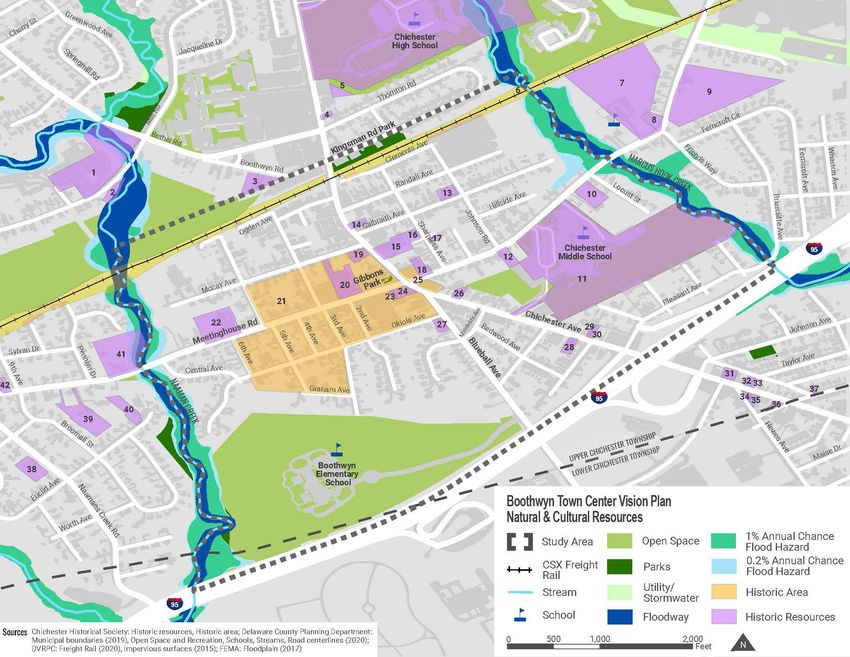
Contents
           1   Introduction								 1
               Purpose and Scope									 1
               Town Center Context								 1
               Historical Overview									 1

           2   Community Engagement					 4
               Stakeholder Surveys								 4
               Public Open Houses									 4
               Community Survey									 7

           3   Boothwyn Today							11
               Socioeconomic Profile								              11
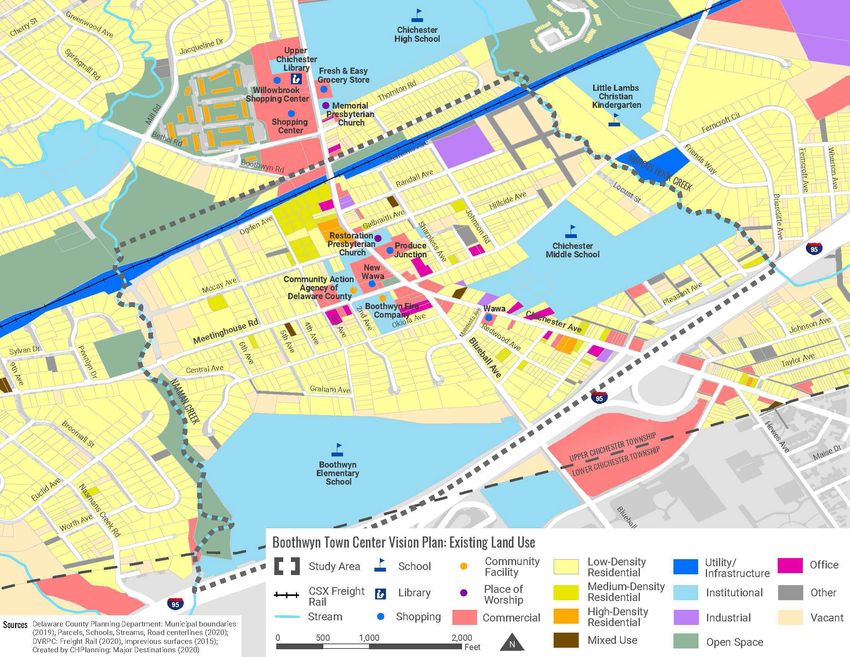
               Exisiting Land Use									                14
               Exisiting Zoning									                  14
               Mobility and Circulation								           14
               Natural Resources									                 19
               Historical and Cultural Resources							   20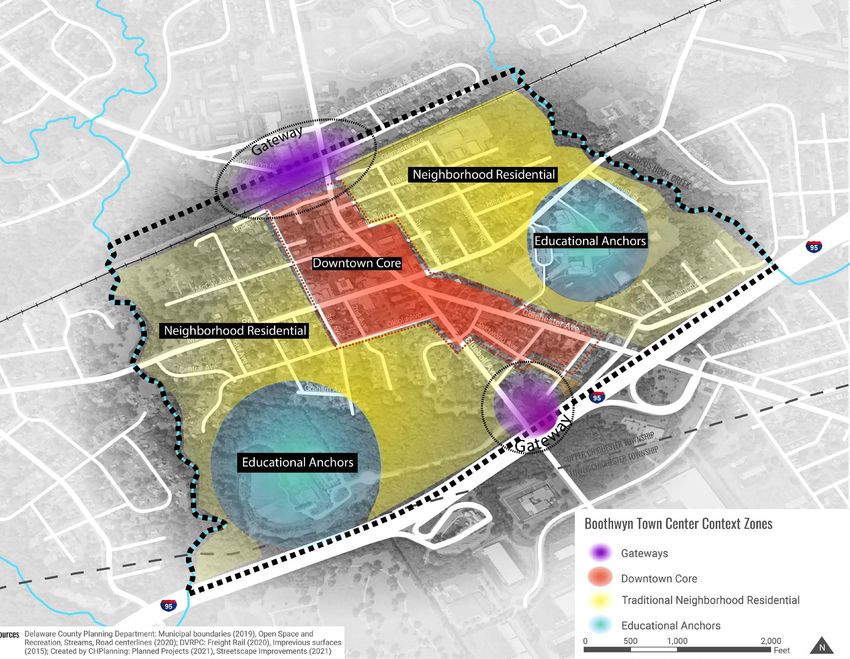
Contents

           4   The Boothwyn Town Center Vision			          24
               Priority Issues and Opportunities							     24
               Vision Statement									                    24
               Goals and Objectives								                 24
               Opportunity Concepts								                 25

           5   Implementation Strategy					 40
               Implementation Projects and Strategies						 40
               Implementation Matrix								 50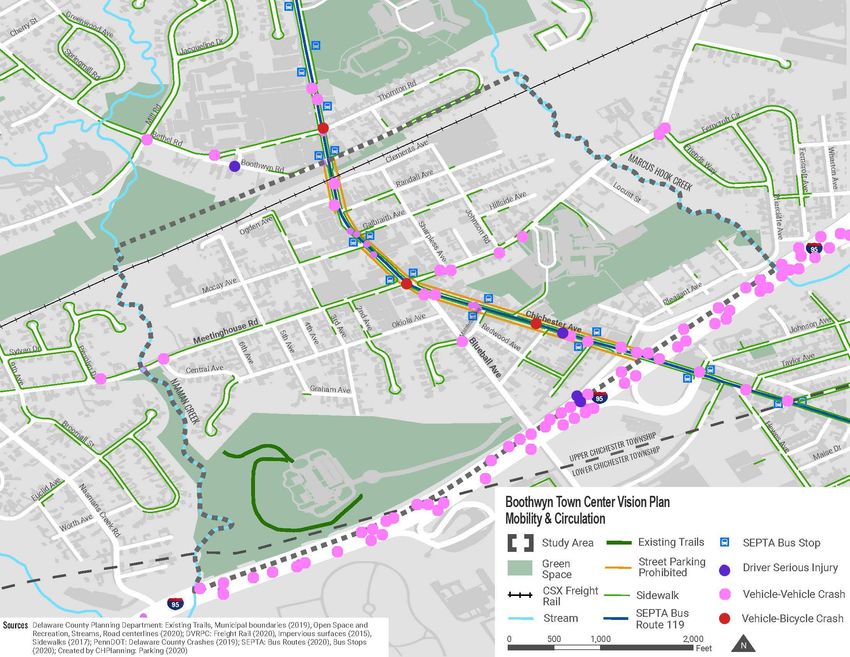
Introduction
1

1 Introduction

                                                                                                                                          Introduction | The Boothwyn Town Center Vision Plan
PURPOSE AND SCOPE
Upper Chichester Township has embarked on the Boothwyn Town
Center Vision Plan, an implementable action plan designed to
establish an overall guiding smart growth development strategy by
attracting economic development opportunities, increasing existing
business opportunities, improving walkability, and increasing the
diversity of businesses and housing options.

In collaboration with residents, business owners, local leadership,
county and state government, and property owners, a vision for
the Boothwyn Town Center was created to include opportunities         Regional Context
and implementation strategies to:

   •   Attract economic development                                   Boothwyn is located near the junction of I-95 and Chichester Ave,
   •   Expand existing business opportunities                         just north of the Delaware state line. The heart of the Boothwyn
                                                                      Town Center is defined by the intersection of Chichester Ave and
   •   Diversify business offerings                                   Meetinghouse Rd, with Chichester Ave as the primary commercial
   •   Expand the diversity of housing options                        spine. The Boothwyn Town Center study area is bordered by I-95
   •   Preserve Historic Character                                    to the south, Kingsman Road to the north, Marcus Hook Creek to
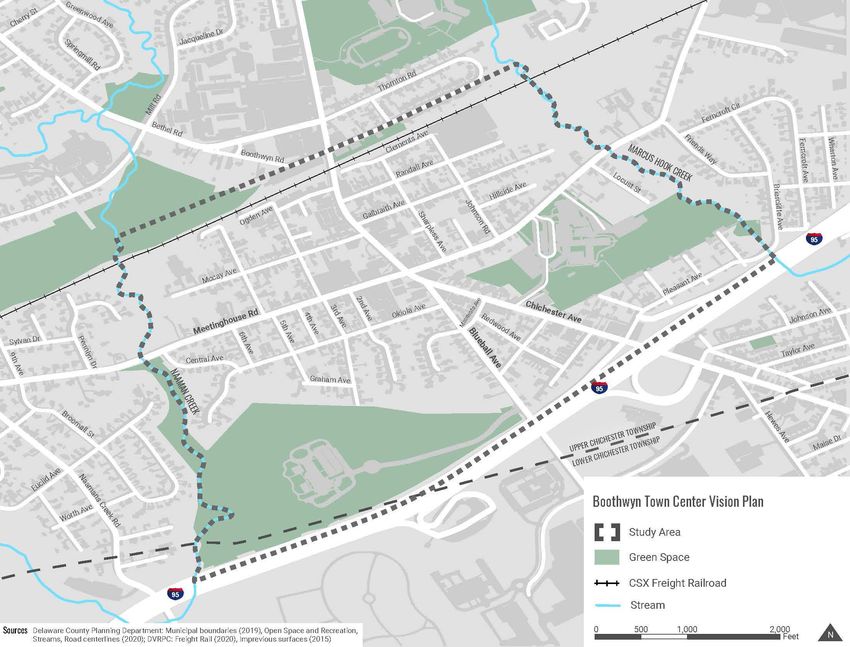
                                                                      the east, and Naamans Creek to the west.
   •   Implement a walkable Town Center with Complete
       Streets
                                                                      HISTORICAL OVERVIEW
   •   Protect the adjacent neighborhoods
                                                                      Upper Chichester Township is named after a market town and
   •   Invigorate downtown with a variety of uses and events
                                                                      seaport in Sussex, England, from which many of its settlers came.
                                                                      Upper Chichester was once part of the “Chichester Liberty” area
TOWN CENTER CONTEXT                                                   established by William Penn in 1683. The area originally included
The Boothwyn Town Center is located in the southern part of           Upper and Lower Chichester Townships and Marcus Hook and
Upper Chichester Township in Delaware County, Pennsylvania.           Trainer Boroughs. The first court record of Upper Chichester as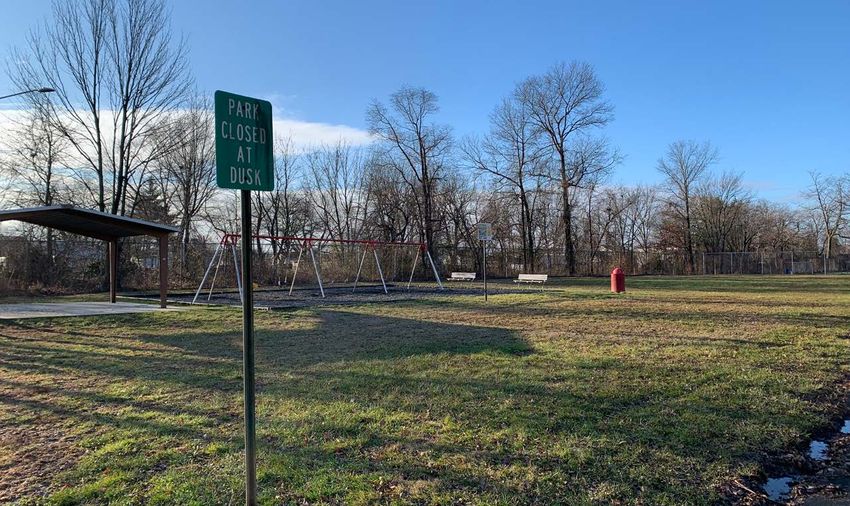
2

                                                          a separate organized entity appears in 1759. The municipality
    Introduction | The Boothwyn Town Center Vision Plan

                                                          became a first-class township on December 30, 1941.

                                                          Prior to European settlement, the Lenni Lenape (Delaware)
                                                          Indians erected several villages in the area. A network of trails
                                                          followed the ridge lines to connect these villages. The European
                                                          settlers converted these trails into roads - Old Concord Road
                                                          became Chichester Avenue and Poulson Road became Blueball
                                                          Ave.

                                                          Quaker meetinghouses are the earliest religious and civic
                                                          structures in the area. Chichester Meeting was the focal point
                                                          for the future settlement of McCaysville, a crossoads village
                                                                                                                              Blacksmith Shop – McCaysville, 1889
                                                          at the intersection of Chichester Avenue and Meetinghouse
                                                                                                                              Source: Chichester Historical Society
                                                          Road. McCaysville, now known as Boothwyn, was the center
                                                          for business and community in Upper Chichester. The McCay-
                                                          Pierce House, still standing at the southwest corner of the
                                                          Chichester Avenue and Meetinghouse Road, was the residence
                                                          of the William McCay Sr. family and was also used as a school,
                                                          post office, and church. The McCay-Pierce House was the main
                                                          residence on the 350-acre estate called Boothwyn Farms. The
                                                          estate was subdivided starting around 1892 and the area was
                                                          renamed to Boothwyn in the early 20th Century.

                                                                                                                              McCay-Pierce House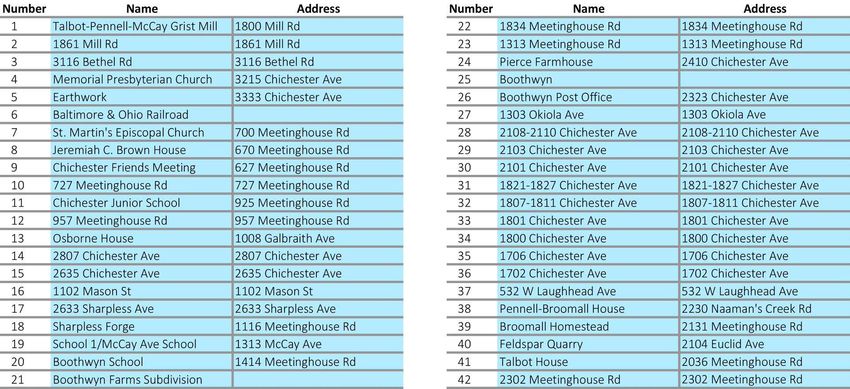
Figure 1: Boothwyn Town Center Study Area

Introduction | The Boothwyn Town Center Vision Plan
                                                                                            3
Community Engagement
4

2 Community Engagement

                                                                                                                                                Community Engagement | The Boothwyn Town Center Vision Plan
The goal of Boothwyn Town Center Vision Plan is to facilitate            PUBLIC OPEN HOUSES
implementation and improvements by obtaining community
involvement early and often. The public outreach and engagement          Two public open houses were held at key points in the planning
process for the plan was designed to actively engage people to           process to engage the community in identifying strengths,
generate excitement and build momentum for change. The public            weaknesses, opportunities, and threats in Boothwyn Town Center
engagement process was guided by the Boothwyn Town Center                and to develop the Town Center vision, goals, and objectives.
Task Force (the Task Force). The Task Force was comprised of
                                                                         Public Open House 1 for the Boothwyn Town Center Vision
community stakeholders including residents, business owners, and
                                                                         Plan was held in June of 2021 at the Boothwyn Fire Station. The
commissioners who were tasked with providing initial observations,
                                                                         event was held in conjunction with Heart & Soul Summit Part 1.
validating information, and keeping the planning process on track.
                                                                         Heart & Soul is a township-wide community engagement effort to
Public outreach and engagement platforms, including community
                                                                         assist Upper Chichester residents in prioritizing actions and future
open houses and community surveys, provided input and
                                                                         decisions expressed through the Heart & Soul Value Statements
feedback to ensure that the Town Center plan meets economic
                                                                         for Community Resources, Recreation & Open Spaces, Sense
development, housing, and mobility goals with beneficial impacts
                                                                         of Community, Location and Accessibility, Safety, Education, and
for the community.
                                                                         Economic Opportunity. The first Heart & Soul Summit focused on

STAKEHOLDER SURVEYS
Community stakeholders, including residents, business owners,
developers, real estate brokers, township staff, township
consultants, school district representatives, planning commissioners,
township commissioners, historic society members, transportation
professionals, and Delaware County planners were asked to
complete an online survey to provide feedback on Town Center
issues based on their interests and areas of expertise. This initial
feedback provided direction for developing communitywide issues
and questions for the public. The stakeholder survey questions and
answers are provided on the Upper Chichester Township website.
                                                                        Public Open House 1
5
making choices and prioritizing action ideas for the Community
Community Engagement | The Boothwyn Town Center Vision Plan
Resources, Recreation & Open Spaces, and Sense of Community
Value Statements. Over 150 people attended the open house
and participated in a Dotmocracy exercise and a SWOT exercise.
Participants were invited to write down their opinions on the
Strengths, Weaknesses, Opportunities, and Threats, ie., a SWOT
exercise. The Dotmocracy stations allowed attendees to choose
and rank their top three issues to address in the plan and top
three types of businesses that they would like to see in the Town
Center. Participants also used the Dotmocracy exercise to choose
their favorite local town center that could serve as a model for
Boothwyn.
Media Borough was selected as the best town center model by
the majority of participants, providing an indication of the scale
of development and business variety preferred by the community.
Participants also wrote down their own ideas for model town SWOT Public Open House 1
Upper Chichester Heart and Soul Dotmocracy-Public Open House 16
Community Engagement | The Boothwyn Town Center Vision Plan
The top three issues were traffic, cleanliness, and parks & public spaces The top three businesses were dine-in restaurants, brewery/brew pub,
and theater
Most participants chose Media as the best
nt
town ce er model for Boothwyn.
Dotmocracy Town Center Tally7
centers, including King of Prussia Town Center; Claymont, DE; and what they feel are the most pressing issues in Boothwyn.
Community Engagement | The Boothwyn Town Center Vision Plan
Kennett Square, PA; and Brandywine Town Center in Delaware. Results of the survey were summarized into the graphs shown
Detailed responses from the SWOT and Dotmocracy exercises on the following page. Detailed responses are included on the
are provided on the Upper Chichester Township website. Detailed Upper Chichester Township website.
responses from the SWOT and Dotmocracy exercises are provided
on the Upper Chichester Township website.
Public Open House 2 was held in November 2021 at the
Community Action Agency of Delaware County (CAADC). Draft
concept plans for recommended development opportunities,
mobility improvements, priority projects, and a future land use plan
were presented on boards for participants to view up close and
discuss with planning consultants, township staff, elected officials,
and Task Force members. Participants also provided their feedback
by writing their comments on large easel boards at the open
house. Community members could also review the concept plans
on the township website and provide comments. The community
feedback was referenced to finalize the concept plans presented in
Chapter 4 of the Vision Plan.
COMMUNITY SURVEY
All Upper Chichester Township citizens were asked to complete
a community survey to help identify and prioritize issues and
opportunities in Boothwyn Town Center. The community survey
was provided in both hard copy format for distribution at Public
Open House 1 and as an online version for those unable to
attend. The survey was made available at Public Open House 1
and the online survey was kept open for a period of one month.
There were 270 total responses from both the online and paper
formats. Survey participants were asked information about their
stake in the community (resident, business owner, neighboring
community), how often they shop in Boothwyn Town Center,
what types of changes would persuade them to shop Boothwyn, Public Open House 2over 270
responses.
Survey received
The Community
Community Engagement | The Boothwyn Town Center Vision Plan
8Community Engagement | The Boothwyn Town Center Vision Plan 9
Boothwyn Today
11

                                                         3 Boothwyn Today
 Boothwyn Today | The Boothwyn Town Center Vision Plan

                                                         Before looking to the future of the Boothwyn Town Center, it       economic health, life cycle, and attractiveness. Based on data
                                                         is important for planners, township officials and residents to     obtained through the U.S. Census Bureau and the Environmental
                                                         understand what the Town Center is today. The information          Systems Research Institute (ESRI)1.
                                                         gathered in this analysis of existing conditions provides a
                                                         foundation for understanding the demographics, socioeconomic       Population
                                                         makeup, current regulations, land use patterns, built features,    As indicated in Figure 2, both Upper Chichester and Boothwyn
                                                         natural features, and infrastructure within Boothwyn. This         have experienced some fluctuations in population from 2000 to the
                                                         foundation provides helpful guidance in identifying the future     present. Between 2000 and 2010, Upper Chichester’s population
                                                         needs and opportunities of the Boothwyn Town Center. The           decreased slightly by about 1%, then increased by about 2.4%
                                                         existing conditions analysis on the following pages provides a     by 2018. Boothwyn’s population decreased about 1.2% from
                                                         snapshot of demographic and socioeconomic trends over a ten        2000 to 2010 and increased by about 4.2% by 2020. Both Upper
                                                         to twenty-year timeframe, as well as existing land use, zoning,    Chichester and Boothwyn are projected to increase in population
                                                         mobility and circulation, and natural and historic resources
                                                                                                                            over the next five years by 0.6% and 1.6% respectfully.
                                                         in Boothwyn. A more detailed existing conditions analysis is
                                                         included in the Boothwyn Town Center Existing Conditions
                                                         Report available digitally on the Upper Chichester Township
                                                         website. Printed copies of the report are available in the Upper
                                                         Chichester Township office.

                                                         SOCIOECONOMIC PROFILE
                                                         Evaluating shifts in demographic and socioeconomic trends is
                                                         one of the most common measures of assessing the viability
                                                         of a community. The rise and fall of a community’s population,     1. The profile includes, where available, five-year estimates projected by ESRI. ESRI
                                                                                                                            uses block group census data as a base and applies their apportionment algorithm
                                                         households, families, employment, etc., says much about its        to assign data to a user-defined geographic area. For the purposes of this analysis,
                                                                                                                            using ESRI apportioned data, Boothwyn is defined as a radius of ½ mile from the
                                                                                                                            intersection of Chichester Avenue and Meetinghouse Road. Currently, ESRI’s five-year
                                                                                                                            estimates for Upper Chichester Township are available for years 2018 to 2023 and
                                                                                                                            data for Boothwyn is available for years 2020 to 2025.
12
Figure 2: Population Trends
Boothwyn Today | The Boothwyn Town Center Vision Plan
Both Upper Chichester Township
and Boothwyn have experienced
some fluctuations in population
from 2000 to the present
Both Upper Chichester Township
and Boothwyn are projected to
increase in population over the next
five years
Source: US Census Bureau, ESRI13
Boothwyn Today | The Boothwyn Town Center Vision Plan
The number of Households in
Boothwyn is increasing
Average Household Size is
decreasing
2020 Median Household
Income
The % of Owner-Occupied
Housing Units in Boowthyn is
decreasing
In 2020, the Median Age in Over 55% of the homes in Boothwyn
Boothwyn was 41.4 were built before 195914
EXISTING LAND USE • The minimum lot size of 12,000 square feet and
Boothwyn Today | The Boothwyn Town Center Vision Plan
minimum tract area of two acres is high for a town
The existing land use map presented in Figure 3 indicates the
center and discourages infill development and denser,
current uses of property in the Boothwyn Town Center. The map was
more walkable development patterns.
developed with parcel and land use data provided by the Delaware
County Planning Department. As indicated on the map, most of • The minimum setback and yard requirements are
the Town Center study area consists of Low Density Residential, excessive for a town center and discourage denser
which is described as single-family housing units on individual walkable development patterns.
lots. The largest properties in the Town Center are Institutional • The maximum building coverage (30%) and impervious
uses - Chichester Middle School and Boothwyn Elementary School. coverage (75%) requirements may be too low for
Commercial uses are concentrated along Chichester Ave, which is a town center and discourage denser walkable
the commercial spine of the Town Center. For a main commercial development patterns.
corridor, Chichester Ave has a greater than typical number of • Residential uses are not permitted, which prohibits
residential properties fronting the road. mixed-use development.
• Maximum height requirement of two stories limits
EXISTING ZONING mixed-use development.
The Existing Zoning Map (Figure 4) represents the intended • Certain conditional uses should only be allowed as
legislated distribution of land uses in the Town Center. Most accessory uses, including storage facilities and solid
of the study area is zoned R-2 Residential. The central waste and recycling facilities.
commercial corridor, Chichester Ave, is zoned C-1 Neighborhood
Commercial. As the central focus of the Town Center, zoning MOBILITY AND CIRCULATION
on the Chichester Avenue corridor deserves special attention.
Currently, a significant number of properties on Chichester Figure 5 presents an overall view of the existing transportation
Ave are in residential use, which is not a permitted use within network in the Boothwyn Town Center and adjacent communities.
the C-1 district. This is a reflection of the historic residential Vehicular modes of transportation intersect with non-vehicular
development pattern along the corridor. There are many modes, including pedestrian, bicycle, and transit to form the
historic homes along Chichester Avenue, some of which have existing Mobility and Circulation network illustrated in Figure 5.
been converted to businesses and many that have remained in
residential use. Vehicular Circulation
Boothwyn’s transportation network is primarily centered around
Regulations within the C-1 district that are inconsistent with
Chichester Ave. Chichester Ave is a two-lane, two-way state-owned
traditional Town Center development standards include the
arterial road that serves as the commercial spine of the Boothwyn
following:
Town Center. Meetinghouse Rd, a secondary arterial road, is theBoothwyn Today | The Boothwyn Town Center Vision Plan 15
Figure 3: Existing Land UseFigure 4: Existing Zoning
Boothwyn Today | The Boothwyn Town Center Vision Plan
1617
next most prominent road in the Town Center.
Boothwyn Today | The Boothwyn Town Center Vision Plan
The Boothwyn Town Center vehicular network enjoys excellent
regional access via the Chichester Avenue interchange with I-95 at
the southern edge of the study area.
Pedestrian and Bicycle Circulation
Pedestrians in the Boothwyn Town Center can access a network of
sidewalks that vary in condition and width. As indicated in Figure
5, there are quite a few gaps in the sidewalk network. There are
sidewalks along the entire length of Chichester Ave, but there are
significant sidewalk gaps on Meetinghouse Rd and no sidewalks
on Blueball Ave. This is particularly concerning since these roads
are routes to Chichester Middle School and Boothwyn Elementary
School. Gaps and physical condition issues in the sidewalk network Crosswalks: Sharrow
throughout the study area impact the walkability of the Town Chichester & Meetinghouse
Center.
There are no designated bike lanes or sharrows in the study area.
Sharrows are road markings in the form of two inverted V-shapes
above a bicycle, indicating which part of a road should be used
by cyclists when the roadway is shared with cars. Cyclists do use
Chichester Ave and other roads. Chichester Ave is particularly
unsafe for cyclists due to the lack of bike lanes, heavy traffic, and
frequent driveways and turning movements. Figure 5 shows the
number of vehicle-bicycle crashes that occurred in 2019. There
were two crashes that occurred at Meetinghouse Rd and Scott Ave.
These crashes were not identified as fatal.
Transit
Transit in the Boothwyn Town Center consists of SEPTA Bus Route
Poor Sidewalk Conditon Varied Sidewalk Width
119, which runs along Chichester Avenue. Route 119 provides
service between the Chester Transportation Center and CheyneyFigure 5: Mobility and Circulation
Boothwyn Today | The Boothwyn Town Center Vision Plan
1819
University, with stops at Concordville Town Center, and Larkin
Boothwyn Today | The Boothwyn Town Center Vision Plan
Shopping Center. Bus frequency is approximately once every hour.
Bus stops are provided at almost all intersection on Chichester Ave.
Bus shelters are provided only at Kingsman Rd and Johnson Ave.
The closest SEPTA regional rail park and ride facility is at Marcus
Hook Station.
Mobility & Safety
Figure 5 shows points of crashes that occurred in the study area in
2019 using data provided by PennDOT. The crashes are categorized
as Vehicle-Vehicle Vehicle-Bicycle, and Serious Injury. There were
no Vehicle-Pedestrian or Fatal crashes in 2019. Within the study
area, all crashes occurred on Chichester Ave or Meetinghouse Rd.
Two crashes were Vehicle-Bicycle and one was a Serious Injury, all
three occurred on Chichester Ave. In 2018, PennDOT recorded 450 Kingsman Rd Playground
crashes over a three-year period on Chichester Avenue and 85 on
side streets that intersect with Chichester Avenue. • Updating signing and pavement marking along the
corridor.
In 2019, PennDOT initiated the Chichester Ave Corridor
Improvement Project to address current safety and congestion In addition to the Chichester Ave Corridor Improvement Project,
issues on Chichester and also address potential future impacts Wawa has constructed right-of-way, sidewalk, and traffic lane
from the increased capacity expected on Route 322. Proposed improvements at Chichester Ave and Meetinghouse Rd as part of
safety improvements in the study area include the following: their new development.
• Installing traffic roundabouts at Pleasant Ave / 1-95
Ramp C Road (Southbound 1-95 on ramp) and Johnson
NATURAL RESOURCES
Ave/ 1-95 Ramp A / B Road (Northbound 1-95 off The Boothwyn Town Center is mostly built up but also has several
ramp). natural areas that must be preserved and enhanced as the Town
• Providing Safety improvements on Chichester Ave Center is further developed. The most prominent environmental
corridor between 1-95 ramps and Bethel / Thornton features in the area include the natural boundaries of Naamans
Rd, including improvements at two signalized Creek and Marcus Hook Creek. Figure 6 shows the presence of
intersections of Meetinghouse Rd and Bethel / flood hazard zones along the creeks. Few if any structures, other
Thornton Rd. than roads, encroach into the flood zones. In an area as developed20
as Boothwyn, the creeks are vulnerable to contamination from
Boothwyn Today | The Boothwyn Town Center Vision Plan
stormwater runoff that picks up pollutants from impervious
surfaces. Poor stormwater management can also lead to flooding.
Drainage issues have been noted on Chichester Ave from Malatesta
to Meetinghouse. The 2005 Multi-Municipal Comprehensive Plan
identified McCay Ave as an area with significant street and property
flooding.
HISTORICAL AND CULTURAL RESOURCES
Figure 6 includes information from the Historic Resources Survey Former Boothwyn School - Currently CAADC
prepared by the Chichester Historical Society. Historic resources
include structures and areas that have been identified as historic by
the County, although many of these resources may not be included
on the National Historic Register of Historic Places. According to the
survey, there are 41 historic resources in Boothwyn alone. Table
1 provides the list of resources that correspond to the numbered
resources on Figure 6.
The Upper Chichester Township’s municipal code includes a
historic preservation ordinance. The ordinance includes a special
demolition permit review process for structures listed on the Upper
Chichester Township Historic Sites Survey as prepared by the
Delaware County Planning Department. The ordinance allows for
application of objectors to the demolition, which then requires a
public hearing and ruling by the Board of Commissioners.
There is no historic commission in Upper Chichester Township to
review and rule on historic structure demolition applications. There
are also no official historic districts or preservation regulations to
permanently protect historic resources.
McCay School Adaptive ReuseBoothwyn Today | The Boothwyn Town Center Vision Plan 21
Figure 6: Natural & Cultural Resources22
Table 1: Historic Resources Key
Boothwyn Today | The Boothwyn Town Center Vision Plan
Episcopal
Source: Delaware County Planning DepartmentThe Boothwyn Town Center Vision
24
4 The Boothwyn Town Center Vision
The Boothwyn Town Center Vision | The Boothwyn Town Center Vision Plan
The community engagement process, review of existing conditions VISION STATEMENT
and trends, and physical assessment informed the development
of the Boothwyn Town Center Vision by establishing a vision The vision statement encapsulates the desired future for the
statement, goals and objectives that focus on addressing priority community in one concise sentence or paragraph. The evaluation
issues and leveraging valuable assets defined by the community. and community engagement process guided the development of
The planning and visioning process for Boothwyn, driven primarily the following vision statement for Boothwyn:
by community input, yielded the following summary of priority
Boothwyn Town Center is a welcoming community with a
issues and opportunities:
unique historic identity and strong sense of place. The Town
Center features housing options for every lifestyle, diverse
PRIORITY ISSUES AND OPPORTUNITIES dining and shopping options, centrally located cultural and
• Address traffic congestion and safety entertainment spaces, and public spaces for community
• Expand dining options gathering and recreation.
• Expand local businesses
GOALS AND OBJECTIVES
• Establish a sense of place
• Improve pedestrian safety Goals
• Improve cleanliness • Guiding town center plan through smart growth
• Improve parking development
• Improve transit connections • Implementable action plan
• Protect historic character • Community oriented engagement process
• Protect residential neighborhoods • Inclusion as Town Center Plan in the UCT
Comprehensive Plan
• Increase parks and open space
• Provide more community gathering opportunities25
Objectives Education Anchors: Improve sidewalk connections,
The Boothwyn Town Center Vision | The Boothwyn Town Center Vision Plan
encourage walking / biking to school, share recreation
• Attract economic development resources with residents.
• Expand existing business opportunities
• Diversify business offerings and housing stock Development Opportunities
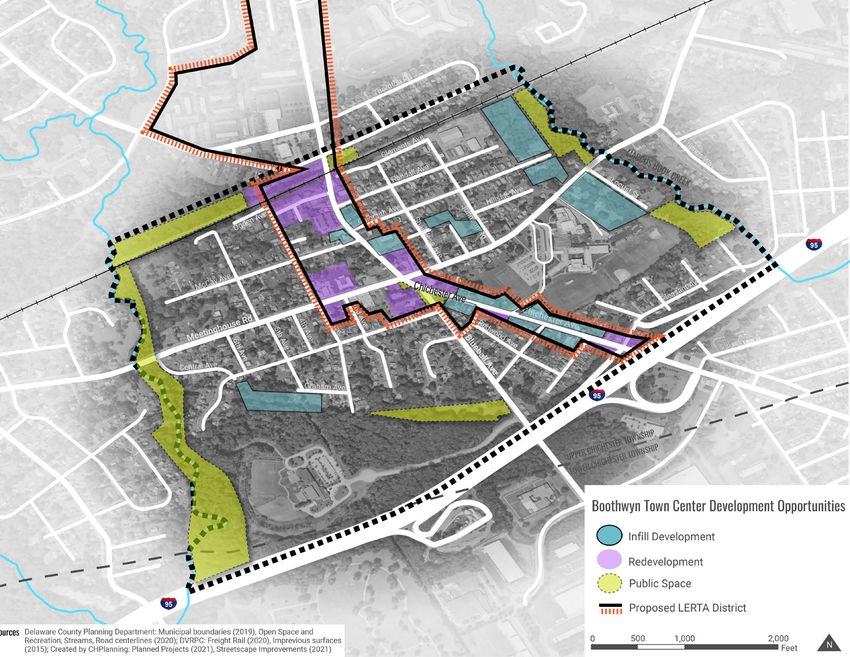
• Preserve Historic Character The Development Opportunities map (Figure 8) identifies
• Implement a walkable Town Center with Complete properties in the study that have the most potential for different
Streets development strategies: Redevelopment, Infill Development,
and Public Space. It also shows the proposed Local Economic
Revitalization Tax Assistance (LERTA) district that the Township
OPPORTUNITY CONCEPTS
is currently studying.
Context Zones
Redevelopment Development: Create new development
The study area was organized into four Context Zones, as illustrated opportunities in place of existing development.
in Figure 7, to illustrate the guiding ideas and objectives for the
different character areas in the Town Center. Infill Development: Add compatible development next to existing
structures to add new development opportunities and preserve
Gateways: Create a great impression upon entering the Town residences and historic structures.
Center – including welcome signs, banners, decorative lighting,
landscaping, decorative paving, and high-quality development Public Space: Create new public parks, plazas, and community
design. buildings within and next to existing developed areas.
Downtown Core: Establish the central identity and brand Mobility Enhancement
for the Town Center – including banners, wide sidewalks,
The Mobility Enhancement concept plan (Figure 9) illustrates
decorative and uniform lighting, denser development close to
recommended improvements for optimizing conditions for all
sidewalk, street trees, façade improvements, traffic calming,
modes of mobility in the Town Center, including automobile
crosswalks, bus shelters, zoning to encourage denser, walkable
circulation, parking, pedestrian, transit, and bicycle.
development patterns, mixed-uses, design quality, and historic
preservation. I-95 Interchange Roundabouts: This improvement
reflects what has already been proposed by PennDOT as
Traditional Neighborhood Residential: Protect existing
part of the Chichester Ave Corridor Improvement Project,
housing, promote new compatible infill housing, improve
including Installing traffic roundabouts at each of the following
sidewalks, provide home improvement assistance, allow for
intersections:
diverse housing options, facilitate historic preservation.Figure 7: Context Zones
The Boothwyn Town Center Vision | The Boothwyn Town Center Vision Plan
26The Boothwyn Town Center Vision | The Boothwyn Town Center Vision Plan 27
Figure 8: Development OpportunitiesFigure 9: Mobility Enhancement Plan
The Boothwyn Town Center Vision | The Boothwyn Town Center Vision Plan
2829
• Pleasant Ave / 1-95 Ramp C Road (Southbound 1-95
The Boothwyn Town Center Vision | The Boothwyn Town Center Vision Plan
on ramp)
• Johnson Ave / 1-95 Ramp A / B Road (Northbound
1-95 off ramp)
The vision plan includes coordination with PennDOT about
redevelopment of land adjacent to the proposed roundabouts,
signage and landscaping to enhance the branding and identify
the gateway to the Town Center and incorporating safe
pedestrian and bicycle connections across the bridge.
Redesign Blueball / Chichester Ave Intersection: This is
a major intersection improvement that is intended to improve
safety and help mitigate congestion on Chichester Ave at this
Example Roundabout - Swarthmore PA
awkward and hazardous intersection. The plan recommends
redesigning the intersection and ultimately redeveloping the
area as a public plaza surrounded by retail, public parking,
and a potential community facility at the historic McCay House.
There are several short and long-term planning and design
alternatives for alleviating congestion and mitigating hazards
at the intersection. As a short-term strategy, Blueball Ave
would be converted to one way between Chichester Ave and
Okiola Ave. Traffic turning onto Blueball Ave from Chichester
Ave would be restricted to right turn only and no turns would
be allowed from Blueball Ave onto Chichester Ave. As a longer-
term strategy, Blueball Ave would terminate at Okiola Ave or,
the intersection could be realigned as part of a public-private
redevelopment project. As an early action item, a traffic
impact study will need to be conducted for each redesign
alternative to determine impacts and mitigation strategies for
the surrounding transportation network.
Example Bridge with Bike Lane - Lynnhaven, VA30
Bridge Replacement: Replace the Chichester Ave bridge Catalyst Projects
over the CSX tracks, which has been classified on PennDOT’s
Catalyst projects are projects that will have the most impact and
Bridge Condition Map as “Poor” condition. Include substantial
The Boothwyn Town Center Vision | The Boothwyn Town Center Vision Plan
influence in implementing the Boothwyn Town Center vision.
sidewalk width and a bike path as essential features of the
Some projects are most impactful because they can be completed
bridge replacement.
immediately and with little cost – such as a new Town Center
Transit: Engage with SEPTA through their Bus Revolution Zoning District. Some projects may take longer to implement but
project to promote increased Route 119 bus frequency, improve are visually compelling and can be tied to specific partnership and
direct connections to Marcus Hook regional rail station, re- grant opportunities – such as a new streetscape design. Other
establish bus service on Meetinghouse Rd, and approve bus projects, such as redevelopment areas, are much longer term with
shelters (not provided by SEPTA) on Chichester Ave. undetermined timelines and partnerships - but have the potential
to visually and economically propel the Town Center vision. These
Streetscape: Continue the Chichester Ave streetscape catalyst project concepts are identified on Figure 10 and described
design plan, focusing on wider sidewalks, improved sidewalk in detail in the following sections.
condition, lighting, landscaping, crosswalks, signage, bus
Town Center Zoning District
shelters, parking lot buffers, and on-street parking.
The creation of a new Town Center zoning district is a high
Parking: Provide on-street parking where feasible, create new priority project to correct inconsistencies in the current zoning
municipal parking lots, implement shared parking. and guide land development. Using the Delaware County model
zoning ordinances for Central Places and Activity Corridors for
Sidewalks / Trails: Provide sidewalks where there are
guidance, the new Town Center district should include the
none and where there are gaps, focusing on roads to schools
following components:
(Meetinghouse and Blueball) and major residential streets.
Develop a trail network using existing publicly owned open • Allow for mixed-uses – primarily first floor commercial
spaces and connecting residential streets to provide safe with residential above.
walking and biking routes to schools and the Town Center. • Allow for higher building heights – 3 to 4 stories is
Work with landowners for opportunities to connect the network appropriate.
on private lands. The proposed trail network would provide an • Require a minimum building height of 2 stories or 25 ft.
additional open space amenity, alternative bike connections
other than Chichester Ave, and ultimately connect with the
• Reduce minimum lot sizes to encourage small business
development and promote compact, pedestrian-
Circuit regional trail network through the Township’s Master
oriented development – approximately 1,200 to 1,600
Recreation Plan and comprehensive plan update process.
ft. is appropriate.
• Increase maximum building coverage limits toThe Boothwyn Town Center Vision | The Boothwyn Town Center Vision Plan 31
Figure 10: Catalyst Projects32
encourage business development and promote
compact, pedestrian-oriented – 100% coverage is
common in town centers - require green stormwater
The Boothwyn Town Center Vision | The Boothwyn Town Center Vision Plan
infrastructure best practices to mitigate the increased
impervious coverage.
• Exclude automobile-oriented uses, including drive-
through facilities, gas stations, automobile service
facilities, car washes, and storage facilities.
• Allow buildings to be built to the sidewalk.
• Restrict parking from fronts of buildings (except on-
street parallel parking).
• Allow for reduced parking with the provision of
on-street parking, shared parking agreements,
interconnected driveways, or a fee in lieu option to
finance municipal parking.
• Instead of front setbacks, establish a “frontage zone”
that allows buildings to be built to the sidewalk, but
requires room for the provision of a minimum number
of streetscape amenities identified in the Chichester
Ave Streetscape Plan, including street lighting, public
plazas, bus shelters, bioswales, street trees, on-street
parking, etc.
• Require wider sidewalk width on Chichester Ave. – 8 to
10 ft. is appropriate.
• Incorporate design guidelines from Article 10
of the Subdivision and Land Development and
Delaware County Design Guidelines: A Template
for Municipalities, available on the County Planning
Department website.
Frontage & Furnishing Zones
Source: JMT33
Chichester Ave Streetscape Design South Gateway Redevelopment
The Boothwyn Town Center Vision | The Boothwyn Town Center Vision Plan
Continue the Chichester Ave streetscape design plan, focusing The objective of this redevelopment concept, illustrated
on wider sidewalks in good condition, lighting, landscaping, in Figure 14, is to create an impressionable gateway image
crosswalks, signage, bus shelters, green infrastructure with new commercial redevelopment at the properties at the
stormwater management (bioswales), parking lot buffers, on- Chichester Ave and Pleasant Ave intersection – soon to be a new
street parking and potential turning lanes. Figure 11 presents roundabout. A priority element of this plan is to coordinate with
an illustrative example of potential streetscape concepts and PennDOT on roundabout aesthetics – including landscaping,
amenities on a sample segment of Chichester Ave – comparing pedestrian and bike route paving, welcoming signage, and
the existing condition with proposed improvements. green infrastructure stormwater management.
North Gateway Redevelopment Future Land Use Framework
The objective of this redevelopment concept, illustrated in The proposed Future Land Use Framework map (Figure 15)
Figure 12, is to create a new image at the northern entrance illustrates the overall concept for anticipated land use based
of the Town Center – including welcoming signage, new on the culmination of objectives for the context zones and
community facility and commercial/mixed-use development, recommendations for development opportunities, proposed
open space and trails, replacement of the bridge with wider zoning, and catalyst redevelopment projects.
sidewalks and bike lanes, decorative paving, and decorative
lighting.
Boothwyn Crossroad Redevelopment
The objective of this redevelopment concept, illustrated
in Figure 13, is to create a new central gathering space
at the Chichester Ave and Meetinghouse intersection by
either closing Blueball Ave at Okiola Ave or realigning the
intersection as part of a redevelopment project that creates
a new public plaza surrounded by new walkable retail, a new
community facility, possible public use of the historic McCay-
Pierce House, outdoor dining areas, and new municipal
parking lots.Figure 11: Chichester Ave Streetscape Concept
The Boothwyn Town Center Vision | The Boothwyn Town Center Vision Plan
34The Boothwyn Town Center Vision | The Boothwyn Town Center Vision Plan 35
Figure 12: North Gateway Concept PlanFigure 13: Boothwyn Crossroad Concept Plan
The Boothwyn Town Center Vision | The Boothwyn Town Center Vision Plan
36The Boothwyn Town Center Vision | The Boothwyn Town Center Vision Plan 37
Figure 14: South Gateway Concept PlanFigure 15: Future Land Use Map
The Boothwyn Town Center Vision | The Boothwyn Town Center Vision Plan
38Implementation Strategy
40

5 Implementation Strategy

                                                                                                                                                 Implementation Strategy | The Boothwyn Town Center Vision Plan
The key to creating an implementable vision plan is guided by           IMPLEMENTATION PROJECTS AND STRATEGIES
the Issues-Based approach advocated by the Pennsylvania
Department of Economic Development (DCED). The issues-based             Town Center Zoning District
approach focuses on high-priority issues and provides specific          The new Town Center zoning district is a high priority project
implementation projects that address issues of local importance,        that is necessary to encourage small business development
are understood by the public, and are measurable, that is,              and shape the downtown as a compact, pedestrian-oriented
can be tied to a specific timeframe and budget. The following           destination.
implementation strategy recommends projects as implementation
actions that can be initiated immediately, within one to two years,         Timeframe: The Town Center zoning district can be started
within five to eight years, or ten or more years. Some projects             immediately and completed within one year.
can be initiated immediately and completed within one to two
years, but full implementation would take place incrementally               Funding: The cost to the Township will be minimal, the work
over time. Some projects, for example, establishing a Downtown              can be prepared in house.
Improvement District, will need to be funded continually. The main          Partnerships: The new zoning district can be developed in
goal is to present projects that are can be included in a budget, can       house with Township staff and consultants. Delaware County
be funded by specific grant and financing programs, and that can            Planning can provide additional guidance.
be completed within an identified schedule.

The implementation strategy includes a list of grants in Table 2:       Chichester Ave Streetscape Design
Funding Resources that can be applied to each project based on          Chichester Ave is the central spine of Boothwyn Town Center. It
eligibility requirements. The descriptions of each project includes     is critical to the success of the vision plan that Chichester Ave
and estimated timeframe, list of eligible funding and grant             functions as a Complete Street with a functional, safe, and attractive
programs, and partnership agencies to support implementation.           activity corridor. A new Chichester Ave Streetscape Design should
The Implementation Matrix - represented in Tables 3, 4, 5, and 6        be initiated immediately, although full completion of the project
at the end of this chapter organizes the projects as actions that       may occur gradually and take up to five years to complete.
should be taken immediately, within two to three years, and four
to ten years.                                                               Timeframe: The Township can start the design process
                                                                            immediately if it wants to use existing Township resources
                                                                            – that is, the Township planner can prepare the design with
41
assistance from the traffic engineer. This process can take Water Projects (for Green Infrastructure Stormwater
Implementation Strategy | The Boothwyn Town Center Vision Plan
approximately six months to one year. Management)
After the streetscape design is approved, the Township can • Transportation & Community Development Initiative
apply for implementation grants, the application processes and (TCDI)
schedules vary for each grant, but generally take approximately • Keystone Communities Implementation Grants
six months to one year.
Partnerships: The PennDOT Connects Program provides
The streetscape design can also be implemented in coordination valuable assistance to municipalities with navigating
with private developers by requiring the provision of streetscape transportation improvements and funding on state roads. Start
amenities or fee in lieu option aligned with the streetscape the project by contacting the PennDOT Connects planner from
plan as part of the land development process. Inclusion of District 6 to review available resources and technical assistance
streetscape requirements in the zoning ordinance can begin opportunities. PennDOT provides free technical assistance
immediately through the creation of the Town Center zoning through the PennDOT Connects Transportation and Land Use
district. Planning Assistance and Training Program.
The streetscape design should also include incorporation of Through the PennDOT Connects Program, engage the following
landscaping and pedestrian amenities for the Pleasant Ave agencies:
roundabout – this will have to follow the PennDOT construction
schedule – using technical assistance through the PennDOT • Delaware County Planning Department
Connects program will help with coordination. • Delaware County Transportation Management
Association (DCTMA)
Full construction of the streetscape plan is estimated at
approximately three to five years. • Delaware Valley Regional Planning Commission
(DVRPC)
Funding: The following funding sources from Table 2:
Funding Resources are available for streetscape design and Boothwyn Downtown Improvement District
construction:
Having the organizational structure to manage the implementation
of Town Center projects and strategies is important to the success
• Multimodal Transportation Fund (MTF) Program
of the Boothwyn Town Center Vision Plan. Upper Chichester
• Community Development Block Grant (CDBG) Township staff may not have the capacity to focus on the many
• Flood Mitigation Program (for Green Infrastructure responsibilities it takes to manage multiple grants and downtown
Stormwater Management) improvement projects. The Chichester Business Association (CBA)
can initiate the creation of a Downtown Improvement District (DID)
• H2O PA – Water Supply, Sanitary Sewer and Storm42
to serve as the lead organization for Boothwyn Town Center. A Timeframe: It can take at least six months to prepare the
Implementation Strategy | The Boothwyn Town Center Vision Plan
DID is a public-private partnership in which property and business required documents and hold required hearings to establish
owners make a collective contribution to the maintenance, a DID in accordance with the legislation. As a first step that
development and promotion of the Town Center district through a can begin immediately, the Chichester Business Association
special assessment fee. A DID manager would be hired, guided by can partner with the Pennsylvania Downtown Center (PDC)
a Board of Directors, to implement the Town Center projects and to determine how best to set up a DID that is aligned with
strategies through the following duties: Boothwyn’s needs and resources. The CBA should reach out to
PDC for technical assistance and training to provide guidance
• Grant application and management on the financial and organizational feasibility of starting a DID
• Leverage public and private partnerships and finding the resources to get started.
• Business recruitment The CBA can apply for a Keystone Communities Planning Grant
• Business loan and grant assistance through DCED to prepare the feasibility plan required to apply
• Marketing and events management for the establishment of the DID. The Planning Grant is a
$25,000 maximum with a dollar-for-dollar match. Other grants
• Façade improvements could potentially help to get the DID started and with initial
• Historic preservation operating expenses, , including CDBG grants and the Marketing
• Developer coordination to Attract Business Grant, but will need an assessment to
continue operations.
• Cleaning and beautification management
• Streetscape coordination The overall process of setting up a DID, hiring an effective
manager, and selecting a Board of Directors can take six
Establishment of a Downtown Improvement District is authorized months to one year to fully implement. But it is essential
by the Pennsylvania Neighborhood Improvement District (NID) Act to the success of the Town Center to have a well-managed
2000, P.L. 949, No. 130 Section 5(c)(2)(i). The DID can be created organizational structure focused on managing the multiple
as a 501(c) 3 in order to access funding from foundations, the state, grants and implementation projects outlined in this plan and to
and federal sources. In accordance with the legislation, the local continue progressing beyond the planning period.
governing body can be petitioned to establish a DID. A feasibility
plan must be created and distributed to all property owners in the Once a DID is established, the Boothwyn DID should apply for
proposed district and public hearings must be held to establish need Main Street Designation through DCED’s Keystone Communities
and garner support for the DID. Objections from at least 40% of Grant Program. Main Street designation provides priority
the property owners within the district boundaries are required to consideration for several DCED funding programs but does not
defeat the establishment of the Downtown Improvement District. guarantee funding of any project. The DID should reach out
to PDC for technical assistance with preparing the required43
application documents for Main Street Designation. The Business Association and the Pennsylvania Downtown Center.
Implementation Strategy | The Boothwyn Town Center Vision Plan
Boothwyn Town Center Vision Plan has much of the information PDC will provide affordable technical assistance and support
required for the application and can be used a resource, along for establishing the DID and continued guidance for effective
with assistance from PDC, to develop the following Main Street operations and implementation grant opportunities.
Designation application requirements:
Additional partners include:
• Five-Year Strategy
• DCED
• Organizational Sustainability Plan
• Delaware County Chamber of Commerce
• Market Assessment and Image
• Delaware Valley Regional Planning Commission
• Development Reports
• Historic Preservation – sample resolution Keystone Elm Street Designation
Funding: The majority of funding for DID operation will come With the formation of the Boothwyn Downtown Improvement
from a special assessment on property owners within the Town District, the DID should apply for Elm Street Designation along
Center district. Additional funding to establish DID and funding with Main Street Designation. The DID Board should create a
for ongoing implementation projects include: Planning Committee to oversee neighborhood preservation and
implementation projects. Members of the Planning Committee
• Keystone Communities Planning Grants should include representatives of residents, Township staff/
• Keystone Communities Implementation Grants officials, historical society, property owners, key institutions, and
neighborhood organizations. The Keystone Elm Street program
• Keystone Communities Façade Grants provides funding and technical assistance for residential and
• Keystone Communities Development Grants mixed-use areas in proximity to the Town Center district. Elm Street
• Keystone Communities Public Improvement Grants grants can provide funding for housing maintenance assistance,
housing rehabilitation assistance, new housing development,
• Keystone Historic Preservation Grant Program
historic surveys, historic district formation, residential sidewalk
• Keystone Historic Preservation Construction Grants improvements, homeownership assistance, community events and
• Community Development Block Grant more. Elm Street designation is not required to receive grants and
• Pennsylvania First grants are not guaranteed, but Elm Street designated community
are given priority consideration.
• Technical Assistance from the Pennsylvania
Downtown Center Timeframe: Once formed, the DID can apply for Elm Street
designation with the established Planning Committee. It can
Partnerships: The primary partners will be the Chichester take up to one year to be approved for designation.44
Funding: The DID will be the lead agency for managing Elm increase in tax payments on improvements to properties in the
Implementation Strategy | The Boothwyn Town Center Vision Plan
Street designation and grants. Most neighborhood improvement Town Center.
projects can be funded by the following resources:
Timeframe: LERTA locations and legislation are currently
• Keystone Communities Planning Grants being considered. This program should be continued and
implemented within the first year of plan adoption.
• Keystone Communities Implementation Grants
• Keystone Communities Façade Grants Funding: The LERTA study is being funded by Upper Chichester
• Keystone Communities Development Grants Township
• Keystone Historic Preservation Grant Program Partnerships: Upper Chichester Township is implementing the
• Keystone Historic Preservation Construction Grants LERTA program. A new DID can market the LERTA incentive to
attract businesses.
• HOME Investment Partnership Program (HOME)
• Technical Assistance from the Pennsylvania Downtown PennDOT Pleasant Ave Roundabout Design
Center
PennDOT is currently implementing the Chichester Avenue
Partnerships: As with the DID formation and Main Street Corridor Improvement Project to address current safety and
designation, the DID will partner with PDC for guidance and congestion issues on Chichester Ave. A key traffic improvement
assistance with applying for Elm Street designation. is the installation of traffic roundabouts at the I-95 ramps at
Pleasant Ave and Johnson Ave. The DID and Township should
Other partners include: coordinate with PennDOT to improve this important gateway
to the Town Center with enhanced landscaping, pedestrian
• DCED paving, a Boothwyn Town Center gateway sign, banners, and
• Delaware County lighting. These enhancements will be included on the Chichester
• Chichester Historical Society Ave Streetscape design, but implementation will need to be
coordinated with PennDOT’s construction schedule – anticipated
LERTA for 2026 completion.
The Local Economic Revitalization Tax Assistance (LERTA) is a Timeframe: As part of the Chichester Ave Streetscape Plan
tax abatement program designed to incentivize redevelopment timeframe – contact the PennDOT Connects planner from
of aging or deteriorating properties. Upper Chichester Township District 6 to ensure coordination with PennDOT’s design and
is currently considering adopting LERTA legislation for various construction schedule for the roundabouts.
properties in the Township, including those located in the Town
Center district. LERTA designation will allow for a graduated Funding: The following funding sources from Table 2: Funding45
Resources are available for landscaping and streetscape Chichester Township Board of Commissioners voted to reserve the
Implementation Strategy | The Boothwyn Town Center Vision Plan
enhancements for the roundabout: front portion of the park for the library development. The existing
playground and other resources in the park will remain. The Friends
• Multimodal Transportation Fund (MTF) Program of Upper Chichester Library have been working to secure funding
• Community Development Block Grant (CDBG) for the library and an architect has prepared preliminary designs.
Upper Chichester Township should continue to support the new
• Transportation & Community Development Initiative
library and resource center with the land reservation and a new
(TCDI)
Downtown Improvement District can help with grant assistance.
• Keystone Communities Implementation Grants
• Keystone Communities Public Improvement Grants Chichester Ave / CSX Bridge Replacement
Partnerships: Contact PennDOT Connects for resource PennDOT’s Bridge Conditions Map indicates that the Chichester
guidance and technical assistance through the PennDOT Ave bridge over the CSX railroad tracks is in poor condition. The
Connects Transportation and Land Use Planning Assistance bridge is also very narrow and in poor conditions for the traffic
and Training Program. volume, the sidewalk is very narrow, and there is not adequate
space to include a bike path to connect the proposed trail network.
Through the PennDOT Connects Program, engage the following Streetscape enhancements, including banners and lighting, are
agencies: needed to present a sense of arrival at this important gateway to
the Town Center.
• Delaware County Planning Department
A full replacement of the bridge is proposed and should include
• Delaware County Transportation Management
streetscape amenities and pedestrian facilities beyond basic
Association (DCTMA)
functionality. This will be a longer-term project, about five to seven
• Delaware Valley Regional Planning Commission years, and will include extensive coordination with PennDOT,
(DVRPC) CSX, and grant applications to fund the features that are beyond
PennDOT’s standard scope
New Upper Chichester Library and Resource Center
Timeframe: This is another opportunity to coordinate
The Upper Chichester Library and Resource Center is currently
with PennDOT through the PennDOT Connects program.
located in a small space in the Willowbrook Shopping Center.
Coordination with the District planner can be concurrent with
Demand for community services and resources provided by the
the Chichester Ave Streetscape Plan, but the actual replacement
library has outgrown the space and the Friends of Upper Chichester
and associated grant application may have to be in a later
Library have been planning for a new state of the art resource
phase due to the cost and longer implementation process.
center to be located on property owned by Upper Chichester
The bridge replacement could also be coordinated with the
Township - a portion of Kingsman Rd Park. In 2020, the UpperYou can also read


