Carbon Material Based Electrochemical Immunosensor for Gastric Cancer Markers Detection
←
→
Page content transcription
If your browser does not render page correctly, please read the page content below
MINI REVIEW
                                                                                                                                                published: 31 August 2021
                                                                                                                                         doi: 10.3389/fchem.2021.736271

                                               Carbon Material Based
                                               Electrochemical Immunosensor for
                                               Gastric Cancer Markers Detection
                                               Zhuliang Zhang†, Minsi Peng†, Defeng Li, Jun Yao, Yingxue Li, Benhua Wu, Lisheng Wang
                                               and Zhenglei Xu *
                                               Department of Gastroenterology, Shenzhen People’s Hospital, The Second Clinical Medical College, Jinan University, Shenzhen,
                                               China

                                               Gastric cancer is one of the most common malignant tumors, and early diagnosis will be of
                                               great significance to improve the survival quality and overall treatment outcome evaluation
                                               of patients. Nanoelectrochemical immunosensor is an emerging biosensor combining
                                               nanotechnology, electrochemical analysis method and immunological technology, which
                                               has simple operation, fast analysis speed, high sensitivity, and good selectivity. This mini-
                                               review summarized immunoassay techniques, nanotechnology and electrochemical
                            Edited by:
                      Fatemeh Karimi,
                                               sensing for the early detection of gastric cancer. In particular, we focus on the tension
         Quchan University of Advanced         of carbon nanomaterials in this field, including the functionalized preparation of materials,
                      Technology, Iran         signal enhancement and the construction of novel sensing interfaces. Currently, various
                        Reviewed by:           tumor markers are being developed, but the more recognized gastric cancer tumor
                     Somaye Cheraghi,
           Shahid Bahonar University of        markers are carcinoembryonic antigen (CEA), carbohydrate antigen (CA), CD44V9,
                          Kerman, Iran         miRNAs, and programmed death ligand 1. Among them, the electrochemical
                         Vahid Arabali,
            Islamic Azad University Sari
                                               immunosensor allows the detection of CEA, CA, and miRNAs. The mini-review
                          Branch, Iran         focused on the development of using carbon based materials, especially carbon
                    *Correspondence:
                                               nanotubes and graphene for immunosensor fabrication and gastric cancer markers
                            Zhenglei Xu        detection.
              ZhengleiXu_xzl3@163.com
     †
                                               Keywords: carbon materials, immunosensor, carbon nanotubes, graphene, gastric cancer, biomarker
         These authors have contributed
                    equally to this work
                                               INTRODUCTION
                      Specialty section:
           This article was submitted to       In recent years, with the increase in the number of gastric cancer patients and their mortality rate, the
                        Electrochemistry,      methods of gastric cancer diagnosis are in urgent need of solution. From the large number of patients
                 a section of the journal      who died of gastric cancer, it can be seen that the main reason for the death is the late detection and
                  Frontiers in Chemistry       untimely treatment. In order to better prevention and detection, early gastric cancer detection is
               Received: 05 July 2021          crucial. The current methods of early gastric cancer detection include gastroscopy, radioactivity
            Accepted: 16 August 2021           (Archer and Grant, 1991), ultrasound, serum gastric function test, and gastrin 17 combined with
            Published: 31 August 2021
                                               pepsinogen serological test. These assays have limitations, such as gastroscopy, ultrasound, and
                            Citation:          radiological testing can be uncomfortable for patients and are not particularly effective. Biologic
 Zhang Z, Peng M, Li D, Yao J, Li Y,           tumor markers for gastric cancer is a more common and hot research direction. It can be detected
Wu B, Wang L and Xu Z (2021) Carbon
                                               quickly and without negative effects on the patients themselves. Currently, various new tumor
      Material Based Electrochemical
   Immunosensor for Gastric Cancer
                                               markers are being developed, but the more recognized gastric cancer tumor markers are
                  Markers Detection.           carcinoembryonic antigen (CEA) (Ishigami et al., 2001; Zhang et al., 2021), carbohydrate
             Front. Chem. 9:736271.            antigen (CA) (Gaspar et al., 2001), CD44V9 (Mashima et al., 2019), miRNAs (Khandelwal et al.,
   doi: 10.3389/fchem.2021.736271              2019), and programmed death ligand 1 (PD-L1) (Wang et al., 2019).

Frontiers in Chemistry | www.frontiersin.org                                          1                                           August 2021 | Volume 9 | Article 736271
Zhang et al. Gastric Cancer Markers Detection
Biosensors are a multidisciplinary intersection that includes adsorption capacity of the materials, increased active sites on the
medical, biological, chemical, and electronic technologies surface, and improved catalytic efficiency. Compared with
(Karimi-Maleh et al., 2021a; Luo et al., 2021). The principle of conventional sensors, carbon nanomaterials sensors are not
biosensor analysis and detection is that when the substance to be only smaller and faster, but also more accurate and reliable.
measured specifically binds to a molecular recognition element the discovery of CNTs has largely enriched the research of carbon
(e.g., enzyme or antibody, etc.), the resulting complex is materials and triggered a trans-generational material revolution.
transformed by a converter into a signal that can be output, Britto et al. (1996) first made CNTs into electrodes and used them
such as an optical signal or an electrical signal. Electrochemical for the electrocatalytic oxidation of the neurotransmitter
biosensors are divided into current, potential, capacitance, and dopamine. The preparation method was similar to that of
conductivity types according to the measurement signal. carbon paste electrodes, using bromine imitation as the binder.
According to the category of bioactive molecules, they can be The CNTs have a good catalytic effect on the electrochemical
divided into enzyme sensors, tissue sensors, immunosensors, oxidation of dopamine. Timur et al. (2007) reported the
DNA sensors, and microbial sensors. Among them, preparation of microbial sensors generated by immobilizing
electrochemical biosensors for monitoring specific reactions Pseudomonas aeruginosa cells on CNTs with osmium
between antigen→antibodies are called electrochemical polymers as intermediates. By optimizing the amount of CNTs
immunosensors. There are two key directions in the research and polymers, the electron migration rate can be increased and
of electrochemical immunosensors: 1) designing novel can be used for microbial fuel cells and biochemical oxygen
biocompatible biocomponent immobilization interfaces to demand (BOD) measurements in wastewater.
improve the loading and bioactivity of biocomponents on the CNTs have high axial strength and stiffness, so they are often
sensing interface; 2) employing novel immunoreactive signal used as reinforcement for composites. Meanwhile, their excellent
amplification techniques to enhance the sensitivity of the electrical and thermal conductivity can improve the functionality
sensors. Therefore, there has been a search for good materials of composite materials. The use of conducting polymers as
for immobilization of bioactive substances and efficient methods sensing electrodes has attracted much attention due to their
for immobilization of biological components. excellent electrochemical properties. The CNTs/polymer
Nanomaterials have become one of the popular materials for composite materials can be divided into two categories. The
research and application in recent years due to their unique first one is to use CNTs as the main body and modify the
properties in optical, magnetic, electrical, and catalytic properties polymer on the wall of CNTs to increase the solubility of
(Medetalibeyoğlu et al., 2020; Akça et al., 2021; Karimi-Maleh CNTs. Another category is based on polymers as the main
et al., 2021c; Liu et al., 2021). As a modifying material for sensor body and CNTs as filler materials, mainly for conductive
interfaces and as a solid-loading matrix for biorecognition polymer materials, with the aim of improving the conductivity
molecules. Due to their large specific surface area, high surface and stability of conductive polymers. Commonly used conductive
free energy, good biocompatibility, and rich in surface functional polymers such as polyaniline (PANI) and polypyrrole (PPy) (Pei
groups, nanomaterials can be used in the construction of et al., 2019; Assari et al., 2020). They have good electrochemical
biosensing interfaces to effectively increase the specific surface properties to amplify the signal current and eliminate the
area of electrodes, increase the loading of biomolecules on the influence of electrode impurities, and provide a suitable
electrode surface, accelerate the electron transfer rate, enhance environment for immobilizing biomolecules. Not only the
the conductivity of modified electrodes, and accelerate the complexation of conductive polymers with CNTs, but also the
response of sensors. Carbon is a widely studied and used complexation of noble metals with CNTs has attracted a lot of
material in electrochemical sensor preparation. In the attention from researchers. Among many noble metals, AuNPs
macroscopic field, there are three forms of carbon isomers: have attracted much attention from researchers due to their
graphite, diamond, and amorphous carbon. However, the ability to maintain the biological activity of adsorbed enzymes
discovery of fullerenes (C60) and carbon nanotubes (CNTs) and reduce the hindrance of direct electron migration by protein
has led to new forms of carbon materials, and since then, the shells.
research on carbon nanomaterials has been booming. In this In addition to CNTs, carbon nanofibers (CNFs) have similar
mini-review, we review the application of carbon nanomaterials, high electrical conductivity, high mechanical strength, large
especially CNTs and graphene, in the preparation of specific surface area, and thermal stability as CNTs. Both of
electrochemical immunosensors and in the detection of gastric them can be used as good metal nanoparticle catalyst carriers with
cancer biomarkers. promising applications in chemical/biological sensing and
catalysis. Sheng et al. (2010) introduced porous carbon
nanofiber (PCNF)/room temperature ionic liquid (RTIL)
Carbon Materials Based Electrochemical membranes, which provide a suitable environment for direct
Biosensors electron migration of ferrous hemoglobin proteins. Hemoglobin
Carbon nanomaterials play an important role in (Hb), myoglobin (Mb), and cytochrome C showed a pair of
bioelectrocatalytic reactions due to their high specific surface reversible redox peaks on the PCNF/RTIL-modified membranes.
area and their better biocompatibility (Naderi Asrami et al., 2020; Graphene has received great attention in the field of biosensors
Karaman et al., 2021; Karimi-Maleh et al., 2021b). Their large in the last decade due to its high specific surface area, fast electron
specific surface area and high surface reactivity lead to enhanced transfer capability and good biocompatibility. Huang et al. (2011)
Frontiers in Chemistry | www.frontiersin.org 2 August 2021 | Volume 9 | Article 736271Zhang et al. Gastric Cancer Markers Detection
prepared a sensitive label-free electrochemical immunosensor by be used as a signal of successful antibody modification. This
modifying carbon ionic liquid electrodes with amino- immunosensor allows linear detection of CEA in the
functionalized graphene and AuNPs complexes. They first concentration range of 0.1–5 ng/ml. The detection limit can
applied the amino-modified graphene dropwise on the surface reach 0.05 ng/ml. Chen et al. (2018) prepared AuNPs-TiO2-
of the carbon paste electrode, and then used electrostatic graphene composites for sandwich immunosensing detection
interaction to adsorb a layer of negatively charged AuNPs on of CEA. in this work, graphene was first modified with
the surface of the GO. A layer of antibodies. The modified dopamine via π-stacking and then immobilized with TiO2
electrode is then immersed in bovine serum albumin (BSA) nanoparticles. After that, AuNPs-TiO2-graphene composites
solution to block the active site for non-specific adsorption. By were synthesized by photoreduction method under UV
the specific interaction of anti-AFP on AFP, this sensor can detect irradiation. The AuNPs interacted with HRP-Ab2 and
different concentrations of AFP. covalently attached HRP-Ab2. Under optimal conditions, this
sandwich immunosensor could detect CEA linearly in a wide
Carcinoembryonic Antigen Detection range of 0.005–200 ng/ml, and the detection limit It can reach
CEA, an acidic glycoprotein with human embryonic antigenic 3.33 pg/ml.
properties, was first discovered in 1965. Chen et al. (2012) found
that perioperative chemotherapy improved overall survival in Carbohydrate Antigen Detection
patients with normal CEA levels prior to treatment in 2012. Bacac CA is a tumor cell-associated antigen. CA125, CA19-9, and
et al. (2016) discovered a novel bispecific antibody to CA72-4 were considered to have the strongest correlation with
carcinoembryonic antigen T cells for the treatment of CEA- gastric cancer. Clinical data from Abbas et al. (Gao et al., 2018)
expressing solid tumors currently in phase I clinical trials in 2016. showed that elevated pre-treatment CA199 levels are associated
CNTs are a very useful substrate material. For example, Lv with a higher risk of tumor progression and a worse prognosis in
et al. (2018) immobilized bimetallic core-shell rhodium@ gastric cancer. CA199 can be reduced with the use of anti-
palladium nanodendrites (Rh@Pd NDs) onto sulfate-based angiogenic agents and first-line platinum-based chemotherapy.
functionalized MWCNTs. This composite can be used as a The role of carbon material in the CA199 assay is very similar
simple electrochemical immunosensor. Rh@Pd NDs possess a to that of the previous assay for CEA. Kalyani et al. (2021)
unique dendritic nanostructure that provides an abundance of reported an electrochemical immunosensor based on
catalytically active sites. Meanwhile, MWCNTs improve the MWCNT-Fe3O4, which was dispersed in chitosan for
performance of the sensor due to their excellent electrical immobilization of specific antibodies. The detection range of
conductivity, good solubility, and high surface area. Their this electrochemical immunosensor was 1.0 pg/ML-100 ng, ml.
proposed electrochemical immunosensor can provide linear the detection limit was 0.163 pg/ml. Very similarly, Huang et al.
detection of CEA within 25 fg/ml-100 ng/ml under optimal (2017) synthesized a polysulfate-gold composite (AuNPs@PThi).
conditions. To further improve the immobilization This AuNPs@PThi can act as a sensitive redox probe and is
performance, cyclodextrins can be modified on CNTs. Han capable of amplifying electrochemical signals. Under optimal
et al. (2017) prepared a novel sensitive sandwich-type non- conditions, this label-free immunosensor can linearly detect
enzymatic electrochemical immunosensor using cyclodextrin- CA199 from 6.5–520 U/ml with detection limits up to 0.26 U/ml.
modified MWCNTs. Synthesized silver nanoparticles-carbon The function of graphene here also remains as a substrate and
nanotubes/manganese dioxide (Ag NPs-MWCNTs/MnO2) is used to improve the performance of the electrodes. As shown in
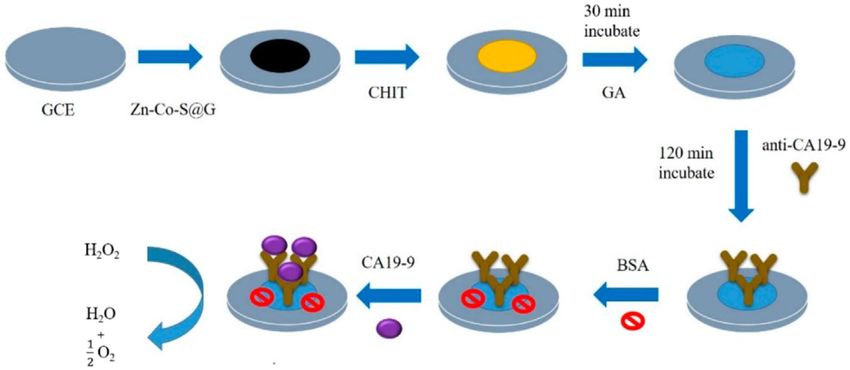
were used as a label for Ab2 to achieve duplex amplification Figure 1, the Zn-Co-S/graphene composite can be used to detect
of the electrochemical signal. This immunosensor can reach the CA199 (Su et al., 2021). The Zn-Co-S dot-like nanoparticles
detection limit of 0.03 pg/ml for CEA. In addition to grown on graphene can form a conductive network, allowing the
cyclodextrins, chitosan also has a similar role. Gao et al. direct reduction of H2O2 by the active site. This electrochemical
(2011) prepared a chitosan-carbon nanotube-gold immunosensor can detect CA199 linearly between 6.3 and 300 U/
nanoparticles nanocomposite membrane. This composite ml with a detection limit of 0 U/ml. For practical considerations,
membrane was able to exhibit better electrical conductivity, electrochemical immunosensors can also be assembled on screen-
high stability and good biocompatibility due to its three- printed electrodes (SPEs). Mic et al. (2020) modified SPEs with
dimensional structure. Under optimal conditions, this thermally reduced graphene oxide (TRGO). The modified
immunosensor can detect CEA in two linear ranges between electrodes can interact with CA199-His molecules by
0.1–2.0 and 2.0–200.0 ng/ml with a detection limit of 0.04 ng/ml. adsorption. It was shown that TRGO has a very strong affinity
Graphene is now replacing carbon nanotubes in the for CA199-His, to the extent that it can be used for quantitative
development of many sensors. For example, Jozghorbani et al. detection.
(2021) developed a label-free electrochemical immunosensor for
the detection of CEA. They modified reduced graphene oxide miRNA Detection
(rGO) on the surface of a glassy carbon electrode to form an miRNAs are a class of small non-coding single-stranded RNAs
interface for binding antibodies. rGO has carboxyl groups on the about 19–25 nt long that are commonly found in plants and
surface that can be used to bind to antibodies. This binding animals. They can inhibit the transcription or translation of target
between antibody and rGO can be confirmed by CV and EIS genes by incomplete binding to target mRNAs to perform their
characterization. The weakening of the electrochemical signal can biological functions. Since the year 2,000, miRNAs have been
Frontiers in Chemistry | www.frontiersin.org 3 August 2021 | Volume 9 | Article 736271Zhang et al. Gastric Cancer Markers Detection
FIGURE 1 | Scheme of fabrication of the Zn-Co-S/graphene electrochemical immunosensor for CA199 detection.
widely studied worldwide and more than two thousand miRNAs new immunoassay techniques that are rapid, sensitive, high-
have been identified and characterized. miRNAs are widely throughput, low-cost, easy for clinical dissemination and field
involved in the development of gastric cancer (Daneshpour application is crucial for early diagnosis, prognosis monitoring,
et al., 2018; Huang et al., 2019). H. pylori (HP) is a class I and treatment of gastric cancer. Carbon nanomaterials have very
gastric carcinogen. miR-223, miR-125a, and miR-21 expression high specific surface area, electrical conductivity and good
was found to be significantly increased in positive gastric cancer mechanical properties, which are ideal materials required in
specimens, while miR-218 expression was significantly decreased. electrochemistry. A large number of theoretical and practical
This suggests that HP infection may promote gastric cancer studies have been conducted on the application of carbon
formation by altering the corresponding miRNAs. Several nanotubes and graphene in the field of electrochemistry,
studies also demonstrated that miR-551b-3p, miR-100-5p, and which fully demonstrate the application prospects of carbon
miR-363-3 were significantly down-regulated in gastric cancer materials as new sensing materials. An ideal tumor marker
tissues and cells. miR-215 was significantly up-regulated in gastric should have high sensitivity, good specificity, and high
cancer tissues and cells. miR-429 aberrant expression may be accuracy. Although many tumor markers have been
associated with age differences in gastric cancer development. continuously discovered, studied and applied, a tumor marker
However, there are not many applications of carbon with high sensitivity, and specificity has not been found yet.
nanomaterials in miRNA detection. Yammouri et al. (2017) Immunosensors will become a widely used novel test in the field
compared the detection of miR-125a by carbon black, of medical diagnosis. Various novel signal-enhanced
MWCNT and GO after preparing an electrochemical immunosensors can effectively improve the sensitivity and
immunosensor. Surprisingly, the lowest detection limit of specificity of tumor marker diagnosis and enable the detection
microRNA-125a was obtained with the sensor modified with of gastric cancer markers.
carbon black.
AUTHOR CONTRIBUTIONS
CONCLUSION
ZZ, MP, and ZX conceptualized the idea. ZZ, MP, DL, JY, and YL
Gastric cancer is a malignant tumor originating from the wrote the original draft. BW, LW, and ZX reviewed and edited the
epithelial cells of the gastric mucosa, and it is the second paper. ZX supervised the work. ZZ, MP, BW, and LW obtained
leading cause of cancer death worldwide. The development of the resources.
Assari, P., Rafati, A. A., Feizollahi, A., and Joghani, R. A. (2020). Fabrication of a Sensitive
REFERENCES Label Free Electrochemical Immunosensor for Detection of Prostate Specific Antigen
Using Functionalized Multi-Walled Carbon Nanotubes/polyaniline/AuNPs. Mater. Sci.
Akça, A., Karaman, O., and Karaman, C. (2021). Mechanistic Insights into Eng. C 115, 111066. doi:10.1016/j.msec.2020.111066
Catalytic Reduction of N2O by CO over Cu-Embedded Graphene: A Bacac, M., Fauti, T., Sam, J., Colombetti, S., Weinzierl, T., Ouaret, D., et al. (2016). A Novel
Density Functional Theory Perspective. ECS J. Solid State. Sci. Technol. Carcinoembryonic Antigen T-Cell Bispecific Antibody (CEA TCB) for the Treatment
10, 041003. doi:10.1149/2162-8777/abf481 of Solid Tumors. Clin. Cancer Res. 22, 3286–3297. doi:10.1158/1078-0432.ccr-15-1696
Archer, A. G., and Grant, D. C. (1991). Recent Developments in Diagnostic Radiology of Britto, P. J., Santhanam, K. S. V., and Ajayan, P. M. (1996). Carbon Nanotube
Primary and Recurrent Gastric Cancer. Cancer Treat. Res. 55, 107–131. doi:10.1007/ Electrode for Oxidation of Dopamine. Bioelectrochemistry Bioenerg. 41,
978-1-4615-3882-0_7 121–125. doi:10.1016/0302-4598(96)05078-7
Frontiers in Chemistry | www.frontiersin.org 4 August 2021 | Volume 9 | Article 736271Zhang et al. Gastric Cancer Markers Detection
Chen, S., Chen, Y.-B., Li, Y.-F., Feng, X.-Y., Zhou, Z.-W., and Yuan, X.-H. Karimi-Maleh, H., Orooji, Y., Karimi, F., Alizadeh, M., Baghayeri, M.,
(2012). Normal Carcinoembryonic Antigen Indicates Benefit from Rouhi, J., et al. (2021b). A Critical Review on the Use of Potentiometric
Perioperative Chemotherapy to Gastric Carcinoma Patients. World Based Biosensors for Biomarkers Detection. Biosens. Bioelectron. 184,
J. Gastroenterol. 18, 3910. doi:10.3748/wjg.v18.i29.3910 113252. doi:10.1016/j.bios.2021.113252
Chen, Y., Li, Y., Deng, D., He, H., Yan, X., Wang, Z., et al. (2018). Effective Karimi-Maleh, H., Yola, M. L., Atar, N., Orooji, Y., Karimi, F., Senthil Kumar,
Immobilization of Au Nanoparticles on TiO2 Loaded Graphene for a P., et al. (2021c). A Novel Detection Method for Organophosphorus
Novel sandwich-type Immunosensor. Biosens. Bioelectron. 102, 301–306. Insecticide Fenamiphos: Molecularly Imprinted Electrochemical Sensor
doi:10.1016/j.bios.2017.11.009 Based on Core-Shell Co3O4@MOF-74 Nanocomposite. J. Colloid Interf.
Daneshpour, M., Karimi, B., and Omidfar, K. (2018). Simultaneous Detection Sci. 592, 174–185. doi:10.1016/j.jcis.2021.02.066
of Gastric Cancer-Involved miR-106a and Let-7a through a Dual-Signal-
Khandelwal, N., Dey, S. K., Chakravarty, S., and Kumar, A. (2019). miR-30 Family
Marked Electrochemical Nanobiosensor. Biosens. Bioelectron. 109,
miRNAs Mediate the Effect of Chronic Social Defeat Stress on Hippocampal
197–205. doi:10.1016/j.bios.2018.03.022
Neurogenesis in Mouse Depression Model. Front. Mol. Neurosci. 12, 188.
Gao, X., Zhang, Y., Wu, Q., Chen, H., Chen, Z., and Lin, X. (2011). One Step
doi:10.3389/fnmol.2019.00188
Electrochemically Deposited Nanocomposite Film of Chitosan-Carbon
Nanotubes-Gold Nanoparticles for Carcinoembryonic Antigen Liu, J., Yang, T., Xu, J., and Sun, Y. (2021). A New Electrochemical Detection
Immunosensor Application. Talanta 85, 1980–1985. doi:10.1016/ Technique for Organic Matter Content in Ecological Soils. Front. Chem. 9, 488.
j.talanta.2011.07.012 doi:10.3389/fchem.2021.699368
Gao, Y., Wang, J., Zhou, Y., Sheng, S., Qian, S. Y., and Huo, X. (2018). Luo, H., Xia, X., Kim, G. D., Liu, Y., Xue, Z., Zhang, L., et al. (2021). Characterizing
Evaluation of Serum CEA, CA19-9, CA72-4, CA125 and Ferritin as Dedifferentiation of Thyroid Cancer by Integrated Analysis. Sci. Adv. 7,
Diagnostic Markers and Factors of Clinical Parameters for Colorectal eabf3657. doi:10.1126/sciadv.abf3657
Cancer. Sci. Rep. 8, 2732–2739. doi:10.1038/s41598-018-21048-y Lv, H., Li, Y., Zhang, X., Gao, Z., Feng, J., Wang, P., et al. (2018). The Label-Free
Gaspar, M. J., Arribas, I., Coca, M. C., and Díez-Alonso, M. (2001). Immunosensor Based on Rhodium@palladium Nanodendrites/sulfo Group
Prognostic Value of Carcinoembryonic Antigen, CA 19-9 and CA 72- Functionalized Multi-Walled Carbon Nanotubes for the Sensitive Analysis
4 in Gastric Carcinoma. Tumor Biol. 22, 318–322. doi:10.1159/ of Carcino Embryonic Antigen. Analytica Chim. Acta 1007, 61–70. doi:10.1016/
000050633 j.aca.2017.12.030
Han, J., Li, Y., Feng, J., Li, M., Wang, P., Chen, Z., et al. (2017). A Novel Mashima, T., Iwasaki, R., Kawata, N., Kawakami, R., Kumagai, K., Migita, T., et al.
Sandwich-Type Immunosensor for Detection of Carcino-Embryonic (2019). In Silico chemical Screening Identifies Epidermal Growth Factor
Antigen Using Silver Hybrid Multiwalled Carbon Nanotubes/ Receptor as a Therapeutic Target of Drug-Tolerant CD44v9-Positive Gastric
manganese Dioxide. J. Electroanalytical Chem. 786, 112–119. Cancer Cells. Br. J. Cancer 121, 846–856. doi:10.1038/s41416-019-0600-9
doi:10.1016/j.jelechem.2017.01.021 Medetalibeyoğlu, H., Beytur, M., Manap, S., Karaman, C., Kardaş, F., and Akyıldırım, O.
Huang, K.-J., Niu, D.-J., Sun, J.-Y., and Zhu, J.-J. (2011). An Electrochemical (2020). Molecular Imprinted Sensor Including Au Nanoparticles/polyoxometalate/
Amperometric Immunobiosensor for Label-Free Detection of α-fetoprotein two-Dimensional Hexagonal boron Nitride Nanocomposite for Diazinon
Based on Amine-Functionalized Graphene and Gold Nanoparticles Modified Recognition. ECS J. Solid State. Sci. Technol. 9, 101006. doi:10.1149/2162-8777/abbe6a
Carbon Ionic Liquid Electrode. J. Electroanalytical Chem. 656, 72–77.
Mic, M., Varodi, C., Pogacean, F., Socaci, C., Coros, M., Stefan-van Staden, R.-I.,
doi:10.1016/j.jelechem.2011.01.007
et al. (2020). Sensing and Interaction of His-Tagged CA19-9 Antigen with
Huang, R., He, L., Xia, Y., Xu, H., Liu, C., Xie, H., et al. (2019). A Sensitive Graphene-Modified Electrodes. Chemosensors 8, 112. doi:10.3390/
Aptasensor Based on a Hemin/G-Quadruplex-Assisted Signal Amplification chemosensors8040112
Strategy for Electrochemical Detection of Gastric Cancer Exosomes. Small 15,
Naderi Asrami, P., Aberoomand Azar, P., Saber Tehrani, M., and Mozaffari, S. A.
1900735. doi:10.1002/smll.201900735
(2020). Glucose Oxidase/nano-ZnO/thin Film Deposit FTO as an Innovative
Huang, Z., Jiang, Z., Zhao, C., Han, W., Lin, L., Liu, A., et al. (2017). Simple and Clinical Transducer: aA Sensitive Glucose Biosensor. Front. Chem. 8, 503.
Effective Label-Free Electrochemical Immunoassay for Carbohydrate Antigen doi:10.3389/fchem.2020.00503
19-9 Based on Polythionine-Au Composites as Enhanced Sensing Signals for
Pei, F., Wang, P., Ma, E., Yang, Q., Yu, H., Gao, C., et al. (2019). A Sandwich-Type
Detecting Different Clinical Samples. Int. J. Nanomedicine. 12, 3049–3058.
Electrochemical Immunosensor Based on RhPt NDs/NH2-GS and Au NPs/PPy
doi:10.2147/ijn.s131805
NS for Quantitative Detection Hepatitis B Surface Antigen. Bioelectrochemistry
Ishigami, S., Natsugoe, S., Hokita, S., Che, X., Tokuda, K., Nakajo, A., et al. (2001).
126, 92–98. doi:10.1016/j.bioelechem.2018.11.008
Clinical Importance of Preoperative Carcinoembryonic Antigen and
Carbohydrate Antigen 19-9 Levels in Gastric Cancer. J. Clin. Gastroenterol. Sheng, Q.-L., Zheng, J.-B., Shang-Guan, X.-D., Lin, W.-H., Li, Y.-Y., and Liu, R.-X.
32, 41–44. doi:10.1097/00004836-200101000-00010 (2010). Direct Electrochemistry and Electrocatalysis of Heme-Proteins
Jozghorbani, M., Fathi, M., Kazemi, S. H., and Alinejadian, N. (2021). Immobilized in Porous Carbon Nanofiber/room-Temperature Ionic Liquid
Determination of Carcinoembryonic Antigen as a Tumor Marker Using a Composite Film. Electrochimica Acta 55, 3185–3191. doi:10.1016/
Novel Graphene-Based Label-Free Electrochemical Immunosensor. Anal. j.electacta.2009.12.101
Biochem. 613, 114017. doi:10.1016/j.ab.2020.114017 Su, C.-W., Tian, J.-H., Ye, J.-J., Chang, H.-W., and Tsai, Y.-C. (2021). Construction
Kalyani, T., Sangili, A., Nanda, A., Prakash, S., Kaushik, A., and Kumar Jana, of a Label-free Electrochemical Immunosensor Based on Zn-Co-S/Graphene
S. (2021). Bio-Nanocomposite Based Highly Sensitive and Label-Free Nanocomposites for Carbohydrate Antigen 19-9 Detection. Nanomaterials 11,
Electrochemical Immunosensor for Endometriosis Diagnostics 1475. doi:10.3390/nano11061475
Application. Bioelectrochemistry 139, 107740. doi:10.1016/ Timur, S., Anik, U., Odaci, D., and Gorton, L. (2007). Development of a
j.bioelechem.2021.107740 Microbial Biosensor Based on Carbon Nanotube (CNT) Modified
Karaman, C., Karaman, O., Atar, N., and Yola, M. L. (2021). Electrochemical Electrodes. Electrochemistry Commun. 9, 1810–1815. doi:10.1016/
Immunosensor Development Based on Core-Shell High-Crystalline Graphitic j.elecom.2007.04.012
Carbon Nitride@ Carbon Dots and Cd 0.5 Zn 0.5 S/d-Ti 3 C 2 T X MXene Wang, X., Wu, W. K. K., Gao, J., Li, Z., Dong, B., Lin, X., et al. (2019). Autophagy
Composite for Heart-Type Fatty Acid–Binding Protein Detection. Microchim. Inhibition Enhances PD-L1 Expression in Gastric Cancer. J. Exp. Clin. Cancer
Acta 188, 1–15. doi:10.1007/s00604-021-04838-6 Res. 38, 140. doi:10.1186/s13046-019-1148-5
Karimi-Maleh, H., Alizadeh, M., Orooji, Y., Karimi, F., Baghayeri, M., Rouhi, J., et al. (2021a). Yammouri, G., Mandli, J., Mohammadi, H., and Amine, A. (2017). Development
Guanine-based DNA Biosensor Amplified with Pt/SWCNTs Nanocomposite as of an Electrochemical Label-Free Biosensor for microRNA-125a Detection
Analytical Tool for Nanomolar Determination of Daunorubicin as an Anticancer Using Pencil Graphite Electrode Modified with Different Carbon
Drug: A Docking/experimental Investigation. Ind. Eng. Chem. Res. 60, 816–823. Nanomaterials. J. Electroanalytical Chem. 806, 75–81. doi:10.1016/
doi:10.1021/acs.iecr.0c04698 j.jelechem.2017.10.012
Frontiers in Chemistry | www.frontiersin.org 5 August 2021 | Volume 9 | Article 736271Zhang et al. Gastric Cancer Markers Detection
Zhang, L., Ren, Z., Su, Z., Liu, Y., Yang, T., Cao, M., et al. (2021). Novel the publisher, the editors and the reviewers. Any product that may be evaluated in
Recurrent Altered Genes in Chinese Patients with Anaplastic Thyroid this article, or claim that may be made by its manufacturer, is not guaranteed or
Cancer. J. Clin. Endocrinol. Metab. 106, 988–998. doi:10.1210/clinem/ endorsed by the publisher.
dgab014
Copyright © 2021 Zhang, Peng, Li, Yao, Li, Wu, Wang and Xu. This is an open-
Conflict of Interest: The authors declare that the research was conducted in the access article distributed under the terms of the Creative Commons Attribution
absence of any commercial or financial relationships that could be construed as a License (CC BY). The use, distribution or reproduction in other forums is permitted,
potential conflict of interest. provided the original author(s) and the copyright owner(s) are credited and that the
original publication in this journal is cited, in accordance with accepted academic
Publisher’s Note: All claims expressed in this article are solely those of the authors practice. No use, distribution or reproduction is permitted which does not comply
and do not necessarily represent those of their affiliated organizations, or those of with these terms.
Frontiers in Chemistry | www.frontiersin.org 6 August 2021 | Volume 9 | Article 736271You can also read


