Chinese autonomous vehicle industry faces geopolitical headwinds - China boosts support for AV sector amid significant market, technological, and ...
←
→
Page content transcription
If your browser does not render page correctly, please read the page content below
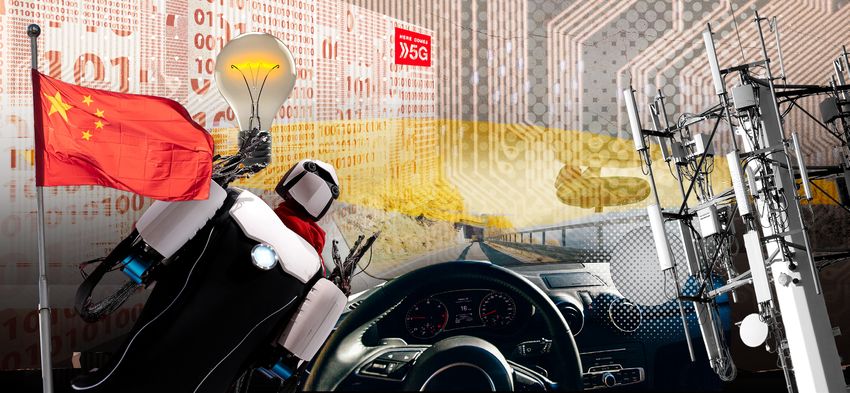
Chinese autonomous vehicle
industry faces geopolitical
headwinds
China boosts support for AV sector amid significant
market, technological, and external challenges

PREPARED BY EURASIA GROUP
MARCH 2021
Chinese autonomous vehicle
industry faces geopolitical
headwinds
China boosts support for AV sector amid significant
market, technological, and external challenges
PREPARED BY EURASIA GROUP
MARCH 2021

CONTENTS
Key findings                                                                                                   3

Overview                                                                                                       4

Beijing seeks to stimulate post-pandemic economy via new
infrastructure investments                                                                                     4

Authorities fast-track regulatory support for the rapidly growing
tech sector …                                                                                                  5

… as local governments pave the way for wide-scale deployment                                                  8

Potential roadblocks loom                                                                                      9

2021 will be critical year for the AV sector                                                                  12

Appendix                                                                                                      14

Prepared by Eurasia Group
This report is based on the opinions of Eurasia Group analysts and various in-country specialists. Eurasia Group
is a private research and consulting firm that maintains no affiliations with governments or political parties.
Report issued March 2021 | © 2021 Eurasia Group
CHINESE AUTONOMOUS VEHICLE INDUSTRY FACES GEOPOLITICAL HEADWINDS

Key findings
• Beijing is making targeted investments in technologies such as 5G networks, data centers,
  electric vehicles (EVs), autonomous vehicles (AVs), and charging infrastructure as part of the
  coronavirus stimulus spending under the so-called New Infrastructure Initiative (NII). The NII,
  which was unveiled last May, includes approximately USD 1.4 trillion of government funding
  over five years.
• The pandemic has also helped encourage the development of commercial use cases for AVs,
  ranging from autonomous delivery services to robotaxis, and has boosted demand for contact-
  less technologies.
• China’s coordinated and ecosystem-centric approach to industry guidance and standards could
  help fast-track the deployment of self-driving cars. Meanwhile, in the US, there is growing in-
  dustry concern that overlap between federal and state authorities is contributing to heightened
  uncertainty and confusion in the market.
• Since the Beijing provincial government issued the country’s first local AV regulations in 2017,
  a growing number of provincial and municipal governments have followed suit. Local officials
  are vying to attract AV industry leaders and startups by removing regulatory barriers, offering
  subsidies, and building out 5G network infrastructure.
• Despite high-level assistance from both central and municipal governments, the wide-scale
  deployment of self-driving vehicles in China will face some of the same regulatory and tech-
  nological challenges that exist in other markets, such as the US and the EU, though these will
  affect domestic and foreign AV producers in different ways. Chinese firms will grapple with an
  array of issues, including talent shortages, legal battles among industry leaders, and “the last
  mile” technical challenge.
• In addition, US President Joe Biden’s administration is conducting a comprehensive review of
  China policy, including the previous administration’s last-minute actions targeting Chinese tech
  companies—some with AV industry ties. While US trade officials have not focused on the AV
  sector, it could assume a more prominent role for issues such as forced technology transfer if
  and when trade talks resume between the two countries.
• Chinese industrial planning ministries will likewise face new challenges in 2021 as the com-
  plexity of AV supply chains becomes more apparent. These supply chains will also come under
  new pressure from US-China tensions and continuing shortages, particularly for auto-related
  semiconductors, caused by the pandemic.

Prepared by Eurasia Group | March 2021                                                               eurasia group | 3
CHINESE AUTONOMOUS VEHICLE INDUSTRY FACES GEOPOLITICAL HEADWINDS

Overview
The Ministry of Industry and Information Technology (MIIT) in mid-January published draft
“Management Standards for Road Testing and Demonstration Application of Intelligent Connected
Vehicles (Test).” The policy document is part of a government effort to increase regulatory support
for AVs and the broader new energy vehicle (NEV) sector. Given the priority Chinese industrial
planners are placing on developing a robust domestic EV/AV technology ecosystem, the sector
achieved a major expansion in 2020, with a host of private and state-owned players—both car
manufacturers and technology companies—ramping up offerings. They are partnering to deploy
more advanced systems and positioning themselves to compete in the EV/AV market.
This report analyzes China’s efforts to fast-track the development and deployment of AVs such as self-
driving delivery vehicles and robotaxis. It describes how policies aimed at boosting the sector and
spurring related infrastructure investment have taken on new urgency during the Covid-19 pandemic,
as the government works to mitigate the virus’s economic impact. It also describes how the US-China
technology and trade confrontation—including US export restrictions on some key tech components—
could pose difficulties for Chinese companies operating in the sector (please see Eurasia Group report:
China/Geo-technology: Chinese AV ambitions at risk amid trade war, 9 July 2019).

 Key definitions and terminology
 Autonomous vehicles           Refers to self-driving cars, which are equipped with technology that allows them to
 (AVs)                         drive without the active control or monitoring of a person. There are varying levels of
                               autonomy, ranging from basic driver assistance, such as adaptive cruise control with
                               forward collision avoidance that automatically slows cars when they encounter obsta-
                               cles, to fully autonomous driving involving no human input.
 Interconnected vehicles       Describes vehicles that are connected to the internet, generally through their own wire-
 (ICVs)                        less local area network (LAN). This enables them to communicate with the driver, other
                               vehicles, and connected infrastructure (V2X).
 Electric vehicles (EVs)       Refers to vehicles, also known as plug-in electric vehicles, that derive all or part of their
                               power from electricity supplied by the electric grid. EVs are widely considered the most
                               compatible with automated driving systems and consequently key to AVs.
 Smart vehicles                Refers to “intelligent cars,” which are characterized by advanced electronic features but
                               are not necessarily fully autonomous.
 New energy vehicles           Refers to vehicles with new-type power systems that are completely or mainly driven by
 (NEVs)                        new energy sources, such as EVs.
 Cellular vehicle-to-          Describes a 3GPP-supported cellular standard helping a technology to achieve V2X
 everything technology         communications. Supports active safety and improves situational awareness by iden-
 (C-V2X)                       tifying and communicating information using low-latency direct transmission in the
                               5.9-gigahertz Intelligent Transportation System band.
 Source: Eurasia Group

Beijing seeks to stimulate post-pandemic economy via new
infrastructure investments
Beijing is pursuing targeted investment in high-tech sectors, such as 5G networks, data centers,
and EV/AVs and charging infrastructure, as part of a coronavirus-related stimulus package
outlined in the so-called New Infrastructure Initiative (NII). The pandemic has also helped
focus thinking on commercial use cases for AVs, ranging from autonomous delivery services to
robotaxis, and has lent momentum to consumer demand for contactless technologies.
Industry leaders, including Alibaba-backed AutoX, have touted the pandemic’s role in
demonstrating the superior safety of robotaxis and robodelivery services relative to traditional
transportation, especially to reduce the risk of infection. For example, e-commerce leader JD.com

Prepared by Eurasia Group | March 2021                                                                                         eurasia group | 4
CHINESE AUTONOMOUS VEHICLE INDUSTRY FACES GEOPOLITICAL HEADWINDS
last February launched its first delivery of coronavirus-related medical aid transported via AV in
Wuhan—the epicenter of the country’s initial outbreak.
Authorities fast-track regulatory support for the rapidly growing tech
sector …
Last May, Beijing unveiled a major push for investment in “new infrastructure” as part of its
evolving high-tech industrial policy. The NII includes an estimated USD 1.4 trillion of government
funding over the next five years for targeted investment in a wide array of emerging technologies,
including next-generation networks, data centers, charging infrastructure, and autonomous and
interconnected vehicles. The two areas are linked, since next-generation networks will enable
certain autonomous and interconnected vehicle applications.
The NII is among the government’s latest support for new energy and smart vehicles, which are
highlighted as strategic priorities under the Made in China 2025 (MIC 2025) industrial policy and
the National Artificial Intelligence Development Plan (2018). The central government founded
more than 300 active state-backed investment funds under MIC 2025 to support high-tech sectors,
including AVs and NEVs. These funds reportedly possess more than USD 200 billion of assets and
have gradually ramped up investment in the AV industry, with an average state-owned enterprise
(SOE) investment of USD 4 billion between 2016 and 2019, according to one estimate.
This injection of fresh capital has been used to invigorate the industry, including by upgrading
production lines, as well as tools and machinery used to manufacture both vehicle hardware and
software. Government ministries, along with AV developers, media, communications, and other
related companies, are eager to stake out a share in the country’s AV sector. The market is expected
to reach 1.5 million units by 2025 and grow at a compound annual growth rate of approximately
28%. This is likely a low estimate, though, given increased funding allocated under the banner of
the NII, including local government financing vehicles such as special bonds and large state-backed
funds. Guangdong’s provincial government, for example, unveiled plans last year to invest USD 154.6
billion (CNY 1 trillion) in digital infrastructure as part of plans to implement the NII, such as 180,000
charging points for NEVs and 220,000 5G base stations by the end of 2022.
Investment in Chinese autonomous vehicle companies
Venture capital and private equity investments in Chinese AV companies have gained momentum over
the past five years, with total private equity investment in the bourgeoning sector climbing to USD 91.64
billion in 2019. The number of companies receiving investments in self-driving vehicles more than tripled
between 2014 and 2019, while the number of investments grew 233% over the same period. Given that
the number of investments appears to be relatively steady over the past four years, investors seem to be
increasingly selective in identifying target companies.
Number of companies Number of investments
50
40
30
20
10
0
2014 2015 2016 2017 2018 2019
Source: Eurasia Group, Yiou Research and Qingke Research
Prepared by Eurasia Group | March 2021 eurasia group | 5CHINESE AUTONOMOUS VEHICLE INDUSTRY FACES GEOPOLITICAL HEADWINDS
China’s central government has demonstrated a sustained commitment to allocating resources
and providing high-level support to the sector. In February 2020, the National Development and
Reform Commission (NDRC) and ten other central government departments jointly issued the
Strategy for Innovation and Development of Intelligent Vehicles. The policy document builds
upon the draft released in late 2018 and provides a policy blueprint for boosting the development
of AVs over the next three decades. It also outlines the following target benchmarks:
• 2025: Establish the standards underpinning smart vehicle technology innovation, the industry
ecosystem, and foundational infrastructure; construct the wireless networks for full coverage of
LTE-V2X and 5G-enabled V2X in main cities
• 2035-2050: Construct and fully deploy a standard smart car system throughout the country to
promote green transportation and improve safety as well as efficiency
The strategy is emblematic of China’s evolving regulatory approach. With nearly a dozen central
government departments involved, the high-level interagency coordination reflects agreement
that a cross-cutting approach is necessary to grapple with the regulatory and industry impacts
of the suite of technologies that will enable AVs. In addition, the document places particular
importance on establishing a big data cloud platform for national smart vehicles and devising
standards to support the industry.
Indeed, industry standards are at the forefront of regulatory efforts. The MIIT in March 2020,
for example, released standards and technical requirements for different levels of autonomous
driving. The ministry highlighted the following benchmarks for the industry:
• 2020:
• Further develop an ICV standards system underpinning driving assistance and low-level
autonomous driving
• Conduct research and assessment for the requirements of national standards, industry
standards, and social organization standards, as well as enhance the ICV standard system
• Chart a course for the standardization of the function and application of automotive
networking
• 2022:
• Complete research on basic technologies and develop more than 20 essential standards
to support the registration, management, identification, etc. of intelligent and
interconnected vehicles; provide support for IoVs
China’s coordinated and ecosystem-centric approach to crafting industry guidance and standards
could help fast-track the development and deployment of self-driving cars. Meanwhile, in the US,
there is growing concern within industry that overlap between federal and state authorities is
contributing to heightened uncertainty and confusion in the market.
Both SOEs and the private sector are responding to Beijing’s high-level push and ramping up
investment in the EV and AV sectors. State-run automaker FAW Group, for example, announced
plans in October to partner with Germany’s Audi AG to establish a joint venture to manufacture
premium EVs. While Audi AG and its parent company Volkswagen will own a 60% stake in
the future joint venture, FAW will own the remainder and the company will be based in the
northeastern city of Changchun. Starting in 2024, the joint venture will focus on the local
production of completely electric vehicles. Meanwhile, Audi AG also plans to produce vehicles
with the Shanghai-based, state-owned SAIC Motor.
Prepared by Eurasia Group | March 2021 eurasia group | 6CHINESE AUTONOMOUS VEHICLE INDUSTRY FACES GEOPOLITICAL HEADWINDS
The planned joint ventures mark the latest between SOEs and private sector players, underscoring
rising interest in China’s growing EV sector and highlighting the appeal of the sector’s relatively
low investment barriers. In 2018, the NDRC removed joint-venture requirements for NEVs and
announced that the removal of foreign ownership restrictions for commercial vehicles and
passenger cars would be phased out by 2022.
Snapshot: High-level government efforts to promote AV development
(December 2018 to present)
Beijing is coordinating interagency efforts to devise the regulatory framework underpinning the AV ecosystem. The
high-level push reflects broader efforts to reduce regulatory uncertainty for AV makers in China. The move contrasts
with the situation in the US, which has seen a proliferation of patchwork state-level legislation in the absence of an
overarching federal approach.
Date released Regulation/official statement Relevant ministries
Management Standards for Road Testing and Ministry of Transportation (MoT), Ministry
January 2021 Demonstration Application of Intelligent Connected of Industry and Information Technology
Vehicles (Test), draft for public comment (MIIT), Ministry of Public Security
Interpretation of “Guiding Opinions on Advancing the
January 2021 Development and Application of Autonomous Driving MIIT
Technology for On-the-road Transportation”
New energy automotive industry development plan (2021-
November 2020 State Council
2035)
Statement in support of pilot projects for next-generation
November 2020 transportation, such as autonomous driving and smart MoT
roads in Beijing, Shanghai, and Hebei province
Statement on speeding up the transformation and
upgrading of key expressways (5G+ Internet of Vehicles
October 2020 MIIT
Ecological Development Summit Forum at the China
International Information and Communication Exhibition)
Statement on accelerating the advancement of smart and
June 2020 MIIT
interconnected vehicle development
Draft document on general technical specifications for
April 2020 MoT
highway auxiliary facilities adapted to automated driving
Date released Regulation/official statement Relevant ministries
Work Priorities for Standards of Intelligent Connected
March 2020 MIIT
Vehicles (ICT) in 2020
National Development and Reform
Strategy for Innovation and Development of Intelligent
February 2020 Commission (NDRC) and 10 central
Vehicles
government departments
Draft Strategy for Innovation and Development of NDRC and 10 central government
January 2018
Intelligent Vehicles departments
Three-Year Action Plan to Enhance Core Competitiveness
January 2018 NDRC
in the Manufacturing Industry (2018-2020)
Guidelines for Development of National Internet of Vehicles
December 2017 Industry Standards System (Intelligent and Connected MIIT
Vehicles) (2018)
July 2017 National Artificial Intelligence Development Plan State Council
Source: Eurasia Group, Xinhua
Prepared by Eurasia Group | March 2021 eurasia group | 7CHINESE AUTONOMOUS VEHICLE INDUSTRY FACES GEOPOLITICAL HEADWINDS
… as local governments pave the way for wide-scale deployment
Since the Beijing provincial government issued the country’s first local AV regulations in 2017,
a growing number of provincial and municipal governments have followed suit. Local officials
are vying to attract AV industry leaders and startups by removing regulatory barriers, offering
subsidies, and building out 5G network infrastructure. Last April, for example, Baidu received
approval from the Hunan government to deploy robotaxi services to the public in Changsha.
Baidu also launched the Apollo Go Robotaxi service in Cangzhou, Hebei province, marking the
first time robotaxi coverage extended to the downtown area of a Chinese city.
Meanwhile, in early September, Wuhan authorities announced plans to construct the country’s
largest AV testbed, expanding the test roads in the National Intelligent Connected Vehicle
(Wuhan) Pilot Zone by 78 kilometers and bringing it to a total of more than 100 kilometers.
Chinese AV developers, including the domestic auto giant Dongfeng, plan to expand the AV fleet
with more than 200 autonomous cars to be deployed by the end of 2022, while also extending
the demonstration zone to the city’s main urban areas. In addition, the Hefei government in
September 2020 issued licenses permitting ride-hailing company Didi Chuxing to conduct road
tests for AVs, while Guangzhou approved Baidu’s request to deploy connected autonomous
vehicles (CAVs) and develop an intelligent transportation network in the city, ranging from
robotaxi operations to 5G-enabled robobuses.
As of 2019, China had approved more than 200 license plates for dozens of companies for AV
testing in an expanding number of cities. The number has almost certainly grown substantially
since then, highlighting the country’s intensifying push to promote AV testing. These local
regulations are a key pillar in the central government’s regulatory efforts as they influence the
high-level rulemaking efforts of the MIIT, the transport ministry, and other ministries.
This has translated to significant policy support for and industry progress in AV development,
with AutoX in December announcing plans to remove safety drivers and deploy a fleet of 25 AVs in
downtown Shenzhen. This represents the first time AVs have been tested in China on public roads
with neither safety drivers nor remote operators, and it paves the way for other AV developers to
follow suit.
Snapshot: Local governments racing to attract AV developers
Beijing-Xiong’an expressway
The 62-mile expressway, which connects Beijing and neighboring greenfield smart city Xiong’an, has several lanes
dedicated to AVs and was built by driverless construction vehicles. The road is set to open in mid-2021.
Cangzhou, Hebei province
The local government in May 2020 announced that it had expanded the city’s self-driving test zone into
some downtown areas.
Wuhan
The Wuhan Economic & Technological Development Zone in September announced plans to construct the country’s
largest autonomous driving test area, which is expected to have more than 100 kilometers of roads available for
testing self-driving vehicles. All participants in the project aim to create AV fleets with at least 200 autonomous cars
to be deployed by the end of 2022 and expand tests into the city's core urban areas. An automated driving system
will also be built to support myriad AV use cases, including self-driving buses, sanitation services, and robotaxis.
Changsha, Hunan
A fleet of robotaxis became available for public use last April in designated areas extending from residential
communities to commercial zones and industrial parks.
Source: Xinhua, Eurasia Group
Prepared by Eurasia Group | March 2021 eurasia group | 8CHINESE AUTONOMOUS VEHICLE INDUSTRY FACES GEOPOLITICAL HEADWINDS
Potential roadblocks loom
Current location of China-educated AI scientists* Despite high-level assistance from
both central and municipal
China governments, the wide-scale
deployment of self-driving vehicles in
26.3% China will face some of the same
regulatory and technological
challenges that exist in other markets,
73.7%
such as the US and the EU, though
Overseas these will manifest differently for
domestic and foreign AV producers.
*The data are calculated according to Chinese AI scientists accepted to the NeurIPS conference, Chinese firms will grapple with an
a renowned global AI conference that represents the pool of top global AI talent.
Sources: NeurIPS and Macro Polo array of issues, including limited
talent pools. Although China’s AI talent
base has grown roughly ten-fold over the past decade, the country struggles to retain AI talent. More
than 70% of China-educated, highly skilled AI scientists pursue employment overseas, according to
one estimate. This has exacerbated concerns about shallow talent pools for highly skilled workers
for leading AV developers, spurring intense competition and allegations of employee poaching.
Baidu in 2017, for example, filed a USD 7.6 million (CNY 50 million renminbi) suit against AV startup
JingChi (currently known as WeRide), alleging that former executive Wang Jing pilfered proprietary
technology and poached staff when he departed Baidu to establish JingChi.
AV companies in China are also dealing with regulatory hurdles. In mid-2016, for instance, the
MIIT imposed a moratorium on AV testing and driving on public roads, with officials warning
developers not to test self-driving vehicles on highways before authorities established ground
rules. Given that the moratorium followed on the heels of a fatal crash in the US involving Tesla
and its beta testing Full Self Driving system, the timing suggests Chinese officials were wary of
a similar incident within the country. The government in 2018 released national rules for road
testing and outlined definitions for key terms, requirements for test vehicles and test drivers, and
liability provisions; but the scope of the rules has largely been limited to existing testing zones.
Snapshot: Challenges facing foreign and domestic AV developers
Developers in China face numerous challenges, including technical ones for achieving Level 5 (fully autonomous)
vehicles. However, regulatory and industry challenges manifest differently for foreign vs domestic companies
operating in this space. The Venn diagram below provides a snapshot.
Foreign AV developers Domestic AV developers
- Joint venture Both - Technical talents
requirements shortage
“The last mile”
- Road test technical challenge
licensing mandate in achieving fully - Legal battles between
autonomous vehicles industry pioneers can
- Cybersecurity hamper innovation
obligations, including
restricted access to
high-definition
mapping licenses
necessary for AVs
Source: Eurasia Group
Prepared by Eurasia Group | March 2021 eurasia group | 9CHINESE AUTONOMOUS VEHICLE INDUSTRY FACES GEOPOLITICAL HEADWINDS In addition, other geopolitical and technological challenges remain, including: US-China tech cold war pressures. Amid the ongoing technology and trade confrontation, Chinese technology companies—including those underpinning the AV ecosystem—may face new obstacles in obtaining vital components necessary to support the wide-scale deployment of fully autonomous fleets and the smart infrastructure on which they rely. The US Commerce Department has subjected telecom supplier Huawei to export restrictions under the entity list since May 2019, for example. While the company is most known as China’s national champion in 5G network equipment, it has also stepped up efforts to supply smart infrastructure such as cameras, radars, and sensors embedded in traffic signs that communicate with AVs. Indeed, the company reportedly aims to become China’s leading platform provider for self-driving vehicles over the next five years. Given its inclusion on the entity list and strong bipartisan support in the US for a hardline stance against Chinese tech companies in general and Huawei in particular, it is possible that export restrictions maintained or increased under President Joe Biden’s administration could impede Huawei’s ambitions in this space. In addition, AI could become an issue given concerns about dual-use technologies, with US automakers operating in China, including Tesla, potentially attracting regulatory scrutiny around how they are importing the necessary software and sourcing the data sets used to train the AI. This could elevate the risk that Chinese AV developers, such as Baidu and Pony.ai, could join the ranks of Huawei and dozens of other Chinese tech companies added to the entity list over the last year. Semiconductors. China’s NEV industry will face challenges over the next decade, according to the National New Energy Vehicle Technology Innovation Center, as the auto industry grapples with global semiconductor shortages. As of early 2020, the serious shortages of automotive semiconductors were due to a combination of factors, including production disruptions amid the pandemic, an uptick in demand for consumer electronics such as laptops, and China’s growing demand for EVs. This supply shortage is further exacerbated by the previous administration’s recent export restrictions designed to curb technology transfers to China. Following the inclusion of China’s leading semiconductor manufacturer, Semiconductor Manufacturing International Corporation (SMIC), on the entity list in December, many automakers shifted production to alternative suppliers such as Taiwan Semiconductor Manufacturing Company (TSMC), which have reportedly been struggling to meet the surging demand. At the same time, most car makers slashed production in 2020 because of the pandemic; and then, when the firms began ramping up production again and returned to semiconductor suppliers to resume filling orders, most manufacturers had already reallocated already scarce capacity. The supply constraints and US government entity list actions highlight China’s reliance on imports of core components, which amounted to USD 350 billion worth of integrated circuits in 2020 (a 14.6% increase from 2019) despite US export restrictions. China still depends heavily on foreign suppliers for core semiconductor components in autonomous driving. Semiconductor companies such as Nvidia provide hardware like the graphics processing unit and in-vehicle AI computer, as well as the training platforms and software development kits around it. The technical barrier is especially high in this space; developing reliable hardware and fostering a mature development framework is a long- term investment. Given mounting political and industry pressures, Beijing will almost certainly intensify its high- level push to reduce supply chain exposure to the US in next-generation technologies, as outlined in the government’s 14th Five-Year Plan (2021-2025), as well as efforts to boost production capacity in key areas such as advanced semiconductor manufacturing, software development, and AI. Prepared by Eurasia Group | March 2021 eurasia group | 10
CHINESE AUTONOMOUS VEHICLE INDUSTRY FACES GEOPOLITICAL HEADWINDS

Vehicle to everything (V2X) connectivity
V2X technology, also known as connected-vehicle-to-everything communication, allows vehicles to
communicate with their surroundings in order to improve safety. It has several aspects, including the following:
                                                                     Vehicle to pedestrian (V2P)
         Vehicle to vehicle (V2V)

                                                                              Vehicle to device (V2D)

      Vehicle to infrastructure (V2I)

                                                       Vehicle to network (V2N)

Source: Department of Transportation, Eurasia Group

Standards. China’s push to develop standards for autonomous and connected vehicles, as
illustrated in the Strategy for Innovation and Development of Intelligent Vehicles, may pose a
challenge for its domestic AV makers as they expand into overseas markets. This is especially true
given that international standards have yet to be agreed upon or developed in major markets,
such as the US and the EU. Moreover, language in China’s emerging standards framework
emphasizes the use of “secure and controllable” standards and technologies. The government
has not provided a concrete definition of “secure and controllable.” However, local and provincial
officials have generally interpreted it to refer to local production, which foreign competitors and
governments have generally criticized as unofficial guidance and approval to give preferential
treatment to domestic suppliers.
This underlines Beijing’s distinct preference to favor domestic AV companies, given growing
cybersecurity concerns around mobility services, for example, which over time could lead to
reduced market access for foreign firms in the sector. That said, Beijing’s overarching goal is
not necessarily to dominate the standards-setting process, but rather to promote international
standards that incorporate or are influenced by Chinese-developed standards. Standards
development has become an acute point of global technology competition as Beijing ratchets up
efforts to influence the process through support for domestic tech companies, such as Huawei and
Baidu, as well as state-affiliated actors.
China’s Innovation Driven Development Strategy—an industrial policy blueprint released in 2016
and focused on areas that Beijing feels would gain the most from increased domestic innovation—
promotes “supporting Chinese enterprises, alliances, and associations to participate in or lead
the development of international standards and promoting China’s ‘superior’ technologies and
standards to become international standards.” This strategic objective is already aligned with high-
level policy priorities as outlined in MIC 2025, including autonomous and interconnected vehicles.
Authorities have significantly downplayed the controversial MIC 2025 industrial policy over the
last year and ceased using references in official speeches, policy documents, and government
press releases amid heightened tech tensions with the US. While this shift is likely due to the high-
level pushback that the document triggered among many of China’s trading partners, including
the US and Germany, Beijing continues to push out preferential policies and subsidies for MIC
2025 sectors, including NEVs. Meanwhile, a long-awaited industrial policy document, China
Standards 2035, aims to establish a blueprint for China’s government and leading tech companies
to participate in global standards setting. The document has yet to be released.

Prepared by Eurasia Group | March 2021                                                                             eurasia group | 11
CHINESE AUTONOMOUS VEHICLE INDUSTRY FACES GEOPOLITICAL HEADWINDS Navigation. The navigation services of China’s BeiDou satellite network are commonly used across the country but have generally lacked the precision necessary to support AV deployment. To address this issue, a budding number of Chinese tech companies have installed base stations, which are used to measure and correct positioning within a certain radius, to help self-driving cars navigate accurately. Hangzhou-based Alibaba, for example, partnered with defense equipment manufacturer China North Industries Group Corporation (NORINCO) in 2015 to establish Qianxun Spatial Intelligence. The company has rolled out more than 3,000 base stations at home and abroad, with its positioning services installed in an EV that was recently unveiled by the state-owned Guangzhou Automobile Group. In addition, Qianxun Spatial Intelligence in November announced plans to supply systems for Guangzhou-based EV manufacturer Xpeng Motors. NORINCO is among a list of dozens of Chinese firms that the US Defense Department has designated as having ties to the People’s Liberation Army, which could lay the groundwork for US actions targeting the company’s access to US technologies and broader role in the country’s AV development. This illustrates the potential for US government actions against Chinese tech firms, including export restrictions and exclusion from US capital markets, to undermine China’s high- tech ambitions in general and AV development in particular. Antitrust. Large Chinese technology companies, such as Tencent and Alibaba, often dominate the market for software provider services supporting vehicle connectivity. Given China’s tightening scrutiny of its tech giants and new antimonopoly rules, they may face mounting regulatory headwinds. The joint venture among US-based General Motors, SAIC Motor, and connected vehicle company PATEO, for instance, submitted a formal complaint against Tencent in early February for allegedly employing illegal and anticompetitive tactics to push back against its rivals. The move is the first in which Chinese automobile manufacturers have reported anticompetitive practices in a complaint about domestic tech titans that are vying for market share in China’s auto sector. Strategic minerals. Geopolitics will continue to define the contours of EV/AV supply chain risks. China’s ability to drive domestic industrial growth in the sector depends in part on its ability to secure reliable access to ample strategic minerals such as lithium and cobalt, important to EVs and AVs as both technologies are battery-dependent and technology component-heavy. China has a wealth of some of the minerals key to these technologies, but vast, state-led international acquisitions to source others have sparked fears of market domination and potential trade disruptions. Concerns about China’s ability to dominate mineral supply access, and its implications for market price distortions and availability, have initiated international efforts to isolate full supply chain risks, in large part through supply diversification. As countries use restrictive trade measures to manage supply and end use, there will be lasting impacts on AV/EV industry scale-up globally. 2021 will be critical year for the AV sector China’s AV ecosystem is poised to benefit from state investment in digital infrastructure over the next year, including 5G and NEV charging stations, yet challenges remain. The government plans to expand the number of charging stations nationwide to more than 36,000 by 2025, for example, but there has generally been a lack of oversight or accountability for where these stations are installed, and many companies previously placed them in remote areas to benefit from subsidies and without regard to consumer demand. According to industry association China EV100, the usage rate of public charging facilities was less than 10% in 2018 despite an outpouring of state capital. Moreover, although China’s demand for EV charging stations is set to soar by 2030, creating a USD 155 million (CNY 1 billion) market, the country’s EV charging industry is Prepared by Eurasia Group | March 2021 eurasia group | 12
CHINESE AUTONOMOUS VEHICLE INDUSTRY FACES GEOPOLITICAL HEADWINDS

struggling. More than half (150) of homegrown EV companies closed or exited the industry in
2019, while an estimated 30% are struggling to break even.
In addition, the Biden administration is conducting a comprehensive review of China policy,
including the previous administration’s last-minute actions targeting Chinese tech companies—
some with AV industry ties. While US trade officials have not focused on this sector, it could
become more prominent around issues such as forced technology transfer when and if detailed
trade talks resume between the two countries.
Many foreign AV developers, for example, have criticized restricted access to high-definition
mapping licenses in China, which require a partnership with one of a handful of Chinese companies
to gain access. Tesla, for instance, formed a partnership last year with Baidu—one of the few
Chinese companies with access to the high-definition mapping licenses necessary to support
autonomous driving—to supply Tesla’s map data services. The industry has expressed interest in
a mutual recognition agreement that would permit companies to test and verify AV technologies
through their vendor of choice rather than a laboratory designated by the Chinese government,
citing concerns about the potential for forced technology transfer, as part of the process for
obtaining approval to test AVs on public roads.
Chinese industrial planning ministries will likewise face new challenges in 2021 as the
complexity of the supply chains for AVs become more apparent and come under new
pressure from US-China relations and continuing shortages, particularly for auto-related
semiconductors, caused by the pandemic.

Prepared by Eurasia Group | March 2021                                                           eurasia group | 13
CHINESE AUTONOMOUS VEHICLE INDUSTRY FACES GEOPOLITICAL HEADWINDS

Appendix

Levels of driving automation

 L0                       L1                  L2                    L3                        L4                     L5
 No                       Driver              Partial               Conditional               High                   Full
 automation               assistance          automation            automation                automation             automation

 Manual control;          The vehicle is      Advanced driver       Environmental             The vehicle            The vehicle performs
 the human being          equipped with a     assistance systems;   detection capabilities;   performs all driving   all driving tasks
 performs all driving     single automated    the human             the vehicle               tasks under certain    under all conditions,
 tasks, such as           system, such as     still monitors        can perform most          conditions; this       without any human
 steering and braking     monitoring speed    all tasks and         driving tasks, but        requires geofencing,   monitoring or
                          through cruise      can assume            human override            a virtual perimeter    attention necessary
                          control             control at will       is still required         for a real-world
                                                                                              geographic area,
                                                                                              and human override
                                                                                              remains optional

         THE HUMAN MONITORS THE DRIVING ENVIRONMENT                  THE AUTOMATED SYSTEM MONITORS THE DRIVING ENVIRONMENT
Source: Synopsys, Eurasia Group

Snapshot: Key AV industry players in China
China’s leading AV companies are stepping up efforts to achieve full autonomy, but they still lag their US competitors, such as
Waymo and Tesla, in terms of technological capability. Touted as the front-runner of China's AV industry, for instance, Baidu's
business model is mainly based on selling smart transportation (surveillance and control) systems to local transportation and
public security bureaus, more than targeting fully self-driving cars designed for individual consumers. Indeed, Baidu and its
Chinese rivals trail US industry leaders and are unlikely to make substantial breakthroughs to narrow the gap in the near future.

Whereas US industry leaders largely prioritize the consumer market, their Chinese competitors ultimately aim to focus on
supplying the public transportation system apparatus. Funds allocated under the NII will keep them afloat commercially as local
governments step up investment in smart transportation systems. This is the key distinguishing factor between the Chinese and
US AV industries. The table below provides an overview of China’s top AV players.
 Company                Description                                                                                      Select known partners
                        E-commerce, payments, and cloud services major Alibaba announced in April                        SAIC Motor, Dongfeng
                        2019 that it has been conducting self-driving vehicle tests, joining rivals Baidu                Peugeot Citroen, AutoX
                        and Tencent in offering technology platforms for the industry. In December,
                        the Alibaba-backed AutoX began fully driverless vehicle tests in China. The
                        company aims to have a fleet of more than two dozen self-driving cars in
                        Shenzhen and five other cities to test the technology. In late January, Alibaba
                        ramped up its involvement in China’s EV space, launching a passenger
                        car with wireless charging, which is jointly developed with China’s largest
                        automaker, SAIC Motor, under the IM brand.
                        Founded in 2016, AutoX is an Alibaba-backed AV startup that has modified                         Alibaba, MediaTek,
                        vehicles from a number of original equipment manufacturers (OEMs) and                            Shanghai Motors,
                        tested them in several Chinese cities, including Shenzhen and Shanghai.                          Dongfeng Motor
                        In December, the company announced it had begun fully driverless vehicle                         Corporation, SAIC
                        testing in China with minivans from Fiat Chrysler Automobiles, marking the                       Motor, Fiat Chrysler
                        first time any AV in China has tested on public roads with neither safety
                        drivers nor remote operators. The company has raised more than USD 160
                        million in funding over five rounds, with the latest funding raised in late 2019.

Prepared by Eurasia Group | March 2021                                                                                                       eurasia group | 14
CHINESE AUTONOMOUS VEHICLE INDUSTRY FACES GEOPOLITICAL HEADWINDS
Company Description Select known partners
Search engine Baidu launched its USD 1.5 billion autonomous driving JAC Motors and BAIC,
ecosystem, Apollo, in 2017. The company aims to establish itself as a world- Cherry Automobile,
class AI leader, with autonomous driving as one of its key focus areas. In Volvo and Ford, GAC
December, Beijing approved permits for Baidu to conduct fully driverless Group, Blackberry,
road tests on public streets. The vehicles participating in the tests will rely Valeo, NXP
on Apollo, which has transported over 100,000 passengers across 27 cities
around the world. Last May, Baidu announced that it had completed what it
claimed to be the world’s largest testing area for AVs and V2X infrastructure
communication, the 13,500-square-meter Apollo Park in Beijing. While Baidu
provides the software, it works with vehicles provided by OEMs such as
BAIC, Chrysler, and Lincoln. In addition, in mid-January, Baidu announced
plans to partner with Guangzhou Automobile Group (GAC Group) to create
intelligent and interconnected vehicles. The strategic partnership will result
in a new and as yet unnamed company. The Baidu Apollo fleet comprises an
estimated 500 self-driving cars that have accumulated more than 7 million
kilometers (4.4 million miles) with more than 210,000 passengers and without
accidents reported. Baidu has also tested AVs extensively in the US and, in
late January, received approval from California for testing self-driving vehicles
without a safety driver. On 25 January, Baidu announced plans to expand its
strategic partnership with BlackBerry, which will allow Baidu’s mapping tools
to be installed in more interconnected and self-driving vehicles in China. The
company hailed the move as an opportunity to “provide car manufacturers
with a clear and fast path to the production of autonomous vehicles …”
Founded in 1995, BYD manufactures an array of electronic products, including Daimler, Didi Chuxing,
NEVs and the batteries that power them. The Shenzhen-based company is Toyota, Hino
the world’s second-largest EV manufacturer in the world in terms of output
but has garnered less attention in part because it lacks US equity exposure.
In 2020, it introduced a L2 driver assistance system but reportedly has yet to
consider L3 development. Its R&D of higher-level automation (namely, L4 and
L5) is likely in the pipeline. BYD in late 2018 announced plans to launch its
first self-driving car by 2021. Meanwhile, in November, the company partnered
with Didi Chuxing to roll out their customized D1 van model for ride-hailing
services.
Cambricon builds core processor chips for intelligent cloud servers, intelligent Huawei, Alibaba
terminals, and intelligent robots. Its edge computing chips will be used
in some AV applications. Portions of core IP for certain Cambricon chip
designs come from the Chinese Academy of Sciences Institute of Computing
Technology.
Founded in 2012, Didi Chuxing is one of the world’s largest ride-hailing BAIC, Nvidia, BYD,
services. The Beijing-based company announced in August 2019 that its SoftBank
autonomous driving unit would become a standalone company. In May
2020, SoftBank Vision Fund injected USD 500 million into Didi. In June, the
company began installing V2X equipment and launched a pilot robotaxi
service in China’s most populous city. Meanwhile, Didi that month also
forged a partnership with Chinese automaker BAIC to develop high-tech,
customized AVs through collaboration in automobile technologies and AI.
Didi in November partnered with China’s largest EV manufacturer, BYD, to
design, develop, and manufacture an EV specifically for ride-hailing, the D1.
In late January, the company announced it has raised USD 300 million for its
autonomous driving unit, marking the second time since last year that Didi
has tapped investors to boost its technological capabilities in the field. Last
year, Didi announced plans to deploy more than 1 million self-driving vehicles
through its platform by 2030.
Prepared by Eurasia Group | March 2021 eurasia group | 15CHINESE AUTONOMOUS VEHICLE INDUSTRY FACES GEOPOLITICAL HEADWINDS
Company Description Select known partners
Horizon Robotics specializes in AI semiconductors for AVs and robots. GAC Group
Horizon in September unveiled a high-level autonomous driving
semiconductor and forged a strategic partnership with GAC Group. In late
December, the company announced that it had secured USD 150 million in
funding in the first tranche of the USD 700 million Series C round.
In May 2020, the Shenzhen-based company announced it had launched a FAW Group, Changan
5G-enabled automobile ecosystem by collaborating with 18 OEMs and mobility Automobile, Dongfeng
service providers, including domestic heavyweights such as Dongfeng Motor Motor Corporation,
Corporation and Changan Automobile. According to reports in late 2020, SAIC Group, BAIC
Huawei has supplied 200 latest-generation 5G vehicle modules (including Group, BYD, Great Wall
Huawei’s Balong 5000 5G semiconductors) to GAC Group, with the latter Motor, GAC Group
planning to move toward rolling out vehicles using the chips in the near future.
Li Auto, established in 2015, is one of China’s leading EV startups. The Meituan, ByteDance,
Beijing-based firm raised more than USD 3.16 billion (CNY 20.7 billion) in 2020, NVIDIA, Desay SV Auto
according to one estimate. In December, the company unveiled a strategic
three-way partnership with the US chipmaker Nvidia and Nvidia’s Chinese
partner, Huizhou Desay SV Automotive (Desay SV). The partnership will
allow Li Auto to become the first OEM to install the Nvidia Orin SoC chipset,
which is set to be mass-produced next year, and leverage one development
investment across an entire fleet from lower automated system levels (L2) to
fully autonomous vehicles (L5).
Founded in 2014, Nio is one of China’s leading EV manufacturers, and it is NVIDIA
targeting the medium and high end of the market. Although the Shanghai-
based company teetered on the brink of bankruptcy in early 2020, a group
of entities backed by the government of Hefei in Anhui province, including
Hefei City Construction and Investment Holding (Group) and Anhui Provincial
Emerging Industry Investment, injected USD 1.08 billion (CNY 7 billion) in Nio
prior to its US IPO. In mid-January, the company unveiled its first autonomous
driving sedan. Last summer, the company launched a successful IPO on the
New York Stock Exchange (NYSE).
Founded in 2016, the California-based self-driving car startup also has Toyota, FAW, Bosch,
headquarters in Guangzhou and develops autonomous vehicle platforms. In Hyundai
late 2020, it announced the completion of a USD 267 million Series C funding
round, which was led by an innovation fund within the Ontario Teachers’
Pension Plan Board. The inflow of fresh capital propelled its valuation to
USD 5.3 billion. The company has launched robotaxi pilots in California and
Guangzhou; last July, co-founder and Chief Technology Officer Lou Tiancheng
said the large-scale commercial deployment of robotaxis would take at least
three to five years.
Tencent is a relative latecomer to the auto sector but is eager to capture GAC Group, Nio, Didi
potential revenue in providing data and cloud processing services in the AV Chuxing, Tesla, Baidu,
market. Last July, Tencent also released its new generation of autonomous BMW, Geely
driving simulation software, the TAD Sim 2.0. In the second quarter of 2020,
the company committed more than USD 70 billion in high-tech areas,
including AV and AI. The software is being used by several AV developers,
including BMW and domestic automaker Zhejiang Geely Holding Group
(Geely). Indeed, Tencent on 19 January announced plans to partner with Geely
on a wide array of automobile technologies, such as intelligent cockpits and
automated driving systems as well as low carbon development.
Prepared by Eurasia Group | March 2021 eurasia group | 16CHINESE AUTONOMOUS VEHICLE INDUSTRY FACES GEOPOLITICAL HEADWINDS
Company Description Select known partners
The US EV leader has ramped up production at its Shanghai manufacturing Contemporary Amperex
plant and captured a major share of the Chinese luxury EV market. The firm’s Technology Co Ltd.
operations in China have benefited from strong government backing—the (CATL), Tencent
USD 1.6 billion Shanghai facility was financed almost completely via state-
owned banks, including the China Construction Bank and the Agricultural
Bank of China. Tesla has been sourcing batteries from Panasonic since 2011,
but it is moving to diversify its battery supply chains. In 2020, Tesla entered
a partnership with China’s battery leader CATL and is pursuing advanced
battery development with CATL for both the China market and other top
markets. Meanwhile, the EV company submitted a proposal to the Indonesian
government in early February to join in Jakarta’s high-level push to develop
an integrated EV battery supply chain in the world’s largest producer of key
battery mineral nickel.
WeRide, previously known as JingChi.ai, was founded in 2017 and is dedicated Guangdong Unicon,
to R&D of L4 autonomous driving technologies. The company in late 2020 Nvidia, Renault-Nissan-
announced that it had raised a USD 200 million strategic round from Chinese Mitsubishi, Baiyun Taxi
bus manufacturer Yutong. The new funding will lay the groundwork for Group, and Science City
WeRide to partner with Yutong on R&D as well as manufacture self-driving Investment Group
minibuses and city buses.
Founded in 2014, Alibaba-backed Xpeng is one of China’s leading EV Alibaba
manufacturers and is targeting the high end of the market, competing directly
with Tesla. The Guangzhou-based company announced in mid-January
that it had secured a credit line of USD 1.98 billion (CNY 12.8 billion) from
major Chinese financial institutions, including Bank of China and China
Construction Bank. The announcement comes as the company unveils a new
beta autonomous driving solution, the Navigation Guided Pilot, as part of its
autonomous driving package. The move is intended to enable Xpeng to better
compete with Tesla, which launched an upgrade to its full self-driving software
in late 2020. Last summer, along with Nio and Li Auto, Xpeng launched a
successful IPO on the NYSE.
Source: Eurasia Group, Xinhua, and Reuters
CONTACTS
Clarise Brown Kevin Allison Allison Sherlock
Associate, Geo-technology Director, Geo-technology Associate, China & NE Asia
+1 202.552.5392 +1 202.552.5399 +1 202.552.5390
cbrown@eurasiagroup.net allison@eurasiagroup.net sherlock@eurasiagroup.net
Paul Triolo Xiaomeng Lu
Practice Head, Geo-technology Senior Analyst,
+1 202.903.0006 Geo-technology
triolo@eurasiagroup.net +1 202.903.0009
lu@eurasiagroup.net
Michael Hirson
Practice Head, China Mikaela McQuade
& Northeast Asia Senior Analyst, Energy,
+1 646.291.4037 Climate & Resources
hirson@eurasiagroup.net +1 202-903-0010
mcquade@eurasiagroup.net
Brasília London New York San Francisco São Paulo Singapore Tokyo Washington D.C.
This report is based on the opinions of Eurasia Group analysts and various in-country specialists. Eurasia Group is a
private research and consulting firm that maintains no affiliations with governments or political parties.
Report issued March 2021 | © 2021 Eurasia GroupYou can also read


