Cleaning up the PLM infrastructure 5/2016 - PROSTEP.US
←
→
Page content transcription
If your browser does not render page correctly, please read the page content below
The Business Magazine for Engineers

                                      Originally published in

                                      5/2016

  Cleaning up
  the PLM infrastructure
DEVELOPMENT METHODS

Cleaning up the
PLM infrastructure
With a workforce of more
than 11,300 across
60 countries and annual
sales of 2.22 billion euros,
Kärcher is the world's leading
supplier of cleaning tech-
nology. But when it comes to
cleaning up its heterogeneous
CAD and PLM architecture,
the family-owned company
does not just rely on its own
expertise. The experts at
PROSTEP are providing advice
on formulating the new PLM
strategy and modernizing the
IT infrastructure.
    By MICHAEL WENDENBURG

P   LM projects that are driven by Enginee-
    ring sometimes lose sight of the strategic
dimension of product lifecycle management.
                                                                                                                                                                                 Picture: Wendenburg / Kärcher

But Kärcher realized in good time that
although unifying the CAD system
environment is a necessary condition for im-
proving integration of the engineering pro-
cesses, it is not, on its own, sufficient.
Discussions with the different departments at
the various locations revealed that clear-cut
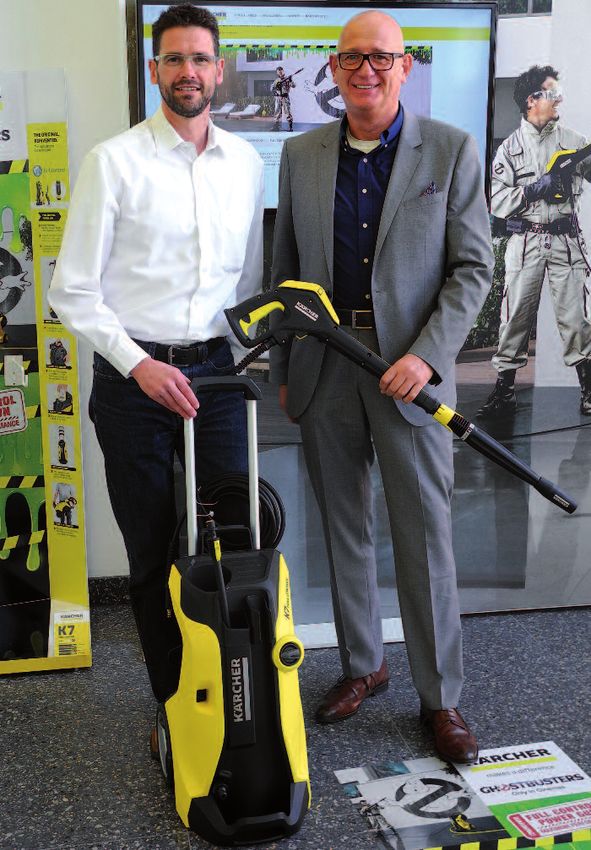
                                                  Matthias Steinmann, Manager Central R & D Services at Kärcher (on the left), and Michael Manderfeld, head of
requirements management, uniform change           sales for the southwest of Germany/Switzerland at PROSTEP
management and end-to-end project
management are equally important aspects.
"When we discovered this, we stopped the          Seven different CAD systems                                  users develop their products using Catia V5,
CAD selection project and asked PROSTEP                                                                        a total of seven different CAD systems are
to help us find the right PLM strategy," states   The global growth of the company involved                    used across the company. A further obstacle
Matthias Steinmann, Central R&D Services          the acquisition of a large number of                         to collaboration across the different locations
Manager at Kärcher, talking to a member of        companies, which led to a heterogeneous IT                   is the lack of a central data backbone for
the editorial team.                               system environment. Although most CAD                        Engineering. In Winnenden, where the

2                                                                                 Originally published in ECONOMIC ENGINEERING 5/2016 / p. 68-71 / www.economic-engineering.de
P R O C E S S H A R M O N I Z AT I O N

company is headquartered, the CAD data is                          PLM solution across the entire group: direct
managed with SAP PLM. In the USA, PTC                              linking via SAP PLM or a dual-vendor
Creo is used and linked to the PLM system                          strategy with separate PLM and ERP
Windchill but with no connection to SAP.                           systems. The analysis revealed that the pro-
And at many other locations, file-based                            cesses at Kärcher are well defined, but that
management systems are still used for the                          they are not put into practice consistently
CAD data.                                                          throughout the company. End-to-end change
                                                                   and maturity management is a fundamental
Kärcher has employees in 100 companies                             prerequisite for collaboration across locations
worldwide, including Germany, Italy,                               and has to be implemented. Changes during
Romania, China, the USA, Mexico and                                the course of the projects are not sufficiently
Brazil. To allow multiple locations to col-                        transparent. BOM management is not
laborate when developing new products, the                         homogeneous and there is also no strategy for
company aims to establish product platforms                        handling BOMs in the concept phase. The in-
and set up competence centers for specific                         tegrated SAP and PLM system environments
technologies. According to Steinmann, this is                      also require considerable manual in-
not possible with the system environment as                        tervention.
it stands: "Engineering operations have to
become far more closely knit if we want to                         On evaluating the findings, the consultants
use the same components everywhere."                               came to the conclusion that separate ERP and
                                                                   PLM systems were a more appropriate
Initially, Kärcher simply wanted to open up                        solution for the various national subsidiaries
its large-scale CATIA installation in                              and for collaboration across different
Winnenden to other locations. But the idea                         locations than direct linking via SAP PLM.
ran into licensing restrictions and would have                     One of the reasons for this is that the process
required considerable additional investment,                       requirements of the various product divisions
and so the company investigated the                                are extremely varied. Kärcher not only makes
alternative of CAD systems from other                              mass-produced goods that are produced to
vendors. Benchmark tests showed that                               order or ordered from stock. They also
Kärcher's products could in principle be                           manufacture custom equipment and variants,
developed using any of the systems under                           which means that it is also necessary to sup-
consideration. But the tests also revealed that                    port configure-to-order and engineer-to-order
                                                                                                                                                                    r
the heterogeneous, fragmented PLM                                  processes. According to Steinmann, it would                                                    he
                                                                                                                                                               ärc
                                                                                                                                                            s:K
environment was a far more significant pro-                        require considerable effort to map this level                                        tur
                                                                                                                                                           e
                                                                                                                                                     Pic
blem when it came to the joint use and                             of complexity in SAP PLM.
exchange of the CAD data. "We remain com-
mitted to the idea of a uniform CAD system,                        System selection criteria
but we have realized that, whatever system
we opt for, PLM offers us far greater leverage                     The second step in the project was for the         order to ensure that the issue of change
in the product engineering process and can                         consultants to work together with the depart-      management was also addressed," explains
even help us migrate the CAD data," says                           ments to specify requirements governing the        Steinmann. Requirements management is of
Steinmann.                                                         choice of PLM system. These were                   particular relevance to electronic engineering
                                                                   incorporated      into    the    requirements      and software engineering, which are
Vendor-neutral PLM consulting                                      specification and an evaluation matrix was         becoming increasingly prominent at Kärcher,
                                                                   drawn up. Kärcher had taken a fundamental          as most of today's products contain me-
Kärcher entrusted Darmstadt-headquartered                          decision not to go with a neutral PLM system.      chatronic components. But it is envisaged that
PROSTEP AG with drawing up the new PLM                             In other words, the decision which PLM             all device requirements be integrated.
strategy and specifying the system                                 system to use entailed a preliminary decision
requirements     because    vendor-neutral                         regarding the CAD system to be used                The consultants from PROSTEP analyzed
consulting was seen as being extremely im-                         throughout the company. Nevertheless, since        Kärcher's product portfolio, which has grown
portant. Or, as Steinmann puts it: "We had                         the migration process will stretch over a sig-     enormously and become far more diverse
already been in touch with an American                             nificant period, support for multi-CAD             over the past few years. The variant and
consulting company but decided to use                              environments is an important criterion that        configuration strategies of the different pro-
PROSTEP because of their closer physical                           has to be met by the PLM system.                   duct divisions vary considerably. This
proximity. We would not have managed to                                                                               demands an extremely flexible PLM solution
handle the project without PROSTEP's                               "One important insight from the assessments        that has to support different processes and bill
consulting services."                                              was the desire expressed by all departments,       of materials (BOM) concepts. "According to
                                                                   including those that were not involved with        our strategy, the eBOMs will be created in the
As a first step in the project, the consultants                    engineering, to implement transparent change       PLM system," says Steinmann and adds:
analyzed the existing system and process                           management that was capable of clearly             "And we and PROSTEP are currently
environments from the perspective of the col-                      representing changes to the requirements           considering whether we should also derive
laboration requirements and the envisaged                          made during the course of the project. And so      the plant-neutral mBOMs directly in the PLM
efficiency gains. The aim was to identify                          we expanded the scope of the project to cover      system and then condition them for the
which was the better option for a uniform                          application lifecycle management (ALM) in          specific plants." One thing is certain: there

Originally published in ECONOMIC ENGINEERING 5/2016 / p. 68-71 / www.economic-engineering.de                                                                            3
DEVELOPMENT METHODS

will be separate engineering and
manufacturing BOMs in order to allow
flexible control over their introduction into
the manufacturing operation.

Cross-system change process

A uniform change process across the entire
group is crucial for collaboration across
different locations, as Steinmann explains:
"We want to know when each change was
incorporated in production and what units
have the changed component fitted so that
service staff can make use of this
information." Details of how the change pro-
cess will be organized with regard to inter-
action between the PLM system and the ERP
system have not yet been finalized, but it is
probable that the two systems will
communicate changes to each other               The importance of project management when               tional unit is responsible for project
depending on the maturity of the product.       selecting the PLM system is still an open               management and the project team do not wish
This requires a powerful, bidirectional in-     issue that will be examined separately. The             to preempt any decisions taken there. "But,
terface.                                        reason for this is that a different organiza-           together with the consultants from PROSTEP,
                                                                                                        we have already developed a concept
                                                                                                        showing how we can use PLM to provide
                                                                                                        optimum support for our new product
Working full steam to ensure success                                                                    engineering process, what tasks need to be
The name Kärcher is synonymous with top performance in the world of cleaning, and                       completed at a given level of maturity and
not just in the professional sector. The foundation for the success of the family-owned                 what work packages result from this," ex-
                                                                                                        plains Steinmann. Ideally, these tasks should
company with headquarters in Winnenden was laid by Swabian inventor Alfred Kärcher
                                                                                                        be mapped in the PLM system in order to be
in 1950, when he developed the world's first hot-water high-pressure cleaner. The in-                   able to monitor their progress more
troduction of the first portable high-pressure cleaner heralded the breakthrough into the               effectively.
domestic appliance market, a market that is today served by a wide range of products
for cleaning floors, windows and facades and for watering the garden – naturally all in                 The decision as to which system to use is due
the familiar Kärcher yellow. In the field of professional cleaning, the company offers not              to be made by the middle of the year. And
                                                                                                        then things will start to get really exciting.
only its anthracite-colored high-pressure cleaner but also floor scrubbers and scrubber
                                                                                                        The company is fully aware that the im-
dryers, sweepers and vacuum sweepers, snow throwers, water treatment and recycling                      plementation of a PLM system is a change
systems and complete vehicle cleaning systems.                                                          project that will run for several years, as
Alongside international expansion, a strategy that the company has followed                             Steinmann points out: "This means that we
systematically since the 1970s, innovation is the most important driver of growth for the               need an open, scalable solution that can grow
                                                                                                        with us, as we cannot roll out everything at
company. This is no longer restricted to the products themselves but also encompasses
                                                                                                        once." PROSTEP will advise and support
digital services such as a fleet management system for facilities cleaning services and a               Kärcher during the introduction phase and
smartphone app for operating the automatic watering unit in the garden.                                 will monitor whether the objectives of the
www.kaercher.com                                                                                        project have been achieved.

                                                PROSTP INC
                                                300 Park Street, Suite 410 Birmingham, MI 48009

                                                Phone: +1 248 247 1007 Fax: +1 248 247 1011
                                                US Toll Free: 8-PROSTEP-01 (877-678-3701)

4                                                                          Originally published in ECONOMIC ENGINEERING 5/2016 / p. 68-71 / www.economic-engineering.de
You can also read


