Cracking the code on cryptocurrency - ING Think
←
→
Page content transcription
If your browser does not render page correctly, please read the page content below

Cracking the code
on cryptocurrency
Bitcoin buy-in across Europe, the USA and Australia

ING International Survey Mobile Banking − Cryptocurrency June 2018

                                                                     This survey was conducted
ING International Survey Mobile Banking − Cryptocurrency June 2018
                                                                     by Ipsos on behalf of ING
                                                                                                 1
Table of contents

                                                                     3 About the ING International Survey
                                                                     4 Executive summary
                                                                     5 Infographic

                                                                     6 Thinking about cryptocurrency
                                                                     › Bitcoin is in the news − and most have heard of it
                                                                     › Men and mobile bankers likelier to be aware of crypto
                                                                     › Around one in ten have purchased crypto assets
                                                                     › Mobile bankers and men more likely to buy in

                                                                     11 Path to a Bitcoin-based future?
                                                                     › Mobile banking − the gateway to cryptocurrency?
                                                                     › Might Bitcoin be popular when going cash-free?
                                                                     › Crypto seen as risky compared to other assets
                                                                     › Websites popular for info − but many would never invest

                                                                     30 Contact details
                                                                     31 Disclaimer

ING International Survey Mobile Banking − Cryptocurrency June 2018                                                               2
The survey

About the ING
International Survey
The ING International Survey aims to gain a
better understanding of how people around the
globe spend, save, invest and feel about money.
It is conducted several times a year, with reports
hosted at www.ezonomics.com/iis. This online
survey was carried out by Ipsos between 26
March and 6 April 2018.
Sampling reflects gender ratios and age
distribution, selecting from pools of possible
respondents furnished by panel providers in
each country. European consumer figures are
an average, weighted to take country
population into account.

                                                                     Austria

15                                                                   Belgium
                                                                     Czech Republic
countries are compared                                               France
in this report.                                                      Germany
                                                                     Italy

1,000                                                                Luxembourg
                                                                     Netherlands
About 1,000 respondents were surveyed in                             Poland
each, apart from Luxembourg, with 500.                               Romania
                                                                     Spain

14,828                                                               Turkey
                                                                     United Kingdom
is the total sample size                                             USA
of this report.                                                      Australia

ING International Survey Mobile Banking − Cryptocurrency June 2018                    3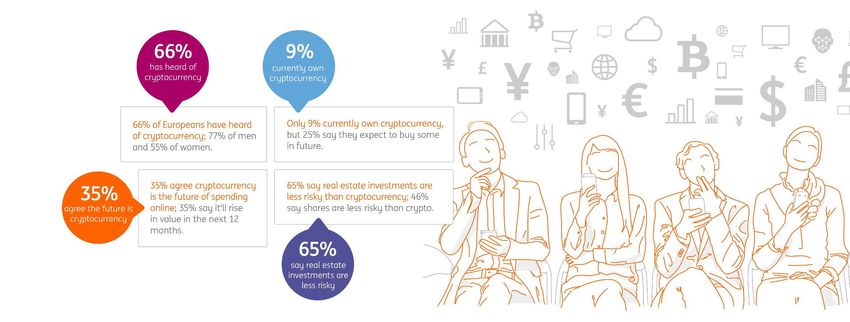
Executive summary

Europe divided on best use and future impact of cryptocurrencies
ING reveals attitudes on the rise of digital currencies such as Bitcoin and what they might mean for our money
The ING International Survey reveals how                             One in four (25%) in Europe indicate they expect          A minority in Europe indicate they would consider
cryptocurrencies, such as Bitcoin, are perceived in                  to own cryptocurrency at some time in the future –        cryptocurrency as a way to pay for items − like a cup
2018 across Europe, the USA and Australia. We                        with the share once again slightly higher among           of coffee (23%), international online purchases (30%),
define cryptocurrency, in part, as a kind of digital                 mobile bankers (31%).                                     or children’s university fees (20%).
currency not created or secured by the government                    Bitcoin as an investment                                  Interestingly, larger shares in lower per-capita
but by a network of individuals.                                     We find that only about a third (35%) in Europe agree     income countries suggest they might consider
News about cryptocurrency has been in the                            Bitcoin is the future of spending online. A similar       investing or paying in cryptocurrency.
headlines through 2017 and 2018. Bitcoin prices                      share (32%) of respondents agree cryptocurrency is        Future impacts?
rocketed to $13,860 in December 2017 yet slid back                   the future of investing.                                  When looking for information about investing in
to $6926 by March 2018 − when the responses to our                   Furthermore, responses to specific questions about        cryptocurrency, Europeans are more likely to seek
survey were collected.                                               whether people would consider investing in                out specialist websites (27%) or financial advisors
Buying into a trend                                                  cryptocurrency are lukewarm.                              (21%) than input from friends or family (8%).
So it’s no surprise that two in three (66%) in Europe                                                                          This may reflect a general feeling that the trend is
have heard of the technology − although higher
shares of males (77%) reply that they have heard of
                                                                     “And many see cryptocurrency as                           complicated or hard to understand and therefore
                                                                                                                               requires a specialist. If cryptocurrency eventually
cryptocurrency than females (55%).                                   rather risky. For instance, 46% in                        goes mainstream, this preference may change.
What is a surprise, though, is that younger age                      Europe see shares as less risky than
brackets − especially people aged 25-34 or 35-44 −
                                                                     digital currencies such as Bitcoin.”
are not much more likely to agree they have heard
of cryptocurrency than other age groups.
                                                                     Nearly three in 10 (29%) Europeans say they would
Those who already use their smartphone, tablet or
                                                                     never invest in cryptocurrency. And many see
wearable to bank “on the go” − the mobile bankers of                                                                           Jessica Exton, behavioural scientist
                                                                     cryptocurrency as rather risky. For instance, 46% in
our survey − are more likely to say they have heard                                                                            Fleur Doidge, editor
                                                                     Europe see shares as less risky than digital currencies
of cryptocurrency (69%) than those who do not bank
                                                                     such as Bitcoin; 24% say they’re equally risky.
using their mobile device (59%).
                                                                     This may be part of why cryptocurrencies seem to
Fewer than one in 10 in Europe (9%) at the time of
                                                                     have less appeal for long-term personal finance
the survey indicate owning cryptocurrency – with the
                                                                     activities, such as receiving pay or saving for
smallest fractions in Luxembourg and Belgium.
                                                                     university, than one-off transactions.
Figures are similar for the USA and Australia.

ING International Survey Mobile Banking − Cryptocurrency June 2018                                                                                                                    4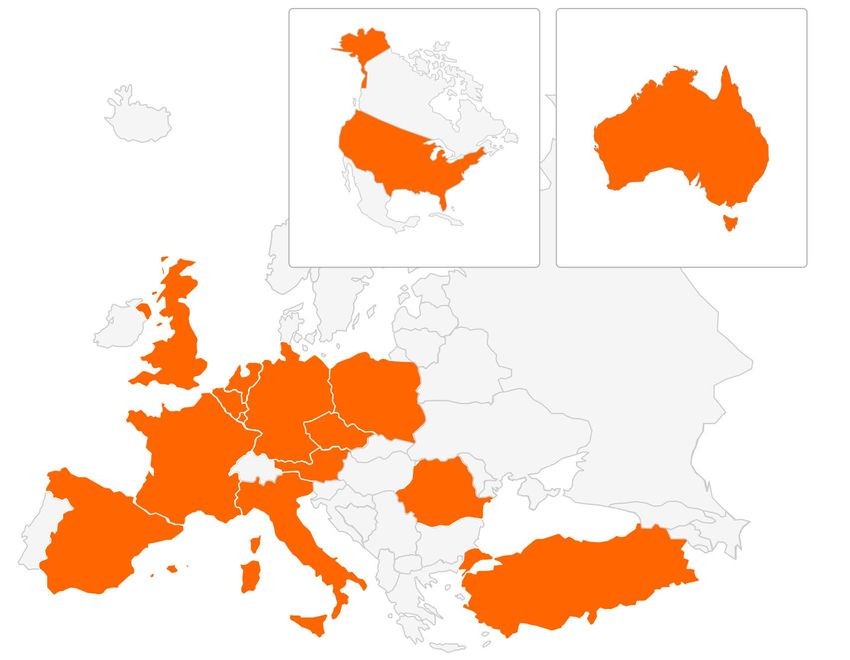
Infographic

Are Europeans betting on Bitcoin?
Few people have invested in cryptocurrencies such as Bitcoin so far − and many
worry about the risks in doing so. The ING International Survey Mobile Banking
2018 asked nearly 15,000 people across Europe, the USA and Australia what they
think of the cryptocurrency opportunity.

ING International Survey Mobile Banking − Cryptocurrency June 2018               5
Thinking
about
cryptocurrency

ING International Survey Mobile Banking − Cryptocurrency June 2018   6
Thinking about cryptocurrency

                                                                           The question

Bitcoin is in the news − and                                               Have you ever heard of cryptocurrency?
                                                                           Asked to everyone. Possible answers are “yes” or “no”.

most have heard of it
Market movements of cryptocurrencies, such as Bitcoin, have hit the
                                                                            European consumer                                 66%                       34%
headlines regularly. It’s no surprise that a majority of people in 11 of
13 countries in Europe have heard of these digital ways to pay.
The share is equal to or exceeds 50% in every country we surveyed                          Belgium                 38%                          62%
except Belgium.
                                                                                             France                     50%                       50%
Awareness is highest in Austria (79%) and Poland (77%), with
Luxembourg and Spain nearest the European average (66%).                              Netherlands                        55%                          46%

Interestingly, several of the lower income per capita countries have             United Kingdom                             61%                        39%
higher shares who have heard of cryptocurrency.                                      Luxembourg                               66%                       34%
Of course, simply having heard of cryptocurrency, perhaps in the                              Spain                           67%                       33%
media, is not the same as knowing about it or understanding it.
                                                                                   Czech Republic                              69%                          31%
Country differences may be due to many factors − including culture,
the popularity of other assets among investors in a country or the                           Turkey                            70%                          30%
prominence of high-tech developments in local news reporting.                                   Italy                          70%                          30%

                                                                                          Germany                               71%                         30%

                                                                                          Romania                                   75%                      26%

                                                                                             Poland                                 77%                      23%
We are hearing more about cryptocurrency                                                    Austria                                  79%                      21%
In our survey, we defined cryptocurrency as a kind of digital
currency. This currency is not created or secured by the government
but by a network of individuals. Bitcoin is the best known example.                             USA                       57%                         43%
Cryptocurrencies have been regularly in the news through 2017 and
                                                                                          Australia                            70%                          30%
2018. Around the time of the survey in March 2018, Bitcoin prices
slid back to $6926 − from a peak of $13,860 in December 2017.
                                                                                                            Yes                            No
                                                                                                                     Sample size: 14,828

ING International Survey Mobile Banking − Cryptocurrency June 2018                                                                                                  7
Thinking about cryptocurrency
The question
Men and mobile bankers “I have heard of cryptocurrency”
Age/gender differences among those in Europe who answered “yes”. Possible answers are “yes” or “no”.
likelier to be aware of crypto
Results show that males are more likely to reply that they have heard
of cryptocurrency than females. Men 77%
Surprisingly, though, younger age brackets − especially people aged
25-34 or 35-44 − are not much more likely to agree they have heard
of cryptocurrency than other age groups. Women 55%
Sixty percent of respondents in Europe aged 65 or older indicate they
have heard of cryptocurrency.
Awareness of digital technology has become widespread in recent
decades and is no longer confined to younger age brackets.
Those in Europe who already use their smartphone, tablet or wearable 18-24 years 64%
to bank “on the go” − the mobile bankers of our survey − are more
likely to say they have heard of cryptocurrency (69%) than those who
do not bank using their mobile device (59%). 25-34 years 69%
The shares opposite refer only to Europe. Fewer American men (69%)
and women (45%) confirm hearing about cryptocurrency.
35-44 years 69%
And 82% of 18-24-year-old Australians say they’ve heard of
cryptocurrency. The share declines slowly with age to 64% around age
55, after which the share in Australia lifts again to 70-71%. 45-54 years 66%
55-64 years 65%
65+ years 60%
Sample size: 12,799
ING International Survey Mobile Banking − Cryptocurrency June 2018 8Thinking about cryptocurrency
The question
Around one in ten have “I own some cryptocurrency”
Asked to everyone. Possible answers are “yes” or “no”.
purchased crypto assets
We asked all respondents whether they had taken the further step of European consumer 9% 91%
owning Bitcoin or a similar digital currency. The percentages are
shown opposite.
Fewer than one in 10 in Europe at the time of the survey indicate Luxembourg 4 96%
owning cryptocurrency − with the smallest fractions in Luxembourg Belgium 5% 95%
and Belgium. Figures are similar from the USA and Australia.
France 6% 94%
Nearly one in five (18%) in Turkey say they own cryptocurrency. In
Turkey the online survey may be biased towards younger professional United Kingdom 6% 94%
people with more exposure to media and technology. In Romania we Netherlands 7% 93%
see a potentially similar effect.
Italy 8% 92%
Our full data set reveals that people in Europe who are mobile bankers
are much more likely to own cryptocurrency (12%) than those who Germany 8% 92%
are not mobile bankers (4%). Austria 8% 92%
Males in Europe are almost twice as likely to own cryptocurrency Czech Republic 9% 91%
(13%) than females (6%). Ownership is more common among the 25-
34s (16%). Spain 10% 90%
Poland 11% 89%
Romania 12% 88%
Turkey 18% 82%
Australia 7% 93%
USA 8% 92%
Yes No
Sample size: 14,828
ING International Survey Mobile Banking − Cryptocurrency June 2018 9Thinking about cryptocurrency
The question
Mobile bankers and men “I expect to own cryptocurrency in the future”
Asked to everyone. Possible answers are “yes” or “no”.
more likely to buy in
European consumer 25% 75%
Nine percent of people in Europe in the survey say they have bought
cryptocurrency. However, a larger additional share may buy into the
trend over time, as the chart opposite suggests. Belgium 10% 90%
Across 13 countries in Europe, one in four (25%) say they expect to Luxembourg 13% 87%
own cryptocurrency in future. This suggests that another 16% share,
Netherlands 14% 86%
who do not yet own cryptocurrency, may buy some over time.
Countries vary, however. In Belgium, for example, just one in ten say United Kingdom 15% 85%
they expect to buy cryptocurrency in future. France 17% 83%
In the five countries where people are least likely to say they have Czech Republic 19% 81%
heard of cryptocurrency, people are also least likely to say they own
or expect to own cryptocurrency. Austria 19% 81%
Our full data set also reveals that people in Europe who are mobile Germany 21% 79%
bankers are more likely to say they expect to own cryptocurrency Italy 24% 76%
(31%) than those who are not mobile bankers (13%).
Poland 29% 71%
There is a difference between men and women: 31% of men in Europe
agree they expect to own cryptocurrency in the future; 20% of women Spain 32% 68%
say the same. Romania 38% 62%
There was no time frame outlined in the question’s wording. Turkey 45% 55%
Nevertheless, it seems likely that cryptocurrency will remain a
minority interest for some time to come.
Australia 15% 85%
USA 21% 79%
Yes No
Sample size: 14,828
ING International Survey Mobile Banking − Cryptocurrency June 2018 10Is Bitcoin in your future? ING International Survey Mobile Banking − Cryptocurrency June 2018 11
Is Bitcoin in your future?

                                                                           The question

Mobile banking − the                                                       How much do you agree or disagree that: “Digital currencies
                                                                           (such as Bitcoin) are the future of spending online”; “digital
gateway to cryptocurrency?                                                 currencies are the future of investment”; “the value of digital
                                                                           currencies will increase in the next 12 months”.
How would people respond to three different statements about the           Shares who have heard of, own or expect to own Bitcoin and “agree” or “strongly agree” with the above.
future of cryptocurrencies?
                                                                                                                                                                 to rise in
The statement “digital currencies such as Bitcoin are the future of           Digital currencies − such           the future of           the future of         value in the
spending online” was also asked in 2015 and 2016, when 28% and                     as Bitcoin − are              spending online           investment             next 12
32% in Europe agreed, respectively. Are attitudes slowly changing?                                                                                                months

Similarly, about a third agree when Bitcoin is framed differently (as an     European consumer                          35%                    32%                  35%
investment, or as an asset rising in value in the nearer term) are
presented.                                                                   Turkey                                     53%                    49%                  51%

Mobile bankers are more likely to answer positively to all three             Romania                                    43%                    41%                  45%
questions. In particular, when asked if cryptocurrencies are the future
                                                                             Spain                                      38%                    37%                  41%
of spending online, 40% of mobile bankers agree. Just 22% of non-
mobile bankers agree with them.                                              Poland                                     38%                    34%                  35%

Yet those keen to invest in the future of cryptocurrency, as investment      Italy                                      36%                    32%                  32%
or otherwise, may be best to take a longer term view. It’s possible that
                                                                             Czech Republic                             32%                    29%                  28%
the price shifts we’ve been seeing for Bitcoin 2017-2018 might be best
described as “animal spirits”.                                               USA                                        31%                    29%                  34%
Economist John Maynard Keynes in 1936 defined animal spirits as the          France                                     30%                    25%                  29%
human emotion that drives consumer confidence. When markets are
highly volatile, for example, investors may attempt to “ride the wave”,      Germany                                    28%                    25%                  29%
behaving more impulsively in the hope of profits.                            United Kingdom                             25%                    26%                  28%
It’s also possible that cryptocurrency might be seen as more
                                                                             Belgium                                    23%                    21%                  27%
promising in countries where the traditional financial system is less
efficient or more expensive to use.                                          Austria                                    20%                    17%                  22%

                                                                             Australia                                  18%                    19%                  22%

                                                                             Netherlands                                17%                    20%                  22%

                                                                             Luxembourg                                 16%                    12%                  20%

ING International Survey Mobile Banking − Cryptocurrency June 2018                                                                                                                  12
Is Bitcoin in your future?
The question
Might Bitcoin be popular Would you use cryptocurrency to buy a cup of coffee; receive
your pay; pay taxes; pay your monthly electricity bill; buy a
when going cash-free? plane fare; make an international payment for a product you
buy online; or save for your child’s university fees?
Our previous ING International Surveys on mobile banking have Chart shows Europe totals only. Shares are those who have heard of, own or expect to own Bitcoin.
highlighted the growing popularity of cash-free transactions. Might
digital currency have a role in this brave new world? No, I don’t No, I think
No, Bitcoin only
Would you use want to there would
We see opposite that 40-49% in Europe don’t want to change the way Yes interests me as
cryptocurrency to change how be too much
they pay in everyday transactions. However, attitudes soften around an investment
I pay risk
less common transactions – such as buying plane tickets.
International payments, when shopping online, are the most popular
Buy a cup of
option among Europeans for transacting with cryptocurrency. 23% 49% 14% 17%
coffee
Only 15% in Europe would opt to receive their wages or salary in
cryptocurrency – probably reflecting the typical aversion to
uncertainty (Pfeffer/Hardisty: Stanford, 2016) around earnings. Receive your take-
15% 47% 25% 17%
home pay
This may relate to the typical bias towards physical assets that can be
seen and handled, like cash or even a plastic card, rather than
relatively intangible items such as shares or Bitcoin. Pay taxes 21% 47% 19% 16%
Interestingly, Bitcoin owners are more likely than non-owners to say
they wouldn’t use cryptocurrency for purchases, due to its risk. Pay your monthly
21% 48% 17% 16%
electric bill
Buy a plane fare 26% 44% 17% 16%
Diverse views, summarised
Younger people and countries with lower per-capita income
levels (Poland, Romania, Spain, Turkey and Italy) seem likelier to Make an
international 30% 40% 18% 14%
consider paying with cryptocurrency. Highly publicised Bitcoin
payment online
price gains 2017-2018 positioned cryptocurrency as a way to
augment earnings. Yet large shares, especially in Australia,
“don’t want to change the way they pay”. Save for university
20% 42% 25% 16%
fees
ING International Survey Mobile Banking − Cryptocurrency June 2018 13Is Bitcoin in your future?
The question
Crypto seen as risky How risky is owning one of the following assets, compared to
cryptocurrency?
compared to other assets Shares in Europe who reply that the named item below is less risky, equally risky, or more risky than
cryptocurrencies such as Bitcoin. Asked to those who have heard of, own or expect to own Bitcoin.
.
In previous ING International Surveys, investing questions have
confirmed that many people are risk-averse and wary of investing in a
range of opportunities. Stock market 46% 24% 30%
In 2016, more than half in Europe told us that investing in shares is
financially risky; 37% said the same about mutual funds, and 33%
about bonds.
Investing in own business 56% 19% 25%
For 2018 we asked people about the comparative risk of Bitcoin.
Responses from Europe are on the chart opposite.
Most respondents indicate they perceive cryptocurrency as a riskier
investment than cash, gold, real estate, government bonds, investing
Government bonds 63% 16% 21%
in your own business, or the share market.
Every investment comes with the risk of lower or even no return.
However, behavioural science suggests the average person’s
perception of risk may be partly based on a natural bias towards Real estate/property funds 65% 14% 21%
tangible and familiar assets, such as gold and property, and less about
the actual degree of risk represented by a particular asset class.
Gold 70% 12% 18%
What ING analysts say
Economists are still learning about the demand function for
cryptocurrency. Our survey evidence, when considered
alongside the price volatility, dispels ideas that Bitcoin might be Cash 70% 11% 19%
an alternative “safe” asset. Further, it corresponds with the idea
that emerging markets or those with less liquid currencies or
more volatile exchange rates have higher crypto ownership. Equal toLower
Bitcoin
risk Lowertorisk
Equal Bitcoin Higher
Higher risk
risk
Sample size: 8,616
ING International Survey Mobile Banking − Cryptocurrency June 2018 14Is Bitcoin in your future?
The question
Websites popular for info − If you had about a month’s take-home pay available and
wanted more information on cryptocurrency as a possible
but many would never invest investment, where would you most likely get advice?
Asked only to respondents replying that they have heard of, own, or expect to own Bitcoin in the future.
Specialist websites seem the preferred source of information on
potential Bitcoin investments in 11 of 15 countries. In Spain,
Luxembourg and France, we see a preference for financial or bank European consumer 27% 21% 8% 7% 29% 9%
advisors instead.
Italians appear divided between specialist websites and professional France 17% 25% 8% 6% 30% 13%
advisors as the favoured information source. Luxembourg 18% 22% 6% 3 42% 10%
Small shares would seek guidance from family or friends, a computer Austria 20% 17% 7% 3 44% 9%
program or algorithm (robo-advice) or simply reply “I don’t know”.
Spain 22% 33% 7% 6% 23% 9%
In Europe, men (29%) are more likely than women (24%) to say they
Netherlands 23% 11% 10% 6% 44% 7%
would seek information on Bitcoin from specialist websites.
Belgium 23% 19% 9% 4 36% 10%
A significant slice, in every country, answer: “I would never invest
Germany 24% 15% 8% 7% 37% 9%
money in cryptocurrency.” The share rises to 44% in Austria and the
Netherlands; Luxembourg, Australia and Germany have the next- Italy 26% 25% 5% 7% 29% 8%
highest shares. United Kingdom 29% 14% 9% 7% 32% 10%
Our full dataset shows this share rises to 54% among Europeans aged Poland 29% 17% 7% 8% 30% 9%
65+ − but only 14% of people in Europe who are 18-34 years old say
Czech Republic 34% 15% 9% 4 30% 9%
they would not consider investing in cryptocurrency.
Turkey 38% 20% 10% 10% 14% 9%
Higher shares of non-mobile bankers (44%) in Europe say they would
never invest in Bitcoin or similar, versus 23% of mobile bankers. Romania 38% 25% 5% 8% 18% 5%
Our results reflect other ING International Surveys: we consistently
find only small shares who own or would be likely to purchase Australia 22% 14% 8% 4 39% 11%
investments. This may be due to risk perception (see previous pages). USA 28% 20% 10% 11% 23% 8%
For instance, 59% of European respondents in 2016 told us they would
Specialist websites Financial/bank advisor
be “unlikely” or “extremely unlikely” to invest 10% of their total
Family or friends Computer program or algorithm
savings in shares, even if they could afford to do so.
I would never invest in cryptocurrency I don’t know
Sample size: 9,957
ING International Survey Mobile Banking − Cryptocurrency June 2018 15Contact details Country Name Phone number Email Australia David Breen +61 2 9028 4347 david.breen@ingdirect.com.au Austria Patrick Herwarth von Bittenfeld +43 168 0005 0181 presse@ing-diba.at Belgium Julie Kerremans +32 491 35 30 32 julie.kerremans@ing.com Czech Republic Martin Tuček +420 2 5747 4364 martin.tuček@ing.cz France Florence Hovsepian +33 1 57 22 55 34 florence.hovsepian@ing.fr Germany Zsofia Köhler +49 69 27 222 65167 zsofia.koehler@ing-diba.de Italy Lucio Rondinelli +39 02 5522 6783 lucio.flavio.rondinelli@ingdirect.it Luxembourg Yves Denasi +352 44 99 9632 yves.denasi@ing.lu The Netherlands Harold Reusken +316 5498 4413 harold.reusken@ing.com Poland Miłosz Gromski +48 22 820 4093 milosz.gromski@ingbank.pl Romania Elena Duculescu +40 73 800 1219 elena-andreea.duculescu@ing.ro Spain Nacho Rodríguez +34 916 349 234 nacho.rodriguez.velasco@ing.com Turkey Hasret Gunes +90 21 2335 1000 hasret.gunes@ingbank.com.tr United Kingdom Jessica Exton +44 20 7767 6542 jessica.exton@ing.com Editor Fleur Doidge +44 20 7767 5567 fleur.doidge@ing.com Ipsos Nieko Sluis +31 20 607 0707 nieko.sluis@ipsos.com ING International Survey Mobile Banking − Cryptocurrency June 2018 16
Disclaimer
This publication has been prepared by ING solely for information
purposes. It is not intended as advice or an offer or solicitation to
purchase or sell any financial instrument or to take any other
particular action. Reasonable care has been taken to ensure that
this publication is not untrue or misleading when published, but
ING does not represent that it is accurate or complete. The
information contained herein is subject to change without notice.
Neither ING nor employees of the bank can be held liable for any
inaccuracies in the content of this publication or for information
offered on or via the sites. Authors rights and data protection
rights apply to this publication. Nothing in this publication may be
reproduced, distributed or published without explicit mention of
ING as the source of this information. The user of this information
is obliged to abide by ING’s instructions relating to the use of this
information. The distribution of this publication may be restricted
by law or regulation in different jurisdictions and persons into
whose possession this publication comes should inform
themselves about, and observe, such restrictions. Dutch law
applies. ING Bank N.V. is incorporated with limited liability in the
Netherlands and is authorised by the Dutch Central Bank.

ING International Survey Mobile Banking − Cryptocurrency June 2018      17
You can also read


