Crystal light: New light-converting materials point to cheaper, more efficient solar power - Phys.org
←
→
Page content transcription
If your browser does not render page correctly, please read the page content below
Crystal light: New light-converting materials
point to cheaper, more efficient solar power
29 January 2015

                                                          perovskite crystals. By tracking down the rapid
                                                          motion of electrons in the material, they have been
                                                          able to determine the diffusion length—how far
                                                          electrons can travel without getting trapped by
                                                          imperfections in the material—as well as
                                                          mobility—how fast the electrons can move through
                                                          the material. Their work was published this week in
                                                          the journal Science.

                                                          "Our work identifies the bar for the ultimate solar
                                                          energy-harvesting potential of perovskites," says
                                                          Riccardo Comin, a post-doctoral fellow with the
                                                          Sargent Group. "With these materials it's been a
                                                          race to try to get record efficiencies, and our results
                                                          indicate that progress is slated to continue without
A pure perovskite crystal, orange in colour, is mounted   slowing down.."
on a cryostat. Credit: U of T Engineering

University of Toronto engineers study first single
crystal perovskites for new applicationsEngineers
have shone new light on an emerging family of
solar-absorbing materials that could clear the way
for cheaper and more efficient solar panels and
LEDs.

The materials, called perovskites, are particularly
good at absorbing visible light, but had never been
thoroughly studied in their purest form: as perfect
single crystals.

Using a new technique, researchers grew large,
pure perovskite crystals and studied how electrons
move through the material as light is converted to
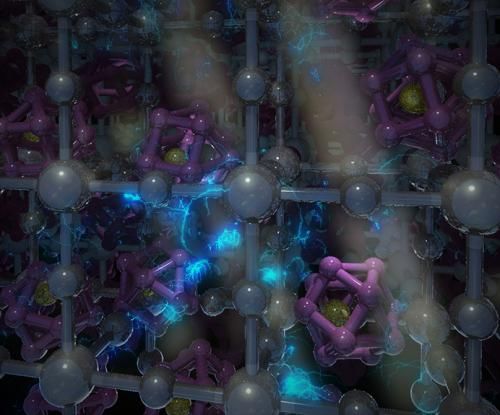
electricity.                                       An artist's rendering of the atomic model of organolead
                                                          trihalide perovskite crystals. Researchers have
Led by Professor Ted Sargent of The Edward S.             succeeded in growing high-quality single crystals of these
Rogers Sr. Department of Electrical & Computer            perovskites at room temperature. The grown crystals
Engineering at the University of Toronto and              efficiently convert light into charge-carriers that travel
Professor Osman Bakr of the King Abdullah                 over very long distances, exceeding 10 micrometers, due
                                                          to the crystals? exceptionally low concentration of defect
University of Science and Technology (KAUST),
                                                          trap-states. This study demonstrates that photovoltaics
the team used a combination of laser-based
                                                          using organolead trihalide perovskite materials stand to
techniques to measure selected properties of the

                                                                                                            1/3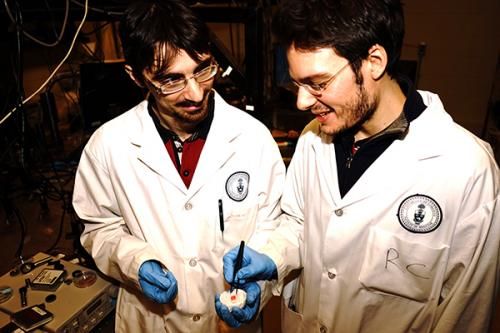
see further breakthroughs through substantial            surface and gets absorbed, exciting electrons in the
 improvement in material purity; it also suggests new     material. Those electrons travel easily through the
 avenues to deploy perovskites in an even wider range of crystal to electrical contacts on its underside, where
 semiconductor and optoelectronic device. Credit: KAUST
                                                     they are collected in the form of electric current.
                                                     Now imagine the sequence in reverse—power the
                                                     slab with electricity, inject electrons, and release
                                                     energy as light. A more efficient electricity-to-light
In recent years, perovskite efficiency has soared to conversion means perovskites could open new
certified efficiencies of just over 20 per cent,     frontiers for energy-efficient LEDs.
beginning to approach the present-day
performance of commercial-grade silicon-based        Parallel work in the Sargent Group focuses on
solar panels mounted in Spanish deserts and on       improving nano-engineered solar-absorbing
Californian roofs.                                   particles called colloidal quantum dots. "Perovskites
                                                           are great visible-light harvesters, and quantum dots
"In their efficiency, perovskites are closely              are great for infrared," says Professor Sargent.
approaching conventional materials that have               "The materials are highly complementary in solar
already been commercialized," says Valerio                 energy harvesting in view of the sun's broad visible
Adinolfi, a PhD candidate in the Sargent Group and         and infrared power spectrum."
co-first author on the paper. "They have the
potential to offer further progress on reducing the        "In future, we will explore the opportunities for
cost of solar electricity in light of their convenient     stacking together complementary absorbent
manufacturability from a liquid chemical precursor."       materials," says Dr. Comin. "There are very
                                                           promising prospects for combining perovskite work
                                                           and quantum dot work for further boosting the
                                                           efficiency."

                                                             More information: Low trap-state density and
                                                           long carrier diffusion in organolead trihalide
                                                           perovskite single crystals, Science 30 January
                                                           2015: Vol. 347 no. 6221 pp. 519-522. DOI:
                                                           10.1126/science.aaa2725

                                                            Provided by University of Toronto

Researchers Valerio Adinolfi (left) and Riccardo Comin
examine a perovskite crystal. Perovskites are attracting
growing interest in the context of thin-film solar
technologies, but had never been studied in their purest
form: as perfect single crystals. Credit: U of T
Engineering

The study has obvious implications for green
energy, but may also enable innovations in lighting.
Think of a solar panel made of perovskite crystals
as a fancy slab of glass: light hits the crystal

                                                                                                        2/3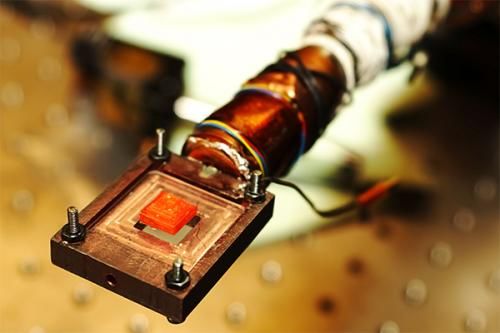
APA citation: Crystal light: New light-converting materials point to cheaper, more efficient solar power
                                   (2015, January 29) retrieved 29 December 2020 from https://phys.org/news/2015-01-crystal-light-
                                   converting-materials-cheaper-efficient.html

                                   This document is subject to copyright. Apart from any fair dealing for the purpose of private study or research, no
                                   part may be reproduced without the written permission. The content is provided for information purposes only.

                                                                                                                                                3/3

Powered by TCPDF (www.tcpdf.org)
You can also read


